

Microsoft and Temenos used Temenos Community Forum 2026 to promote an Azure AI integration with Temenos Core Banking that is meant to let banks run governed, multi-step “agentic operations” inside modern core banking workflows. The announcement matters because it moves the AI pitch from the call-center chatbot to the ledger-adjacent operating layer, where mistakes are costlier and benefits are harder to fake. It is also a reminder that the next phase of banking modernization will not be sold as “cloud migration” alone. It will be sold as autonomy with audit trails.
For years, the safest place to put generative AI in banking was at the edge: a website assistant, an employee knowledge bot, a document summarizer, a marketing personalization engine. That made sense. The closer software gets to the system of record, the more every optimistic demo collides with governance, reconciliation, regulatory reporting, and the old-fashioned fact that money either moved or it did not.
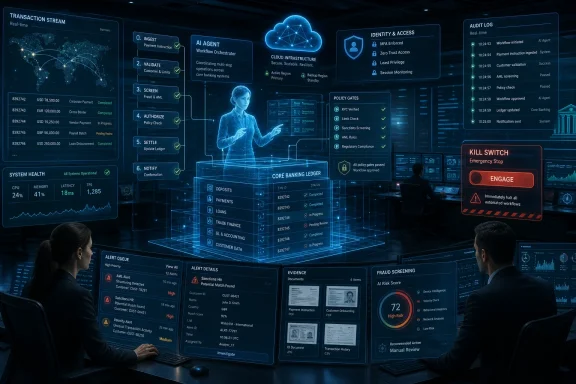
The Microsoft-Temenos pitch is different because it plants AI closer to the bank’s operational bloodstream. Temenos is not positioning these capabilities as a decorative conversational layer over banking software. It is describing AI agents, copilots, and conversational tooling embedded across core banking, digital banking, and financial crime mitigation products.
That distinction is the whole story. In consumer tech, “agentic AI” can mean an assistant that books a trip, drafts an email, or shops across websites. In banking, it means software that may touch onboarding, disputes, payments operations, compliance checks, fraud queues, liquidity analysis, or back-office exceptions. The word agentic sounds futuristic; the operational reality is closer to workflow automation with judgment-shaped interfaces and a compliance department sitting in the room.
Microsoft’s role is equally clear. Azure gives Temenos the cloud substrate, AI services, identity controls, data tooling, and enterprise sales channel needed to make the idea plausible for heavily regulated institutions. Temenos brings the banking domain model, the core platform, and the installed credibility with banks that do not make architectural decisions because a keynote looked clever.
This is why the announcement deserves attention from WindowsForum readers even if they do not spend their days running a bank. Microsoft’s AI strategy is increasingly vertical. The company is no longer merely selling copilots as productivity ornaments; it is embedding Azure AI into industry platforms where Windows, Entra, Purview, Azure SQL, Kubernetes, and governance tooling become part of the same procurement conversation.
Agentic operations raise the stakes because the software is meant to complete work, not merely discuss it. Microsoft has been arguing this point across financial services: the industry’s automation problem is not that banks lack digital channels, but that too many customer journeys still break at the point where a task crosses systems, departments, risk policies, or data boundaries. A chatbot can tell a customer how to dispute a transaction. An agentic workflow, at least in the vendor vision, can gather context, check policy, route evidence, flag fraud risk, update case status, and keep the customer informed without forcing a human to stitch the process together.
That is a more interesting promise than “AI answers questions.” It is also a more dangerous one. Banks are not short of workflows; they are short of workflows that can be safely changed. Their technology estates are layered with mainframes, vendor platforms, custom integrations, spreadsheet-based controls, regional compliance requirements, and business units that have learned to survive by building process sediment over decades.
Temenos and Microsoft are trying to sell agentic operations as a bridge across that mess. The implied bargain is that banks can keep the control expectations of traditional core banking while using AI to orchestrate the work around it. The agent does not replace the ledger. It becomes a governed actor that can reason over context and invoke approved services.
That is the narrow path the industry will have to walk. If AI is kept too far from the operational layer, it becomes another executive demo that employees quietly ignore. If it is allowed to act too freely, it becomes a regulatory incident waiting for a postmortem. The real product is not the model. The real product is the control plane around the model.
That is where Microsoft has an advantage. Azure is already a common landing zone for regulated enterprise workloads, and Microsoft has spent years building the language of responsible AI, governance, security, and compliance into its cloud story. The company’s financial services messaging around agentic banking leans heavily on policy-driven execution, consent, identity, and auditability. That is not accidental. It is the vocabulary needed to make AI sound less like improvisation and more like infrastructure.
Temenos has been preparing the ground as well. Earlier this year, it said its Core Banking SaaS on Azure had earned a Microsoft AI Cloud Partner Program certified software designation, validating interoperability and technical requirements for core banking on Temenos SaaS. In 2025, Temenos and Microsoft also publicized performance work showing Temenos cloud-native banking solutions running on Azure at high transaction volumes while including AI workloads.
Those details matter because banks will not adopt agentic operations on faith. They will ask whether the system can sustain transaction pressure, whether the database layer can behave predictably, whether the AI services can be monitored, whether recovery procedures are clear, and whether every automated action can be reconstructed after the fact. The moment AI touches a core banking workflow, uptime and explainability become the same conversation.
The Azure stack also gives Microsoft a way to make its AI investments sticky. A bank that adopts Azure AI inside a Temenos deployment is not simply buying a model endpoint. It is deepening reliance on Microsoft’s cloud, security, database, and development ecosystem. For Redmond, industry AI is a wedge into long-lived workloads that are far less flighty than consumer subscriptions.
The phrase “trusted core” does a lot of work here. Core banking systems are not loved because they are beautiful. They are trusted because they are boring in the best sense: they maintain balances, process transactions, enforce product rules, and produce records that can survive audits and disputes. Temenos is arguing that AI becomes bankable only when it inherits that boring discipline.
That is why the most important word in the announcement may not be “agentic.” It may be traceable. A bank can tolerate automation only when it knows which system made which recommendation, which policy permitted which action, which data was used, and which human, if any, approved the final step. Without traceability, AI becomes an unmanageable liability.
This is also where the gulf between marketing and implementation will be widest. A polished demo can show an agent resolving a back-office case in seconds. A real deployment must handle missing data, contradictory records, jurisdictional policy differences, customer vulnerability rules, suspicious activity escalation, model drift, and exceptions that exist precisely because the happy path failed.
Temenos has a credible reason to be in this fight because core banking vendors already encode much of the domain complexity banks need. But credibility is not inevitability. The burden now shifts from announcement to adoption: which banks deploy these agents, in which workflows, with what controls, and with what measurable gains beyond vendor-supplied efficiency claims.
An AI agent that can assemble context, summarize evidence, identify missing documentation, and route a case to the right team could reduce friction without making the final judgment. That is the low-risk version of the story: augment investigators, reduce clerical burden, improve consistency, and preserve human accountability for consequential calls.
The high-risk version is more seductive. If the agent can identify suspicious behavior, why not let it close low-risk alerts? If it can gather evidence, why not let it submit reports? If it can compare a customer’s profile against policy, why not let it recommend account restrictions? Each step may look reasonable in isolation, but together they create a system where automated judgment starts to shape access to financial services.
That is why banks will likely begin with internal and semi-supervised deployments. Back-office copilots, operations assistants, and case-preparation agents are easier to justify than fully autonomous customer-impacting systems. The near-term win is not a robot banker making grand decisions. It is fewer swivel-chair tasks for employees who currently move information between systems that should have been integrated years ago.
For IT teams, this means the operational questions will be brutally practical. Where are prompts stored? How are model responses logged? Can sensitive data be masked? What happens when an agent’s recommended action conflicts with policy? Can the bank reproduce the agent’s reasoning during an audit months later? If a regulator asks for evidence, “the model said so” is not an answer.
Agentic AI could improve that experience if it can operate across identity, consent, product, risk, and transaction systems. The assistant would not merely answer “how do I do this?” It would know where the customer is in the journey, what information is missing, what policy applies, and what action can safely happen next. That is the dream Microsoft has been sketching in its financial services AI messaging.
But banks do not become customer-centric because they add a conversational interface. They become customer-centric when their internal systems can actually execute the promise made by that interface. A beautiful AI assistant wrapped around a fragmented bank will simply expose the fragmentation faster.
This is why the Temenos integration is more meaningful than a generic AI announcement. If agents are embedded close to core and digital banking functions, they have a better chance of completing real tasks. The core system knows products, accounts, limits, balances, postings, and customer relationships. The digital layer knows journeys, channels, and interactions. The AI layer can only be useful if it can act through those systems rather than hallucinating around them.
That said, customer trust will be fragile. People may tolerate an AI agent that explains a card charge or helps upload a document. They may be less forgiving if the same agent mishandles a mortgage payment, freezes an account, or misunderstands a hardship request. Banking is personal in ways that productivity software is not. A bad AI summary in a meeting is annoying; a bad AI action in a bank account is an event.
Back-office banking is full of work that looks ripe for automation. Employees reconcile exceptions, rekey data, validate documents, check policy, prepare reports, respond to internal requests, and chase approvals. Generative AI and agentic orchestration can plausibly reduce that burden, especially when workflows require reading, summarizing, comparing, and routing information.
But productivity gains in regulated environments are rarely plug-and-play. A bank may save time in one process while adding review steps elsewhere. It may reduce manual data entry while increasing model monitoring. It may accelerate case preparation while requiring new governance boards, risk controls, test harnesses, and incident-response procedures. The labor does not vanish; some of it moves up the stack.
There is also the uncomfortable organizational question. If an AI agent can handle multi-step operational work, what happens to the junior roles that historically performed that work and learned the bank from the inside? Banking operations teams are not just cost centers. They are training grounds for institutional knowledge, fraud intuition, and process memory. Automating the bottom rungs may create a skills problem later.
The best banks will treat agentic AI as a redesign project, not a headcount spreadsheet. They will decide which processes should be automated, which should be assisted, which should remain human-led, and which should be eliminated because AI merely reveals they were bad processes all along. The worst banks will bolt agents onto broken workflows and call the confusion transformation.
That makes governance the central issue. Banks will need to define where agents can operate, what data they can access, what tools they can call, which decisions require human approval, and what thresholds trigger escalation. They will also need to prove that these controls are not merely written in policy documents but enforced in software.
Microsoft’s Responsible AI framework and enterprise governance stack give the partnership a vocabulary for that work. Temenos’ banking logic gives it domain constraints. Still, the hard part will be local implementation. A global bank operating across jurisdictions cannot rely on a single generic policy layer. It needs rules that reflect geography, product type, customer segment, risk appetite, and regulatory obligation.
The kill switch matters because autonomy without revocation is not governance. If an agent begins producing unexpected recommendations, calling the wrong tools, mishandling data, or failing a control test, the bank must be able to disable, roll back, isolate, and investigate. That sounds obvious, but enterprise history is full of systems that became operationally critical before they became operationally governable.
For Windows and Microsoft admins, this is where familiar disciplines reappear under new names. Identity and access management, least privilege, logging, endpoint security, data loss prevention, change control, privileged access, backup, and incident response do not become obsolete because the interface is conversational. They become more important because the software can act.
AI changes the sales motion. The argument is no longer only that a modern core is more scalable or cheaper to run. It is that a modern core is necessary for intelligent operations. If agentic AI needs clean APIs, real-time data, policy-aware execution, elastic compute, and observable workflows, then legacy modernization becomes a prerequisite for AI competitiveness.
That is powerful positioning for Temenos. It allows the company to frame core modernization not as plumbing replacement, but as the foundation for autonomous banking. It also gives Microsoft a way to make Azure more than a hosting option. Azure becomes the operating environment where AI, data, security, and core banking converge.
Competitors will not stand still. Other core vendors, cloud providers, consultancies, and fintech platforms are also racing to attach agents to banking workflows. The market will be crowded with claims about copilots, autonomous operations, AI-native cores, and compliance-aware orchestration. The winners will not be the vendors with the flashiest vocabulary. They will be the ones whose systems can survive procurement, implementation, audit, and production incidents.
Banks should therefore be skeptical in a constructive way. They should ask for reference architectures, failure modes, latency benchmarks, model governance evidence, data lineage, customer impact analysis, and clear responsibility boundaries between Microsoft, Temenos, the bank, and any third-party model or integration provider. In banking, ambiguity is not innovation. It is risk waiting for an owner.
That is a rational strategy. General-purpose AI assistants are easy to trial and easy to abandon. Embedded AI inside core enterprise systems is harder to displace because it becomes part of process, governance, training, and procurement. Microsoft wants Azure AI to be the connective tissue between data, applications, identity, and automation.
For banks, the advantage is that Microsoft is not a speculative vendor. It has enterprise relationships, compliance teams, cloud regions, partner programs, security tooling, and a long history of selling into conservative IT departments. For Temenos, the advantage is that Azure gives it scale and a modern AI platform without forcing it to build every layer itself.
The risk is dependency. A bank that standardizes agentic operations on Temenos and Azure is making a long-term bet on both companies’ roadmaps, pricing, reliability, and governance models. That may be a reasonable bet, but it is still a bet. Financial institutions spent years trying to avoid vendor lock-in; AI may reintroduce it under the more attractive name of integration.
There is also a strategic asymmetry. Microsoft can partner deeply with Temenos while also supporting other banking platforms, consulting partners, and internal bank development teams. Temenos gains from Microsoft’s cloud and AI momentum, but Microsoft gains from the entire category moving toward Azure-hosted, AI-orchestrated banking workloads. The platform owner usually has more ways to win.
 Microsoft and Temenos Move the AI Argument Into the Core
For years, the safest place to put generative AI in banking was at the edge: a website assistant, an employee knowledge bot, a document summarizer, a marketing personalization engine. That made sense. The closer software gets to the system of record, the more every optimistic demo collides with governance, reconciliation, regulatory reporting, and the old-fashioned fact that money either moved or it did not.The Microsoft-Temenos pitch is different because it plants AI closer to the bank’s operational bloodstream. Temenos is not positioning these capabilities as a decorative conversational layer over banking software. It is describing AI agents, copilots, and conversational tooling embedded across core banking, digital banking, and financial crime mitigation products.
That distinction is the whole story. In consumer tech, “agentic AI” can mean an assistant that books a trip, drafts an email, or shops across websites. In banking, it means software that may touch onboarding, disputes, payments operations, compliance checks, fraud queues, liquidity analysis, or back-office exceptions. The word agentic sounds futuristic; the operational reality is closer to workflow automation with judgment-shaped interfaces and a compliance department sitting in the room.
Microsoft’s role is equally clear. Azure gives Temenos the cloud substrate, AI services, identity controls, data tooling, and enterprise sales channel needed to make the idea plausible for heavily regulated institutions. Temenos brings the banking domain model, the core platform, and the installed credibility with banks that do not make architectural decisions because a keynote looked clever.
This is why the announcement deserves attention from WindowsForum readers even if they do not spend their days running a bank. Microsoft’s AI strategy is increasingly vertical. The company is no longer merely selling copilots as productivity ornaments; it is embedding Azure AI into industry platforms where Windows, Entra, Purview, Azure SQL, Kubernetes, and governance tooling become part of the same procurement conversation.
The Chatbot Era Was the Training Wheel Phase
The first wave of banking AI was deliberately unimpressive because it had to be. Banks used chatbots to answer predictable questions, triage support requests, summarize policies, and deflect routine customer service volume. Those systems were often brittle, but they were bounded. If they failed, the result was irritation, escalation, and perhaps reputational embarrassment.Agentic operations raise the stakes because the software is meant to complete work, not merely discuss it. Microsoft has been arguing this point across financial services: the industry’s automation problem is not that banks lack digital channels, but that too many customer journeys still break at the point where a task crosses systems, departments, risk policies, or data boundaries. A chatbot can tell a customer how to dispute a transaction. An agentic workflow, at least in the vendor vision, can gather context, check policy, route evidence, flag fraud risk, update case status, and keep the customer informed without forcing a human to stitch the process together.
That is a more interesting promise than “AI answers questions.” It is also a more dangerous one. Banks are not short of workflows; they are short of workflows that can be safely changed. Their technology estates are layered with mainframes, vendor platforms, custom integrations, spreadsheet-based controls, regional compliance requirements, and business units that have learned to survive by building process sediment over decades.
Temenos and Microsoft are trying to sell agentic operations as a bridge across that mess. The implied bargain is that banks can keep the control expectations of traditional core banking while using AI to orchestrate the work around it. The agent does not replace the ledger. It becomes a governed actor that can reason over context and invoke approved services.
That is the narrow path the industry will have to walk. If AI is kept too far from the operational layer, it becomes another executive demo that employees quietly ignore. If it is allowed to act too freely, it becomes a regulatory incident waiting for a postmortem. The real product is not the model. The real product is the control plane around the model.
Azure Gives the Pitch Its Enterprise Shape
The Microsoft half of the announcement is not just “AI runs in the cloud.” Azure matters because banks buy platforms, not parlor tricks. They want identity, access control, auditability, encryption, data residency options, monitoring, disaster recovery, and a credible story for regulators who will ask exactly where data moves and exactly who can prove what happened.That is where Microsoft has an advantage. Azure is already a common landing zone for regulated enterprise workloads, and Microsoft has spent years building the language of responsible AI, governance, security, and compliance into its cloud story. The company’s financial services messaging around agentic banking leans heavily on policy-driven execution, consent, identity, and auditability. That is not accidental. It is the vocabulary needed to make AI sound less like improvisation and more like infrastructure.
Temenos has been preparing the ground as well. Earlier this year, it said its Core Banking SaaS on Azure had earned a Microsoft AI Cloud Partner Program certified software designation, validating interoperability and technical requirements for core banking on Temenos SaaS. In 2025, Temenos and Microsoft also publicized performance work showing Temenos cloud-native banking solutions running on Azure at high transaction volumes while including AI workloads.
Those details matter because banks will not adopt agentic operations on faith. They will ask whether the system can sustain transaction pressure, whether the database layer can behave predictably, whether the AI services can be monitored, whether recovery procedures are clear, and whether every automated action can be reconstructed after the fact. The moment AI touches a core banking workflow, uptime and explainability become the same conversation.
The Azure stack also gives Microsoft a way to make its AI investments sticky. A bank that adopts Azure AI inside a Temenos deployment is not simply buying a model endpoint. It is deepening reliance on Microsoft’s cloud, security, database, and development ecosystem. For Redmond, industry AI is a wedge into long-lived workloads that are far less flighty than consumer subscriptions.
Temenos Is Selling Control as Much as Autonomy
Temenos is careful to frame its AI push around control. Its TCF 2026 product announcements included AI agents, copilots, and a conversational studio, but the company’s broader messaging emphasizes embedded intelligence inside the trusted banking platform rather than AI floating above it. That is the right posture for the market. Banks may want speed, but they are not looking for a black box with signing authority.The phrase “trusted core” does a lot of work here. Core banking systems are not loved because they are beautiful. They are trusted because they are boring in the best sense: they maintain balances, process transactions, enforce product rules, and produce records that can survive audits and disputes. Temenos is arguing that AI becomes bankable only when it inherits that boring discipline.
That is why the most important word in the announcement may not be “agentic.” It may be traceable. A bank can tolerate automation only when it knows which system made which recommendation, which policy permitted which action, which data was used, and which human, if any, approved the final step. Without traceability, AI becomes an unmanageable liability.
This is also where the gulf between marketing and implementation will be widest. A polished demo can show an agent resolving a back-office case in seconds. A real deployment must handle missing data, contradictory records, jurisdictional policy differences, customer vulnerability rules, suspicious activity escalation, model drift, and exceptions that exist precisely because the happy path failed.
Temenos has a credible reason to be in this fight because core banking vendors already encode much of the domain complexity banks need. But credibility is not inevitability. The burden now shifts from announcement to adoption: which banks deploy these agents, in which workflows, with what controls, and with what measurable gains beyond vendor-supplied efficiency claims.
The Financial Crime Angle Is Where the Stakes Become Obvious
Financial crime mitigation is one of the most plausible places for agentic AI to matter, and one of the easiest places for it to go wrong. Banks spend enormous effort triaging alerts, collecting case evidence, screening customers, reviewing transactions, and documenting decisions. Much of that work is repetitive, data-heavy, and time-sensitive.An AI agent that can assemble context, summarize evidence, identify missing documentation, and route a case to the right team could reduce friction without making the final judgment. That is the low-risk version of the story: augment investigators, reduce clerical burden, improve consistency, and preserve human accountability for consequential calls.
The high-risk version is more seductive. If the agent can identify suspicious behavior, why not let it close low-risk alerts? If it can gather evidence, why not let it submit reports? If it can compare a customer’s profile against policy, why not let it recommend account restrictions? Each step may look reasonable in isolation, but together they create a system where automated judgment starts to shape access to financial services.
That is why banks will likely begin with internal and semi-supervised deployments. Back-office copilots, operations assistants, and case-preparation agents are easier to justify than fully autonomous customer-impacting systems. The near-term win is not a robot banker making grand decisions. It is fewer swivel-chair tasks for employees who currently move information between systems that should have been integrated years ago.
For IT teams, this means the operational questions will be brutally practical. Where are prompts stored? How are model responses logged? Can sensitive data be masked? What happens when an agent’s recommended action conflicts with policy? Can the bank reproduce the agent’s reasoning during an audit months later? If a regulator asks for evidence, “the model said so” is not an answer.
The Customer Experience Story Depends on Plumbing Nobody Sees
The customer-facing promise is simple: fewer broken journeys. A customer wants to open an account, dispute a transaction, restructure a loan, prove identity, update details, or understand a blocked payment. Today, even well-funded banks often make those tasks feel like a scavenger hunt across mobile apps, call centers, PDFs, and branch processes.Agentic AI could improve that experience if it can operate across identity, consent, product, risk, and transaction systems. The assistant would not merely answer “how do I do this?” It would know where the customer is in the journey, what information is missing, what policy applies, and what action can safely happen next. That is the dream Microsoft has been sketching in its financial services AI messaging.
But banks do not become customer-centric because they add a conversational interface. They become customer-centric when their internal systems can actually execute the promise made by that interface. A beautiful AI assistant wrapped around a fragmented bank will simply expose the fragmentation faster.
This is why the Temenos integration is more meaningful than a generic AI announcement. If agents are embedded close to core and digital banking functions, they have a better chance of completing real tasks. The core system knows products, accounts, limits, balances, postings, and customer relationships. The digital layer knows journeys, channels, and interactions. The AI layer can only be useful if it can act through those systems rather than hallucinating around them.
That said, customer trust will be fragile. People may tolerate an AI agent that explains a card charge or helps upload a document. They may be less forgiving if the same agent mishandles a mortgage payment, freezes an account, or misunderstands a hardship request. Banking is personal in ways that productivity software is not. A bad AI summary in a meeting is annoying; a bad AI action in a bank account is an event.
The Productivity Claim Is Real, but It Is Not Free
The FF News summary attached to the announcement points to faster processing for complex back-office tasks, lower operational risk through automated compliance checks, and improved employee productivity. Those are exactly the claims every bank executive wants to hear. They are also claims that need disciplined measurement.Back-office banking is full of work that looks ripe for automation. Employees reconcile exceptions, rekey data, validate documents, check policy, prepare reports, respond to internal requests, and chase approvals. Generative AI and agentic orchestration can plausibly reduce that burden, especially when workflows require reading, summarizing, comparing, and routing information.
But productivity gains in regulated environments are rarely plug-and-play. A bank may save time in one process while adding review steps elsewhere. It may reduce manual data entry while increasing model monitoring. It may accelerate case preparation while requiring new governance boards, risk controls, test harnesses, and incident-response procedures. The labor does not vanish; some of it moves up the stack.
There is also the uncomfortable organizational question. If an AI agent can handle multi-step operational work, what happens to the junior roles that historically performed that work and learned the bank from the inside? Banking operations teams are not just cost centers. They are training grounds for institutional knowledge, fraud intuition, and process memory. Automating the bottom rungs may create a skills problem later.
The best banks will treat agentic AI as a redesign project, not a headcount spreadsheet. They will decide which processes should be automated, which should be assisted, which should remain human-led, and which should be eliminated because AI merely reveals they were bad processes all along. The worst banks will bolt agents onto broken workflows and call the confusion transformation.
Regulators Will Care Less About the Demo Than the Kill Switch
The regulatory challenge is not that AI is forbidden in banking. Banks already use machine learning in fraud detection, credit risk, anti-money laundering, customer analytics, and operations. The challenge is that generative and agentic systems introduce new forms of uncertainty: probabilistic outputs, tool use, reasoning chains that may be difficult to inspect, and workflows that can cross system boundaries dynamically.That makes governance the central issue. Banks will need to define where agents can operate, what data they can access, what tools they can call, which decisions require human approval, and what thresholds trigger escalation. They will also need to prove that these controls are not merely written in policy documents but enforced in software.
Microsoft’s Responsible AI framework and enterprise governance stack give the partnership a vocabulary for that work. Temenos’ banking logic gives it domain constraints. Still, the hard part will be local implementation. A global bank operating across jurisdictions cannot rely on a single generic policy layer. It needs rules that reflect geography, product type, customer segment, risk appetite, and regulatory obligation.
The kill switch matters because autonomy without revocation is not governance. If an agent begins producing unexpected recommendations, calling the wrong tools, mishandling data, or failing a control test, the bank must be able to disable, roll back, isolate, and investigate. That sounds obvious, but enterprise history is full of systems that became operationally critical before they became operationally governable.
For Windows and Microsoft admins, this is where familiar disciplines reappear under new names. Identity and access management, least privilege, logging, endpoint security, data loss prevention, change control, privileged access, backup, and incident response do not become obsolete because the interface is conversational. They become more important because the software can act.
The Core Modernization War Has a New Front
Core banking modernization has always been a slow, expensive, politically fraught market. Banks know legacy platforms constrain them, but replacing a core system can be a career-ending adventure. Vendors have spent years pitching cloud-native cores, SaaS delivery, modular architectures, API-first integration, and faster product launches.AI changes the sales motion. The argument is no longer only that a modern core is more scalable or cheaper to run. It is that a modern core is necessary for intelligent operations. If agentic AI needs clean APIs, real-time data, policy-aware execution, elastic compute, and observable workflows, then legacy modernization becomes a prerequisite for AI competitiveness.
That is powerful positioning for Temenos. It allows the company to frame core modernization not as plumbing replacement, but as the foundation for autonomous banking. It also gives Microsoft a way to make Azure more than a hosting option. Azure becomes the operating environment where AI, data, security, and core banking converge.
Competitors will not stand still. Other core vendors, cloud providers, consultancies, and fintech platforms are also racing to attach agents to banking workflows. The market will be crowded with claims about copilots, autonomous operations, AI-native cores, and compliance-aware orchestration. The winners will not be the vendors with the flashiest vocabulary. They will be the ones whose systems can survive procurement, implementation, audit, and production incidents.
Banks should therefore be skeptical in a constructive way. They should ask for reference architectures, failure modes, latency benchmarks, model governance evidence, data lineage, customer impact analysis, and clear responsibility boundaries between Microsoft, Temenos, the bank, and any third-party model or integration provider. In banking, ambiguity is not innovation. It is risk waiting for an owner.
Microsoft’s Vertical AI Strategy Is Becoming Harder to Ignore
This announcement also fits a broader Microsoft pattern. The company is taking the generic excitement around Copilot and Azure AI and pushing it into vertical workflows where domain partners provide the industry application layer. Healthcare, manufacturing, retail, security, finance, and public sector each get their own version of the same argument: AI becomes useful when it is embedded into the systems where work already happens.That is a rational strategy. General-purpose AI assistants are easy to trial and easy to abandon. Embedded AI inside core enterprise systems is harder to displace because it becomes part of process, governance, training, and procurement. Microsoft wants Azure AI to be the connective tissue between data, applications, identity, and automation.
For banks, the advantage is that Microsoft is not a speculative vendor. It has enterprise relationships, compliance teams, cloud regions, partner programs, security tooling, and a long history of selling into conservative IT departments. For Temenos, the advantage is that Azure gives it scale and a modern AI platform without forcing it to build every layer itself.
The risk is dependency. A bank that standardizes agentic operations on Temenos and Azure is making a long-term bet on both companies’ roadmaps, pricing, reliability, and governance models. That may be a reasonable bet, but it is still a bet. Financial institutions spent years trying to avoid vendor lock-in; AI may reintroduce it under the more attractive name of integration.
There is also a strategic asymmetry. Microsoft can partner deeply with Temenos while also supporting other banking platforms, consulting partners, and internal bank development teams. Temenos gains from Microsoft’s cloud and AI momentum, but Microsoft gains from the entire category moving toward Azure-hosted, AI-orchestrated banking workloads. The platform owner usually has more ways to win.
The Real Test Comes After the Keynote
The concrete lesson from the Microsoft-Temenos announcement is not that banks are suddenly ready to let AI run the vault. It is that the industry is moving from AI as an interface to AI as an operational actor. That shift will be gradual, uneven, and full of procurement language, but it is real.- Microsoft and Temenos are positioning Azure AI and Temenos Core Banking as a governed foundation for agentic banking operations rather than a standalone chatbot layer.
- The most credible early use cases will be internal operations, compliance support, financial crime case preparation, and employee productivity workflows.
- The highest-risk use cases will be those where autonomous agents directly affect customer access, account status, credit decisions, or regulated reporting.
- The success of the partnership will depend less on model intelligence than on auditability, identity controls, data governance, policy enforcement, and human escalation paths.
- Banks evaluating the technology should demand production evidence, not just benchmark claims or conference demos.
- For Microsoft, the announcement reinforces a broader push to make Azure AI part of industry-critical software stacks where long-term cloud dependency is likely to deepen.
References
- Primary source: FF News
Published: Mon, 29 Jun 2026 09:30:00 GMT
Loading…
ffnews.com - Related coverage: temenos.com
Loading…
www.temenos.com - Official source: microsoft.com
Agentic AI in Banking: A Blueprint for Modern Customer Experience | The Microsoft Cloud Blog
Agentic AI in banking is moving from pilots to production. Explore real-world use cases and a blueprint for secure, scalable AI deployment. www.microsoft.com
- Related coverage: finextra.com
Loading…
www.finextra.com - Related coverage: thefintechtimes.com
Loading…
thefintechtimes.com