

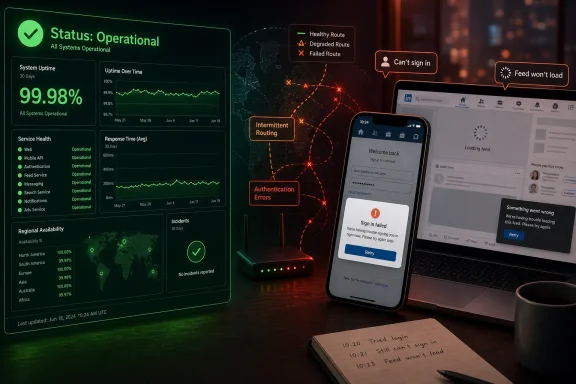
LinkedIn experienced scattered access problems on Monday, June 29, 2026, with some users reporting failed logins, slow feeds, and loading errors while LinkedIn’s own status page continued to indicate that its core systems were operational. That gap between user pain and official green lights is the real story. For a platform embedded in recruiting, sales, publishing, and professional identity, “not fully down” can still mean meaningfully broken. The modern outage is increasingly less like a blackout and more like bad plumbing: pressure in some rooms, brown water in others, and a utility company insisting the grid is fine.
The reports around Monday’s LinkedIn problems appear to describe an intermittent service issue rather than a clean, global failure. Some users could load the platform normally, while others saw login failures, feed stalls, or pages that spun without resolution. That pattern matters because it is exactly the kind of disruption that slips through the language companies prefer to use.
A “major outage” is easy to understand. A partial degradation is not. It produces screenshots, frustration, and uncertainty, but often no single moment when a company declares the service unavailable.
LinkedIn’s official posture, according to the available reporting, was that systems remained operational. That may have been technically true from the company’s monitoring perspective. But from the user’s side, a professional network that cannot reliably load a feed, open a message thread, or surface job listings during business hours is not meaningfully healthy.
This is the tension at the center of cloud-era reliability. Platforms are no longer judged only by whether their servers are alive. They are judged by whether the user journey works end to end.
That makes even a brief disruption more consequential than the phrase “some users affected” suggests. A failed login at 8:45 a.m. can mean a missed candidate reply. A broken company page can delay a product announcement. A stalled message thread can interrupt business development that has already moved away from email.
Microsoft’s ownership adds another layer. LinkedIn sits inside the broader Microsoft productivity universe, even if it remains a distinct platform with its own operational status and user experience. The brand halo from Microsoft’s enterprise infrastructure cuts both ways: users expect resilience, and they notice when the polish cracks.
The irony is that LinkedIn’s value comes from its centrality. The more indispensable it becomes, the less tolerance users have for ambiguity when it falters.
A service can be “operational” while a subset of authentication requests fail. A feed can technically respond while rendering slowly enough to feel unusable. A mobile app can work while the desktop web experience breaks for certain browsers, regions, cached sessions, or network paths.
For administrators and support desks, this is familiar territory. The dashboard says green. The tickets say red. The right answer is usually somewhere in between.
Crowd-sourced outage trackers fill that gap because they measure pain rather than architecture. They are noisy, vulnerable to false positives, and often imprecise. But they also capture the first wave of user impact before a vendor has enough internal signal to publish an incident.
That is why users increasingly triangulate reality from three places: the vendor’s status page, independent outage monitors, and social media. None is sufficient alone. Together, they sketch the shape of a disruption before the official narrative catches up.
That uncertainty is why user workarounds sound so mundane. Try a different browser. Switch from Wi-Fi to cellular. Open the mobile app instead of the desktop site. Clear cache. Disable extensions. Use a different device.
None of those steps “fix” LinkedIn. They merely test whether the failure is tied to a local client, a session token, a browser path, or a network route. For ordinary users, that distinction is mostly academic. For IT teams, it is the difference between telling staff to wait and opening a broader incident response thread.
This is also where modern web complexity creates its own fragility. LinkedIn is not a static page of profiles and job listings. It is a heavy, personalized application with feeds, messaging, ads, analytics, recommendations, anti-abuse systems, AI-driven ranking, media uploads, and enterprise integrations.
Every feature that makes the platform more useful also expands the number of ways it can degrade.
The same is true for sales teams using LinkedIn for prospecting and relationship mapping. A broken feed may be annoying for casual users, but a failed search, inaccessible profile, or delayed message can interrupt a live pipeline. A platform does not need to collapse globally to become operationally expensive.
Job seekers face a different version of the same problem. Many already experience hiring platforms as opaque and unforgiving. If LinkedIn fails while someone is applying, replying to a recruiter, or updating a profile before an interview, the disruption feels personal even when it is technical.
That is why the industry’s habit of describing these events in aggregate percentages can miss the point. A tiny affected slice of LinkedIn’s user base can still represent millions of people. For the person blocked at the wrong moment, “limited impact” is not a comfort.
That does not mean a LinkedIn hiccup is an Azure incident. It does mean users will judge the company’s services through a shared expectation of enterprise-grade reliability and communication. Microsoft has spent decades convincing businesses that its platforms are infrastructure, not merely applications.
Infrastructure is held to a harsher standard. Users may grumble when a consumer app breaks. They escalate when a work platform does.
LinkedIn’s official silence, if the disruption remained limited, is understandable. Companies do not want to over-declare incidents and create panic where there is only localized degradation. But under-communication carries its own risk: users assume the company is either unaware, evasive, or measuring the wrong thing.
The best incident communication is not merely an admission of failure. It is a signal that the vendor sees what users see.
With LinkedIn, scale makes the phrase especially slippery. A small percentage of a global professional network can still be a very large crowd. The platform’s reach turns edge cases into visible public episodes.
This is why user reports matter even when they do not prove a global outage. They identify where the user experience is breaking. They also pressure vendors to investigate conditions that may not trip conventional uptime alarms.
The lesson for businesses is not to panic every time Downdetector twitches. It is to understand that vendor status pages are one input, not the final word. If your employees, recruiters, or marketing team cannot use a platform, your internal reality is already an incident.
AI does not automatically make LinkedIn less reliable. But the broader pattern across software is clear: more personalization, more inference, more ranking, and more automation mean more systems must cooperate before a page feels complete.
If a feed loads but recommendations fail, users may call the site slow. If search works but job cards do not populate, users may call the jobs page broken. If messaging opens but profile context does not appear, the experience feels degraded even though individual services may be responding.
This is the new reliability challenge for large platforms. Uptime is no longer binary. A service can be alive while the product feels hollowed out.
For WindowsForum readers, that distinction should feel familiar. Anyone who has debugged Microsoft 365 sign-in failures, Teams presence weirdness, OneDrive sync loops, or Windows Update stalls knows that the most frustrating failures are the ones that do not cleanly announce themselves.
For businesses, the response should be more structured. Recruiting teams should know how to contact high-priority candidates outside LinkedIn. Marketing teams should avoid treating a single social platform as the only launch channel. Sales teams should keep CRM records independent of LinkedIn access.
The point is not to abandon LinkedIn. The point is to stop pretending any single cloud service is immune to ordinary failure.
A brief LinkedIn disruption is also a useful reminder that “professional networking” should not be synonymous with one company’s interface. Email, direct phone contact, company career portals, personal websites, and alternative social channels still matter because resilience is built from redundancy.
If LinkedIn’s Monday issues were brief and limited, many users will forget them by the afternoon. But the pattern remains important: scattered user complaints, mixed third-party signals, and an official status page showing normal operations. That is the anatomy of a modern partial outage.
The companies that handle these moments well do not necessarily publish dramatic mea culpas. They provide timely acknowledgments, narrow the scope, and tell users when the situation has normalized. Even a short note saying that some users may be experiencing degraded access can lower the temperature.
The companies that handle them poorly let users do the incident analysis themselves. That creates a vacuum filled by speculation, screenshots, and bad advice. Once that happens, the status page stops being an authority and becomes just another tab people refresh in frustration.
LinkedIn’s challenge is not merely to maintain uptime. It is to maintain confidence when uptime is contested.
The next time LinkedIn stutters, the question will not simply be whether the site is “down.” It will be whether the people and businesses that depend on it have learned to distinguish a platform’s green status light from their own operational reality — and whether Microsoft’s professional network can communicate partial failure with the clarity expected of infrastructure rather than the vagueness tolerated from an app.
 The Outage That Wasn’t Quite an Outage Still Cost People Time
The reports around Monday’s LinkedIn problems appear to describe an intermittent service issue rather than a clean, global failure. Some users could load the platform normally, while others saw login failures, feed stalls, or pages that spun without resolution. That pattern matters because it is exactly the kind of disruption that slips through the language companies prefer to use.A “major outage” is easy to understand. A partial degradation is not. It produces screenshots, frustration, and uncertainty, but often no single moment when a company declares the service unavailable.
LinkedIn’s official posture, according to the available reporting, was that systems remained operational. That may have been technically true from the company’s monitoring perspective. But from the user’s side, a professional network that cannot reliably load a feed, open a message thread, or surface job listings during business hours is not meaningfully healthy.
This is the tension at the center of cloud-era reliability. Platforms are no longer judged only by whether their servers are alive. They are judged by whether the user journey works end to end.
LinkedIn Is No Longer Just a Website People Check Between Meetings
LinkedIn’s reliability problem is bigger than LinkedIn because the service has become part of the operating system of white-collar work. Recruiters use it as a sourcing database. Job seekers treat it as a public résumé. Sales teams rely on it for prospecting. Founders, consultants, and executives use it as a distribution channel.That makes even a brief disruption more consequential than the phrase “some users affected” suggests. A failed login at 8:45 a.m. can mean a missed candidate reply. A broken company page can delay a product announcement. A stalled message thread can interrupt business development that has already moved away from email.
Microsoft’s ownership adds another layer. LinkedIn sits inside the broader Microsoft productivity universe, even if it remains a distinct platform with its own operational status and user experience. The brand halo from Microsoft’s enterprise infrastructure cuts both ways: users expect resilience, and they notice when the polish cracks.
The irony is that LinkedIn’s value comes from its centrality. The more indispensable it becomes, the less tolerance users have for ambiguity when it falters.
Status Pages Tell the Infrastructure Story, Not Always the Human One
The most revealing detail in Monday’s reports is the mismatch between monitoring sites, social complaints, and LinkedIn’s official status view. That does not automatically mean LinkedIn was hiding anything. It means the machinery of incident detection often measures a different reality than users do.A service can be “operational” while a subset of authentication requests fail. A feed can technically respond while rendering slowly enough to feel unusable. A mobile app can work while the desktop web experience breaks for certain browsers, regions, cached sessions, or network paths.
For administrators and support desks, this is familiar territory. The dashboard says green. The tickets say red. The right answer is usually somewhere in between.
Crowd-sourced outage trackers fill that gap because they measure pain rather than architecture. They are noisy, vulnerable to false positives, and often imprecise. But they also capture the first wave of user impact before a vendor has enough internal signal to publish an incident.
That is why users increasingly triangulate reality from three places: the vendor’s status page, independent outage monitors, and social media. None is sufficient alone. Together, they sketch the shape of a disruption before the official narrative catches up.
The Browser, the App, and the Network All Become Suspects
The practical difficulty with an intermittent LinkedIn failure is that the cause can sit almost anywhere in the stack. It might be LinkedIn’s backend. It might be a routing issue. It might be an authentication dependency. It might be a browser-side script gone sideways. It might be a regional CDN or cache problem.That uncertainty is why user workarounds sound so mundane. Try a different browser. Switch from Wi-Fi to cellular. Open the mobile app instead of the desktop site. Clear cache. Disable extensions. Use a different device.
None of those steps “fix” LinkedIn. They merely test whether the failure is tied to a local client, a session token, a browser path, or a network route. For ordinary users, that distinction is mostly academic. For IT teams, it is the difference between telling staff to wait and opening a broader incident response thread.
This is also where modern web complexity creates its own fragility. LinkedIn is not a static page of profiles and job listings. It is a heavy, personalized application with feeds, messaging, ads, analytics, recommendations, anti-abuse systems, AI-driven ranking, media uploads, and enterprise integrations.
Every feature that makes the platform more useful also expands the number of ways it can degrade.
Recruiters Feel Partial Failures First
Recruiters are among the least forgiving LinkedIn users because they often work in time-sensitive loops. Candidate outreach, hiring manager updates, and job-posting workflows all depend on quick access. If LinkedIn is slow or unreliable for even an hour, the interruption lands directly in the workday.The same is true for sales teams using LinkedIn for prospecting and relationship mapping. A broken feed may be annoying for casual users, but a failed search, inaccessible profile, or delayed message can interrupt a live pipeline. A platform does not need to collapse globally to become operationally expensive.
Job seekers face a different version of the same problem. Many already experience hiring platforms as opaque and unforgiving. If LinkedIn fails while someone is applying, replying to a recruiter, or updating a profile before an interview, the disruption feels personal even when it is technical.
That is why the industry’s habit of describing these events in aggregate percentages can miss the point. A tiny affected slice of LinkedIn’s user base can still represent millions of people. For the person blocked at the wrong moment, “limited impact” is not a comfort.
Microsoft’s Reliability Halo Raises the Bar
LinkedIn’s parentage matters because Microsoft sells trust as much as it sells software. Azure, Microsoft 365, Teams, Entra, Windows, and LinkedIn all occupy different parts of the enterprise psyche, but customers increasingly experience them as pieces of one Microsoft-shaped work environment.That does not mean a LinkedIn hiccup is an Azure incident. It does mean users will judge the company’s services through a shared expectation of enterprise-grade reliability and communication. Microsoft has spent decades convincing businesses that its platforms are infrastructure, not merely applications.
Infrastructure is held to a harsher standard. Users may grumble when a consumer app breaks. They escalate when a work platform does.
LinkedIn’s official silence, if the disruption remained limited, is understandable. Companies do not want to over-declare incidents and create panic where there is only localized degradation. But under-communication carries its own risk: users assume the company is either unaware, evasive, or measuring the wrong thing.
The best incident communication is not merely an admission of failure. It is a signal that the vendor sees what users see.
“Some Users” Is a Bigger Category Than It Sounds
The phrase “some users” has become one of the most elastic formulations in technology communications. It can mean a handful of people. It can mean a region. It can mean a specific product surface. It can mean a large but statistically small population inside a massive platform.With LinkedIn, scale makes the phrase especially slippery. A small percentage of a global professional network can still be a very large crowd. The platform’s reach turns edge cases into visible public episodes.
This is why user reports matter even when they do not prove a global outage. They identify where the user experience is breaking. They also pressure vendors to investigate conditions that may not trip conventional uptime alarms.
The lesson for businesses is not to panic every time Downdetector twitches. It is to understand that vendor status pages are one input, not the final word. If your employees, recruiters, or marketing team cannot use a platform, your internal reality is already an incident.
AI Features Add Utility, but They Also Add Moving Parts
LinkedIn has been pushing deeper into AI-assisted work: job matching, writing suggestions, recruiting workflows, learning recommendations, and content tools. Those features are logical extensions of the data LinkedIn already holds. They also increase the platform’s dependency on complex backend services.AI does not automatically make LinkedIn less reliable. But the broader pattern across software is clear: more personalization, more inference, more ranking, and more automation mean more systems must cooperate before a page feels complete.
If a feed loads but recommendations fail, users may call the site slow. If search works but job cards do not populate, users may call the jobs page broken. If messaging opens but profile context does not appear, the experience feels degraded even though individual services may be responding.
This is the new reliability challenge for large platforms. Uptime is no longer binary. A service can be alive while the product feels hollowed out.
For WindowsForum readers, that distinction should feel familiar. Anyone who has debugged Microsoft 365 sign-in failures, Teams presence weirdness, OneDrive sync loops, or Windows Update stalls knows that the most frustrating failures are the ones that do not cleanly announce themselves.
The Sensible User Response Is Boring, Which Is Why It Works
For individual users, the right response to an intermittent LinkedIn issue is not heroic troubleshooting. It is a quick set of checks followed by restraint. Test another browser, another network, or the mobile app. Confirm whether others are seeing similar symptoms. Avoid repeated login attempts if authentication appears unstable.For businesses, the response should be more structured. Recruiting teams should know how to contact high-priority candidates outside LinkedIn. Marketing teams should avoid treating a single social platform as the only launch channel. Sales teams should keep CRM records independent of LinkedIn access.
The point is not to abandon LinkedIn. The point is to stop pretending any single cloud service is immune to ordinary failure.
A brief LinkedIn disruption is also a useful reminder that “professional networking” should not be synonymous with one company’s interface. Email, direct phone contact, company career portals, personal websites, and alternative social channels still matter because resilience is built from redundancy.
The Real Test Is How Quickly Ambiguity Shrinks
Every outage has two clocks. One measures technical recovery. The other measures uncertainty. The second clock is often the one users remember.If LinkedIn’s Monday issues were brief and limited, many users will forget them by the afternoon. But the pattern remains important: scattered user complaints, mixed third-party signals, and an official status page showing normal operations. That is the anatomy of a modern partial outage.
The companies that handle these moments well do not necessarily publish dramatic mea culpas. They provide timely acknowledgments, narrow the scope, and tell users when the situation has normalized. Even a short note saying that some users may be experiencing degraded access can lower the temperature.
The companies that handle them poorly let users do the incident analysis themselves. That creates a vacuum filled by speculation, screenshots, and bad advice. Once that happens, the status page stops being an authority and becomes just another tab people refresh in frustration.
LinkedIn’s challenge is not merely to maintain uptime. It is to maintain confidence when uptime is contested.
A Work Platform Needs a Plan B, Even When the Vendor Is Microsoft
The concrete lesson from Monday’s LinkedIn reports is not that LinkedIn is unreliable. Large platforms will stumble. The lesson is that professionals and businesses should treat even dominant services as dependencies that can fail at inconvenient moments.- LinkedIn appeared to suffer intermittent access issues on June 29, 2026, but the available information did not establish a confirmed global outage.
- Users reported symptoms such as failed logins, slow loading, feed problems, and temporary inability to access parts of the service.
- LinkedIn’s official status information reportedly continued to show overall systems as operational, illustrating the gap between platform monitoring and user experience.
- Recruiters, job seekers, sales teams, and company-page managers are the groups most likely to feel even a short disruption during working hours.
- The safest response is to verify the issue across devices and networks, avoid over-troubleshooting, and keep alternative communication channels ready.
The next time LinkedIn stutters, the question will not simply be whether the site is “down.” It will be whether the people and businesses that depend on it have learned to distinguish a platform’s green status light from their own operational reality — and whether Microsoft’s professional network can communicate partial failure with the clarity expected of infrastructure rather than the vagueness tolerated from an app.
References
- Primary source: International Business Times Australia
Published: 2026-06-29T10:01:30.409752
Loading…
www.ibtimes.com.au - Related coverage: linkedin.com
Loading…
www.linkedin.com - Related coverage: isdown.app
Loading…
isdown.app - Related coverage: entireweb.com
Loading…
www.entireweb.com - Related coverage: netbeep.com
Loading…
www.netbeep.com - Related coverage: outage.com
Loading…
www.outage.com
- Related coverage: linkedin-status.com
Loading…
www.linkedin-status.com - Related coverage: servicealert.ai
Loading…
servicealert.ai - Related coverage: outage.report
Loading…
outage.report - Related coverage: updownradar.com
Loading…
updownradar.com - Related coverage: tomshardware.com
Loading…
www.tomshardware.com - Related coverage: techradar.com
DoorDash was down for many — here's what happened in the major outage | TechRadar
DoorDash crashed today, but is now back onlinewww.techradar.com - Related coverage: tomsguide.com
Facebook and Instagram were down — live updates on outage hitting Meta services | Tom's Guide
This isn't good for Meta userswww.tomsguide.com - Related coverage: handlewithcaremo.org
Loading…
handlewithcaremo.org