

On June 26, 2026, reports said Paul Meade, the Apple vice president overseeing Vision Pro hardware and smart-glasses work, would leave Cupertino for OpenAI’s hardware group, adding another senior Apple veteran to Sam Altman and Jony Ive’s device-building bench. The move is not merely another executive hop in Silicon Valley’s endless talent carousel. It is a signal that the center of gravity in consumer computing is shifting from polished devices that occasionally use AI to AI systems looking for bodies of their own. Apple is not doomed, but it is being forced to defend the very thing it once owned: the future’s physical interface.
OpenAI’s hardware ambitions have never been subtle, but they are becoming less abstract. The company did not spend billions to acquire Jony Ive’s io and then recruit senior Apple hardware people because it wanted nicer ChatGPT merch. It is assembling a team with unusually specific knowledge: how to make unfamiliar technology feel inevitable.
That matters because AI hardware is currently an industry of contradictions. Everyone agrees the smartphone is no longer the final form of personal computing, yet almost nobody has proven what comes next. The first wave of AI pins, pendants, and voice-first gadgets showed how difficult it is to replace a slab of glass that already has a screen, a battery, a camera, an app ecosystem, cellular radios, payments, maps, messaging, and social gravity.
OpenAI’s wager is that the missing ingredient is not just a better model. It is product taste, supply-chain discipline, mechanical engineering, thermal engineering, industrial design, and the dark art of making people want to carry something every day. Those are not skills a frontier AI lab learns overnight by hiring a few consultants and buying a CNC machine.
Meade’s reported move is therefore more consequential than his title alone suggests. Vision Pro may not have become Apple’s next iPhone, but it remains one of the most technically ambitious consumer devices Apple has ever shipped. A person who spent years working through its sensors, displays, optics, fit, weight, heat, and manufacturing compromises has lived inside the hardest parts of spatial computing.
OpenAI is not simply poaching résumés. It is poaching accumulated scar tissue.
That distinction is now haunting Apple. The company’s long-term vision strategy was never going to hinge on the first $3,499 headset. The real contest is lighter devices, better displays, stronger battery life, more convincing passthrough, more useful AI, and eventually glasses that look less like a dev kit from the future and more like something a normal person might wear outside.
That is precisely the territory Meade was reportedly helping to steer. Smart glasses are not just “Vision Pro, but smaller.” They are a brutal compression problem. They demand tradeoffs in power, sensors, privacy, weight, optics, compute, latency, and social acceptability that make phones look forgiving.
Apple still has deep engineering ranks, and it is foolish to reduce a company of its scale to a handful of celebrity departures. But teams have culture, and products have authorship. When the people who have spent years internalizing a product’s constraints leave just as the next form factor becomes strategically urgent, momentum suffers.
The timing is especially awkward because rivals are no longer waiting for Apple to define the category. Meta has spent years normalizing camera glasses through Ray-Ban partnerships and is pushing aggressively toward AI-assisted wearables. Google, Samsung, and others continue to circle Android XR. OpenAI, now equipped with a model platform and a growing hardware bench, is entering from the opposite direction: not from screens toward intelligence, but from intelligence toward devices.
Apple once had the luxury of arriving late and looking inevitable. In AI hardware, late may simply look late.
For a decade and a half, Apple sat at the center of that problem. If you wanted to shape how humans touched the digital world, you worked on iPhone, iPad, Watch, AirPods, or the operating systems around them. Apple offered the rare combination of industrial scale, consumer trust, design authority, and vertical control.
Now OpenAI can offer something Apple cannot: proximity to the frontier model itself. That is not a small recruiting advantage. If the next generation of hardware is built around ambient assistants, multimodal perception, persistent memory, speech, cameras, and on-device or near-device reasoning, the model is not a feature bolted onto the product. It is the product’s nervous system.
Apple’s traditional strength is integration. It controls silicon, software, services, retail, privacy architecture, and the customer relationship. But in generative AI, Apple has looked more like a careful platform steward than a category-defining aggressor. Its AI story has improved, but it has often felt mediated, cautious, and dependent on partnerships when the task moves beyond tightly bounded on-device functions.
That may be rational. Apple ships to billions of users, and a hallucinating assistant on an iPhone is not the same reputational problem as an experimental chatbot on a web page. Apple’s threshold for embarrassment is lower because its products are more intimate and more mainstream.
But talent markets reward perceived momentum. If OpenAI looks like the place where the next interface will be invented, and Apple looks like the place where it will be debated, reviewed, localized, privacy-scoped, and rolled out in stages, some builders will choose the former.
That does not guarantee success. Design history is littered with brilliant teams that could not overcome timing, cost, distribution, or a bad core assumption. The iPhone was not just a beautiful object; it arrived when mobile chips, capacitive touchscreens, cellular networks, web services, carrier economics, and consumer behavior were all converging.
AI hardware still lacks that convergence. Batteries remain stubborn. Always-on cameras create social friction. Voice interfaces are powerful but awkward in public. Tiny screens are limiting, no screens are worse, and full augmented reality remains constrained by optics and physics. The winning device may not be a pendant, a pin, glasses, earbuds, or a phone replacement at all.
Still, OpenAI has one advantage that previous hardware dreamers lacked: a service people already use at massive scale. If ChatGPT is becoming a daily work tool, tutor, coding partner, writing assistant, and search substitute, then OpenAI does not need to create demand for AI assistance from scratch. It needs to find the form in which that assistance becomes less trapped by the browser tab and phone app.
That is why the old Apple talent matters. The next AI device will not win because it produces the cleverest demo on stage. It will win if it reduces friction in ordinary moments: asking, seeing, remembering, translating, summarizing, guiding, buying, navigating, and creating without making the user feel like they joined a science experiment.
Apple knows how to erase friction. OpenAI knows how to generate intelligence-like behavior at scale. The uncomfortable possibility for Cupertino is that those strengths are no longer housed in the same company.
Ternus is a hardware executive, which on paper should reassure anyone worried that Apple is losing its product nerve. His ascent suggests the company still believes deeply in devices, silicon, manufacturing excellence, and the integrated stack. It also gives Apple a leader whose career is closer to the engineering organization than to finance, operations, or services.
But succession creates turbulence below the surface. When reporting describes hardware restructuring under Johny Srouji and VPs feeling shifted or demoted, it points to the human side of corporate reorganization. Apple’s org chart is not just boxes and reporting lines; it is influence, access, taste, veto power, and the ability to get resources for risky ideas.
OpenAI can exploit that moment. A senior Apple executive looking at a changed reporting structure, a long hardware roadmap, and a company still finding its AI footing may see an unusually rare alternative: join a lavishly funded AI leader, reunite with former Apple design colleagues, and work on a device category whose rules have not yet been written.
For Apple, the challenge is not simply retaining people with higher compensation. It is convincing its best builders that the most important work of the next decade can still happen inside Apple. That argument used to make itself. Now it has to be made against companies whose entire identity is built around the AI transition.
AI hardware faces a similar trap. The first ten minutes of a demo can feel magical. A camera sees what you see. A model answers in natural language. A wearable summarizes a meeting, translates a sign, or remembers where you left your keys. Then reality intrudes: latency, battery life, privacy, misrecognition, awkwardness, subscription pricing, and the question of whether the phone could have done it better.
This is where Apple should, in theory, still be formidable. The company’s best products rarely win by being first. They win by waiting until a technology can be packaged into a coherent experience and then making competitors look unfinished. The iPod was not the first MP3 player, the iPhone was not the first smartphone, and the Watch was not the first smartwatch.
But AI compresses the timeline. Models improve quickly, user habits shift quickly, and developers chase the platforms that expose the most powerful capabilities. If Apple waits too long to define the AI-native device, it risks allowing someone else to establish the interaction patterns that matter.
The phone is not going away. The more realistic near-term future is a mesh of devices: phone, earbuds, watch, glasses, car, PC, and home hardware, all mediated by AI agents that understand context across them. Apple owns many of those endpoints already. The question is whether its AI layer will feel like the connective tissue or like a cautious assistant living inside old containers.
OpenAI already learned this lesson with ChatGPT. The product’s breakthrough was not only model capability; it was accessibility. A general-purpose text box made AI legible to people who had never read a machine-learning paper and did not care what a transformer was. The interface turned a research trajectory into a consumer phenomenon.
Hardware is the next version of that same battle. If OpenAI remains an app on Apple’s devices, Apple taxes the experience literally and strategically. Apple controls default surfaces, notification rules, background behavior, privacy prompts, app review boundaries, and OS-level integrations. OpenAI can be popular there, but it cannot be fully sovereign.
A dedicated device, or a family of devices, is an escape attempt. It gives OpenAI a chance to define when the assistant listens, what it sees, how it interrupts, how memory works, how identity travels, and how developers build around it. Those choices are too important to leave entirely inside someone else’s operating system.
Microsoft understood a version of this when it pushed Copilot across Windows, Microsoft 365, Edge, GitHub, and Azure. Google understands it as it fuses Gemini into search, Android, Workspace, and cloud. Meta understands it through glasses, social feeds, messaging, and open models. The AI race is not only about whose model tops a benchmark. It is about whose assistant becomes the default layer between people and their digital lives.
That is why Apple should be worried. The company has spent decades being the default layer for premium consumers. OpenAI is now hiring people who know exactly how that layer was built.
Windows has already become one of the main battlegrounds for AI integration. Copilot is not just a chatbot pinned to a taskbar; it is Microsoft’s attempt to make AI part of the operating environment, the productivity suite, and the developer workflow. Whether users love, ignore, disable, or grudgingly adopt it, Microsoft’s direction is clear: AI belongs inside the work surface, not off to the side.
That creates a strange inversion. Apple has the stronger consumer hardware mythos, but Microsoft may have the stronger enterprise AI distribution. Windows PCs sit inside managed fleets. Microsoft 365 holds mail, documents, calendars, chats, meetings, and identity. Azure sells the infrastructure. GitHub reaches developers. Intune and Entra give administrators the policy levers.
If OpenAI builds hardware that becomes attractive to consumers or knowledge workers, it will eventually collide with corporate policy. Admins will have to decide whether an always-listening, camera-equipped AI device belongs in offices, labs, hospitals, classrooms, government facilities, and regulated environments. The same arguments now surrounding Copilot data boundaries will extend to wearables and ambient assistants.
That future is closer than it sounds. The first successful AI hardware may not replace the PC, but it could change how users initiate work. A device that records a site visit, drafts tickets, summarizes conversations, identifies equipment, or guides a field technician could become part of the endpoint estate. Once that happens, IT will care about enrollment, identity, logging, retention, remote wipe, firmware updates, and whether the device leaks sensitive data to a cloud model.
Apple’s talent loss is therefore a preview of a broader platform fight. The next endpoint may not look like a laptop, but it will still need governance.
A sales assistant that cannot see CRM data, call transcripts, permissions, account history, and current pipeline is a toy. A finance assistant that cannot respect role-based access or query the right databases is a liability. An HR assistant that ignores identity boundaries is not an assistant at all; it is a compliance incident waiting for a calendar invite.
This is the unglamorous side of AI that hardware hype tends to skip. Models are powerful, but systems are messy. Real organizations run on Salesforce, Workday, ServiceNow, SAP, Microsoft 365, PostgreSQL, file shares, ticketing systems, custom line-of-business apps, and years of inconsistent permissions. The AI layer has to negotiate all of that without turning every workflow into a bespoke integration project.
Apple’s consumer challenge has an enterprise mirror. It is not enough to build something impressive. The product has to fit into existing patterns of trust, control, and daily behavior. For Apple, that means AI that feels native across iPhone, Mac, Watch, AirPods, Vision, and whatever comes next. For Microsoft, it means Copilot that respects tenant boundaries, admin controls, and user expectations. For OpenAI, it means moving beyond the magic box into managed environments without losing the simplicity that made ChatGPT explode.
The companies that win will be the ones that understand that AI is not a destination. It is a layer. Layers become powerful only when they are trusted enough to sit between the user and everything else.
If large companies are already rationing access to frontier models and token usage, the dream of ubiquitous ambient AI runs into hard economics. A successful consumer AI device could generate staggering inference demand. Unlike a phone app that users open occasionally, a wearable assistant might invite constant interaction, passive perception, and background processing.
That does not make the category impossible. It means architecture matters. Some tasks will have to run locally. Some will need smaller models. Some will be deferred, compressed, cached, or routed through cheaper systems. Privacy and latency will push compute toward the edge, while capability will keep pulling it back toward the cloud.
Apple has a natural advantage here because of its silicon strategy. The company has spent years building efficient chips for phones, tablets, Macs, watches, and headsets. If AI hardware requires a careful balance of local processing and cloud intelligence, Apple should be well positioned. Its problem is not a lack of hardware competence. It is whether its AI services and developer story can match the ambition of its silicon.
OpenAI has the opposite problem. It has the AI demand, brand, and model momentum, but must learn the full brutality of hardware margins, repairs, inventory, retail, support, and lifecycle management. Hiring Apple veterans is one way to reduce that risk. It does not erase the risk.
But privacy is also a constraint when the product category rewards memory and context. The most useful assistant is often the one that knows more, sees more, remembers more, and can act across more services. The safest assistant is often the one that knows less, forgets faster, and asks permission more often. Product magic lives in the tension between those two truths.
OpenAI will face this tension too, but its user contract is different. People already send sensitive work, code, writing, and questions into ChatGPT because they perceive the utility as high enough. Apple users expect the device to protect them by default. That expectation is valuable, but it can slow the path to features that feel astonishing.
The winning AI hardware platform will need a new privacy grammar. Users will need clear ways to know when a device is seeing, listening, remembering, and sharing. Organizations will need enforceable controls. Developers will need APIs that do not become surveillance shortcuts. Regulators will eventually arrive, and when they do, vague assurances will not be enough.
Apple should be able to lead here. The danger is that leadership in privacy becomes an excuse for hesitation rather than a foundation for invention.
Apple also does not need to beat OpenAI at being OpenAI. It needs to make AI useful inside Apple’s world. That could mean AirPods that become the most natural voice interface, watches that understand health and context, Macs that make local AI practical for developers and creators, iPhones that coordinate personal agents, and future glasses that arrive only when the hardware is socially and technically ready.
But the company cannot rely on inevitability. The AI transition is not like adding a better camera or faster chip. It changes where value is created. If users begin to see the assistant as the primary interface, the device becomes a vessel. Apple’s entire business has been built on making the vessel matter.
The way forward is not to chase every AI gadget rumor. It is to make the Apple ecosystem feel decisively more intelligent without making it feel less trustworthy. That requires stronger models, richer developer tools, clearer automation, better Siri-level interaction, and a willingness to let AI reshape workflows rather than decorate them.
The irony is that Apple may have the best hardware foundation for the AI age. It just needs to prove that the intelligence layer can be as opinionated, coherent, and delightful as the aluminum and glass around it.
Apple is heading into a Ternus era, defending Vision, preparing for smart glasses, integrating AI across its platforms, and watching a former design dynasty gather around OpenAI. The company still has extraordinary advantages, but the narrative has shifted. Instead of asking when Apple will reveal the next interface, the industry is asking whether that interface is being built somewhere else.
For users, administrators, and developers, the practical lesson is to separate theater from trajectory. The first generation of AI hardware may disappoint. The first enterprise agents may overpromise. The first ambient devices may create as many policy headaches as productivity gains. Yet the direction is clear enough: AI is moving out of isolated apps and into the surfaces where people live and work.
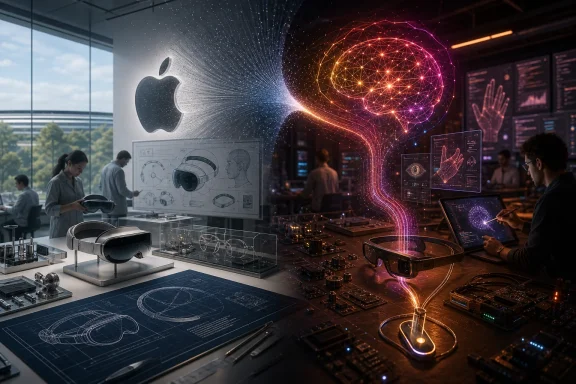 OpenAI Is Hiring the Muscle Memory of the iPhone Era
OpenAI’s hardware ambitions have never been subtle, but they are becoming less abstract. The company did not spend billions to acquire Jony Ive’s io and then recruit senior Apple hardware people because it wanted nicer ChatGPT merch. It is assembling a team with unusually specific knowledge: how to make unfamiliar technology feel inevitable.That matters because AI hardware is currently an industry of contradictions. Everyone agrees the smartphone is no longer the final form of personal computing, yet almost nobody has proven what comes next. The first wave of AI pins, pendants, and voice-first gadgets showed how difficult it is to replace a slab of glass that already has a screen, a battery, a camera, an app ecosystem, cellular radios, payments, maps, messaging, and social gravity.
OpenAI’s wager is that the missing ingredient is not just a better model. It is product taste, supply-chain discipline, mechanical engineering, thermal engineering, industrial design, and the dark art of making people want to carry something every day. Those are not skills a frontier AI lab learns overnight by hiring a few consultants and buying a CNC machine.
Meade’s reported move is therefore more consequential than his title alone suggests. Vision Pro may not have become Apple’s next iPhone, but it remains one of the most technically ambitious consumer devices Apple has ever shipped. A person who spent years working through its sensors, displays, optics, fit, weight, heat, and manufacturing compromises has lived inside the hardest parts of spatial computing.
OpenAI is not simply poaching résumés. It is poaching accumulated scar tissue.
Apple’s Vision Bet Looks More Fragile Without Its Builders
The Vision Pro was always an odd product: too expensive for the mass market, too polished to dismiss as a prototype, and too strategically important to treat as a hobby. Apple sold it as the beginning of spatial computing, but the first version felt more like a statement of capability than a solved category. It proved Apple could build the most sophisticated headset in consumer electronics; it did not prove that millions of people wanted to wear one.That distinction is now haunting Apple. The company’s long-term vision strategy was never going to hinge on the first $3,499 headset. The real contest is lighter devices, better displays, stronger battery life, more convincing passthrough, more useful AI, and eventually glasses that look less like a dev kit from the future and more like something a normal person might wear outside.
That is precisely the territory Meade was reportedly helping to steer. Smart glasses are not just “Vision Pro, but smaller.” They are a brutal compression problem. They demand tradeoffs in power, sensors, privacy, weight, optics, compute, latency, and social acceptability that make phones look forgiving.
Apple still has deep engineering ranks, and it is foolish to reduce a company of its scale to a handful of celebrity departures. But teams have culture, and products have authorship. When the people who have spent years internalizing a product’s constraints leave just as the next form factor becomes strategically urgent, momentum suffers.
The timing is especially awkward because rivals are no longer waiting for Apple to define the category. Meta has spent years normalizing camera glasses through Ray-Ban partnerships and is pushing aggressively toward AI-assisted wearables. Google, Samsung, and others continue to circle Android XR. OpenAI, now equipped with a model platform and a growing hardware bench, is entering from the opposite direction: not from screens toward intelligence, but from intelligence toward devices.
Apple once had the luxury of arriving late and looking inevitable. In AI hardware, late may simply look late.
The Design Exodus Is Really an AI Platform Story
The phrase “brain drain” is useful but incomplete. It implies Apple is losing talent in isolation, as if the story were only about retention, morale, or executive politics. The larger shift is more structural: the most exciting consumer-computing problem in Silicon Valley has moved from better phones to better AI interfaces.For a decade and a half, Apple sat at the center of that problem. If you wanted to shape how humans touched the digital world, you worked on iPhone, iPad, Watch, AirPods, or the operating systems around them. Apple offered the rare combination of industrial scale, consumer trust, design authority, and vertical control.
Now OpenAI can offer something Apple cannot: proximity to the frontier model itself. That is not a small recruiting advantage. If the next generation of hardware is built around ambient assistants, multimodal perception, persistent memory, speech, cameras, and on-device or near-device reasoning, the model is not a feature bolted onto the product. It is the product’s nervous system.
Apple’s traditional strength is integration. It controls silicon, software, services, retail, privacy architecture, and the customer relationship. But in generative AI, Apple has looked more like a careful platform steward than a category-defining aggressor. Its AI story has improved, but it has often felt mediated, cautious, and dependent on partnerships when the task moves beyond tightly bounded on-device functions.
That may be rational. Apple ships to billions of users, and a hallucinating assistant on an iPhone is not the same reputational problem as an experimental chatbot on a web page. Apple’s threshold for embarrassment is lower because its products are more intimate and more mainstream.
But talent markets reward perceived momentum. If OpenAI looks like the place where the next interface will be invented, and Apple looks like the place where it will be debated, reviewed, localized, privacy-scoped, and rolled out in stages, some builders will choose the former.
Jony Ive Gives OpenAI Something Startups Usually Lack
Jony Ive’s presence changes how OpenAI’s hardware push is read. Without him, OpenAI building devices might look like another software company overestimating the ease of atoms. With him, Tang Tan, Evans Hankey, and now reportedly Meade in the orbit, the project begins to look like a deliberate attempt to reconstruct a slice of Apple’s old product machine outside Apple.That does not guarantee success. Design history is littered with brilliant teams that could not overcome timing, cost, distribution, or a bad core assumption. The iPhone was not just a beautiful object; it arrived when mobile chips, capacitive touchscreens, cellular networks, web services, carrier economics, and consumer behavior were all converging.
AI hardware still lacks that convergence. Batteries remain stubborn. Always-on cameras create social friction. Voice interfaces are powerful but awkward in public. Tiny screens are limiting, no screens are worse, and full augmented reality remains constrained by optics and physics. The winning device may not be a pendant, a pin, glasses, earbuds, or a phone replacement at all.
Still, OpenAI has one advantage that previous hardware dreamers lacked: a service people already use at massive scale. If ChatGPT is becoming a daily work tool, tutor, coding partner, writing assistant, and search substitute, then OpenAI does not need to create demand for AI assistance from scratch. It needs to find the form in which that assistance becomes less trapped by the browser tab and phone app.
That is why the old Apple talent matters. The next AI device will not win because it produces the cleverest demo on stage. It will win if it reduces friction in ordinary moments: asking, seeing, remembering, translating, summarizing, guiding, buying, navigating, and creating without making the user feel like they joined a science experiment.
Apple knows how to erase friction. OpenAI knows how to generate intelligence-like behavior at scale. The uncomfortable possibility for Cupertino is that those strengths are no longer housed in the same company.
Cupertino’s Succession Moment Raises the Stakes
Apple is already in the middle of a leadership transition. Tim Cook’s move toward an executive-chairman role and John Ternus’s elevation to CEO mark the most important Apple succession since Steve Jobs handed the company to Cook. Even if the transition is orderly, it inevitably changes internal gravity.Ternus is a hardware executive, which on paper should reassure anyone worried that Apple is losing its product nerve. His ascent suggests the company still believes deeply in devices, silicon, manufacturing excellence, and the integrated stack. It also gives Apple a leader whose career is closer to the engineering organization than to finance, operations, or services.
But succession creates turbulence below the surface. When reporting describes hardware restructuring under Johny Srouji and VPs feeling shifted or demoted, it points to the human side of corporate reorganization. Apple’s org chart is not just boxes and reporting lines; it is influence, access, taste, veto power, and the ability to get resources for risky ideas.
OpenAI can exploit that moment. A senior Apple executive looking at a changed reporting structure, a long hardware roadmap, and a company still finding its AI footing may see an unusually rare alternative: join a lavishly funded AI leader, reunite with former Apple design colleagues, and work on a device category whose rules have not yet been written.
For Apple, the challenge is not simply retaining people with higher compensation. It is convincing its best builders that the most important work of the next decade can still happen inside Apple. That argument used to make itself. Now it has to be made against companies whose entire identity is built around the AI transition.
Vision Pro Was a Marvel, but AI Rewards Usefulness Over Awe
The Vision Pro’s most important lesson may be that technical awe is not enough. Reviewers and early users often marveled at the displays, passthrough, eye tracking, and interface ambition. Then many of them put the device down because daily life did not reorganize itself around a face computer.AI hardware faces a similar trap. The first ten minutes of a demo can feel magical. A camera sees what you see. A model answers in natural language. A wearable summarizes a meeting, translates a sign, or remembers where you left your keys. Then reality intrudes: latency, battery life, privacy, misrecognition, awkwardness, subscription pricing, and the question of whether the phone could have done it better.
This is where Apple should, in theory, still be formidable. The company’s best products rarely win by being first. They win by waiting until a technology can be packaged into a coherent experience and then making competitors look unfinished. The iPod was not the first MP3 player, the iPhone was not the first smartphone, and the Watch was not the first smartwatch.
But AI compresses the timeline. Models improve quickly, user habits shift quickly, and developers chase the platforms that expose the most powerful capabilities. If Apple waits too long to define the AI-native device, it risks allowing someone else to establish the interaction patterns that matter.
The phone is not going away. The more realistic near-term future is a mesh of devices: phone, earbuds, watch, glasses, car, PC, and home hardware, all mediated by AI agents that understand context across them. Apple owns many of those endpoints already. The question is whether its AI layer will feel like the connective tissue or like a cautious assistant living inside old containers.
OpenAI Wants the Interface, Not Just the API
The enterprise world tends to discuss AI in terms of models, agents, tokens, compute, governance, and integration. Consumer computing is more primal. Whoever owns the interface owns the habit, and whoever owns the habit shapes the platform.OpenAI already learned this lesson with ChatGPT. The product’s breakthrough was not only model capability; it was accessibility. A general-purpose text box made AI legible to people who had never read a machine-learning paper and did not care what a transformer was. The interface turned a research trajectory into a consumer phenomenon.
Hardware is the next version of that same battle. If OpenAI remains an app on Apple’s devices, Apple taxes the experience literally and strategically. Apple controls default surfaces, notification rules, background behavior, privacy prompts, app review boundaries, and OS-level integrations. OpenAI can be popular there, but it cannot be fully sovereign.
A dedicated device, or a family of devices, is an escape attempt. It gives OpenAI a chance to define when the assistant listens, what it sees, how it interrupts, how memory works, how identity travels, and how developers build around it. Those choices are too important to leave entirely inside someone else’s operating system.
Microsoft understood a version of this when it pushed Copilot across Windows, Microsoft 365, Edge, GitHub, and Azure. Google understands it as it fuses Gemini into search, Android, Workspace, and cloud. Meta understands it through glasses, social feeds, messaging, and open models. The AI race is not only about whose model tops a benchmark. It is about whose assistant becomes the default layer between people and their digital lives.
That is why Apple should be worried. The company has spent decades being the default layer for premium consumers. OpenAI is now hiring people who know exactly how that layer was built.
The Windows Angle Is Bigger Than Apple Gossip
For WindowsForum readers, this may sound like a Cupertino drama with little practical relevance. It is not. The same forces pulling Apple executives toward OpenAI are reshaping the PC, enterprise software, endpoint management, and the daily toolchain of IT.Windows has already become one of the main battlegrounds for AI integration. Copilot is not just a chatbot pinned to a taskbar; it is Microsoft’s attempt to make AI part of the operating environment, the productivity suite, and the developer workflow. Whether users love, ignore, disable, or grudgingly adopt it, Microsoft’s direction is clear: AI belongs inside the work surface, not off to the side.
That creates a strange inversion. Apple has the stronger consumer hardware mythos, but Microsoft may have the stronger enterprise AI distribution. Windows PCs sit inside managed fleets. Microsoft 365 holds mail, documents, calendars, chats, meetings, and identity. Azure sells the infrastructure. GitHub reaches developers. Intune and Entra give administrators the policy levers.
If OpenAI builds hardware that becomes attractive to consumers or knowledge workers, it will eventually collide with corporate policy. Admins will have to decide whether an always-listening, camera-equipped AI device belongs in offices, labs, hospitals, classrooms, government facilities, and regulated environments. The same arguments now surrounding Copilot data boundaries will extend to wearables and ambient assistants.
That future is closer than it sounds. The first successful AI hardware may not replace the PC, but it could change how users initiate work. A device that records a site visit, drafts tickets, summarizes conversations, identifies equipment, or guides a field technician could become part of the endpoint estate. Once that happens, IT will care about enrollment, identity, logging, retention, remote wipe, firmware updates, and whether the device leaks sensitive data to a cloud model.
Apple’s talent loss is therefore a preview of a broader platform fight. The next endpoint may not look like a laptop, but it will still need governance.
Enterprise AI Is Learning That Demos Are Cheap and Context Is Expensive
The newsletter item that paired Apple’s hardware drama with enterprise AI integration was unintentionally revealing. In consumer markets, the race is for the next device. In business, the race is for trusted context. Both are attempts to solve the same problem: AI becomes valuable when it can act where the user already lives.A sales assistant that cannot see CRM data, call transcripts, permissions, account history, and current pipeline is a toy. A finance assistant that cannot respect role-based access or query the right databases is a liability. An HR assistant that ignores identity boundaries is not an assistant at all; it is a compliance incident waiting for a calendar invite.
This is the unglamorous side of AI that hardware hype tends to skip. Models are powerful, but systems are messy. Real organizations run on Salesforce, Workday, ServiceNow, SAP, Microsoft 365, PostgreSQL, file shares, ticketing systems, custom line-of-business apps, and years of inconsistent permissions. The AI layer has to negotiate all of that without turning every workflow into a bespoke integration project.
Apple’s consumer challenge has an enterprise mirror. It is not enough to build something impressive. The product has to fit into existing patterns of trust, control, and daily behavior. For Apple, that means AI that feels native across iPhone, Mac, Watch, AirPods, Vision, and whatever comes next. For Microsoft, it means Copilot that respects tenant boundaries, admin controls, and user expectations. For OpenAI, it means moving beyond the magic box into managed environments without losing the simplicity that made ChatGPT explode.
The companies that win will be the ones that understand that AI is not a destination. It is a layer. Layers become powerful only when they are trusted enough to sit between the user and everything else.
The Compute Shortage Is the Shadow Behind the Device Race
The reported Google-Meta compute squeeze points to another constraint that makes OpenAI’s hardware ambitions risky. AI products are not only designed; they are provisioned. Every magical interaction has a cost in chips, power, cooling, data centers, networking, and inference optimization.If large companies are already rationing access to frontier models and token usage, the dream of ubiquitous ambient AI runs into hard economics. A successful consumer AI device could generate staggering inference demand. Unlike a phone app that users open occasionally, a wearable assistant might invite constant interaction, passive perception, and background processing.
That does not make the category impossible. It means architecture matters. Some tasks will have to run locally. Some will need smaller models. Some will be deferred, compressed, cached, or routed through cheaper systems. Privacy and latency will push compute toward the edge, while capability will keep pulling it back toward the cloud.
Apple has a natural advantage here because of its silicon strategy. The company has spent years building efficient chips for phones, tablets, Macs, watches, and headsets. If AI hardware requires a careful balance of local processing and cloud intelligence, Apple should be well positioned. Its problem is not a lack of hardware competence. It is whether its AI services and developer story can match the ambition of its silicon.
OpenAI has the opposite problem. It has the AI demand, brand, and model momentum, but must learn the full brutality of hardware margins, repairs, inventory, retail, support, and lifecycle management. Hiring Apple veterans is one way to reduce that risk. It does not erase the risk.
Apple’s Privacy Brand Is an Asset and a Constraint
Apple’s strongest argument in AI hardware may be privacy. A world of camera-equipped, microphone-rich, memory-enabled assistants will make users and regulators nervous. Apple can credibly say it has spent years designing systems around on-device processing, data minimization, permission prompts, and privacy marketing that competitors struggle to match.But privacy is also a constraint when the product category rewards memory and context. The most useful assistant is often the one that knows more, sees more, remembers more, and can act across more services. The safest assistant is often the one that knows less, forgets faster, and asks permission more often. Product magic lives in the tension between those two truths.
OpenAI will face this tension too, but its user contract is different. People already send sensitive work, code, writing, and questions into ChatGPT because they perceive the utility as high enough. Apple users expect the device to protect them by default. That expectation is valuable, but it can slow the path to features that feel astonishing.
The winning AI hardware platform will need a new privacy grammar. Users will need clear ways to know when a device is seeing, listening, remembering, and sharing. Organizations will need enforceable controls. Developers will need APIs that do not become surveillance shortcuts. Regulators will eventually arrive, and when they do, vague assurances will not be enough.
Apple should be able to lead here. The danger is that leadership in privacy becomes an excuse for hesitation rather than a foundation for invention.
The Old Apple Playbook Still Works, but It Needs a New Chapter
It is tempting to declare Apple’s AI hardware prospects wounded beyond repair. That would be premature. Apple has weathered executive departures before, absorbed criticism before, entered markets late before, and converted skepticism into profit before. The company’s installed base remains one of the most valuable assets in technology.Apple also does not need to beat OpenAI at being OpenAI. It needs to make AI useful inside Apple’s world. That could mean AirPods that become the most natural voice interface, watches that understand health and context, Macs that make local AI practical for developers and creators, iPhones that coordinate personal agents, and future glasses that arrive only when the hardware is socially and technically ready.
But the company cannot rely on inevitability. The AI transition is not like adding a better camera or faster chip. It changes where value is created. If users begin to see the assistant as the primary interface, the device becomes a vessel. Apple’s entire business has been built on making the vessel matter.
The way forward is not to chase every AI gadget rumor. It is to make the Apple ecosystem feel decisively more intelligent without making it feel less trustworthy. That requires stronger models, richer developer tools, clearer automation, better Siri-level interaction, and a willingness to let AI reshape workflows rather than decorate them.
The irony is that Apple may have the best hardware foundation for the AI age. It just needs to prove that the intelligence layer can be as opinionated, coherent, and delightful as the aluminum and glass around it.
The Departure That Turns Apple’s Roadmap Into a Referendum
Meade’s reported move will not decide the future by itself. No single executive carries an entire platform on his back, and no rival becomes Apple merely by hiring people who once worked there. But departures become symbolic when they align with a strategic anxiety everyone can already feel.Apple is heading into a Ternus era, defending Vision, preparing for smart glasses, integrating AI across its platforms, and watching a former design dynasty gather around OpenAI. The company still has extraordinary advantages, but the narrative has shifted. Instead of asking when Apple will reveal the next interface, the industry is asking whether that interface is being built somewhere else.
For users, administrators, and developers, the practical lesson is to separate theater from trajectory. The first generation of AI hardware may disappoint. The first enterprise agents may overpromise. The first ambient devices may create as many policy headaches as productivity gains. Yet the direction is clear enough: AI is moving out of isolated apps and into the surfaces where people live and work.
- Apple’s immediate risk is not that Vision Pro collapses, but that its next wearable-computing chapter loses speed while rivals define AI-first habits.
- OpenAI’s opportunity is not merely better hardware, but ownership of an interface that no longer depends entirely on iOS, Android, Windows, or the browser.
- Microsoft’s advantage is that enterprise AI can be distributed through Windows, Microsoft 365, Azure, identity, and management tools that businesses already use.
- IT departments should expect AI devices to become endpoint-management problems, not just consumer curiosities.
- The companies that win will combine model capability, hardware discipline, privacy architecture, developer ecosystems, and credible governance.
References
- Primary source: The Neuron
Published: 2026-06-29T10:05:30.404260
Apple's brain drain continues 🍎
AI is killing entry-level jobs, and Google ran out of compute for Meta.www.theneurondaily.com - Related coverage: macrumors.com
Apple Loses Another Top Executive to OpenAI
Paul Meade, who oversees development on the Vision Pro and Apple's upcoming smart glasses, is leaving Apple for OpenAI, reports Bloomberg. Meade took over leadership of Apple's Vision Products Group when Vision Pro chief Mike Rockwell took over Siri's AI upgrade. He was previously...www.macrumors.com - Related coverage: techcrunch.com
Apple Vision Pro exec is reportedly leaving for OpenAI | TechCrunch
Paul Meade, the Apple vice president in charge of the Vision Pro headset, is reportedly leaving the company to join OpenAI’s hardware team.techcrunch.com - Related coverage: appleinsider.com
Apple Vision Pro executive leaving Apple for OpenAI
Apple has lost yet another upper-level executive to OpenAI, this time Paul Meade from its Vision Products Group.appleinsider.com - Official source: everything-apple.com
Apple Vision Pro Chief Leaves Apple for OpenAI - Everything Apple
Apple Leadershipeverything-apple.com
- Related coverage: pymnts.com
PYMNTS | Apple Smart Glasses and Vision Pro Boss Leaving for OpenAI
Paul Meade, Apple’s executive leading the smart glasses project, is leaving for OpenAI, the latest high-level departure from Apple. www.pymnts.com
- Official source: apple.com
Tim Cook to become Apple Executive Chairman John Ternus to become Apple CEO - Apple (IE)
Apple announced Tim Cook will become executive chairman of Apple’s board of directors and John Ternus will become Apple’s next CEO.www.apple.com - Related coverage: tomsguide.com
Apple's Tim Cook steps aside as John Ternus becomes the new CEO | Tom's Guide
After 15 years at the helm of Apple, Tim Cook is handing over the reins to John Ternus.www.tomsguide.com - Related coverage: mactech.com
Loading…
www.mactech.com - Related coverage: techtimes.com
Apple Vision Pro Hardware Chief Joins OpenAI as Smart Glasses Deadline Looms
OpenAI hardware team gains Paul Meade, Apple’s VP who spent seven years building the Vision Pro and was leading its smart glasses effort. His departure leaves Apple without its most seasoned ARwww.techtimes.com - Related coverage: macobserver.com
Apple Smart Glasses and Vision Pro Chief Leaves for OpenAI Hardware Team
Apple executive Paul Meade leaves the Vision Pro and smart glasses team to join OpenAI's hardware division, marking another major departure.www.macobserver.com - Related coverage: oquilia.com
Apple's Vision Pro chief jumps to OpenAI's secret hardware push | Oquilia
The engineer behind Apple's Vision Pro and its unreleased smart glasses is defecting to OpenAI's hardware team, and the move says more about the next computing platform than about Apple.www.oquilia.com - Related coverage: tomshardware.com
Apple CEO Tim Cook steps down, company names Ternus as incoming CEO | Tom's Hardware
Ternus has overseen many high-profile projects, including the recent MacBook Neo.www.tomshardware.com - Related coverage: elpais.com
Loading…
elpais.com - Related coverage: lemonde.fr
Who is John Ternus, Tim Cook's successor as Apple CEO?
A hands-on leader known for his calm management style, Apple's future CEO must now prove his ability to drive innovation.www.lemonde.fr - Related coverage: issuewire.com
Apple Announced a New Name as Chief Executive Replacing Tim Cook After 15 Years | IssueWire
Newswww.issuewire.com