

Kenya’s June 30, 2026 income tax deadline has turned iTax into a stress test for the state’s digital tax machine, as taxpayers trying to file 2025 returns face intermittent portal access, eTIMS validation confusion, and no guaranteed extension. The outage story is not just about overloaded servers. It is about what happens when a government makes digital compliance mandatory before the surrounding infrastructure, business habits, and support channels have fully caught up. For millions of Kenyans, the practical answer is blunt: file early, prepare offline, use the temporary eTIMS relief carefully, and do not assume downtime will excuse a missed statutory deadline.
KRA’s annual income tax return season has always had a predictable cliff edge: returns for the 2025 year of income must be filed by June 30, 2026. That date applies to active PIN holders with income tax obligations, including people filing nil returns. It is the kind of deadline that looks manageable in January and suddenly becomes a national technology event in the final week of June.
This year, the familiar last-minute rush is colliding with a more consequential change. KRA is not merely asking taxpayers to submit numbers through iTax; it is tightening the connection between declared income, claimed expenses, and invoice data captured through eTIMS or TIMS. That turns filing from a formality into a data-reconciliation exercise.
The result is a filing season where a taxpayer may have all the ordinary documents — P9 forms, withholding certificates, bank records, receipts — and still find the process blocked by portal congestion or validation rules. A tax system that used to tolerate a degree of manual cleanup is becoming a system that wants machine-readable proof at the point of submission.
That is the central tension. KRA is right to modernize tax administration, but modernization changes the failure mode. When paper systems fail, queues get longer. When digital tax systems fail, the deadline remains visible while the door to compliance intermittently disappears.
That breadth matters because traffic is not only coming from salaried workers filing nil or employment returns. It is also coming from businesses reconciling VAT positions, companies filing income tax returns, tax agents handling multiple clients, and taxpayers trying to resolve ledger anomalies before submission. In the final days before June 30, those users are not casually browsing. They are repeatedly logging in, refreshing, uploading files, downloading acknowledgements, and retrying failed sessions.
The most visible complaints — network errors, failed logins, ledger access problems — are symptoms of a wider load problem. Even a well-designed portal can struggle when millions of users compress a six-month filing window into a few frantic days. The more complex the return, the greater the burden on the backend.
That is why advice to “try again later” feels inadequate but is still technically meaningful. A user filing a basic nil return may only need a few successful screens. A business uploading supporting schedules may need a stable session long enough to complete a workflow that cannot easily be resumed midway. In a congested system, the difference between those two experiences is enormous.
For the 2025 year of income, however, KRA has created a temporary landing zone. Taxpayers may claim valid business expenses that are not supported by eTIMS or TIMS invoices, provided those expenses were genuinely incurred in producing taxable income and are captured through the appropriate return fields or schedules. That is not a waiver from proof. It is a transitional method for declaring expenses that the electronic system does not yet fully see.
This distinction is critical for small and medium-sized enterprises. Many Kenyan businesses still buy from informal suppliers, pay through mobile money or bank transfer, and retain traditional receipts rather than fully compliant electronic invoices. For them, a hard eTIMS-only rule in the 2025 return could have disallowed real costs simply because the supply chain had not digitized fast enough.
The temporary allowance reduces that immediate shock. But it also gives KRA a richer target for future audit work. A taxpayer who enters non-eTIMS expenses is effectively telling the authority: these costs are real, but the electronic invoice trail is incomplete. That may be acceptable today, but it also creates a file KRA can revisit.
That means a business should be able to explain the supplier, the date, the purpose of the expense, the amount paid, and how the payment relates to taxable income. A traditional receipt is stronger when matched with a bank transfer, delivery note, contract, inventory record, or mobile money confirmation. A spreadsheet entry with no documentary trail is weaker, even if the portal accepts it.
There is also a timing issue. The 2025 return is being filed in 2026, and many taxpayers are now reconstructing records after the fact. That is always dangerous. Memory fades, suppliers vanish, phone numbers change, and paper receipts disappear exactly when an audit letter arrives.
The smarter way to use the 2025 transition is not to treat it as a loophole. It is to treat it as a warning shot. KRA is showing taxpayers what the future looks like while giving them one cycle to clean up supplier discipline, invoicing habits, and bookkeeping systems.
Individuals should gather P9 forms, insurance relief documents where applicable, mortgage interest certificates if relevant, withholding certificates, and any other income records before opening the portal. Anyone filing nil should still confirm that their PIN obligations are active and that they are selecting the correct return period. A nil return is simple until a taxpayer discovers a forgotten obligation or a mismatch at the last minute.
Businesses need a more disciplined routine. They should separate eTIMS-supported expenses from non-eTIMS expenses before logging in. They should reconcile bank statements against invoices, identify supplier PINs where available, and prepare any required templates offline. If a return depends on an Excel macro file, the file should be completed, validated, and saved locally before upload.
Tax agents face a special risk because they are often handling dozens or hundreds of returns under the same deadline pressure. A failed upload is irritating for one taxpayer. Multiplied across a client book, it becomes an operational crisis. Agents should prioritize clients with tax payable, complex business expenses, or known ledger issues rather than leaving all returns to the same final-night queue.
That is not a satisfying answer for taxpayers who reasonably expect a public service to operate during normal hours. Yet in the final days before a statutory deadline, practical compliance often beats principled frustration. If the system is unstable, a prepared taxpayer who files at an ugly hour has a better chance than an unprepared taxpayer who waits for the perfect moment.
The same logic applies to screenshots and acknowledgements. Taxpayers should keep evidence of successful submission, payment slips, and any material error messages encountered during repeated attempts. Screenshots do not automatically cancel penalties, but they help reconstruct the timeline if a dispute arises.
KRA’s customer care channels and Huduma Centre support can also help, but they should not be treated as magic backdoors. In peak season, support channels become congested too. A taxpayer who arrives with a specific error, return period, PIN details, and prepared documents is more likely to get useful help than one asking a general “the portal is not working” question hours before midnight.
The practical lesson is that filing and payment should be separated in the taxpayer’s mind. Filing late creates one type of exposure. Paying late creates another. A taxpayer who cannot immediately clear the full liability may still reduce risk by filing the return on time and then dealing with payment obligations, payment plans, or disputes through the proper channels.
This is especially important for taxpayers tempted to delay because they are missing one document. In some cases, the better course may be to file the best supportable return on time and correct it later through amendment or engagement with KRA, rather than miss the statutory deadline entirely. That is not a substitute for professional advice, but it reflects the hierarchy of risk: silence is often worse than an imperfect but honest filing.
Businesses claiming non-eTIMS expenses should be particularly cautious. A return that reduces taxable income through poorly documented expenses may attract future audit attention. But failing to file because the documentation is messy creates immediate penalty risk. The uncomfortable middle ground is to file with care, preserve every record, and be ready to defend the claim.
The common pattern is that tax authorities gain visibility and speed, while taxpayers absorb new compliance complexity. Governments like digital systems because they reduce leakage, improve audit targeting, and shrink the space for informal reporting. Taxpayers often experience the same reform as another password, another template, another validation rule, and another way for a legitimate return to fail.
Kenya’s case is sharper because eTIMS reaches deep into everyday business practice. It does not merely ask a company to submit an annual number. It pushes invoice discipline down the supply chain, including to small suppliers who may not have the tools, incentives, or literacy to comply smoothly.
That is where policy ambition meets economic reality. A large company can insist on compliant invoices from suppliers. A small trader buying from informal vendors may not have that leverage. If the tax system ignores that asymmetry, it risks punishing formalizing businesses for the informality around them.
That does not mean every outage should automatically extend every deadline. Tax deadlines need certainty, and governments cannot run revenue systems on open-ended exceptions. But it does mean tax authorities should be judged not only by whether they digitize services, but by whether those services scale during the very periods when the law requires people to use them.
A credible digital tax system needs redundancy, transparent incident communication, realistic load testing, and clear escalation paths. It also needs plain-language guidance when validation rules change. The taxpayer should not have to infer from a rejected return which invoice rule, template field, or ledger mismatch caused the failure.
KRA’s deployment of additional infrastructure and scheduled maintenance may improve capacity, but capacity upgrades alone cannot solve deadline psychology. If millions of users believe the safest time to file is the final week, the system will continue to face annual stampedes. The long-term fix is partly technical and partly behavioral: earlier filing incentives, better reminders, smoother pre-filled data, and confidence that the portal will work when used.
That changes the taxpayer’s risk profile. In the older world, a weak expense record might only matter if a human auditor selected the file. In the newer world, mismatches can be flagged algorithmically before or soon after submission. Compliance becomes continuous rather than episodic.
This is why the 2025 year of income is such an important transition point. It is not just the year taxpayers learned a new field in a return. It is the year KRA signaled that the return is becoming an interface to a larger evidence system. The form is no longer the whole story; it is the taxpayer’s version of events compared against machine-held records.
That development will reward businesses that keep clean books and punish those that treat tax filing as an annual scramble. It may also expose KRA to criticism if its own data is incomplete or inaccurate. Automated validation is only as fair as the records behind it.
Taxpayers who wait until the portal is congested are not only fighting KRA’s servers. They are fighting their own recordkeeping habits. The businesses that will suffer most under full eTIMS discipline are not necessarily the most dishonest; they are the least organized.
The practical lessons are concrete:
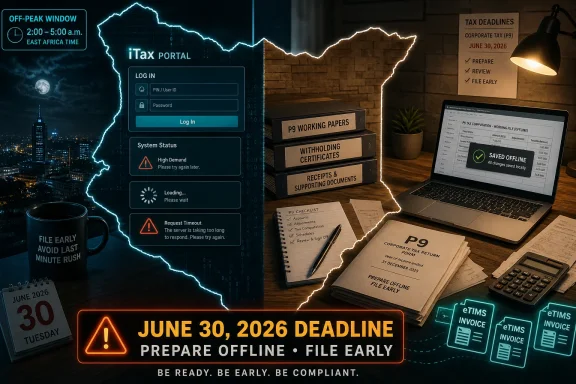 The Deadline Is Fixed, Even If the Portal Feels Fragile
KRA’s annual income tax return season has always had a predictable cliff edge: returns for the 2025 year of income must be filed by June 30, 2026. That date applies to active PIN holders with income tax obligations, including people filing nil returns. It is the kind of deadline that looks manageable in January and suddenly becomes a national technology event in the final week of June.This year, the familiar last-minute rush is colliding with a more consequential change. KRA is not merely asking taxpayers to submit numbers through iTax; it is tightening the connection between declared income, claimed expenses, and invoice data captured through eTIMS or TIMS. That turns filing from a formality into a data-reconciliation exercise.
The result is a filing season where a taxpayer may have all the ordinary documents — P9 forms, withholding certificates, bank records, receipts — and still find the process blocked by portal congestion or validation rules. A tax system that used to tolerate a degree of manual cleanup is becoming a system that wants machine-readable proof at the point of submission.
That is the central tension. KRA is right to modernize tax administration, but modernization changes the failure mode. When paper systems fail, queues get longer. When digital tax systems fail, the deadline remains visible while the door to compliance intermittently disappears.
iTax Is Carrying More Than a Login Screen
The public tends to experience iTax as a website: enter a PIN, type a password, download a form, upload a return, pray the session survives. But for KRA, the platform is an enforcement and revenue backbone. It handles income tax, VAT, PAYE, ledgers, assessments, refunds, certificates, and compliance status.That breadth matters because traffic is not only coming from salaried workers filing nil or employment returns. It is also coming from businesses reconciling VAT positions, companies filing income tax returns, tax agents handling multiple clients, and taxpayers trying to resolve ledger anomalies before submission. In the final days before June 30, those users are not casually browsing. They are repeatedly logging in, refreshing, uploading files, downloading acknowledgements, and retrying failed sessions.
The most visible complaints — network errors, failed logins, ledger access problems — are symptoms of a wider load problem. Even a well-designed portal can struggle when millions of users compress a six-month filing window into a few frantic days. The more complex the return, the greater the burden on the backend.
That is why advice to “try again later” feels inadequate but is still technically meaningful. A user filing a basic nil return may only need a few successful screens. A business uploading supporting schedules may need a stable session long enough to complete a workflow that cannot easily be resumed midway. In a congested system, the difference between those two experiences is enormous.
The eTIMS Transition Turns Filing Into Evidence Management
The biggest substantive change in this filing cycle is not the downtime. It is the way eTIMS has moved from an invoicing tool into the heart of income tax validation. KRA’s direction of travel is clear: expenses claimed for tax purposes should increasingly be supported by electronic tax invoices tied to taxpayer records.For the 2025 year of income, however, KRA has created a temporary landing zone. Taxpayers may claim valid business expenses that are not supported by eTIMS or TIMS invoices, provided those expenses were genuinely incurred in producing taxable income and are captured through the appropriate return fields or schedules. That is not a waiver from proof. It is a transitional method for declaring expenses that the electronic system does not yet fully see.
This distinction is critical for small and medium-sized enterprises. Many Kenyan businesses still buy from informal suppliers, pay through mobile money or bank transfer, and retain traditional receipts rather than fully compliant electronic invoices. For them, a hard eTIMS-only rule in the 2025 return could have disallowed real costs simply because the supply chain had not digitized fast enough.
The temporary allowance reduces that immediate shock. But it also gives KRA a richer target for future audit work. A taxpayer who enters non-eTIMS expenses is effectively telling the authority: these costs are real, but the electronic invoice trail is incomplete. That may be acceptable today, but it also creates a file KRA can revisit.
Relief Is Not Amnesty, and That Is Where Some Filers May Stumble
The word “relief” can be misleading. KRA’s temporary treatment of non-eTIMS expenses does not mean taxpayers can invent costs, upload rough estimates, or treat manual receipts as immune from scrutiny. The old tax principle still applies: expenses must be wholly and exclusively incurred in the production of income.That means a business should be able to explain the supplier, the date, the purpose of the expense, the amount paid, and how the payment relates to taxable income. A traditional receipt is stronger when matched with a bank transfer, delivery note, contract, inventory record, or mobile money confirmation. A spreadsheet entry with no documentary trail is weaker, even if the portal accepts it.
There is also a timing issue. The 2025 return is being filed in 2026, and many taxpayers are now reconstructing records after the fact. That is always dangerous. Memory fades, suppliers vanish, phone numbers change, and paper receipts disappear exactly when an audit letter arrives.
The smarter way to use the 2025 transition is not to treat it as a loophole. It is to treat it as a warning shot. KRA is showing taxpayers what the future looks like while giving them one cycle to clean up supplier discipline, invoicing habits, and bookkeeping systems.
Filing Before June 30 Now Requires a Different Kind of Preparation
The practical strategy for taxpayers is to reduce the amount of work done while logged into iTax. In a stable portal, it is tempting to calculate, cross-check, and edit online. In a congested portal, that is how sessions expire and partial work disappears.Individuals should gather P9 forms, insurance relief documents where applicable, mortgage interest certificates if relevant, withholding certificates, and any other income records before opening the portal. Anyone filing nil should still confirm that their PIN obligations are active and that they are selecting the correct return period. A nil return is simple until a taxpayer discovers a forgotten obligation or a mismatch at the last minute.
Businesses need a more disciplined routine. They should separate eTIMS-supported expenses from non-eTIMS expenses before logging in. They should reconcile bank statements against invoices, identify supplier PINs where available, and prepare any required templates offline. If a return depends on an Excel macro file, the file should be completed, validated, and saved locally before upload.
Tax agents face a special risk because they are often handling dozens or hundreds of returns under the same deadline pressure. A failed upload is irritating for one taxpayer. Multiplied across a client book, it becomes an operational crisis. Agents should prioritize clients with tax payable, complex business expenses, or known ledger issues rather than leaving all returns to the same final-night queue.
Off-Peak Filing Is Not a Hack; It Is Load Management
The advice to file between roughly 2:00 a.m. and 5:00 a.m. East African Time sounds like folklore, but it reflects a basic truth of shared systems. If most users try to access a service during business hours and early evening, the quietest hours will usually produce better results. The portal may still fail, but the odds improve.That is not a satisfying answer for taxpayers who reasonably expect a public service to operate during normal hours. Yet in the final days before a statutory deadline, practical compliance often beats principled frustration. If the system is unstable, a prepared taxpayer who files at an ugly hour has a better chance than an unprepared taxpayer who waits for the perfect moment.
The same logic applies to screenshots and acknowledgements. Taxpayers should keep evidence of successful submission, payment slips, and any material error messages encountered during repeated attempts. Screenshots do not automatically cancel penalties, but they help reconstruct the timeline if a dispute arises.
KRA’s customer care channels and Huduma Centre support can also help, but they should not be treated as magic backdoors. In peak season, support channels become congested too. A taxpayer who arrives with a specific error, return period, PIN details, and prepared documents is more likely to get useful help than one asking a general “the portal is not working” question hours before midnight.
Penalties Make Waiting an Expensive Form of Optimism
Kenya’s late filing penalties are not symbolic. For individual annual income tax returns, the penalty is commonly framed as KES 2,000 or a percentage of tax due, depending on the applicable rule and taxpayer circumstances. For companies, the exposure is much larger: KES 20,000 or 5 percent of the tax due, whichever is higher. Late payment interest can also accrue at 1 percent per month on unpaid tax.The practical lesson is that filing and payment should be separated in the taxpayer’s mind. Filing late creates one type of exposure. Paying late creates another. A taxpayer who cannot immediately clear the full liability may still reduce risk by filing the return on time and then dealing with payment obligations, payment plans, or disputes through the proper channels.
This is especially important for taxpayers tempted to delay because they are missing one document. In some cases, the better course may be to file the best supportable return on time and correct it later through amendment or engagement with KRA, rather than miss the statutory deadline entirely. That is not a substitute for professional advice, but it reflects the hierarchy of risk: silence is often worse than an imperfect but honest filing.
Businesses claiming non-eTIMS expenses should be particularly cautious. A return that reduces taxable income through poorly documented expenses may attract future audit attention. But failing to file because the documentation is messy creates immediate penalty risk. The uncomfortable middle ground is to file with care, preserve every record, and be ready to defend the claim.
Kenya Is Repeating a Global Pattern With Local Stakes
Kenya’s iTax crunch is not unique. Every government that digitizes tax compliance eventually discovers that digital systems create their own bottlenecks. The United Kingdom’s Making Tax Digital program forced businesses to rethink bookkeeping software. Australia’s Single Touch Payroll changed how employers report wage data. Nigeria and Uganda have both seen peak-period pressure on tax portals as filing obligations moved online.The common pattern is that tax authorities gain visibility and speed, while taxpayers absorb new compliance complexity. Governments like digital systems because they reduce leakage, improve audit targeting, and shrink the space for informal reporting. Taxpayers often experience the same reform as another password, another template, another validation rule, and another way for a legitimate return to fail.
Kenya’s case is sharper because eTIMS reaches deep into everyday business practice. It does not merely ask a company to submit an annual number. It pushes invoice discipline down the supply chain, including to small suppliers who may not have the tools, incentives, or literacy to comply smoothly.
That is where policy ambition meets economic reality. A large company can insist on compliant invoices from suppliers. A small trader buying from informal vendors may not have that leverage. If the tax system ignores that asymmetry, it risks punishing formalizing businesses for the informality around them.
The Infrastructure Question Is Now a Compliance Question
Public-sector technology is often discussed as if uptime were a convenience metric. In tax administration, uptime is a legal access issue. If the state requires digital filing by a fixed date, then access to the digital filing channel becomes part of the compliance environment.That does not mean every outage should automatically extend every deadline. Tax deadlines need certainty, and governments cannot run revenue systems on open-ended exceptions. But it does mean tax authorities should be judged not only by whether they digitize services, but by whether those services scale during the very periods when the law requires people to use them.
A credible digital tax system needs redundancy, transparent incident communication, realistic load testing, and clear escalation paths. It also needs plain-language guidance when validation rules change. The taxpayer should not have to infer from a rejected return which invoice rule, template field, or ledger mismatch caused the failure.
KRA’s deployment of additional infrastructure and scheduled maintenance may improve capacity, but capacity upgrades alone cannot solve deadline psychology. If millions of users believe the safest time to file is the final week, the system will continue to face annual stampedes. The long-term fix is partly technical and partly behavioral: earlier filing incentives, better reminders, smoother pre-filled data, and confidence that the portal will work when used.
The Real Reform Is Happening in the Back Office
For taxpayers, the visible reform is eTIMS. For KRA, the more powerful reform is data matching. Once income, expenses, invoices, withholding records, VAT filings, and payment ledgers can be compared automatically, the authority no longer needs to audit blindly. It can identify mismatches at scale.That changes the taxpayer’s risk profile. In the older world, a weak expense record might only matter if a human auditor selected the file. In the newer world, mismatches can be flagged algorithmically before or soon after submission. Compliance becomes continuous rather than episodic.
This is why the 2025 year of income is such an important transition point. It is not just the year taxpayers learned a new field in a return. It is the year KRA signaled that the return is becoming an interface to a larger evidence system. The form is no longer the whole story; it is the taxpayer’s version of events compared against machine-held records.
That development will reward businesses that keep clean books and punish those that treat tax filing as an annual scramble. It may also expose KRA to criticism if its own data is incomplete or inaccurate. Automated validation is only as fair as the records behind it.
The June 30 Survival Plan Is Really a 2027 Compliance Plan
The immediate priority is getting the 2025 return filed before midnight on June 30. But the more strategic priority is avoiding the same panic next year, when tolerance for non-eTIMS documentation is likely to narrow. This filing season should be treated as a rehearsal for stricter enforcement.Taxpayers who wait until the portal is congested are not only fighting KRA’s servers. They are fighting their own recordkeeping habits. The businesses that will suffer most under full eTIMS discipline are not necessarily the most dishonest; they are the least organized.
The practical lessons are concrete:
- Taxpayers should prepare all documents offline before logging into iTax, because portal instability makes online calculation and last-minute editing risky.
- Businesses should separate eTIMS-supported expenses from valid non-eTIMS expenses and preserve manual proof for future audits.
- Filing during off-peak hours may improve the odds of completing submission before the June 30 deadline.
- Late filing penalties and late payment interest are separate risks, so taxpayers should not miss the filing deadline simply because payment or documentation is difficult.
- The 2025 non-eTIMS allowance should be treated as a transition rule, not a permanent escape route from electronic invoicing.
- Businesses should use the next year to bring suppliers, bookkeeping tools, and internal approval processes into line with eTIMS expectations.
References
- Primary source: streamlinefeed.co.ke
Published: 2026-06-29T12:40:36.637478
Loading…
streamlinefeed.co.ke - Related coverage: openaccountants.com

Individual Tax Return — Kenya Tax Deadline June 30, 2026 | OpenAccountants
Kenya Revenue Authority individual income tax return deadline.
www.openaccountants.com
- Related coverage: kra.go.ke

File Returns - KRA
File your annual Income Tax Return for the 2025 year of income. Learn who needs to file, how to file on iTax, key filing considerations, validation of income and expenses, and where to get support.
www.kra.go.ke
- Related coverage: muteaassociatescpas.co.ke
KRA Tax Returns Deadline June 30, 2026, What You Need to Know - Mutea & Associates Certified Public Accountants
Whether you are in Meru, Isiolo, Tharaka Nithi, Embu, or Kirinyaga, the KRA tax returns deadline of 30th June 2026 applies to every Kenyan taxpayer with a KRA PIN, no exceptions. Whether you are an employee, self-employed trader, business owner, or landlord, you have until midnight on June 30th...www.muteaassociatescpas.co.ke - Related coverage: standardmedia.co.ke
KRA rules out extension of June 30 deadline to file tax returns - The Standard
Kenya Revenue Authority says there will be no extension to file tax returns after the June 30 deadline, warns dafaulters of penaltie www.standardmedia.co.ke
- Related coverage: theonlinekenyan.com
Tax Penalties and Charges in Kenya | How-To Guides - The Online Kenyan
Guide to common KRA penalties, late filing charges, late payment interest, and how to avoid tax compliance problems in Kenya.www.theonlinekenyan.com