

Meta is putting reclaimed DDR4 from retired servers back into production through a custom CXL ASIC called Vistara, a system it says is already running across millions of machines and cutting required server counts by up to 25 percent for some disaggregated inference workloads. That is the sort of claim that sounds like a clever infrastructure footnote until you realize what it really says: hyperscale AI is now expensive enough that the world’s richest platforms are mining their own server graveyards for usable memory. The breakthrough is not merely that Meta reused old DIMMs. It is that the company appears to have made memory reuse operationally boring at a scale where “boring” is the highest compliment engineering can earn.
The industry has spent the last two years talking as if AI infrastructure were mainly a GPU story. Meta’s Vistara paper is a reminder that the less glamorous bottleneck may be the one sitting next to the accelerator: memory capacity, memory bandwidth, memory placement, memory power, and memory lifecycle. If the report holds up under wider scrutiny after its ISCA 2026 presentation, Vistara is not just a data center trick. It is an argument that the next phase of hyperscale computing will be won by companies that treat memory as a fleet-level resource rather than a motherboard accessory.
The useful absurdity of Vistara begins with a mismatch in aging curves. Meta’s servers may age out of primary service after three to five years, but the DDR4 memory inside them can remain useful for seven to ten years. In a normal enterprise, that gap becomes an asset-disposal problem. At Meta’s scale, it becomes a balance-sheet opportunity measured in millions of servers.
The Register’s account of Meta’s paper says about 40 percent of the company’s fleet cannot be upgraded with more memory. That is not a niche corner case; it is a structural constraint across a vast installed base. The result is a familiar hyperscale headache: CPUs and platforms that still have computational value can be stranded because their memory ceiling no longer fits modern workloads.
Vistara attacks the problem by separating “old memory” from “old server.” Meta removes DDR4 DIMMs from retired systems and installs them into new machines that otherwise use DDR5. A custom Compute Express Link ASIC bridges that memory into the host system so it can be consumed as additional capacity.
That sounds tidy only if you ignore the hard part. Mixing DDR4 and DDR5 is not like adding a second hard drive. The latency and bandwidth characteristics differ, the processor’s direct-attached memory remains the preferred path, and operating systems have to understand that not all addressable memory is created equal. The engineering challenge is to expose extra capacity without turning every workload into a performance autopsy.
Meta’s answer is not to pretend the old memory is the same as the new memory. It presents the CXL-attached DDR4 as a separate, CPU-less NUMA node, letting the software stack treat it as a lower-tier pool. That distinction is central. Vistara works because it makes heterogeneous memory visible enough to be managed, but integrated enough to be useful.
In practice, “in theory” has done a lot of work. Memory pooling is easy to describe on a conference slide and difficult to run under production load. The moment memory leaves the familiar local DRAM path, every system architect starts asking the same questions: How much latency? How much bandwidth? How much kernel complexity? How much power? What happens when the fancy shared tier becomes the slow tier that everyone blames?
That is why Meta’s Vistara disclosure matters. The company is not describing a lab demo or an appliance vendor’s reference board. It is describing a CXL deployment across hyperscale infrastructure, covering machine-learning inference, big data processing, databases, caches, and CI/CD build systems. That breadth is the news.
The system uses CXL 2.0/1.1 over PCIe Gen5 x16, with each Vistara ASIC integrating two independent 72-bit DDR4 channels. Meta says the chips support up to 3,200 MT/s and up to 256 GB per chip using 64 GB DIMMs. A pair of custom RISC-V processors drives the ASIC.
There is a quiet strategic message in that silicon choice. Meta did not merely buy a generic CXL expander, bolt it into a rack, and declare victory. According to the paper as reported, the company found off-the-shelf products wanting: many bundled DRAM with the controller, lacked DDR4 support, consumed too much power, or cost too much. In other words, the commercial CXL ecosystem did not solve Meta’s problem because Meta’s problem was not “add memory.” It was “reuse this specific memory at this specific scale with this specific operational model.”
That is the sort of problem hyperscalers increasingly solve with custom silicon. Not because every chip must be exotic, but because small efficiency deltas become enormous when multiplied across a planet-sized fleet.
Each MemServer reportedly combines 768 GB of DDR5 with 256 GB of DDR4 attached through Vistara. The old memory does not replace local memory; it absorbs overflow and headroom demand. Meta’s platforms use local memory first and turn to the CXL-attached tier when needed.
That hierarchy matters because most workloads do not need every byte of memory to behave like the hottest cache line. Plenty of enterprise and hyperscale jobs need large address spaces, burst capacity, or protection against out-of-memory crashes more than they need uniform nanosecond perfection. In those cases, the difference between “slower memory” and “no memory” is not subtle. It is the difference between a completed job and a failed pipeline.
Meta’s reported 33 percent reduction in job failures and associated restart overhead for certain big data environments gets at the real payoff. Out-of-memory failures are not merely annoying log entries. They waste CPU time, fragment cluster resources, delay analytics, and force schedulers to rerun work that may already have consumed substantial power and wall-clock time.
This is where Vistara becomes more than a clever reuse project. A memory expansion tier can convert hard failures into softer performance tradeoffs. It gives the scheduler and runtime another place to go before the job dies.
That is also why the OS presentation matters. By exposing CXL DDR4 as a distinct NUMA node, Meta avoids the fiction of a flat memory universe. Software can make placement choices, and administrators can reason about the system. The worst version of CXL would hide too much and leave operators chasing mysterious latency regressions. The better version tells the truth: this is memory, but it is not the same memory.
The phrase disaggregated inference deserves attention. Modern recommendation systems, the kind that power feeds, ads, ranking, and personalization, often depend on enormous embedding tables. These tables can be memory-hungry in ways that do not map cleanly to traditional CPU sizing. You may have enough compute but not enough memory capacity in the right place.
That imbalance is precisely where old DDR4 can become valuable. It does not need to be the fastest memory in the building to be useful. It needs to be fast enough, predictable enough, and integrated enough to let the system run fewer machines without making latency budgets collapse.
This should sound familiar to anyone who has watched storage tiers evolve. Enterprises learned long ago that not every bit belongs on the fastest media. The trick is not to make cheap storage pretend to be expensive storage; it is to build software that knows which data belongs where. Vistara suggests hyperscale memory is entering a similar tiered era.
The AI boom sharpens the incentive. High-bandwidth memory gets the headlines because it sits beside GPUs, but general-purpose DRAM is also under pressure. AI servers, recommendation systems, vector databases, analytics clusters, and cache-heavy services all compete for capacity. If new DRAM is expensive and old DRAM is sitting in retired hosts, a company like Meta is almost compelled to find a way to bridge the gap.
That is what makes the “saves bucks” framing both right and incomplete. Yes, this is about cost. But at hyperscale, cost is architecture. If the memory market becomes a constraint on AI deployment, memory reclamation becomes a product strategy.
Against that backdrop, Vistara reads like a form of supply-chain self-defense. Meta can reduce exposure to new DRAM pricing by extending the useful life of DDR4 already paid for in previous server generations. The company still needs new hardware, new ASICs, new chassis design, and software integration, but it can extract value from a component that would otherwise be warehoused, resold, or scrapped.
There is also an environmental story here, though it should not be overstated. Reusing working memory is plainly better than treating it as waste. But data centers do not become green because a hyperscaler moves DIMMs from one server generation to another. The more grounded claim is that extending component life can reduce embodied waste and reduce the need for some new machines in specific workloads.
That distinction matters because big tech loves sustainability narratives that double as margin improvement. Vistara is likely both. The elegant part is that the incentives align: if reclaimed memory cuts server counts, saves money, and reduces waste, the project does not need moral purity to be valuable.
For IT buyers outside Meta, the broader lesson is uncomfortable. Hyperscalers can increasingly arbitrage their own hardware lifecycle in ways normal enterprises cannot. They have enough retired servers to make reclaimed memory a platform. They have enough software control to adjust kernels and schedulers. They have enough workload volume to justify custom ASICs.
The enterprise version of this may eventually arrive through commercial CXL products, but it will not look like Meta’s internal design. Most organizations will not be ripping DIMMs out of retired fleets and wiring them into custom rear-access cards. They will buy supported memory expansion appliances, composable infrastructure platforms, or cloud instances shaped by the hyperscalers’ own lessons.
Linux is the substrate that makes much of modern hyperscale infrastructure possible, and CXL’s success depends heavily on the kernel growing the right abstractions for heterogeneous memory. Detection is not enough. The OS needs to represent topology, expose performance characteristics, support NUMA behavior, and give user space or orchestration layers enough information to make rational placement decisions.
This is where WindowsForum readers should pay attention, even though Meta’s implementation is Linux-first. The big shifts in data center architecture rarely stay confined to one operating system. When hyperscalers normalize memory tiering and CXL-attached capacity, server OS vendors, hypervisor teams, cloud platforms, and hardware OEMs all have to respond.
Microsoft has its own incentives here. Azure runs enormous fleets with heterogeneous hardware, AI acceleration, and memory-intensive services. Windows Server shops may not see Vistara-like systems in the near term, but the underlying pressure — memory as a composable resource — will shape the servers they buy and the cloud SKUs they rent.
The question for Windows environments is not whether a sysadmin will soon plug reclaimed DDR4 into a CXL card and hand-tune NUMA placement. The question is how quickly the abstraction moves up the stack. Today it is a hyperscale Linux project. Tomorrow it may influence Hyper-V hosts, Azure instance families, SQL Server memory behavior, or vendor appliances marketed as “AI-ready” infrastructure.
That transition will not be frictionless. Windows has NUMA awareness and enterprise memory management, but production-grade tiered memory requires application behavior, driver maturity, firmware correctness, monitoring, and support contracts to align. Vistara shows the destination. It does not make the path easy for everyone else.
Vistara is different in tone because it is not a glamorous accelerator. It is an enabler for reused memory. That makes it arguably more interesting. The chip exists because the ordinary server market did not solve a fleet-wide lifecycle problem efficiently enough.
The vendor ecosystem should read that as both validation and warning. CXL is real enough for Meta to bet production infrastructure on it, but the company still concluded that available products were not aligned with its needs. Commercial CXL vendors can point to Vistara as proof that demand exists. They cannot assume hyperscalers will buy generic parts when custom designs can save enough money to justify themselves.
This has consequences for standardization. CXL provides the common language, but the most valuable deployments may be deeply customized. Standards make the ecosystem possible; hyperscale economics decide which implementations survive.
There is a parallel with networking. Ethernet is a standard, but hyperscale data center networks are not built like office LANs. They use standard protocols, merchant silicon where appropriate, custom hardware where necessary, and software-defined control planes everywhere. CXL memory may follow the same path: standardized enough to avoid total fragmentation, customized enough that the best deployments are invisible to ordinary buyers.
That is good news for innovation and mixed news for market access. The benefits may reach enterprises indirectly through cheaper cloud services or more capable server platforms. But the first and largest gains will accrue to companies that can afford to design around their own fleet telemetry.
That distinction is essential because CXL hype can drift into fantasy. There is no universal pool of memory that every workload can dip into without consequence. Databases, caches, inference systems, analytics jobs, and build systems all have different sensitivity to latency, bandwidth, locality, and failure modes. Some will thrive with expanded headroom. Some will punish every remote access.
Meta’s advantage is that it can classify workloads at scale. It knows where memory pressure causes failures, where extra capacity prevents retries, and where slower memory is acceptable. That lets the company deploy CXL memory as a targeted tier rather than a universal replacement.
This is the kind of nuance that gets lost when infrastructure ideas become product categories. “CXL memory expansion” is not one thing. It can mean direct-attached expansion, pooled memory, switched fabrics, persistent memory, accelerator coherence, or tiered capacity. The use case determines whether the result is brilliant or disappointing.
The most credible part of the Vistara story is that Meta did not claim the technology solves everything. The paper, as reported, names concrete workloads: disaggregated ML inference, big data processing, databases, distributed caches, and CI/CD build systems. That is a broad set, but not an infinite one. It suggests a carefully engineered deployment, not a magic memory fabric sprinkled across the fleet.
For enterprises, the lesson is to distrust any CXL pitch that starts with architecture and ends before workload analysis. The buying question is not “Does it support CXL?” It is “Which memory accesses move, who controls placement, what happens under pressure, and how do we prove the application still meets its service-level objectives?”
Composable infrastructure promised to break that model, often with more marketing ambition than operational success. CXL gives the idea a more credible hardware foundation, especially for memory. It does not eliminate physical constraints, but it makes them more negotiable.
Meta’s reuse angle adds a sharper point: composition is not only about flexibility, it is about scarcity management. When memory is expensive and workloads are uneven, the ability to pool or tier capacity becomes a hedge against waste. The old sin was underutilization. The new sin is leaving usable components trapped in the wrong chassis.
This will matter more as AI workloads diversify. Training clusters, inference fleets, recommendation engines, retrieval systems, analytics jobs, and software build farms all stress infrastructure differently. A single fixed server ratio cannot be optimal for all of them. Hyperscalers know this, which is why they keep disaggregating the data center piece by piece.
The challenge is operational complexity. Every layer of composition introduces a new failure domain and a new debugging surface. Memory used to be local enough that failure was at least conceptually contained. CXL memory tiers force operators to think about links, devices, firmware, NUMA policy, thermal behavior, and kernel support as part of the memory story.
Meta’s MemServer design underscores that physical reality. The Vistara cards sit in dedicated rear-accessible slots, and the chassis uses directed airflow with high-capacity fans to manage thermal load. Even when memory becomes more composable, it remains stubbornly material. Someone still has to cool the DIMMs.
If hyperscalers can reduce the number of machines needed for certain inference workloads, that can influence capacity planning, service margins, and eventually pricing pressure. The effect may be indirect and uneven; no cloud provider automatically hands savings to customers. But infrastructure efficiencies shape what services become cheap enough to offer broadly.
There is also a software architecture lesson for Windows-heavy enterprises building AI systems. Memory sizing is not a footnote. Retrieval-augmented generation, recommendation models, feature stores, analytics pipelines, build systems, and cache layers can all become memory-constrained before they become CPU-constrained. Treating memory as a first-class design axis is no longer optional.
On-prem Windows Server environments should watch the OEM ecosystem. As CXL support matures, server vendors will likely package memory expansion and pooling in ways that do not require hyperscale-level engineering teams. The early products may target databases, virtualization hosts, analytics appliances, and AI inference nodes.
The management tools will matter as much as the hardware. Administrators will need visibility into which workloads are using which memory tier, how latency changes under pressure, and whether an apparent capacity win is hiding an application-level regression. If monitoring treats all memory as equal, tiered memory will become a troubleshooting trap.
Security will also require scrutiny. CXL introduces new device classes, firmware paths, and memory-sharing possibilities. Standards include mechanisms for integrity and security, but implementation details decide real-world risk. Any technology that makes memory more shareable also expands the importance of isolation, attestation, and patch discipline.
Meta can decide that reclaimed DDR4 is worth a custom ASIC because it has enough DIMMs, enough servers, enough workloads, and enough engineering capacity. It can modify Linux drivers, tune placement policies, design chassis airflow, and validate behavior across production services. That is not the procurement reality of a hospital, a school district, a regional bank, or even many large manufacturers.
This does not mean the technology will remain inaccessible. Hyperscaler inventions often become generalized later. The cloud itself is the commercial packaging of internal infrastructure lessons. Kubernetes, warehouse-scale scheduling, distributed tracing, and software-defined networking all traveled from elite engineering environments into broader use, though rarely in their original form.
The commercial CXL ecosystem now has a stronger story to tell. If Meta can justify custom hardware to reuse DDR4, OEMs and silicon vendors can justify products that bring similar economics to less specialized buyers. But those products must avoid selling the dream without the control plane. Memory expansion without workload-aware management is just another expensive way to move a bottleneck.
There is also a competitive angle inside the AI platform wars. The companies that can stretch infrastructure further can deploy more models, serve more users, and absorb more experimentation before hitting capital constraints. AI economics are not only about who has the best model. They are about who can serve that model profitably at scale.
In that sense, Vistara is a small window into Meta’s real AI strategy. Llama models and consumer AI features get public attention. Fleet-level memory reuse is the machinery that determines how much of that ambition can be delivered without setting money on fire.
The industry has spent the last two years talking as if AI infrastructure were mainly a GPU story. Meta’s Vistara paper is a reminder that the less glamorous bottleneck may be the one sitting next to the accelerator: memory capacity, memory bandwidth, memory placement, memory power, and memory lifecycle. If the report holds up under wider scrutiny after its ISCA 2026 presentation, Vistara is not just a data center trick. It is an argument that the next phase of hyperscale computing will be won by companies that treat memory as a fleet-level resource rather than a motherboard accessory.
 Meta Turns the Server Junk Drawer Into an AI Budget Line
The useful absurdity of Vistara begins with a mismatch in aging curves. Meta’s servers may age out of primary service after three to five years, but the DDR4 memory inside them can remain useful for seven to ten years. In a normal enterprise, that gap becomes an asset-disposal problem. At Meta’s scale, it becomes a balance-sheet opportunity measured in millions of servers.The Register’s account of Meta’s paper says about 40 percent of the company’s fleet cannot be upgraded with more memory. That is not a niche corner case; it is a structural constraint across a vast installed base. The result is a familiar hyperscale headache: CPUs and platforms that still have computational value can be stranded because their memory ceiling no longer fits modern workloads.
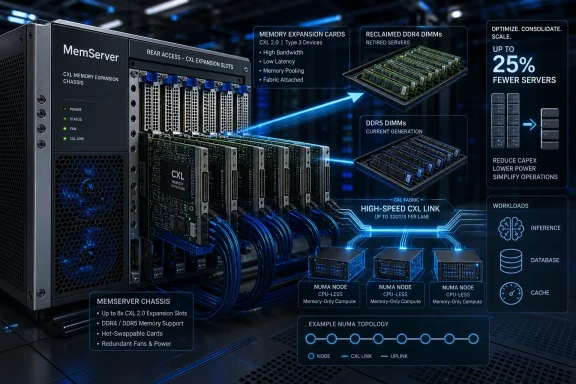
Vistara attacks the problem by separating “old memory” from “old server.” Meta removes DDR4 DIMMs from retired systems and installs them into new machines that otherwise use DDR5. A custom Compute Express Link ASIC bridges that memory into the host system so it can be consumed as additional capacity.
That sounds tidy only if you ignore the hard part. Mixing DDR4 and DDR5 is not like adding a second hard drive. The latency and bandwidth characteristics differ, the processor’s direct-attached memory remains the preferred path, and operating systems have to understand that not all addressable memory is created equal. The engineering challenge is to expose extra capacity without turning every workload into a performance autopsy.
Meta’s answer is not to pretend the old memory is the same as the new memory. It presents the CXL-attached DDR4 as a separate, CPU-less NUMA node, letting the software stack treat it as a lower-tier pool. That distinction is central. Vistara works because it makes heterogeneous memory visible enough to be managed, but integrated enough to be useful.
CXL Finally Gets a Hyperscale Proof Point
CXL has long carried the smell of inevitability. The standard promises coherent, high-speed links between CPUs, memory expanders, accelerators, and other devices over PCIe-derived plumbing. In theory, it lets data centers break the old rule that memory must be permanently soldered, slotted, and stranded inside a single host.In practice, “in theory” has done a lot of work. Memory pooling is easy to describe on a conference slide and difficult to run under production load. The moment memory leaves the familiar local DRAM path, every system architect starts asking the same questions: How much latency? How much bandwidth? How much kernel complexity? How much power? What happens when the fancy shared tier becomes the slow tier that everyone blames?
That is why Meta’s Vistara disclosure matters. The company is not describing a lab demo or an appliance vendor’s reference board. It is describing a CXL deployment across hyperscale infrastructure, covering machine-learning inference, big data processing, databases, caches, and CI/CD build systems. That breadth is the news.
The system uses CXL 2.0/1.1 over PCIe Gen5 x16, with each Vistara ASIC integrating two independent 72-bit DDR4 channels. Meta says the chips support up to 3,200 MT/s and up to 256 GB per chip using 64 GB DIMMs. A pair of custom RISC-V processors drives the ASIC.
There is a quiet strategic message in that silicon choice. Meta did not merely buy a generic CXL expander, bolt it into a rack, and declare victory. According to the paper as reported, the company found off-the-shelf products wanting: many bundled DRAM with the controller, lacked DDR4 support, consumed too much power, or cost too much. In other words, the commercial CXL ecosystem did not solve Meta’s problem because Meta’s problem was not “add memory.” It was “reuse this specific memory at this specific scale with this specific operational model.”
That is the sort of problem hyperscalers increasingly solve with custom silicon. Not because every chip must be exotic, but because small efficiency deltas become enormous when multiplied across a planet-sized fleet.
The Real Product Is Not the ASIC, It Is the Memory Policy
The seductive part of Vistara is the hardware: a custom ASIC, CXL links, RISC-V control cores, rear-accessible cards, and dedicated airflow in a chassis Meta calls a MemServer. But the deeper achievement is policy. Vistara is less a memory card than a system for deciding where memory pressure should go.Each MemServer reportedly combines 768 GB of DDR5 with 256 GB of DDR4 attached through Vistara. The old memory does not replace local memory; it absorbs overflow and headroom demand. Meta’s platforms use local memory first and turn to the CXL-attached tier when needed.
That hierarchy matters because most workloads do not need every byte of memory to behave like the hottest cache line. Plenty of enterprise and hyperscale jobs need large address spaces, burst capacity, or protection against out-of-memory crashes more than they need uniform nanosecond perfection. In those cases, the difference between “slower memory” and “no memory” is not subtle. It is the difference between a completed job and a failed pipeline.
Meta’s reported 33 percent reduction in job failures and associated restart overhead for certain big data environments gets at the real payoff. Out-of-memory failures are not merely annoying log entries. They waste CPU time, fragment cluster resources, delay analytics, and force schedulers to rerun work that may already have consumed substantial power and wall-clock time.
This is where Vistara becomes more than a clever reuse project. A memory expansion tier can convert hard failures into softer performance tradeoffs. It gives the scheduler and runtime another place to go before the job dies.
That is also why the OS presentation matters. By exposing CXL DDR4 as a distinct NUMA node, Meta avoids the fiction of a flat memory universe. Software can make placement choices, and administrators can reason about the system. The worst version of CXL would hide too much and leave operators chasing mysterious latency regressions. The better version tells the truth: this is memory, but it is not the same memory.
AI Inference Makes Memory Reuse Look Like Strategy, Not Thrift
The most eye-catching number in the report is Meta’s claim that Vistara can reduce server count by up to 25 percent for disaggregated inference. That is not a rounding error. In a hyperscale environment, a 25 percent reduction in machines for a workload can ripple through capital expenditure, rack space, power distribution, cooling, maintenance, and deployment velocity.The phrase disaggregated inference deserves attention. Modern recommendation systems, the kind that power feeds, ads, ranking, and personalization, often depend on enormous embedding tables. These tables can be memory-hungry in ways that do not map cleanly to traditional CPU sizing. You may have enough compute but not enough memory capacity in the right place.
That imbalance is precisely where old DDR4 can become valuable. It does not need to be the fastest memory in the building to be useful. It needs to be fast enough, predictable enough, and integrated enough to let the system run fewer machines without making latency budgets collapse.
This should sound familiar to anyone who has watched storage tiers evolve. Enterprises learned long ago that not every bit belongs on the fastest media. The trick is not to make cheap storage pretend to be expensive storage; it is to build software that knows which data belongs where. Vistara suggests hyperscale memory is entering a similar tiered era.
The AI boom sharpens the incentive. High-bandwidth memory gets the headlines because it sits beside GPUs, but general-purpose DRAM is also under pressure. AI servers, recommendation systems, vector databases, analytics clusters, and cache-heavy services all compete for capacity. If new DRAM is expensive and old DRAM is sitting in retired hosts, a company like Meta is almost compelled to find a way to bridge the gap.
That is what makes the “saves bucks” framing both right and incomplete. Yes, this is about cost. But at hyperscale, cost is architecture. If the memory market becomes a constraint on AI deployment, memory reclamation becomes a product strategy.
The RAMpocalypse Makes Old DIMMs Politically Useful
Memory pricing has become a recurring industry anxiety because AI demand distorts supply chains far beyond the accelerator card itself. When hyperscalers chase capacity, they do not merely bid up the latest high-end parts. They reshape procurement expectations across the market, from cloud fleets to enterprise refreshes to consumer PCs.Against that backdrop, Vistara reads like a form of supply-chain self-defense. Meta can reduce exposure to new DRAM pricing by extending the useful life of DDR4 already paid for in previous server generations. The company still needs new hardware, new ASICs, new chassis design, and software integration, but it can extract value from a component that would otherwise be warehoused, resold, or scrapped.
There is also an environmental story here, though it should not be overstated. Reusing working memory is plainly better than treating it as waste. But data centers do not become green because a hyperscaler moves DIMMs from one server generation to another. The more grounded claim is that extending component life can reduce embodied waste and reduce the need for some new machines in specific workloads.
That distinction matters because big tech loves sustainability narratives that double as margin improvement. Vistara is likely both. The elegant part is that the incentives align: if reclaimed memory cuts server counts, saves money, and reduces waste, the project does not need moral purity to be valuable.
For IT buyers outside Meta, the broader lesson is uncomfortable. Hyperscalers can increasingly arbitrage their own hardware lifecycle in ways normal enterprises cannot. They have enough retired servers to make reclaimed memory a platform. They have enough software control to adjust kernels and schedulers. They have enough workload volume to justify custom ASICs.
The enterprise version of this may eventually arrive through commercial CXL products, but it will not look like Meta’s internal design. Most organizations will not be ripping DIMMs out of retired fleets and wiring them into custom rear-access cards. They will buy supported memory expansion appliances, composable infrastructure platforms, or cloud instances shaped by the hyperscalers’ own lessons.
Linux Is the Unsung Control Plane
One of the most important details in the report is easy to skip: Meta says the Linux CXL driver code used for Vistara is either already upstream or on its way upstream. That matters because exotic hardware becomes operationally dangerous when it depends on a private kernel fork that only three people understand.Linux is the substrate that makes much of modern hyperscale infrastructure possible, and CXL’s success depends heavily on the kernel growing the right abstractions for heterogeneous memory. Detection is not enough. The OS needs to represent topology, expose performance characteristics, support NUMA behavior, and give user space or orchestration layers enough information to make rational placement decisions.
This is where WindowsForum readers should pay attention, even though Meta’s implementation is Linux-first. The big shifts in data center architecture rarely stay confined to one operating system. When hyperscalers normalize memory tiering and CXL-attached capacity, server OS vendors, hypervisor teams, cloud platforms, and hardware OEMs all have to respond.
Microsoft has its own incentives here. Azure runs enormous fleets with heterogeneous hardware, AI acceleration, and memory-intensive services. Windows Server shops may not see Vistara-like systems in the near term, but the underlying pressure — memory as a composable resource — will shape the servers they buy and the cloud SKUs they rent.
The question for Windows environments is not whether a sysadmin will soon plug reclaimed DDR4 into a CXL card and hand-tune NUMA placement. The question is how quickly the abstraction moves up the stack. Today it is a hyperscale Linux project. Tomorrow it may influence Hyper-V hosts, Azure instance families, SQL Server memory behavior, or vendor appliances marketed as “AI-ready” infrastructure.
That transition will not be frictionless. Windows has NUMA awareness and enterprise memory management, but production-grade tiered memory requires application behavior, driver maturity, firmware correctness, monitoring, and support contracts to align. Vistara shows the destination. It does not make the path easy for everyone else.
Custom Silicon Is Becoming the Hyperscaler’s Procurement Department
The Vistara ASIC is another example of a broader hyperscale pattern: when the market cannot supply the exact economic shape big platforms need, they build the missing part themselves. Google did it with TPUs. Amazon did it with Graviton, Trainium, Nitro, and other infrastructure silicon. Microsoft has moved deeper into custom chips for AI and cloud workloads. Meta has pursued its own AI and infrastructure silicon efforts.Vistara is different in tone because it is not a glamorous accelerator. It is an enabler for reused memory. That makes it arguably more interesting. The chip exists because the ordinary server market did not solve a fleet-wide lifecycle problem efficiently enough.
The vendor ecosystem should read that as both validation and warning. CXL is real enough for Meta to bet production infrastructure on it, but the company still concluded that available products were not aligned with its needs. Commercial CXL vendors can point to Vistara as proof that demand exists. They cannot assume hyperscalers will buy generic parts when custom designs can save enough money to justify themselves.
This has consequences for standardization. CXL provides the common language, but the most valuable deployments may be deeply customized. Standards make the ecosystem possible; hyperscale economics decide which implementations survive.
There is a parallel with networking. Ethernet is a standard, but hyperscale data center networks are not built like office LANs. They use standard protocols, merchant silicon where appropriate, custom hardware where necessary, and software-defined control planes everywhere. CXL memory may follow the same path: standardized enough to avoid total fragmentation, customized enough that the best deployments are invisible to ordinary buyers.
That is good news for innovation and mixed news for market access. The benefits may reach enterprises indirectly through cheaper cloud services or more capable server platforms. But the first and largest gains will accrue to companies that can afford to design around their own fleet telemetry.
Latency Did Not Disappear; Meta Made It Accountable
The Register’s summary says Meta is sharing memory without encountering latency problems. That should be read carefully. CXL-attached DDR4 is not magically the same as local DDR5. Physics, topology, and protocol overhead still exist. The claim is better understood as: Meta found workloads and policies where the added latency does not break the economics.That distinction is essential because CXL hype can drift into fantasy. There is no universal pool of memory that every workload can dip into without consequence. Databases, caches, inference systems, analytics jobs, and build systems all have different sensitivity to latency, bandwidth, locality, and failure modes. Some will thrive with expanded headroom. Some will punish every remote access.
Meta’s advantage is that it can classify workloads at scale. It knows where memory pressure causes failures, where extra capacity prevents retries, and where slower memory is acceptable. That lets the company deploy CXL memory as a targeted tier rather than a universal replacement.
This is the kind of nuance that gets lost when infrastructure ideas become product categories. “CXL memory expansion” is not one thing. It can mean direct-attached expansion, pooled memory, switched fabrics, persistent memory, accelerator coherence, or tiered capacity. The use case determines whether the result is brilliant or disappointing.
The most credible part of the Vistara story is that Meta did not claim the technology solves everything. The paper, as reported, names concrete workloads: disaggregated ML inference, big data processing, databases, distributed caches, and CI/CD build systems. That is a broad set, but not an infinite one. It suggests a carefully engineered deployment, not a magic memory fabric sprinkled across the fleet.
For enterprises, the lesson is to distrust any CXL pitch that starts with architecture and ends before workload analysis. The buying question is not “Does it support CXL?” It is “Which memory accesses move, who controls placement, what happens under pressure, and how do we prove the application still meets its service-level objectives?”
The Data Center Is Learning to Compose Around Scarcity
Vistara fits into a larger shift away from fixed server identity. For decades, a server was a bundle: CPU, memory, storage, network, accelerators, power, thermals, and firmware in one box. Virtualization softened that identity at the software layer, but the hardware ratios remained stubborn. If a workload needed more memory but not more CPU, the usual answer was still to buy a bigger server or more servers.Composable infrastructure promised to break that model, often with more marketing ambition than operational success. CXL gives the idea a more credible hardware foundation, especially for memory. It does not eliminate physical constraints, but it makes them more negotiable.
Meta’s reuse angle adds a sharper point: composition is not only about flexibility, it is about scarcity management. When memory is expensive and workloads are uneven, the ability to pool or tier capacity becomes a hedge against waste. The old sin was underutilization. The new sin is leaving usable components trapped in the wrong chassis.
This will matter more as AI workloads diversify. Training clusters, inference fleets, recommendation engines, retrieval systems, analytics jobs, and software build farms all stress infrastructure differently. A single fixed server ratio cannot be optimal for all of them. Hyperscalers know this, which is why they keep disaggregating the data center piece by piece.
The challenge is operational complexity. Every layer of composition introduces a new failure domain and a new debugging surface. Memory used to be local enough that failure was at least conceptually contained. CXL memory tiers force operators to think about links, devices, firmware, NUMA policy, thermal behavior, and kernel support as part of the memory story.
Meta’s MemServer design underscores that physical reality. The Vistara cards sit in dedicated rear-accessible slots, and the chassis uses directed airflow with high-capacity fans to manage thermal load. Even when memory becomes more composable, it remains stubbornly material. Someone still has to cool the DIMMs.
Windows Shops Will Feel This First Through the Cloud
Most Windows administrators will not deploy anything like Vistara directly in 2026. That does not make the news irrelevant. The first place many organizations will experience this architecture is through cloud economics and instance behavior, not through hardware procurement.If hyperscalers can reduce the number of machines needed for certain inference workloads, that can influence capacity planning, service margins, and eventually pricing pressure. The effect may be indirect and uneven; no cloud provider automatically hands savings to customers. But infrastructure efficiencies shape what services become cheap enough to offer broadly.
There is also a software architecture lesson for Windows-heavy enterprises building AI systems. Memory sizing is not a footnote. Retrieval-augmented generation, recommendation models, feature stores, analytics pipelines, build systems, and cache layers can all become memory-constrained before they become CPU-constrained. Treating memory as a first-class design axis is no longer optional.
On-prem Windows Server environments should watch the OEM ecosystem. As CXL support matures, server vendors will likely package memory expansion and pooling in ways that do not require hyperscale-level engineering teams. The early products may target databases, virtualization hosts, analytics appliances, and AI inference nodes.
The management tools will matter as much as the hardware. Administrators will need visibility into which workloads are using which memory tier, how latency changes under pressure, and whether an apparent capacity win is hiding an application-level regression. If monitoring treats all memory as equal, tiered memory will become a troubleshooting trap.
Security will also require scrutiny. CXL introduces new device classes, firmware paths, and memory-sharing possibilities. Standards include mechanisms for integrity and security, but implementation details decide real-world risk. Any technology that makes memory more shareable also expands the importance of isolation, attestation, and patch discipline.
Meta’s Frugal Breakthrough Is Still a Walled-Garden Advantage
The awkward truth is that Vistara is both inspiring and exclusionary. It shows what is possible when a company owns the entire stack from fleet inventory to workload scheduler. It also highlights how far normal enterprises are from that level of control.Meta can decide that reclaimed DDR4 is worth a custom ASIC because it has enough DIMMs, enough servers, enough workloads, and enough engineering capacity. It can modify Linux drivers, tune placement policies, design chassis airflow, and validate behavior across production services. That is not the procurement reality of a hospital, a school district, a regional bank, or even many large manufacturers.
This does not mean the technology will remain inaccessible. Hyperscaler inventions often become generalized later. The cloud itself is the commercial packaging of internal infrastructure lessons. Kubernetes, warehouse-scale scheduling, distributed tracing, and software-defined networking all traveled from elite engineering environments into broader use, though rarely in their original form.
The commercial CXL ecosystem now has a stronger story to tell. If Meta can justify custom hardware to reuse DDR4, OEMs and silicon vendors can justify products that bring similar economics to less specialized buyers. But those products must avoid selling the dream without the control plane. Memory expansion without workload-aware management is just another expensive way to move a bottleneck.
There is also a competitive angle inside the AI platform wars. The companies that can stretch infrastructure further can deploy more models, serve more users, and absorb more experimentation before hitting capital constraints. AI economics are not only about who has the best model. They are about who can serve that model profitably at scale.
In that sense, Vistara is a small window into Meta’s real AI strategy. Llama models and consumer AI features get public attention. Fleet-level memory reuse is the machinery that determines how much of that ambition can be delivered without setting money on fire.
The Old DIMM Becomes the New Capacity Plan
Vistara’s significance is not that every data center should copy Meta. It is that memory has become strategic enough for one of the world’s largest technology companies to design custom silicon around yesterday’s DIMMs. The most concrete lessons are practical, not mystical.- Meta’s Vistara system reportedly reuses DDR4 from retired servers by attaching it to newer DDR5-based machines through a custom CXL ASIC.
- The deployment is described as production-scale, spanning millions of servers and workloads including inference, analytics, databases, caches, and build systems.
- The strongest reported business result is a server-count reduction of up to 25 percent for some disaggregated inference workloads.
- The operating-system model matters because the reused DDR4 is exposed as a separate CPU-less NUMA node rather than disguised as identical local memory.
- The project shows that CXL’s near-term value may come less from universal memory pooling and more from disciplined tiering for workloads that can tolerate differentiated latency.
- Windows and enterprise IT teams are more likely to encounter the impact through cloud services, OEM platforms, and future memory-expansion products than through Meta-style custom deployments.
References
- Primary source: The Register
Published: 2026-06-29T11:40:36.636103
Zuck saves Meta bucks by reusing memory from old servers with a custom CXL ASIC
In production on millions of boxes and the payoff is a 25% reduction in machines needed for some inference workloadswww.theregister.com - Related coverage: computeexpresslink.org
Compute Express Link® (CXL®) 2.0 Specification: Memory Pooling – Questions from the Webinar Part 1 - Compute Express Link
The CXL™ 2.0 specification, released in November 2020, includes support for a number of new features, including memory pooling for increased memory utilization while providing memory capacity on demand. In the recent CXL Consortium webinar, we explored how CXL 2.0 supports memory pooling for...computeexpresslink.org - Related coverage: blocksandfiles.com
Panmnesia boosts CXL scale with fabric switching. Meta repurposes old DRAM with CXL
Panmnesia is pushing ahead with advancing combined CXL and UAL/Ethernet technology by sampling a fus ...www.blocksandfiles.com - Related coverage: techradar.com
A single PCIe device could turn outdated DDR4 into nearly triple the effective memory capacity for hyperscalers | TechRadar
It's promising, but the lack of latency confirmation raises huge questionswww.techradar.com