

Microsoft Copilot became the classroom exhibit in a first-year ancient global history course when students were asked to test AI-generated work, and the most alarming result was not that the software produced bad maps but that many students accepted them without looking closely. The episode is a small academic story with a much larger Windows-era implication. The first generation to treat generative AI as ordinary software is also learning, in real time, how much intellectual work can be surrendered to a confident interface. The danger is not that AI has become smarter than students; it is that students are being trained to stop checking whether it is.
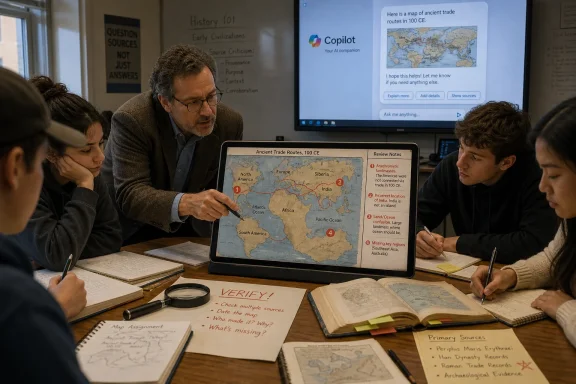
The most vivid detail in the University Affairs essay is almost absurd enough to sound like a satire of AI panic. A Microsoft Copilot map, prompted to draw common trade routes across Afro-Eurasia around 500 BCE, reportedly mislabeled continents, misplaced India, confused oceans and landmasses, and produced a historical-geographical artifact so broken that it could have doubled as a test of whether anyone was paying attention.
That is exactly what it became. In the instructor’s account, only about a quarter of students who attempted the assignment recognized that the maps were problematic, despite being warned that AI-generated maps could contain serious errors. These were not subtle historiographical mistakes about the chronology of Achaemenid trade or the diffusion of Mediterranean commodities. These were errors at the level of Africa-is-not-Australia.
The obvious reaction is to blame the tool. Copilot, like ChatGPT, Gemini, Claude, and the rest of the consumer AI stack, can generate fluent nonsense. It can produce imaginary citations, flatten nuance into generic prose, and treat visual tasks as a kind of dream logic exercise in which place names, coastlines, and routes are plausible-looking tokens rather than verified facts.
But the more important reaction is to blame the habit. The students could find the errors when the final exam explicitly told them to look for six mistakes. The problem was not that they lacked all geographic knowledge. The problem was that the presence of an AI answer suppressed the instinct to inspect.
That distinction matters because it shifts the issue from “AI is unreliable” to “AI changes the user.” A bad map can be discarded. A bad reflex, repeated across school, work, and civic life, becomes culture.
Generative AI does not fit that lineage neatly. A calculator returns an answer to a constrained symbolic operation. Spellcheck flags a small part of a larger act of composition. Search engines retrieve documents whose existence can be inspected, compared, and attributed. A chatbot instead performs the shape of reasoning while hiding most of the machinery that would let a novice distinguish retrieval from invention.
That is why the map example lands so hard. The artifact was visual, immediate, and wrong in ways a student could have caught without advanced training. Yet the interface carried the authority of software. The answer appeared finished. It was not a source to interrogate but an output to submit.
This is the consumerization of epistemology: knowledge as something an app hands back in a clean box. Windows users have lived through decades of interface abstraction, from command lines to graphical shells to search bars to virtual assistants. The best interfaces reduce friction. But learning often depends on friction, and generative AI is unusually good at sanding it away.
Microsoft has particular stakes here because Copilot is not a fringe chatbot sitting outside institutional life. It is being embedded across Windows, Edge, Microsoft 365, Teams, and enterprise accounts. In universities with Microsoft enterprise licensing, Copilot may look safer, more official, and more institutionally blessed than a random web app. That can be useful for privacy and governance, but it also deepens the trust problem: if the university provides the tool, students may assume the tool is fit for purpose.
In other words, this was not the caricature of a humanities professor yelling at the cloud. It was an attempt to teach AI literacy by putting the tool on the table and asking students to examine it. That makes the result more unsettling, not less.
The students’ failure was not an inability to use AI. They could prompt it. They could generate material. They could complete the mechanics of the assignment. What many could not yet do was treat the output as suspicious.
That is the new digital divide. Twenty years ago, schools worried about who had access to computers and broadband. Ten years ago, they worried about who could navigate search, databases, and learning platforms. Now the divide is between users who can verify machine output and users who mistake machine fluency for authority.
The verification divide will not map neatly onto socioeconomic categories, academic disciplines, or technical skill. A computer science student can overtrust generated code just as easily as a history student can overtrust a generated map. A humanities student trained to read against the grain may be better prepared for AI than a technically fluent student trained to optimize for completion.
That is the irony hiding inside the panic about “keeping the human in humanities.” The humanities are not ornamental in an AI-saturated education system. They are the place where students learn that texts have motives, sources have contexts, maps are arguments, and confident narratives can be wrong.
The difference with generative AI is that it offloads not just memory or calculation but judgment-shaped activity. It summarizes, drafts, explains, translates, prioritizes, brainstorms, outlines, and argues. It does not merely save a fact; it simulates the process by which a person might decide what facts matter.
That simulation is seductive because it meets students at the point of maximum academic discomfort. The blank page is uncomfortable. Dense readings are uncomfortable. Translating a sentence from Latin is uncomfortable. Figuring out why Hammurabi’s law code does or does not fit a modern moral category is uncomfortable. AI offers relief at precisely the moment when struggle would have produced learning.
Educators are not imagining the scale of adoption. KPMG Canada’s 2025 survey found that 73 percent of Canadian students use generative AI for schoolwork, up sharply from prior years. The same research reported that a large share of students believed their critical thinking had deteriorated since they began using the tools. Even if every survey number deserves caution, the trend is no longer speculative. AI is not coming to campus; it is already in the backpack.
The pandemic context matters too. Many undergraduates now arriving in first-year courses experienced disrupted middle-school or high-school years, remote learning, weakened classroom routines, and then a sudden explosion of free AI tools during formative academic years. It would be strange if that sequence did not affect how they approach assignments.
The problem is not laziness as a moral category. It is learned dependency as a system outcome. If students spend years receiving instant drafts, instant summaries, and instant answers, the habit of pausing to ask “How would I know whether this is true?” can atrophy.
Yet hallucination is not the disease. It is the rash. The deeper disease is the delegation of epistemic responsibility to systems that have no responsibility.
A student who copies a fake citation from Copilot has made an error. A student who never checks the citation has acquired a dangerous workflow. A university that responds only with plagiarism detection has missed the larger point. Detection asks whether the student cheated. AI literacy asks whether the student knows how knowledge is made.
The distinction matters for Windows users and IT administrators because the same pattern is appearing in professional environments. Copilot for Microsoft 365 can summarize meetings, draft emails, produce slide decks, extract action items, and answer questions across organizational data. Those features can save time. They can also launder uncertainty into executive-ready prose.
In a workplace, the equivalent of the bad ancient trade map might be a flawed policy summary, a misread contract clause, an invented software dependency, or a confident but wrong security recommendation. The danger grows when the output is formatted like work product. A hallucinated fact inside a polished memo is harder to spot than a hallucinated fact inside a weird chatbot response.
That is why education is the proving ground for a much broader human-computer problem. Schools are not merely deciding whether students may use AI on essays. They are training the future workforce in whether machine output is treated as draft, evidence, assistant, oracle, or excuse.
That may be true in a data-protection sense. It does not solve the cognition problem.
Enterprise licensing can protect prompts from being sprayed into unknown consumer training pipelines. It can give administrators controls, auditability, and contractual assurances. It can align AI use with existing Microsoft environments. Those are real benefits, especially for schools and public institutions that cannot simply tell students and staff to paste sensitive material into any chatbot they find online.
But institutional approval has a psychological effect. When a tool appears inside a managed account, behind a university login, under a familiar Microsoft brand, it inherits authority from the institution. Students may not distinguish between “approved for use under certain privacy conditions” and “approved as accurate.” Administrators may not either.
This is the same problem Microsoft faces with Copilot in Windows. The more AI becomes part of the operating system’s furniture, the less users experience it as a special mode requiring skepticism. It becomes another pane, another button, another suggestion. Familiarity becomes credibility.
The company’s challenge is not merely to improve model accuracy. Accuracy will improve unevenly, and some failure modes will become less cartoonish. But as the errors become subtler, the need for user skepticism grows rather than shrinks. A map that labels Africa as Australia is a gift. A map that gets the continents right but quietly invents historically implausible trade routes is the real threat.
A historian’s ordinary toolkit is an AI-resilience toolkit. Who produced this? For what audience? What is missing? What assumptions organize the narrative? What sources would confirm it? What would count as a contradiction? How does a map encode power, uncertainty, and simplification?
Those questions are not anti-technology. They are the precondition for using technology well. A student who can interrogate a medieval chronicle, a colonial archive, or a modern political speech is better prepared to interrogate a chatbot than a student who has only been taught to produce acceptable outputs.
This is why technology-free classrooms and AI-integrated assignments should not be treated as opposites. Students need spaces where they read, write, calculate, draw, and argue without machine completion. They also need spaces where they deliberately test machine output and learn how it fails. The pedagogical question is not whether AI is present. It is whether the human skill is developed before, during, and after the tool is used.
The phrase “keeping the human in humanities” captures something important, but the argument should go further. The issue is keeping the human in knowledge work. Humanities classrooms are simply where the human part has always been hardest to automate honestly, because the work depends on judgment, ambiguity, and context.
But bans are blunt instruments. They can create protected spaces for attention, but they cannot prepare students for the environments they will enter outside the classroom. A student can write one in-class essay without AI and still rely on a chatbot for every other act of reading, planning, and revision. A ban can preserve an assessment; it cannot by itself build a habit.
The better argument for AI-free learning is not nostalgia. It is sequencing. Students need to experience what it feels like to wrestle with a problem before they outsource parts of that struggle. They need to know the difference between an idea they have earned and a sentence they have accepted. They need enough internal baseline competence to recognize when the machine is bluffing.
That baseline is not automatic. The University Affairs example shows students who could identify errors once prompted but did not spontaneously inspect the map. That means the classroom intervention worked partially. It moved students from passive acceptance to active critique when the task demanded it. The next step is making critique the default rather than the special instruction.
Educators have a phrase for this: metacognition, the ability to think about one’s own thinking. AI literacy without metacognition becomes prompt literacy, which is mostly a productivity skill. The deeper need is for students to notice when they have stopped thinking.
But if the response stops at cheating, it will fail. The Copilot map assignment did not reveal students hiding AI use; it revealed students openly using AI and still failing to evaluate it. That is a different institutional problem.
Assignments now need to test process more deliberately. Not every task must become an oral exam or handwritten blue-book exercise, but instructors need ways to see how students arrived at an answer. They need students to compare AI output against primary sources, annotate machine-generated claims, identify uncertainty, and explain why a response is adequate or inadequate.
This does not mean turning every course into a course about AI. It means admitting that AI has entered the conditions under which ordinary coursework happens. A history assignment that ignores AI may still be an AI assignment if students use a chatbot to summarize the readings. A programming assignment that ignores AI may still be an AI assignment if students generate the code and only debug the surface. A writing assignment that ignores AI may still be an AI assignment if students outsource the outline, thesis, and transitions.
The point is not to make students afraid of AI. Fear produces concealment. The point is to make them slightly less impressed by it.
The first IT instinct is often policy: approved tools, blocked tools, data classifications, retention rules, acceptable-use language, and training modules. Those are necessary. They are not sufficient. A student can comply with every data policy and still submit nonsense.
The second instinct is detection. Institutions buy or test AI detectors, plagiarism systems, browser lockdown tools, and analytics dashboards. Some may help in narrow contexts, but the cat-and-mouse framing can distract from the more durable goal. The institution should care less about whether a paragraph was generated and more about whether the student can defend, verify, and extend the ideas in it.
The third instinct is procurement optimism. If the school standardizes on an enterprise AI platform, perhaps the chaos becomes manageable. That may reduce privacy risk, but it can increase cognitive risk if the rollout sends the message that the tool is institutionally endorsed as a knowledge authority.
The better IT role is to support bounded experimentation. Give faculty safe environments to test tools. Make privacy terms legible. Provide guidance on what enterprise protection does and does not mean. Help create defaults that remind users to verify rather than defaults that make AI output feel frictionless and final.
In practical terms, this may mean watermarking AI-assisted classroom materials, building verification steps into LMS templates, supporting citation and source-checking workflows, and resisting executive demands to sprinkle Copilot over every process before anyone has defined what good use looks like. IT cannot teach historical reasoning. It can, however, avoid designing systems that quietly train users to skip it.
The disinformation risk is not merely that AI can generate false content. Humans have always generated false content. The new risk is cheap personalization at scale, wrapped in the tone of helpful neutrality. A chatbot can produce propaganda that does not sound like propaganda. It can answer a student’s question with a slanted frame, omit inconvenient context, or present contested claims as settled.
This is where AI literacy becomes civic literacy. Students who learn to ask “What is the source?” and “What is missing?” are not just protecting their grades. They are protecting their ability to live in an information environment where synthetic persuasion will be ordinary.
The map assignment is almost a parable. A map is never just a picture of the world; it is a claim about what matters, where things are, and how places relate. AI-generated maps make that literal. They can be visually authoritative while epistemically empty.
The same is true of AI-generated prose. A confident paragraph can create the sensation of understanding before understanding has occurred. That sensation may be the most dangerous hallucination of all.
But some anecdotes clarify a system better than a dashboard can. A group of students accepted absurd AI maps until they were explicitly told to look for errors. Then many could find them. The gap between those two moments is where AI education now lives.
That gap is not closed by better prompts. A better prompt might produce a better map, or it might produce a more plausible wrong one. Prompt engineering has its place, but it is not a substitute for domain knowledge and skeptical reading. The student who knows only how to ask again is still dependent on the system. The student who knows how to check has regained agency.
This is also where Microsoft and other AI vendors should be judged. Safety disclaimers and small-print warnings are not enough. If products are designed to sound authoritative, integrate seamlessly, and minimize friction, then the predictable social effect is overtrust. The burden cannot fall entirely on teachers to add skepticism after the interface has removed it.
The broken map is funny until it becomes a workflow. If AI is going to sit inside the operating system, the browser, the word processor, the classroom, and the workplace, then the next phase of digital literacy cannot be about access or fluency alone. It has to be about resistance: the trained pause before acceptance, the habit of checking, the confidence to say that the polished answer is wrong. The students in that history class eventually saw the errors when asked; the future of AI-assisted education depends on whether they learn to ask themselves.
 The Map Was Wrong, but the Reflex Was Worse
The most vivid detail in the University Affairs essay is almost absurd enough to sound like a satire of AI panic. A Microsoft Copilot map, prompted to draw common trade routes across Afro-Eurasia around 500 BCE, reportedly mislabeled continents, misplaced India, confused oceans and landmasses, and produced a historical-geographical artifact so broken that it could have doubled as a test of whether anyone was paying attention.That is exactly what it became. In the instructor’s account, only about a quarter of students who attempted the assignment recognized that the maps were problematic, despite being warned that AI-generated maps could contain serious errors. These were not subtle historiographical mistakes about the chronology of Achaemenid trade or the diffusion of Mediterranean commodities. These were errors at the level of Africa-is-not-Australia.
The obvious reaction is to blame the tool. Copilot, like ChatGPT, Gemini, Claude, and the rest of the consumer AI stack, can generate fluent nonsense. It can produce imaginary citations, flatten nuance into generic prose, and treat visual tasks as a kind of dream logic exercise in which place names, coastlines, and routes are plausible-looking tokens rather than verified facts.
But the more important reaction is to blame the habit. The students could find the errors when the final exam explicitly told them to look for six mistakes. The problem was not that they lacked all geographic knowledge. The problem was that the presence of an AI answer suppressed the instinct to inspect.
That distinction matters because it shifts the issue from “AI is unreliable” to “AI changes the user.” A bad map can be discarded. A bad reflex, repeated across school, work, and civic life, becomes culture.
Copilot Is Not Just Another Calculator
The education debate keeps reaching for old analogies. Calculators did not destroy arithmetic. Spellcheck did not destroy writing. Search engines did not destroy research. Every wave of classroom technology arrives with a moral panic, then settles into the mundane background of learning.Generative AI does not fit that lineage neatly. A calculator returns an answer to a constrained symbolic operation. Spellcheck flags a small part of a larger act of composition. Search engines retrieve documents whose existence can be inspected, compared, and attributed. A chatbot instead performs the shape of reasoning while hiding most of the machinery that would let a novice distinguish retrieval from invention.
That is why the map example lands so hard. The artifact was visual, immediate, and wrong in ways a student could have caught without advanced training. Yet the interface carried the authority of software. The answer appeared finished. It was not a source to interrogate but an output to submit.
This is the consumerization of epistemology: knowledge as something an app hands back in a clean box. Windows users have lived through decades of interface abstraction, from command lines to graphical shells to search bars to virtual assistants. The best interfaces reduce friction. But learning often depends on friction, and generative AI is unusually good at sanding it away.
Microsoft has particular stakes here because Copilot is not a fringe chatbot sitting outside institutional life. It is being embedded across Windows, Edge, Microsoft 365, Teams, and enterprise accounts. In universities with Microsoft enterprise licensing, Copilot may look safer, more official, and more institutionally blessed than a random web app. That can be useful for privacy and governance, but it also deepens the trust problem: if the university provides the tool, students may assume the tool is fit for purpose.
The Real Classroom Divide Is Verification
The University Affairs account describes a set of assignments that did exactly what many AI optimists say instructors should do. The class did not simply ban the technology or pretend it did not exist. Students were asked to edit AI-produced essays, analyze summaries, tweak prompts, and evaluate outputs. They used Copilot under an enterprise license, a reasonable choice in a world where data protection and institutional compliance matter.In other words, this was not the caricature of a humanities professor yelling at the cloud. It was an attempt to teach AI literacy by putting the tool on the table and asking students to examine it. That makes the result more unsettling, not less.
The students’ failure was not an inability to use AI. They could prompt it. They could generate material. They could complete the mechanics of the assignment. What many could not yet do was treat the output as suspicious.
That is the new digital divide. Twenty years ago, schools worried about who had access to computers and broadband. Ten years ago, they worried about who could navigate search, databases, and learning platforms. Now the divide is between users who can verify machine output and users who mistake machine fluency for authority.
The verification divide will not map neatly onto socioeconomic categories, academic disciplines, or technical skill. A computer science student can overtrust generated code just as easily as a history student can overtrust a generated map. A humanities student trained to read against the grain may be better prepared for AI than a technically fluent student trained to optimize for completion.
That is the irony hiding inside the panic about “keeping the human in humanities.” The humanities are not ornamental in an AI-saturated education system. They are the place where students learn that texts have motives, sources have contexts, maps are arguments, and confident narratives can be wrong.
Cognitive Offloading Has Become a Design Feature
The phrase cognitive offloading sounds clinical, but the behavior is ordinary. Humans have always moved mental work into tools: calendars remember appointments, GPS remembers routes, search engines remember facts, and notes remember what working memory cannot. Offloading is not inherently bad. Civilization is, in one sense, a long history of building systems that keep us from having to reinvent everything from scratch.The difference with generative AI is that it offloads not just memory or calculation but judgment-shaped activity. It summarizes, drafts, explains, translates, prioritizes, brainstorms, outlines, and argues. It does not merely save a fact; it simulates the process by which a person might decide what facts matter.
That simulation is seductive because it meets students at the point of maximum academic discomfort. The blank page is uncomfortable. Dense readings are uncomfortable. Translating a sentence from Latin is uncomfortable. Figuring out why Hammurabi’s law code does or does not fit a modern moral category is uncomfortable. AI offers relief at precisely the moment when struggle would have produced learning.
Educators are not imagining the scale of adoption. KPMG Canada’s 2025 survey found that 73 percent of Canadian students use generative AI for schoolwork, up sharply from prior years. The same research reported that a large share of students believed their critical thinking had deteriorated since they began using the tools. Even if every survey number deserves caution, the trend is no longer speculative. AI is not coming to campus; it is already in the backpack.
The pandemic context matters too. Many undergraduates now arriving in first-year courses experienced disrupted middle-school or high-school years, remote learning, weakened classroom routines, and then a sudden explosion of free AI tools during formative academic years. It would be strange if that sequence did not affect how they approach assignments.
The problem is not laziness as a moral category. It is learned dependency as a system outcome. If students spend years receiving instant drafts, instant summaries, and instant answers, the habit of pausing to ask “How would I know whether this is true?” can atrophy.
Hallucination Is a Symptom, Not the Disease
AI hallucination remains the easiest problem to explain because it produces screenshots. A chatbot invents a journal article. A legal brief cites cases that do not exist. A generated bibliography looks scholarly but collapses under inspection. A map places India in Europe or labels Africa as Australia. The error is concrete, shareable, and embarrassing.Yet hallucination is not the disease. It is the rash. The deeper disease is the delegation of epistemic responsibility to systems that have no responsibility.
A student who copies a fake citation from Copilot has made an error. A student who never checks the citation has acquired a dangerous workflow. A university that responds only with plagiarism detection has missed the larger point. Detection asks whether the student cheated. AI literacy asks whether the student knows how knowledge is made.
The distinction matters for Windows users and IT administrators because the same pattern is appearing in professional environments. Copilot for Microsoft 365 can summarize meetings, draft emails, produce slide decks, extract action items, and answer questions across organizational data. Those features can save time. They can also launder uncertainty into executive-ready prose.
In a workplace, the equivalent of the bad ancient trade map might be a flawed policy summary, a misread contract clause, an invented software dependency, or a confident but wrong security recommendation. The danger grows when the output is formatted like work product. A hallucinated fact inside a polished memo is harder to spot than a hallucinated fact inside a weird chatbot response.
That is why education is the proving ground for a much broader human-computer problem. Schools are not merely deciding whether students may use AI on essays. They are training the future workforce in whether machine output is treated as draft, evidence, assistant, oracle, or excuse.
The Microsoft Problem Is Trust at Enterprise Scale
Microsoft did not create the student trust problem, but it is positioned to amplify or mitigate it. Copilot’s institutional appeal rests on precisely the features that make it socially powerful: integration, governance, identity management, security promises, and proximity to the tools people already use. For a university or company, an enterprise Copilot deployment can look like the responsible alternative to uncontrolled consumer AI use.That may be true in a data-protection sense. It does not solve the cognition problem.
Enterprise licensing can protect prompts from being sprayed into unknown consumer training pipelines. It can give administrators controls, auditability, and contractual assurances. It can align AI use with existing Microsoft environments. Those are real benefits, especially for schools and public institutions that cannot simply tell students and staff to paste sensitive material into any chatbot they find online.
But institutional approval has a psychological effect. When a tool appears inside a managed account, behind a university login, under a familiar Microsoft brand, it inherits authority from the institution. Students may not distinguish between “approved for use under certain privacy conditions” and “approved as accurate.” Administrators may not either.
This is the same problem Microsoft faces with Copilot in Windows. The more AI becomes part of the operating system’s furniture, the less users experience it as a special mode requiring skepticism. It becomes another pane, another button, another suggestion. Familiarity becomes credibility.
The company’s challenge is not merely to improve model accuracy. Accuracy will improve unevenly, and some failure modes will become less cartoonish. But as the errors become subtler, the need for user skepticism grows rather than shrinks. A map that labels Africa as Australia is a gift. A map that gets the continents right but quietly invents historically implausible trade routes is the real threat.
The Humanities Are the Control Plane
It is fashionable in some policy circles to treat the humanities as a legacy department while AI, data science, and engineering represent the future. The classroom described in the University Affairs essay suggests the opposite. The humanities may be where the most important AI skills are taught, because those skills are not primarily about prompting. They are about interpretation.A historian’s ordinary toolkit is an AI-resilience toolkit. Who produced this? For what audience? What is missing? What assumptions organize the narrative? What sources would confirm it? What would count as a contradiction? How does a map encode power, uncertainty, and simplification?
Those questions are not anti-technology. They are the precondition for using technology well. A student who can interrogate a medieval chronicle, a colonial archive, or a modern political speech is better prepared to interrogate a chatbot than a student who has only been taught to produce acceptable outputs.
This is why technology-free classrooms and AI-integrated assignments should not be treated as opposites. Students need spaces where they read, write, calculate, draw, and argue without machine completion. They also need spaces where they deliberately test machine output and learn how it fails. The pedagogical question is not whether AI is present. It is whether the human skill is developed before, during, and after the tool is used.
The phrase “keeping the human in humanities” captures something important, but the argument should go further. The issue is keeping the human in knowledge work. Humanities classrooms are simply where the human part has always been hardest to automate honestly, because the work depends on judgment, ambiguity, and context.
Bans Alone Will Not Rebuild Attention
There is a tempting simplicity in declaring classrooms AI-free. Put away the laptops. Collect the phones. Return to paper, books, discussion, and handwritten exams. For some courses and some moments, that may be exactly right.But bans are blunt instruments. They can create protected spaces for attention, but they cannot prepare students for the environments they will enter outside the classroom. A student can write one in-class essay without AI and still rely on a chatbot for every other act of reading, planning, and revision. A ban can preserve an assessment; it cannot by itself build a habit.
The better argument for AI-free learning is not nostalgia. It is sequencing. Students need to experience what it feels like to wrestle with a problem before they outsource parts of that struggle. They need to know the difference between an idea they have earned and a sentence they have accepted. They need enough internal baseline competence to recognize when the machine is bluffing.
That baseline is not automatic. The University Affairs example shows students who could identify errors once prompted but did not spontaneously inspect the map. That means the classroom intervention worked partially. It moved students from passive acceptance to active critique when the task demanded it. The next step is making critique the default rather than the special instruction.
Educators have a phrase for this: metacognition, the ability to think about one’s own thinking. AI literacy without metacognition becomes prompt literacy, which is mostly a productivity skill. The deeper need is for students to notice when they have stopped thinking.
The Assignment Has to Change Because the Interface Changed
Many universities initially framed generative AI as an academic integrity problem, and understandably so. The first shock was essays that appeared from nowhere, written in generic but competent prose. Faculty who had spent years designing take-home assignments suddenly faced a machine that could produce acceptable first drafts in seconds.But if the response stops at cheating, it will fail. The Copilot map assignment did not reveal students hiding AI use; it revealed students openly using AI and still failing to evaluate it. That is a different institutional problem.
Assignments now need to test process more deliberately. Not every task must become an oral exam or handwritten blue-book exercise, but instructors need ways to see how students arrived at an answer. They need students to compare AI output against primary sources, annotate machine-generated claims, identify uncertainty, and explain why a response is adequate or inadequate.
This does not mean turning every course into a course about AI. It means admitting that AI has entered the conditions under which ordinary coursework happens. A history assignment that ignores AI may still be an AI assignment if students use a chatbot to summarize the readings. A programming assignment that ignores AI may still be an AI assignment if students generate the code and only debug the surface. A writing assignment that ignores AI may still be an AI assignment if students outsource the outline, thesis, and transitions.
The point is not to make students afraid of AI. Fear produces concealment. The point is to make them slightly less impressed by it.
IT Departments Cannot Solve a Pedagogical Problem, but They Can Make It Worse
For WindowsForum’s core audience of sysadmins, school technologists, and Microsoft-watchers, the education debate has a familiar architecture. Leadership wants AI readiness. Vendors offer enterprise tools. Faculty worry about learning. Students use whatever is easiest. IT is asked to secure, enable, restrict, log, integrate, and explain the mess.The first IT instinct is often policy: approved tools, blocked tools, data classifications, retention rules, acceptable-use language, and training modules. Those are necessary. They are not sufficient. A student can comply with every data policy and still submit nonsense.
The second instinct is detection. Institutions buy or test AI detectors, plagiarism systems, browser lockdown tools, and analytics dashboards. Some may help in narrow contexts, but the cat-and-mouse framing can distract from the more durable goal. The institution should care less about whether a paragraph was generated and more about whether the student can defend, verify, and extend the ideas in it.
The third instinct is procurement optimism. If the school standardizes on an enterprise AI platform, perhaps the chaos becomes manageable. That may reduce privacy risk, but it can increase cognitive risk if the rollout sends the message that the tool is institutionally endorsed as a knowledge authority.
The better IT role is to support bounded experimentation. Give faculty safe environments to test tools. Make privacy terms legible. Provide guidance on what enterprise protection does and does not mean. Help create defaults that remind users to verify rather than defaults that make AI output feel frictionless and final.
In practical terms, this may mean watermarking AI-assisted classroom materials, building verification steps into LMS templates, supporting citation and source-checking workflows, and resisting executive demands to sprinkle Copilot over every process before anyone has defined what good use looks like. IT cannot teach historical reasoning. It can, however, avoid designing systems that quietly train users to skip it.
Disinformation Is the Final Exam Nobody Scheduled
The University Affairs essay briefly raises Russian propaganda, and that mention deserves more attention than it usually gets in classroom AI debates. If students cannot identify a mislabeled continent in a classroom map, how reliably will they identify a synthetic explanation of a war, an election, a pandemic, or a protest movement?The disinformation risk is not merely that AI can generate false content. Humans have always generated false content. The new risk is cheap personalization at scale, wrapped in the tone of helpful neutrality. A chatbot can produce propaganda that does not sound like propaganda. It can answer a student’s question with a slanted frame, omit inconvenient context, or present contested claims as settled.
This is where AI literacy becomes civic literacy. Students who learn to ask “What is the source?” and “What is missing?” are not just protecting their grades. They are protecting their ability to live in an information environment where synthetic persuasion will be ordinary.
The map assignment is almost a parable. A map is never just a picture of the world; it is a claim about what matters, where things are, and how places relate. AI-generated maps make that literal. They can be visually authoritative while epistemically empty.
The same is true of AI-generated prose. A confident paragraph can create the sensation of understanding before understanding has occurred. That sensation may be the most dangerous hallucination of all.
The Lesson From the Broken Copilot Map Is Narrow but Urgent
The classroom episode does not prove that AI is destroying a generation’s mind, and it should not be inflated into a universal law. It is one instructor’s account from one course, reinforced by broader survey data and by a growing body of concern about cognitive offloading. Anecdotes are not destiny.But some anecdotes clarify a system better than a dashboard can. A group of students accepted absurd AI maps until they were explicitly told to look for errors. Then many could find them. The gap between those two moments is where AI education now lives.
That gap is not closed by better prompts. A better prompt might produce a better map, or it might produce a more plausible wrong one. Prompt engineering has its place, but it is not a substitute for domain knowledge and skeptical reading. The student who knows only how to ask again is still dependent on the system. The student who knows how to check has regained agency.
This is also where Microsoft and other AI vendors should be judged. Safety disclaimers and small-print warnings are not enough. If products are designed to sound authoritative, integrate seamlessly, and minimize friction, then the predictable social effect is overtrust. The burden cannot fall entirely on teachers to add skepticism after the interface has removed it.
The Classroom Needs a New Default Setting
The most useful takeaway from the Copilot map story is not that schools should panic, ban everything, or surrender to the bots. It is that skepticism must become a practiced default, not an exam instruction.- Students should be taught that AI output is a draft or hypothesis until it has been checked against reliable sources, domain knowledge, or direct evidence.
- Instructors should design some assignments where AI is prohibited to preserve first-contact struggle, and other assignments where AI is used openly so its failures can be studied.
- Universities should distinguish clearly between tools approved for privacy and tools trusted for accuracy, because those are not the same approval.
- IT departments should treat enterprise AI rollouts as educational interventions, not merely software deployments.
- Microsoft and other vendors should build verification friction into academic and professional AI workflows instead of assuming that users will add it themselves.
- The humanities should be treated as central to AI literacy because interpretation, context, and source criticism are now practical technical skills.
The broken map is funny until it becomes a workflow. If AI is going to sit inside the operating system, the browser, the word processor, the classroom, and the workplace, then the next phase of digital literacy cannot be about access or fluency alone. It has to be about resistance: the trained pause before acceptance, the habit of checking, the confidence to say that the polished answer is wrong. The students in that history class eventually saw the errors when asked; the future of AI-assisted education depends on whether they learn to ask themselves.
References
- Primary source: University Affairs
Published: 2026-06-29T14:11:12.915017
Loading…
universityaffairs.ca - Related coverage: kpmg.com
Loading…
kpmg.com - Related coverage: kqed.org
Loading…
www.kqed.org - Related coverage: phys.org
Loading…
phys.org - Related coverage: insidehighered.com
Loading…
www.insidehighered.com