

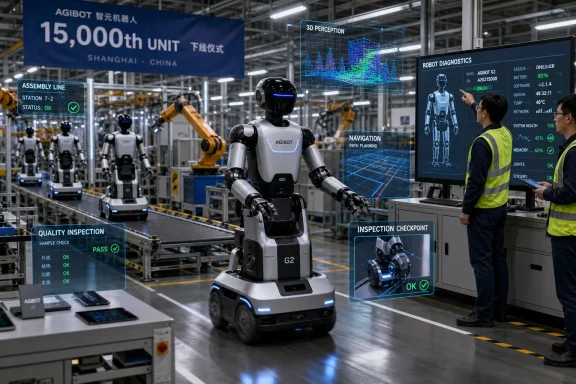
AGIBOT said on June 28, 2026, in Shanghai that its 15,000th robot, an AGIBOT G2 industrial embodied-AI machine, had rolled off the production line and would move into real factory deployment. That number matters less as a trophy than as a signal: the humanoid and embodied robotics race is beginning to shift from theater to throughput. The industry’s defining question is no longer whether a robot can perform a neatly edited task on video, but whether companies can manufacture, deploy, maintain, and improve thousands of machines under industrial conditions. AGIBOT’s milestone does not settle that question, but it makes the question impossible to ignore.
For the past two years, humanoid robotics has lived in a strange split-screen reality. On one screen, the public sees cinematic clips: machines folding laundry, carrying boxes, picking fruit, or strolling through offices with a level of confidence that often depends on the camera angle. On the other screen, plant managers, logistics operators, and automation engineers ask the less glamorous questions that determine whether any of this becomes a business.
Can the robot work for an entire shift? Can it recover when a tray is misaligned, a cable droops into the wrong place, or a human coworker steps into its path? Can the vendor deliver spares, software updates, service technicians, and enough units to justify redesigning a workflow around them?
AGIBOT’s 15,000th unit lands squarely in that second world. The company is not merely saying it has built another prototype. It is saying it has crossed a production threshold that most embodied-AI companies still discuss in future tense.
That does not mean the hard problems are solved. A robot rolling off a line is not the same as a robot generating profit on a line. But the center of gravity is moving. The robotics story is becoming less about capability demos and more about industrialization.
The 15,000th unit was an AGIBOT G2, described as an industrial-grade embodied task robot. It is not the science-fiction version of a humanoid that walks like a person and does everything a person can do. It is a wheeled mobile manipulator with a humanoid-style torso and arms, a design that quietly admits something important: in factories, wheels may matter more than legs.
That is not a retreat from ambition. It is a concession to physics, uptime, and cost. A robot assigned to inspection, handling, or repetitive production support does not need to mimic a human ankle if the factory floor is flat and controlled. It needs stable mobility, repeatable manipulation, safe interaction, and enough perception to avoid becoming a very expensive obstruction.
This is where AGIBOT’s approach looks less like consumer robotics hype and more like industrial automation with a new interface. The company talks about locomotion, interaction, and manipulation as an integrated architecture. Those words are familiar in robotics, but the factory test is unforgiving: if the system cannot turn those modules into reliable behavior, the architecture is just a slide deck.
A wheeled manipulator with arms is a pragmatic machine. It can work around benches, conveyors, carts, and inspection stations without spending a large part of its energy budget on balancing. It can be shaped around the task rather than around the fantasy of a general-purpose mechanical worker. In an industrial setting, that tradeoff may be the difference between a demo and a deployment.
The humanoid torso still matters. Factories are built around human reach, human work envelopes, and human tools. A robot with arms, hands, cameras, and a body plan that roughly maps onto existing stations may be easier to insert into a line than a traditional fixed automation cell. That is the promise of embodied AI: not just smarter robots, but robots that can inhabit spaces designed for people without rebuilding the entire site.
Yet the G2 also exposes the ambiguity in the term “humanoid.” Market-share tables, vendor press releases, and investor decks often blur distinctions among bipedal humanoids, wheeled humanoid-like robots, mobile manipulators, and general-purpose research platforms. For buyers, those distinctions are not academic. They determine safety certification, floor layout, maintenance burden, task suitability, and total cost of ownership.
AGIBOT benefits from the expansive language of the moment. But if the company keeps pushing machines into actual production environments, it will also face a more disciplined vocabulary imposed by customers. A procurement team does not buy a vibe. It buys a machine that either meets a process requirement or does not.
A livestream is not the same as an independent audit. It can still be curated, bounded, supervised, and optimized for a specific station. But it is harder to fake than a highlight reel, and it moves the conversation toward duration, environment, and repeatability.
Factory work has a useful cruelty to it. It is repetitive, measurable, and indifferent to marketing. If a robot slows a line, misses defects, requires constant babysitting, or creates safety friction, the cost shows up quickly.
That makes electronics assembly and inspection a logical early proving ground. Tablet and smartphone manufacturing combine high volume, standardized parts, structured workstations, and intense pressure to reduce labor variability. A robot does not need to be universally intelligent to add value there. It needs to be good at a narrow family of tasks and adaptable enough to survive the small deviations that make real production different from lab robotics.
The open question is whether AGIBOT’s performance generalizes. A robot that inspects tablets at one Longcheer line may not be ready to handle automotive subassemblies, warehouse picking, food processing, or hospital logistics. The path from one successful cell to broad deployment is usually longer than the press release implies.
AGIBOT has claimed, citing Omdia data, that it ranked first globally in humanoid robot shipments and market share in 2025, with 5,168 units shipped and roughly 39 percent of the market. Those figures should be treated as market estimates rather than immutable truth, especially in a young category with fuzzy definitions. Still, the direction is difficult to dismiss: Chinese firms appear to be shipping embodied robots in volumes that many Western startups have not yet approached.
That matters because robotics improves through use. More units mean more manufacturing feedback, more field failures, more operator complaints, more task data, and more chances to discover what breaks outside the lab. In software, scale creates learning loops. In robotics, scale creates learning loops plus bruised hardware, worn joints, calibration drift, scratched sensors, bent grippers, and service tickets.
The country that can put more machines into more semi-structured environments may learn faster than the country that produces the best keynote video. This is not an argument that AGIBOT has solved general-purpose robotics. It is an argument that industrial volume can become its own kind of research infrastructure.
For WindowsForum readers, the analogy is familiar. The PC industry was not won by the most elegant prototype computer. It was won by supply chains, standards, developers, OEM relationships, peripheral ecosystems, and boring reliability. Robotics may be entering a similar phase, where the decisive advantage belongs to companies that can turn impressive engineering into repeatable product.
But industrial buyers are not TikTok viewers. They care about uptime, accuracy, cycle time, integration, safety, warranty terms, and cost per task. In that world, the most exciting robot may be the one no one notices because it simply keeps working.
AGIBOT’s milestone presses on this divide. The company is making an argument that embodied AI is entering the deployment era. Its evidence is not a single astonishing task, but an accumulation of units and factory work.
That is the right argument to make. It is also the harder one to sustain. A company can produce a viral demo with a small team, a controlled setting, and enough editing. It cannot support thousands of robots across customers without operations discipline.
The deployment era will punish vague claims. “AI-powered” will not be enough. Customers will ask how much autonomy is actually involved, how often humans intervene, whether teleoperation is part of the workflow, how updates are validated, and what happens when the model behaves unpredictably near people or expensive equipment.
The distinction matters because autonomy is not binary. A robot may be autonomous within a narrow task envelope, semi-autonomous under supervision, or dependent on human fallback when uncertainty rises. In a factory, that can still be useful. The mistake is pretending every supervised automation system is a general-purpose worker.
AGIBOT’s strongest near-term case is not that its robots are ready to replace human labor wholesale. It is that they may be ready to absorb constrained, repetitive, ergonomically awkward, or inspection-heavy work in environments where the business case is clear. That is how automation often arrives: not as a grand substitution, but as a gradual reallocation of tasks.
The reliability debt remains. Robots must handle lighting changes, part variation, human interruption, network outages, sensor fouling, battery degradation, gripper wear, and software regressions. They must do so safely, repeatedly, and with enough transparency that operators trust them.
For IT pros, this should sound familiar. The first version of a system that works in a lab is rarely the version you want in production. Real deployment begins when the vendor can document failure modes, support rollback, monitor fleets, patch securely, and explain what changed after an update.
That is where robotics starts to overlap with the concerns of enterprise IT. A factory robot is no longer just a machine tool. It is a networked endpoint with sensors, actuators, compute, identity, data flows, update channels, and operational risk.
Every robot added to a workplace expands the attack surface. Cameras may capture sensitive production details. Logs may reveal process data. Remote support channels may become privileged pathways into industrial environments. AI models may be updated in ways that change behavior faster than traditional safety processes are comfortable with.
AGIBOT’s milestone therefore invites a security conversation that is still too immature in robotics coverage. If embodied robots become common in factories, warehouses, hospitals, hotels, and campuses, they will need the same governance discipline applied to servers, laptops, mobile devices, and industrial control systems. That means asset inventory, network segmentation, access controls, update policies, telemetry review, incident response planning, and vendor risk assessment.
This is especially true for cross-border deployments. Robotics supply chains are physical, digital, and geopolitical at once. Buyers will need to understand where hardware is made, where data is processed, how remote access is controlled, and what legal obligations govern the vendor. That does not mean every foreign robot is a threat. It means robotics procurement cannot be treated as a facilities purchase with a little AI sprinkled on top.
Robots in factories and warehouses will need identity, certificates, secure Wi-Fi or private 5G, device management, monitoring dashboards, log ingestion, and role-based access. They will interact with manufacturing execution systems, quality databases, ERP platforms, ticketing systems, and security operations centers. Somewhere, inevitably, a Windows workstation will be used to configure, supervise, audit, or troubleshoot them.
The endpoint model is expanding. PCs, phones, tablets, kiosks, cameras, badge readers, and IoT sensors have already stretched IT’s boundaries. Robots add movement, force, perception, and autonomy to that endpoint universe.
That changes the risk profile. A compromised laptop leaks data. A compromised robot may leak data, damage goods, injure someone, or halt a production line. Even a non-malicious software fault can have physical consequences.
This is why the most serious buyers will not evaluate AGIBOT or its competitors only on dexterity. They will evaluate their device lifecycle story. How are robots enrolled? How are updates staged? Can behavior-changing software be pinned, tested, and rolled back? How are logs exported? What is the support SLA? Who has remote access? What happens when the cloud connection fails?
The companies that answer those questions clearly will have an advantage over companies that treat enterprise integration as an afterthought. In robotics, the sale does not end when the robot ships. In many ways, that is when the expensive part begins.
Factories have long automated tasks that are repetitive, dangerous, dirty, precise, or difficult to staff. Embodied robots extend that logic into spaces where traditional automation was too rigid or too expensive. If a robot can be dropped into a human-designed station with less retooling, the threshold for automation falls.
That could displace certain jobs, especially in high-volume manufacturing where tasks are standardized and margins reward incremental efficiency. It could also reduce injury, address labor shortages, and shift human workers toward oversight, exception handling, maintenance, and process improvement. The balance will depend on industry, region, wage levels, and how capable the machines become.
The Longcheer example is instructive because electronics manufacturing is already intensely optimized. If robots can prove themselves there, they may spread quickly through adjacent operations. But even successful deployments may look less like a lights-out factory and more like a hybrid line where humans and robots divide tasks based on reliability, flexibility, and cost.
The danger is that public discussion swings between utopia and panic. The more useful framing is operational. Which tasks are being automated? How many people are reassigned rather than removed? What skills are needed to supervise and maintain the systems? Are safety and ergonomics improving? Are productivity gains shared, or simply extracted?
AGIBOT’s 15,000th robot does not answer those social questions. It makes them more urgent.
The company still has to show that its installed base produces satisfied customers rather than impressive cumulative counts. It has to prove that robots deployed today will remain useful after thousands of hours of operation. It has to maintain quality as production ramps. It has to avoid the classic hardware startup problem: shipping faster than support can keep up.
There is also the matter of margins. Robotics companies can buy market share by selling hardware aggressively, especially if they believe the long-term value sits in software, services, data, and fleet learning. That strategy can work, but only if the installed base becomes a platform rather than a liability.
Investors and customers should watch for signs beyond unit milestones. Repeat orders matter. Multi-site deployments matter. Service costs matter. Task expansion at existing customers matters. So do boring indicators such as spare-part availability, mean time between failures, technician training, and software update cadence.
AGIBOT has earned attention by reaching scale early. Keeping that attention will require evidence that scale is translating into durable industrial value.
This does not mean Western firms are doomed. They may compete on safety certification, enterprise trust, vertical specialization, software quality, defense restrictions, local support, or integration with existing automation vendors. In some sectors, buyers may prefer a slower vendor with stronger compliance guarantees over a faster vendor with geopolitical uncertainty.
But the old assumption that the West would lead in intelligence while China merely manufactured hardware is looking dangerously simplistic. In embodied robotics, manufacturing scale and intelligence development reinforce each other. The more robots you build and deploy, the more you learn about the edge cases that matter.
The competitive benchmark is changing from “Who has the best demo?” to “Who can operate the best learning factory?” That includes physical manufacturing, software iteration, data collection, field support, and customer integration. It is a full-stack industrial contest.
AGIBOT is not alone in that contest. Unitree, UBTech, Tesla, Figure AI, Agility Robotics, Apptronik, Fourier, and others are all pursuing different versions of the humanoid or embodied-robotics opportunity. The category is still young enough that leadership can shift quickly. But AGIBOT’s latest milestone suggests that any serious competitor now has to explain not only what its robot can do, but how many it can build and where they are actually working.
The next phase will be judged by operational metrics. How many robots are in paid production rather than internal testing? How many hours do they run per week? What is their intervention rate? What tasks can they learn without expensive custom engineering? How do customers calculate payback?
Those numbers will be harder to obtain than shipment counts, and companies will disclose them selectively. That makes independent reporting, customer references, and long-duration demonstrations more valuable. The industry needs fewer montages and more logs.
For buyers, the practical advice is to treat embodied robotics like any other emerging enterprise platform. Start narrow. Demand measurable outcomes. Preserve human fallback. Separate vendor claims from observed performance. Plan for integration and security from day one.
The worst mistake would be to buy a robot because the category feels inevitable. The second-worst mistake would be to ignore the category because today’s systems are imperfect. The right stance is disciplined curiosity.
 The Robotics Race Has Found Its Factory Floor
For the past two years, humanoid robotics has lived in a strange split-screen reality. On one screen, the public sees cinematic clips: machines folding laundry, carrying boxes, picking fruit, or strolling through offices with a level of confidence that often depends on the camera angle. On the other screen, plant managers, logistics operators, and automation engineers ask the less glamorous questions that determine whether any of this becomes a business.Can the robot work for an entire shift? Can it recover when a tray is misaligned, a cable droops into the wrong place, or a human coworker steps into its path? Can the vendor deliver spares, software updates, service technicians, and enough units to justify redesigning a workflow around them?
AGIBOT’s 15,000th unit lands squarely in that second world. The company is not merely saying it has built another prototype. It is saying it has crossed a production threshold that most embodied-AI companies still discuss in future tense.
That does not mean the hard problems are solved. A robot rolling off a line is not the same as a robot generating profit on a line. But the center of gravity is moving. The robotics story is becoming less about capability demos and more about industrialization.
AGIBOT Is Selling Scale Before the West Has Settled the Product
AGIBOT, founded in 2023, has moved with startling speed by the standards of robotics hardware. The company says it progressed from 1,000 to 5,000 units in about a year, then from 5,000 to 10,000 units in roughly three months, before reaching 15,000 units in June 2026. Even allowing for the usual caution around vendor-announced milestones, the curve is the story.The 15,000th unit was an AGIBOT G2, described as an industrial-grade embodied task robot. It is not the science-fiction version of a humanoid that walks like a person and does everything a person can do. It is a wheeled mobile manipulator with a humanoid-style torso and arms, a design that quietly admits something important: in factories, wheels may matter more than legs.
That is not a retreat from ambition. It is a concession to physics, uptime, and cost. A robot assigned to inspection, handling, or repetitive production support does not need to mimic a human ankle if the factory floor is flat and controlled. It needs stable mobility, repeatable manipulation, safe interaction, and enough perception to avoid becoming a very expensive obstruction.
This is where AGIBOT’s approach looks less like consumer robotics hype and more like industrial automation with a new interface. The company talks about locomotion, interaction, and manipulation as an integrated architecture. Those words are familiar in robotics, but the factory test is unforgiving: if the system cannot turn those modules into reliable behavior, the architecture is just a slide deck.
The G2 Is a More Revealing Milestone Than a Walking Humanoid Would Be
The temptation in covering humanoid robotics is to focus on the most human-looking machine. That is understandable; a bipedal robot makes the future legible. But AGIBOT’s milestone being tied to the G2 is more interesting precisely because it is less theatrical.A wheeled manipulator with arms is a pragmatic machine. It can work around benches, conveyors, carts, and inspection stations without spending a large part of its energy budget on balancing. It can be shaped around the task rather than around the fantasy of a general-purpose mechanical worker. In an industrial setting, that tradeoff may be the difference between a demo and a deployment.
The humanoid torso still matters. Factories are built around human reach, human work envelopes, and human tools. A robot with arms, hands, cameras, and a body plan that roughly maps onto existing stations may be easier to insert into a line than a traditional fixed automation cell. That is the promise of embodied AI: not just smarter robots, but robots that can inhabit spaces designed for people without rebuilding the entire site.
Yet the G2 also exposes the ambiguity in the term “humanoid.” Market-share tables, vendor press releases, and investor decks often blur distinctions among bipedal humanoids, wheeled humanoid-like robots, mobile manipulators, and general-purpose research platforms. For buyers, those distinctions are not academic. They determine safety certification, floor layout, maintenance burden, task suitability, and total cost of ownership.
AGIBOT benefits from the expansive language of the moment. But if the company keeps pushing machines into actual production environments, it will also face a more disciplined vocabulary imposed by customers. A procurement team does not buy a vibe. It buys a machine that either meets a process requirement or does not.
Livestreamed Factory Work Raises the Bar, but Not the Verdict
AGIBOT’s recent factory livestreams at Longcheer Technology’s tablet manufacturing operation are more important than the production-number celebration. The company reportedly completed about 100 cumulative hours of livestreamed factory operations with the G2, including tablet quality inspection performed in line with production rhythms and alongside human workers. That is exactly the kind of evidence the robotics industry needs more of.A livestream is not the same as an independent audit. It can still be curated, bounded, supervised, and optimized for a specific station. But it is harder to fake than a highlight reel, and it moves the conversation toward duration, environment, and repeatability.
Factory work has a useful cruelty to it. It is repetitive, measurable, and indifferent to marketing. If a robot slows a line, misses defects, requires constant babysitting, or creates safety friction, the cost shows up quickly.
That makes electronics assembly and inspection a logical early proving ground. Tablet and smartphone manufacturing combine high volume, standardized parts, structured workstations, and intense pressure to reduce labor variability. A robot does not need to be universally intelligent to add value there. It needs to be good at a narrow family of tasks and adaptable enough to survive the small deviations that make real production different from lab robotics.
The open question is whether AGIBOT’s performance generalizes. A robot that inspects tablets at one Longcheer line may not be ready to handle automotive subassemblies, warehouse picking, food processing, or hospital logistics. The path from one successful cell to broad deployment is usually longer than the press release implies.
China’s Robotics Advantage Is Becoming a Manufacturing Advantage
The milestone also illustrates a broader geopolitical and industrial pattern. China’s robotics sector is not merely trying to match Western demos. It is trying to outproduce them.AGIBOT has claimed, citing Omdia data, that it ranked first globally in humanoid robot shipments and market share in 2025, with 5,168 units shipped and roughly 39 percent of the market. Those figures should be treated as market estimates rather than immutable truth, especially in a young category with fuzzy definitions. Still, the direction is difficult to dismiss: Chinese firms appear to be shipping embodied robots in volumes that many Western startups have not yet approached.
That matters because robotics improves through use. More units mean more manufacturing feedback, more field failures, more operator complaints, more task data, and more chances to discover what breaks outside the lab. In software, scale creates learning loops. In robotics, scale creates learning loops plus bruised hardware, worn joints, calibration drift, scratched sensors, bent grippers, and service tickets.
The country that can put more machines into more semi-structured environments may learn faster than the country that produces the best keynote video. This is not an argument that AGIBOT has solved general-purpose robotics. It is an argument that industrial volume can become its own kind of research infrastructure.
For WindowsForum readers, the analogy is familiar. The PC industry was not won by the most elegant prototype computer. It was won by supply chains, standards, developers, OEM relationships, peripheral ecosystems, and boring reliability. Robotics may be entering a similar phase, where the decisive advantage belongs to companies that can turn impressive engineering into repeatable product.
The Demo Economy Is Losing Its Monopoly on Attention
Humanoid robotics has been distorted by the economics of attention. Startups need funding, big technology firms need narrative gravity, and social platforms reward the uncanny. A robot doing a backflip, loading a dishwasher, or walking through a mock apartment will travel farther than a robot completing another hundred cycles of inspection under fluorescent lights.But industrial buyers are not TikTok viewers. They care about uptime, accuracy, cycle time, integration, safety, warranty terms, and cost per task. In that world, the most exciting robot may be the one no one notices because it simply keeps working.
AGIBOT’s milestone presses on this divide. The company is making an argument that embodied AI is entering the deployment era. Its evidence is not a single astonishing task, but an accumulation of units and factory work.
That is the right argument to make. It is also the harder one to sustain. A company can produce a viral demo with a small team, a controlled setting, and enough editing. It cannot support thousands of robots across customers without operations discipline.
The deployment era will punish vague claims. “AI-powered” will not be enough. Customers will ask how much autonomy is actually involved, how often humans intervene, whether teleoperation is part of the workflow, how updates are validated, and what happens when the model behaves unpredictably near people or expensive equipment.
Embodied AI Still Has a Reliability Debt
The phrase embodied AI does a lot of work in this market. It suggests machines that do not merely execute preprogrammed motions, but perceive, decide, adapt, and learn in physical space. That is a legitimate technical frontier. It is also a convenient wrapper for systems that may combine traditional robotics, remote human assistance, scripted routines, machine vision, reinforcement learning, and large AI models in varying proportions.The distinction matters because autonomy is not binary. A robot may be autonomous within a narrow task envelope, semi-autonomous under supervision, or dependent on human fallback when uncertainty rises. In a factory, that can still be useful. The mistake is pretending every supervised automation system is a general-purpose worker.
AGIBOT’s strongest near-term case is not that its robots are ready to replace human labor wholesale. It is that they may be ready to absorb constrained, repetitive, ergonomically awkward, or inspection-heavy work in environments where the business case is clear. That is how automation often arrives: not as a grand substitution, but as a gradual reallocation of tasks.
The reliability debt remains. Robots must handle lighting changes, part variation, human interruption, network outages, sensor fouling, battery degradation, gripper wear, and software regressions. They must do so safely, repeatedly, and with enough transparency that operators trust them.
For IT pros, this should sound familiar. The first version of a system that works in a lab is rarely the version you want in production. Real deployment begins when the vendor can document failure modes, support rollback, monitor fleets, patch securely, and explain what changed after an update.
The Real Product Is the Fleet, Not the Robot
One reason AGIBOT’s production milestone matters is that embodied robotics is ultimately a fleet business. A single robot may be the visible product, but the value comes from fleet management, shared learning, maintenance logistics, remote diagnostics, software deployment, and task libraries.That is where robotics starts to overlap with the concerns of enterprise IT. A factory robot is no longer just a machine tool. It is a networked endpoint with sensors, actuators, compute, identity, data flows, update channels, and operational risk.
Every robot added to a workplace expands the attack surface. Cameras may capture sensitive production details. Logs may reveal process data. Remote support channels may become privileged pathways into industrial environments. AI models may be updated in ways that change behavior faster than traditional safety processes are comfortable with.
AGIBOT’s milestone therefore invites a security conversation that is still too immature in robotics coverage. If embodied robots become common in factories, warehouses, hospitals, hotels, and campuses, they will need the same governance discipline applied to servers, laptops, mobile devices, and industrial control systems. That means asset inventory, network segmentation, access controls, update policies, telemetry review, incident response planning, and vendor risk assessment.
This is especially true for cross-border deployments. Robotics supply chains are physical, digital, and geopolitical at once. Buyers will need to understand where hardware is made, where data is processed, how remote access is controlled, and what legal obligations govern the vendor. That does not mean every foreign robot is a threat. It means robotics procurement cannot be treated as a facilities purchase with a little AI sprinkled on top.
Windows Shops Should Watch the Edge, Not Just the Robot
For Windows administrators and enterprise technology teams, the AGIBOT story may seem far from the desktop. It is not. The arrival of embodied AI at scale will create a new class of edge devices that must integrate with familiar enterprise systems.Robots in factories and warehouses will need identity, certificates, secure Wi-Fi or private 5G, device management, monitoring dashboards, log ingestion, and role-based access. They will interact with manufacturing execution systems, quality databases, ERP platforms, ticketing systems, and security operations centers. Somewhere, inevitably, a Windows workstation will be used to configure, supervise, audit, or troubleshoot them.
The endpoint model is expanding. PCs, phones, tablets, kiosks, cameras, badge readers, and IoT sensors have already stretched IT’s boundaries. Robots add movement, force, perception, and autonomy to that endpoint universe.
That changes the risk profile. A compromised laptop leaks data. A compromised robot may leak data, damage goods, injure someone, or halt a production line. Even a non-malicious software fault can have physical consequences.
This is why the most serious buyers will not evaluate AGIBOT or its competitors only on dexterity. They will evaluate their device lifecycle story. How are robots enrolled? How are updates staged? Can behavior-changing software be pinned, tested, and rolled back? How are logs exported? What is the support SLA? Who has remote access? What happens when the cloud connection fails?
The companies that answer those questions clearly will have an advantage over companies that treat enterprise integration as an afterthought. In robotics, the sale does not end when the robot ships. In many ways, that is when the expensive part begins.
The Labor Story Is More Complicated Than Replacement
Every humanoid robot milestone arrives with an implied labor question. Are these machines here to replace workers? In some cases, yes. In many others, the first effect will be narrower and messier.Factories have long automated tasks that are repetitive, dangerous, dirty, precise, or difficult to staff. Embodied robots extend that logic into spaces where traditional automation was too rigid or too expensive. If a robot can be dropped into a human-designed station with less retooling, the threshold for automation falls.
That could displace certain jobs, especially in high-volume manufacturing where tasks are standardized and margins reward incremental efficiency. It could also reduce injury, address labor shortages, and shift human workers toward oversight, exception handling, maintenance, and process improvement. The balance will depend on industry, region, wage levels, and how capable the machines become.
The Longcheer example is instructive because electronics manufacturing is already intensely optimized. If robots can prove themselves there, they may spread quickly through adjacent operations. But even successful deployments may look less like a lights-out factory and more like a hybrid line where humans and robots divide tasks based on reliability, flexibility, and cost.
The danger is that public discussion swings between utopia and panic. The more useful framing is operational. Which tasks are being automated? How many people are reassigned rather than removed? What skills are needed to supervise and maintain the systems? Are safety and ergonomics improving? Are productivity gains shared, or simply extracted?
AGIBOT’s 15,000th robot does not answer those social questions. It makes them more urgent.
Scale Is Not the Same as Market Victory
There is a trap in treating shipment numbers as destiny. Hardware history is full of companies that scaled early and still lost to better ecosystems, better economics, or better timing. AGIBOT’s milestone is significant, but it is not proof of durable dominance.The company still has to show that its installed base produces satisfied customers rather than impressive cumulative counts. It has to prove that robots deployed today will remain useful after thousands of hours of operation. It has to maintain quality as production ramps. It has to avoid the classic hardware startup problem: shipping faster than support can keep up.
There is also the matter of margins. Robotics companies can buy market share by selling hardware aggressively, especially if they believe the long-term value sits in software, services, data, and fleet learning. That strategy can work, but only if the installed base becomes a platform rather than a liability.
Investors and customers should watch for signs beyond unit milestones. Repeat orders matter. Multi-site deployments matter. Service costs matter. Task expansion at existing customers matters. So do boring indicators such as spare-part availability, mean time between failures, technician training, and software update cadence.
AGIBOT has earned attention by reaching scale early. Keeping that attention will require evidence that scale is translating into durable industrial value.
Western Robotics Now Faces a Less Comfortable Benchmark
For U.S. and European robotics firms, AGIBOT’s milestone should be uncomfortable. Many Western companies have strong research teams, impressive models, and serious customer pilots. But the volume narrative is increasingly being written elsewhere.This does not mean Western firms are doomed. They may compete on safety certification, enterprise trust, vertical specialization, software quality, defense restrictions, local support, or integration with existing automation vendors. In some sectors, buyers may prefer a slower vendor with stronger compliance guarantees over a faster vendor with geopolitical uncertainty.
But the old assumption that the West would lead in intelligence while China merely manufactured hardware is looking dangerously simplistic. In embodied robotics, manufacturing scale and intelligence development reinforce each other. The more robots you build and deploy, the more you learn about the edge cases that matter.
The competitive benchmark is changing from “Who has the best demo?” to “Who can operate the best learning factory?” That includes physical manufacturing, software iteration, data collection, field support, and customer integration. It is a full-stack industrial contest.
AGIBOT is not alone in that contest. Unitree, UBTech, Tesla, Figure AI, Agility Robotics, Apptronik, Fourier, and others are all pursuing different versions of the humanoid or embodied-robotics opportunity. The category is still young enough that leadership can shift quickly. But AGIBOT’s latest milestone suggests that any serious competitor now has to explain not only what its robot can do, but how many it can build and where they are actually working.
The 15,000th Robot Changes the Burden of Proof
AGIBOT’s milestone should not be swallowed whole as proof that general-purpose robots have arrived. It should be read as a change in the burden of proof. Skeptics can no longer dismiss the category as pure stagecraft, but vendors can no longer hide behind stagecraft either.The next phase will be judged by operational metrics. How many robots are in paid production rather than internal testing? How many hours do they run per week? What is their intervention rate? What tasks can they learn without expensive custom engineering? How do customers calculate payback?
Those numbers will be harder to obtain than shipment counts, and companies will disclose them selectively. That makes independent reporting, customer references, and long-duration demonstrations more valuable. The industry needs fewer montages and more logs.
For buyers, the practical advice is to treat embodied robotics like any other emerging enterprise platform. Start narrow. Demand measurable outcomes. Preserve human fallback. Separate vendor claims from observed performance. Plan for integration and security from day one.
The worst mistake would be to buy a robot because the category feels inevitable. The second-worst mistake would be to ignore the category because today’s systems are imperfect. The right stance is disciplined curiosity.
The Factory Milestone That Actually Matters
AGIBOT’s 15,000th robot is less a finish line than a marker showing where the race has moved. The interesting part is not the ceremony; it is the pressure the milestone puts on everyone else in the sector.- AGIBOT’s June 2026 production milestone strengthens the case that embodied robotics is moving from prototype culture toward manufacturing scale.
- The G2’s wheeled industrial design shows that practical factory robots may look less like sci-fi humanoids and more like task-optimized mobile manipulators.
- Livestreamed work at Longcheer gives AGIBOT’s claims more credibility, but long-term reliability, intervention rates, and customer economics remain the decisive tests.
- Shipment leadership in a young market is meaningful, but it does not prove durable profitability, broad autonomy, or customer satisfaction.
- Enterprise buyers should evaluate robots as networked edge systems with safety, cybersecurity, identity, update, and support requirements.
- The next robotics winners are likely to be companies that combine manufacturing discipline, software iteration, fleet operations, and real deployment data.
References
- Primary source: eWeek
Published: 2026-06-29T14:50:14.833999
Loading…
www.eweek.com - Related coverage: gizmochina.com
Loading…
www.gizmochina.com - Related coverage: prnewswire.com
Loading…
www.prnewswire.com - Related coverage: robotics.press
Loading…
robotics.press - Related coverage: momenta.media
Loading…
www.momenta.media - Related coverage: machinebrief.com
Loading…
www.machinebrief.com
- Related coverage: yangtzeer.com
Loading…
yangtzeer.com - Related coverage: robotsbeat.com
Loading…
robotsbeat.com - Related coverage: roboticsandautomationnews.com
Loading…
roboticsandautomationnews.com - Related coverage: lostjobs.ai
Loading…
lostjobs.ai - Related coverage: agibot.com.cn
Loading…
www.agibot.com.cn - Related coverage: zhiyuan-robot.com
Loading…
www.zhiyuan-robot.com