

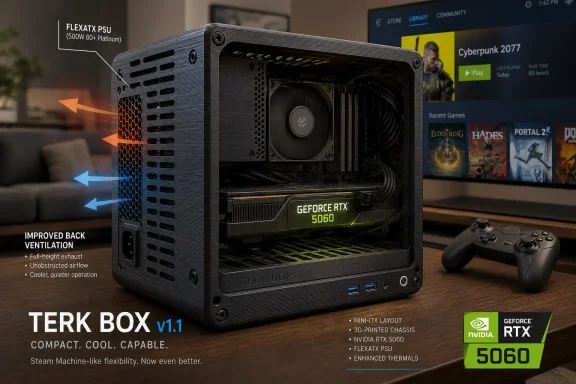
Jacob Terkelsen, an AMD AI GPU engineer and PC enthusiast, showed off a 3D-printed “Terk Box v1.1” on June 24, 2026, using a mini-ITX layout, FlexATX power supply, and Nvidia RTX 5060 inside a compact Steam Machine-like enclosure. The build is not an official AMD project, not a Valve product, and not a simple proof that Valve’s $1,049 living-room PC is easy to undercut. It is something more interesting: a reminder that small-form-factor PC building is where neat spec-sheet arguments go to get humbled by thermals, acoustics, driver support, and mechanical design. The Steam Machine may be expensive, but the DIY alternative is not automatically cheap, quiet, polished, or living-room ready.
The Terk Box landed at exactly the right moment to become internet bait. Valve’s revived Steam Machine has just been priced from $1,049, and the old PC-gamer reflex kicked in almost instantly: surely a hobbyist can build something faster, cheaper, and cooler-looking with off-the-shelf parts. Terkelsen’s little cube appears, with an RTX 5060 where Valve’s semi-custom AMD graphics live, and the comparison writes itself.
But that comparison is also where the story starts to wobble. A raw GPU upgrade is not the same thing as a product. Terkelsen himself pushed back on the assumption that the build was a tidy sub-$1,000 dunk on Valve, saying the cost was “nowhere close to $1000” and explicitly recommending Valve’s fully engineered solution for the software and mechanical design.
That caveat matters because the Steam Machine is not being sold as the fastest possible PC for the money. It is being sold as a couch PC that behaves more like a console: predictable, compact, supported, and tuned for an operating system that boots directly into the games-first Steam experience. Enthusiasts can dislike the price and still admit that those qualities are expensive to deliver.
The Terk Box v1.1 is exciting because it shows what builders can do now that Valve has moved SteamOS closer to a general PC platform. It is also exciting because it shows how far the gap remains between “I built one” and “you should buy or copy one.”
In a normal mid-tower, mistakes have room to breathe. A slightly inefficient airflow path, an overenthusiastic GPU, or a PSU with awkward cabling can be worked around with another fan, a different mounting point, or just the blessed emptiness of a larger case. In a compact cube, every millimeter becomes a negotiation between heat, noise, rigidity, serviceability, and component compatibility.
That is why the most important detail in Terkelsen’s post was not the RTX 5060. It was the admission that the design needed more ventilation in the back because the GPU was being choked. This is the small-form-factor experience in miniature: the first version works, the second version breathes, the third version hopefully stops sounding like a hair dryer.
A 400W FlexATX power supply is another tell. FlexATX units are useful in compact builds because they save space, but they are rarely loved for silence. The smaller the PSU fan and the tighter the enclosure, the more the builder is fighting physics rather than merely shopping for components.
This is where Valve’s industrial design earns part of its price. A commercial box has to survive a living room, a dusty shelf, a distracted user, years of heat cycles, and a warranty process. A maker project only has to be good enough for the builder to enjoy, revise, and explain.
But a living-room gaming box is not a GPU benchmark in cube form. The first-order question is not whether the RTX 5060 can outrun Valve’s GPU in ideal conditions. It is whether that performance can be sustained inside a printed enclosure with acceptable noise and temperature behavior while the rest of the platform remains stable.
That is the cruel trick of compact gaming PCs. The part that wins the benchmark may be the same part that complicates the build. Modern GPUs are not merely chips; they are coolers, board layouts, power connectors, transient loads, driver stacks, display behaviors, and firmware assumptions.
Valve’s hardware may look less exciting because it is less modular. But that integration also lets Valve define the thermal envelope, the fan curve, the firmware behavior, and the SteamOS experience as one system. The DIY builder gets freedom, and freedom often arrives with a troubleshooting bill.
Microsoft’s Xbox Full Screen Experience is an attempt to close that gap. It makes Windows feel less like a desktop OS dragged to the couch and more like something designed for a controller-first session. For a custom RTX 5060 box, that matters because official SteamOS support for Nvidia GPUs remains a work in progress.
The irony is hard to miss. A homebuilt Steam Machine clone with an Nvidia GPU is, at least for now, most straightforwardly a Windows gaming PC in Steam Machine cosplay. It can launch Steam Big Picture, Game Pass, Epic, Battle.net, emulators, and anything else Windows can tolerate, but it is not the same proposition as Valve’s SteamOS appliance.
Terkelsen noted that Linux is much better these days and that the build would support alternatives such as Bazzite or CachyOS. That is true, and it is important. Community Linux gaming distributions have done remarkable work turning the Steam Deck’s success into a broader desktop movement.
Still, “would support” is not the same as “ships supported.” Valve’s first-party box gives buyers a defined target. A DIY RTX build gives enthusiasts a weekend, a Discord search history, and the satisfaction of owning the entire mess.
Valve is selling an operating environment as much as hardware. SteamOS, Proton, shader pre-caching, controller integration, suspend-and-resume behavior, the Steam storefront, cloud saves, community layouts, and console-like updates are the real bundle. The box is the visible part of a platform strategy.
That strategy only works if SteamOS becomes credible beyond handhelds. The Steam Deck proved that Linux gaming could be good enough when the hardware target was fixed. The Steam Machine is Valve’s attempt to bring that lesson back to the living room after the original Steam Machines failed in the mid-2010s under the weight of weak software support, confusing hardware variation, and a market that was not ready.
The difference this time is Proton. Windows game compatibility on Linux is no longer a theoretical pitch to developers; it is a consumer feature that millions of Steam Deck users already understand. That gives Valve a stronger foundation than it had a decade ago.
But the same ecosystem logic is why Nvidia support matters so much. The DIY PC market is full of GeForce cards. If SteamOS remains most comfortable on AMD graphics, then the “build your own Steam Machine” dream will keep splitting into two camps: official-feeling AMD builds and better-supported-by-Windows Nvidia builds.
Sometimes that is true. Often it is true in a narrow and mostly unhelpful way. A skilled builder can absolutely assemble a faster compact PC than Valve’s Steam Machine, especially if the goal is maximum raster performance in a small box. The question is whether that builder can also match the total experience.
A consumer product has to make compromises that enthusiasts can ignore. It has to be manufacturable, shippable, repairable, consistent, certifiable, and understandable to buyers who do not want to debate RAM topology, GPU thermals, or whether the latest Linux kernel fixed their HDMI audio bug. It has to work after an update, not just after a forum thread.
Terkelsen’s own response is striking because it cuts against the way the internet wanted to use his project. He did not present the Terk Box as proof that Valve was foolish. He presented it as a personal project and then stressed the difficulty of small-form-factor builds.
That honesty makes the project more valuable, not less. It moves the conversation from “look, Valve got owned” to “look, this is what the enthusiast version of the idea requires.” That is a much more useful lesson.
But 3D printing also changes the failure modes. Printed plastics vary by material, printer calibration, wall thickness, infill, heat resistance, and post-processing. What works for one builder may warp, resonate, crack, or simply look rough for another.
A commercial enclosure is boring for good reasons. It is designed around repeatable tolerances, airflow modeling, material behavior, assembly time, regulatory constraints, and user abuse. Nobody applauds a stamped vent pattern until the alternative is a GPU that cannot breathe.
That does not diminish the value of the Terk Box. It places it in the right category. It is not a product that happens to be homemade; it is a prototype that demonstrates a direction.
The fact that Terkelsen is working with the designer on future improvements is exactly how these projects should develop. More ventilation, better internal routing, cleaner GPU support, quieter PSU options, and perhaps AMD-oriented SteamOS-friendly variants could all turn this from a clever clone into a small ecosystem of living-room PC experiments.
They are threatening because the reason people are excited about Steam Machine clones is not just the hardware. It is the possibility of escaping the Windows desktop in the living room. The modern PC gamer may tolerate Windows at a desk, but on a television the cracks are harder to forgive.
Updates, pop-ups, account prompts, driver utilities, storefront launchers, notification surfaces, and legacy UI all feel more intrusive when the machine is ten feet away and controlled with a gamepad. Microsoft has spent years trying to make Windows more console-like for gaming, but the operating system still carries decades of desktop expectations into every room it enters.
Xbox Full Screen Experience is therefore more than a cosmetic feature. It is Microsoft recognizing that the living-room PC cannot be treated as a normal Windows desktop with Steam pinned to the taskbar. If Valve owns the couch interface and Linux becomes less scary, Windows has to compete on experience rather than inertia.
That competition is good for users. The worst outcome would be a PC gaming market where Windows remains dominant by default while becoming steadily less pleasant. SteamOS, Bazzite, CachyOS, and other Linux gaming efforts pressure Microsoft to make Windows gaming cleaner, faster, and less hostile to appliance-like use.
That is why the Terk Box became a story so quickly. It gives form to the suspicion that Valve’s machine may be elegant but underpowered for the money. A compact RTX 5060 build is a visual argument that says: why settle?
Valve’s answer is that buyers are not merely paying for components. That answer is defensible, but it has limits. If the performance gap feels too large, or if 8GB of VRAM becomes a visible constraint in the games people actually play, polish will not silence the criticism.
The memory and component market has also made every hardware conversation more combustible. Storage, RAM, GPUs, and power supplies have all been affected by pricing pressures in recent years, and consumers are less willing to accept vague explanations when they can see retail parts listings every day. Valve’s claim to be selling hardware in line with component costs may be reasonable, but reasonableness does not create excitement.
This is where the Steam Machine has to succeed as a machine, not as a spreadsheet. If it is quiet, stable, responsive, and dramatically easier to live with than a Windows mini-PC, it will have an argument. If it feels like an expensive low-midrange PC with a nicer launcher, the DIY crowd will not be the only skeptical audience.
Some will target Nvidia performance and use Windows or community Linux distributions. Some will stay AMD-only to chase the cleanest SteamOS path. Some will cram absurd GPUs into shoeboxes and declare victory until the first summer heat wave. Others will produce practical, reproducible builds that become templates for the wider community.
That is healthy. The original Steam Machine era suffered partly because Valve tried to create a platform through OEM fragmentation before the software was ready. This time, the platform is more mature, the community is larger, and the Steam Deck has trained users to understand what SteamOS is for.
But the community will also expose every limitation. If Valve’s hardware is too expensive, builders will show alternatives. If SteamOS is too AMD-centric, Nvidia users will keep drifting to Windows or Bazzite. If Microsoft improves the living-room Windows experience, some of the pressure on SteamOS will ease.
The Terk Box is therefore less a Steam Machine killer than a Steam Machine stress test. It asks whether Valve’s concept is strong enough to survive imitation. The best platforms usually are.
The most concrete lessons are narrower, and more useful:
 The Clone Makes Valve Look Expensive, Then Makes Valve Look Sane
The Terk Box landed at exactly the right moment to become internet bait. Valve’s revived Steam Machine has just been priced from $1,049, and the old PC-gamer reflex kicked in almost instantly: surely a hobbyist can build something faster, cheaper, and cooler-looking with off-the-shelf parts. Terkelsen’s little cube appears, with an RTX 5060 where Valve’s semi-custom AMD graphics live, and the comparison writes itself.But that comparison is also where the story starts to wobble. A raw GPU upgrade is not the same thing as a product. Terkelsen himself pushed back on the assumption that the build was a tidy sub-$1,000 dunk on Valve, saying the cost was “nowhere close to $1000” and explicitly recommending Valve’s fully engineered solution for the software and mechanical design.
That caveat matters because the Steam Machine is not being sold as the fastest possible PC for the money. It is being sold as a couch PC that behaves more like a console: predictable, compact, supported, and tuned for an operating system that boots directly into the games-first Steam experience. Enthusiasts can dislike the price and still admit that those qualities are expensive to deliver.
The Terk Box v1.1 is exciting because it shows what builders can do now that Valve has moved SteamOS closer to a general PC platform. It is also exciting because it shows how far the gap remains between “I built one” and “you should buy or copy one.”
Small PCs Punish Optimism More Efficiently Than Full Towers
The physical dimensions are the hook. The 3D-printed chassis is roughly 167mm by 168mm by 225mm, putting it in the same visual neighborhood as Valve’s cube. That is small enough to feel like an appliance, not a desktop tower pretending to be welcome under the television.In a normal mid-tower, mistakes have room to breathe. A slightly inefficient airflow path, an overenthusiastic GPU, or a PSU with awkward cabling can be worked around with another fan, a different mounting point, or just the blessed emptiness of a larger case. In a compact cube, every millimeter becomes a negotiation between heat, noise, rigidity, serviceability, and component compatibility.
That is why the most important detail in Terkelsen’s post was not the RTX 5060. It was the admission that the design needed more ventilation in the back because the GPU was being choked. This is the small-form-factor experience in miniature: the first version works, the second version breathes, the third version hopefully stops sounding like a hair dryer.
A 400W FlexATX power supply is another tell. FlexATX units are useful in compact builds because they save space, but they are rarely loved for silence. The smaller the PSU fan and the tighter the enclosure, the more the builder is fighting physics rather than merely shopping for components.
This is where Valve’s industrial design earns part of its price. A commercial box has to survive a living room, a dusty shelf, a distracted user, years of heat cycles, and a warranty process. A maker project only has to be good enough for the builder to enjoy, revise, and explain.
The RTX 5060 Is the Easy Part of the Argument
On paper, the RTX 5060 inside the Terk Box makes Valve’s graphics choice look conservative. Valve’s Steam Machine uses a semi-custom AMD graphics solution with 8GB of GDDR6 VRAM, generally discussed in the territory of an RTX 3060-class or Radeon RX 7600M-like experience depending on workload and settings. The RTX 5060 is newer, more efficient, and more appealing to anyone who thinks the only interesting number is frame rate.But a living-room gaming box is not a GPU benchmark in cube form. The first-order question is not whether the RTX 5060 can outrun Valve’s GPU in ideal conditions. It is whether that performance can be sustained inside a printed enclosure with acceptable noise and temperature behavior while the rest of the platform remains stable.
That is the cruel trick of compact gaming PCs. The part that wins the benchmark may be the same part that complicates the build. Modern GPUs are not merely chips; they are coolers, board layouts, power connectors, transient loads, driver stacks, display behaviors, and firmware assumptions.
Valve’s hardware may look less exciting because it is less modular. But that integration also lets Valve define the thermal envelope, the fan curve, the firmware behavior, and the SteamOS experience as one system. The DIY builder gets freedom, and freedom often arrives with a troubleshooting bill.
Windows 11 Is the Fallback, SteamOS Is the Prize
The most WindowsForum-relevant detail is that Terkelsen’s build runs Windows 11 with Xbox Full Screen Experience. That choice is practical, and it reveals the awkward middle ground where living-room PC gaming now sits. Windows still has the broadest compatibility story, especially when Nvidia hardware is involved, but it does not become a console interface just because the case is small.Microsoft’s Xbox Full Screen Experience is an attempt to close that gap. It makes Windows feel less like a desktop OS dragged to the couch and more like something designed for a controller-first session. For a custom RTX 5060 box, that matters because official SteamOS support for Nvidia GPUs remains a work in progress.
The irony is hard to miss. A homebuilt Steam Machine clone with an Nvidia GPU is, at least for now, most straightforwardly a Windows gaming PC in Steam Machine cosplay. It can launch Steam Big Picture, Game Pass, Epic, Battle.net, emulators, and anything else Windows can tolerate, but it is not the same proposition as Valve’s SteamOS appliance.
Terkelsen noted that Linux is much better these days and that the build would support alternatives such as Bazzite or CachyOS. That is true, and it is important. Community Linux gaming distributions have done remarkable work turning the Steam Deck’s success into a broader desktop movement.
Still, “would support” is not the same as “ships supported.” Valve’s first-party box gives buyers a defined target. A DIY RTX build gives enthusiasts a weekend, a Discord search history, and the satisfaction of owning the entire mess.
Valve’s Real Product Is Not the Cube
The 2026 Steam Machine conversation keeps collapsing into price-per-frame analysis because PC gamers are trained to do that. If a prebuilt desktop at the same price has a stronger GPU, more storage, or more RAM, then Valve must be overcharging. That argument is not wrong so much as incomplete.Valve is selling an operating environment as much as hardware. SteamOS, Proton, shader pre-caching, controller integration, suspend-and-resume behavior, the Steam storefront, cloud saves, community layouts, and console-like updates are the real bundle. The box is the visible part of a platform strategy.
That strategy only works if SteamOS becomes credible beyond handhelds. The Steam Deck proved that Linux gaming could be good enough when the hardware target was fixed. The Steam Machine is Valve’s attempt to bring that lesson back to the living room after the original Steam Machines failed in the mid-2010s under the weight of weak software support, confusing hardware variation, and a market that was not ready.
The difference this time is Proton. Windows game compatibility on Linux is no longer a theoretical pitch to developers; it is a consumer feature that millions of Steam Deck users already understand. That gives Valve a stronger foundation than it had a decade ago.
But the same ecosystem logic is why Nvidia support matters so much. The DIY PC market is full of GeForce cards. If SteamOS remains most comfortable on AMD graphics, then the “build your own Steam Machine” dream will keep splitting into two camps: official-feeling AMD builds and better-supported-by-Windows Nvidia builds.
The Terk Box Exposes the Weakness of Spec-Sheet Populism
There is a recurring genre of PC discourse that treats every commercial device as an insult to the savvy buyer. A console is just a locked-down PC. A handheld is just laptop parts with a controller. A Steam Machine is just a mini-ITX build with a Linux skin. Therefore, the argument goes, a real enthusiast can build a better one.Sometimes that is true. Often it is true in a narrow and mostly unhelpful way. A skilled builder can absolutely assemble a faster compact PC than Valve’s Steam Machine, especially if the goal is maximum raster performance in a small box. The question is whether that builder can also match the total experience.
A consumer product has to make compromises that enthusiasts can ignore. It has to be manufacturable, shippable, repairable, consistent, certifiable, and understandable to buyers who do not want to debate RAM topology, GPU thermals, or whether the latest Linux kernel fixed their HDMI audio bug. It has to work after an update, not just after a forum thread.
Terkelsen’s own response is striking because it cuts against the way the internet wanted to use his project. He did not present the Terk Box as proof that Valve was foolish. He presented it as a personal project and then stressed the difficulty of small-form-factor builds.
That honesty makes the project more valuable, not less. It moves the conversation from “look, Valve got owned” to “look, this is what the enthusiast version of the idea requires.” That is a much more useful lesson.
3D Printing Solves the Shape, Not the Product
The 3D-printed case is the romantic part of the Terk Box. Downloadable files, custom revisions, visible iteration, and a named community designer all make the build feel more alive than another black steel mini-ITX chassis. This is the maker economy at its best: a product category becomes a prompt, and the community starts prototyping in public.But 3D printing also changes the failure modes. Printed plastics vary by material, printer calibration, wall thickness, infill, heat resistance, and post-processing. What works for one builder may warp, resonate, crack, or simply look rough for another.
A commercial enclosure is boring for good reasons. It is designed around repeatable tolerances, airflow modeling, material behavior, assembly time, regulatory constraints, and user abuse. Nobody applauds a stamped vent pattern until the alternative is a GPU that cannot breathe.
That does not diminish the value of the Terk Box. It places it in the right category. It is not a product that happens to be homemade; it is a prototype that demonstrates a direction.
The fact that Terkelsen is working with the designer on future improvements is exactly how these projects should develop. More ventilation, better internal routing, cleaner GPU support, quieter PSU options, and perhaps AMD-oriented SteamOS-friendly variants could all turn this from a clever clone into a small ecosystem of living-room PC experiments.
The Windows Angle Is Bigger Than One Hobby Build
For Microsoft, projects like this are both reassuring and threatening. They are reassuring because the first practical answer for an RTX 5060 living-room PC is still Windows 11. If you want broad launcher support, Game Pass, Nvidia drivers, anti-cheat compatibility, and minimal friction, Windows remains the default.They are threatening because the reason people are excited about Steam Machine clones is not just the hardware. It is the possibility of escaping the Windows desktop in the living room. The modern PC gamer may tolerate Windows at a desk, but on a television the cracks are harder to forgive.
Updates, pop-ups, account prompts, driver utilities, storefront launchers, notification surfaces, and legacy UI all feel more intrusive when the machine is ten feet away and controlled with a gamepad. Microsoft has spent years trying to make Windows more console-like for gaming, but the operating system still carries decades of desktop expectations into every room it enters.
Xbox Full Screen Experience is therefore more than a cosmetic feature. It is Microsoft recognizing that the living-room PC cannot be treated as a normal Windows desktop with Steam pinned to the taskbar. If Valve owns the couch interface and Linux becomes less scary, Windows has to compete on experience rather than inertia.
That competition is good for users. The worst outcome would be a PC gaming market where Windows remains dominant by default while becoming steadily less pleasant. SteamOS, Bazzite, CachyOS, and other Linux gaming efforts pressure Microsoft to make Windows gaming cleaner, faster, and less hostile to appliance-like use.
Price Is the Problem Valve Cannot Hand-Wave Away
None of this makes Valve’s $1,049 starting price painless. At that number, buyers are right to compare the Steam Machine with prebuilt gaming desktops, discounted laptops, used PCs, and DIY configurations. Valve is not pricing against consoles; it is pricing into the psychological territory of real gaming PCs.That is why the Terk Box became a story so quickly. It gives form to the suspicion that Valve’s machine may be elegant but underpowered for the money. A compact RTX 5060 build is a visual argument that says: why settle?
Valve’s answer is that buyers are not merely paying for components. That answer is defensible, but it has limits. If the performance gap feels too large, or if 8GB of VRAM becomes a visible constraint in the games people actually play, polish will not silence the criticism.
The memory and component market has also made every hardware conversation more combustible. Storage, RAM, GPUs, and power supplies have all been affected by pricing pressures in recent years, and consumers are less willing to accept vague explanations when they can see retail parts listings every day. Valve’s claim to be selling hardware in line with component costs may be reasonable, but reasonableness does not create excitement.
This is where the Steam Machine has to succeed as a machine, not as a spreadsheet. If it is quiet, stable, responsive, and dramatically easier to live with than a Windows mini-PC, it will have an argument. If it feels like an expensive low-midrange PC with a nicer launcher, the DIY crowd will not be the only skeptical audience.
Enthusiasts Will Build Better Steam Machines Before Valve Builds the Perfect One
The most likely future is not that Terk Box-like projects replace Valve’s Steam Machine. It is that they create a halo around the category. Once Valve legitimizes the living-room SteamOS PC again, hobbyists will do what hobbyists always do: build stranger, faster, cheaper, louder, quieter, uglier, and occasionally better versions.Some will target Nvidia performance and use Windows or community Linux distributions. Some will stay AMD-only to chase the cleanest SteamOS path. Some will cram absurd GPUs into shoeboxes and declare victory until the first summer heat wave. Others will produce practical, reproducible builds that become templates for the wider community.
That is healthy. The original Steam Machine era suffered partly because Valve tried to create a platform through OEM fragmentation before the software was ready. This time, the platform is more mature, the community is larger, and the Steam Deck has trained users to understand what SteamOS is for.
But the community will also expose every limitation. If Valve’s hardware is too expensive, builders will show alternatives. If SteamOS is too AMD-centric, Nvidia users will keep drifting to Windows or Bazzite. If Microsoft improves the living-room Windows experience, some of the pressure on SteamOS will ease.
The Terk Box is therefore less a Steam Machine killer than a Steam Machine stress test. It asks whether Valve’s concept is strong enough to survive imitation. The best platforms usually are.
The Little RTX Cube Teaches the Hard Lesson Valve Is Charging For
The practical message from Terkelsen’s build is not that everyone should 3D-print a Steam Machine. It is that the category is now real enough for enthusiasts to start arguing with it in hardware. That is a milestone for Valve, even when the argument is unflattering.The most concrete lessons are narrower, and more useful:
- A compact RTX 5060 build can outperform Valve’s Steam Machine on paper, but sustaining that performance in a tiny enclosure requires careful thermal design.
- A 3D-printed case can make a Steam Machine-like PC accessible to hobbyists, but it does not remove the engineering burden that commercial hardware absorbs.
- Windows 11 remains the practical path for Nvidia-based living-room PCs, especially while official SteamOS support for RTX GPUs continues to mature.
- Valve’s $1,049 price is vulnerable to spec comparisons, but its strongest defense is the integrated SteamOS experience rather than raw component value.
- The DIY Steam Machine scene will probably grow quickly, but the best builds will come from iteration, not from simply stuffing stronger parts into smaller boxes.
References
- Primary source: Windows Central
Published: 2026-06-29T15:23:11.699083
Loading…
www.windowscentral.com - Related coverage: tomshardware.com
Loading…
www.tomshardware.com - Related coverage: pcgamer.com
Valve greenlights SteamOS installs on normal PCs with AMD GPUs, so you can go make your own Steam Machine if you don't wanna fork over $1,049 | PC Gamer
Not all of us have Machine money.www.pcgamer.com - Related coverage: techradar.com
Loading…
www.techradar.com - Related coverage: notebookcheck.net
Loading…
www.notebookcheck.net - Related coverage: phoronix.com
Steam Machine Launches, Priced $1049 To $1428 USD - Phoronix
Valve today finally revealed pricing on their SteamOS Linux-powered Steam Machine living room PCwww.phoronix.com
- Related coverage: gematsu.com
Steam Machine launches June 30, starting at $1,049 - Gematsu
Steam Machine will launch on June 30, Valve announced. The 512 gigabyte model without a controller will be priced at $1,049, while the two terabyte model with a…www.gematsu.com - Related coverage: notebookcheck-cn.com
Loading…
www.notebookcheck-cn.com - Related coverage: tweaktown.com
Loading…
www.tweaktown.com - Related coverage: techspot.com
Valve's Steam Machine is here: starts at $1,049 for 512GB or $1,349 for the 2TB version | TechSpot
Under the hood, the Steam Machine packs a semi-custom AMD platform: a 6-core, 12-thread Zen 4 CPU clocked up to 4.86GHz, an RDNA 3 GPU with 28...www.techspot.com - Related coverage: pcper.com
Loading…
pcper.com - Related coverage: tech4gamers.com
Loading…
tech4gamers.com - Related coverage: worthplaying.com
Loading…
www.worthplaying.com - Related coverage: shacknews.com
Steam Machine price revealed, starting at $1049 | Shacknews
Steam Machine pricing has been revealed for a base 512GB version and a 2TB version that comes with a Steam Controller.www.shacknews.com - Related coverage: tomsguide.com
Valve confirms you can build your own Steam Machine with latest SteamOS update | Tom's Guide
Valve confirmed that you can build your own Steam Machine PC with the most recent SteamOS update.www.tomsguide.com - Related coverage: gamespot.com
Valve Releases SteamOS So Anyone Can Make A Steam Machine Now - GameSpot
With SteamOS 3.8 out now, you can turn your existing PC into a Steam Machine.www.gamespot.com - Related coverage: technobaboy.com
Loading…
www.technobaboy.com - Related coverage: gamingonlinux.com
Loading…
www.gamingonlinux.com - Related coverage: gameluster.com
Loading…
gameluster.com - Related coverage: overclock3d.net
AMD GPU users can now build their own Steam Machines - OC3D
PC gamers can now build their own Steam Machines with AMD Radeon GPUs. Support for other GPUs is planned, but it won't arrive soon.overclock3d.net