

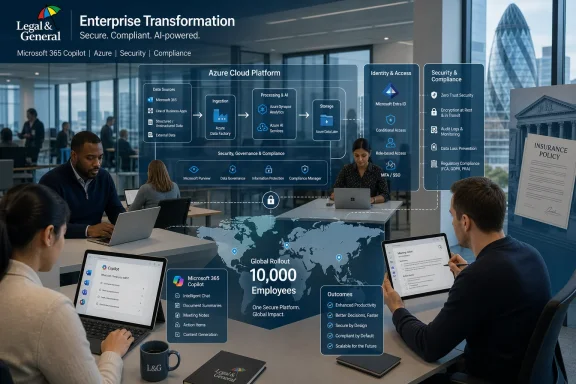
Legal & General announced on June 29, 2026, that it has expanded its Microsoft relationship through a new three-year agreement covering Microsoft 365 Copilot for 10,000 global employees and broader Azure use to modernise its technology platforms. The announcement is not merely another corporate AI press release; it is a useful marker of where enterprise generative AI is moving next. For WindowsForum readers, the interesting part is not that a large insurer bought more Microsoft software. It is that Microsoft’s AI stack is becoming the default operating layer for heavily regulated businesses that want transformation without tearing out their existing systems.
The headline number is clean: 10,000 employees, globally, with Microsoft 365 Copilot embedded into everyday work. That is the sort of figure Microsoft likes because it turns Copilot from a product demo into a population-scale deployment. For L&G, it turns generative AI from a specialist tool into office infrastructure.
That distinction matters. A limited AI pilot can be treated as innovation theatre, assigned to a controlled group, measured with friendly metrics, and quietly retired if it disappoints. A company-wide Copilot deployment is harder to dismiss because it lands inside Outlook, Teams, Word, Excel, PowerPoint, and the Microsoft Graph permissions model that already shapes how employees find and share information.
L&G’s stated aim is familiar: reduce administrative work, accelerate insight generation, and free staff to spend more time helping customers. Those are exactly the white-collar bottlenecks Microsoft has been targeting since it repositioned Copilot as the productivity layer above Microsoft 365 rather than a standalone chatbot. The bet is that AI will be most valuable when it appears where the work already happens.
The more consequential claim is not that Copilot can summarise meetings or draft documents. It is that an insurer can standardise AI-assisted knowledge work across functions without losing control of data, compliance, or auditability. That is the promise Microsoft is selling to regulated industries, and L&G is now one of the more visible UK examples.
That language can sound generic, but in financial services it points to a real architectural shift. Large insurers rarely suffer from a shortage of data; they suffer from fragmented systems, ageing platforms, duplicated customer records, and the governance burden created by decades of incremental technology decisions. AI does not solve that mess by magic. In many cases, it exposes it.
This is why the Azure side of the agreement is not just a cloud migration footnote. Copilot’s usefulness depends heavily on what the organisation’s data estate looks like, how access controls are designed, and whether employees can retrieve reliable information without tripping over stale repositories. If the foundations are weak, AI becomes a faster way to produce confident summaries of bad information.
For Microsoft, the combination is the sales motion. Copilot increases demand for data readiness, identity hygiene, governance, and cloud services. Azure then becomes the place where those capabilities are built, scaled, and measured. The product pitch is productivity; the platform consequence is deeper dependency on Microsoft’s cloud.
That claim gives the announcement a sharper edge. The enterprise AI market has been crowded with productivity anecdotes: faster meeting notes, cleaner email drafts, better first versions of slide decks. Useful, certainly, but not always strategic. Customer experience gives executives something more boardroom-friendly: a line between AI investment and customer outcomes.
The mechanism L&G describes is also telling. Service teams are getting a real-time view of customer interactions while AI streamlines processes around them. In plain English, that means the insurer is trying to collapse the gap between customer history, employee action, and operational workflow. For customers, the ideal result is fewer repetitions, fewer handoffs, and fewer cases where the person on the other end of the line appears to know less than the system should.
This is where AI in financial services becomes less about novelty and more about expectation management. Customers do not care whether an agent used Copilot, Dynamics, Azure AI, or a bespoke workflow engine. They care whether the company can answer accurately, act quickly, and avoid making them explain the same problem three times.
Those traits make the industry both promising and difficult. Policies, claims, pensions, workplace savings, underwriting, complaints, and regulatory communications all involve large volumes of structured and unstructured information. Generative AI can help employees navigate that material, but it also raises the cost of mistakes. A hallucinated summary in a casual brainstorming session is annoying; a hallucinated customer-facing answer in financial services is a governance problem.
That is why the L&G announcement fits a broader pattern of Microsoft pushing Copilot into large organisations that already depend on Microsoft 365, Teams, Entra, Purview, Dynamics, and Azure. The sales pitch is not simply “use AI.” It is “use AI inside the environment your security, compliance, and identity teams already understand.”
This is Microsoft’s strongest enterprise argument against more free-floating AI tools. A standalone chatbot may produce impressive answers, but it sits awkwardly next to permissions, retention policies, audit logs, data residency requirements, and regulated workflows. Copilot’s advantage is not always model quality; it is institutional fit.
Generative AI adoption requires more than a launch email and a few prompt-writing workshops. Employees need to know when AI is appropriate, when it is risky, and when it is simply a slower way to do work they already understand. Managers need metrics that distinguish real productivity from activity inflation. Security teams need to revisit access controls that may have been tolerable when humans searched manually but become dangerous when AI can surface information instantly.
This is the uncomfortable truth behind enterprise Copilot deployments: AI makes information architecture visible. If a company has over-permissive SharePoint sites, poorly labelled documents, abandoned Teams channels, and inconsistent retention policies, Copilot can turn those quiet weaknesses into front-line operational issues. The tool does not create every governance problem, but it can make existing ones easier to discover at scale.
L&G’s emphasis on modernising its technology estate therefore reads as more than corporate housekeeping. It is the prerequisite for making Copilot useful rather than chaotic. The companies that benefit most from enterprise AI will not necessarily be those with the most licenses; they will be those with the cleanest data boundaries and the clearest operating rules.
L&G has offered one customer-experience metric, and that is more concrete than many AI announcements provide. Still, Net Promoter Score is influenced by many factors, from service staffing to product design to broader customer sentiment. The company’s challenge will be to show that Copilot and Azure-enabled changes are not just correlated with better service but materially contributing to it.
For IT leaders, the more practical measurements will be less glamorous. They will want to know whether case handling times fall, whether first-contact resolution improves, whether compliance escalations decline, whether employees trust AI-generated summaries, and whether customer complaints about inconsistency decrease. They will also want to see whether productivity gains survive beyond the initial excitement of a new tool.
That is where the three-year term becomes important. A one-year pilot can show enthusiasm. A three-year agreement has to show operational absorption. By the end of it, Copilot will either be a normal part of work at L&G or another layer of software employees tolerate because the organisation bought it for them.
This is not accidental bundling; it is ecosystem design. Microsoft does not need every Copilot interaction to be revolutionary if Copilot makes Microsoft’s broader cloud stack more central to daily operations. The value is cumulative. Every AI-assisted meeting recap, customer summary, policy search, or workflow automation deepens the case for keeping work inside Microsoft’s environment.
The strategy also blurs the line between desktop productivity and enterprise architecture. For decades, Office was the place workers produced documents while back-end systems did the “serious” business processing. Copilot collapses some of that separation by making productivity tools aware of organisational context. In a company like L&G, that means the office suite increasingly becomes a front end for enterprise knowledge.
WindowsForum readers should recognise the shape of this shift. Microsoft has always been strongest when it turns a tool into a platform and a platform into a dependency. Copilot is following that familiar path, but at cloud speed and with AI as the accelerant.
That is why AI enablement is becoming part of the sysadmin workload. Rolling out Copilot across 10,000 users means thinking about permissions, sensitivity labels, conditional access, device security, data loss prevention, audit trails, and user training. It also means deciding which workflows should remain human-controlled and which can safely be AI-assisted.
The endpoint still matters because AI does not remove the need for secure devices. If anything, it increases the stakes. A compromised account with access to AI-assisted search and summarisation may be more dangerous than a compromised account in a less connected environment. The ability to ask natural-language questions across corporate data changes the threat model.
For Windows admins, the lesson is that AI adoption will rarely arrive as a single project called “AI.” It will appear through Microsoft 365 licensing, Teams features, Edge integrations, Azure services, security baselines, and business-unit demands for automation. The work will be distributed, and so will the risk.
In consumer AI, the demo is often enough to create excitement. In regulated enterprise AI, the demo is the beginning of the argument. The real questions are whether the system respects permissions, whether it can be monitored, whether outputs can be challenged, whether data residency rules are satisfied, and whether the business can explain what happened when a decision is disputed.
This is one reason Microsoft has an advantage in large organisations despite intense competition from model providers and AI-native challengers. Many enterprises do not want to assemble governance from scratch around a dozen disconnected tools. They want AI inserted into an existing control plane, even if that means accepting Microsoft’s design choices and commercial terms.
That trade-off will define the next phase of adoption. Companies may gain speed, consistency, and integration by standardising on Microsoft’s stack. They may also lose bargaining power, architectural flexibility, and some ability to choose best-of-breed tools in each category. L&G’s agreement is a vote for integration over fragmentation.
If L&G employees begin treating AI-generated summaries, drafts, and insights as ordinary parts of daily work, the deployment will have crossed an important threshold. If service teams can use those capabilities to resolve issues faster without weakening oversight, the customer-experience argument gets stronger. If Azure modernisation reduces fragmentation and improves data quality, the Copilot investment becomes easier to defend.
But if employees see Copilot as a costly autocomplete layer, or if governance teams spend more time cleaning up access problems than enabling new workflows, the story changes. Enterprise AI is not immune to the old laws of IT. Bad data remains bad data, unclear ownership remains unclear ownership, and automation without process discipline still produces faster confusion.
That is why the L&G deal should be read as a serious commitment rather than a finished achievement. It gives the insurer the tools and platform alignment to pursue AI-enabled transformation. It does not guarantee the transformation.
 L&G Turns Copilot From Pilot Project Into Workplace Plumbing
The headline number is clean: 10,000 employees, globally, with Microsoft 365 Copilot embedded into everyday work. That is the sort of figure Microsoft likes because it turns Copilot from a product demo into a population-scale deployment. For L&G, it turns generative AI from a specialist tool into office infrastructure.That distinction matters. A limited AI pilot can be treated as innovation theatre, assigned to a controlled group, measured with friendly metrics, and quietly retired if it disappoints. A company-wide Copilot deployment is harder to dismiss because it lands inside Outlook, Teams, Word, Excel, PowerPoint, and the Microsoft Graph permissions model that already shapes how employees find and share information.
L&G’s stated aim is familiar: reduce administrative work, accelerate insight generation, and free staff to spend more time helping customers. Those are exactly the white-collar bottlenecks Microsoft has been targeting since it repositioned Copilot as the productivity layer above Microsoft 365 rather than a standalone chatbot. The bet is that AI will be most valuable when it appears where the work already happens.
The more consequential claim is not that Copilot can summarise meetings or draft documents. It is that an insurer can standardise AI-assisted knowledge work across functions without losing control of data, compliance, or auditability. That is the promise Microsoft is selling to regulated industries, and L&G is now one of the more visible UK examples.
Azure Is the Deal’s Quieter, More Durable Half
Copilot gets the attention because it is visible to employees. Azure is the part of the agreement that may matter more over the three-year term. L&G says it will expand Azure use to support modernisation of its technology estate, move key platforms to the cloud, and strengthen its ability to manage and analyse large volumes of data securely.That language can sound generic, but in financial services it points to a real architectural shift. Large insurers rarely suffer from a shortage of data; they suffer from fragmented systems, ageing platforms, duplicated customer records, and the governance burden created by decades of incremental technology decisions. AI does not solve that mess by magic. In many cases, it exposes it.
This is why the Azure side of the agreement is not just a cloud migration footnote. Copilot’s usefulness depends heavily on what the organisation’s data estate looks like, how access controls are designed, and whether employees can retrieve reliable information without tripping over stale repositories. If the foundations are weak, AI becomes a faster way to produce confident summaries of bad information.
For Microsoft, the combination is the sales motion. Copilot increases demand for data readiness, identity hygiene, governance, and cloud services. Azure then becomes the place where those capabilities are built, scaled, and measured. The product pitch is productivity; the platform consequence is deeper dependency on Microsoft’s cloud.
Customer Experience Is the Proof Point Microsoft Wants
L&G is not positioning this as a back-office automation exercise alone. The company says its existing Microsoft collaboration has already supported faster and more seamless service for more than 12 million customers in its Retail business. It also points to an eight-point year-on-year increase in Net Promoter Score during the first quarter in DC & Workplace Savings.That claim gives the announcement a sharper edge. The enterprise AI market has been crowded with productivity anecdotes: faster meeting notes, cleaner email drafts, better first versions of slide decks. Useful, certainly, but not always strategic. Customer experience gives executives something more boardroom-friendly: a line between AI investment and customer outcomes.
The mechanism L&G describes is also telling. Service teams are getting a real-time view of customer interactions while AI streamlines processes around them. In plain English, that means the insurer is trying to collapse the gap between customer history, employee action, and operational workflow. For customers, the ideal result is fewer repetitions, fewer handoffs, and fewer cases where the person on the other end of the line appears to know less than the system should.
This is where AI in financial services becomes less about novelty and more about expectation management. Customers do not care whether an agent used Copilot, Dynamics, Azure AI, or a bespoke workflow engine. They care whether the company can answer accurately, act quickly, and avoid making them explain the same problem three times.
The Insurance Sector Is Becoming Microsoft’s AI Showcase
Microsoft’s UK leadership framed the L&G deal in sector-wide terms, arguing that AI will define the next decade of growth, resilience, and customer trust in UK insurance. That is vendor positioning, but it is not empty positioning. Insurance is an attractive showcase for enterprise AI because it is document-heavy, data-rich, process-bound, and customer-facing.Those traits make the industry both promising and difficult. Policies, claims, pensions, workplace savings, underwriting, complaints, and regulatory communications all involve large volumes of structured and unstructured information. Generative AI can help employees navigate that material, but it also raises the cost of mistakes. A hallucinated summary in a casual brainstorming session is annoying; a hallucinated customer-facing answer in financial services is a governance problem.
That is why the L&G announcement fits a broader pattern of Microsoft pushing Copilot into large organisations that already depend on Microsoft 365, Teams, Entra, Purview, Dynamics, and Azure. The sales pitch is not simply “use AI.” It is “use AI inside the environment your security, compliance, and identity teams already understand.”
This is Microsoft’s strongest enterprise argument against more free-floating AI tools. A standalone chatbot may produce impressive answers, but it sits awkwardly next to permissions, retention policies, audit logs, data residency requirements, and regulated workflows. Copilot’s advantage is not always model quality; it is institutional fit.
The Hard Part Is Not Buying Copilot
The risk in announcements like this is that procurement begins to masquerade as transformation. Buying Copilot licenses is the easy part. Making thousands of employees use the tool well, safely, and consistently is the hard part.Generative AI adoption requires more than a launch email and a few prompt-writing workshops. Employees need to know when AI is appropriate, when it is risky, and when it is simply a slower way to do work they already understand. Managers need metrics that distinguish real productivity from activity inflation. Security teams need to revisit access controls that may have been tolerable when humans searched manually but become dangerous when AI can surface information instantly.
This is the uncomfortable truth behind enterprise Copilot deployments: AI makes information architecture visible. If a company has over-permissive SharePoint sites, poorly labelled documents, abandoned Teams channels, and inconsistent retention policies, Copilot can turn those quiet weaknesses into front-line operational issues. The tool does not create every governance problem, but it can make existing ones easier to discover at scale.
L&G’s emphasis on modernising its technology estate therefore reads as more than corporate housekeeping. It is the prerequisite for making Copilot useful rather than chaotic. The companies that benefit most from enterprise AI will not necessarily be those with the most licenses; they will be those with the cleanest data boundaries and the clearest operating rules.
Productivity Promises Now Need Evidence
Microsoft and its customers have spent the past two years telling variations of the same story: AI will reduce drudgery, improve collaboration, and give employees more time for valuable work. That may be true, but the next phase of enterprise AI will demand harder evidence. The market is moving from belief to measurement.L&G has offered one customer-experience metric, and that is more concrete than many AI announcements provide. Still, Net Promoter Score is influenced by many factors, from service staffing to product design to broader customer sentiment. The company’s challenge will be to show that Copilot and Azure-enabled changes are not just correlated with better service but materially contributing to it.
For IT leaders, the more practical measurements will be less glamorous. They will want to know whether case handling times fall, whether first-contact resolution improves, whether compliance escalations decline, whether employees trust AI-generated summaries, and whether customer complaints about inconsistency decrease. They will also want to see whether productivity gains survive beyond the initial excitement of a new tool.
That is where the three-year term becomes important. A one-year pilot can show enthusiasm. A three-year agreement has to show operational absorption. By the end of it, Copilot will either be a normal part of work at L&G or another layer of software employees tolerate because the organisation bought it for them.
Microsoft’s Enterprise AI Strategy Runs Through Familiar Doors
For Microsoft, L&G’s expansion is strategically neat because it reinforces the company’s preferred AI adoption path. The user enters through Microsoft 365 Copilot. The organisation then confronts data, governance, workflow, and integration requirements. Those requirements pull more work toward Azure, Microsoft Graph, Purview, Entra, Dynamics, Copilot Studio, and related services.This is not accidental bundling; it is ecosystem design. Microsoft does not need every Copilot interaction to be revolutionary if Copilot makes Microsoft’s broader cloud stack more central to daily operations. The value is cumulative. Every AI-assisted meeting recap, customer summary, policy search, or workflow automation deepens the case for keeping work inside Microsoft’s environment.
The strategy also blurs the line between desktop productivity and enterprise architecture. For decades, Office was the place workers produced documents while back-end systems did the “serious” business processing. Copilot collapses some of that separation by making productivity tools aware of organisational context. In a company like L&G, that means the office suite increasingly becomes a front end for enterprise knowledge.
WindowsForum readers should recognise the shape of this shift. Microsoft has always been strongest when it turns a tool into a platform and a platform into a dependency. Copilot is following that familiar path, but at cloud speed and with AI as the accelerant.
The Windows Angle Is Bigger Than Windows
This announcement is not about a Windows feature update, but it belongs in the Windows ecosystem story. Microsoft 365 Copilot, Azure, Entra, Teams, Edge, and Windows endpoints are now pieces of the same enterprise operating environment. The user may experience Copilot as a button in an app, but administrators experience it as an identity, data, compliance, endpoint, and licensing problem.That is why AI enablement is becoming part of the sysadmin workload. Rolling out Copilot across 10,000 users means thinking about permissions, sensitivity labels, conditional access, device security, data loss prevention, audit trails, and user training. It also means deciding which workflows should remain human-controlled and which can safely be AI-assisted.
The endpoint still matters because AI does not remove the need for secure devices. If anything, it increases the stakes. A compromised account with access to AI-assisted search and summarisation may be more dangerous than a compromised account in a less connected environment. The ability to ask natural-language questions across corporate data changes the threat model.
For Windows admins, the lesson is that AI adoption will rarely arrive as a single project called “AI.” It will appear through Microsoft 365 licensing, Teams features, Edge integrations, Azure services, security baselines, and business-unit demands for automation. The work will be distributed, and so will the risk.
Regulated AI Will Be Won in the Boring Layers
The most important parts of L&G’s announcement are not futuristic. They are the boring layers: cloud migration, data management, service workflows, employee productivity, customer records, and security controls. That is where enterprise AI will either become durable or disappoint.In consumer AI, the demo is often enough to create excitement. In regulated enterprise AI, the demo is the beginning of the argument. The real questions are whether the system respects permissions, whether it can be monitored, whether outputs can be challenged, whether data residency rules are satisfied, and whether the business can explain what happened when a decision is disputed.
This is one reason Microsoft has an advantage in large organisations despite intense competition from model providers and AI-native challengers. Many enterprises do not want to assemble governance from scratch around a dozen disconnected tools. They want AI inserted into an existing control plane, even if that means accepting Microsoft’s design choices and commercial terms.
That trade-off will define the next phase of adoption. Companies may gain speed, consistency, and integration by standardising on Microsoft’s stack. They may also lose bargaining power, architectural flexibility, and some ability to choose best-of-breed tools in each category. L&G’s agreement is a vote for integration over fragmentation.
The Real Test Comes After the Announcement Cycle
The next few months will not prove much. Large enterprise technology programmes often look best at the moment of announcement, before adoption friction, exception handling, budget scrutiny, and user fatigue arrive. The more useful test will come when Copilot is no longer new.If L&G employees begin treating AI-generated summaries, drafts, and insights as ordinary parts of daily work, the deployment will have crossed an important threshold. If service teams can use those capabilities to resolve issues faster without weakening oversight, the customer-experience argument gets stronger. If Azure modernisation reduces fragmentation and improves data quality, the Copilot investment becomes easier to defend.
But if employees see Copilot as a costly autocomplete layer, or if governance teams spend more time cleaning up access problems than enabling new workflows, the story changes. Enterprise AI is not immune to the old laws of IT. Bad data remains bad data, unclear ownership remains unclear ownership, and automation without process discipline still produces faster confusion.
That is why the L&G deal should be read as a serious commitment rather than a finished achievement. It gives the insurer the tools and platform alignment to pursue AI-enabled transformation. It does not guarantee the transformation.
L&G’s Microsoft Bet Narrows the AI Debate to Execution
The useful reading of this deal is practical rather than breathless. L&G is not experimenting at the margins; it is standardising Microsoft’s AI and cloud stack across employee productivity, platform modernisation, and customer-service improvement.- L&G is extending Microsoft 365 Copilot to 10,000 employees globally under a new three-year agreement.
- The company is expanding Azure use to modernise core technology platforms and strengthen data management.
- The customer-experience case rests partly on prior work in Retail, including support for more than 12 million customers and a reported eight-point year-on-year NPS increase in DC & Workplace Savings during the first quarter.
- The deployment’s success will depend on governance, permissions, training, and data quality as much as on Copilot’s model capabilities.
- Microsoft benefits because Copilot adoption tends to pull enterprises deeper into Azure, identity, compliance, and workflow services.
- For Windows and Microsoft 365 administrators, AI rollout is now inseparable from endpoint security, access control, information governance, and user enablement.
References
- Primary source: Directors Club News -
Published: Mon, 29 Jun 2026 16:13:19 GMT
Loading…
directorsclub.news - Official source: microsoft.com
AI for Enterprise Productivity | Microsoft 365 Copilot
Explore how to boost enterprise productivity by automating tasks and generating content with one seamless AI enterprise tool from Microsoft 365 Copilot. (152 characters)www.microsoft.com
- Official source: ukstories.microsoft.com
L&G expands Microsoft AI collaboration
Legal & General (L&G) has announced a significant expansion of its relationship with Microsoft, entering a new three-year agreement to support delivery of its digital strategy.ukstories.microsoft.com - Related coverage: lloydsbankinggroup.com
Loading…
www.lloydsbankinggroup.com - Related coverage: windowsforum.com
Loading…
windowsforum.com - Related coverage: bechtle.com
Loading…
www.bechtle.com
- Official source: adoption.microsoft.com
Loading…
adoption.microsoft.com - Related coverage: techradar.com
Barclays signs major Microsoft Copilot deal - over 100,000 workers set for major AI boost | TechRadar
Agreement worth tens of millions per yearwww.techradar.com - Related coverage: itpro.com
Accenture has been trialling Microsoft Copilot since 2023 – now it’s rolling out the AI tool to all 743,000 staff | IT Pro
Accenture will roll out Microsoft Copilot to 743,000 employees after years of testing.www.itpro.com - Related coverage: lighthouseglobal.com
Loading…
www.lighthouseglobal.com - Official source: news.microsoft.com
- Official source: pulse.microsoft.com
AI Powered Customer Experiences Transform your sales marketing and service with Dynamics 365 Copilot komprimiert
PDF documentpulse.microsoft.com
- Official source: techcommunity.microsoft.com
- Related coverage: newsroom.workday.com
Workday and Microsoft to Deliver Unified AI Agent Experience for the Enterprise - Sep 16, 2025
PDF documentnewsroom.workday.com