

Apple’s June 2026 Mac price increases have given Microsoft and Windows PC manufacturers a narrow opening in the consumer laptop market, after months in which the low-cost MacBook Neo made many entry-level Windows machines look overpriced and underbuilt. The reprieve is real, but it is not a rescue. If the Windows ecosystem treats Apple’s higher prices as proof that the old playbook still works, it will waste the best competitive moment it has had in years. The real question is whether Microsoft, Intel, AMD, Nvidia, Dell, HP, Lenovo, Acer, Asus, and the rest can make Windows PCs feel like products people choose rather than tolerate.
The How-To Geek argument lands because it captures a strange reversal: Apple, the company long mocked for premium pricing, briefly made much of the low-end Windows PC market look complacent. The MacBook Neo’s original $599 price was not just a product launch; it was a public audit of everything PC buyers had been asked to accept in the budget tier. Plastic shells, dim screens, old processors, noisy fans, and preloaded trialware suddenly looked less like necessary compromises and more like industry habits.
Apple’s reported price bump to $699 changes the comparison, but it does not erase it. A $699 MacBook Neo is less of a shock weapon than a $599 one, yet it remains a carefully integrated machine from a company that controls the silicon, operating system, chassis, retail story, and support model. Windows PC makers can beat Apple on variety, repair options, ports, gaming, enterprise manageability, and price segmentation. What they have too often failed to beat is the buyer’s first impression.
That is the danger in calling Apple’s move a “reprieve.” A reprieve is temporary by definition. Memory and storage costs may be the immediate explanation for higher Mac prices, but Apple’s long-term advantage is not that NAND flash was cheap in March and expensive in June. It is that Apple has trained customers to expect the bottom of its lineup to feel deliberately made.
Windows vendors have trained too many customers to read the spec sheet defensively. How old is this CPU? Is the RAM soldered? Is the display tolerable? Is the charger proprietary? How many apps will I uninstall before I can start working? That posture is toxic for a platform that needs to win trust at the point of sale.
The Start menu remains the symbolic battleground. A desktop operating system’s launch surface should be sacred real estate, especially on a paid PC. When users see recommendations, promotions, pinned services, or content funnels they did not ask for, they do not experience that as discovery. They experience it as erosion.
Copilot complicates the issue because AI is both Microsoft’s biggest strategic bet and one of Windows 11’s most visible irritants. There is nothing inherently wrong with making AI assistance available from the desktop. There is something deeply wrong with making users feel that their operating system is being redesigned around a corporate priority they cannot meaningfully refuse.
The winning move is not to pretend AI does not matter. It is to make Copilot feel optional, useful, and contextually respectful. Microsoft should be able to say: if you want AI in Windows, it is deeply integrated; if you do not, Windows remains a clean, predictable, local-first operating system. That distinction matters because power users, admins, developers, and privacy-conscious consumers are not anti-feature. They are anti-coercion.
Apple’s macOS strategy is not free of ecosystem pressure, and Apple Intelligence has its own limits. But Apple generally understands that the operating system’s job is to stage the user’s work, not constantly advertise the vendor’s roadmap. Microsoft needs to recover that discipline. Windows should feel like the computer’s foundation, not a rotating billboard attached to one.
The budget Windows laptop problem is not just cheap materials. Cheap can be honest. The deeper problem is inconsistency: one model is surprisingly excellent, the next is a parts-bin compromise, and the naming scheme gives ordinary buyers no reliable way to tell the difference. Even enthusiasts struggle to decode the alphabet soup of model numbers, processor suffixes, display options, memory configurations, and retailer-specific variants.
This is where Apple’s restraint becomes a weapon. Apple does not need dozens of near-identical MacBook Neo configurations to make the product legible. The message is simple: this is the affordable Mac. Windows OEMs, by contrast, often behave as if confusion is a pricing strategy.
A better Windows response would not be to copy Apple’s narrow lineup. The PC ecosystem’s strength is choice. But choice only works when the baseline is credible. A buyer should not have to become an amateur procurement analyst to avoid a bad laptop.
Intel’s Project Firefly is interesting precisely because it attacks that baseline problem. A reference push toward thinner metal chassis, more efficient layouts, phone-class manufacturing techniques, and cost-controlled modern platforms could make the phrase “budget Windows laptop” less ominous. But reference designs do not buy customer loyalty by themselves. OEMs have to ship the good version, not the retail-channel version that quietly trades away the screen, battery, or memory to hit a weekend-sale price.
The problem is partly software. Windows does not yet have a broad catalog of everyday local AI experiences that make an NPU feel indispensable. But the problem is also architectural. Local AI workloads benefit from memory bandwidth, capacity, efficiency, and unified access patterns. Apple’s Mac mini, Mac Studio, and higher-end MacBooks have attracted developers and AI hobbyists not because every Apple claim is magic, but because unified memory can be very attractive for certain model sizes and workflows.
The Windows answer cannot simply be “buy a bigger GPU.” A discrete Nvidia GPU remains the obvious route for many AI workloads, especially serious development and inference tasks, but it also pushes buyers toward expensive, power-hungry machines. That may serve workstation users. It does not solve the mainstream AI PC promise.
AMD’s Strix Halo-style approach, Framework’s modular desktop ambitions, and Nvidia’s smaller AI-focused systems all point toward a more interesting future. The ideal Windows AI machine is not necessarily a tower with a furnace-class GPU. It is a compact, efficient system with enough memory, bandwidth, and software support to run meaningful local workloads without sounding like a leaf blower.
Microsoft has a role here that goes beyond marketing Copilot. It needs to help define what good local AI on Windows actually feels like. That means better developer tooling, clearer privacy boundaries, OS-level acceleration that does not privilege only one silicon vendor, and user-facing features that justify the hardware. Otherwise, “AI PC” will remain another sticker on the palm rest.
That asymmetry matters. Apple sells confidence. Windows sells possibility. Possibility is powerful for enthusiasts and businesses with procurement teams, but it is exhausting for ordinary buyers.
The PC industry has long treated that exhaustion as the cost of flexibility. Want a touchscreen? A convertible? A gaming GPU? A matte display? Ethernet? Repairable storage? A numpad? Windows has you covered. That remains true, and it is not trivial. But flexibility cannot excuse poor defaults.
A platform that wants to regain momentum should set a higher floor. The worst mainstream Windows laptops should be less bad. The average Windows laptop should be easier to recommend. The best Windows laptops should stop feeling like exceptions that prove the rule.
This is especially important for students, families, small businesses, and first-time buyers. These are the customers most likely to buy on price and most likely to remember disappointment. If their first Windows 11 laptop feels slow, cluttered, fragile, or short-lived, the platform does not merely lose one sale. It plants a future Mac buyer.
The company has already shown it can enforce hardware direction when it wants to. Secure Boot, TPM 2.0 requirements, modern standby expectations, Copilot+ PC branding, and Windows Hello support all demonstrate that Microsoft can shape the market. The question is whether it is willing to shape the parts users actually feel.
A stricter Windows quality program for consumer PCs would be controversial, especially among OEMs that rely on aggressive segmentation. But Microsoft does not need to ban cheap machines. It needs to make quality more visible and bad compromises less easy to hide. A laptop that ships with a poor display, single-channel memory, years-old silicon, or intrusive preloads should not receive the same consumer-facing halo as a clean, modern, efficient design.
This is where Microsoft could learn from its own Xbox instincts. Console buyers understand generations, baselines, and compatibility promises. PC buyers understand almost nothing from a shelf tag that says Core Series 3, Ryzen AI, Copilot+, 8GB, 512GB, OLED maybe, retailer exclusive, limited-time bundle. The Windows ecosystem needs a more honest vocabulary.
The irony is that Microsoft’s Surface line already tries to tell a cleaner story. But Surface cannot carry the entire Windows brand, especially when pricing and availability put it outside many budget conversations. Microsoft needs its partners to succeed, and partners need Microsoft to stop treating Windows defaults as an advertising surface.
But that moat is not infinite. Macs have become more manageable in enterprise environments, developers continue to favor macOS in many software organizations, and security teams increasingly evaluate platforms based on actual administrative burden rather than old assumptions. If Windows endpoints demand more cleanup, more policy work, more user education, and more post-deployment de-bloating, the cost advantage narrows.
The biggest enterprise risk for Microsoft is not a sudden mass migration to Mac. It is gradual permission. A department asks for Macs because developers prefer them. Executives want them because battery life and build quality are better. Security signs off because management tools have improved. Finance accepts the higher purchase price because replacement cycles look longer. Over time, Windows becomes less of a standard and more of a default that must be defended.
That is why Windows 11’s consumer irritations matter even in business contexts. Admins can suppress many of the worst behaviors with policy, imaging, and endpoint management. But every default that has to be disabled is still a signal. It tells IT that Microsoft’s interests and the organization’s interests are not perfectly aligned.
Microsoft can still win this argument decisively. It has unmatched enterprise relationships, a mature security ecosystem, and enormous leverage through Microsoft 365, Entra, Intune, Defender, and Azure. But the desktop experience has to feel like part of that professional stack, not an exception to it.
Apple has quietly made the compact desktop interesting again. The Mac mini and Mac Studio are not perfect machines, and they are not cheap once memory and storage upgrades enter the chat. But they are small, quiet, power-efficient, and easy to understand. For certain creative and AI-adjacent workloads, they offer a clean proposition.
Windows should dominate this category. The ecosystem can offer mini PCs, modular desktops, compact workstations, gaming systems, home servers, and repairable towers at every price point. Yet the mainstream retail desktop often feels stuck between office appliance and gamer spectacle.
A serious Windows comeback should include desktops that are quiet, efficient, serviceable, and attractive without becoming luxury objects. Small-form-factor PCs with modern integrated graphics, generous memory options, fast storage, and clean Windows images could be a powerful answer to Apple’s compact Macs. They would also serve the growing number of users who want a home AI box, media workstation, or family computer that does not look like a compromise.
The desktop is also where Windows can press its repairability advantage. Apple’s integration is elegant, but it often comes with fixed memory, costly upgrades, and limited internal flexibility. Windows vendors should stop hiding that advantage inside ugly chassis and confusing configurations. A repairable, quiet, well-built Windows desktop is not nostalgia. It is a market opening.
Apple’s price increase temporarily reduces the pressure on that system, but it does not solve the alignment problem. If anything, it makes the next few months more important. A market that has just been spared from a deeper Apple price assault has a rare chance to fix itself before the next Apple silicon cycle arrives.
The rumored acceleration toward future Apple M-series chips should concentrate minds. Apple does not need to win every benchmark or every price tier. It only needs to keep making the Windows middle look messier than it should. If the next wave of Macs combines stronger AI performance, better memory bandwidth, cleaner software integration, and tolerable pricing, the current opening will close quickly.
Windows vendors should not respond by chasing Apple feature for feature. They should respond by making the PC’s natural strengths impossible to ignore. That means better ports, broader form factors, better gaming, better enterprise manageability, better repairability, better upgrade paths, and better price diversity. But those strengths need to sit on top of a cleaner baseline.
The customer should not have to choose between Apple’s polish and Windows’ freedom. The entire point of the PC was that users could have control, compatibility, and value. The industry’s task now is to make that old promise feel modern again.
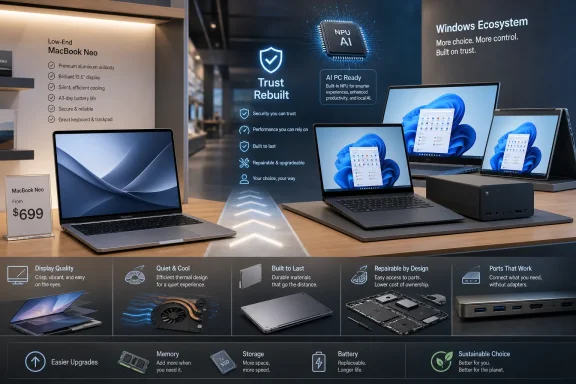 Apple Raised the Ceiling, but Windows Still Owns the Floor
The How-To Geek argument lands because it captures a strange reversal: Apple, the company long mocked for premium pricing, briefly made much of the low-end Windows PC market look complacent. The MacBook Neo’s original $599 price was not just a product launch; it was a public audit of everything PC buyers had been asked to accept in the budget tier. Plastic shells, dim screens, old processors, noisy fans, and preloaded trialware suddenly looked less like necessary compromises and more like industry habits.Apple’s reported price bump to $699 changes the comparison, but it does not erase it. A $699 MacBook Neo is less of a shock weapon than a $599 one, yet it remains a carefully integrated machine from a company that controls the silicon, operating system, chassis, retail story, and support model. Windows PC makers can beat Apple on variety, repair options, ports, gaming, enterprise manageability, and price segmentation. What they have too often failed to beat is the buyer’s first impression.
That is the danger in calling Apple’s move a “reprieve.” A reprieve is temporary by definition. Memory and storage costs may be the immediate explanation for higher Mac prices, but Apple’s long-term advantage is not that NAND flash was cheap in March and expensive in June. It is that Apple has trained customers to expect the bottom of its lineup to feel deliberately made.
Windows vendors have trained too many customers to read the spec sheet defensively. How old is this CPU? Is the RAM soldered? Is the display tolerable? Is the charger proprietary? How many apps will I uninstall before I can start working? That posture is toxic for a platform that needs to win trust at the point of sale.
Windows 11 Cannot Be the Thing Buyers Have to Clean Up First
Microsoft’s most urgent problem is not that Windows 11 lacks features. It is that Windows 11 too often feels like a product manager’s argument with the user. The operating system has improved in performance, design consistency, and hardware support since launch, but the default experience still carries the scent of monetization.The Start menu remains the symbolic battleground. A desktop operating system’s launch surface should be sacred real estate, especially on a paid PC. When users see recommendations, promotions, pinned services, or content funnels they did not ask for, they do not experience that as discovery. They experience it as erosion.
Copilot complicates the issue because AI is both Microsoft’s biggest strategic bet and one of Windows 11’s most visible irritants. There is nothing inherently wrong with making AI assistance available from the desktop. There is something deeply wrong with making users feel that their operating system is being redesigned around a corporate priority they cannot meaningfully refuse.
The winning move is not to pretend AI does not matter. It is to make Copilot feel optional, useful, and contextually respectful. Microsoft should be able to say: if you want AI in Windows, it is deeply integrated; if you do not, Windows remains a clean, predictable, local-first operating system. That distinction matters because power users, admins, developers, and privacy-conscious consumers are not anti-feature. They are anti-coercion.
Apple’s macOS strategy is not free of ecosystem pressure, and Apple Intelligence has its own limits. But Apple generally understands that the operating system’s job is to stage the user’s work, not constantly advertise the vendor’s roadmap. Microsoft needs to recover that discipline. Windows should feel like the computer’s foundation, not a rotating billboard attached to one.
The OEM Bargain Has Become Too Visible
Windows PC makers have historically relied on scale, retail promotions, and SKU sprawl to cover uneven quality. That worked when the Mac was expensive enough to be aspirational rather than directly competitive. It works less well when a low-cost Mac exists and the average buyer can compare build quality in a store or on YouTube within minutes.The budget Windows laptop problem is not just cheap materials. Cheap can be honest. The deeper problem is inconsistency: one model is surprisingly excellent, the next is a parts-bin compromise, and the naming scheme gives ordinary buyers no reliable way to tell the difference. Even enthusiasts struggle to decode the alphabet soup of model numbers, processor suffixes, display options, memory configurations, and retailer-specific variants.
This is where Apple’s restraint becomes a weapon. Apple does not need dozens of near-identical MacBook Neo configurations to make the product legible. The message is simple: this is the affordable Mac. Windows OEMs, by contrast, often behave as if confusion is a pricing strategy.
A better Windows response would not be to copy Apple’s narrow lineup. The PC ecosystem’s strength is choice. But choice only works when the baseline is credible. A buyer should not have to become an amateur procurement analyst to avoid a bad laptop.
Intel’s Project Firefly is interesting precisely because it attacks that baseline problem. A reference push toward thinner metal chassis, more efficient layouts, phone-class manufacturing techniques, and cost-controlled modern platforms could make the phrase “budget Windows laptop” less ominous. But reference designs do not buy customer loyalty by themselves. OEMs have to ship the good version, not the retail-channel version that quietly trades away the screen, battery, or memory to hit a weekend-sale price.
The AI PC Pitch Needs Hardware That Makes Sense Without a Press Release
The PC industry has spent the past two years trying to make “AI PC” happen, and the results have been uneven. NPUs are now common in modern laptop chips, Copilot keys have appeared on keyboards, and silicon vendors have learned to recite TOPS figures with the confidence once reserved for gigahertz. Yet for many buyers, the AI PC remains more badge than lived benefit.The problem is partly software. Windows does not yet have a broad catalog of everyday local AI experiences that make an NPU feel indispensable. But the problem is also architectural. Local AI workloads benefit from memory bandwidth, capacity, efficiency, and unified access patterns. Apple’s Mac mini, Mac Studio, and higher-end MacBooks have attracted developers and AI hobbyists not because every Apple claim is magic, but because unified memory can be very attractive for certain model sizes and workflows.
The Windows answer cannot simply be “buy a bigger GPU.” A discrete Nvidia GPU remains the obvious route for many AI workloads, especially serious development and inference tasks, but it also pushes buyers toward expensive, power-hungry machines. That may serve workstation users. It does not solve the mainstream AI PC promise.
AMD’s Strix Halo-style approach, Framework’s modular desktop ambitions, and Nvidia’s smaller AI-focused systems all point toward a more interesting future. The ideal Windows AI machine is not necessarily a tower with a furnace-class GPU. It is a compact, efficient system with enough memory, bandwidth, and software support to run meaningful local workloads without sounding like a leaf blower.
Microsoft has a role here that goes beyond marketing Copilot. It needs to help define what good local AI on Windows actually feels like. That means better developer tooling, clearer privacy boundaries, OS-level acceleration that does not privilege only one silicon vendor, and user-facing features that justify the hardware. Otherwise, “AI PC” will remain another sticker on the palm rest.
The MacBook Neo Exposed a Trust Deficit, Not Just a Price Gap
The most painful lesson for Windows vendors is that Apple’s advantage is emotional as much as technical. When people buy a Mac, they generally expect the trackpad to be good, the display to be decent, the speakers to be usable, the battery life to be respectable, and the software image to be clean. Windows machines can match or exceed every one of those qualities, but the buyer often has to know exactly which machine to choose.That asymmetry matters. Apple sells confidence. Windows sells possibility. Possibility is powerful for enthusiasts and businesses with procurement teams, but it is exhausting for ordinary buyers.
The PC industry has long treated that exhaustion as the cost of flexibility. Want a touchscreen? A convertible? A gaming GPU? A matte display? Ethernet? Repairable storage? A numpad? Windows has you covered. That remains true, and it is not trivial. But flexibility cannot excuse poor defaults.
A platform that wants to regain momentum should set a higher floor. The worst mainstream Windows laptops should be less bad. The average Windows laptop should be easier to recommend. The best Windows laptops should stop feeling like exceptions that prove the rule.
This is especially important for students, families, small businesses, and first-time buyers. These are the customers most likely to buy on price and most likely to remember disappointment. If their first Windows 11 laptop feels slow, cluttered, fragile, or short-lived, the platform does not merely lose one sale. It plants a future Mac buyer.
Microsoft Must Stop Making OEMs Carry the Whole Experience
It is tempting to blame PC makers for the low-end mess, but Microsoft cannot wash its hands of the experience. Windows is the thing every OEM ships. It is also the thing many users blame first when a machine feels cluttered, unstable, or pushy.The company has already shown it can enforce hardware direction when it wants to. Secure Boot, TPM 2.0 requirements, modern standby expectations, Copilot+ PC branding, and Windows Hello support all demonstrate that Microsoft can shape the market. The question is whether it is willing to shape the parts users actually feel.
A stricter Windows quality program for consumer PCs would be controversial, especially among OEMs that rely on aggressive segmentation. But Microsoft does not need to ban cheap machines. It needs to make quality more visible and bad compromises less easy to hide. A laptop that ships with a poor display, single-channel memory, years-old silicon, or intrusive preloads should not receive the same consumer-facing halo as a clean, modern, efficient design.
This is where Microsoft could learn from its own Xbox instincts. Console buyers understand generations, baselines, and compatibility promises. PC buyers understand almost nothing from a shelf tag that says Core Series 3, Ryzen AI, Copilot+, 8GB, 512GB, OLED maybe, retailer exclusive, limited-time bundle. The Windows ecosystem needs a more honest vocabulary.
The irony is that Microsoft’s Surface line already tries to tell a cleaner story. But Surface cannot carry the entire Windows brand, especially when pricing and availability put it outside many budget conversations. Microsoft needs its partners to succeed, and partners need Microsoft to stop treating Windows defaults as an advertising surface.
Enterprise IT Will Care Less About Apple’s Price Than Windows’ Predictability
For corporate buyers, Apple’s price increase is less dramatic than it is for consumers. Enterprises evaluate total cost, support, manageability, security posture, software compatibility, deployment tooling, and lifecycle predictability. Windows remains deeply entrenched because it is still the default platform for line-of-business software, domain management, endpoint security, and broad hardware procurement.But that moat is not infinite. Macs have become more manageable in enterprise environments, developers continue to favor macOS in many software organizations, and security teams increasingly evaluate platforms based on actual administrative burden rather than old assumptions. If Windows endpoints demand more cleanup, more policy work, more user education, and more post-deployment de-bloating, the cost advantage narrows.
The biggest enterprise risk for Microsoft is not a sudden mass migration to Mac. It is gradual permission. A department asks for Macs because developers prefer them. Executives want them because battery life and build quality are better. Security signs off because management tools have improved. Finance accepts the higher purchase price because replacement cycles look longer. Over time, Windows becomes less of a standard and more of a default that must be defended.
That is why Windows 11’s consumer irritations matter even in business contexts. Admins can suppress many of the worst behaviors with policy, imaging, and endpoint management. But every default that has to be disabled is still a signal. It tells IT that Microsoft’s interests and the organization’s interests are not perfectly aligned.
Microsoft can still win this argument decisively. It has unmatched enterprise relationships, a mature security ecosystem, and enormous leverage through Microsoft 365, Entra, Intune, Defender, and Azure. But the desktop experience has to feel like part of that professional stack, not an exception to it.
The Low-End Desktop Should Not Be an Afterthought
The How-To Geek piece rightly focuses on laptops, because laptops are where the MacBook Neo applies the most direct pressure. But desktops matter too, especially for families, schools, small offices, hobbyists, and AI experimenters. The Windows desktop market has its own version of the same quality problem: too many machines are either bargain-bin boxes with uninspiring parts or expensive gaming rigs with more RGB than restraint.Apple has quietly made the compact desktop interesting again. The Mac mini and Mac Studio are not perfect machines, and they are not cheap once memory and storage upgrades enter the chat. But they are small, quiet, power-efficient, and easy to understand. For certain creative and AI-adjacent workloads, they offer a clean proposition.
Windows should dominate this category. The ecosystem can offer mini PCs, modular desktops, compact workstations, gaming systems, home servers, and repairable towers at every price point. Yet the mainstream retail desktop often feels stuck between office appliance and gamer spectacle.
A serious Windows comeback should include desktops that are quiet, efficient, serviceable, and attractive without becoming luxury objects. Small-form-factor PCs with modern integrated graphics, generous memory options, fast storage, and clean Windows images could be a powerful answer to Apple’s compact Macs. They would also serve the growing number of users who want a home AI box, media workstation, or family computer that does not look like a compromise.
The desktop is also where Windows can press its repairability advantage. Apple’s integration is elegant, but it often comes with fixed memory, costly upgrades, and limited internal flexibility. Windows vendors should stop hiding that advantage inside ugly chassis and confusing configurations. A repairable, quiet, well-built Windows desktop is not nostalgia. It is a market opening.
The Comeback Requires Fewer Excuses and Better Defaults
The Windows PC ecosystem does not lack engineering talent. It lacks alignment. Microsoft wants services engagement, OEMs want margin, retailers want differentiated SKUs, silicon vendors want platform narratives, and users want a computer that feels fast, clean, durable, and fairly priced.Apple’s price increase temporarily reduces the pressure on that system, but it does not solve the alignment problem. If anything, it makes the next few months more important. A market that has just been spared from a deeper Apple price assault has a rare chance to fix itself before the next Apple silicon cycle arrives.
The rumored acceleration toward future Apple M-series chips should concentrate minds. Apple does not need to win every benchmark or every price tier. It only needs to keep making the Windows middle look messier than it should. If the next wave of Macs combines stronger AI performance, better memory bandwidth, cleaner software integration, and tolerable pricing, the current opening will close quickly.
Windows vendors should not respond by chasing Apple feature for feature. They should respond by making the PC’s natural strengths impossible to ignore. That means better ports, broader form factors, better gaming, better enterprise manageability, better repairability, better upgrade paths, and better price diversity. But those strengths need to sit on top of a cleaner baseline.
The customer should not have to choose between Apple’s polish and Windows’ freedom. The entire point of the PC was that users could have control, compatibility, and value. The industry’s task now is to make that old promise feel modern again.
The Reprieve Comes With a Deadline
Apple’s higher prices give Microsoft and its partners room to maneuver, but the room is smaller than it looks. The practical lessons are already visible, and none of them require waiting for some perfect next-generation platform.- Microsoft should make Windows 11 feel less like a services funnel by reducing promotions, simplifying Copilot controls, and restoring the sense that the user owns the desktop.
- PC makers should treat sturdy construction, decent displays, modern processors, and clean software images as baseline requirements rather than premium upsells.
- Intel’s Project Firefly and similar efforts should be judged by shipping products, not reference-design promises or launch-stage talking points.
- The AI PC category needs efficient memory-rich systems and useful local software, not just louder marketing around NPUs and keyboard keys.
- Windows desktops deserve the same quality reset as laptops, especially as compact Macs make small, quiet, powerful computers more visible to mainstream buyers.
- The ecosystem should compete with Apple by making Windows PCs more trustworthy, not by waiting for Macs to become expensive enough that old compromises look acceptable again.
References
- Primary source: How-To Geek
Published: Mon, 29 Jun 2026 17:45:18 GMT
Microsoft and Windows PC makers just got a reprieve—here's what they must do to survive
Fixing Windows and PC quality could help while Apple struggles with price hikes. www.howtogeek.com
- Related coverage: techradar.com
I can’t believe I’m saying this, but the MacBook Neo’s $100 price bump means budget Windows 11 laptops are now the better buy | TechRadar
Now $699 :()|default(As feared, Apple has announced price rises for its MacBooks, and they've made the MacBook Neo and MacBook Air much harder to justify. Check out these Windows laptop deals instead!)|default(The latest Deals,\/deals,,deals, breaking news, comment, reviews and features from the...www.techradar.com - Related coverage: pcworld.com
Why Microsoft is raising laptop prices as Apple makes productivity cheaper | PCWorld
Analysts say Apple’s control over chips, memory strategy, and margins gives it pricing power Microsoft and other PC makers lack.www.pcworld.com - Related coverage: macworld.com
What macOS version can my Mac run? macOS 27 Golden Gate compatibility list | Macworld
Check your Mac's macOS compatibility – including whether it will run macOS Golden Gate or if your Mac model is limited to older versions.www.macworld.com - Related coverage: computerworld.com
Apple's new $599 MacBook Neo is a nightmare for Windows OEMs – Computerworld
Apple Silicon really is re-shaping the tech industry. www.computerworld.com
- Related coverage: intel.com