

During the four-day Prime Day shopping event in late June 2026, Adobe found that shoppers referred to retail sites by AI chatbots were 40 percent more likely to buy than visitors arriving through any other channel. That is the kind of metric retailers usually dream about, except it lands like a warning shot for Amazon. The company that trained consumers to begin every purchase inside its own search box is now watching a new class of assistants prove they can send retailers some of the highest-intent customers on the web. The Prime Day paradox is simple: AI shopping may help online retail grow, but it threatens to loosen Amazon’s grip on where shopping starts.
For most of the modern e-commerce era, Amazon’s strategic advantage has been less about any single product category than about habit. Consumers did not open Amazon only because it always had the lowest price or the most elegant discovery experience. They opened it because it was the default place to check first.
That default status is enormously valuable. It gives Amazon first look at demand, first shot at conversion, and a privileged position in the advertising market that now sits on top of its marketplace. Retail media works because shoppers arrive with intent; Amazon can sell sponsored placement precisely because users are already close to purchase.
AI shopping assistants threaten that arrangement at the top of the funnel. If a shopper asks ChatGPT, Gemini, Perplexity, Copilot, or another assistant which espresso machine, gaming laptop, children’s tablet, air purifier, or USB-C dock to buy, the first commercial decision may happen before Amazon is ever opened. The old contest was between Amazon, Walmart, Target, Best Buy, Etsy, and thousands of direct-to-consumer merchants. The new contest is between the retailer and the answer engine.
That distinction matters. A retailer can compete with another retailer on price, delivery, returns, selection, brand trust, and loyalty perks. Competing with an AI assistant is harder, because the assistant may control comparison, ranking, explanation, and recommendation in one conversational layer. It can make the shopping decision feel less like browsing and more like delegation.
Adobe’s Prime Day finding does not mean AI chatbots have already conquered commerce. AI-referred traffic is still a developing channel, and the total volume remains far smaller than search, email, direct traffic, paid ads, or marketplace discovery. But conversion rate is the early signal that should make incumbents nervous. If AI sends fewer shoppers but better shoppers, every retailer will chase that traffic—and every platform that controls the assistant will gain leverage.
The reported 40 percent conversion advantage for AI-referred shoppers is especially notable because Prime Day is a high-noise environment. Consumers are bombarded by flash deals, sponsored placements, countdown timers, influencer links, newsletters, and browser extensions. In that mess, AI referrals performing best suggests that chatbots are not merely another novelty traffic source. They may be acting as a pre-filter.
That pre-filtering is the whole point. A shopper who asks an assistant for “the best robot vacuum under $400 for pet hair” has already declared intent, constraints, and context. If the assistant returns a narrowed list and the user clicks through, that click is not equivalent to a casual social media tap or a generic search impression. It is closer to a researched handoff.
This is why the conversion result matters even if the absolute traffic share is modest. Early e-commerce shifts often arrive first as a quality signal before becoming a volume story. Mobile commerce began as clunky browsing and became the default. Retail media began as sponsored product placement and became one of Amazon’s most profitable engines. AI referrals may be at the quality-signal stage: not yet dominant, but already unusually efficient.
Amazon understands this better than anyone. Its marketplace was built by collapsing friction: search, reviews, payment, shipping, returns, and subscriptions all into one experience. AI assistants promise to collapse a different kind of friction: the cognitive labor of deciding. That is more dangerous to Amazon than another retailer with a better coupon.
Rufus, Alexa for Shopping, and related conversational tools are Amazon’s attempt to keep the AI layer inside the Amazon perimeter. In that model, a user can ask natural-language questions, compare products, track prices, and eventually automate parts of the purchase journey without leaving Amazon’s environment. The assistant becomes a better search box, not a replacement for the store.
External assistants invert that relationship. If ChatGPT or another agent becomes the place where a user asks what to buy, Amazon risks becoming one option among many in a machine-generated recommendation. The power moves upstream. Amazon may still get the sale, but it no longer owns the moment of consideration.
That is why Amazon’s resistance to third-party agents should not be read merely as a technical dispute over scraping or bots. Those issues are real, especially when agents log in, interact with carts, handle user credentials, or strain site infrastructure. But the deeper argument is strategic: who gets to intermediate the customer?
Retailers have spent years optimizing for search engines, social platforms, affiliate networks, and marketplace algorithms. AI shopping assistants combine pieces of all four. They can be discovery channel, comparison engine, recommendation layer, and purchasing concierge. For Amazon, allowing an outside assistant to freely mine its listings and act on behalf of shoppers could mean subsidizing the very interface that weakens Amazon’s own starting-point advantage.
That would be a major shift from the web’s familiar retail pattern. In the search era, Google pointed users outward but did not usually complete the shopping journey. In the marketplace era, Amazon pulled users inward and monetized everything around the transaction. In the agent era, the assistant may sit above retailers and decide which ones deserve attention.
This is not only a consumer story. For merchants, AI referrals could become the new search engine optimization, but with murkier rules. Instead of optimizing product pages for keywords and metadata, retailers may need to optimize for machine-readable catalogs, clean inventory feeds, transparent pricing, reliable fulfillment promises, structured reviews, and assistant-friendly return policies. The winning product page may be the one an AI can understand with the least ambiguity.
That could help smaller retailers in some cases. A specialty merchant that cannot outbid Amazon on ads might still win if an assistant judges its product to be a better fit for a specific user. A local store with accurate inventory could become more visible if agents are designed to factor proximity, pickup, or sustainability into recommendations. But it could also create a new dependency on opaque AI ranking systems controlled by a handful of tech platforms.
This is the familiar platform bargain in a new costume. Retailers may gain access to high-intent customers, only to discover that the tollbooth has moved. Yesterday’s question was how to rank on Amazon or Google. Tomorrow’s question may be how to be chosen by an AI agent whose reasoning is partly hidden, constantly changing, and shaped by commercial partnerships.
Microsoft’s consumer Copilot problem has always been different from its enterprise Copilot opportunity. In the workplace, Microsoft can attach AI to Windows, Office, Teams, Outlook, SharePoint, GitHub, and Azure. The user’s context already lives there. In the consumer world, attention is more fragmented, and habits are harder to change.
The “super app” dream is Microsoft’s attempt to solve that fragmentation. If Copilot can become a persistent assistant across work, personal tasks, web browsing, shopping, travel, documents, and communication, Microsoft gets something it has not had in consumer internet life for years: a front door. Not a browser monopoly, not a start menu, not a search deal, but an assistant that remembers and acts.
That is why retail should watch Microsoft, even though Amazon is the central actor in the Prime Day story. A unified Copilot could become a shopping research layer for Windows users, Edge users, Outlook users, and Microsoft 365 subscribers. It could recommend products from emails, receipts, calendars, documents, chats, and browsing history—assuming users grant the necessary permissions and Microsoft can make the experience trustworthy rather than creepy.
This is also where the enterprise and consumer worlds blur. IT departments are already wrestling with Copilot governance, data boundaries, retention policies, and plugin permissions. The same architecture that lets an assistant summarize a quarterly report could, in a personal context, let it compare insurance plans, book travel, or buy hardware. Once assistants become action layers, every permission model becomes a commerce model too.
There is a difference between asking a chatbot for gift ideas and letting it buy the gift. There is a difference between asking for a laptop comparison and letting an agent decide which seller is reputable. There is a difference between summarizing reviews and trusting an assistant to distinguish authentic complaints from manipulated marketplace noise.
This adoption gap gives Amazon time. Consumers may experiment with AI shopping, especially for research, but still return to Amazon for checkout because the transaction layer feels safe. Prime shipping, saved payment methods, easy returns, and customer service remain powerful forms of trust. For many households, the final buying decision is still wrapped in Amazon’s convenience infrastructure.
But time is not immunity. The consumer adoption curve can look slow until a particular use case becomes obvious. Shopping is a plausible candidate because the pain is universal: too many choices, too many fake discounts, too many sponsored results, too many reviews of uncertain quality. If AI agents can consistently reduce that mess, adoption may move faster than retailers expect.
The key word is consistently. A shopping assistant that hallucinates prices, misses shipping fees, recommends unavailable products, ignores return policies, or favors paid placements without disclosure will burn trust quickly. But a good one—one that explains tradeoffs, respects budgets, remembers preferences, and sends users to reliable merchants—could become one of the first mainstream AI habits that feels practical rather than performative.
If consumers increasingly ask an assistant for the “best” product and receive a short ranked set, the traditional shelf shrinks. There are fewer visible slots, fewer impulse detours, and fewer opportunities for sponsored products to intercept attention. The assistant’s answer becomes the shelf.
That does not mean advertising disappears. It means advertising becomes more contested and probably more opaque. AI platforms will be tempted to monetize recommendations, preferred merchants, sponsored answers, checkout integrations, or data partnerships. Retailers will demand measurement. Regulators will demand disclosure. Users will demand that the assistant not quietly become a commissioned salesperson.
Amazon has an advantage here because it already knows how to monetize commercial intent without making the experience collapse entirely under ads. But that experience has also drawn criticism from shoppers who feel Amazon search results are increasingly cluttered, sponsored, or difficult to interpret. AI assistants can exploit that frustration by promising cleaner guidance.
The danger for Amazon is that the more its marketplace feels like an ad-loaded maze, the more attractive an outside concierge becomes. The danger for AI companies is that the more they monetize recommendations, the more they risk recreating the very maze they claim to simplify. The next version of retail media may be fought not on product pages, but inside conversational answers.
But defensive moves can also train the market to route around you. If an AI assistant cannot reliably access Amazon product data, it may recommend other retailers with cleaner feeds and friendlier integrations. If enough users begin their shopping journey outside Amazon, absence from the assistant’s answer set becomes its own kind of penalty.
This is the strategic bind. Amazon wants to prevent outside AI platforms from building a shopping layer on top of Amazon’s data. But if AI shopping becomes mainstream, Amazon also cannot afford to be invisible or degraded inside the assistants consumers use. The company may try to resolve this through controlled partnerships, ads, APIs, structured feeds, or its own agent infrastructure offered to other retailers.
That last possibility is especially important. Amazon Web Services gives Amazon a way to participate in agentic commerce even when the transaction does not happen on Amazon.com. If Amazon can sell the underlying infrastructure for retail agents, it can hedge against a world where commerce becomes more distributed. The company has played this game before: AWS monetized the internet beyond Amazon’s storefront, and Amazon Ads monetized attention inside it.
Still, the conflict remains. A world of interoperable shopping agents is not the same as a world of Amazon-controlled shopping agents. The former weakens marketplace lock-in; the latter extends it. The battle now is over which version consumers, merchants, regulators, and platform companies will tolerate.
When an AI assistant shops on behalf of a user, it may need access to browsing sessions, saved credentials, payment information, delivery addresses, order histories, calendars, emails, and personal preferences. That turns shopping from a website interaction into a permissions problem. The assistant is no longer just reading the web; it is acting inside a user’s digital life.
For consumers, the practical questions are straightforward but serious. Which assistant is allowed to see what? Can it distinguish a real product page from a fraudulent one? Does it understand return windows, warranty terms, marketplace sellers, and shipping costs? Can it be tricked by prompt injection hidden in a product description or review?
For IT pros, the enterprise implications are even broader. Employees already use consumer AI tools at work, sometimes against policy and often before governance catches up. If agents gain the ability to buy supplies, book travel, compare software, or interact with vendor portals, organizations will need rules for authorization, logging, reimbursement, procurement compliance, and data leakage.
Browser makers and OS vendors will be tempted to make these experiences seamless. Seamlessness is convenient, but it is also where mistakes scale. The same autofill and single-sign-on conveniences that make web work tolerable can become dangerous when an autonomous or semi-autonomous agent begins clicking, comparing, and purchasing.
For a Windows user trying to buy a monitor, docking station, mini PC, router, SSD, webcam, or battery backup, an AI assistant could reduce hours of tab juggling. It could check whether a laptop supports DisplayPort over USB-C, whether a monitor includes the right stand, whether a RAM kit matches a motherboard, or whether a charger meets USB Power Delivery requirements. That is not futuristic; it is exactly the kind of structured reasoning today’s shopping sites frequently fail to provide.
The benefit becomes more obvious in categories where compatibility matters. PC components, smart home devices, networking gear, and accessibility technology are all areas where shoppers can make expensive mistakes despite reading reviews. If assistants can combine product data with user context, they can make commerce less adversarial.
But that same helpfulness makes the gatekeeper problem sharper. The assistant that knows your devices, budget, habits, family needs, and work constraints will have extraordinary influence over what you buy. If its recommendations are biased by commercial arrangements, incomplete data, or platform incentives, the manipulation will be harder to see than a sponsored search result.
This is the old problem of trust, intensified by intimacy. A search engine knows what you typed. A marketplace knows what you bought. An AI assistant may know what you considered, rejected, asked privately, could not afford, and planned to do next. Commerce built on that layer demands a higher standard than “users can always click elsewhere.”
Merchants will begin asking how to appear in AI-generated shopping answers. Agencies will sell AI commerce optimization. Analytics vendors will build dashboards to separate chatbot referrals from traditional search and affiliate traffic. Retailers will clean up product feeds not because humans demand it, but because machines do.
Amazon will not sit still. It will keep embedding conversational shopping into its own products, keep defending its marketplace from uncontrolled agents, and keep experimenting with ways to turn AI into another Amazon-controlled funnel. It may also use advertising and partnerships to make sure Amazon deals appear where AI users are already asking shopping questions.
The interesting question is not whether Amazon can build a good shopping assistant. It probably can. The question is whether consumers want one assistant per retailer or one assistant that shops across retailers. Amazon’s preferred answer is obvious. Consumers’ answer may depend on who saves them more time and money.
This is where the Prime Day paradox bites. Amazon created the shopping holiday that revealed the strength of a channel it does not fully control. AI assistants are now proving their worth not in a lab demo, but in one of the most commercially intense retail moments of the year. That will attract investment, merchant attention, and platform competition.
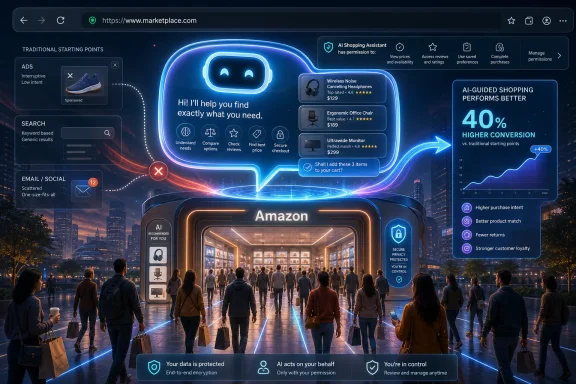 Amazon’s Real Rival Is No Longer Another Storefront
For most of the modern e-commerce era, Amazon’s strategic advantage has been less about any single product category than about habit. Consumers did not open Amazon only because it always had the lowest price or the most elegant discovery experience. They opened it because it was the default place to check first.That default status is enormously valuable. It gives Amazon first look at demand, first shot at conversion, and a privileged position in the advertising market that now sits on top of its marketplace. Retail media works because shoppers arrive with intent; Amazon can sell sponsored placement precisely because users are already close to purchase.
AI shopping assistants threaten that arrangement at the top of the funnel. If a shopper asks ChatGPT, Gemini, Perplexity, Copilot, or another assistant which espresso machine, gaming laptop, children’s tablet, air purifier, or USB-C dock to buy, the first commercial decision may happen before Amazon is ever opened. The old contest was between Amazon, Walmart, Target, Best Buy, Etsy, and thousands of direct-to-consumer merchants. The new contest is between the retailer and the answer engine.
That distinction matters. A retailer can compete with another retailer on price, delivery, returns, selection, brand trust, and loyalty perks. Competing with an AI assistant is harder, because the assistant may control comparison, ranking, explanation, and recommendation in one conversational layer. It can make the shopping decision feel less like browsing and more like delegation.
Adobe’s Prime Day finding does not mean AI chatbots have already conquered commerce. AI-referred traffic is still a developing channel, and the total volume remains far smaller than search, email, direct traffic, paid ads, or marketplace discovery. But conversion rate is the early signal that should make incumbents nervous. If AI sends fewer shoppers but better shoppers, every retailer will chase that traffic—and every platform that controls the assistant will gain leverage.
The Prime Day Signal Is Small Enough to Dismiss and Big Enough to Matter
Prime Day has always been a strange measuring stick. It is an Amazon-created shopping holiday that spills across the rest of online retail, as competitors run their own promotions to catch deal-seeking consumers who have been trained to spend. That makes it useful for observing broader e-commerce behavior, even when Amazon itself remains the gravitational center.The reported 40 percent conversion advantage for AI-referred shoppers is especially notable because Prime Day is a high-noise environment. Consumers are bombarded by flash deals, sponsored placements, countdown timers, influencer links, newsletters, and browser extensions. In that mess, AI referrals performing best suggests that chatbots are not merely another novelty traffic source. They may be acting as a pre-filter.
That pre-filtering is the whole point. A shopper who asks an assistant for “the best robot vacuum under $400 for pet hair” has already declared intent, constraints, and context. If the assistant returns a narrowed list and the user clicks through, that click is not equivalent to a casual social media tap or a generic search impression. It is closer to a researched handoff.
This is why the conversion result matters even if the absolute traffic share is modest. Early e-commerce shifts often arrive first as a quality signal before becoming a volume story. Mobile commerce began as clunky browsing and became the default. Retail media began as sponsored product placement and became one of Amazon’s most profitable engines. AI referrals may be at the quality-signal stage: not yet dominant, but already unusually efficient.
Amazon understands this better than anyone. Its marketplace was built by collapsing friction: search, reviews, payment, shipping, returns, and subscriptions all into one experience. AI assistants promise to collapse a different kind of friction: the cognitive labor of deciding. That is more dangerous to Amazon than another retailer with a better coupon.
Amazon Wants Agents—Just Not Everyone Else’s
Amazon is not anti-AI shopping. It is anti-losing-control-of-AI-shopping. That distinction explains the company’s seemingly contradictory posture: it is building its own AI shopping assistants while resisting outside agents that want to crawl, interpret, compare, or transact through Amazon’s marketplace.Rufus, Alexa for Shopping, and related conversational tools are Amazon’s attempt to keep the AI layer inside the Amazon perimeter. In that model, a user can ask natural-language questions, compare products, track prices, and eventually automate parts of the purchase journey without leaving Amazon’s environment. The assistant becomes a better search box, not a replacement for the store.
External assistants invert that relationship. If ChatGPT or another agent becomes the place where a user asks what to buy, Amazon risks becoming one option among many in a machine-generated recommendation. The power moves upstream. Amazon may still get the sale, but it no longer owns the moment of consideration.
That is why Amazon’s resistance to third-party agents should not be read merely as a technical dispute over scraping or bots. Those issues are real, especially when agents log in, interact with carts, handle user credentials, or strain site infrastructure. But the deeper argument is strategic: who gets to intermediate the customer?
Retailers have spent years optimizing for search engines, social platforms, affiliate networks, and marketplace algorithms. AI shopping assistants combine pieces of all four. They can be discovery channel, comparison engine, recommendation layer, and purchasing concierge. For Amazon, allowing an outside assistant to freely mine its listings and act on behalf of shoppers could mean subsidizing the very interface that weakens Amazon’s own starting-point advantage.
The New Gatekeeper Does Not Look Like a Store
The uncomfortable truth for Amazon is that shoppers may not care who owns the interface if the interface saves time. Consumers are rarely loyal to a channel out of principle. They are loyal to convenience, trust, price, and habit. If an assistant reliably finds a better deal, avoids fake reviews, summarizes tradeoffs, and remembers preferences, the assistant becomes the habit.That would be a major shift from the web’s familiar retail pattern. In the search era, Google pointed users outward but did not usually complete the shopping journey. In the marketplace era, Amazon pulled users inward and monetized everything around the transaction. In the agent era, the assistant may sit above retailers and decide which ones deserve attention.
This is not only a consumer story. For merchants, AI referrals could become the new search engine optimization, but with murkier rules. Instead of optimizing product pages for keywords and metadata, retailers may need to optimize for machine-readable catalogs, clean inventory feeds, transparent pricing, reliable fulfillment promises, structured reviews, and assistant-friendly return policies. The winning product page may be the one an AI can understand with the least ambiguity.
That could help smaller retailers in some cases. A specialty merchant that cannot outbid Amazon on ads might still win if an assistant judges its product to be a better fit for a specific user. A local store with accurate inventory could become more visible if agents are designed to factor proximity, pickup, or sustainability into recommendations. But it could also create a new dependency on opaque AI ranking systems controlled by a handful of tech platforms.
This is the familiar platform bargain in a new costume. Retailers may gain access to high-intent customers, only to discover that the tollbooth has moved. Yesterday’s question was how to rank on Amazon or Google. Tomorrow’s question may be how to be chosen by an AI agent whose reasoning is partly hidden, constantly changing, and shaped by commercial partnerships.
Microsoft’s Copilot Ambition Belongs in the Same Story
The GeekWire note about Microsoft’s push to merge consumer and enterprise Copilot into a single AI experience may look, at first glance, like a separate story. It is not. The same platform logic driving AI shopping is driving the race to make assistants into everyday operating layers.Microsoft’s consumer Copilot problem has always been different from its enterprise Copilot opportunity. In the workplace, Microsoft can attach AI to Windows, Office, Teams, Outlook, SharePoint, GitHub, and Azure. The user’s context already lives there. In the consumer world, attention is more fragmented, and habits are harder to change.
The “super app” dream is Microsoft’s attempt to solve that fragmentation. If Copilot can become a persistent assistant across work, personal tasks, web browsing, shopping, travel, documents, and communication, Microsoft gets something it has not had in consumer internet life for years: a front door. Not a browser monopoly, not a start menu, not a search deal, but an assistant that remembers and acts.
That is why retail should watch Microsoft, even though Amazon is the central actor in the Prime Day story. A unified Copilot could become a shopping research layer for Windows users, Edge users, Outlook users, and Microsoft 365 subscribers. It could recommend products from emails, receipts, calendars, documents, chats, and browsing history—assuming users grant the necessary permissions and Microsoft can make the experience trustworthy rather than creepy.
This is also where the enterprise and consumer worlds blur. IT departments are already wrestling with Copilot governance, data boundaries, retention policies, and plugin permissions. The same architecture that lets an assistant summarize a quarterly report could, in a personal context, let it compare insurance plans, book travel, or buy hardware. Once assistants become action layers, every permission model becomes a commerce model too.
The Diffusion Gap Is the Catch
The Stanford AI Index discussion cited by Oren Etzioni points to a useful counterweight: the United States has invested heavily in developing generative AI, but everyday adoption remains uneven. That matters because the agentic-commerce future depends not only on model capability, but on ordinary users trusting assistants with consequential tasks.There is a difference between asking a chatbot for gift ideas and letting it buy the gift. There is a difference between asking for a laptop comparison and letting an agent decide which seller is reputable. There is a difference between summarizing reviews and trusting an assistant to distinguish authentic complaints from manipulated marketplace noise.
This adoption gap gives Amazon time. Consumers may experiment with AI shopping, especially for research, but still return to Amazon for checkout because the transaction layer feels safe. Prime shipping, saved payment methods, easy returns, and customer service remain powerful forms of trust. For many households, the final buying decision is still wrapped in Amazon’s convenience infrastructure.
But time is not immunity. The consumer adoption curve can look slow until a particular use case becomes obvious. Shopping is a plausible candidate because the pain is universal: too many choices, too many fake discounts, too many sponsored results, too many reviews of uncertain quality. If AI agents can consistently reduce that mess, adoption may move faster than retailers expect.
The key word is consistently. A shopping assistant that hallucinates prices, misses shipping fees, recommends unavailable products, ignores return policies, or favors paid placements without disclosure will burn trust quickly. But a good one—one that explains tradeoffs, respects budgets, remembers preferences, and sends users to reliable merchants—could become one of the first mainstream AI habits that feels practical rather than performative.
The Advertising Model Is Where the Fight Gets Expensive
Amazon’s concern is not simply that an AI assistant might send a customer to Walmart. It is that an assistant might reduce the value of Amazon’s advertising real estate. Sponsored search results, display placements, and retail media campaigns depend on the retailer controlling the browsing environment in which decisions are made.If consumers increasingly ask an assistant for the “best” product and receive a short ranked set, the traditional shelf shrinks. There are fewer visible slots, fewer impulse detours, and fewer opportunities for sponsored products to intercept attention. The assistant’s answer becomes the shelf.
That does not mean advertising disappears. It means advertising becomes more contested and probably more opaque. AI platforms will be tempted to monetize recommendations, preferred merchants, sponsored answers, checkout integrations, or data partnerships. Retailers will demand measurement. Regulators will demand disclosure. Users will demand that the assistant not quietly become a commissioned salesperson.
Amazon has an advantage here because it already knows how to monetize commercial intent without making the experience collapse entirely under ads. But that experience has also drawn criticism from shoppers who feel Amazon search results are increasingly cluttered, sponsored, or difficult to interpret. AI assistants can exploit that frustration by promising cleaner guidance.
The danger for Amazon is that the more its marketplace feels like an ad-loaded maze, the more attractive an outside concierge becomes. The danger for AI companies is that the more they monetize recommendations, the more they risk recreating the very maze they claim to simplify. The next version of retail media may be fought not on product pages, but inside conversational answers.
Blocking Bots Solves the Immediate Problem and Sharpens the Long-Term One
Amazon’s efforts to block third-party agents are rational. A retailer has legitimate reasons to control automated access to its site, protect user accounts, enforce terms, prevent scraping, and maintain a reliable shopping experience. Agentic browsing introduces security, privacy, fraud, and accountability questions that cannot be waved away with slogans about openness.But defensive moves can also train the market to route around you. If an AI assistant cannot reliably access Amazon product data, it may recommend other retailers with cleaner feeds and friendlier integrations. If enough users begin their shopping journey outside Amazon, absence from the assistant’s answer set becomes its own kind of penalty.
This is the strategic bind. Amazon wants to prevent outside AI platforms from building a shopping layer on top of Amazon’s data. But if AI shopping becomes mainstream, Amazon also cannot afford to be invisible or degraded inside the assistants consumers use. The company may try to resolve this through controlled partnerships, ads, APIs, structured feeds, or its own agent infrastructure offered to other retailers.
That last possibility is especially important. Amazon Web Services gives Amazon a way to participate in agentic commerce even when the transaction does not happen on Amazon.com. If Amazon can sell the underlying infrastructure for retail agents, it can hedge against a world where commerce becomes more distributed. The company has played this game before: AWS monetized the internet beyond Amazon’s storefront, and Amazon Ads monetized attention inside it.
Still, the conflict remains. A world of interoperable shopping agents is not the same as a world of Amazon-controlled shopping agents. The former weakens marketplace lock-in; the latter extends it. The battle now is over which version consumers, merchants, regulators, and platform companies will tolerate.
Windows Users Will Meet This Fight in the Browser
For WindowsForum readers, this might sound like a retail industry drama happening far away from the desktop. It is not. The user interface for AI shopping will often be the browser, the operating system, the search box, the email client, the password manager, and the digital wallet—all places Windows users and administrators already manage.When an AI assistant shops on behalf of a user, it may need access to browsing sessions, saved credentials, payment information, delivery addresses, order histories, calendars, emails, and personal preferences. That turns shopping from a website interaction into a permissions problem. The assistant is no longer just reading the web; it is acting inside a user’s digital life.
For consumers, the practical questions are straightforward but serious. Which assistant is allowed to see what? Can it distinguish a real product page from a fraudulent one? Does it understand return windows, warranty terms, marketplace sellers, and shipping costs? Can it be tricked by prompt injection hidden in a product description or review?
For IT pros, the enterprise implications are even broader. Employees already use consumer AI tools at work, sometimes against policy and often before governance catches up. If agents gain the ability to buy supplies, book travel, compare software, or interact with vendor portals, organizations will need rules for authorization, logging, reimbursement, procurement compliance, and data leakage.
Browser makers and OS vendors will be tempted to make these experiences seamless. Seamlessness is convenient, but it is also where mistakes scale. The same autofill and single-sign-on conveniences that make web work tolerable can become dangerous when an autonomous or semi-autonomous agent begins clicking, comparing, and purchasing.
The Consumer Benefit Is Real, Which Is Why the Platform Risk Is Real
It would be a mistake to frame AI shopping only as a threat. The current online shopping experience is often bad. Search results are polluted by ads, reviews are gamed, prices fluctuate constantly, compatibility details are buried, and marketplaces mix first-party goods with third-party sellers of varying reliability. A competent assistant could genuinely help.For a Windows user trying to buy a monitor, docking station, mini PC, router, SSD, webcam, or battery backup, an AI assistant could reduce hours of tab juggling. It could check whether a laptop supports DisplayPort over USB-C, whether a monitor includes the right stand, whether a RAM kit matches a motherboard, or whether a charger meets USB Power Delivery requirements. That is not futuristic; it is exactly the kind of structured reasoning today’s shopping sites frequently fail to provide.
The benefit becomes more obvious in categories where compatibility matters. PC components, smart home devices, networking gear, and accessibility technology are all areas where shoppers can make expensive mistakes despite reading reviews. If assistants can combine product data with user context, they can make commerce less adversarial.
But that same helpfulness makes the gatekeeper problem sharper. The assistant that knows your devices, budget, habits, family needs, and work constraints will have extraordinary influence over what you buy. If its recommendations are biased by commercial arrangements, incomplete data, or platform incentives, the manipulation will be harder to see than a sponsored search result.
This is the old problem of trust, intensified by intimacy. A search engine knows what you typed. A marketplace knows what you bought. An AI assistant may know what you considered, rejected, asked privately, could not afford, and planned to do next. Commerce built on that layer demands a higher standard than “users can always click elsewhere.”
The Prime Day Lesson Amazon Cannot Ignore
The Prime Day data does not prove that ChatGPT or any single assistant is about to dethrone Amazon. It does prove that AI-referred shoppers can be unusually valuable once they arrive. That is enough to change retailer behavior.Merchants will begin asking how to appear in AI-generated shopping answers. Agencies will sell AI commerce optimization. Analytics vendors will build dashboards to separate chatbot referrals from traditional search and affiliate traffic. Retailers will clean up product feeds not because humans demand it, but because machines do.
Amazon will not sit still. It will keep embedding conversational shopping into its own products, keep defending its marketplace from uncontrolled agents, and keep experimenting with ways to turn AI into another Amazon-controlled funnel. It may also use advertising and partnerships to make sure Amazon deals appear where AI users are already asking shopping questions.
The interesting question is not whether Amazon can build a good shopping assistant. It probably can. The question is whether consumers want one assistant per retailer or one assistant that shops across retailers. Amazon’s preferred answer is obvious. Consumers’ answer may depend on who saves them more time and money.
This is where the Prime Day paradox bites. Amazon created the shopping holiday that revealed the strength of a channel it does not fully control. AI assistants are now proving their worth not in a lab demo, but in one of the most commercially intense retail moments of the year. That will attract investment, merchant attention, and platform competition.
The Cart Is Becoming a Control Plane
The concrete lesson from this year’s Prime Day is not that every purchase will soon be delegated to a bot. It is that the most valuable shopper may increasingly arrive after a machine has already narrowed the field. That changes what retailers, platforms, and users should watch next.- AI-referred shoppers converted better than other channels during the four-day Prime Day event, suggesting that chatbot traffic may be small but unusually high intent.
- Amazon’s resistance to outside shopping agents is best understood as a fight over customer intermediation, not simply a fight over scraping or site access.
- Microsoft’s effort to make Copilot a unified consumer and enterprise assistant belongs to the same platform shift, because the assistant that owns context can influence commerce.
- Retailers will need cleaner product data, clearer policies, and machine-readable inventory if they want to be recommended by AI shopping systems.
- Windows users and IT departments should treat agentic shopping as a permissions, identity, and security issue, not merely a convenience feature.
- The next retail advertising battle will be fought inside AI-generated recommendations, where disclosure and trust will matter as much as placement.
References
- Primary source: LinkedIn
Published: 2026-06-29T18:20:23.150762
AI shopping trends test Amazon’s bet against ChatGPT
Prime Day paradox: Adobe found that shoppers who clicked through to all retail sites from AI chatbots were 40% more likely to buy than those from any other channel during the four-day Prime Day shopping event last week — the first time AI-referred traffic has converted best. That puts Amazon in an uwww.linkedin.com
- Related coverage: creati.ai
AI Drives 40% Better Conversion Rate During Amazon Prime Day 2026
Adobe data shows AI-directed shoppers had 40% better purchase conversion than non-AI channels during Prime Day, with $26.4B in total online sales up 9.3% YoY.creati.ai
- Related coverage: fyinternational.net
Amazon Tests ChatGPT Ads for Prime Day Traffic | FY International LLC
Amazon's Prime Day ads inside ChatGPT make AI answer surfaces a new channel to watch.fyinternational.net
- Related coverage: pymnts.com
PYMNTS | Amazon Gives Alexa 96 Hours to Prove AI Can Sell
With growth slowing and millions of buyers moving simultaneously, the 96-hour window is AI commerce’s most demanding live test yet. www.pymnts.com
- Related coverage: retailbrew.com
Amazon CEO: shoppers will choose retailers over third-party AI platforms
As AI platforms wade into e-commerce, Amazon is betting consumers will choose in-house shopping agents over “horizontal agents” like ChatGPT.www.retailbrew.com
- Related coverage: geekwire.com
Judge blocks Perplexity's AI bot from shopping on Amazon in early test of agentic commerce – GeekWire
A federal judge sided with Amazon in its lawsuit over Perplexity's Comet browser, granting a preliminary injunction in an early legal test of AI-powered shopping tools.www.geekwire.com
- Related coverage: techradar.com
Amazon blocks ChatGPT's new shopping agent – what the fallout could mean for you | TechRadar
AI shopping assistants are rising fast, but Amazon is pushing backwww.techradar.com - Related coverage: bloomberg.com
- Related coverage: axios.com
Amazon pushes Alexa deeper into AI shopping with Rufus integration
Amazon is folding its Rufus assistant into Alexa+ as it pushes deeper into AI shopping tools that track deals, automate purchases and shop across devices.www.axios.com
- Related coverage: retaildive.com
Amazon offers AI agent tech to other retailers | Retail Dive
The online retail behemoth wants to narrow the time it takes for retailers to launch AI shopping assistants, starting with Kate Spade.www.retaildive.com
- Related coverage: realitymine.com
ChatGPT isn’t reshaping Prime Day shopping — yet
Despite widespread speculation that AI tools like ChatGPT are transforming consumer behaviour, new data from RealityMine reveals that Prime Day still runs on the same tried-and-tested mechanics that have powered Amazon’s success for years.www.realitymine.com - Related coverage: windowscentral.com
Amazon vs Perplexity: Why a judge blocked AI shopping agents | Windows Central
I\u2019ve called out "AI slop" for years, but I\u2019ll defend any bot that dares to bypass Amazon\u2019s "Sponsored" junk to save you money.www.windowscentral.com - Related coverage: practicalecommerce.com
Why Marketplaces Block AI Shopping Agents - Practical Ecommerce
Autonomous AI shopping agents threaten the role of marketplaces in product discovery, advertising, and transactions.www.practicalecommerce.com - Related coverage: tomsguide.com
Amazon blocks ChatGPT's new research feature amid the festive season — here's why | Tom's Guide
Amazon has already put the brakes on ChatGPT's new shopping feature, stopping the chatbot from serving up its deals.www.tomsguide.com - Related coverage: nextepinvestimentos.com.br
- Related coverage: s3.amazonaws.com
