

Europe’s late-June heatwave has pushed temperatures above 40°C in several countries, closed schools, strained public services, and sharpened a fast-growing concern for the AI buildout: data centers are becoming both more essential to computing and more exposed to climate-driven operational risk. The industry’s problem is no longer simply whether a rack of GPUs can be kept cool. It is whether the financing, insurance, siting, grid planning, and public consent behind the AI boom can survive a hotter baseline. The awkward truth is that artificial intelligence’s most physical dependency is now the weather.
For years, the language of AI infrastructure has been triumphantly abstract: models, tokens, accelerators, inference, clusters, scale. But every one of those abstractions terminates in a building full of servers, transformers, switchgear, pumps, pipes, chillers, batteries, fuel systems, and people who must keep all of it running when the outside world is hostile. Extreme heat makes that physical dependency impossible to ignore.
The new anxiety is not that data centers suddenly stop working at 40°C. Serious facilities are engineered with margins, redundancy, and operating procedures for hot days. The problem is that a climate regime with more frequent heatwaves, stronger storms, wildfire exposure, flooding, hail, and grid stress changes the probability model underneath the business.
That matters because AI data centers are not ordinary server rooms with a new marketing label. They concentrate far more power and heat than conventional enterprise facilities, and they do so at a moment when companies are racing to deploy capacity faster than permitting systems, utilities, and insurers can comfortably absorb. The result is a collision between hyperscale ambition and local infrastructure that was not designed around gigawatt-era computing.
The warning from insurers is especially important because insurers are paid to be professionally unimpressed by hype. If severe weather is now reportedly accounting for roughly a third of losses in Zurich’s U.S. data center builder’s risk portfolio, that is not a culture-war talking point or an environmental slogan. It is a price signal from the part of the economy that turns risk into invoices.
Builder’s risk insurance is particularly revealing because it covers the construction phase, when a site is full of partially completed structures, equipment deliveries, cranes, exposed materials, and temporary systems. A severe storm that damages cooling towers or electrical gear before commissioning can delay a project and create cascading financial losses. In an AI market where capacity is being monetized before it is even fully built, delays are not merely construction headaches; they are missed revenue windows.
The reported Zurich comments point to a deeper shift: the data center map is spreading beyond long-established hubs into suburban and rural areas where historical development has been thinner and risk records may be less complete. That migration makes sense on paper. Land is cheaper, campuses can be larger, and access to power may be more negotiable than in saturated core markets.
But the move also pushes facilities into places where the weather record is less forgiving or less well understood. West Texas, Tennessee, Wisconsin, Ohio, and other emerging markets may offer attractive economics, yet they can bring higher exposure to tornadoes, hail, wind, freeze-thaw stress, or grid fragility. The same bargain that lowers upfront cost can raise long-term operational risk.
This is where AI’s capital structure starts to look climate-sensitive. If a project depends on cheap debt, aggressive completion schedules, tax incentives, and high utilization, then insurance friction is not a side issue. It can become one of the mechanisms by which climate risk reprices the entire AI infrastructure stack.
AI is disrupting that geography because the new constraint is not just connectivity but power at extraordinary scale. The largest AI campuses need access to electricity, land, and construction timelines that mature markets may struggle to provide. That is pushing development into places where the grid can be expanded, where utilities are willing to negotiate, and where local governments see economic development.
The risk is that the industry is optimizing for the bottleneck it can see most clearly. Power availability is visible. Land price is visible. Tax treatment is visible. Latency can be measured. But climate risk is probabilistic, politically inconvenient, and often site-specific in ways that do not fit neatly into a spreadsheet built for speed.
This is why the reported First Street finding that 79 percent of global data center capacity faces acute climate hazards lands with force. Flood, wind, and wildfire exposure are not exotic edge cases if they apply to most of the world’s installed or planned computing capacity. They are part of the operating environment.
The industry’s defense is that data centers are among the most carefully engineered commercial buildings in the world. That is true. It is also incomplete. A facility can be robust while the roads, substations, transmission lines, water systems, emergency services, and neighboring communities around it remain vulnerable.
This creates a brutally simple timing problem: data centers need more energy for cooling precisely when the grid may have less flexible capacity to spare. Thermal stress can reduce the efficiency of transmission and distribution assets, raise failure rates, and force utilities to manage peaks more aggressively. In regions where underground cables, substations, or transformers were not designed for repeated extremes, the weakest link may sit far outside the data center fence.
Cooling already represents a large share of data center energy consumption, and AI servers make the arithmetic less forgiving. Dense GPU clusters produce concentrated heat loads that traditional air cooling struggles to remove efficiently. As rack densities climb, the old model of moving vast volumes of cold air around a white space starts to look like a transitional technology.
That does not mean every data center is one heatwave away from collapse. Operators know how to derate equipment, shift loads, rely on redundancy, and use backup systems. The more important point is economic: every extra degree of ambient heat can translate into higher operating expense, reduced efficiency, accelerated wear, or more expensive cooling architecture.
For WindowsForum readers, this should sound familiar. The PC world has always understood that performance is thermal. A desktop CPU that boosts aggressively under ideal cooling will throttle under poor airflow. AI infrastructure is that same principle scaled up to campuses where the cooling system becomes a strategic asset rather than a case fan.
The basic idea is not mystical. If the cooling loop can safely operate at a higher temperature, the facility has an easier time rejecting heat to the outside environment. In some climates, that can reduce or eliminate reliance on mechanical chillers and evaporative cooling towers, lowering both electricity and water consumption.
That is a real engineering advance because AI servers are moving beyond what air cooling can comfortably handle. Liquid cooling brings heat removal closer to the chips, improves thermal transfer, and allows denser deployments. For operators trying to pack more compute into constrained buildings and power envelopes, that matters.
But it is also not a get-out-of-climate-free card. A 45°C coolant loop helps the facility tolerate warmer conditions; it does not make wildfires harmless, floodplains safe, transmission lines invincible, or local politics disappear. It also does not erase the upstream energy burden of running the compute in the first place.
The more honest reading is that Nvidia is trying to redesign the server around the climate reality that data center operators already face. The chip company is not merely selling faster accelerators; it is selling an architecture that assumes heat rejection, water use, and facility design are part of the product. In the AI era, silicon and plumbing have become one system.
Site selection used to be a competitive edge hidden inside real-estate and utility teams. Now it is a climate strategy. The wrong site can saddle a facility with decades of elevated cooling cost, water conflict, storm exposure, insurance friction, or grid dependence. The right site can reduce operational stress before a single watt is consumed.
Redundancy remains essential, but redundancy is not the same as invulnerability. Backup generators need fuel logistics. Batteries have thermal limits. Multiple utility feeds may still depend on shared regional infrastructure. Cooling loops can be duplicated, but they still reject heat into an environment that may be getting hotter.
Real-time monitoring helps because the modern data center is a sensor-rich machine. Operators can watch temperatures, pressures, humidity, equipment health, workload placement, and grid signals in detail. That enables faster response and better predictive maintenance.
Still, monitoring is not prevention. It tells you when the system is approaching limits; it does not necessarily change the limits. The next phase of resilience will be less about dashboards and more about whether companies are willing to build fewer facilities in places where the spreadsheet looks good but the climate file looks ugly.
That matters because many proposed data centers are already running into opposition over power lines, substations, diesel backup generators, water withdrawals, land use, and noise. Heat adds another grievance. A facility that exports waste heat into the local environment may be judged differently during a deadly heatwave than during a mild planning-board meeting.
The scientific details will require careful interpretation. Land surface temperature is not identical to the air temperature a resident feels on a sidewalk, and not every facility has the same design, density, climate, or surrounding land use. But the political lesson is straightforward: waste heat is no longer invisible.
In colder regions, waste heat can sometimes be framed as a resource. District heating schemes and industrial heat reuse have long promised a way to turn data center exhaust into useful energy. In practice, those projects are complicated by distance, economics, temperature requirements, and the need for matching heat demand.
In hot regions, the pitch is much harder. A community already facing heat stress may not be eager to host an AI campus that consumes scarce power and water while adding localized thermal effects. The social license for data centers will depend increasingly on whether operators can prove local benefits beyond construction jobs and tax revenue.
That mismatch is growing. If a single hyperscale campus can draw power comparable to a sizable town, it is not just another commercial customer. If its failure can disrupt business services, cloud workloads, AI products, and potentially public-sector systems, it has public consequences. If its operation affects local grids during heat emergencies, it belongs in the same conversation as industrial demand response and emergency planning.
The Windows ecosystem sits directly in the blast radius. Microsoft’s cloud, Copilot services, Azure AI workloads, developer tooling, identity platforms, and enterprise management stack all depend on global data center capacity. When AI infrastructure becomes more expensive or constrained, the impact can surface as higher cloud pricing, regional capacity limits, delayed features, or more aggressive optimization of compute usage.
For sysadmins, this argues for a more sober view of cloud resilience. Multi-region architecture, backup plans, offline procedures, and workload portability are not relics of a pre-cloud era. They are practical responses to a world where the cloud’s physical substrate faces more frequent environmental stress.
For developers, it also changes the ethics of efficiency. Bloated inference calls, wasteful model selection, and unnecessary compute are not just cost issues. They are infrastructure issues. Every inefficient workload has a thermal and electrical shadow.
But technical adaptation can create a dangerous illusion if it is treated as total adaptation. More efficient cooling can lower water use per unit of compute, but total water and power demand can still rise if the industry builds vastly more compute. This is the classic rebound problem: efficiency gains reduce the cost of consumption, which can encourage more consumption.
That is particularly relevant to AI because demand is elastic and speculative. The industry is not merely satisfying a stable workload more efficiently. It is inventing new workloads, embedding AI into existing software, and encouraging businesses to treat inference as a default interface. If every search, spreadsheet, help-desk ticket, code completion, and Windows feature becomes AI-mediated, efficiency improvements may be swallowed by growth.
The more realistic goal is not to stop the data center boom but to discipline it. Site selection must account for climate scenarios, not just historical averages. Utilities must model coincident peaks from heatwaves and compute loads. Insurers must price risk without simply abandoning exposed regions. Operators must disclose enough information for communities to judge local impacts.
The alternative is a brittle buildout: enormous, expensive, strategically important facilities deployed at speed into places where the weather, grid, water politics, and insurance market are all deteriorating at once. That is not resilience. That is leverage.
Copilot is the obvious example, but it is only the visible edge. AI-assisted administration, identity protection, automated incident response, data classification, code generation, and cloud-based productivity features all depend on inference capacity. If that capacity becomes more expensive or regionally constrained, software strategy changes.
Administrators may see this first in procurement language rather than product splash screens. Cloud contracts may contain more regional caveats, sustainability commitments, resilience disclosures, or pricing structures that reflect energy intensity. Enterprises may ask harder questions about where AI workloads run, what happens during grid emergencies, and whether providers can shift loads without violating data residency rules.
Consumers may see a softer version: AI features that are metered, delayed, degraded, or reserved for paid tiers because inference is not free. The economics of AI are inseparable from the economics of the buildings that run it. Heatwaves make that linkage harder to hide.
This is also a reminder that local computing still has strategic value. On-device AI will not replace hyperscale training clusters, but it can reduce dependency on remote inference for some tasks. Microsoft, Intel, AMD, Qualcomm, and Nvidia all have reasons to push more AI capability to client hardware, and climate pressure gives that trend another argument.
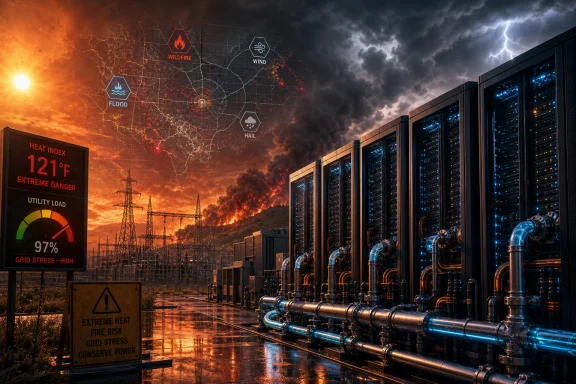 The AI Boom Has Discovered Its Most Analog Failure Mode
For years, the language of AI infrastructure has been triumphantly abstract: models, tokens, accelerators, inference, clusters, scale. But every one of those abstractions terminates in a building full of servers, transformers, switchgear, pumps, pipes, chillers, batteries, fuel systems, and people who must keep all of it running when the outside world is hostile. Extreme heat makes that physical dependency impossible to ignore.The new anxiety is not that data centers suddenly stop working at 40°C. Serious facilities are engineered with margins, redundancy, and operating procedures for hot days. The problem is that a climate regime with more frequent heatwaves, stronger storms, wildfire exposure, flooding, hail, and grid stress changes the probability model underneath the business.
That matters because AI data centers are not ordinary server rooms with a new marketing label. They concentrate far more power and heat than conventional enterprise facilities, and they do so at a moment when companies are racing to deploy capacity faster than permitting systems, utilities, and insurers can comfortably absorb. The result is a collision between hyperscale ambition and local infrastructure that was not designed around gigawatt-era computing.
The warning from insurers is especially important because insurers are paid to be professionally unimpressed by hype. If severe weather is now reportedly accounting for roughly a third of losses in Zurich’s U.S. data center builder’s risk portfolio, that is not a culture-war talking point or an environmental slogan. It is a price signal from the part of the economy that turns risk into invoices.
Insurance Is Where Climate Risk Stops Being Theoretical
The insurance angle cuts through the usual technology-industry fog. A data center operator can issue sustainability reports, a chip vendor can promise warmer liquid cooling, and a cloud provider can talk about resilience. But when underwriters see losses accumulating, the result eventually shows up in deductibles, exclusions, premiums, required design changes, and financing costs.Builder’s risk insurance is particularly revealing because it covers the construction phase, when a site is full of partially completed structures, equipment deliveries, cranes, exposed materials, and temporary systems. A severe storm that damages cooling towers or electrical gear before commissioning can delay a project and create cascading financial losses. In an AI market where capacity is being monetized before it is even fully built, delays are not merely construction headaches; they are missed revenue windows.
The reported Zurich comments point to a deeper shift: the data center map is spreading beyond long-established hubs into suburban and rural areas where historical development has been thinner and risk records may be less complete. That migration makes sense on paper. Land is cheaper, campuses can be larger, and access to power may be more negotiable than in saturated core markets.
But the move also pushes facilities into places where the weather record is less forgiving or less well understood. West Texas, Tennessee, Wisconsin, Ohio, and other emerging markets may offer attractive economics, yet they can bring higher exposure to tornadoes, hail, wind, freeze-thaw stress, or grid fragility. The same bargain that lowers upfront cost can raise long-term operational risk.
This is where AI’s capital structure starts to look climate-sensitive. If a project depends on cheap debt, aggressive completion schedules, tax incentives, and high utilization, then insurance friction is not a side issue. It can become one of the mechanisms by which climate risk reprices the entire AI infrastructure stack.
The Site Selection Map Is Moving Faster Than The Risk Models
Data centers historically clustered around places like Northern Virginia for reasons that had little to do with weather romance. Fiber density, cloud ecosystems, tax policy, power access, skilled labor, and customer proximity all reinforced each other. Once a hub becomes dominant, every new facility benefits from the infrastructure and expertise created by the previous one.AI is disrupting that geography because the new constraint is not just connectivity but power at extraordinary scale. The largest AI campuses need access to electricity, land, and construction timelines that mature markets may struggle to provide. That is pushing development into places where the grid can be expanded, where utilities are willing to negotiate, and where local governments see economic development.
The risk is that the industry is optimizing for the bottleneck it can see most clearly. Power availability is visible. Land price is visible. Tax treatment is visible. Latency can be measured. But climate risk is probabilistic, politically inconvenient, and often site-specific in ways that do not fit neatly into a spreadsheet built for speed.
This is why the reported First Street finding that 79 percent of global data center capacity faces acute climate hazards lands with force. Flood, wind, and wildfire exposure are not exotic edge cases if they apply to most of the world’s installed or planned computing capacity. They are part of the operating environment.
The industry’s defense is that data centers are among the most carefully engineered commercial buildings in the world. That is true. It is also incomplete. A facility can be robust while the roads, substations, transmission lines, water systems, emergency services, and neighboring communities around it remain vulnerable.
Heat Turns Cooling Into A Grid Problem
Extreme heat is especially awkward for data centers because it attacks from both sides of the energy equation. On the demand side, hotter weather increases cooling requirements inside the facility. On the supply side, the broader grid is also under stress because homes, offices, hospitals, schools, and transit systems are drawing more power for air conditioning.This creates a brutally simple timing problem: data centers need more energy for cooling precisely when the grid may have less flexible capacity to spare. Thermal stress can reduce the efficiency of transmission and distribution assets, raise failure rates, and force utilities to manage peaks more aggressively. In regions where underground cables, substations, or transformers were not designed for repeated extremes, the weakest link may sit far outside the data center fence.
Cooling already represents a large share of data center energy consumption, and AI servers make the arithmetic less forgiving. Dense GPU clusters produce concentrated heat loads that traditional air cooling struggles to remove efficiently. As rack densities climb, the old model of moving vast volumes of cold air around a white space starts to look like a transitional technology.
That does not mean every data center is one heatwave away from collapse. Operators know how to derate equipment, shift loads, rely on redundancy, and use backup systems. The more important point is economic: every extra degree of ambient heat can translate into higher operating expense, reduced efficiency, accelerated wear, or more expensive cooling architecture.
For WindowsForum readers, this should sound familiar. The PC world has always understood that performance is thermal. A desktop CPU that boosts aggressively under ideal cooling will throttle under poor airflow. AI infrastructure is that same principle scaled up to campuses where the cooling system becomes a strategic asset rather than a case fan.
Nvidia’s Warm-Water Bet Is A Serious Answer, Not A Magic Trick
Nvidia’s latest liquid-cooling claims are important because they attack one of the real technical bottlenecks. The company says its next-generation AI server designs can run with coolant temperatures up to 45°C, enabling warmer liquid loops and reducing the need for traditional chilled-water systems in favorable conditions. The company has also argued that raising coolant temperature can cut cooling energy costs meaningfully, with industry estimates often framed around several percentage points per degree Celsius.The basic idea is not mystical. If the cooling loop can safely operate at a higher temperature, the facility has an easier time rejecting heat to the outside environment. In some climates, that can reduce or eliminate reliance on mechanical chillers and evaporative cooling towers, lowering both electricity and water consumption.
That is a real engineering advance because AI servers are moving beyond what air cooling can comfortably handle. Liquid cooling brings heat removal closer to the chips, improves thermal transfer, and allows denser deployments. For operators trying to pack more compute into constrained buildings and power envelopes, that matters.
But it is also not a get-out-of-climate-free card. A 45°C coolant loop helps the facility tolerate warmer conditions; it does not make wildfires harmless, floodplains safe, transmission lines invincible, or local politics disappear. It also does not erase the upstream energy burden of running the compute in the first place.
The more honest reading is that Nvidia is trying to redesign the server around the climate reality that data center operators already face. The chip company is not merely selling faster accelerators; it is selling an architecture that assumes heat rejection, water use, and facility design are part of the product. In the AI era, silicon and plumbing have become one system.
Microsoft’s Reliability Play Is Really A Siting Play
Microsoft’s stated response — better site selection, redundancy, real-time monitoring, and resilient operations across a range of environmental conditions — sounds less dramatic than Nvidia’s warm-water cooling. It is also where much of the real battle will be fought. A data center’s climate exposure is often locked in before the first rack is ordered.Site selection used to be a competitive edge hidden inside real-estate and utility teams. Now it is a climate strategy. The wrong site can saddle a facility with decades of elevated cooling cost, water conflict, storm exposure, insurance friction, or grid dependence. The right site can reduce operational stress before a single watt is consumed.
Redundancy remains essential, but redundancy is not the same as invulnerability. Backup generators need fuel logistics. Batteries have thermal limits. Multiple utility feeds may still depend on shared regional infrastructure. Cooling loops can be duplicated, but they still reject heat into an environment that may be getting hotter.
Real-time monitoring helps because the modern data center is a sensor-rich machine. Operators can watch temperatures, pressures, humidity, equipment health, workload placement, and grid signals in detail. That enables faster response and better predictive maintenance.
Still, monitoring is not prevention. It tells you when the system is approaching limits; it does not necessarily change the limits. The next phase of resilience will be less about dashboards and more about whether companies are willing to build fewer facilities in places where the spreadsheet looks good but the climate file looks ugly.
The Heat Island Problem Makes Data Centers Political Neighbors
The emerging research on data center heat islands adds a politically combustible layer to the story. If large AI facilities can measurably raise surrounding land surface temperatures, even by a few degrees on average and more in extreme cases, then communities will not experience data centers only as abstract consumers of water and electricity. They may experience them as local environmental actors.That matters because many proposed data centers are already running into opposition over power lines, substations, diesel backup generators, water withdrawals, land use, and noise. Heat adds another grievance. A facility that exports waste heat into the local environment may be judged differently during a deadly heatwave than during a mild planning-board meeting.
The scientific details will require careful interpretation. Land surface temperature is not identical to the air temperature a resident feels on a sidewalk, and not every facility has the same design, density, climate, or surrounding land use. But the political lesson is straightforward: waste heat is no longer invisible.
In colder regions, waste heat can sometimes be framed as a resource. District heating schemes and industrial heat reuse have long promised a way to turn data center exhaust into useful energy. In practice, those projects are complicated by distance, economics, temperature requirements, and the need for matching heat demand.
In hot regions, the pitch is much harder. A community already facing heat stress may not be eager to host an AI campus that consumes scarce power and water while adding localized thermal effects. The social license for data centers will depend increasingly on whether operators can prove local benefits beyond construction jobs and tax revenue.
AI Infrastructure Is Becoming A Utility Before It Has Utility-Grade Governance
The uncomfortable policy question is whether AI data centers are now critical infrastructure. Cloud platforms, enterprise software, cybersecurity systems, productivity tools, government services, and consumer applications increasingly depend on them. Yet the buildout is still governed largely through private capital decisions, local permitting fights, utility negotiations, and fragmented regulation.That mismatch is growing. If a single hyperscale campus can draw power comparable to a sizable town, it is not just another commercial customer. If its failure can disrupt business services, cloud workloads, AI products, and potentially public-sector systems, it has public consequences. If its operation affects local grids during heat emergencies, it belongs in the same conversation as industrial demand response and emergency planning.
The Windows ecosystem sits directly in the blast radius. Microsoft’s cloud, Copilot services, Azure AI workloads, developer tooling, identity platforms, and enterprise management stack all depend on global data center capacity. When AI infrastructure becomes more expensive or constrained, the impact can surface as higher cloud pricing, regional capacity limits, delayed features, or more aggressive optimization of compute usage.
For sysadmins, this argues for a more sober view of cloud resilience. Multi-region architecture, backup plans, offline procedures, and workload portability are not relics of a pre-cloud era. They are practical responses to a world where the cloud’s physical substrate faces more frequent environmental stress.
For developers, it also changes the ethics of efficiency. Bloated inference calls, wasteful model selection, and unnecessary compute are not just cost issues. They are infrastructure issues. Every inefficient workload has a thermal and electrical shadow.
The Industry Cannot Cool Its Way Out Of Every Constraint
Cooling innovation is necessary, and the pace of engineering is impressive. Direct-to-chip liquid cooling, warmer loops, dry coolers, immersion systems, better controls, and AI-assisted facility management can all reduce the stress imposed by high-density compute. These advances will keep many facilities viable in conditions that would have been difficult a decade ago.But technical adaptation can create a dangerous illusion if it is treated as total adaptation. More efficient cooling can lower water use per unit of compute, but total water and power demand can still rise if the industry builds vastly more compute. This is the classic rebound problem: efficiency gains reduce the cost of consumption, which can encourage more consumption.
That is particularly relevant to AI because demand is elastic and speculative. The industry is not merely satisfying a stable workload more efficiently. It is inventing new workloads, embedding AI into existing software, and encouraging businesses to treat inference as a default interface. If every search, spreadsheet, help-desk ticket, code completion, and Windows feature becomes AI-mediated, efficiency improvements may be swallowed by growth.
The more realistic goal is not to stop the data center boom but to discipline it. Site selection must account for climate scenarios, not just historical averages. Utilities must model coincident peaks from heatwaves and compute loads. Insurers must price risk without simply abandoning exposed regions. Operators must disclose enough information for communities to judge local impacts.
The alternative is a brittle buildout: enormous, expensive, strategically important facilities deployed at speed into places where the weather, grid, water politics, and insurance market are all deteriorating at once. That is not resilience. That is leverage.
The Windows Crowd Should Watch The Infrastructure Layer, Not Just The Features
It is tempting for Windows users to see this as a cloud-industry problem happening somewhere beyond the desktop. That would be a mistake. The direction of Windows, Microsoft 365, Azure, GitHub, endpoint management, security analytics, and developer tools is increasingly tied to remote compute.Copilot is the obvious example, but it is only the visible edge. AI-assisted administration, identity protection, automated incident response, data classification, code generation, and cloud-based productivity features all depend on inference capacity. If that capacity becomes more expensive or regionally constrained, software strategy changes.
Administrators may see this first in procurement language rather than product splash screens. Cloud contracts may contain more regional caveats, sustainability commitments, resilience disclosures, or pricing structures that reflect energy intensity. Enterprises may ask harder questions about where AI workloads run, what happens during grid emergencies, and whether providers can shift loads without violating data residency rules.
Consumers may see a softer version: AI features that are metered, delayed, degraded, or reserved for paid tiers because inference is not free. The economics of AI are inseparable from the economics of the buildings that run it. Heatwaves make that linkage harder to hide.
This is also a reminder that local computing still has strategic value. On-device AI will not replace hyperscale training clusters, but it can reduce dependency on remote inference for some tasks. Microsoft, Intel, AMD, Qualcomm, and Nvidia all have reasons to push more AI capability to client hardware, and climate pressure gives that trend another argument.
The High-Temperature Trial Has Already Rewritten The Brief
The practical lessons from this heatwave and the insurance data are not subtle, but they are easy to understate because each one belongs to a different professional silo. Facilities engineers see cooling. Utilities see load. Insurers see claims. Cloud architects see availability zones. Local residents see heat, water, land, and noise. The AI boom forces all of them into the same room.- Extreme weather is becoming a front-line financial risk for data center construction, not a distant sustainability concern.
- The migration of AI capacity into emerging markets may solve land and power bottlenecks while increasing exposure to hail, wind, tornadoes, wildfire, flood, and grid stress.
- Warmer liquid cooling from vendors such as Nvidia can materially improve facility efficiency, but it cannot neutralize poor siting or regional infrastructure weakness.
- Microsoft’s emphasis on site selection, redundancy, and monitoring reflects the new reality that reliability begins before construction, not after commissioning.
- Data center heat islands could turn waste heat into a local political issue, especially in communities already facing dangerous summer temperatures.
- Windows users and IT administrators should treat AI cloud capacity as physical infrastructure with climate exposure, not as an infinitely elastic software layer.
References
- Primary source: BigGo Finance
Published: 2026-06-29T11:52:09.517441
Loading…
finance.biggo.com - Related coverage: tomsguide.com
NVIDIA claims its new AI data centers use almost no water — here's what that actually means | Tom's Guide
NVIDIA says its new AI data centers can use almost no water thanks to advanced liquid cooling. Here's how the technology works and whether it really solves AI's growing environmental problem.www.tomsguide.com - Related coverage: blogs.nvidia.com
Loading…
blogs.nvidia.com - Related coverage: datacenterdynamics.com
Loading…
www.datacenterdynamics.com - Related coverage: theinsurer.com
Loading…
www.theinsurer.com - Related coverage: forbes.com.br
Loading…
forbes.com.br
- Related coverage: tomshardware.com
Nvidia announces liquid cooling system that runs ‘hotter than a hot tub’ — promises to reduce electricity consumption and cut water use by up to 100%, but sustainability challenges remain | Tom's Hardware
Data centers are about to go from freezing to sweltering.www.tomshardware.com - Related coverage: it-news.uk
NVIDIA's AI Servers Now Run 100% Liquid-Cooled — at 45°C, Hotter Than Bath Water - IT News
NVIDIA's Rubin AI infrastructure becomes the first to achieve 100% liquid cooling, running at 45°C coolant temperatures that slash energy costs by up to $4 million annually per hyperscale facility.www.it-news.uk
- Related coverage: itinsight.pt
Loading…
www.itinsight.pt - Related coverage: dcmag.fr
Loading…
dcmag.fr - Related coverage: techradar.com
Loading…
www.techradar.com - Related coverage: nvidia.com
Loading…
www.nvidia.com - Related coverage: zurichna.com
Loading…
www.zurichna.com - Related coverage: particle.news
Particle: Nvidia Rolls Out 100% Liquid‑Cooled Rubin Servers That Run Coolant to 45°C
The company says its closed‑loop DSX reference design can cut or eliminate facility cooling water use in the right locations, lowering energy needs for large AI deployments.particle.news - Related coverage: axios.com
Loading…
www.axios.com - Related coverage: itv.com
Loading…
www.itv.com - Related coverage: benton.org
Loading…
www.benton.org - Related coverage: aljazeera.com
Loading…
www.aljazeera.com - Related coverage: lemonde.fr
Loading…
www.lemonde.fr - Related coverage: sites.ecmwf.int
Loading…
sites.ecmwf.int