

Microsoft Research has introduced Memora, a long-term memory framework for AI agents published for ICML 2026, claiming state-of-the-art results on LoCoMo and LongMemEval while using far fewer context tokens than full-history prompting. The pitch is simple but consequential: future agents will not get much smarter merely by stuffing more conversation into the prompt. They will need memory systems that know what to keep, how to organize it, and when to retrieve it. Memora is Microsoft’s latest argument that the next productivity jump in AI may come less from a bigger model than from a better filing cabinet.
The current generation of AI assistants has a strangely human marketing story and a very inhuman operating reality. Vendors sell them as collaborators, copilots, teammates, and autonomous agents, but most still behave like contractors with no durable institutional memory unless every relevant fact is pasted back into the conversation or fetched from some external system.
That weakness is tolerable when the job is a single prompt, a short email, or a one-off script. It becomes poisonous when the task stretches across weeks or months. A workplace assistant that helps manage a product launch must remember not only the final milestone date but the abandoned alternatives, the objections from legal, the customer constraint that shaped the compromise, and the person who quietly became the blocker.
This is the practical gap Memora is trying to close. Microsoft frames it as a scalable memory system for long-horizon agents, but the more interesting claim is architectural: memory should separate the rich content worth preserving from the lightweight handles used to find it later. That sounds mundane until you consider how much of today’s agent stack still treats memory as either searchable chunks or lossy summaries.
Memora’s bet is that neither approach is enough. If the memory is too detailed, retrieval becomes noisy, expensive, and fragmented. If it is too abstract, the agent remembers the gist and forgets the facts. Microsoft’s contribution is to make that tension explicit and then propose a middle layer between raw recall and summary.
Full-context inference has an appealing brute-force simplicity. Put the whole chat history in front of the model and ask it to reason. For a benchmark, this can look like the cleanest possible baseline because nothing is omitted on purpose. For a real system, it is an expensive habit that scales badly, especially when most of the old text is irrelevant to the current decision.
The deeper problem is not just token cost. Long histories contain contradictions, stale plans, tangents, and half-formed ideas. A model given everything must rediscover what matters every time. That makes “remembering” less like consulting a well-kept project notebook and more like re-reading an entire Slack channel from the beginning.
Traditional retrieval-augmented generation improves the economics by indexing fragments and fetching only the chunks that appear relevant. But RAG was largely designed for documents, not evolving relationships and decisions. It is good at finding passages that resemble a query; it is less good at preserving the narrative shape of a project where the relevant answer may depend on a chain of updates spread across time.
Summaries attack the problem from the opposite direction. They compress the conversation into something the model can carry forward, but compression is an act of editorial violence. The very details that matter in a future dispute — dates, exceptions, caveats, names, numbers — are often the first things sacrificed.
That inversion matters. In ordinary vector retrieval, the stored text and the retrieval surface are often the same thing. If a conversation contains three related updates about the same project timeline, the system may end up with three separate chunks competing for attention. The memory grows, but it does not necessarily become wiser.
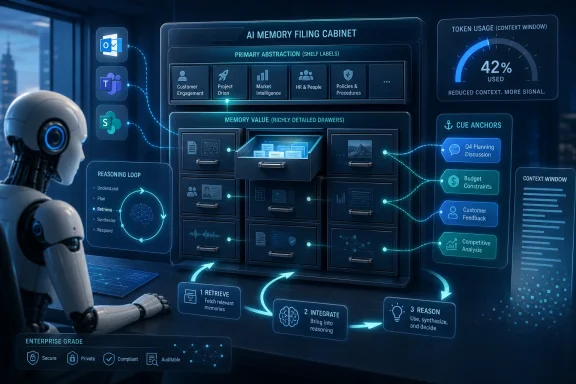
In Memora, the primary abstraction acts more like a canonical shelf label. New information about an evolving topic can be merged into a stable memory unit instead of splintering into a long trail of semantically similar fragments. The memory value remains rich enough to preserve nuance, but the retrieval layer stays compact enough to scale.
This is the part of the system that feels most relevant to enterprise AI. Real organizational memory is not a bag of facts. It is clustered around accounts, projects, incidents, people, approvals, risks, and recurring rituals. A memory system that cannot consolidate related experience will eventually bury the agent in its own recall.
Memora also adds cue anchors, short context-aware tags extracted from the memory value. These serve as alternative routes back to the same memory. A project schedule might be reachable through the project name, the people involved, the prototype deadline, or the pilot milestone, even if the user’s later question does not closely resemble the original wording.
That is a subtle but important distinction from simply tagging everything. The aim is not to impose a rigid ontology on every domain. It is to let memories develop flexible retrieval handles that reflect how users actually ask follow-up questions. In that sense, Memora is less a database schema than a navigational map.
The catch is that graphs require decisions about what counts as an entity, what relationships matter, and how new relation types should be represented. That works well in domains with stable schemas. It becomes harder in messy office life, where the important fact may be that Sarah was reluctantly okay with a delay as long as procurement did not slip again.
Memora’s example of a project timeline captures the difference. A graph system might model people, milestones, dates, and agreement relations. Memora instead creates a compact abstraction around the update and attaches cue anchors that can lead future queries back to the full memory. The system preserves the detail without insisting that every fact be normalized into a predeclared structure.
This does not make graphs obsolete. For compliance, identity, finance, asset management, and security operations, structured relationships remain essential. But agent memory has a broader problem: most useful workplace recollection is semi-structured, contextual, and full of exceptions. If a system can only remember what fits a schema, it will miss much of what makes collaboration hard.
Microsoft’s argument is therefore not that structure is bad, but that retrieval structure should be lighter than stored experience. That distinction will resonate with anyone who has watched knowledge-management systems collapse under the weight of taxonomy design. The best memory system may be one that imposes just enough order to find things without pretending that human work is cleaner than it is.
That matters because many real questions are not answered by the most similar past sentence. A user might ask why a deadline moved, who objected to a plan, or whether a current proposal conflicts with an earlier constraint. The relevant memories may be adjacent conceptually but not lexically similar.
This is where cue anchors become more than metadata. They provide bridges between memories that a pure embedding search might rank too low. A deadline query can lead to a stakeholder discussion; a stakeholder query can lead to a risk note; a risk note can lead to the old compromise that explains the current policy.
Microsoft says this retrieval policy can be driven by a strong prompted model or distilled into a smaller model using reinforcement learning. That dual path is notable. If memory retrieval requires a frontier model to babysit every lookup, the cost savings become less compelling. If the behavior can be transferred to a smaller retriever, the architecture starts to look more production-friendly.
There is a broader lesson here for AI agents. We often talk about reasoning as something that happens after information reaches the model. Memora suggests that reasoning increasingly has to happen before the main model answers, in the selection and assembly of context itself. The agent’s intelligence is partly in what it chooses not to read.
Those are strong claims, especially the combination of higher accuracy and lower token consumption. In agent systems, efficiency is not a side concern. A memory technique that improves answers but multiplies retrieval cost may win a paper table and lose a product roadmap.
Still, memory benchmarks deserve skepticism. LoCoMo and LongMemEval have become common reference points for long-conversation and long-memory evaluation, but benchmark ecosystems move quickly, and reported scores can vary with judge prompts, model choice, dataset handling, retrieval settings, and whether the test measures memory, reasoning, or context-window brute force. There are also competing claims from other memory vendors and research projects, some reporting higher scores under their own setups.
That does not invalidate Memora’s result. It does mean the most durable part of the work may be the representation, not the leaderboard slot. In a crowded memory race, “state of the art” is a temporary badge; a clean abstraction that other systems can reuse is more likely to matter six months from now.
The more useful reading is this: Microsoft has shown that careful memory organization can beat simply dumping more context into a model, at least on these long-memory tasks and under its reported evaluation. That is an important direction even if the exact margins shift as other teams reproduce, contest, or extend the results.
For Windows users, the stakes are increasingly local and personal. A future PC assistant that remembers app preferences, troubleshooting history, device quirks, accessibility choices, recurring workflows, and prior failed fixes would feel meaningfully different from today’s chatbots. It would not merely answer “how do I fix Bluetooth?”; it would know that last time the issue followed a driver update, that the user uses a particular headset for Teams, and that rolling back the driver broke audio routing.
For Microsoft 365 tenants, the opportunity is larger and more dangerous. Organizational memory could make Copilot far more useful in project management, sales, support, engineering, HR, and incident response. It could also amplify every existing governance problem around retention, access control, stale information, and sensitive context.
A memory system that can recall the journey behind a decision is powerful. It is also capable of surfacing material that users assumed was ephemeral. If an agent remembers who objected, what compromise was made, and which stakeholder preference shaped the outcome, administrators will need clear answers about provenance, permissions, deletion, auditability, and user consent.
Microsoft’s own forward-looking notes acknowledge this terrain. The company points to related work on memory systems that learn from failures, defer memory construction until enough context exists, and support group memory while preserving provenance and access boundaries. Those are not academic niceties. They are the difference between an assistant that helps an organization remember and one that becomes an ungoverned shadow archive.
This is where Memora’s abstraction layer cuts both ways. Stable memory units are useful because they consolidate related information. But consolidation is an editorial act. The system must decide when two pieces of information belong together, when an update supersedes an older fact, and when similar-looking memories should remain separate.
That matters in regulated or security-conscious environments. If an agent merges memories across clients, matters, incidents, patients, departments, or access boundaries, the result is not merely a bad answer. It may be a policy violation. The richer the memory value, the more important the retrieval guardrails become.
There is also the problem of authority. Human memory is fallible, but humans usually know when a recollection is uncertain. AI memory systems will need comparable humility. A retrieved memory should be treated as evidence with provenance, not as unquestioned truth. The agent should know whether a date came from a formal approval, a casual chat, a draft document, or an inference made during summarization.
For sysadmins, this means memory will become another managed surface. It will require lifecycle policies, retention settings, eDiscovery integration, role-based access, tenant controls, and incident response procedures. The hard part will not be turning memory on; it will be deciding what the agent is allowed to remember and who gets to make it forget.
Many agent prototypes start with a simple pattern: chunk the conversation, embed the chunks, retrieve the top matches, and append them to the next prompt. That is often enough for a demo. It is rarely enough for a system that must survive months of use and changing goals.
Memora’s storage-retrieval split suggests a more mature interface. Developers should think about memory objects with explicit abstractions, rich values, alternate cues, update behavior, and retrieval policies. They should also think about how memory gets corrected, expired, merged, and audited.
The retrieval policy is especially important for tool-using agents. An agent that can call APIs, change tickets, send email, or modify files should not act on a memory merely because it was semantically similar. It needs to gather enough context, inspect related memories, and stop when confidence is adequate. In high-impact workflows, the memory system must support caution, not just recall.
This also points to a likely market split. Consumer assistants may optimize for personalization and convenience, while enterprise systems optimize for governed recall. The underlying techniques may overlap, but the product requirements will diverge sharply. A home assistant remembering your preferred thermostat setting is not the same problem as a corporate agent remembering a merger discussion.
Some systems focus on extracting atomic facts. Others emphasize graph structure, episodic recall, personalization, compression, or cost-efficient retrieval. Some are developer tools; others are embedded into larger assistant platforms. Memora’s contribution is to argue that the core design axis is abstraction versus specificity, and that a scalable agent needs both.
Microsoft has an obvious platform incentive here. If Copilot is to become a durable work companion rather than a per-session assistant, memory must be integrated with Microsoft’s identity, data, security, and productivity stack. A standalone memory library is interesting; a governed memory layer across Microsoft 365 would be strategically significant.
That is also why WindowsForum readers should care even if they never run the Memora code. Research prototypes are often the earliest visible signs of future platform behavior. Today’s paper about cue anchors and policy-guided retrieval can become tomorrow’s admin toggle, compliance setting, SDK capability, or Copilot feature.
The risk for Microsoft is that memory is both technically and socially unforgiving. Users like assistants that remember helpful preferences. They dislike software that remembers too much, remembers without permission, or remembers in ways they cannot inspect. The company will need to prove that agent memory can be legible, controllable, and reversible.
 Microsoft Is Trying to Fix the Agent Amnesia Problem
The current generation of AI assistants has a strangely human marketing story and a very inhuman operating reality. Vendors sell them as collaborators, copilots, teammates, and autonomous agents, but most still behave like contractors with no durable institutional memory unless every relevant fact is pasted back into the conversation or fetched from some external system.That weakness is tolerable when the job is a single prompt, a short email, or a one-off script. It becomes poisonous when the task stretches across weeks or months. A workplace assistant that helps manage a product launch must remember not only the final milestone date but the abandoned alternatives, the objections from legal, the customer constraint that shaped the compromise, and the person who quietly became the blocker.
This is the practical gap Memora is trying to close. Microsoft frames it as a scalable memory system for long-horizon agents, but the more interesting claim is architectural: memory should separate the rich content worth preserving from the lightweight handles used to find it later. That sounds mundane until you consider how much of today’s agent stack still treats memory as either searchable chunks or lossy summaries.
Memora’s bet is that neither approach is enough. If the memory is too detailed, retrieval becomes noisy, expensive, and fragmented. If it is too abstract, the agent remembers the gist and forgets the facts. Microsoft’s contribution is to make that tension explicit and then propose a middle layer between raw recall and summary.
The Context Window Was Never a Memory System
The AI industry has spent the past two years stretching context windows as if size alone could solve persistence. Larger windows are useful, and for many workloads they are transformative. But a context window is not memory in the way an enterprise user means memory; it is a temporary workspace, not an archive with judgment.Full-context inference has an appealing brute-force simplicity. Put the whole chat history in front of the model and ask it to reason. For a benchmark, this can look like the cleanest possible baseline because nothing is omitted on purpose. For a real system, it is an expensive habit that scales badly, especially when most of the old text is irrelevant to the current decision.
The deeper problem is not just token cost. Long histories contain contradictions, stale plans, tangents, and half-formed ideas. A model given everything must rediscover what matters every time. That makes “remembering” less like consulting a well-kept project notebook and more like re-reading an entire Slack channel from the beginning.
Traditional retrieval-augmented generation improves the economics by indexing fragments and fetching only the chunks that appear relevant. But RAG was largely designed for documents, not evolving relationships and decisions. It is good at finding passages that resemble a query; it is less good at preserving the narrative shape of a project where the relevant answer may depend on a chain of updates spread across time.
Summaries attack the problem from the opposite direction. They compress the conversation into something the model can carry forward, but compression is an act of editorial violence. The very details that matter in a future dispute — dates, exceptions, caveats, names, numbers — are often the first things sacrificed.
Memora’s Real Trick Is Decoupling Storage From Retrieval
Microsoft describes Memora as a harmonic memory representation, a phrase that sounds like research-paper poetry but points to a concrete design choice. Each memory has a rich value, where the useful details live, and a short primary abstraction, which describes what the memory is fundamentally about. The abstraction is what gets embedded for similarity search; the detailed memory value is not directly used as the retrieval key.That inversion matters. In ordinary vector retrieval, the stored text and the retrieval surface are often the same thing. If a conversation contains three related updates about the same project timeline, the system may end up with three separate chunks competing for attention. The memory grows, but it does not necessarily become wiser.
In Memora, the primary abstraction acts more like a canonical shelf label. New information about an evolving topic can be merged into a stable memory unit instead of splintering into a long trail of semantically similar fragments. The memory value remains rich enough to preserve nuance, but the retrieval layer stays compact enough to scale.
This is the part of the system that feels most relevant to enterprise AI. Real organizational memory is not a bag of facts. It is clustered around accounts, projects, incidents, people, approvals, risks, and recurring rituals. A memory system that cannot consolidate related experience will eventually bury the agent in its own recall.
Memora also adds cue anchors, short context-aware tags extracted from the memory value. These serve as alternative routes back to the same memory. A project schedule might be reachable through the project name, the people involved, the prototype deadline, or the pilot milestone, even if the user’s later question does not closely resemble the original wording.
That is a subtle but important distinction from simply tagging everything. The aim is not to impose a rigid ontology on every domain. It is to let memories develop flexible retrieval handles that reflect how users actually ask follow-up questions. In that sense, Memora is less a database schema than a navigational map.
Graphs Promise Structure, but Structure Has a Price
Graph-based memory systems have become popular because they offer an obvious answer to the chaos of raw text. If the agent can extract entities and relationships, it can reason over people, projects, dates, and dependencies. In theory, this brings memory closer to the structured knowledge systems that enterprises already understand.The catch is that graphs require decisions about what counts as an entity, what relationships matter, and how new relation types should be represented. That works well in domains with stable schemas. It becomes harder in messy office life, where the important fact may be that Sarah was reluctantly okay with a delay as long as procurement did not slip again.
Memora’s example of a project timeline captures the difference. A graph system might model people, milestones, dates, and agreement relations. Memora instead creates a compact abstraction around the update and attaches cue anchors that can lead future queries back to the full memory. The system preserves the detail without insisting that every fact be normalized into a predeclared structure.
This does not make graphs obsolete. For compliance, identity, finance, asset management, and security operations, structured relationships remain essential. But agent memory has a broader problem: most useful workplace recollection is semi-structured, contextual, and full of exceptions. If a system can only remember what fits a schema, it will miss much of what makes collaboration hard.
Microsoft’s argument is therefore not that structure is bad, but that retrieval structure should be lighter than stored experience. That distinction will resonate with anyone who has watched knowledge-management systems collapse under the weight of taxonomy design. The best memory system may be one that imposes just enough order to find things without pretending that human work is cleaner than it is.
The Retriever Becomes Part of the Reasoning Loop
Memora’s second major move is to make retrieval iterative rather than one-shot. Instead of asking for the top few semantically similar memories and moving on, the policy-guided retriever can refine its query, follow cue anchors, expand to related memories, and decide when it has enough context. This turns memory access into a small reasoning process of its own.That matters because many real questions are not answered by the most similar past sentence. A user might ask why a deadline moved, who objected to a plan, or whether a current proposal conflicts with an earlier constraint. The relevant memories may be adjacent conceptually but not lexically similar.
This is where cue anchors become more than metadata. They provide bridges between memories that a pure embedding search might rank too low. A deadline query can lead to a stakeholder discussion; a stakeholder query can lead to a risk note; a risk note can lead to the old compromise that explains the current policy.
Microsoft says this retrieval policy can be driven by a strong prompted model or distilled into a smaller model using reinforcement learning. That dual path is notable. If memory retrieval requires a frontier model to babysit every lookup, the cost savings become less compelling. If the behavior can be transferred to a smaller retriever, the architecture starts to look more production-friendly.
There is a broader lesson here for AI agents. We often talk about reasoning as something that happens after information reaches the model. Memora suggests that reasoning increasingly has to happen before the main model answers, in the selection and assembly of context itself. The agent’s intelligence is partly in what it chooses not to read.
The Benchmark Numbers Are Impressive, but They Need Adult Supervision
Microsoft reports that Memora reaches 86.3 percent LLM-judge accuracy on LoCoMo and 87.4 percent on LongMemEval, outperforming RAG, Mem0, Nemori, Zep, LangMem, and full-context inference in the company’s evaluation. It also says Memora stores roughly half as many memory entries per conversation as Mem0 in one comparison and can reduce token use by up to 98 percent compared with full-context inference.Those are strong claims, especially the combination of higher accuracy and lower token consumption. In agent systems, efficiency is not a side concern. A memory technique that improves answers but multiplies retrieval cost may win a paper table and lose a product roadmap.
Still, memory benchmarks deserve skepticism. LoCoMo and LongMemEval have become common reference points for long-conversation and long-memory evaluation, but benchmark ecosystems move quickly, and reported scores can vary with judge prompts, model choice, dataset handling, retrieval settings, and whether the test measures memory, reasoning, or context-window brute force. There are also competing claims from other memory vendors and research projects, some reporting higher scores under their own setups.
That does not invalidate Memora’s result. It does mean the most durable part of the work may be the representation, not the leaderboard slot. In a crowded memory race, “state of the art” is a temporary badge; a clean abstraction that other systems can reuse is more likely to matter six months from now.
The more useful reading is this: Microsoft has shown that careful memory organization can beat simply dumping more context into a model, at least on these long-memory tasks and under its reported evaluation. That is an important direction even if the exact margins shift as other teams reproduce, contest, or extend the results.
For Windows and Microsoft 365, Memory Is the Product Surface
Memora is a research project, not a shipping Windows feature. But it is hard to read it outside Microsoft’s broader Copilot strategy. The company’s AI ambitions depend heavily on assistants that can operate across Outlook, Teams, Word, SharePoint, GitHub, security tooling, and line-of-business data without behaving like forgetful autocomplete.For Windows users, the stakes are increasingly local and personal. A future PC assistant that remembers app preferences, troubleshooting history, device quirks, accessibility choices, recurring workflows, and prior failed fixes would feel meaningfully different from today’s chatbots. It would not merely answer “how do I fix Bluetooth?”; it would know that last time the issue followed a driver update, that the user uses a particular headset for Teams, and that rolling back the driver broke audio routing.
For Microsoft 365 tenants, the opportunity is larger and more dangerous. Organizational memory could make Copilot far more useful in project management, sales, support, engineering, HR, and incident response. It could also amplify every existing governance problem around retention, access control, stale information, and sensitive context.
A memory system that can recall the journey behind a decision is powerful. It is also capable of surfacing material that users assumed was ephemeral. If an agent remembers who objected, what compromise was made, and which stakeholder preference shaped the outcome, administrators will need clear answers about provenance, permissions, deletion, auditability, and user consent.
Microsoft’s own forward-looking notes acknowledge this terrain. The company points to related work on memory systems that learn from failures, defer memory construction until enough context exists, and support group memory while preserving provenance and access boundaries. Those are not academic niceties. They are the difference between an assistant that helps an organization remember and one that becomes an ungoverned shadow archive.
The Enterprise Risk Is Not That Agents Remember Too Little
The obvious complaint about agents is that they forget. The less obvious risk is that they remember badly. A faulty memory system can preserve the wrong version of a plan, over-weight an outdated preference, merge two similar projects, or retrieve a sensitive fact into a context where it does not belong.This is where Memora’s abstraction layer cuts both ways. Stable memory units are useful because they consolidate related information. But consolidation is an editorial act. The system must decide when two pieces of information belong together, when an update supersedes an older fact, and when similar-looking memories should remain separate.
That matters in regulated or security-conscious environments. If an agent merges memories across clients, matters, incidents, patients, departments, or access boundaries, the result is not merely a bad answer. It may be a policy violation. The richer the memory value, the more important the retrieval guardrails become.
There is also the problem of authority. Human memory is fallible, but humans usually know when a recollection is uncertain. AI memory systems will need comparable humility. A retrieved memory should be treated as evidence with provenance, not as unquestioned truth. The agent should know whether a date came from a formal approval, a casual chat, a draft document, or an inference made during summarization.
For sysadmins, this means memory will become another managed surface. It will require lifecycle policies, retention settings, eDiscovery integration, role-based access, tenant controls, and incident response procedures. The hard part will not be turning memory on; it will be deciding what the agent is allowed to remember and who gets to make it forget.
Developers Should Read Memora as an API Design Warning
For developers building agents, Memora is a warning against treating memory as a quick vector database integration. Embeddings are useful, but memory is not just search. The shape of what gets stored determines what the agent can later believe, retrieve, and act upon.Many agent prototypes start with a simple pattern: chunk the conversation, embed the chunks, retrieve the top matches, and append them to the next prompt. That is often enough for a demo. It is rarely enough for a system that must survive months of use and changing goals.
Memora’s storage-retrieval split suggests a more mature interface. Developers should think about memory objects with explicit abstractions, rich values, alternate cues, update behavior, and retrieval policies. They should also think about how memory gets corrected, expired, merged, and audited.
The retrieval policy is especially important for tool-using agents. An agent that can call APIs, change tickets, send email, or modify files should not act on a memory merely because it was semantically similar. It needs to gather enough context, inspect related memories, and stop when confidence is adequate. In high-impact workflows, the memory system must support caution, not just recall.
This also points to a likely market split. Consumer assistants may optimize for personalization and convenience, while enterprise systems optimize for governed recall. The underlying techniques may overlap, but the product requirements will diverge sharply. A home assistant remembering your preferred thermostat setting is not the same problem as a corporate agent remembering a merger discussion.
The Memory Race Is Becoming a Platform Contest
Memora arrives amid a broader surge of research and commercialization around AI memory. Mem0, Zep, LangMem, GraphRAG-style systems, and a growing list of academic projects are all trying to solve the persistence problem from different angles. The competition is healthy, but it also makes the term “memory” increasingly overloaded.Some systems focus on extracting atomic facts. Others emphasize graph structure, episodic recall, personalization, compression, or cost-efficient retrieval. Some are developer tools; others are embedded into larger assistant platforms. Memora’s contribution is to argue that the core design axis is abstraction versus specificity, and that a scalable agent needs both.
Microsoft has an obvious platform incentive here. If Copilot is to become a durable work companion rather than a per-session assistant, memory must be integrated with Microsoft’s identity, data, security, and productivity stack. A standalone memory library is interesting; a governed memory layer across Microsoft 365 would be strategically significant.
That is also why WindowsForum readers should care even if they never run the Memora code. Research prototypes are often the earliest visible signs of future platform behavior. Today’s paper about cue anchors and policy-guided retrieval can become tomorrow’s admin toggle, compliance setting, SDK capability, or Copilot feature.
The risk for Microsoft is that memory is both technically and socially unforgiving. Users like assistants that remember helpful preferences. They dislike software that remembers too much, remembers without permission, or remembers in ways they cannot inspect. The company will need to prove that agent memory can be legible, controllable, and reversible.
Memora Moves the Argument From Bigger Prompts to Better Recall
Memora’s practical message is not that one Microsoft Research paper has solved long-term AI memory. It is that the industry is converging on a more realistic view of agent productivity. Long-horizon work requires memory architectures, not just larger windows and clever prompts.- Memora separates rich stored memories from lightweight retrieval abstractions, which helps preserve detail without making every lookup depend on searching raw content.
- Cue anchors give agents multiple paths back to the same memory, making retrieval less dependent on whether a future query resembles the original wording.
- Microsoft’s reported results show strong accuracy on LoCoMo and LongMemEval while sharply reducing context-token use compared with full-history prompting.
- The benchmark claims are promising but should be treated as part of a fast-moving and contested evaluation landscape, not as a permanent leaderboard verdict.
- The most important enterprise questions will be governance questions: what gets remembered, who can retrieve it, how provenance is preserved, and how memory is corrected or deleted.
- For developers, Memora is a reminder that durable agents need memory objects, update policies, and retrieval strategies rather than a thin layer of vector search alone.
References
- Primary source: Microsoft
Published: Mon, 29 Jun 2026 21:14:22 GMT
Memora: A Harmonic Memory Representation Balancing Abstraction and Specificity - Microsoft Research
AI agents can't remember past conversations. They must constantly reload or retrieve context, which grows less efficient as tasks get longer and more complex. Memora solves this with a scalable memory system separating what’s stored from how it's retrieved.www.microsoft.com - Related coverage: mem0.ai
AI Memory Benchmarks 2026: LoCoMo, LongMemEval & BEAM
LoCoMo 92.5%, LongMemEval 94.4%, BEAM 1M 62%: a breakdown of every major AI memory benchmark in 2026 and where Mem0 stands mem0.ai
- Related coverage: researchgate.net
(PDF) Memora: A Harmonic Memory Representation Balancing Abstraction and Specificity
PDF | Agent memory systems must accommodate continuously growing information while supporting efficient, context-aware retrieval for downstream tasks.... | Find, read and cite all the research you need on ResearchGate www.researchgate.net
- Related coverage: aclanthology.org