

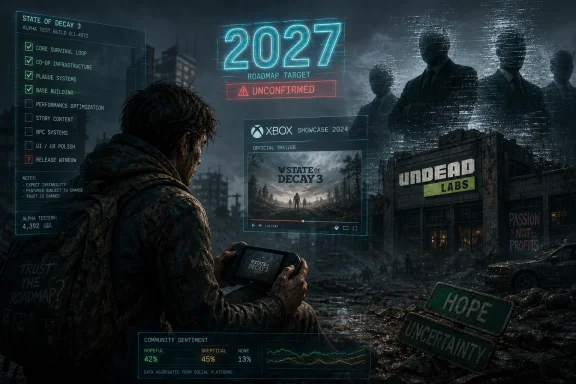
Microsoft is reportedly exploring a sale of Undead Labs and could cancel State of Decay 3 if no buyer emerges, even though Xbox showed the game at its June 2026 showcase, promoted a 2027 launch window, and recently ran closed alpha testing. That is the kind of report that lands differently from ordinary restructuring gossip. If true, it says Xbox’s problem is no longer just production discipline, Game Pass economics, or the hangover from too many acquisitions. It is that Microsoft may be teaching players, developers, and even its own studios that an Xbox promise is no longer a promise at all.
The modern Xbox showcase has always carried a strange burden. It is not just a marketing event; it is a credibility exercise for a platform that has spent years asking customers to believe that the next wave of first-party games will finally justify the ecosystem.
That is why the State of Decay 3 situation is so corrosive. This was not a forgotten prototype quietly aging inside a studio wiki. Microsoft put the game in front of the public, attached it to Xbox Game Studios, showed gameplay, positioned it for 2027, and framed it as part of the future of the platform.
If the report is accurate, the trailer was not a confident statement of intent. It was a snapshot of an asset that might now be sold, spun out, or buried depending on fiscal-year arithmetic. That changes how every future Xbox announcement is heard.
A trailer used to mean: this game exists, this publisher intends to ship it, and the platform holder is willing to attach its reputation to the promise. Under the darkest reading of this report, a trailer now means: this project survived long enough to be useful in a showcase.
That is a brutal distinction, and it is exactly the kind of distinction fans remember.
The series has always had rough edges, but those rough edges were part of its identity. It was a zombie survival game less interested in cinematic heroics than attrition, base management, scavenging routes, community tradeoffs, and the creeping dread of losing people you had come to rely on. In an industry where every survival game promises emergent drama, State of Decay actually had the bones of one.
That made Undead Labs a logical acquisition for Microsoft. The studio had a recognizable IP, an existing Xbox audience, a design niche that did not overlap heavily with Microsoft’s other first-party teams, and a franchise that could benefit from patient investment. If Xbox Game Studios was meant to be a portfolio rather than a factory, Undead Labs was exactly the kind of team that justified the model.
The reported danger is not merely that Microsoft might cancel a promising zombie game. It is that Microsoft might be unwilling to carry a studio through the final stretch of a project that already appears to have cleared the public-announcement hurdle multiple times.
That is not portfolio management. That is panic management.
That matters because it narrows the range of plausible explanations. A game that exists only as a CG announcement trailer can disappear into the fog with minimal public damage. A game that has been shown repeatedly, discussed by developers, wishlisted by players, and tested by the community carries a different obligation.
Xbox has spent years telling players that it wants to build communities, not just sell discs. Game Pass itself is sold as an ongoing relationship with an audience. But communities are not just content targets; they are trust structures. When fans sign up for tests, follow development beats, and organize around a franchise, they are investing attention in the belief that the platform holder is acting in good faith.
If Microsoft is now willing to put Undead Labs on the block with State of Decay 3 so publicly alive, it undercuts that compact. It tells fans that even visible progress may not be enough to protect a game from corporate recalibration.
The chilling effect is obvious. Why get excited early? Why sign up for tests? Why believe that a “coming in 2027” beat is anything more than a placeholder until the next margin review?
Acquisitions are easy to announce. Integration is harder. Shipping games is harder still. Maintaining a healthy studio culture after inserting it into one of the largest corporations on Earth is harder than all of that.
For a while, Microsoft’s pitch was that Xbox would be a better home for creative teams than the more ruthless corners of the industry. Studios would get resources, stability, technical support, and access to a large subscription audience. The platform needed content; the studios needed runway. The bargain sounded reasonable.
But the past few years have made that pitch wobble. Layoffs, closures, cancellations, and restructuring reports have accumulated around Xbox so steadily that the individual stories blur together. Each one can be explained in isolation. Together, they form a pattern.
That pattern is not simply “Microsoft cuts costs.” Every large company cuts costs. The pattern is that Microsoft’s public-facing gaming ambitions keep colliding with internal expectations that look mismatched to the volatility of game development.
You cannot buy studios to solve a content problem and then judge those studios as if they are quarterly software widgets. Games take time. Sequels slip. New IP misses. Great teams sometimes need one bad project to find the next great one. If the business cannot tolerate that, it should stop presenting itself as a creative patron.
A traditional retail release gives a publisher a fairly legible signal. The game sold this many copies at this price in this window. Game Pass muddies that. A game can be widely played, culturally appreciated, and strategically useful while still failing to satisfy internal revenue targets.
That ambiguity is dangerous inside a company like Microsoft. If leadership cannot clearly translate engagement into durable financial value, creative teams can become exposed to whatever metric is currently fashionable. A studio may be told for years that ecosystem value matters, only to discover later that ecosystem value is not enough.
State of Decay 3 sits right in the middle of that tension. It looks like a game built for long-tail play, recurring updates, community storytelling, and co-op survival loops. In theory, that is Game Pass territory. In practice, it may also be the kind of game that suffers if Microsoft decides the subscription math no longer excuses long development cycles.
The irony is sharp. Xbox spent years training customers not to think about individual purchases in the old way. Now some of its studios may be judged by a financial regime that still wants old-fashioned proof of commercial performance.
A console maker’s promise used to be straightforward: buy the box, get the games. Microsoft’s pitch has become more abstract: enter the ecosystem, and Xbox will meet you where you are. That can work, but only if the content pipeline feels reliable.
If first-party games appear unstable, the whole abstraction suffers. Players can forgive a delayed title. They can even forgive a canceled title if the reasons are clear and rare. What they cannot easily forgive is the sense that Xbox’s public roadmap is provisional in a deeper, more cynical way.
This is where State of Decay 3 becomes bigger than itself. The game is not just another release on a calendar. It is a test of whether Microsoft’s new Xbox can honor the continuity between announcement, development, community engagement, and launch.
If Microsoft sells Undead Labs and the game survives elsewhere, that might be the best available outcome. But even that would raise a grim question: why was Microsoft unable or unwilling to finish the job itself?
When a studio is shuttered or forced into a rushed independence deal, some of that knowledge scatters. Tools are abandoned. Design instincts leave with senior staff. Junior developers lose mentors. The next version of the game, if it exists at all, may not inherit the invisible craft that made the previous work viable.
That is especially relevant for a systems-heavy franchise like State of Decay. These games are not carried by one cinematic trick or one licensed universe. They depend on tuning, simulation, AI behavior, base systems, scavenging loops, and a feel for player-driven chaos. Those are not commodities.
Selling a studio can save a team if the buyer is committed and the terms are sane. It can also be a polite prelude to fragmentation. The public usually finds out which version happened too late.
For workers, the cruelty is the uncertainty. A studio can spend years building toward a public reveal only to have its future become a negotiation conducted above its head. That is not just demoralizing; it is operationally destructive.
If players do not trust Xbox announcements, wishlists mean less. Showcase enthusiasm fades faster. Subscription value becomes harder to communicate. Fans stop treating first-party games as future pillars and start treating them as rumors with trailers attached.
That matters for administrators and Windows enthusiasts more than it might seem. Xbox is not a distant console island inside Microsoft. It is tied to the Microsoft Store, PC Game Pass, Xbox app distribution, cloud gaming, account infrastructure, cross-save, Play Anywhere, controller standards, and the broader Windows gaming story. When Xbox’s content strategy looks unstable, Microsoft’s gaming presence on Windows looks less coherent too.
PC players already have alternatives. Steam is not waiting for Microsoft to solve its identity crisis. Epic, GOG, Battle.net, Riot, EA, Ubisoft, and countless standalone launchers compete for attention. Game Pass on PC is attractive when the pipeline is strong and the value proposition feels obvious. It is less attractive when the first-party slate feels like it might be revised by spreadsheet.
The harsh lesson is that a platform’s technical infrastructure cannot compensate forever for a weakening emotional contract. Xbox can have cloud saves, cross-play, and a polished app. If users suspect the games they care about are disposable, the ecosystem feels disposable too.
The problem is that Microsoft is not a fragile publisher trying to survive one failed release. It is one of the richest technology companies in the world, a company willing to spend enormous sums on AI infrastructure, acquisitions, and strategic positioning. When that company pleads discipline in gaming, the question is not whether discipline is necessary. The question is whether the discipline is being applied intelligently.
Cutting a project late can save money in the narrowest sense. It can also destroy years of goodwill, waste sunk development effort, and train customers to discount future announcements. Those costs may not show up neatly in a fiscal-year table, but they are real.
This is where the reported State of Decay 3 situation feels self-defeating. If Microsoft had quietly decided years ago that Undead Labs did not fit the strategy, that would be one kind of story. Letting the studio build toward a public gameplay reveal and then reportedly exploring a sale or cancellation is another.
It suggests not clarity, but churn.
But disbelief is more dangerous than disappointment. Disappointment assumes the thing you wanted may still arrive later. Disbelief assumes the institution telling you to wait is not competent enough, stable enough, or honest enough to be worth waiting for.
That is the threshold Xbox is flirting with now. If State of Decay 3 is at risk after its public reemergence, fans will reasonably ask what other showcased games are secure. They will wonder which studios are protected and which are merely being exhibited before restructuring. They will parse every trailer not for gameplay details, but for signs of corporate survivability.
That is poison for a showcase-driven business. Marketing depends on suspension of disbelief. A platform holder says, “Here is the future,” and the audience agrees, temporarily, to imagine living in it. Once that agreement breaks, even good trailers struggle to land.
Microsoft can still prevent the worst version of this story. It can keep Undead Labs, ship the game, and accept that credibility has value. It can find a buyer that preserves the team and the franchise. It can communicate clearly instead of letting rumor fill the vacuum.
But the margin for ambiguity is shrinking.
Here is what matters now:
 Xbox Is Turning Its Showcase Into a Risk Disclosure
The modern Xbox showcase has always carried a strange burden. It is not just a marketing event; it is a credibility exercise for a platform that has spent years asking customers to believe that the next wave of first-party games will finally justify the ecosystem.That is why the State of Decay 3 situation is so corrosive. This was not a forgotten prototype quietly aging inside a studio wiki. Microsoft put the game in front of the public, attached it to Xbox Game Studios, showed gameplay, positioned it for 2027, and framed it as part of the future of the platform.
If the report is accurate, the trailer was not a confident statement of intent. It was a snapshot of an asset that might now be sold, spun out, or buried depending on fiscal-year arithmetic. That changes how every future Xbox announcement is heard.
A trailer used to mean: this game exists, this publisher intends to ship it, and the platform holder is willing to attach its reputation to the promise. Under the darkest reading of this report, a trailer now means: this project survived long enough to be useful in a showcase.
That is a brutal distinction, and it is exactly the kind of distinction fans remember.
State of Decay Was Supposed to Be the Kind of Bet Microsoft Could Afford
State of Decay is not Halo, Call of Duty, or Forza. It is more interesting than that. It is the sort of mid-budget, system-driven, deeply replayable franchise that should make sense inside a subscription-heavy, multi-platform Xbox strategy.The series has always had rough edges, but those rough edges were part of its identity. It was a zombie survival game less interested in cinematic heroics than attrition, base management, scavenging routes, community tradeoffs, and the creeping dread of losing people you had come to rely on. In an industry where every survival game promises emergent drama, State of Decay actually had the bones of one.
That made Undead Labs a logical acquisition for Microsoft. The studio had a recognizable IP, an existing Xbox audience, a design niche that did not overlap heavily with Microsoft’s other first-party teams, and a franchise that could benefit from patient investment. If Xbox Game Studios was meant to be a portfolio rather than a factory, Undead Labs was exactly the kind of team that justified the model.
The reported danger is not merely that Microsoft might cancel a promising zombie game. It is that Microsoft might be unwilling to carry a studio through the final stretch of a project that already appears to have cleared the public-announcement hurdle multiple times.
That is not portfolio management. That is panic management.
The Alpha Makes the Report Feel Worse, Not Better
Closed alpha tests are not proof that a game is nearly finished. Plenty of games reach external testing with years of iteration still ahead. But an alpha is proof of something important: the project has crossed from abstract development into playable reality.That matters because it narrows the range of plausible explanations. A game that exists only as a CG announcement trailer can disappear into the fog with minimal public damage. A game that has been shown repeatedly, discussed by developers, wishlisted by players, and tested by the community carries a different obligation.
Xbox has spent years telling players that it wants to build communities, not just sell discs. Game Pass itself is sold as an ongoing relationship with an audience. But communities are not just content targets; they are trust structures. When fans sign up for tests, follow development beats, and organize around a franchise, they are investing attention in the belief that the platform holder is acting in good faith.
If Microsoft is now willing to put Undead Labs on the block with State of Decay 3 so publicly alive, it undercuts that compact. It tells fans that even visible progress may not be enough to protect a game from corporate recalibration.
The chilling effect is obvious. Why get excited early? Why sign up for tests? Why believe that a “coming in 2027” beat is anything more than a placeholder until the next margin review?
Microsoft Bought Studios, Then Discovered Studios Require Patience
The uncomfortable truth is that Xbox’s current crisis was not created overnight. Microsoft spent years buying creative capacity while struggling to explain how that capacity would be managed, measured, and protected.Acquisitions are easy to announce. Integration is harder. Shipping games is harder still. Maintaining a healthy studio culture after inserting it into one of the largest corporations on Earth is harder than all of that.
For a while, Microsoft’s pitch was that Xbox would be a better home for creative teams than the more ruthless corners of the industry. Studios would get resources, stability, technical support, and access to a large subscription audience. The platform needed content; the studios needed runway. The bargain sounded reasonable.
But the past few years have made that pitch wobble. Layoffs, closures, cancellations, and restructuring reports have accumulated around Xbox so steadily that the individual stories blur together. Each one can be explained in isolation. Together, they form a pattern.
That pattern is not simply “Microsoft cuts costs.” Every large company cuts costs. The pattern is that Microsoft’s public-facing gaming ambitions keep colliding with internal expectations that look mismatched to the volatility of game development.
You cannot buy studios to solve a content problem and then judge those studios as if they are quarterly software widgets. Games take time. Sequels slip. New IP misses. Great teams sometimes need one bad project to find the next great one. If the business cannot tolerate that, it should stop presenting itself as a creative patron.
Game Pass Made the Accounting Harder to Read
Game Pass remains one of Xbox’s boldest ideas and one of its most persistent complications. It changed consumer expectations, helped Microsoft differentiate itself from Sony and Nintendo, and gave smaller games a way to reach large audiences quickly. It also made success harder to define.A traditional retail release gives a publisher a fairly legible signal. The game sold this many copies at this price in this window. Game Pass muddies that. A game can be widely played, culturally appreciated, and strategically useful while still failing to satisfy internal revenue targets.
That ambiguity is dangerous inside a company like Microsoft. If leadership cannot clearly translate engagement into durable financial value, creative teams can become exposed to whatever metric is currently fashionable. A studio may be told for years that ecosystem value matters, only to discover later that ecosystem value is not enough.
State of Decay 3 sits right in the middle of that tension. It looks like a game built for long-tail play, recurring updates, community storytelling, and co-op survival loops. In theory, that is Game Pass territory. In practice, it may also be the kind of game that suffers if Microsoft decides the subscription math no longer excuses long development cycles.
The irony is sharp. Xbox spent years training customers not to think about individual purchases in the old way. Now some of its studios may be judged by a financial regime that still wants old-fashioned proof of commercial performance.
The Platform Strategy Is Starting to Eat the Brand Strategy
Xbox no longer means one thing. It is a console, a PC storefront, a cloud service, a publisher, a subscription, a controller ecosystem, a mobile ambition, and increasingly a catalog that shows up on PlayStation. That breadth is not automatically a weakness. But it does make trust more difficult to maintain.A console maker’s promise used to be straightforward: buy the box, get the games. Microsoft’s pitch has become more abstract: enter the ecosystem, and Xbox will meet you where you are. That can work, but only if the content pipeline feels reliable.
If first-party games appear unstable, the whole abstraction suffers. Players can forgive a delayed title. They can even forgive a canceled title if the reasons are clear and rare. What they cannot easily forgive is the sense that Xbox’s public roadmap is provisional in a deeper, more cynical way.
This is where State of Decay 3 becomes bigger than itself. The game is not just another release on a calendar. It is a test of whether Microsoft’s new Xbox can honor the continuity between announcement, development, community engagement, and launch.
If Microsoft sells Undead Labs and the game survives elsewhere, that might be the best available outcome. But even that would raise a grim question: why was Microsoft unable or unwilling to finish the job itself?
The Human Cost Is Not a Footnote to the Business Story
Studio closures are often discussed in the language of brands and assets, but game studios are not just IP containers. They are groups of artists, engineers, designers, producers, QA staff, writers, community managers, and support teams whose accumulated knowledge is the product.When a studio is shuttered or forced into a rushed independence deal, some of that knowledge scatters. Tools are abandoned. Design instincts leave with senior staff. Junior developers lose mentors. The next version of the game, if it exists at all, may not inherit the invisible craft that made the previous work viable.
That is especially relevant for a systems-heavy franchise like State of Decay. These games are not carried by one cinematic trick or one licensed universe. They depend on tuning, simulation, AI behavior, base systems, scavenging loops, and a feel for player-driven chaos. Those are not commodities.
Selling a studio can save a team if the buyer is committed and the terms are sane. It can also be a polite prelude to fragmentation. The public usually finds out which version happened too late.
For workers, the cruelty is the uncertainty. A studio can spend years building toward a public reveal only to have its future become a negotiation conducted above its head. That is not just demoralizing; it is operationally destructive.
Xbox’s Trust Problem Is Now a Product Problem
Trust sounds soft until it starts affecting behavior. Then it becomes a product problem.If players do not trust Xbox announcements, wishlists mean less. Showcase enthusiasm fades faster. Subscription value becomes harder to communicate. Fans stop treating first-party games as future pillars and start treating them as rumors with trailers attached.
That matters for administrators and Windows enthusiasts more than it might seem. Xbox is not a distant console island inside Microsoft. It is tied to the Microsoft Store, PC Game Pass, Xbox app distribution, cloud gaming, account infrastructure, cross-save, Play Anywhere, controller standards, and the broader Windows gaming story. When Xbox’s content strategy looks unstable, Microsoft’s gaming presence on Windows looks less coherent too.
PC players already have alternatives. Steam is not waiting for Microsoft to solve its identity crisis. Epic, GOG, Battle.net, Riot, EA, Ubisoft, and countless standalone launchers compete for attention. Game Pass on PC is attractive when the pipeline is strong and the value proposition feels obvious. It is less attractive when the first-party slate feels like it might be revised by spreadsheet.
The harsh lesson is that a platform’s technical infrastructure cannot compensate forever for a weakening emotional contract. Xbox can have cloud saves, cross-play, and a polished app. If users suspect the games they care about are disposable, the ecosystem feels disposable too.
Microsoft’s Scale Makes the Cuts Feel Less Forgivable
Every company has budgets. Every division has constraints. Gaming is expensive, and not every studio can be insulated from commercial reality. That argument is true as far as it goes.The problem is that Microsoft is not a fragile publisher trying to survive one failed release. It is one of the richest technology companies in the world, a company willing to spend enormous sums on AI infrastructure, acquisitions, and strategic positioning. When that company pleads discipline in gaming, the question is not whether discipline is necessary. The question is whether the discipline is being applied intelligently.
Cutting a project late can save money in the narrowest sense. It can also destroy years of goodwill, waste sunk development effort, and train customers to discount future announcements. Those costs may not show up neatly in a fiscal-year table, but they are real.
This is where the reported State of Decay 3 situation feels self-defeating. If Microsoft had quietly decided years ago that Undead Labs did not fit the strategy, that would be one kind of story. Letting the studio build toward a public gameplay reveal and then reportedly exploring a sale or cancellation is another.
It suggests not clarity, but churn.
The Old Xbox Could Survive Delays; This Xbox May Not Survive Disbelief
Xbox fans have endured delays before. They endured the Xbox One launch. They endured droughts, reboots, vaporous CG trailers, and years of “wait until next year” rhetoric. The brand has been bruised many times and lived.But disbelief is more dangerous than disappointment. Disappointment assumes the thing you wanted may still arrive later. Disbelief assumes the institution telling you to wait is not competent enough, stable enough, or honest enough to be worth waiting for.
That is the threshold Xbox is flirting with now. If State of Decay 3 is at risk after its public reemergence, fans will reasonably ask what other showcased games are secure. They will wonder which studios are protected and which are merely being exhibited before restructuring. They will parse every trailer not for gameplay details, but for signs of corporate survivability.
That is poison for a showcase-driven business. Marketing depends on suspension of disbelief. A platform holder says, “Here is the future,” and the audience agrees, temporarily, to imagine living in it. Once that agreement breaks, even good trailers struggle to land.
Microsoft can still prevent the worst version of this story. It can keep Undead Labs, ship the game, and accept that credibility has value. It can find a buyer that preserves the team and the franchise. It can communicate clearly instead of letting rumor fill the vacuum.
But the margin for ambiguity is shrinking.
The Zombie Game Became a Canary in the Redmond Mine
The practical read is not complicated, even if the corporate machinery behind it is. If the report is wrong, Microsoft should say so quickly. If it is directionally right, Xbox has a deeper credibility problem than one studio’s fate.Here is what matters now:
- Microsoft has publicly positioned State of Decay 3 as a 2027 Xbox Game Studios release after years of silence and renewed showcase attention.
- A reported sale or cancellation threat would make even late-stage public marketing feel conditional rather than committed.
- Undead Labs represents the kind of specialized, mid-sized creative team that Xbox once implied it wanted to protect and grow.
- Game Pass makes audience value harder to measure, which may expose studios to shifting internal financial targets after years of ecosystem-first messaging.
- The damage would extend beyond one game because every future Xbox trailer would be interpreted through the possibility of sudden corporate reversal.
- The best outcome is not merely that State of Decay 3 survives, but that Microsoft proves its public roadmap means something again.
References
- Primary source: Windows Central
Published: 2026-06-29T21:52:10.299853
Loading…
www.windowscentral.com - Related coverage: news.xbox.com
Loading…
news.xbox.com - Related coverage: gamespot.com
Loading…
www.gamespot.com - Related coverage: xbox.com
Loading…
www.xbox.com - Related coverage: xbox-mag.net
Loading…
xbox-mag.net - Related coverage: adrenaline.com.br
Loading…
www.adrenaline.com.br
- Related coverage: kotaku.com
Loading…
kotaku.com - Related coverage: xboxdynasty.de
Loading…
www.xboxdynasty.de - Related coverage: videogameschronicle.com
Loading…
www.videogameschronicle.com - Related coverage: gamesradar.com
Loading…
www.gamesradar.com - Related coverage: as.com
Loading…
as.com - Related coverage: tomsguide.com
Loading…
www.tomsguide.com - Related coverage: t3.com
Loading…
www.t3.com - Related coverage: techtimes.com
Xbox Studio Closures Confirmed: Ninja Theory Shut Down Nine Days After Showcase
Xbox studio closures 2026 hit Ninja Theory, Double Fine, and Compulsion Games as Microsoft’s Reset executes its first cuts. The Hellblade studio was told Monday it is closing, just nine days afterwww.techtimes.com - Related coverage: gadgets360.com
Loading…
www.gadgets360.com - Related coverage: latimes.com
Loading…
www.latimes.com - Related coverage: metaintro.com
Loading…
www.metaintro.com - Related coverage: gematsu.com
Xbox CEO Asha Sharma and executive vice president Matt Booty publish staff memo ‘Next 100 Days: Xbox Reset’ - Gematsu
Xbox CEO Asha Sharma and Xbox executive vice president and chief content officer Matt Booty have published a memo sent to Xbox staff today…www.gematsu.com - Related coverage: geekwire.com
Loading…
www.geekwire.com - Related coverage: techspot.com
Xbox is planning major layoffs and hinting at "radically different" console business model | TechSpot
Although Xbox chief Asha Sharma didn't say "layoffs" in her recent memo to staff, the message's tone certainly gives off the feeling that they're coming. Sources recently...www.techspot.com - Related coverage: arstechnica.com
"This cannot continue": Xbox leaders lay out "hard truths" behind sagging brand - Ars Technica
Brutal self-assessment paints a picture of a Microsoft gaming division in crisis.arstechnica.com - Related coverage: pcgamer.com
Xbox Game Studios head and chief of staff step down as 'Xbox reset' looms | PC Gamer
Studio closures are expected as Xbox's new leadership looks for a fresh start.www.pcgamer.com