

Lexar used a 2026 China press tour through Suzhou, Zhongshan, and Shenzhen to show how its 30-year-old storage brand now depends on Longsys manufacturing, large-scale compatibility testing, and an AI-era product strategy built around faster, more reliable flash. The interesting part was not that Lexar has factories and labs; any serious storage company does. The story is that Lexar is trying to sell trust in a market where speed claims are cheap, devices are fragmented, and users increasingly treat storage as invisible infrastructure until the moment it fails. For Windows users, creators, gamers, and administrators, that makes Lexar’s lab tour less like corporate theater and more like a useful reminder: storage quality is not created at the spec sheet.
The modern storage market is a strange place to build a brand. On one side, buyers obsess over headline numbers: PCIe generation, sequential throughput, random IOPS, bus interface, card rating, endurance class, and warranty length. On the other side, most real-world failures feel brutally simple: the card was not recognized, the SSD throttled, the footage corrupted, the laptop refused to boot, or the drive disappeared at exactly the wrong time.
Lexar’s China tour, as described by Neoseeker and other visiting press, was clearly designed to move the conversation away from packaging claims and into process. The company showed manufacturing, validation, compatibility testing, a storage-history exhibit, and executive messaging around AI-era workloads. That itinerary was not subtle. Lexar is arguing that a storage brand earns credibility not merely by sourcing NAND and assembling products, but by proving that those products survive the messy diversity of actual devices.
That is a smart argument because the consumer storage aisle has become visually indistinguishable. A microSD card, USB drive, or M.2 SSD gives buyers very little physical evidence of competence. The same tiny rectangle can be a trustworthy tool or a future support ticket, and the user often cannot tell which until after data has been written to it.
For a WindowsForum audience, the most relevant part of this story is not the romance of a factory tour. It is the implicit warning that compatibility remains a first-class engineering problem. A storage device that behaves perfectly in a benchmark rig can still behave badly in a camera, handheld console, USB enclosure, laptop, motherboard slot, or surveillance system.
A memory card may advertise a speed class, a USB drive may claim broad platform support, and an SSD may meet a protocol requirement. Yet the user’s actual experience depends on controller behavior, firmware, host compatibility, thermal conditions, filesystem handling, power delivery, workload shape, and device-specific quirks. Lexar’s lab exists because “compliant” and “works reliably in the field” are not identical claims.
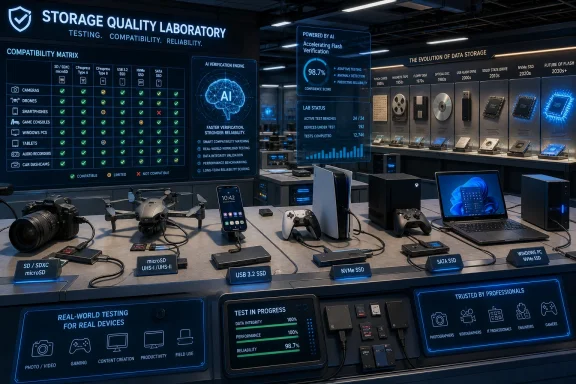
The reported device mix inside the lab is revealing. Apple hardware, Windows laptops, desktops, tablets, smartphones, Sony and Nikon cameras, drones, action cameras, card readers, IP cameras, game consoles, projectors, dash cameras, and other devices all appeared in the compatibility matrix. That is not a neat hierarchy of enterprise test platforms. It is a junk drawer of the modern digital life, and that is exactly the point.
The most convincing detail is that Lexar was not shown merely running synthetic tests on identical benches. The tour reportedly included consumer devices arrayed across rooms and tables: drones, handheld gaming systems, smartphones, compact cameras, action cameras, and racks of PC test systems. In other words, the company was demonstrating an engineering posture built around heterogeneity.
That posture matters more now than it did when storage mostly meant a PC hard drive or a camera card. A modern storage product may be used in a Steam Deck-style handheld one day, a drone the next, a mirrorless camera after that, and a USB-C workflow with Windows and macOS in between. Even when the interface appears universal, the host assumptions are not.
A security camera does not care whether a card can briefly hit a spectacular write speed if sustained writes become unstable over days of recording. A drone does not care about a benchmark screenshot if the card mishandles bursts during high-resolution capture. A Windows gaming handheld does not merely need storage that is fast in isolation; it needs storage that behaves predictably under heat, sleep states, updates, suspend-resume cycles, shader compilation, and random access.
That is why the IP camera section of Lexar’s lab is more interesting than it first sounds. Surveillance workloads are punishing in a very different way from photography or gaming. They are long-running, repetitive, and unforgiving of small interruptions. A product that looks fine during short tests can reveal different weaknesses when it is asked to write continuously.
The same is true for action cameras and drones, where failed writes can destroy moments that cannot be recreated. A corrupted file on a test bench is an inconvenience. A corrupted file after a paid shoot, travel day, crash investigation, or once-in-a-lifetime recording is something else entirely.
For Windows users, the analog is familiar. Nobody cares how elegant a storage stack looks when CrystalDiskMark is open if the system stutters under mixed workloads, drops from a USB dock, disappears after sleep, or crawls during a real backup. The storage product is judged at the edge cases, not at the cleanest number.
That shift gives Lexar both an opportunity and a challenge. The opportunity is vertical storytelling. Rather than presenting itself as a label on outsourced products, Lexar can point to Longsys facilities, validation labs, firmware work, controller development, and manufacturing infrastructure. The challenge is that global buyers are increasingly sensitive to supply chain location, geopolitical risk, tariffs, sanctions, and the practical consequences of dependence on Chinese electronics manufacturing.
The tour’s itinerary appears designed to answer the first concern more than the second. By moving journalists through Longforce manufacturing in Suzhou, Longsys facilities in Zhongshan, and Lexar offices in Shenzhen, the company showed the physical chain behind its products. It wanted visitors to see that the brand is embedded in a larger storage operation rather than floating above one.
That is useful context, but it does not make the geopolitical questions vanish. Storage is part of the global electronics nervous system, and the supply chain for NAND, controllers, substrates, packaging, firmware, and finished products is already politically sensitive. Lexar’s China-centered tour reinforces the company’s engineering scale while also reminding enterprise buyers that storage procurement now sits inside a larger risk model.
For consumers, that may remain abstract. For business buyers, school districts, government-adjacent organizations, managed service providers, and security-conscious administrators, it is not. The question is no longer just “Is this SSD fast?” It is also “Can I source it reliably, validate it, support it, trust its firmware, and explain its place in my supply chain?”
Those things matter, but compatibility is where they meet reality. A drive can be made from good components and still create pain if its firmware negotiates badly with a host, if it behaves unpredictably in enclosures, if it mishandles power-loss edge cases, or if it does not tolerate the device patterns users actually create. In that sense, compatibility testing is not a customer-service add-on. It is a core part of product definition.
The reported shelves of cameras and Apple hardware in Lexar’s lab make this especially clear. Apple systems, Windows PCs, camera bodies, Android phones, gaming consoles, and embedded devices do not all treat external and removable storage identically. Filesystems, sleep behavior, media indexing, thermal envelopes, and power states can vary wildly.
PC enthusiasts know this in a different form. A motherboard vendor’s qualified vendor list for memory is not exciting, but it reflects the same reality. Standards define the language devices use to talk; validation determines whether they can hold a conversation under stress.
Lexar’s reported use of KVM-accessible racks and multiple desktop test systems also speaks to the PC side of the equation. Enthusiast desktops, gaming PCs, and workstation-like builds are not uniform. BIOS settings, PCIe lane allocation, chipset behavior, cooling, firmware versions, and operating system updates can all complicate what looks like a simple SSD installation.
Storage has always followed the device. That is the through line from early recordkeeping to removable cards, USB drives, SSDs, and AI infrastructure. People do not buy storage in the abstract. They buy the ability to preserve, move, process, and trust information created by the tools of their era.
That matters because every new computing wave changes the stress placed on storage. Early PCs needed local persistence. Digital cameras needed removable media with predictable capture behavior. Smartphones normalized high-capacity mobile storage and cloud synchronization. Gaming pushed faster random access and larger installs. Surveillance demanded endurance and constant writes. AI now threatens to stretch both capacity and throughput expectations again.
The museum’s circuit-board models of company facilities, as described in the tour account, were a neat piece of corporate symbolism. They tied the physical infrastructure of modern manufacturing to the history of information storage. The message was clear enough: Lexar wants to be seen not as a brand that merely sells commodity flash, but as a participant in the longer evolution of how humans keep data.
That framing is ambitious, perhaps too ambitious for a company selling SSDs and memory cards in a brutally competitive market. But it is not wrong. The devices may be small and inexpensive, but the consequences of storage failure are personal, professional, and sometimes institutional.
AI changes storage demand in at least two directions. At the high end, model training, inference infrastructure, and data pipelines place enormous pressure on throughput, capacity, endurance, and reliability. At the client edge, AI-capable PCs, creator workflows, local indexing, media generation, and increasingly large datasets may make storage feel less passive than it has in recent years.
For Windows users, the AI PC conversation has often centered on NPUs, Copilot branding, memory capacity, and CPU/GPU capabilities. Storage deserves more attention. Local AI features need models, caches, embeddings, media libraries, checkpoints, and temporary files. Creative AI workloads can multiply the amount of intermediate data users generate before they ever save a final file.
That does not mean every home PC suddenly needs enterprise-grade storage. It does mean that the old assumption that storage is a dull capacity bucket is aging badly. As workloads become more data-hungry, the difference between cheap flash that works under light use and storage designed for sustained mixed behavior becomes more visible.
Lexar’s challenge is that “AI-ready storage” risks becoming the next meaningless sticker. The only way to make it credible is to tie it to specific behavior: endurance, latency consistency, thermal management, power efficiency, firmware reliability, data protection, and validated use cases. The lab story helps because it gives the AI pitch something more concrete to stand on.
That is why compatibility testing across desktops and laptops matters. Even within the Windows ecosystem, there is no single host device. A premium Intel laptop, a budget AMD desktop, a gaming handheld, a USB4 docked workstation, an older tower with a PCIe adapter, and a mini PC can all touch storage differently.
The most visible storage failures on Windows are often not catastrophic at first. They arrive as intermittent disconnects, unexplained slowdowns, heat-related throttling, SMART warnings, failed clones, odd boot behavior, or inconsistent resume from sleep. These are the kinds of failures that generate forum threads because they live between vendor responsibility and system complexity.
Lexar’s lab narrative suggests an awareness of that messy middle. Testing against real hardware cannot guarantee that every edge case will be caught, but it is more meaningful than validating only against idealized reference platforms. For users who build, repair, or administer PCs, that distinction matters.
The gaming angle is also more than decorative. The reported Iron Man-themed watercooled build and racks of SSD and memory test systems sound like press-tour eye candy, but gaming PCs are useful chaos engines. They combine high-performance storage, heat, power spikes, firmware experimentation, RGB control software, aggressive sleep settings, and impatient users. If a storage product behaves well there, it has passed a kind of cultural stress test.
That gives Lexar a cleaner quality argument than many SSD brands can make. A creator does not need to understand controller firmware to understand the stakes of a corrupted card. A wedding shoot, documentary interview, drone pass, wildlife moment, or travel sequence is not always repeatable. Storage reliability becomes part of the creative process because the medium is trusted before the edit ever begins.
The compatibility lab’s collection of camera bodies and related devices therefore looks less like excess and more like product necessity. Camera makers implement standards, but each model has its own behavior around sustained recording, file segmentation, buffer clearing, heat management, and error handling. The only honest way to validate broadly is to test broadly.
This also explains why the Memory History Exhibition’s mobile-phone and PC evolution displays are not merely decorative. Creators now move across device categories constantly. A workflow may begin on a camera, move through a card reader into a Windows laptop, sync to external SSDs, get backed up to a NAS, and then pass through editing software accelerated by GPU and AI tools.
That chain has many points of failure, and storage is implicated in nearly all of them. Lexar’s pitch is that it understands the chain, not just the component.
Large-scale compatibility testing is a positive signal, but it is not a substitute for enterprise validation. IT departments care about repeatable part numbers, known controller behavior, update policies, encryption support, failure-rate data, and how a vendor handles field issues. They also care about whether a product bought six months from now is materially the same as the product they tested today.
That is one of the uncomfortable realities of the storage market. Vendors sometimes change components across product revisions while keeping retail branding similar. In the consumer space, that may pass with limited backlash unless performance changes dramatically. In business environments, it can break trust.
Lexar’s Longsys connection could help if it allows tighter control over design, firmware, and production. It could also raise more questions if buyers feel the brand story is stronger than the operational transparency. The burden is higher when storage moves from a personal purchase to fleet deployment.
For Windows administrators, the lesson is practical. Do not treat a factory tour as a qualification report. Treat it as a reason to ask better questions. If Lexar is serious about professional and enterprise markets, its lab capacity should translate into clearer compatibility data, firmware policies, endurance disclosures, and support practices that IT buyers can actually use.
Established brands therefore have to compete not only on performance, but on confidence. That is difficult because quality assurance is mostly invisible. A user can see RGB lighting, metal heatsinks, and benchmark charts. They cannot see validation hours, firmware test coverage, compatibility matrices, bad-block management, or how a product behaves after years of writes.
This is where Lexar’s lab story has genuine value. Showing more than 1,200 devices is a way of making invisible work visible. It tells buyers that the company is at least investing in the unglamorous layer between engineering theory and real customer use.
But there is a risk, too. Press tours can turn process into performance. A room full of devices photographs well, and a museum full of storage artifacts creates a sense of heritage. The hard question is whether the investment produces fewer field failures, clearer product segmentation, better firmware, and more predictable customer experiences.
That is where reviewers, users, and administrators still have a role. The storage industry should be rewarded for serious validation, but it should not be allowed to replace independent testing with guided tours. A lab is evidence of seriousness, not proof of perfection.
A better storage conversation would include validated host categories, sustained workload behavior, thermal consistency, firmware update history, power-loss characteristics, and known compatibility limitations. Some of this already exists in professional documentation, but it rarely reaches mainstream buyers in a digestible form.
The problem is not that every shopper wants to become a storage engineer. The problem is that the market leaves too much room for fake simplicity. “Fast” is easy to understand. “Reliable across the devices you actually own” is harder to print on a box.
Lexar’s lab tour implicitly argues for the second definition. By showing cameras, drones, desktops, phones, handhelds, IP cameras, and consoles, the company is saying that storage must be judged in context. That is a better frame for 2026 than another fight over peak sequential throughput.
For WindowsForum readers, this should sound familiar. The best PC advice often comes down to context: the right part for the workload, platform, budget, and risk tolerance. Storage should be no different.
 Lexar Wants to Be Judged by the Boring Work Behind the Box
The modern storage market is a strange place to build a brand. On one side, buyers obsess over headline numbers: PCIe generation, sequential throughput, random IOPS, bus interface, card rating, endurance class, and warranty length. On the other side, most real-world failures feel brutally simple: the card was not recognized, the SSD throttled, the footage corrupted, the laptop refused to boot, or the drive disappeared at exactly the wrong time.Lexar’s China tour, as described by Neoseeker and other visiting press, was clearly designed to move the conversation away from packaging claims and into process. The company showed manufacturing, validation, compatibility testing, a storage-history exhibit, and executive messaging around AI-era workloads. That itinerary was not subtle. Lexar is arguing that a storage brand earns credibility not merely by sourcing NAND and assembling products, but by proving that those products survive the messy diversity of actual devices.
That is a smart argument because the consumer storage aisle has become visually indistinguishable. A microSD card, USB drive, or M.2 SSD gives buyers very little physical evidence of competence. The same tiny rectangle can be a trustworthy tool or a future support ticket, and the user often cannot tell which until after data has been written to it.
For a WindowsForum audience, the most relevant part of this story is not the romance of a factory tour. It is the implicit warning that compatibility remains a first-class engineering problem. A storage device that behaves perfectly in a benchmark rig can still behave badly in a camera, handheld console, USB enclosure, laptop, motherboard slot, or surveillance system.
The Quality Lab Is the Real Product Demo
The headline number from Lexar’s Quality Laboratory is the kind of figure marketing departments love: more than 1,200 testing devices across roughly 700 models from more than 230 domestic and international brands. But the number matters because it points to a practical truth that the PC industry often hides under standards language. Standards narrow the field of chaos; they do not eliminate it.A memory card may advertise a speed class, a USB drive may claim broad platform support, and an SSD may meet a protocol requirement. Yet the user’s actual experience depends on controller behavior, firmware, host compatibility, thermal conditions, filesystem handling, power delivery, workload shape, and device-specific quirks. Lexar’s lab exists because “compliant” and “works reliably in the field” are not identical claims.
The reported device mix inside the lab is revealing. Apple hardware, Windows laptops, desktops, tablets, smartphones, Sony and Nikon cameras, drones, action cameras, card readers, IP cameras, game consoles, projectors, dash cameras, and other devices all appeared in the compatibility matrix. That is not a neat hierarchy of enterprise test platforms. It is a junk drawer of the modern digital life, and that is exactly the point.
The most convincing detail is that Lexar was not shown merely running synthetic tests on identical benches. The tour reportedly included consumer devices arrayed across rooms and tables: drones, handheld gaming systems, smartphones, compact cameras, action cameras, and racks of PC test systems. In other words, the company was demonstrating an engineering posture built around heterogeneity.
That posture matters more now than it did when storage mostly meant a PC hard drive or a camera card. A modern storage product may be used in a Steam Deck-style handheld one day, a drone the next, a mirrorless camera after that, and a USB-C workflow with Windows and macOS in between. Even when the interface appears universal, the host assumptions are not.
The Benchmark Is Not the Workload
The storage industry has trained buyers to think in peaks. Sequential read and write numbers dominate SSD packaging because they are easy to print and easy to compare. Memory cards carry speed classes and video ratings because they reduce complex behavior to a shorthand. The problem is that many of the most important workloads are not peaks.A security camera does not care whether a card can briefly hit a spectacular write speed if sustained writes become unstable over days of recording. A drone does not care about a benchmark screenshot if the card mishandles bursts during high-resolution capture. A Windows gaming handheld does not merely need storage that is fast in isolation; it needs storage that behaves predictably under heat, sleep states, updates, suspend-resume cycles, shader compilation, and random access.
That is why the IP camera section of Lexar’s lab is more interesting than it first sounds. Surveillance workloads are punishing in a very different way from photography or gaming. They are long-running, repetitive, and unforgiving of small interruptions. A product that looks fine during short tests can reveal different weaknesses when it is asked to write continuously.
The same is true for action cameras and drones, where failed writes can destroy moments that cannot be recreated. A corrupted file on a test bench is an inconvenience. A corrupted file after a paid shoot, travel day, crash investigation, or once-in-a-lifetime recording is something else entirely.
For Windows users, the analog is familiar. Nobody cares how elegant a storage stack looks when CrystalDiskMark is open if the system stutters under mixed workloads, drops from a USB dock, disappears after sleep, or crawls during a real backup. The storage product is judged at the edge cases, not at the cleanest number.
Longsys Gives Lexar a Different Kind of Story to Tell
Lexar’s ownership history is important because it shapes the current pitch. Founded in California in 1996, Lexar became best known for removable storage used by photographers, videographers, and general consumers. Longsys acquired the Lexar brand and trademark rights in 2017, placing it inside a China-based storage company with broader design, manufacturing, testing, packaging, and sales operations.That shift gives Lexar both an opportunity and a challenge. The opportunity is vertical storytelling. Rather than presenting itself as a label on outsourced products, Lexar can point to Longsys facilities, validation labs, firmware work, controller development, and manufacturing infrastructure. The challenge is that global buyers are increasingly sensitive to supply chain location, geopolitical risk, tariffs, sanctions, and the practical consequences of dependence on Chinese electronics manufacturing.
The tour’s itinerary appears designed to answer the first concern more than the second. By moving journalists through Longforce manufacturing in Suzhou, Longsys facilities in Zhongshan, and Lexar offices in Shenzhen, the company showed the physical chain behind its products. It wanted visitors to see that the brand is embedded in a larger storage operation rather than floating above one.
That is useful context, but it does not make the geopolitical questions vanish. Storage is part of the global electronics nervous system, and the supply chain for NAND, controllers, substrates, packaging, firmware, and finished products is already politically sensitive. Lexar’s China-centered tour reinforces the company’s engineering scale while also reminding enterprise buyers that storage procurement now sits inside a larger risk model.
For consumers, that may remain abstract. For business buyers, school districts, government-adjacent organizations, managed service providers, and security-conscious administrators, it is not. The question is no longer just “Is this SSD fast?” It is also “Can I source it reliably, validate it, support it, trust its firmware, and explain its place in my supply chain?”
Compatibility Has Become a Form of Quality Control
The most persuasive argument in Lexar’s lab narrative is that compatibility itself should be treated as quality control. That sounds obvious until one considers how often storage products are reviewed, marketed, and purchased almost entirely on performance and price. The quality of a storage product is often discussed as if it begins and ends with NAND grade, endurance rating, controller choice, and thermal design.Those things matter, but compatibility is where they meet reality. A drive can be made from good components and still create pain if its firmware negotiates badly with a host, if it behaves unpredictably in enclosures, if it mishandles power-loss edge cases, or if it does not tolerate the device patterns users actually create. In that sense, compatibility testing is not a customer-service add-on. It is a core part of product definition.
The reported shelves of cameras and Apple hardware in Lexar’s lab make this especially clear. Apple systems, Windows PCs, camera bodies, Android phones, gaming consoles, and embedded devices do not all treat external and removable storage identically. Filesystems, sleep behavior, media indexing, thermal envelopes, and power states can vary wildly.
PC enthusiasts know this in a different form. A motherboard vendor’s qualified vendor list for memory is not exciting, but it reflects the same reality. Standards define the language devices use to talk; validation determines whether they can hold a conversation under stress.
Lexar’s reported use of KVM-accessible racks and multiple desktop test systems also speaks to the PC side of the equation. Enthusiast desktops, gaming PCs, and workstation-like builds are not uniform. BIOS settings, PCIe lane allocation, chipset behavior, cooling, firmware versions, and operating system updates can all complicate what looks like a simple SSD installation.
The Memory Museum Was More Than Corporate Nostalgia
The Memory History Exhibition could easily have been the softest part of the tour: a corporate museum where old artifacts flatter the brand by placing it inside a grand human story. Rope knot records, oracle bone replicas, bamboo slips, punch cards, magnetic media, optical discs, early PCs, consoles, mobile phones, wafers, ICs, and modern storage products make for a visually satisfying walk through time. But the exhibit also makes a sharper argument if one looks past the nostalgia.Storage has always followed the device. That is the through line from early recordkeeping to removable cards, USB drives, SSDs, and AI infrastructure. People do not buy storage in the abstract. They buy the ability to preserve, move, process, and trust information created by the tools of their era.
That matters because every new computing wave changes the stress placed on storage. Early PCs needed local persistence. Digital cameras needed removable media with predictable capture behavior. Smartphones normalized high-capacity mobile storage and cloud synchronization. Gaming pushed faster random access and larger installs. Surveillance demanded endurance and constant writes. AI now threatens to stretch both capacity and throughput expectations again.
The museum’s circuit-board models of company facilities, as described in the tour account, were a neat piece of corporate symbolism. They tied the physical infrastructure of modern manufacturing to the history of information storage. The message was clear enough: Lexar wants to be seen not as a brand that merely sells commodity flash, but as a participant in the longer evolution of how humans keep data.
That framing is ambitious, perhaps too ambitious for a company selling SSDs and memory cards in a brutally competitive market. But it is not wrong. The devices may be small and inexpensive, but the consequences of storage failure are personal, professional, and sometimes institutional.
AI Gives Every Storage Vendor a New Script
No 2026 hardware story can avoid AI, and Lexar is no exception. The company’s tour and executive conversations reportedly connected its 30-year history to an AI-ready future, including controller work, firmware, software, new form factors, and storage products designed for more demanding workloads. That is predictable marketing language, but it should not be dismissed out of hand.AI changes storage demand in at least two directions. At the high end, model training, inference infrastructure, and data pipelines place enormous pressure on throughput, capacity, endurance, and reliability. At the client edge, AI-capable PCs, creator workflows, local indexing, media generation, and increasingly large datasets may make storage feel less passive than it has in recent years.
For Windows users, the AI PC conversation has often centered on NPUs, Copilot branding, memory capacity, and CPU/GPU capabilities. Storage deserves more attention. Local AI features need models, caches, embeddings, media libraries, checkpoints, and temporary files. Creative AI workloads can multiply the amount of intermediate data users generate before they ever save a final file.
That does not mean every home PC suddenly needs enterprise-grade storage. It does mean that the old assumption that storage is a dull capacity bucket is aging badly. As workloads become more data-hungry, the difference between cheap flash that works under light use and storage designed for sustained mixed behavior becomes more visible.
Lexar’s challenge is that “AI-ready storage” risks becoming the next meaningless sticker. The only way to make it credible is to tie it to specific behavior: endurance, latency consistency, thermal management, power efficiency, firmware reliability, data protection, and validated use cases. The lab story helps because it gives the AI pitch something more concrete to stand on.
The Windows Angle Is Not Just SSD Speed
Windows users are natural targets for storage marketing, but the operating system also exposes storage weaknesses in ways vendors cannot fully control. Windows Update, sleep and resume, BitLocker, DirectStorage-style gaming workloads, driver stacks, USB controller variation, file indexing, antivirus scanning, virtualization, and backup tools all create patterns that differ from a clean benchmark environment. A drive’s behavior inside Windows is a composite of hardware, firmware, platform, and workload.That is why compatibility testing across desktops and laptops matters. Even within the Windows ecosystem, there is no single host device. A premium Intel laptop, a budget AMD desktop, a gaming handheld, a USB4 docked workstation, an older tower with a PCIe adapter, and a mini PC can all touch storage differently.
The most visible storage failures on Windows are often not catastrophic at first. They arrive as intermittent disconnects, unexplained slowdowns, heat-related throttling, SMART warnings, failed clones, odd boot behavior, or inconsistent resume from sleep. These are the kinds of failures that generate forum threads because they live between vendor responsibility and system complexity.
Lexar’s lab narrative suggests an awareness of that messy middle. Testing against real hardware cannot guarantee that every edge case will be caught, but it is more meaningful than validating only against idealized reference platforms. For users who build, repair, or administer PCs, that distinction matters.
The gaming angle is also more than decorative. The reported Iron Man-themed watercooled build and racks of SSD and memory test systems sound like press-tour eye candy, but gaming PCs are useful chaos engines. They combine high-performance storage, heat, power spikes, firmware experimentation, RGB control software, aggressive sleep settings, and impatient users. If a storage product behaves well there, it has passed a kind of cultural stress test.
The Creator Market Still Explains Lexar Best
Lexar’s strongest brand association remains with photographers and videographers, and the lab tour reinforces why. Cameras, drones, and action cameras are storage-first devices in a way most PCs are not. If the storage fails, the device may still power on, but the work is gone.That gives Lexar a cleaner quality argument than many SSD brands can make. A creator does not need to understand controller firmware to understand the stakes of a corrupted card. A wedding shoot, documentary interview, drone pass, wildlife moment, or travel sequence is not always repeatable. Storage reliability becomes part of the creative process because the medium is trusted before the edit ever begins.
The compatibility lab’s collection of camera bodies and related devices therefore looks less like excess and more like product necessity. Camera makers implement standards, but each model has its own behavior around sustained recording, file segmentation, buffer clearing, heat management, and error handling. The only honest way to validate broadly is to test broadly.
This also explains why the Memory History Exhibition’s mobile-phone and PC evolution displays are not merely decorative. Creators now move across device categories constantly. A workflow may begin on a camera, move through a card reader into a Windows laptop, sync to external SSDs, get backed up to a NAS, and then pass through editing software accelerated by GPU and AI tools.
That chain has many points of failure, and storage is implicated in nearly all of them. Lexar’s pitch is that it understands the chain, not just the component.
Enterprise Buyers Will Want More Than a Tour
The tour also gestured toward enterprise and professional markets, but that audience is harder to satisfy. A consumer can be persuaded by brand reputation, warranty language, and visible testing. Enterprise buyers want documentation, lifecycle predictability, firmware management, security assurances, supply continuity, and support channels that survive beyond a launch cycle.Large-scale compatibility testing is a positive signal, but it is not a substitute for enterprise validation. IT departments care about repeatable part numbers, known controller behavior, update policies, encryption support, failure-rate data, and how a vendor handles field issues. They also care about whether a product bought six months from now is materially the same as the product they tested today.
That is one of the uncomfortable realities of the storage market. Vendors sometimes change components across product revisions while keeping retail branding similar. In the consumer space, that may pass with limited backlash unless performance changes dramatically. In business environments, it can break trust.
Lexar’s Longsys connection could help if it allows tighter control over design, firmware, and production. It could also raise more questions if buyers feel the brand story is stronger than the operational transparency. The burden is higher when storage moves from a personal purchase to fleet deployment.
For Windows administrators, the lesson is practical. Do not treat a factory tour as a qualification report. Treat it as a reason to ask better questions. If Lexar is serious about professional and enterprise markets, its lab capacity should translate into clearer compatibility data, firmware policies, endurance disclosures, and support practices that IT buyers can actually use.
The Trust Problem Is Bigger Than Lexar
Lexar’s tour is interesting partly because it reflects a broader industry problem. Flash storage is everywhere, but buyer trust is uneven. Marketplaces are crowded with counterfeit cards, misleading capacity claims, recycled components, controller swaps, vague warranties, and products that look legitimate enough to fool casual users.Established brands therefore have to compete not only on performance, but on confidence. That is difficult because quality assurance is mostly invisible. A user can see RGB lighting, metal heatsinks, and benchmark charts. They cannot see validation hours, firmware test coverage, compatibility matrices, bad-block management, or how a product behaves after years of writes.
This is where Lexar’s lab story has genuine value. Showing more than 1,200 devices is a way of making invisible work visible. It tells buyers that the company is at least investing in the unglamorous layer between engineering theory and real customer use.
But there is a risk, too. Press tours can turn process into performance. A room full of devices photographs well, and a museum full of storage artifacts creates a sense of heritage. The hard question is whether the investment produces fewer field failures, clearer product segmentation, better firmware, and more predictable customer experiences.
That is where reviewers, users, and administrators still have a role. The storage industry should be rewarded for serious validation, but it should not be allowed to replace independent testing with guided tours. A lab is evidence of seriousness, not proof of perfection.
The Spec Sheet Needs a Reliability Column
If there is a takeaway from Lexar’s China tour, it is that the consumer storage spec sheet is too narrow. It captures performance in ways that are easy to compare and reliability in ways that are often too abstract. Warranty length and endurance ratings help, but they do not tell the whole story.A better storage conversation would include validated host categories, sustained workload behavior, thermal consistency, firmware update history, power-loss characteristics, and known compatibility limitations. Some of this already exists in professional documentation, but it rarely reaches mainstream buyers in a digestible form.
The problem is not that every shopper wants to become a storage engineer. The problem is that the market leaves too much room for fake simplicity. “Fast” is easy to understand. “Reliable across the devices you actually own” is harder to print on a box.
Lexar’s lab tour implicitly argues for the second definition. By showing cameras, drones, desktops, phones, handhelds, IP cameras, and consoles, the company is saying that storage must be judged in context. That is a better frame for 2026 than another fight over peak sequential throughput.
For WindowsForum readers, this should sound familiar. The best PC advice often comes down to context: the right part for the workload, platform, budget, and risk tolerance. Storage should be no different.
The China Tour Leaves a Practical Checklist Behind
Lexar’s anniversary tour was built as a brand story, but the useful lessons are more concrete than the celebration. The company is trying to connect manufacturing, validation, compatibility, history, and AI into a single claim about trust. Buyers should appreciate the ambition while still demanding proof where it matters.- Lexar’s most important claim is not that its products are fast, but that they are tested across a wide range of real devices before reaching customers.
- Compatibility testing matters because cameras, PCs, consoles, drones, phones, and surveillance systems can stress storage in very different ways.
- Longsys ownership gives Lexar a deeper manufacturing and engineering story, but it also places the brand inside a supply-chain context that enterprise buyers will scrutinize.
- AI-era storage claims should be judged by endurance, sustained performance, latency consistency, firmware quality, and real workload validation rather than by marketing language alone.
- Windows users should treat storage reliability as a platform issue, especially when sleep states, USB controllers, firmware, thermal limits, and mixed workloads are involved.
- The lab tour is a positive signal, but independent testing, transparent specifications, and long-term field behavior remain essential.
References
- Primary source: Neoseeker
Published: 2026-06-29T19:50:39.813112
Loading…
www.neoseeker.com - Related coverage: tomshardware.com
Loading…
www.tomshardware.com - Related coverage: longsys.com
Loading…
www.longsys.com - Related coverage: lexar.com
Loading…
www.lexar.com - Related coverage: inkl.com
Loading…
www.inkl.com - Related coverage: cowcotland.com
Loading…
www.cowcotland.com