

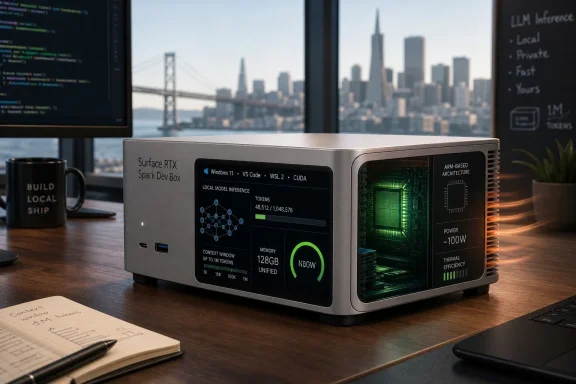
Microsoft used Build 2026 in San Francisco on June 2 to unveil the Surface RTX Spark Dev Box, a compact Windows 11 developer workstation built around NVIDIA’s Arm-based RTX Spark superchip with 20 CPU cores, 128GB of unified memory, and up to one petaflop of AI compute. The pitch is simple: put enough local AI horsepower on a desk that developers can stop treating every serious model experiment as a cloud rental problem. The implications are less simple, because this little aluminum box sits at the collision point of Windows on Arm, NVIDIA’s post-data-center ambitions, and Microsoft’s desire to make the PC feel relevant again in the age of agents.
The Surface RTX Spark Dev Box is not just another mini PC with an inflated AI badge. It is Microsoft’s clearest statement yet that local AI development is moving from toy demos and quantized hobbyist models into a more serious workstation category. For Windows users and IT departments, the real question is not whether one petaflop sounds impressive. It is whether Microsoft can turn that spec sheet into a trustworthy developer platform before the cloud economics, software compatibility, and pricing caveats swallow the story.
The Surface RTX Spark Dev Box arrives after several years in which “AI PC” has meant different things to different vendors, many of them unhelpful. Qualcomm, Intel, AMD, Microsoft, and OEMs have all spent time explaining neural processing units, Copilot keys, and on-device inference, but much of the first wave has been pitched at consumer convenience: summarize this meeting, blur that background, generate this image faster. Microsoft’s new box is aimed somewhere else entirely.
This is a developer machine, and that distinction matters. A developer workstation does not need to win a Best Buy shelf war or justify itself with battery-life slides. It needs to run models, absorb toolchains, avoid driver drama, and make expensive iteration feel less expensive. Microsoft’s claim that the system can run models with more than 120 billion parameters locally is the kind of number that changes the conversation from “Can I prototype this?” to “Can I keep this workload off someone else’s servers?”
The company is also trying to make the desktop relevant to a generation of AI development that has become cloud-native by default. For many teams, experimentation now starts with rented GPU instances, managed notebooks, API calls, and a billing meter that runs while developers discover what does not work. A local box does not replace Azure, but it can change the rhythm of development. It brings back a familiar workstation pattern: build, break, inspect, and repeat without asking procurement or the cloud budget for permission every time.
That is why the Dev Box is more interesting than its chassis. Microsoft is not merely saying Windows can run AI apps. It is saying Windows can be the place where AI systems are authored, tested, fine-tuned, secured, and then scaled elsewhere. That is a much more ambitious claim, and it explains why this product is wrapped in Surface branding rather than left as an NVIDIA reference design with a Microsoft logo nearby.
Memory is the wall that local AI hits first. A fast GPU is not especially useful if the model cannot fit where it needs to run, and traditional PC architectures split memory between CPU and GPU in ways that become awkward when large language models enter the room. Unified memory does not make capacity infinite, and it does not magically eliminate every bandwidth or scheduling constraint. But it gives developers a larger shared pool to work with, which is exactly the kind of architectural shift local inference and fine-tuning have been waiting for.
The one-petaflop AI compute claim is best read as a platform marker rather than a universal performance promise. AI TOPS and petaflop figures depend on precision, sparsity, software support, and workload shape. Anyone who has benchmarked inference knows that the difference between a marketing number and useful throughput can be large. Still, paired with 128GB of unified memory, this is not the same class of device as the NPU-equipped ultraportable being asked to summarize a Word document.
The 100-watt thermal envelope is also part of the story. Microsoft is positioning the Dev Box as a compact desk-side machine rather than a roaring workstation tower or a repurposed gaming rig. That matters in offices, labs, classrooms, and small development teams where the practical barriers to local compute include heat, noise, power, and physical space. If Microsoft and NVIDIA can make a petaflop-class AI workstation behave like a civilized desktop appliance, they may find buyers who would never rack a server or manage a multi-GPU tower.
AI developers are unusually tolerant of rough edges in one sense and unusually unforgiving in another. They will edit config files, compile packages, run nightly builds, and live in terminals. But they will not accept a workstation that collapses under dependency friction. CUDA support, WSL 2 integration, Python environments, container workflows, VS Code, GitHub Copilot, Node.js, and native tooling all have to feel boringly reliable.
That is the importance of Microsoft preloading the software stack. The company is not merely saving developers a setup afternoon. It is trying to define the blessed path for local AI development on Windows: use VS Code, use Copilot, use WSL 2, use CUDA, stay inside the Microsoft-and-NVIDIA lane, and move to Azure when scale demands it. The Dev Box is a hardware product, but it is also a workflow argument.
The risk is that Windows on Arm inherits the blame for anything that breaks, even when the culprit is a library, a driver, a Python wheel, or a project that assumes x86. Developers do not always distinguish between architecture problems and platform problems when they are trying to ship. If Microsoft wants this machine to matter, it needs the out-of-box experience to be excellent and the month-three maintenance story to be even better.
The Surface RTX Spark Dev Box gives NVIDIA a new foothold between consumer GPUs and enterprise AI infrastructure. That middle tier has always existed in workstations, but AI changes the sizing. A gamer GPU with generous VRAM can do remarkable work in the hands of local model enthusiasts, yet it is not the same thing as a coherent, vendor-backed development platform with a shared memory architecture and a curated software stack. NVIDIA wants RTX Spark to make that middle tier legible.
It also helps NVIDIA defend against the idea that AI development must flow exclusively through cloud APIs. If the only serious path is through hosted models and hyperscale GPU clusters, NVIDIA still wins indirectly, but developers lose daily intimacy with NVIDIA hardware. A local AI workstation keeps CUDA, Blackwell, and NVIDIA’s software ecosystem under developers’ fingers. That familiarity pays dividends when projects scale upward.
The OEM roadmap matters here. Microsoft’s Surface device is the prestige reference point, but ASUS, Dell, HP, Lenovo, and MSI are expected to bring RTX Spark systems of their own. That is how a concept becomes a category. If the fall 2026 rollout produces a range of credible devices rather than a few expensive curiosities, NVIDIA and Microsoft may have created the first serious Windows workstation class for local large-model development.
Local compute changes the early stages of work. A developer can test an agent, evaluate prompts against private data, tune retrieval behavior, inspect failures, and run offline experiments without immediately exposing data to a hosted service or paying by the hour. When the work is ready to scale, Microsoft would very much like that path to lead to Azure. The Dev Box is therefore not anti-cloud; it is a more comfortable on-ramp.
That distinction is important for enterprise IT. Many organizations are interested in AI but cautious about data residency, leakage, vendor terms, and the operational opacity of hosted models. A local development workstation gives teams a place to experiment with sensitive workflows inside existing endpoint governance. It will not solve every compliance question, but it gives security teams a more familiar object to manage: a Windows 11 secured-core PC, enrolled, monitored, encrypted, and governed.
The cloud economics are also changing. GPU rental is flexible, but flexibility has a price, and idle experimentation can become surprisingly expensive. A purchased workstation shifts the cost curve. It makes more sense for teams with sustained local development needs, less sense for occasional experimentation, and probably no sense at all if Microsoft prices it like a boutique halo device. Pricing is the missing variable that could turn a smart platform move into a narrow prestige play.
That is why the industrial design matters less than the signal. Microsoft is showing OEMs what a Windows AI developer box should look like: compact, quiet, Arm-based, NVIDIA-powered, secured, and preconfigured for modern development. The company is not trying to displace Dell Precision, HP Z, or Lenovo ThinkStation overnight. It is trying to set the template for a new subcategory before OEMs fragment it into confusing SKUs and half-compatible marketing claims.
This is also a message to Apple. Apple has spent years making unified memory feel normal to creative professionals and developers who buy Macs with M-series chips. Microsoft and NVIDIA are now borrowing that architectural conversation for Windows AI development, but with CUDA and Blackwell as the differentiators. The Dev Box is not a Mac Studio clone in any simple sense, yet it clearly competes for mindshare in the same “small box, large memory, serious local compute” territory.
The danger for Microsoft is familiar: Surface can inspire the ecosystem without winning the market itself. If OEM systems arrive cheaper, more expandable, or better supported, Microsoft’s device may become a beautiful reference design that few people buy. That would not necessarily be a failure. But for developers to trust the category, someone needs to make the first version feel less like a demo and more like a workstation they can depend on for years.
Preloading VS Code, GitHub Copilot, Python, Node.js, and WSL 2 with CUDA support is a practical move and a strategic one. It makes the Dev Box feel immediately useful while also nudging developers toward Microsoft’s preferred environment. VS Code is the editor layer, GitHub is the collaboration and automation layer, Copilot is the AI assistance layer, WSL is the Linux compatibility layer, Windows is the managed endpoint layer, and Azure waits at the deployment layer.
That stack is coherent, but coherence can slide into lock-in. Developers may appreciate the convenience while still resisting a workflow that quietly assumes Microsoft at every turn. The question is whether the Dev Box remains genuinely flexible for open-source AI work or becomes primarily a showcase for Microsoft’s agentic Windows strategy. The best outcome for users is a machine that runs local models, open frameworks, containers, notebooks, and vendor tools without forcing a theological commitment.
The CUDA piece is especially significant. Much of modern AI development is CUDA-shaped, and that gives NVIDIA a moat that competing silicon vendors continue to struggle against. If Windows on Arm plus WSL 2 plus CUDA becomes a first-class experience, Microsoft gets a rare chance to turn a historical Windows weakness — Linux-native AI workflows — into something closer to a hybrid strength.
The reported support for context windows up to 1 million tokens is similarly impressive but workload-dependent. Long context is valuable for codebases, legal archives, research corpora, enterprise documentation, and agent memory, but it can be computationally expensive and operationally tricky. A local machine that can handle large context windows in practical workflows would be genuinely useful. A machine that can technically fit them under ideal demos would be less transformative.
This is where early reviews and independent benchmarks will matter. Microsoft’s launch framing gives the Dev Box a high ceiling, but developers will want to know how it behaves under real loads: local inference with popular open models, retrieval-augmented generation pipelines, LoRA fine-tuning, multi-agent orchestration, CUDA-heavy notebooks, containerized services, and mixed CPU-GPU workflows. The first wave of buyers will not just benchmark performance. They will benchmark patience.
There is also a subtle difference between running a model and developing with one. Interactive speeds are valuable, but development involves iteration, monitoring, data preparation, evaluation, and failure analysis. If the Dev Box makes those loops faster and more private, it succeeds even if it does not match a cloud instance in raw throughput. If it merely runs a few showcase models while serious work still flees to the cloud, it becomes an expensive conversation piece.
A managed Windows AI workstation gives IT a more governable alternative. Security teams can enforce device compliance, encrypt storage, control identities, monitor behavior, and apply policy. Developers get local compute without resorting to a personal gaming rig or a cloud account expensed through creative accounting. In theory, everyone wins.
In practice, governance will need to evolve. Local AI workloads may involve models whose licenses vary, datasets that should not leave certain boundaries, and generated artifacts that are hard to classify. Endpoint security tools may need to understand not just files and processes, but model weights, vector stores, prompts, and agent actions. The Dev Box makes those issues more manageable by bringing them onto a known platform, but it does not make them disappear.
Admins will also have to think about lifecycle management. AI frameworks move quickly, NVIDIA drivers matter, WSL distributions require care, and developer environments have a way of drifting. If Microsoft wants businesses to buy these machines in volume, it needs a credible story for imaging, patching, rollback, driver validation, and long-term support. A great first boot is not enough for the people who will be blamed when the CUDA stack breaks on a deadline.
The pricing question is also comparative. Developers will measure the Dev Box against cloud GPU rental, high-end consumer GPU builds, used workstation hardware, Apple’s Mac Studio line, and whatever OEM RTX Spark systems arrive later. Each comparison favors a different buyer. The Surface device may win on integration and manageability, lose on expandability, and sit awkwardly against cloud options for teams with bursty workloads.
There is a second pricing issue: memory configurations. The 128GB unified memory figure is central to the product’s appeal. If OEMs fragment the RTX Spark category into lower-memory configurations that carry the same branding but cannot handle the same workloads, buyers will need to read spec sheets carefully. Microsoft’s Surface version, at least as announced, has the virtue of being easy to understand.
Waiting-list availability is another reminder that this is an early category, not a mature procurement option. Developers can get excited now; IT departments will wait for order pages, warranty terms, support documentation, benchmark results, and deployment guidance. The gap between keynote and fleet deployment is where many promising Windows devices have lost momentum.
That omission is revealing. In 2026, the strategic center of gravity for high-performance desktop compute is no longer crypto speculation; it is local AI inference, agent development, and model customization. The same broad appetite for parallel compute remains, but the narrative has shifted from extracting tokens to building systems that can reason over private data and automate work. Microsoft is following the money, but also the developer mindshare.
For investors, that means the device is another small sign of NVIDIA’s ability to create markets adjacent to the data center. For Microsoft, it is a way to reinforce the idea that Windows is still a serious development platform, not merely the endpoint where cloud AI features show up after the real work happens elsewhere. The lack of crypto integration is not an oversight. It is a prioritization.
That will disappoint almost nobody in enterprise IT. Crypto workloads brought power, heat, policy, and reputational headaches into environments that did not need them. AI workloads bring their own risks, but they also map more directly to business demand. Microsoft is betting that the next wave of local high-performance computing will be justified by productivity, privacy, and product development rather than by speculative yield.
Those are plausible ideas, but none is guaranteed. Local AI is powerful, but cloud platforms move quickly and abstract away complexity. Windows on Arm is improving, but developer trust is earned through years of compatibility, not one keynote. The AI PC category is real, but it has already been muddied by marketing that stretches the term across everything from low-power NPUs to serious GPU workstations.
The Dev Box is therefore both promising and fragile. Its success depends less on the launch specs than on the mundane details that follow: drivers, thermals, software updates, model support, pricing, availability, enterprise management, and OEM execution. In other words, the things that decide whether a developer machine becomes a daily tool or a shelf ornament.
For WindowsForum readers, the practical stance is cautious interest. This is the most convincing local AI hardware story Microsoft has told so far, and it aligns with where developer workflows are heading. But the correct response is not preorder euphoria. It is to wait for pricing, benchmarks, software compatibility reports, and evidence that Microsoft will support the platform with the seriousness it deserves.
The Surface RTX Spark Dev Box is not just another mini PC with an inflated AI badge. It is Microsoft’s clearest statement yet that local AI development is moving from toy demos and quantized hobbyist models into a more serious workstation category. For Windows users and IT departments, the real question is not whether one petaflop sounds impressive. It is whether Microsoft can turn that spec sheet into a trustworthy developer platform before the cloud economics, software compatibility, and pricing caveats swallow the story.
 Microsoft Is Selling the Desk as the New Edge
The Surface RTX Spark Dev Box arrives after several years in which “AI PC” has meant different things to different vendors, many of them unhelpful. Qualcomm, Intel, AMD, Microsoft, and OEMs have all spent time explaining neural processing units, Copilot keys, and on-device inference, but much of the first wave has been pitched at consumer convenience: summarize this meeting, blur that background, generate this image faster. Microsoft’s new box is aimed somewhere else entirely.This is a developer machine, and that distinction matters. A developer workstation does not need to win a Best Buy shelf war or justify itself with battery-life slides. It needs to run models, absorb toolchains, avoid driver drama, and make expensive iteration feel less expensive. Microsoft’s claim that the system can run models with more than 120 billion parameters locally is the kind of number that changes the conversation from “Can I prototype this?” to “Can I keep this workload off someone else’s servers?”
The company is also trying to make the desktop relevant to a generation of AI development that has become cloud-native by default. For many teams, experimentation now starts with rented GPU instances, managed notebooks, API calls, and a billing meter that runs while developers discover what does not work. A local box does not replace Azure, but it can change the rhythm of development. It brings back a familiar workstation pattern: build, break, inspect, and repeat without asking procurement or the cloud budget for permission every time.
That is why the Dev Box is more interesting than its chassis. Microsoft is not merely saying Windows can run AI apps. It is saying Windows can be the place where AI systems are authored, tested, fine-tuned, secured, and then scaled elsewhere. That is a much more ambitious claim, and it explains why this product is wrapped in Surface branding rather than left as an NVIDIA reference design with a Microsoft logo nearby.
The Spec Sheet Is a Declaration of Intent
The headline configuration is designed to hit the pressure points that matter for local AI. The RTX Spark superchip combines NVIDIA’s Grace CPU architecture with Blackwell-generation RTX graphics, giving Microsoft an Arm-based Windows workstation that is not trying to win the old x86 desktop fight on x86 terms. The machine’s 20 CPU cores sound impressive, but the more consequential number is the 128GB of unified memory.Memory is the wall that local AI hits first. A fast GPU is not especially useful if the model cannot fit where it needs to run, and traditional PC architectures split memory between CPU and GPU in ways that become awkward when large language models enter the room. Unified memory does not make capacity infinite, and it does not magically eliminate every bandwidth or scheduling constraint. But it gives developers a larger shared pool to work with, which is exactly the kind of architectural shift local inference and fine-tuning have been waiting for.
The one-petaflop AI compute claim is best read as a platform marker rather than a universal performance promise. AI TOPS and petaflop figures depend on precision, sparsity, software support, and workload shape. Anyone who has benchmarked inference knows that the difference between a marketing number and useful throughput can be large. Still, paired with 128GB of unified memory, this is not the same class of device as the NPU-equipped ultraportable being asked to summarize a Word document.
The 100-watt thermal envelope is also part of the story. Microsoft is positioning the Dev Box as a compact desk-side machine rather than a roaring workstation tower or a repurposed gaming rig. That matters in offices, labs, classrooms, and small development teams where the practical barriers to local compute include heat, noise, power, and physical space. If Microsoft and NVIDIA can make a petaflop-class AI workstation behave like a civilized desktop appliance, they may find buyers who would never rack a server or manage a multi-GPU tower.
Windows on Arm Gets a Workstation It Cannot Afford to Waste
The Arm architecture inside the Surface RTX Spark Dev Box is not a footnote. Windows on Arm has spent years oscillating between promise and caveat, with the same basic questions recurring every generation: Does the software run? Are drivers ready? Are native tools available? Does emulation hide the gaps well enough? The Dev Box pushes those questions into a more demanding arena.AI developers are unusually tolerant of rough edges in one sense and unusually unforgiving in another. They will edit config files, compile packages, run nightly builds, and live in terminals. But they will not accept a workstation that collapses under dependency friction. CUDA support, WSL 2 integration, Python environments, container workflows, VS Code, GitHub Copilot, Node.js, and native tooling all have to feel boringly reliable.
That is the importance of Microsoft preloading the software stack. The company is not merely saving developers a setup afternoon. It is trying to define the blessed path for local AI development on Windows: use VS Code, use Copilot, use WSL 2, use CUDA, stay inside the Microsoft-and-NVIDIA lane, and move to Azure when scale demands it. The Dev Box is a hardware product, but it is also a workflow argument.
The risk is that Windows on Arm inherits the blame for anything that breaks, even when the culprit is a library, a driver, a Python wheel, or a project that assumes x86. Developers do not always distinguish between architecture problems and platform problems when they are trying to ship. If Microsoft wants this machine to matter, it needs the out-of-box experience to be excellent and the month-three maintenance story to be even better.
NVIDIA Moves Down From the Data Center Without Leaving It
For NVIDIA, RTX Spark is a logical expansion of a strategy that has already worked spectacularly in the data center. The company has made itself the default hardware substrate of the AI boom, but that success created a gap below the enterprise rack. Not every developer, research group, startup, or IT team needs a DGX-class system. Many need something that feels local, owned, and available.The Surface RTX Spark Dev Box gives NVIDIA a new foothold between consumer GPUs and enterprise AI infrastructure. That middle tier has always existed in workstations, but AI changes the sizing. A gamer GPU with generous VRAM can do remarkable work in the hands of local model enthusiasts, yet it is not the same thing as a coherent, vendor-backed development platform with a shared memory architecture and a curated software stack. NVIDIA wants RTX Spark to make that middle tier legible.
It also helps NVIDIA defend against the idea that AI development must flow exclusively through cloud APIs. If the only serious path is through hosted models and hyperscale GPU clusters, NVIDIA still wins indirectly, but developers lose daily intimacy with NVIDIA hardware. A local AI workstation keeps CUDA, Blackwell, and NVIDIA’s software ecosystem under developers’ fingers. That familiarity pays dividends when projects scale upward.
The OEM roadmap matters here. Microsoft’s Surface device is the prestige reference point, but ASUS, Dell, HP, Lenovo, and MSI are expected to bring RTX Spark systems of their own. That is how a concept becomes a category. If the fall 2026 rollout produces a range of credible devices rather than a few expensive curiosities, NVIDIA and Microsoft may have created the first serious Windows workstation class for local large-model development.
The Cloud Is Still the Destination, But No Longer the Only Workshop
The Dev Box does not end the cloud’s role in AI development. Training frontier-scale models, serving production workloads, handling massive datasets, and coordinating distributed inference remain cloud and data-center problems. Microsoft knows this better than anyone, because Azure is central to its AI business. The cleverness of the Dev Box is that it does not threaten Azure so much as feed it.Local compute changes the early stages of work. A developer can test an agent, evaluate prompts against private data, tune retrieval behavior, inspect failures, and run offline experiments without immediately exposing data to a hosted service or paying by the hour. When the work is ready to scale, Microsoft would very much like that path to lead to Azure. The Dev Box is therefore not anti-cloud; it is a more comfortable on-ramp.
That distinction is important for enterprise IT. Many organizations are interested in AI but cautious about data residency, leakage, vendor terms, and the operational opacity of hosted models. A local development workstation gives teams a place to experiment with sensitive workflows inside existing endpoint governance. It will not solve every compliance question, but it gives security teams a more familiar object to manage: a Windows 11 secured-core PC, enrolled, monitored, encrypted, and governed.
The cloud economics are also changing. GPU rental is flexible, but flexibility has a price, and idle experimentation can become surprisingly expensive. A purchased workstation shifts the cost curve. It makes more sense for teams with sustained local development needs, less sense for occasional experimentation, and probably no sense at all if Microsoft prices it like a boutique halo device. Pricing is the missing variable that could turn a smart platform move into a narrow prestige play.
Surface Becomes a Reference Design for the AI Workstation
Surface has always been at its best when it defines a shape for the Windows ecosystem. The original Surface Pro did not single-handedly invent the 2-in-1, but it forced the PC industry to take the category seriously. Surface Studio made a similar, if more niche, argument for creative desktops. The Surface RTX Spark Dev Box appears to be playing that role for local AI workstations.That is why the industrial design matters less than the signal. Microsoft is showing OEMs what a Windows AI developer box should look like: compact, quiet, Arm-based, NVIDIA-powered, secured, and preconfigured for modern development. The company is not trying to displace Dell Precision, HP Z, or Lenovo ThinkStation overnight. It is trying to set the template for a new subcategory before OEMs fragment it into confusing SKUs and half-compatible marketing claims.
This is also a message to Apple. Apple has spent years making unified memory feel normal to creative professionals and developers who buy Macs with M-series chips. Microsoft and NVIDIA are now borrowing that architectural conversation for Windows AI development, but with CUDA and Blackwell as the differentiators. The Dev Box is not a Mac Studio clone in any simple sense, yet it clearly competes for mindshare in the same “small box, large memory, serious local compute” territory.
The danger for Microsoft is familiar: Surface can inspire the ecosystem without winning the market itself. If OEM systems arrive cheaper, more expandable, or better supported, Microsoft’s device may become a beautiful reference design that few people buy. That would not necessarily be a failure. But for developers to trust the category, someone needs to make the first version feel less like a demo and more like a workstation they can depend on for years.
The Software Stack Is the Real Product
Hardware announcements in AI tend to attract numerology: cores, memory, tokens, parameters, petaflops. Those numbers matter, but the developer experience will be decided by the software stack. Microsoft has learned this lesson repeatedly, sometimes the hard way. Developers do not adopt platforms because the launch keynote said “agentic” often enough. They adopt platforms when the path from clone to run to debug to deploy is shorter than the alternatives.Preloading VS Code, GitHub Copilot, Python, Node.js, and WSL 2 with CUDA support is a practical move and a strategic one. It makes the Dev Box feel immediately useful while also nudging developers toward Microsoft’s preferred environment. VS Code is the editor layer, GitHub is the collaboration and automation layer, Copilot is the AI assistance layer, WSL is the Linux compatibility layer, Windows is the managed endpoint layer, and Azure waits at the deployment layer.
That stack is coherent, but coherence can slide into lock-in. Developers may appreciate the convenience while still resisting a workflow that quietly assumes Microsoft at every turn. The question is whether the Dev Box remains genuinely flexible for open-source AI work or becomes primarily a showcase for Microsoft’s agentic Windows strategy. The best outcome for users is a machine that runs local models, open frameworks, containers, notebooks, and vendor tools without forcing a theological commitment.
The CUDA piece is especially significant. Much of modern AI development is CUDA-shaped, and that gives NVIDIA a moat that competing silicon vendors continue to struggle against. If Windows on Arm plus WSL 2 plus CUDA becomes a first-class experience, Microsoft gets a rare chance to turn a historical Windows weakness — Linux-native AI workflows — into something closer to a hybrid strength.
The 120-Billion-Parameter Claim Needs Context
A machine that can run models with more than 120 billion parameters locally is a serious claim, but it should not be mistaken for a guarantee of effortless frontier-model computing. Parameter count is only one dimension of usefulness. Quantization, context length, batch size, latency, fine-tuning method, memory bandwidth, framework support, and model architecture all shape the real experience.The reported support for context windows up to 1 million tokens is similarly impressive but workload-dependent. Long context is valuable for codebases, legal archives, research corpora, enterprise documentation, and agent memory, but it can be computationally expensive and operationally tricky. A local machine that can handle large context windows in practical workflows would be genuinely useful. A machine that can technically fit them under ideal demos would be less transformative.
This is where early reviews and independent benchmarks will matter. Microsoft’s launch framing gives the Dev Box a high ceiling, but developers will want to know how it behaves under real loads: local inference with popular open models, retrieval-augmented generation pipelines, LoRA fine-tuning, multi-agent orchestration, CUDA-heavy notebooks, containerized services, and mixed CPU-GPU workflows. The first wave of buyers will not just benchmark performance. They will benchmark patience.
There is also a subtle difference between running a model and developing with one. Interactive speeds are valuable, but development involves iteration, monitoring, data preparation, evaluation, and failure analysis. If the Dev Box makes those loops faster and more private, it succeeds even if it does not match a cloud instance in raw throughput. If it merely runs a few showcase models while serious work still flees to the cloud, it becomes an expensive conversation piece.
IT Departments Will See Both Opportunity and Another Endpoint to Govern
For enterprise IT, the Surface RTX Spark Dev Box is attractive precisely because it is not a random GPU tower under a developer’s desk. Microsoft says the system is a Windows 11 secured-core PC, with the expected hooks into BitLocker, Microsoft Defender, Entra ID, and Intune. That matters because local AI development can create uncomfortable shadow IT patterns: downloaded models, sensitive datasets, unapproved tools, unmanaged Python environments, and opaque outputs.A managed Windows AI workstation gives IT a more governable alternative. Security teams can enforce device compliance, encrypt storage, control identities, monitor behavior, and apply policy. Developers get local compute without resorting to a personal gaming rig or a cloud account expensed through creative accounting. In theory, everyone wins.
In practice, governance will need to evolve. Local AI workloads may involve models whose licenses vary, datasets that should not leave certain boundaries, and generated artifacts that are hard to classify. Endpoint security tools may need to understand not just files and processes, but model weights, vector stores, prompts, and agent actions. The Dev Box makes those issues more manageable by bringing them onto a known platform, but it does not make them disappear.
Admins will also have to think about lifecycle management. AI frameworks move quickly, NVIDIA drivers matter, WSL distributions require care, and developer environments have a way of drifting. If Microsoft wants businesses to buy these machines in volume, it needs a credible story for imaging, patching, rollback, driver validation, and long-term support. A great first boot is not enough for the people who will be blamed when the CUDA stack breaks on a deadline.
The Price Will Decide Whether This Is a Platform or a Trophy
Microsoft has not disclosed pricing, and that absence hangs over the whole announcement. A compact AI workstation with 128GB of unified memory and NVIDIA’s newest silicon was never going to be cheap. But there is a difference between expensive and strategically priced. If the Dev Box lands in a range that small teams, research labs, independent developers, and enterprise departments can justify, it could seed a real ecosystem. If it lands as a luxury object, it will mostly validate the category for someone else to commercialize.The pricing question is also comparative. Developers will measure the Dev Box against cloud GPU rental, high-end consumer GPU builds, used workstation hardware, Apple’s Mac Studio line, and whatever OEM RTX Spark systems arrive later. Each comparison favors a different buyer. The Surface device may win on integration and manageability, lose on expandability, and sit awkwardly against cloud options for teams with bursty workloads.
There is a second pricing issue: memory configurations. The 128GB unified memory figure is central to the product’s appeal. If OEMs fragment the RTX Spark category into lower-memory configurations that carry the same branding but cannot handle the same workloads, buyers will need to read spec sheets carefully. Microsoft’s Surface version, at least as announced, has the virtue of being easy to understand.
Waiting-list availability is another reminder that this is an early category, not a mature procurement option. Developers can get excited now; IT departments will wait for order pages, warranty terms, support documentation, benchmark results, and deployment guidance. The gap between keynote and fleet deployment is where many promising Windows devices have lost momentum.
The Crypto Angle Is What Microsoft Did Not Say
The Crypto Briefing framing naturally notes what is absent: blockchain. NVIDIA hardware has a long history with crypto mining, and Microsoft has experimented around Web3 in various forms over the years. But the Surface RTX Spark Dev Box is not being positioned as a mining box, validator appliance, decentralized compute node, or Web3 developer kit. It is AI all the way down.That omission is revealing. In 2026, the strategic center of gravity for high-performance desktop compute is no longer crypto speculation; it is local AI inference, agent development, and model customization. The same broad appetite for parallel compute remains, but the narrative has shifted from extracting tokens to building systems that can reason over private data and automate work. Microsoft is following the money, but also the developer mindshare.
For investors, that means the device is another small sign of NVIDIA’s ability to create markets adjacent to the data center. For Microsoft, it is a way to reinforce the idea that Windows is still a serious development platform, not merely the endpoint where cloud AI features show up after the real work happens elsewhere. The lack of crypto integration is not an oversight. It is a prioritization.
That will disappoint almost nobody in enterprise IT. Crypto workloads brought power, heat, policy, and reputational headaches into environments that did not need them. AI workloads bring their own risks, but they also map more directly to business demand. Microsoft is betting that the next wave of local high-performance computing will be justified by productivity, privacy, and product development rather than by speculative yield.
The Small Box Carries a Large Bet
The Surface RTX Spark Dev Box should be read as a bet on three ideas arriving at once. First, developers will want more local AI compute as models become more capable and cloud costs remain material. Second, Windows on Arm can become credible in demanding workstation scenarios if Microsoft and NVIDIA own enough of the stack. Third, the PC can regain strategic importance by becoming the place where agents are built and tested, not merely where they are consumed.Those are plausible ideas, but none is guaranteed. Local AI is powerful, but cloud platforms move quickly and abstract away complexity. Windows on Arm is improving, but developer trust is earned through years of compatibility, not one keynote. The AI PC category is real, but it has already been muddied by marketing that stretches the term across everything from low-power NPUs to serious GPU workstations.
The Dev Box is therefore both promising and fragile. Its success depends less on the launch specs than on the mundane details that follow: drivers, thermals, software updates, model support, pricing, availability, enterprise management, and OEM execution. In other words, the things that decide whether a developer machine becomes a daily tool or a shelf ornament.
For WindowsForum readers, the practical stance is cautious interest. This is the most convincing local AI hardware story Microsoft has told so far, and it aligns with where developer workflows are heading. But the correct response is not preorder euphoria. It is to wait for pricing, benchmarks, software compatibility reports, and evidence that Microsoft will support the platform with the seriousness it deserves.
The Windows AI Workstation Finally Has a Shape
The Surface RTX Spark Dev Box gives the emerging Windows AI workstation category a concrete form, but the launch leaves several questions that buyers should keep in view.- Microsoft announced the Surface RTX Spark Dev Box at Build 2026 as a compact Windows 11 developer machine built on NVIDIA’s Arm-based RTX Spark superchip.
- The system’s most important specification is its 128GB of unified memory, because local large-model work is often constrained by memory capacity before raw compute.
- The claimed ability to run models above 120 billion parameters locally is meaningful, but real-world usefulness will depend on quantization, latency, context handling, software support, and workload type.
- The preloaded stack of VS Code, GitHub Copilot, Python, Node.js, WSL 2, and CUDA support shows that Microsoft is selling a workflow, not just a box.
- Pricing, availability, independent benchmarks, and enterprise support will decide whether this becomes a serious platform or an expensive reference design.
- The absence of crypto positioning is deliberate: Microsoft and NVIDIA are aiming this machine squarely at AI developers, local agents, and managed enterprise experimentation.
References
- Primary source: Crypto Briefing
Published: Tue, 30 Jun 2026 04:45:21 GMT
Loading…
cryptobriefing.com - Related coverage: techspot.com
Microsoft Surface RTX Spark Dev Box packs 128GB unified memory and Nvidia's new Arm chip for local AI | TechSpot
At first glance, the device is understated, with a design that loosely resembles the top of an Xbox Series X. The aluminum casing isn't just aesthetic; it...www.techspot.com - Official source: microsoft.com
Your Privacy Choices Opt-Out Icon
Discover the new Surface RTX Spark Dev Box built for developers. Small enough to sit on your desktop. Powerful enough to create the future. Right out of the box.www.microsoft.com - Related coverage: pcvenus.com
Loading…
pcvenus.com - Related coverage: tomshardware.com
Microsoft debuts Surface RTX Spark Dev Box — Nvidia-powered mini-PC helps devs get ready for an agentic Windows
It will have Visual Studio Code and GitHub Copilot preinstalled.www.tomshardware.com
- Related coverage: windowscentral.com
Microsoft is making a Surface mini PC for AI developers: Meet the Surface RTX Spark Dev Box, featuring 128GB RAM and one petaflop of AI compute power | Windows Central
Coming later this year, Microsoft is shipping its first Surface branded mini PC, aimed solely at AI developers looking to adopt NVIDIA's new RTX Spark platform.www.windowscentral.com
- Related coverage: nvidia.com
NVIDIA DGX Spark: AI Supercomputer on Your Desk
Run autonomous AI agents from your desktop.www.nvidia.com - Related coverage: reviewstown.com
Loading…
www.reviewstown.com - Related coverage: mindcron.com
Loading…
mindcron.com - Related coverage: trendhunter.com
Loading…
www.trendhunter.com - Related coverage: berrall.com
Loading…
www.berrall.com - Related coverage: dataconomy.com
Loading…
dataconomy.com - Related coverage: dvnx.net
Loading…
dvnx.net - Related coverage: tomsguide.com
Biggest Microsoft Build 2026 announcements — agentic AI, RTX Spark Dev Box, GitHub Copilot app, new MAI models, and more | Tom's Guide
All the big news from Microsoft's AI-focused eventwww.tomsguide.com - Related coverage: tdsynnex.com
- Official source: news.microsoft.com
- Related coverage: docs.nvidia.com
- Related coverage: arturmarkus.com