

Samsung Galaxy phones began receiving a June 1, 2026 Google Play System update and Google Play Services version 26.24.34 in late June 2026, with early reports showing availability on Galaxy S25 and Galaxy S26 devices running One UI 8.5 and One UI 9.0 in India. The update looks small, dull, and almost aggressively undocumented. That is precisely why it matters. In modern Android, some of the most consequential platform changes no longer arrive with a dramatic One UI splash screen or a carrier-certified firmware package; they slip in through Google’s modular plumbing, reboot once, and leave users wondering what changed.
For years, Samsung trained Galaxy owners to think of software updates as Samsung events. One UI version numbers, monthly security patch levels, camera tuning, Galaxy AI feature drops, and carrier certification schedules all sit under Samsung’s visible control. A Galaxy phone is, culturally and commercially, a Samsung product first.
But Android has been moving in the opposite direction. Google has spent the better part of the last decade carving system behavior into updateable modules, Play services components, Play Store-delivered frameworks, and background services that can move independently of full operating system releases. The result is a phone that can receive meaningful platform changes even when the Samsung firmware build number does not budge.
That split is easy to ignore when everything works. It becomes harder to ignore when a Galaxy phone reports a fresh Android security patch but an aging Google Play System date, or when a Google Play Services update unlocks new password, wallet, safety, or developer-facing behavior without a Samsung changelog to explain it. The June 2026 update is a reminder that the Android update story is no longer one pipeline. It is a mesh.
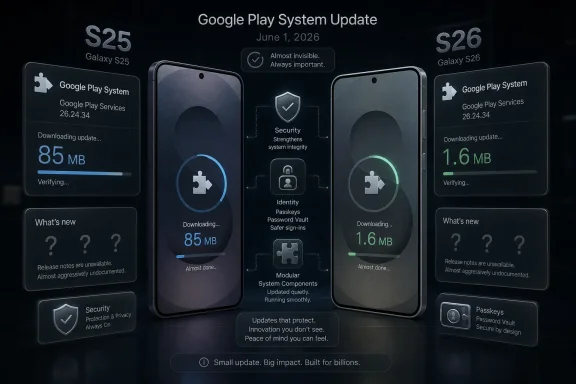
The practical impact for users is modest on the surface. SamMobile reports that the Google Play System update is dated June 1, 2026, while Google Play Services is moving to version 26.24.34. The outlet saw the update on a Galaxy S25 running One UI 8.5 and a Galaxy S26 running One UI 9.0 in India, with package sizes varying sharply by device: 85MB on the Galaxy S25 and just 1.6MB on the Galaxy S26.
That size difference is not a typo-sized curiosity. It is the tell. Google Play System updates are not conventional monolithic firmware packages. They can include different module payloads depending on a device’s current state, Android baseline, regional configuration, and OEM integration. One Galaxy may need a relatively large catch-up bundle; another may need a tiny delta. Both can end up reporting the same date.
Google’s broader system services release notes do explain the general direction of travel for June 2026. Around that period, Google documented Play services changes including developer features for Maps-related processes and Credential Exchange support for importing and exporting passwords and passkeys between Google Password Manager and third-party password managers. It also documented Play Store changes involving Play Protect verifications, AI-assisted Play search, clearer sales information, and refreshed install or purchase dialogs.
But that does not automatically prove that every Galaxy receiving Google Play Services 26.24.34 or a June 1 Play System date receives every listed feature immediately. Google’s own release-note style has long mixed component versions, staged rollouts, server-side flags, device classes, regions, and experiments. The line between “installed” and “enabled” is deliberately porous.
That is the problem for power users and IT departments alike. A changelog that says “security and reliability improvements” is too vague to be operationally useful. A missing changelog is worse. If a component touches credential exchange, Play Protect behavior, WebView security, device setup, Wallet, or background developer APIs, administrators need to know whether they should test for compatibility, update user guidance, or simply let the rollout proceed.
Google has reasons for this opacity. Some changes are anti-abuse measures that lose value if documented too precisely. Others are staged experiments that may never hit every device. Some are plumbing changes that would make no sense to consumers. Still, the result is an Android ecosystem where users are asked to treat invisible platform change as normal maintenance.
That is defensible only up to a point. The more Google moves meaningful system behavior into Play-delivered components, the stronger the case for clearer release accounting becomes. Not every fix needs a novella. But version numbers should map more reliably to what a device can actually do.
Those two instincts collide on every Galaxy phone. Samsung may be current on its monthly security maintenance release while Google Play System lags behind. Google may push a new Play Services version that affects sign-in, location, payments, or app compatibility while Samsung’s own update screen stays quiet. Neither company is exactly wrong, but the user is left to reconcile two clocks.
That dual-clock problem has been especially visible on Samsung devices over the past year. Reports earlier in 2026 described some Galaxy phones finally receiving newer Google Play System updates after spending months on older 2025 dates. Enthusiast forums were full of users comparing Play System dates the way PC users once compared BIOS versions: not always because they knew what the number meant, but because a stale number suggested something was stuck.
This is where Samsung’s scale matters. A delay or oddity on a niche Android handset is a footnote. A delay or oddity on Galaxy devices is ecosystem news. Samsung is the dominant Android manufacturer in many markets, and its phones are common in businesses, schools, families, and carrier retail channels. If Google’s modular update system behaves unevenly on Galaxy hardware, the average Android user experiences that as Android behaving unevenly.
It is tempting to blame Samsung whenever a Galaxy device sits on an old Play System date. That may be too simple. Google Play System updates still have to coexist with OEM customizations, carrier requirements, Android version differences, and device-specific certification. Samsung has strong reasons to avoid pushing a module that breaks core functions on tens of millions of phones.
But from the user’s perspective, the distinction is academic. The phone says Samsung on the back, Google in the services layer, Android in the settings menu, and One UI on the screen. When an update is delayed or undocumented, the whole stack looks evasive.
That does not make it trivial. Google Play System updates belong to Android’s modular update architecture, often associated with Project Mainline and related efforts to separate critical system components from full OS upgrades. The point is not spectacle. The point is that certain security, privacy, networking, media, permission, and runtime components can be serviced faster than a traditional firmware cycle allows.
This is one of Android’s most important answers to fragmentation. In the old Android world, a platform bug could wait on a manufacturer, a carrier, a region, and a device model. In the modern Android world, Google can update more of the base system through Play infrastructure, even on phones that are not receiving a full operating system update that month.
That shift has obvious benefits. It gives Google a way to patch classes of issues across the ecosystem more quickly. It lets developers rely on newer platform services without waiting years for every user to buy a new phone. It gives older devices a longer functional tail, at least for components that Google can modularize.
But it also creates a new kind of fragmentation: the fragmentation of visibility. Two users may both say they are “on Android 16” or “on One UI 8.5,” yet have different Play Services versions, different Play System dates, different server-side flags, and different behavior inside the same Google feature. For a consumer, that is annoying. For a developer or support desk, it is a matrix.
The Galaxy S25 and S26 examples make that matrix tangible. A Galaxy S25 receiving an 85MB Play System package and a Galaxy S26 receiving a 1.6MB package are not necessarily receiving different headline updates, but they are clearly not walking the same update path. One device may be catching up on modules. The other may already have most of the pieces and only need a small adjustment.
That is how modern Android works. It is also why modern Android is harder to explain than the old version-number era.
Samsung’s own firmware update screen remains the obvious place most users go. The Play Store’s “Manage apps and device” screen is the obvious place many others go. Neither necessarily tells the full story for Google Play System modules. Google Play Services, meanwhile, behaves like an app, a platform dependency, and a background system layer all at once.
That design is hostile to understanding. It asks users to know the difference between a Samsung software update, an Android security patch level, a Google Play System update, Google Play Services, Android System WebView, Android System Intelligence, Play Store updates, and ordinary app updates. Enthusiasts can learn the taxonomy. Normal people should not have to.
Windows users know this problem in another form. Microsoft has long split servicing among cumulative updates, servicing stack updates, Microsoft Store app updates, Defender intelligence updates, driver updates, optional previews, and feature enablement packages. The upside is agility. The downside is that “fully updated” becomes a sentence that needs qualifiers.
Android is now deep in that same territory. A Galaxy phone can be fully updated in Samsung’s firmware channel but not in Google’s system channel. It can have the newest Play Services build but not a newly enabled feature. It can have a current Play System date but still wait on a regional server-side rollout. This is not a bug in the strategy. It is the strategy.
The question is whether the interface catches up. If Google and Samsung want users to trust modular updates, they need to make the state of those updates less mysterious. A single health panel that distinguishes firmware, security patch level, Play System modules, Play Services, WebView, and Play Protect status would do more for confidence than another generic “your device is up to date” message.
Google Play Services sits close to many of those trust surfaces. It touches authentication, device integrity signals, location APIs, app compatibility frameworks, wallet features, account recovery flows, safety services, and developer-facing interfaces. Google Play System modules can service lower-level pieces of Android that would once have been tied more tightly to OS releases.
That does not mean every Play Services update is a security emergency. Version 26.24.34 may include bug fixes, staged feature flags, regional enablement, compatibility work, or preparatory plumbing. Without a changelog, outsiders should not pretend to know. But the class of component being updated is consequential by design.
The best argument for installing the June update is therefore not “new features.” It is operational hygiene. Keeping Play System and Play Services current reduces the chance that a phone misses fixes or compatibility changes that Google expects modern Android apps and services to rely on. In a fleet environment, that matters even when nobody can point to a shiny new button.
This is also where users should resist a common enthusiast reflex: treating every undocumented update as suspicious. Lack of transparency deserves criticism, but withholding modular system updates is usually the worse trade-off. These components are part of the security and compatibility baseline for Android. Avoiding them because the changelog is thin is like refusing browser engine updates because the release notes are boring.
The better demand is not fewer background updates. It is better evidence. Google should explain enough for users and administrators to understand the category of change, the affected surfaces, and any known compatibility risks. Samsung should make the update state easier to inspect on Galaxy devices. Both companies can do that without disclosing exploit details or overwhelming consumers.
That substrate can affect sign-in behavior, managed account flows, passkey support, app distribution, Play Protect enforcement, location behavior, and compatibility with line-of-business apps. Even small changes can matter if a company relies on custom apps, identity providers, device compliance checks, or regulated workflows. An undocumented Play Services update is not automatically risky, but it is another moving part.
The difficulty is that many organizations do not monitor Play Services with the same rigor they apply to OS builds. Mobile device management dashboards often emphasize Android version, security patch level, enrollment state, and compliance policies. Play Services version drift can hide in plain sight until an app starts requiring a newer baseline or a Google feature behaves differently across devices.
Samsung’s enterprise credibility rests partly on Knox, long support windows, and predictable security releases. Google’s modular update machinery strengthens that story when it delivers faster fixes. It weakens it when administrators cannot easily answer which Google system components changed, when, and on which devices.
The answer is not to freeze everything. Mobile platforms are now too exposed and too cloud-connected for a 1990s-style change-control fantasy. But enterprises need observability. If Google is going to move more identity, safety, and system behavior through Play-delivered components, those components need to be first-class citizens in management reporting.
There is an opportunity here for Samsung as much as Google. Galaxy devices already differentiate themselves with management tooling and security positioning. A clearer Galaxy-side interface for Play System status, Play Services versioning, WebView freshness, and module health would be a genuinely useful enterprise feature, not just another settings-page rearrangement.
This has been happening for years, but AI and identity make it more consequential. Features involving Gemini, app actions, cross-device continuity, fraud prevention, Credential Manager, passkeys, digital IDs, and wallet integrations are unlikely to fit neatly into old Android version boundaries. They depend on cloud services, app updates, Play Services APIs, and OEM integration layers all moving in concert.
Samsung is both a beneficiary and a constraint in this model. Galaxy phones get access to Google’s newest platform services without waiting for every improvement to be baked into a One UI release. At the same time, Samsung has its own account system, wallet, password tools, AI branding, device ecosystem, and security framework. The result is cooperation with friction.
Users experience that friction as duplication and opacity. There is Samsung Wallet and Google Wallet. Samsung Pass and Google Password Manager. Galaxy AI and Gemini. Samsung security updates and Google Play System updates. None of these pairings is inherently bad, but each adds another layer to the question: who is responsible when something changes?
The June Play Services and Play System updates sit right in that blurred zone. They are Google updates landing on Samsung hardware, inside a Samsung settings experience, affecting an Android platform that both companies shape. The average Galaxy owner does not care which corporate boundary a fix crossed. They care whether the phone remains secure, compatible, and predictable.
That is the bargain the Android ecosystem has chosen. More modularity means faster movement. Faster movement means less ceremony. Less ceremony means users and administrators need better tools to see what moved.
The more important lesson is that the Play System date deserves a place in the routine maintenance mental model. It is not a replacement for Samsung firmware updates, monthly security patches, or Play Store app updates. It is a separate layer, and on modern Android, separate layers can matter.
 The Most Important Android Update Is the One Samsung Barely Owns
For years, Samsung trained Galaxy owners to think of software updates as Samsung events. One UI version numbers, monthly security patch levels, camera tuning, Galaxy AI feature drops, and carrier certification schedules all sit under Samsung’s visible control. A Galaxy phone is, culturally and commercially, a Samsung product first.But Android has been moving in the opposite direction. Google has spent the better part of the last decade carving system behavior into updateable modules, Play services components, Play Store-delivered frameworks, and background services that can move independently of full operating system releases. The result is a phone that can receive meaningful platform changes even when the Samsung firmware build number does not budge.
That split is easy to ignore when everything works. It becomes harder to ignore when a Galaxy phone reports a fresh Android security patch but an aging Google Play System date, or when a Google Play Services update unlocks new password, wallet, safety, or developer-facing behavior without a Samsung changelog to explain it. The June 2026 update is a reminder that the Android update story is no longer one pipeline. It is a mesh.
The practical impact for users is modest on the surface. SamMobile reports that the Google Play System update is dated June 1, 2026, while Google Play Services is moving to version 26.24.34. The outlet saw the update on a Galaxy S25 running One UI 8.5 and a Galaxy S26 running One UI 9.0 in India, with package sizes varying sharply by device: 85MB on the Galaxy S25 and just 1.6MB on the Galaxy S26.
That size difference is not a typo-sized curiosity. It is the tell. Google Play System updates are not conventional monolithic firmware packages. They can include different module payloads depending on a device’s current state, Android baseline, regional configuration, and OEM integration. One Galaxy may need a relatively large catch-up bundle; another may need a tiny delta. Both can end up reporting the same date.
No Changelog Is a Message, Even If Google Did Not Mean It That Way
The most frustrating part of this rollout is not that the updates are obscure. It is that the specific pair reported here does not appear to come with a useful public changelog. SamMobile says Google had not provided release notes for the June 1 Google Play System update or Play Services 26.24.34 at the time of reporting. For ordinary users, that turns the update into an act of faith.Google’s broader system services release notes do explain the general direction of travel for June 2026. Around that period, Google documented Play services changes including developer features for Maps-related processes and Credential Exchange support for importing and exporting passwords and passkeys between Google Password Manager and third-party password managers. It also documented Play Store changes involving Play Protect verifications, AI-assisted Play search, clearer sales information, and refreshed install or purchase dialogs.
But that does not automatically prove that every Galaxy receiving Google Play Services 26.24.34 or a June 1 Play System date receives every listed feature immediately. Google’s own release-note style has long mixed component versions, staged rollouts, server-side flags, device classes, regions, and experiments. The line between “installed” and “enabled” is deliberately porous.
That is the problem for power users and IT departments alike. A changelog that says “security and reliability improvements” is too vague to be operationally useful. A missing changelog is worse. If a component touches credential exchange, Play Protect behavior, WebView security, device setup, Wallet, or background developer APIs, administrators need to know whether they should test for compatibility, update user guidance, or simply let the rollout proceed.
Google has reasons for this opacity. Some changes are anti-abuse measures that lose value if documented too precisely. Others are staged experiments that may never hit every device. Some are plumbing changes that would make no sense to consumers. Still, the result is an Android ecosystem where users are asked to treat invisible platform change as normal maintenance.
That is defensible only up to a point. The more Google moves meaningful system behavior into Play-delivered components, the stronger the case for clearer release accounting becomes. Not every fix needs a novella. But version numbers should map more reliably to what a device can actually do.
Galaxy Owners Are Caught Between Two Update Cultures
Samsung and Google approach updates from different institutional instincts. Samsung sells hardware, owns the customer relationship, and packages major changes as part of the Galaxy experience. Google operates Android as a distributed platform and increasingly wants core services to evolve continuously across manufacturers.Those two instincts collide on every Galaxy phone. Samsung may be current on its monthly security maintenance release while Google Play System lags behind. Google may push a new Play Services version that affects sign-in, location, payments, or app compatibility while Samsung’s own update screen stays quiet. Neither company is exactly wrong, but the user is left to reconcile two clocks.
That dual-clock problem has been especially visible on Samsung devices over the past year. Reports earlier in 2026 described some Galaxy phones finally receiving newer Google Play System updates after spending months on older 2025 dates. Enthusiast forums were full of users comparing Play System dates the way PC users once compared BIOS versions: not always because they knew what the number meant, but because a stale number suggested something was stuck.
This is where Samsung’s scale matters. A delay or oddity on a niche Android handset is a footnote. A delay or oddity on Galaxy devices is ecosystem news. Samsung is the dominant Android manufacturer in many markets, and its phones are common in businesses, schools, families, and carrier retail channels. If Google’s modular update system behaves unevenly on Galaxy hardware, the average Android user experiences that as Android behaving unevenly.
It is tempting to blame Samsung whenever a Galaxy device sits on an old Play System date. That may be too simple. Google Play System updates still have to coexist with OEM customizations, carrier requirements, Android version differences, and device-specific certification. Samsung has strong reasons to avoid pushing a module that breaks core functions on tens of millions of phones.
But from the user’s perspective, the distinction is academic. The phone says Samsung on the back, Google in the services layer, Android in the settings menu, and One UI on the screen. When an update is delayed or undocumented, the whole stack looks evasive.
The June Rollout Is Small Because the Architecture Is Big
The June 2026 update should not be mistaken for a major One UI release. It does not appear to bring a visible redesign, a new AI suite, or an obvious battery-life miracle. Most users will install it, reboot if prompted, and notice nothing.That does not make it trivial. Google Play System updates belong to Android’s modular update architecture, often associated with Project Mainline and related efforts to separate critical system components from full OS upgrades. The point is not spectacle. The point is that certain security, privacy, networking, media, permission, and runtime components can be serviced faster than a traditional firmware cycle allows.
This is one of Android’s most important answers to fragmentation. In the old Android world, a platform bug could wait on a manufacturer, a carrier, a region, and a device model. In the modern Android world, Google can update more of the base system through Play infrastructure, even on phones that are not receiving a full operating system update that month.
That shift has obvious benefits. It gives Google a way to patch classes of issues across the ecosystem more quickly. It lets developers rely on newer platform services without waiting years for every user to buy a new phone. It gives older devices a longer functional tail, at least for components that Google can modularize.
But it also creates a new kind of fragmentation: the fragmentation of visibility. Two users may both say they are “on Android 16” or “on One UI 8.5,” yet have different Play Services versions, different Play System dates, different server-side flags, and different behavior inside the same Google feature. For a consumer, that is annoying. For a developer or support desk, it is a matrix.
The Galaxy S25 and S26 examples make that matrix tangible. A Galaxy S25 receiving an 85MB Play System package and a Galaxy S26 receiving a 1.6MB package are not necessarily receiving different headline updates, but they are clearly not walking the same update path. One device may be catching up on modules. The other may already have most of the pieces and only need a small adjustment.
That is how modern Android works. It is also why modern Android is harder to explain than the old version-number era.
The Settings Path Says Everything About the Confusion
SamMobile says users can check for the Google Play System update under Settings, then Security and privacy, then Updates, then Google Play System updates. On some Samsung builds, similar controls have also appeared through About phone, Software information, and the Google Play System update entry. The shifting path is not just a support annoyance; it is a symptom of a platform whose update model has outgrown its user interface.Samsung’s own firmware update screen remains the obvious place most users go. The Play Store’s “Manage apps and device” screen is the obvious place many others go. Neither necessarily tells the full story for Google Play System modules. Google Play Services, meanwhile, behaves like an app, a platform dependency, and a background system layer all at once.
That design is hostile to understanding. It asks users to know the difference between a Samsung software update, an Android security patch level, a Google Play System update, Google Play Services, Android System WebView, Android System Intelligence, Play Store updates, and ordinary app updates. Enthusiasts can learn the taxonomy. Normal people should not have to.
Windows users know this problem in another form. Microsoft has long split servicing among cumulative updates, servicing stack updates, Microsoft Store app updates, Defender intelligence updates, driver updates, optional previews, and feature enablement packages. The upside is agility. The downside is that “fully updated” becomes a sentence that needs qualifiers.
Android is now deep in that same territory. A Galaxy phone can be fully updated in Samsung’s firmware channel but not in Google’s system channel. It can have the newest Play Services build but not a newly enabled feature. It can have a current Play System date but still wait on a regional server-side rollout. This is not a bug in the strategy. It is the strategy.
The question is whether the interface catches up. If Google and Samsung want users to trust modular updates, they need to make the state of those updates less mysterious. A single health panel that distinguishes firmware, security patch level, Play System modules, Play Services, WebView, and Play Protect status would do more for confidence than another generic “your device is up to date” message.
Security Is the Strongest Argument for Tolerating the Mess
The case for Google’s modular system is strongest when framed around security. Phones are not just communication devices; they are identity wallets, payment tokens, password vaults, passkey stores, medical portals, work endpoints, and location beacons. Waiting for a full OEM firmware release to fix every relevant platform component is no longer acceptable.Google Play Services sits close to many of those trust surfaces. It touches authentication, device integrity signals, location APIs, app compatibility frameworks, wallet features, account recovery flows, safety services, and developer-facing interfaces. Google Play System modules can service lower-level pieces of Android that would once have been tied more tightly to OS releases.
That does not mean every Play Services update is a security emergency. Version 26.24.34 may include bug fixes, staged feature flags, regional enablement, compatibility work, or preparatory plumbing. Without a changelog, outsiders should not pretend to know. But the class of component being updated is consequential by design.
The best argument for installing the June update is therefore not “new features.” It is operational hygiene. Keeping Play System and Play Services current reduces the chance that a phone misses fixes or compatibility changes that Google expects modern Android apps and services to rely on. In a fleet environment, that matters even when nobody can point to a shiny new button.
This is also where users should resist a common enthusiast reflex: treating every undocumented update as suspicious. Lack of transparency deserves criticism, but withholding modular system updates is usually the worse trade-off. These components are part of the security and compatibility baseline for Android. Avoiding them because the changelog is thin is like refusing browser engine updates because the release notes are boring.
The better demand is not fewer background updates. It is better evidence. Google should explain enough for users and administrators to understand the category of change, the affected surfaces, and any known compatibility risks. Samsung should make the update state easier to inspect on Galaxy devices. Both companies can do that without disclosing exploit details or overwhelming consumers.
Enterprise IT Gets Another Quiet Variable to Manage
For consumers, the June update is a manual check and a shrug. For enterprise IT, it is another reminder that Android device management has moved beyond the firmware calendar. A managed Galaxy phone is not only Samsung’s patch level and Android version; it is also Google’s services substrate.That substrate can affect sign-in behavior, managed account flows, passkey support, app distribution, Play Protect enforcement, location behavior, and compatibility with line-of-business apps. Even small changes can matter if a company relies on custom apps, identity providers, device compliance checks, or regulated workflows. An undocumented Play Services update is not automatically risky, but it is another moving part.
The difficulty is that many organizations do not monitor Play Services with the same rigor they apply to OS builds. Mobile device management dashboards often emphasize Android version, security patch level, enrollment state, and compliance policies. Play Services version drift can hide in plain sight until an app starts requiring a newer baseline or a Google feature behaves differently across devices.
Samsung’s enterprise credibility rests partly on Knox, long support windows, and predictable security releases. Google’s modular update machinery strengthens that story when it delivers faster fixes. It weakens it when administrators cannot easily answer which Google system components changed, when, and on which devices.
The answer is not to freeze everything. Mobile platforms are now too exposed and too cloud-connected for a 1990s-style change-control fantasy. But enterprises need observability. If Google is going to move more identity, safety, and system behavior through Play-delivered components, those components need to be first-class citizens in management reporting.
There is an opportunity here for Samsung as much as Google. Galaxy devices already differentiate themselves with management tooling and security positioning. A clearer Galaxy-side interface for Play System status, Play Services versioning, WebView freshness, and module health would be a genuinely useful enterprise feature, not just another settings-page rearrangement.
Android’s Future Looks Less Like an OS Release and More Like a Service
The June 2026 update is easy to dismiss because it lacks ceremony. That is exactly why it is worth watching. Android’s future is not only annual OS releases and OEM skins. It is the steady migration of meaningful behavior into services that update when Google decides they should.This has been happening for years, but AI and identity make it more consequential. Features involving Gemini, app actions, cross-device continuity, fraud prevention, Credential Manager, passkeys, digital IDs, and wallet integrations are unlikely to fit neatly into old Android version boundaries. They depend on cloud services, app updates, Play Services APIs, and OEM integration layers all moving in concert.
Samsung is both a beneficiary and a constraint in this model. Galaxy phones get access to Google’s newest platform services without waiting for every improvement to be baked into a One UI release. At the same time, Samsung has its own account system, wallet, password tools, AI branding, device ecosystem, and security framework. The result is cooperation with friction.
Users experience that friction as duplication and opacity. There is Samsung Wallet and Google Wallet. Samsung Pass and Google Password Manager. Galaxy AI and Gemini. Samsung security updates and Google Play System updates. None of these pairings is inherently bad, but each adds another layer to the question: who is responsible when something changes?
The June Play Services and Play System updates sit right in that blurred zone. They are Google updates landing on Samsung hardware, inside a Samsung settings experience, affecting an Android platform that both companies shape. The average Galaxy owner does not care which corporate boundary a fix crossed. They care whether the phone remains secure, compatible, and predictable.
That is the bargain the Android ecosystem has chosen. More modularity means faster movement. Faster movement means less ceremony. Less ceremony means users and administrators need better tools to see what moved.
The June Patch Tells Galaxy Users to Check the Plumbing, Not the Paint
For Galaxy owners, the immediate action is simple: check the Google Play System update manually if the phone has not already prompted for it, and make sure Google Play Services is allowed to update normally. The reported path on newer Samsung software is Settings, Security and privacy, Updates, and then Google Play System updates. If the update appears, install it and reboot if requested.The more important lesson is that the Play System date deserves a place in the routine maintenance mental model. It is not a replacement for Samsung firmware updates, monthly security patches, or Play Store app updates. It is a separate layer, and on modern Android, separate layers can matter.
- Galaxy phones are receiving a Google Play System update dated June 1, 2026, alongside Google Play Services version 26.24.34.
- SamMobile observed the rollout on Galaxy S25 and Galaxy S26 devices in India, running One UI 8.5 and One UI 9.0 respectively.
- The update size can vary dramatically by model and software state, with reported packages of 85MB and 1.6MB on different Galaxy devices.
- Google had not provided a specific changelog for the reported Play System update or Play Services 26.24.34 at the time of publication.
- Users should treat Google Play System updates as distinct from Samsung firmware updates, Android security patches, and ordinary Play Store app updates.
- Administrators should monitor Play Services and Play System status because these components increasingly affect security, identity, compatibility, and platform behavior.
References
- Primary source: SamMobile
Published: Tue, 30 Jun 2026 08:00:00 GMT
Samsung phones get new Google Play System, Services updates - SamMobile
New Google Play System and Google Play Services updates are available for Samsung phones running One UI 9.0 and One UI 8.5. - SamMobilewww.sammobile.com - Related coverage: samfw.com
Samsung Begins Rolling Out June 2026 Google Play System Update
Samsung has officially begun rolling out the June 2026 Google Play System update to its smartphone users. While Google has kept the exact file size...samfw.com - Related coverage: androidnewswire.com
June 2026 Android System Updates: The Complete Changelog Across All Three Play Services Releases | Android Newswire | Android Newswire
Google’s June 2026 Android system updates rolled out across three Play Services releases — v26.21 on June 1, v26.22 on June 8, and v26.23 on June 15. The headline feature is the one most users will notice immediately: WhatsApp backups can now be managed directly from Android device...androidnewswire.com - Related coverage: phonearena.com
Your Samsung Galaxy may be sitting on these crucial manual updates - PhoneArena
They never show up in the Play Store's usual update list, so they slip right past you.www.phonearena.com - Related coverage: androidauthority.com
These crucial Google services on Samsung phones may be waiting for you to update
A trio of important Google apps have recently received updates on Samsung phones and they require a manual update.www.androidauthority.com - Official source: support.google.com

Google system services release notes - Help
Google system services updates make your Android devices more secure and reliable, and give you new and useful features. They include updates from Google to the Android operating system, Google Play S
support.google.com
- Related coverage: samsung.gadgethacks.com
Samsung Phone Google App Updates Not Showing in Play Store—Manual Install Guide << Samsung :: Gadget Hacks
Three Google system components on Samsung Galaxy phones have pending updates that do not appear on the Play Store's "Manage apps &amp; device" screen, the... samsung.gadgethacks.com
- Related coverage: androidheadlines.com
Galaxy Phones Are Finally Being Treated to a New Google Play System Update
Select Galaxy phones are being treated with new Google Play system updates, dated January 1st, 2026. The update weighs 90MB in size. www.androidheadlines.com
- Related coverage: androidcentral.com
Google I/O 2026 Live Blog updates: Android 17, Android XR glasses, Gemini AI news | Android Central
Follow along as Android Central covers everything at Google I/O 2026!www.androidcentral.com