

AMD’s latest Linux kernel patches add support for a third AMD heterogeneous CPU core class, a “Low Power” type reported through CPUID on future AMD and Hygon x86 parts, strongly suggesting that Zen 6-era processors will go beyond today’s Zen and Zen C split. The important part is not that AMD has suddenly discovered hybrid CPUs; it is that AMD appears to be refining what “hybrid” means. If Zen 6 brings standard, dense, and low-power cores under one ISA umbrella, the fight with Intel shifts from peak performance to power-state choreography. For Windows users and administrators, that makes the scheduler, firmware, and telemetry just as consequential as the silicon.
For years, AMD’s pitch against Intel’s hybrid client CPUs was elegantly simple: all Ryzen cores were broadly the same kind of core, and the operating system did not need to make hard choices between two materially different instruction-set personalities. Zen 4C and Zen 5C complicated that message, but only slightly. The dense cores were smaller and tuned differently, yet they remained recognizably Zen.
The new Linux patches suggest AMD is preparing for a sharper distinction. The kernel already had a way to classify performance and efficiency cores on x86 systems. AMD’s new contribution extends that taxonomy to include a low-power core type, with the patch text describing it as intended for minimal power consumption during background or idle workloads.
That wording matters. An efficiency core is not automatically an idle core. In modern laptop silicon, there is a real difference between a core built to deliver decent throughput per watt and a core designed to keep the platform awake, connected, and responsive while the rest of the chip sleeps.
This is where AMD’s move starts to look less like a copy of Intel and more like a delayed answer to a problem Intel forced into the mainstream. Windows laptops are no longer judged only by Cinebench bursts and gaming frame rates. They are judged by lid-closed drain, Teams-call thermals, standby reliability, fan behavior, resume latency, and whether the machine quietly burns through a backpack battery by morning.
That is a real enablement signal. Kernel patches do not prove launch dates, retail configurations, or benchmark outcomes, but they do reveal the categories hardware vendors expect operating systems to understand. In this case, AMD is not merely asking Linux to recognize a new model number; it is asking Linux to distinguish a different kind of core behavior.
The patch also touches boost-ratio handling. Low-power cores should not be treated as if they share the same performance ceiling assumptions as performance cores. That is a small implementation detail with a large implication: once a chip contains cores with meaningfully different power-performance envelopes, the operating system needs accurate metadata or it will make bad decisions.
This is the unglamorous layer of processor launches that enthusiasts tend to underestimate. A hybrid CPU is only as good as the contract among silicon, firmware, kernel, drivers, and user-space policy. If any layer lies, guesses, or rounds away the difference, the machine may still benchmark well but feel wrong in daily use.
That points toward workloads users rarely think about until they go badly. Mail sync, notification handling, browser wakeups, security agents, audio services, cloud backup clients, Teams presence, device management, and modern standby all generate small but persistent CPU demands. On an ordinary high-performance core, these tasks are trivial computationally but expensive systemically because waking large silicon blocks can drag power rails, caches, fabric, and firmware paths along for the ride.
A low-power core gives AMD another place to put that work. The value is not that a tiny task finishes dramatically faster. The value is that the rest of the processor may not need to wake up as often, or may wake for shorter periods, or may stay in a deeper idle state without making the system feel asleep.
That is also why the phrase background or idle workloads should be read carefully. This is not simply about low TDP modes under load. It is about the long tail of work that happens when the user is not actively benchmarking, rendering, compiling, or gaming. In a world where laptops spend much of their lives half-awake, that long tail is the battery story.
AMD avoided the worst of that transition by keeping its core families closer together. Zen C cores were dense variants, not a completely alien class of small core. That allowed AMD to scale core count and improve area efficiency without asking Windows to solve the same kind of split personality problem Intel introduced.
The low-power core class changes the tone. AMD still appears to be staying inside a common x86 ISA model, which should reduce software compatibility risk. But once a chip exposes performance, dense, and low-power cores, it has accepted that the best core for a task depends on more than whether the task is single-threaded or multi-threaded.
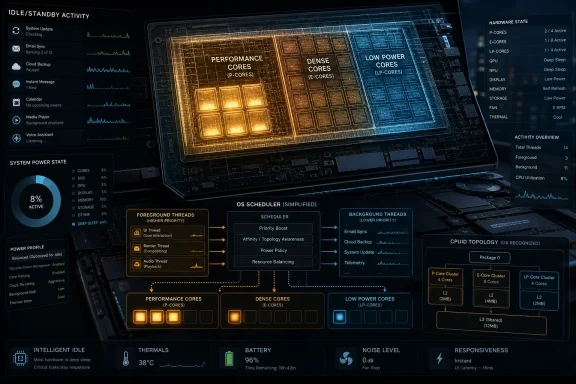
That is the Intel premise, even if the implementation differs. The processor is no longer a collection of interchangeable workers. It is a small city with districts: fast cores for urgency, dense cores for throughput, and low-power cores for keeping the lights on.
Windows has spent years learning to deal with hybrid Intel systems. It now has a richer vocabulary for core preference, power policy, and foreground prioritization than it did in the pre-Alder Lake era. That does not mean AMD can simply drop in a third core type and assume the operating system will do the right thing.
The challenge is that low-power cores are not necessarily where users want “slow” work to go. Background work may be latency-sensitive. Audio processing, input handling, network wakeups, security monitoring, and collaboration apps all look small until they miss a deadline. A poor scheduler policy could save power while introducing tiny stutters that users perceive as flakiness.
The best version of this design will be mostly invisible. A Zen 6 laptop should wake quickly, stay cool, sip power during standby, and still shove foreground work onto the right cores without the user managing modes. The worst version will produce a familiar enthusiast complaint: a machine that looks brilliant in reviews but behaves inconsistently under real software clutter.
This is especially true for thin-and-light systems. If AMD’s Zen 6LP cores arrive in mobile APUs, the most visible benefits will likely appear in premium laptops where OEMs care about standby drain, acoustics, and power policy. In bargain designs with weak firmware support or aggressive preinstalled software, the theoretical savings may be consumed by bad platform behavior.
Business PCs add another complication. Enterprise endpoint agents are notorious for turning “idle” into a busy fiction. Security scanners, inventory tools, VPN clients, update services, browser management, and collaboration stacks can generate a continuous stream of small wakeups. Low-power cores could help, but only if the OS and firmware classify that background churn intelligently.
Administrators should therefore resist the urge to evaluate Zen 6LP purely as a CPU feature. It will be a platform feature. The right question for fleets will be whether the whole device demonstrates better connected-standby reliability, lower drain, predictable thermals, and fewer user complaints — not whether the spec sheet says it has a new kind of core.
This is particularly relevant for power users and system builders. Linux users often see new hardware support in pieces: topology detection first, performance counters later, scheduler refinements after that, and distro-level power-management defaults sometime after the kernel knows what it is looking at. The first patch is not the finish line. It is the point at which the public can watch the enablement story begin.
There is also a debugging benefit. When a system has three classes of cores, observability becomes essential. Users need to know where threads are landing, why boost behavior differs, and whether a workload is being constrained by policy or hardware. Kernel topology exposure is the foundation for that kind of visibility.
For WindowsForum readers, the lesson is not that Linux will necessarily support Zen 6LP better than Windows. The lesson is that public Linux patches often reveal the hardware contract early. If AMD is teaching Linux about a low-power core class now, Windows support almost certainly has a parallel private track.
That matters because hybrid composition can change the character of a chip. A ten-core processor with eight large-ish cores and two low-power housekeeping cores is not the same product as a ten-core processor built for sustained throughput. Counting cores without identifying core types becomes increasingly misleading.
Intel has already trained buyers to ask about P-cores and E-cores. AMD may now need a cleaner public vocabulary for its own approach. “Classic,” “dense,” and “low power” are technically useful, but they are not consumer-friendly. Worse, “efficiency” and “low power” sound nearly identical to normal people while meaning different things in scheduler policy.
If AMD does not explain the distinction, reviewers will. If reviewers do not explain it consistently, retailers will flatten it into nonsense. That is how we end up with spec sheets that advertise core counts while hiding the one fact that determines how those cores behave.
That does not mean the idea is irrelevant to desktops. Modern desktop systems also spend vast amounts of time idle or near-idle, and enthusiasts increasingly care about idle power because electricity costs, heat, noise, and small-form-factor constraints all matter. A gaming PC that pulls less power while downloading updates, streaming media, or sitting at the desktop is simply a better-behaved machine.
Still, desktop buyers are likely to judge Zen 6 by boost clocks, cache, gaming performance, memory behavior, and platform longevity. Low-power cores will not carry the launch narrative unless AMD can show they improve everyday responsiveness or reduce idle draw in a way users can measure.
The more plausible first showcase is mobile. That is where AMD has the biggest opportunity to close any perceived gap with Intel and Arm-based systems on standby behavior. It is also where Windows power policy has the most room to turn a silicon feature into a user-visible advantage.
AMD cannot win that argument with peak multithreaded performance alone. Ryzen laptops have often been excellent performers, but the next battleground is whether they can feel fast while behaving frugally. Low-power cores are one way to attack the part of the experience that benchmarks historically miss.
This is also about credibility in AI-branded PCs. “Ryzen AI” systems already lean on NPUs for certain acceleration tasks, but the platform still needs CPU cores to orchestrate background work, OS services, and conventional applications. An efficient AI PC is not just a machine with a faster NPU. It is a machine where all the background intelligence does not punish battery life.
That is why Zen 6LP could be more strategically important than its likely benchmark footprint suggests. The best low-power core is not the one that wins a chart. It is the one nobody notices because the laptop lasted longer, stayed cooler, and woke instantly.
Most enterprises will not manually pin workloads to core types. They should not have to. But they will care if endpoint protection causes drain, if VPN software keeps waking performance cores, or if management tools misread CPU utilization because they do not understand the topology.
Low-power cores could help security software become less intrusive during idle periods. They could also hide inefficiencies by allowing bloated background agents to run constantly without obvious fan noise. That is not entirely a win. Better hardware often enables worse software habits.
For IT departments, the practical question will be whether management tools expose enough information to distinguish a healthy low-power background state from a machine that is quietly busy all day. If Zen 6 systems arrive with new core classes, Windows performance tooling, vendor dashboards, and enterprise monitoring agents will need to present that topology clearly.
This distinction matters because hardware rumor cycles tend to collapse enablement, engineering samples, announcement windows, and shipping products into a single imagined launch. Kernel support can appear months before hardware is broadly available. Engineering samples can leak with clocks, caches, and configurations that never match final retail parts.
The sober reading is that AMD is preparing operating-system support for a low-power x86 core type that is likely associated with future heterogeneous processors. The more speculative reading is that Zen 6 mobile APUs will combine standard Zen 6, Zen 6C, and Zen 6LP cores. The former is strongly supported by the patches. The latter is plausible but still belongs in the bucket marked “reported” until AMD says it on stage.
That is not a reason to dismiss the story. It is the reason to focus on the architecture direction rather than the exact SKU table. Whether the first retail chip has two low-power cores, four, or a more conservative arrangement, AMD is preparing software for a third category of core.
This is why the Linux patch’s boost-ratio detail is so revealing. AMD knows low-power cores cannot simply inherit assumptions built for performance cores. That sounds obvious, but obvious things still have to be encoded in software before users benefit from them.
Windows has its own version of this challenge. Foreground apps need responsiveness. Background apps need restraint. Games need predictable scheduling. Creative workloads need sustained throughput. System services need to avoid waking the wrong parts of the chip. Battery saver modes need to be aggressive without making the PC feel broken.
The future of x86 performance is therefore less about one heroic core and more about orchestration. AMD’s classic Zen cores may still carry the benchmark headlines, but Zen 6LP would represent a different kind of engineering bet: that a PC feels better when the smallest suitable engine handles the smallest suitable job.
The modern PC is full of idle-adjacent activity. It is syncing, scanning, indexing, listening, updating, authenticating, and waiting for the next human input. A processor that handles that state elegantly can improve the daily experience without changing a single headline benchmark.
This is also where AMD has room to differentiate from Intel without pretending the hybrid question does not exist. If AMD can keep a shared ISA model, preserve strong compatibility, and add a low-power tier that reduces platform waste, it can argue that its hybrid approach is cleaner rather than late.
But the proof will not be a diagram. It will be in machines that sleep properly, wake reliably, and do not need vendor utilities to achieve sane battery life. Hybrid architecture is only impressive when users stop thinking about it.
 AMD’s Hybrid Strategy Is Becoming Less Philosophical and More Practical
For years, AMD’s pitch against Intel’s hybrid client CPUs was elegantly simple: all Ryzen cores were broadly the same kind of core, and the operating system did not need to make hard choices between two materially different instruction-set personalities. Zen 4C and Zen 5C complicated that message, but only slightly. The dense cores were smaller and tuned differently, yet they remained recognizably Zen.The new Linux patches suggest AMD is preparing for a sharper distinction. The kernel already had a way to classify performance and efficiency cores on x86 systems. AMD’s new contribution extends that taxonomy to include a low-power core type, with the patch text describing it as intended for minimal power consumption during background or idle workloads.
That wording matters. An efficiency core is not automatically an idle core. In modern laptop silicon, there is a real difference between a core built to deliver decent throughput per watt and a core designed to keep the platform awake, connected, and responsive while the rest of the chip sleeps.
This is where AMD’s move starts to look less like a copy of Intel and more like a delayed answer to a problem Intel forced into the mainstream. Windows laptops are no longer judged only by Cinebench bursts and gaming frame rates. They are judged by lid-closed drain, Teams-call thermals, standby reliability, fan behavior, resume latency, and whether the machine quietly burns through a backpack battery by morning.
The Patch Says More Than the Rumor Mill
The interesting evidence here is not the product-name speculation around Medusa, Medusa Point, or future Ryzen AI branding. Those names may prove accurate, partially accurate, or marketing-confused by launch. The kernel patch is narrower but firmer: AMD has hardware that can report a low-power core type through CPUID, and Linux needs to stop treating that class as unknown.That is a real enablement signal. Kernel patches do not prove launch dates, retail configurations, or benchmark outcomes, but they do reveal the categories hardware vendors expect operating systems to understand. In this case, AMD is not merely asking Linux to recognize a new model number; it is asking Linux to distinguish a different kind of core behavior.
The patch also touches boost-ratio handling. Low-power cores should not be treated as if they share the same performance ceiling assumptions as performance cores. That is a small implementation detail with a large implication: once a chip contains cores with meaningfully different power-performance envelopes, the operating system needs accurate metadata or it will make bad decisions.
This is the unglamorous layer of processor launches that enthusiasts tend to underestimate. A hybrid CPU is only as good as the contract among silicon, firmware, kernel, drivers, and user-space policy. If any layer lies, guesses, or rounds away the difference, the machine may still benchmark well but feel wrong in daily use.
Zen 6LP Looks Like a Battery-Life Play, Not a Benchmark Play
The temptation will be to ask how fast these low-power cores are. That is probably the least useful first question. If AMD’s description is taken at face value, Zen 6LP is not being positioned as another dense compute engine; it is being positioned as a way to handle background and idle workloads with less platform energy.That points toward workloads users rarely think about until they go badly. Mail sync, notification handling, browser wakeups, security agents, audio services, cloud backup clients, Teams presence, device management, and modern standby all generate small but persistent CPU demands. On an ordinary high-performance core, these tasks are trivial computationally but expensive systemically because waking large silicon blocks can drag power rails, caches, fabric, and firmware paths along for the ride.
A low-power core gives AMD another place to put that work. The value is not that a tiny task finishes dramatically faster. The value is that the rest of the processor may not need to wake up as often, or may wake for shorter periods, or may stay in a deeper idle state without making the system feel asleep.
That is also why the phrase background or idle workloads should be read carefully. This is not simply about low TDP modes under load. It is about the long tail of work that happens when the user is not actively benchmarking, rendering, compiling, or gaming. In a world where laptops spend much of their lives half-awake, that long tail is the battery story.
AMD Is Not Becoming Intel, but It Is Accepting Intel’s Premise
Intel’s Alder Lake made hybrid x86 unavoidable on the Windows desktop. Its combination of performance cores and efficiency cores forced Microsoft, game developers, anti-cheat vendors, and power users to confront scheduling as a first-class performance variable. Early rough edges were real, but the direction of travel was obvious: client CPUs were becoming heterogeneous because workloads had become heterogeneous.AMD avoided the worst of that transition by keeping its core families closer together. Zen C cores were dense variants, not a completely alien class of small core. That allowed AMD to scale core count and improve area efficiency without asking Windows to solve the same kind of split personality problem Intel introduced.
The low-power core class changes the tone. AMD still appears to be staying inside a common x86 ISA model, which should reduce software compatibility risk. But once a chip exposes performance, dense, and low-power cores, it has accepted that the best core for a task depends on more than whether the task is single-threaded or multi-threaded.
That is the Intel premise, even if the implementation differs. The processor is no longer a collection of interchangeable workers. It is a small city with districts: fast cores for urgency, dense cores for throughput, and low-power cores for keeping the lights on.
Windows Will Be the Real Test Bed
Linux patches are the visible breadcrumb because Linux development happens in public. For the mass-market PC, however, Windows support will decide whether the design feels elegant or awkward. Microsoft’s scheduler, AMD’s chipset drivers, ACPI tables, CPPC data, firmware hints, OEM power profiles, and application behavior will all matter.Windows has spent years learning to deal with hybrid Intel systems. It now has a richer vocabulary for core preference, power policy, and foreground prioritization than it did in the pre-Alder Lake era. That does not mean AMD can simply drop in a third core type and assume the operating system will do the right thing.
The challenge is that low-power cores are not necessarily where users want “slow” work to go. Background work may be latency-sensitive. Audio processing, input handling, network wakeups, security monitoring, and collaboration apps all look small until they miss a deadline. A poor scheduler policy could save power while introducing tiny stutters that users perceive as flakiness.
The best version of this design will be mostly invisible. A Zen 6 laptop should wake quickly, stay cool, sip power during standby, and still shove foreground work onto the right cores without the user managing modes. The worst version will produce a familiar enthusiast complaint: a machine that looks brilliant in reviews but behaves inconsistently under real software clutter.
OEMs May Matter as Much as AMD
Hybrid designs expose platform quality. That is uncomfortable for PC buyers because it means two laptops with the same processor brand can behave very differently. Firmware tuning, thermal design, battery size, memory choice, panel power, embedded controller behavior, and vendor utilities all shape whether low-power cores deliver meaningful gains.This is especially true for thin-and-light systems. If AMD’s Zen 6LP cores arrive in mobile APUs, the most visible benefits will likely appear in premium laptops where OEMs care about standby drain, acoustics, and power policy. In bargain designs with weak firmware support or aggressive preinstalled software, the theoretical savings may be consumed by bad platform behavior.
Business PCs add another complication. Enterprise endpoint agents are notorious for turning “idle” into a busy fiction. Security scanners, inventory tools, VPN clients, update services, browser management, and collaboration stacks can generate a continuous stream of small wakeups. Low-power cores could help, but only if the OS and firmware classify that background churn intelligently.
Administrators should therefore resist the urge to evaluate Zen 6LP purely as a CPU feature. It will be a platform feature. The right question for fleets will be whether the whole device demonstrates better connected-standby reliability, lower drain, predictable thermals, and fewer user complaints — not whether the spec sheet says it has a new kind of core.
Linux Gets the First Public Plumbing
The Linux angle is still important because it shows the plumbing being laid before the marketing arrives. Exposing the low-power core type through kernel topology allows user-space tools and developers to see what the hardware actually contains. Without that, a low-power core could appear as unknown, misleading diagnostics and making policy harder.This is particularly relevant for power users and system builders. Linux users often see new hardware support in pieces: topology detection first, performance counters later, scheduler refinements after that, and distro-level power-management defaults sometime after the kernel knows what it is looking at. The first patch is not the finish line. It is the point at which the public can watch the enablement story begin.
There is also a debugging benefit. When a system has three classes of cores, observability becomes essential. Users need to know where threads are landing, why boost behavior differs, and whether a workload is being constrained by policy or hardware. Kernel topology exposure is the foundation for that kind of visibility.
For WindowsForum readers, the lesson is not that Linux will necessarily support Zen 6LP better than Windows. The lesson is that public Linux patches often reveal the hardware contract early. If AMD is teaching Linux about a low-power core class now, Windows support almost certainly has a parallel private track.
The Naming Trap Is Already Open
The industry is going to make this harder than it needs to be. Zen 6, Zen 6C, and Zen 6LP are understandable to architects and enthusiasts, but they will probably be buried under Ryzen AI branding, model numbers, OEM suffixes, and laptop names that obscure the actual topology. Buyers may not know whether a given system has low-power cores at all.That matters because hybrid composition can change the character of a chip. A ten-core processor with eight large-ish cores and two low-power housekeeping cores is not the same product as a ten-core processor built for sustained throughput. Counting cores without identifying core types becomes increasingly misleading.
Intel has already trained buyers to ask about P-cores and E-cores. AMD may now need a cleaner public vocabulary for its own approach. “Classic,” “dense,” and “low power” are technically useful, but they are not consumer-friendly. Worse, “efficiency” and “low power” sound nearly identical to normal people while meaning different things in scheduler policy.
If AMD does not explain the distinction, reviewers will. If reviewers do not explain it consistently, retailers will flatten it into nonsense. That is how we end up with spec sheets that advertise core counts while hiding the one fact that determines how those cores behave.
The Desktop Story Is Less Obvious
The immediate speculation points toward mobile APUs, and that makes sense. Low-power cores have their clearest value in laptops, handhelds, mini PCs, and always-connected systems where idle drain and thermals are product-defining. On a desktop plugged into a wall, the benefit is subtler.That does not mean the idea is irrelevant to desktops. Modern desktop systems also spend vast amounts of time idle or near-idle, and enthusiasts increasingly care about idle power because electricity costs, heat, noise, and small-form-factor constraints all matter. A gaming PC that pulls less power while downloading updates, streaming media, or sitting at the desktop is simply a better-behaved machine.
Still, desktop buyers are likely to judge Zen 6 by boost clocks, cache, gaming performance, memory behavior, and platform longevity. Low-power cores will not carry the launch narrative unless AMD can show they improve everyday responsiveness or reduce idle draw in a way users can measure.
The more plausible first showcase is mobile. That is where AMD has the biggest opportunity to close any perceived gap with Intel and Arm-based systems on standby behavior. It is also where Windows power policy has the most room to turn a silicon feature into a user-visible advantage.
Arm PCs Are the Shadow Competitor
Intel is the obvious comparison, but Arm is the quieter pressure behind this move. Qualcomm, Apple, and other Arm ecosystem players have made battery life and idle efficiency central to the premium-client conversation. The Windows-on-Arm push has not erased x86, but it has changed what reviewers and buyers expect from a modern laptop.AMD cannot win that argument with peak multithreaded performance alone. Ryzen laptops have often been excellent performers, but the next battleground is whether they can feel fast while behaving frugally. Low-power cores are one way to attack the part of the experience that benchmarks historically miss.
This is also about credibility in AI-branded PCs. “Ryzen AI” systems already lean on NPUs for certain acceleration tasks, but the platform still needs CPU cores to orchestrate background work, OS services, and conventional applications. An efficient AI PC is not just a machine with a faster NPU. It is a machine where all the background intelligence does not punish battery life.
That is why Zen 6LP could be more strategically important than its likely benchmark footprint suggests. The best low-power core is not the one that wins a chart. It is the one nobody notices because the laptop lasted longer, stayed cooler, and woke instantly.
Security and Manageability Will Need Better Maps
There is another audience for topology detail: administrators and security teams. Heterogeneous CPUs complicate performance baselines, forensic expectations, and workload isolation assumptions. If a background agent behaves differently depending on which class of core it lands on, fleet telemetry can become noisier.Most enterprises will not manually pin workloads to core types. They should not have to. But they will care if endpoint protection causes drain, if VPN software keeps waking performance cores, or if management tools misread CPU utilization because they do not understand the topology.
Low-power cores could help security software become less intrusive during idle periods. They could also hide inefficiencies by allowing bloated background agents to run constantly without obvious fan noise. That is not entirely a win. Better hardware often enables worse software habits.
For IT departments, the practical question will be whether management tools expose enough information to distinguish a healthy low-power background state from a machine that is quietly busy all day. If Zen 6 systems arrive with new core classes, Windows performance tooling, vendor dashboards, and enterprise monitoring agents will need to present that topology clearly.
The CES 2027 Timeline Is Plausible, but Not Proven
Reports around Medusa-class APUs have pointed toward a 2027 client reveal window, with CES 2027 a plausible stage. That fits the cadence of mobile PC launches, especially if Zen 6 server or desktop pieces arrive in a staggered fashion. But the patch itself does not name Medusa, does not promise CES, and does not guarantee retail availability on any particular date.This distinction matters because hardware rumor cycles tend to collapse enablement, engineering samples, announcement windows, and shipping products into a single imagined launch. Kernel support can appear months before hardware is broadly available. Engineering samples can leak with clocks, caches, and configurations that never match final retail parts.
The sober reading is that AMD is preparing operating-system support for a low-power x86 core type that is likely associated with future heterogeneous processors. The more speculative reading is that Zen 6 mobile APUs will combine standard Zen 6, Zen 6C, and Zen 6LP cores. The former is strongly supported by the patches. The latter is plausible but still belongs in the bucket marked “reported” until AMD says it on stage.
That is not a reason to dismiss the story. It is the reason to focus on the architecture direction rather than the exact SKU table. Whether the first retail chip has two low-power cores, four, or a more conservative arrangement, AMD is preparing software for a third category of core.
The Scheduler Becomes Part of the Product
The more heterogeneous x86 becomes, the less meaningful it is to talk about the processor as a standalone object. A CPU with three core classes is a policy machine. It depends on decisions about thread placement, wake behavior, boost ceilings, thermal headroom, and user intent.This is why the Linux patch’s boost-ratio detail is so revealing. AMD knows low-power cores cannot simply inherit assumptions built for performance cores. That sounds obvious, but obvious things still have to be encoded in software before users benefit from them.
Windows has its own version of this challenge. Foreground apps need responsiveness. Background apps need restraint. Games need predictable scheduling. Creative workloads need sustained throughput. System services need to avoid waking the wrong parts of the chip. Battery saver modes need to be aggressive without making the PC feel broken.
The future of x86 performance is therefore less about one heroic core and more about orchestration. AMD’s classic Zen cores may still carry the benchmark headlines, but Zen 6LP would represent a different kind of engineering bet: that a PC feels better when the smallest suitable engine handles the smallest suitable job.
The Real Win Would Be Boring
If AMD succeeds, Zen 6LP will produce a strangely boring kind of progress. Reviews may show better idle draw, better standby numbers, improved light-load battery life, and cooler chassis behavior during mundane tasks. That is not as intoxicating as a huge IPC uplift, but it is arguably more relevant to many laptop users.The modern PC is full of idle-adjacent activity. It is syncing, scanning, indexing, listening, updating, authenticating, and waiting for the next human input. A processor that handles that state elegantly can improve the daily experience without changing a single headline benchmark.
This is also where AMD has room to differentiate from Intel without pretending the hybrid question does not exist. If AMD can keep a shared ISA model, preserve strong compatibility, and add a low-power tier that reduces platform waste, it can argue that its hybrid approach is cleaner rather than late.
But the proof will not be a diagram. It will be in machines that sleep properly, wake reliably, and do not need vendor utilities to achieve sane battery life. Hybrid architecture is only impressive when users stop thinking about it.
The Fine Print That Will Matter When Zen 6 Laptops Arrive
The kernel patch is an early signal, not a product launch, but it gives buyers and administrators a useful checklist for the next wave of AMD PCs. The most concrete implications are already visible if we separate confirmed plumbing from launch-season speculation.- AMD is adding software support for a distinct low-power x86 core type rather than merely relabeling existing performance and dense cores.
- The new core class is described as targeting background or idle workloads, which makes battery life and standby behavior the natural places to look for impact.
- The patch does not itself confirm final Zen 6 product names, retail configurations, or a CES 2027 launch, even if those rumors are plausible.
- Windows support will be decisive because scheduler policy, firmware data, and OEM power tuning will determine whether the new core type improves real laptops.
- Core counts will become less informative unless spec sheets and reviews clearly identify how many cores are standard, dense, and low-power.
- Enterprise buyers should evaluate whole-system behavior, including standby drain and background-agent impact, rather than treating Zen 6LP as an isolated CPU feature.
References
- Primary source: Wccftech
Published: 2026-06-29T22:20:31.379503
Loading…
wccftech.com - Related coverage: phoronix.com
Loading…
www.phoronix.com - Related coverage: vgtimes.com
Loading…
vgtimes.com - Related coverage: tomshardware.com
Loading…
www.tomshardware.com - Related coverage: videocardz.com
Loading…
videocardz.com - Related coverage: pcgameshardware.de
Loading…
www.pcgameshardware.de