

Microsoft entered the final trading days of June 2026 as the weakest Magnificent Seven stock of the year, with shares down roughly a quarter year to date and heading for their worst month since the dot-com crash. That is not supposed to happen to the company with the world’s default productivity suite, a cloud business still growing at hyperscale, and the most visible enterprise AI assistant on the market. Yet the selloff is a reminder that the AI trade has moved from story stock enthusiasm to cash-flow interrogation. Microsoft is no longer being rewarded merely for being early to generative AI; it is being asked to prove that the bill will not swallow the business model.
For most of the generative AI boom, Microsoft enjoyed the cleanest narrative in big tech. It had OpenAI exposure without being OpenAI. It had Azure, GitHub, Windows, Office, security, gaming, and a sales force that could carry AI into boardrooms where consumer chatbots were still blocked by policy.
That was the pitch: Microsoft was not a moonshot. It was the distribution layer for AI.
The trouble with distribution-layer stories is that they eventually become spreadsheet stories. Investors can tolerate vague timelines from a pure research lab, a social network with advertising optionality, or a chipmaker riding a capacity crunch. Microsoft, by contrast, is an operating machine with visible margins, visible capital expenditure, visible deferred revenue, and visible expectations. The more visible the machine, the harder it is to hide the cost of retrofitting it for AI.
That is why the company’s fall stands out. Microsoft has not suddenly become a weak company. The market is punishing the fact that Microsoft is strong enough to spend almost unimaginably large sums on AI infrastructure — and exposed enough to software disruption that the same technology could pressure its most profitable franchises.
The black-sheep status is not about irrelevance. It is about being too central to ignore.
But Microsoft’s problem is sharper than the generic hyperscaler problem. It is not merely building AI infrastructure. It is also selling the software most likely to be transformed by AI.
That creates an awkward double exposure. If AI demand disappoints, Microsoft has overspent on the infrastructure side. If AI demand succeeds too well, the company may have to defend pricing and packaging across Office, Windows, developer tools, customer service software, security, and business applications. In other words, Microsoft is exposed to both the shovel-seller economics and the gold-mine disruption.
This is the part of the story that makes the stock’s weakness more interesting than a simple valuation reset. Microsoft’s diversification, normally its great defense, becomes a map of possible disruption. Every business line offers a monetization path, but also a point of attack.
That is the uncomfortable beauty of Microsoft’s position. The company is arguably the best placed enterprise vendor in AI, and that is precisely why investors can see the risks first.
The problem is that “Copilot everywhere” is not the same as “Copilot margin expansion everywhere.” Enterprise AI assistants are expensive to run, hard to evaluate, and uneven in their usefulness. A feature that delights a consultant drafting memos may matter less to a warehouse manager, a claims adjuster, or a finance team locked into heavily customized workflows.
Microsoft’s advantage is bundling. Its risk is that bundling can blur the economics. If customers pay extra for Copilot, adoption must justify the premium. If AI features become part of broader licenses, Microsoft must prove they deepen retention, lift average revenue, or defend the platform from rivals. If inference costs remain high, even impressive adoption may disappoint investors trained to expect software margins.
GitHub Copilot showed that developers will pay for productivity when the tool is good enough and the workflow is obvious. Microsoft 365 Copilot faces a broader, messier enterprise reality. Many employees do not live in one application all day. Many companies have data hygiene problems. Many regulated customers need controls, auditability, and proof that the assistant is not turning confidential information into liability.
This does not mean Copilot is failing. It means Copilot has entered the phase where demos no longer carry the argument.
The echo lies elsewhere. In both eras, investors were asked to finance a technological buildout before the economics were fully visible. In the late 1990s, the internet was real but the valuations were often absurd. In the mid-2020s, AI is real, but the payback period for the infrastructure boom remains contested.
That distinction matters because it prevents the lazy conclusion. The market is not necessarily saying AI is fake. It is saying that even real platform shifts can transfer too much value to suppliers, destroy too much incumbent pricing, or arrive too slowly to justify current spending.
Microsoft sits at the center of that argument. It buys or leases massive compute capacity, partners deeply with model providers, builds its own services, and tries to sell AI into the enterprise at scale. If the returns are spectacular, Microsoft will look like it endured temporary pain to secure the next computing platform. If the returns are ordinary, the company may have converted a high-margin software story into a lower-margin infrastructure arms race.
Investors are not allergic to AI spending. They are allergic to AI spending that lacks a clock.
That makes Oracle a useful contrast. Microsoft can absorb AI spending with more internal firepower than Oracle can. Its balance sheet, cash flow, and installed base give it room to maneuver. Yet the two companies are now being discussed in the same breath because investors are less interested in who has the prettier AI story and more interested in who is financing the buildout, on what terms, and against what future revenue.
Oracle’s case turns the AI trade into a credit-market question. Microsoft’s case turns it into a software-margin question. Together, they show how the boom has matured from a stock-market slogan into a capital structure problem.
This is why the “AI trade” now feels less like one trade. Nvidia’s economics are not Microsoft’s economics. Microsoft’s risks are not Oracle’s risks. Alphabet’s model efficiencies and ad business are different again. The Magnificent Seven label obscures as much as it reveals.
For WindowsForum readers, the Oracle parallel is useful for another reason. It shows that cloud capacity is not an abstract background service. The AI features appearing in Windows, Office, Teams, GitHub, and security consoles sit atop an expensive and increasingly contested infrastructure stack. Someone has to pay for that stack. The question is whether customers, shareholders, bondholders, or margins take the hit.
But Burry’s bet should not be mistaken for a solution to Microsoft’s AI economics. Options expiring years from now can express a view that the market has overreacted without requiring the near-term AI spending debate to be resolved. A stock can be too cheap and still face real operational questions.
The more important point is psychological. A prominent contrarian buying Microsoft suggests that the market may be approaching the stage where quality buyers begin to separate valuation from narrative exhaustion. That is different from saying the AI capex worries are wrong.
Microsoft bulls can make a strong case. Azure remains strategically vital. Office remains embedded. Windows still anchors device management, identity, security, and enterprise workflows. GitHub gives Microsoft a privileged position with developers, and security has become one of the company’s most important growth engines. Even Xbox, often treated as a sideshow by enterprise investors, reflects Microsoft’s broader strategy of subscription, cloud distribution, and platform control.
The bear case is not that Microsoft lacks assets. The bear case is that the assets may need more capital, more time, and more pricing discipline than the market expected six months ago.
AI complicates that moat. If AI assistants become the new interface to work, the value of the underlying application suite could either rise or be partially abstracted away. Microsoft wants Copilot to be the assistant that strengthens the suite. Rivals want assistants that make individual applications less important.
This is not a theoretical risk. The history of software is full of interface shifts that moved profit pools. The browser weakened desktop application control. Mobile apps changed distribution. Cloud software changed procurement. AI could change not only how software is written, but how software is consumed.
Microsoft understands this better than anyone. The company’s history is a long series of attempts to own the layer through which users and developers access computing: DOS, Windows, Office, Internet Explorer, Azure, Teams, GitHub, and now Copilot. The strategic logic is consistent. The financial question is whether owning the AI layer will cost more than previous platform transitions.
For administrators, this matters because AI will not arrive as one clean product decision. It will arrive as licensing changes, compliance controls, endpoint features, data governance requirements, security dashboards, and pressure from executives who saw a demo. Microsoft’s stock chart is Wall Street’s version of the same question IT departments are asking: how much of this is indispensable, and how much of it is expensive theater?
That is the consumer-side tension. Microsoft’s enterprise AI story depends on trust, governance, and administrative control, while its Windows AI story has often felt more like a product mandate. The company has improved messaging and controls over time, but the reputational risk remains: AI features that feel imposed can weaken confidence in AI features that are genuinely useful.
Windows also highlights the gap between capability and desire. Just because Microsoft can integrate an assistant into the operating system does not mean users want the assistant in every workflow. Power users may want local control, transparent settings, and predictable performance more than another panel of generated suggestions. Enterprises may want audit logs and policy enforcement more than novelty.
None of this will determine Microsoft’s valuation by itself. Azure and Microsoft 365 matter far more to the stock. But Windows shapes public trust, and trust is increasingly part of the AI product. A company asking customers to let AI reason over email, files, meetings, code, and business data cannot afford to appear casual about consent.
If Microsoft wants Copilot to be the enterprise AI default, Windows must stop feeling like the place where AI ambitions are tested on users first.
That shift explains why Microsoft can have a strong business and a weak stock at the same time. Investors are not only asking whether AI revenue grows. They are asking whether AI revenue grows fast enough, at high enough margin, with enough customer willingness to pay, to justify the infrastructure race now underway.
The forward price-to-earnings compression is part of that repricing. A lower multiple does not necessarily mean investors have lost faith in Microsoft. It can also mean they are assigning a higher discount rate to the AI transition. When uncertainty rises, even excellent companies can look less exceptional.
This is especially true for companies that spent years being treated as compounders. Microsoft became a market darling because it combined growth, margins, buybacks, dividends, enterprise durability, and cloud upside. AI spending muddies that formula. The market can tolerate lower free cash flow if it believes the investment cycle is temporary and the returns are superior. It becomes less forgiving when the investment cycle looks open-ended.
That is the calendar problem. Microsoft is spending now. Customers are experimenting now. The margin payoff may arrive later. Public markets are not famous for patience when “later” lacks a firm date.
Nvidia sells the scarce inputs. Alphabet has model capability, cloud exposure, and an advertising engine that funds experimentation. Meta is making an enormous AI bet but can tie improvements to ad targeting, engagement, and content systems. Apple faces its own AI credibility problem, but its capital intensity is not the same kind of data-center burden. Amazon has AWS, retail logistics, and a long history of absorbing capex cycles. Microsoft has perhaps the most enterprise-ready AI channel, but also the clearest software disruption risk.
That is why calling Microsoft the “worst” AI stock can be misleading. It may be the stock where the contradictions are simply most measurable. The company is not peripheral to AI. It is too exposed to every layer.
There is also a deeper lesson here: the first phase of a platform shift often rewards whoever can tell the cleanest story. The second phase rewards whoever can survive the accounting. Microsoft is now in the second phase.
For IT buyers, that means pricing, packaging, and bundling will matter more. For developers, it means AI-assisted coding will keep expanding, but procurement and governance will become more disciplined. For security teams, it means AI features will be judged not just by promise but by auditability, data boundaries, and incident response implications. For Windows enthusiasts, it means the operating system’s AI future will be shaped as much by enterprise trust as by consumer features.
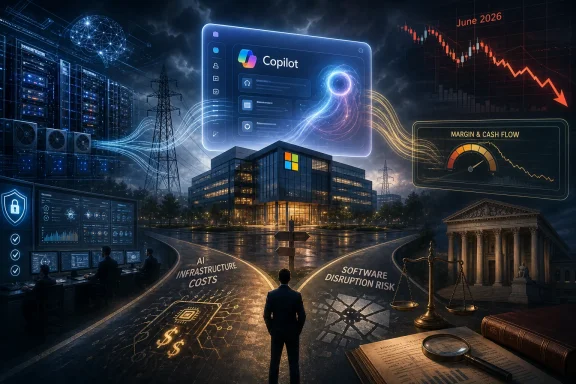 The Safest AI Bet Became the One Investors Could Actually Measure
For most of the generative AI boom, Microsoft enjoyed the cleanest narrative in big tech. It had OpenAI exposure without being OpenAI. It had Azure, GitHub, Windows, Office, security, gaming, and a sales force that could carry AI into boardrooms where consumer chatbots were still blocked by policy.That was the pitch: Microsoft was not a moonshot. It was the distribution layer for AI.
The trouble with distribution-layer stories is that they eventually become spreadsheet stories. Investors can tolerate vague timelines from a pure research lab, a social network with advertising optionality, or a chipmaker riding a capacity crunch. Microsoft, by contrast, is an operating machine with visible margins, visible capital expenditure, visible deferred revenue, and visible expectations. The more visible the machine, the harder it is to hide the cost of retrofitting it for AI.
That is why the company’s fall stands out. Microsoft has not suddenly become a weak company. The market is punishing the fact that Microsoft is strong enough to spend almost unimaginably large sums on AI infrastructure — and exposed enough to software disruption that the same technology could pressure its most profitable franchises.
The black-sheep status is not about irrelevance. It is about being too central to ignore.
Microsoft Is Being Hit by Both Sides of the AI Argument
The simplest explanation for the selloff is capital expenditure. Microsoft and its peers are pouring money into data centers, GPUs, networking, power, cooling, and long-term capacity commitments at a scale that makes even the cloud buildout of the 2010s look quaint. Investors who spent 2023 and 2024 celebrating AI capacity are now asking how much of that spending becomes durable revenue, how much becomes price competition, and how much becomes stranded infrastructure when models get more efficient.But Microsoft’s problem is sharper than the generic hyperscaler problem. It is not merely building AI infrastructure. It is also selling the software most likely to be transformed by AI.
That creates an awkward double exposure. If AI demand disappoints, Microsoft has overspent on the infrastructure side. If AI demand succeeds too well, the company may have to defend pricing and packaging across Office, Windows, developer tools, customer service software, security, and business applications. In other words, Microsoft is exposed to both the shovel-seller economics and the gold-mine disruption.
This is the part of the story that makes the stock’s weakness more interesting than a simple valuation reset. Microsoft’s diversification, normally its great defense, becomes a map of possible disruption. Every business line offers a monetization path, but also a point of attack.
That is the uncomfortable beauty of Microsoft’s position. The company is arguably the best placed enterprise vendor in AI, and that is precisely why investors can see the risks first.
Copilot Is a Product, but Wall Street Wants a Profit Formula
Copilot remains Microsoft’s central AI promise: an assistant woven through Windows, Microsoft 365, GitHub, security products, and business workflows. Strategically, it is exactly what Microsoft should have built. It places generative AI where workers already spend their days and gives IT departments a familiar vendor to approve.The problem is that “Copilot everywhere” is not the same as “Copilot margin expansion everywhere.” Enterprise AI assistants are expensive to run, hard to evaluate, and uneven in their usefulness. A feature that delights a consultant drafting memos may matter less to a warehouse manager, a claims adjuster, or a finance team locked into heavily customized workflows.
Microsoft’s advantage is bundling. Its risk is that bundling can blur the economics. If customers pay extra for Copilot, adoption must justify the premium. If AI features become part of broader licenses, Microsoft must prove they deepen retention, lift average revenue, or defend the platform from rivals. If inference costs remain high, even impressive adoption may disappoint investors trained to expect software margins.
GitHub Copilot showed that developers will pay for productivity when the tool is good enough and the workflow is obvious. Microsoft 365 Copilot faces a broader, messier enterprise reality. Many employees do not live in one application all day. Many companies have data hygiene problems. Many regulated customers need controls, auditability, and proof that the assistant is not turning confidential information into liability.
This does not mean Copilot is failing. It means Copilot has entered the phase where demos no longer carry the argument.
The Dot-Com Echo Is About Capital Discipline, Not Pets.com
Any comparison to 2000 risks melodrama. Microsoft in 2026 is not a revenue-less dot-com. It is a cash-generating giant with entrenched enterprise relationships, immense technical talent, and products that remain infrastructure for the modern workplace.The echo lies elsewhere. In both eras, investors were asked to finance a technological buildout before the economics were fully visible. In the late 1990s, the internet was real but the valuations were often absurd. In the mid-2020s, AI is real, but the payback period for the infrastructure boom remains contested.
That distinction matters because it prevents the lazy conclusion. The market is not necessarily saying AI is fake. It is saying that even real platform shifts can transfer too much value to suppliers, destroy too much incumbent pricing, or arrive too slowly to justify current spending.
Microsoft sits at the center of that argument. It buys or leases massive compute capacity, partners deeply with model providers, builds its own services, and tries to sell AI into the enterprise at scale. If the returns are spectacular, Microsoft will look like it endured temporary pain to secure the next computing platform. If the returns are ordinary, the company may have converted a high-margin software story into a lower-margin infrastructure arms race.
Investors are not allergic to AI spending. They are allergic to AI spending that lacks a clock.
Oracle Shows the Same Anxiety in a Different Accent
Oracle’s recent pressure helps explain why Microsoft is not alone. Oracle has become one of the more dramatic infrastructure stories of the AI cycle, signing enormous cloud commitments and promising investors that demand for AI compute will pull its cloud business into a new era. But Oracle also carries a different financial profile, including far more attention on debt markets as it funds expansion.That makes Oracle a useful contrast. Microsoft can absorb AI spending with more internal firepower than Oracle can. Its balance sheet, cash flow, and installed base give it room to maneuver. Yet the two companies are now being discussed in the same breath because investors are less interested in who has the prettier AI story and more interested in who is financing the buildout, on what terms, and against what future revenue.
Oracle’s case turns the AI trade into a credit-market question. Microsoft’s case turns it into a software-margin question. Together, they show how the boom has matured from a stock-market slogan into a capital structure problem.
This is why the “AI trade” now feels less like one trade. Nvidia’s economics are not Microsoft’s economics. Microsoft’s risks are not Oracle’s risks. Alphabet’s model efficiencies and ad business are different again. The Magnificent Seven label obscures as much as it reveals.
For WindowsForum readers, the Oracle parallel is useful for another reason. It shows that cloud capacity is not an abstract background service. The AI features appearing in Windows, Office, Teams, GitHub, and security consoles sit atop an expensive and increasingly contested infrastructure stack. Someone has to pay for that stack. The question is whether customers, shareholders, bondholders, or margins take the hit.
Michael Burry’s Bet Is a Signal, Not a Rescue Plan
Michael Burry’s reported purchase of long-dated Microsoft call options gave the stock a short-term jolt and provided the market with a familiar character: the contrarian investor willing to buy when sentiment is rotten. It is not hard to see the appeal. Microsoft’s valuation has compressed, the business remains formidable, and panic around megacap quality companies often overshoots.But Burry’s bet should not be mistaken for a solution to Microsoft’s AI economics. Options expiring years from now can express a view that the market has overreacted without requiring the near-term AI spending debate to be resolved. A stock can be too cheap and still face real operational questions.
The more important point is psychological. A prominent contrarian buying Microsoft suggests that the market may be approaching the stage where quality buyers begin to separate valuation from narrative exhaustion. That is different from saying the AI capex worries are wrong.
Microsoft bulls can make a strong case. Azure remains strategically vital. Office remains embedded. Windows still anchors device management, identity, security, and enterprise workflows. GitHub gives Microsoft a privileged position with developers, and security has become one of the company’s most important growth engines. Even Xbox, often treated as a sideshow by enterprise investors, reflects Microsoft’s broader strategy of subscription, cloud distribution, and platform control.
The bear case is not that Microsoft lacks assets. The bear case is that the assets may need more capital, more time, and more pricing discipline than the market expected six months ago.
The Software Franchise Is Both Moat and Target
Microsoft’s greatest strength is that its software is hard to remove. Companies can complain about licensing, Teams, Outlook, SharePoint, Intune, Entra, Defender, and the endless administrative sprawl of Microsoft 365, but they rarely rip it all out. The switching costs are cultural as much as technical.AI complicates that moat. If AI assistants become the new interface to work, the value of the underlying application suite could either rise or be partially abstracted away. Microsoft wants Copilot to be the assistant that strengthens the suite. Rivals want assistants that make individual applications less important.
This is not a theoretical risk. The history of software is full of interface shifts that moved profit pools. The browser weakened desktop application control. Mobile apps changed distribution. Cloud software changed procurement. AI could change not only how software is written, but how software is consumed.
Microsoft understands this better than anyone. The company’s history is a long series of attempts to own the layer through which users and developers access computing: DOS, Windows, Office, Internet Explorer, Azure, Teams, GitHub, and now Copilot. The strategic logic is consistent. The financial question is whether owning the AI layer will cost more than previous platform transitions.
For administrators, this matters because AI will not arrive as one clean product decision. It will arrive as licensing changes, compliance controls, endpoint features, data governance requirements, security dashboards, and pressure from executives who saw a demo. Microsoft’s stock chart is Wall Street’s version of the same question IT departments are asking: how much of this is indispensable, and how much of it is expensive theater?
Windows Is No Longer the Center, but It Still Carries the Brand Risk
Microsoft’s AI problem is not primarily a Windows problem, but Windows remains the emotional surface area for millions of users. When Copilot is added to the taskbar, when Recall-like features raise privacy concerns, when AI settings move around the OS, the broader AI strategy becomes tangible. Users who will never read a capex estimate still form opinions about whether Microsoft is helping them or using them as a distribution channel.That is the consumer-side tension. Microsoft’s enterprise AI story depends on trust, governance, and administrative control, while its Windows AI story has often felt more like a product mandate. The company has improved messaging and controls over time, but the reputational risk remains: AI features that feel imposed can weaken confidence in AI features that are genuinely useful.
Windows also highlights the gap between capability and desire. Just because Microsoft can integrate an assistant into the operating system does not mean users want the assistant in every workflow. Power users may want local control, transparent settings, and predictable performance more than another panel of generated suggestions. Enterprises may want audit logs and policy enforcement more than novelty.
None of this will determine Microsoft’s valuation by itself. Azure and Microsoft 365 matter far more to the stock. But Windows shapes public trust, and trust is increasingly part of the AI product. A company asking customers to let AI reason over email, files, meetings, code, and business data cannot afford to appear casual about consent.
If Microsoft wants Copilot to be the enterprise AI default, Windows must stop feeling like the place where AI ambitions are tested on users first.
The Market Is Repricing Patience
The old AI market rewarded positioning. The new AI market is starting to reward proof.That shift explains why Microsoft can have a strong business and a weak stock at the same time. Investors are not only asking whether AI revenue grows. They are asking whether AI revenue grows fast enough, at high enough margin, with enough customer willingness to pay, to justify the infrastructure race now underway.
The forward price-to-earnings compression is part of that repricing. A lower multiple does not necessarily mean investors have lost faith in Microsoft. It can also mean they are assigning a higher discount rate to the AI transition. When uncertainty rises, even excellent companies can look less exceptional.
This is especially true for companies that spent years being treated as compounders. Microsoft became a market darling because it combined growth, margins, buybacks, dividends, enterprise durability, and cloud upside. AI spending muddies that formula. The market can tolerate lower free cash flow if it believes the investment cycle is temporary and the returns are superior. It becomes less forgiving when the investment cycle looks open-ended.
That is the calendar problem. Microsoft is spending now. Customers are experimenting now. The margin payoff may arrive later. Public markets are not famous for patience when “later” lacks a firm date.
The AI Trade Is Splitting Into Winners, Landlords, and Bill Payers
The Magnificent Seven label made sense when low rates, index flows, cloud growth, and AI enthusiasm lifted the same handful of companies. It makes less sense now that AI is dividing them by economics.Nvidia sells the scarce inputs. Alphabet has model capability, cloud exposure, and an advertising engine that funds experimentation. Meta is making an enormous AI bet but can tie improvements to ad targeting, engagement, and content systems. Apple faces its own AI credibility problem, but its capital intensity is not the same kind of data-center burden. Amazon has AWS, retail logistics, and a long history of absorbing capex cycles. Microsoft has perhaps the most enterprise-ready AI channel, but also the clearest software disruption risk.
That is why calling Microsoft the “worst” AI stock can be misleading. It may be the stock where the contradictions are simply most measurable. The company is not peripheral to AI. It is too exposed to every layer.
There is also a deeper lesson here: the first phase of a platform shift often rewards whoever can tell the cleanest story. The second phase rewards whoever can survive the accounting. Microsoft is now in the second phase.
For IT buyers, that means pricing, packaging, and bundling will matter more. For developers, it means AI-assisted coding will keep expanding, but procurement and governance will become more disciplined. For security teams, it means AI features will be judged not just by promise but by auditability, data boundaries, and incident response implications. For Windows enthusiasts, it means the operating system’s AI future will be shaped as much by enterprise trust as by consumer features.
The June Rout Turns Microsoft’s AI Halo Into an IT Budget Question
The practical read is not that Microsoft has lost the AI race. It is that the race has become expensive enough for investors and customers to demand a clearer map. The company still has unmatched enterprise reach, but that reach now comes with scrutiny attached.- Microsoft’s stock weakness reflects concern about both AI infrastructure spending and possible disruption to the software businesses that made the company so profitable.
- Copilot’s strategic value is obvious, but Microsoft still has to prove that adoption converts into durable, high-margin revenue at enterprise scale.
- Oracle’s parallel selloff shows that investors are increasingly focused on how AI infrastructure is financed, not merely whether demand exists.
- Michael Burry’s reported long-dated Microsoft bet may indicate valuation support, but it does not resolve the underlying debate about AI payback periods.
- Windows users and administrators should expect AI features to keep arriving, but the winning products will be the ones that make control, privacy, and measurable productivity feel real rather than imposed.
References
- Primary source: Business Insider
Published: Tue, 30 Jun 2026 09:50:06 GMT
Loading…
www.businessinsider.com - Related coverage: investing.com
Loading…
www.investing.com - Related coverage: tradingnews.com
Loading…
www.tradingnews.com - Related coverage: financialexpress.com
Loading…
www.financialexpress.com - Related coverage: economictimes.indiatimes.com
Loading…
economictimes.indiatimes.com - Related coverage: rallies.ai
Loading…
rallies.ai
- Related coverage: undervalued.ai
Loading…
undervalued.ai - Related coverage: edgen.beta.edgen.tech
Loading…
edgen.beta.edgen.tech - Related coverage: boursel.com
Loading…
boursel.com - Related coverage: benzinga.com
Loading…
www.benzinga.com - Related coverage: cryptobriefing.com
Loading…
cryptobriefing.com - Related coverage: americancourant.com
Loading…
americancourant.com - Related coverage: techradar.com
Loading…
www.techradar.com - Related coverage: axios.com
Loading…
www.axios.com - Related coverage: windowscentral.com
Loading…
www.windowscentral.com