

Valve has removed the Steam Machine’s explicit “4K gaming at 60 FPS with FSR” claim from its official product page in late June 2026, replacing it with softer wording that promises “up to 4K gaming with FSR 4.1” after reviewers and users questioned real-world performance. The edit is small enough to fit inside a marketing blurb, but large enough to change the promise being sold. Valve is not walking back a feature; it is walking back a performance expectation. For a living-room PC trying to occupy the psychological space between a console and a desktop, that distinction matters.
The old phrase did a lot of work. “4K gaming at 60 FPS with FSR” was not the same as saying the Steam Machine could output a 4K signal, or that some games could be configured to reach 60 frames per second, or that upscaling would be part of the story. It implied a mainstream target: buy this box, plug it into the television, and expect the familiar console-era ideal.
The new phrase — “up to 4K gaming with FSR 4.1” — is lawyerly in all the ways hardware marketing becomes lawyerly when the benchmarks arrive. “Up to” moves the ceiling into view while quietly refusing to describe the floor. Dropping the frame-rate number removes the part of the claim most likely to collide with modern PC gaming’s messy reality.
Valve’s problem is not that the Steam Machine cannot run games. By most accounts, it can, and in the right circumstances it can look impressive. The problem is that a product pitched as a console-like appliance inherits console-like expectations, and those expectations are unforgiving when the promise is reduced after launch.
The company has been here before in spirit, if not in exactly this form. Steam Deck succeeded partly because Valve under-promised around a small screen, a modest resolution, and a clear handheld use case. The Steam Machine is trying to scale that philosophy into the living room, where the screen is larger, the pixels are more visible, and “4K60” has become less a specification than a cultural shorthand for “this will feel current.”
That is also why the 4K60 language was so potent. It placed the Steam Machine into the same mental category as the PlayStation 5 and Xbox Series X, not necessarily as a direct replacement, but as a living-room machine that could speak the same performance language. Consumers do not parse internal render resolution, temporal reconstruction, FSR modes, and variable refresh rate compromises when they see “4K gaming at 60 FPS.” They hear: modern console target achieved.
Valve’s earlier FAQ language softened the claim somewhat, saying that in its testing the majority of Steam titles played well at 4K 60 FPS with FSR, while acknowledging that some games would require heavier upscaling or lower frame rates. That is more careful than a naked 4K60 boast, but it still frames 4K60 as the expected norm across most of the catalog. The phrase “majority of Steam titles” is technically plausible because Steam’s library includes vast numbers of older, lighter, indie, 2D, and esports titles. It is much less helpful as a buying guide for someone imagining 2026 blockbuster games on a big OLED.
This is the oldest trick in PC performance discourse: the average library is not the average buyer’s expectation. A machine that can run thousands of games at 4K60 may still disappoint if the games people use to judge the purchase are Cyberpunk-class stress tests, Unreal Engine 5 showpieces, and ray-traced open worlds. Valve knows this better than almost anyone, because Steam’s own catalog data is both its superpower and its rhetorical escape hatch.
The revised wording acknowledges that gap without saying so directly. “Up to 4K” is not a performance promise; it is a capability boundary. It tells buyers what the box can attempt, not what they should expect.
But upscaling is not magic. It is a bargain: trade native pixel cost for algorithmic reconstruction, then hope the game’s art style, motion, user interface, sharpening, and temporal stability cooperate. Sometimes that bargain is excellent. Sometimes it produces a perfectly acceptable couch-distance image. Sometimes it smears fine detail, shimmers in motion, or turns distant geometry into a reminder that the marketing department and the GPU are not the same thing.
FSR 4.1 may improve the equation, and naming it on the product page gives Valve a more specific technology claim than the older generic FSR language. But the underlying math still matters. If a game is internally rendering at 1440p and being reconstructed to 4K, that is one conversation. If it must lean into Performance mode from a much lower base resolution to hold frame rate, that is another.
The distinction is especially important in the living room. On a handheld, lower native resolution is masked by screen size. On a television, the user’s tolerance depends on panel size, seating distance, game type, and how sensitive they are to artifacts. A racing game at couch distance may flatter the hardware; a dense open-world RPG with foliage, particle effects, and thin geometry may not.
This is where Valve’s change becomes more than a marketing cleanup. The company is implicitly admitting that the phrase “4K gaming at 60 FPS” flattened too many variables into one promise. The Steam Machine may be capable, but capability is not consistency.
That is harder in 2026 than it was when the first Steam Machines stumbled into the market years ago. Games have become more dependent on reconstruction, shader compilation, CPU-heavy simulation, streaming assets, and engine-specific quirks. “Runs at 60 FPS” is no longer a simple product of GPU horsepower. It is a negotiation among the game, the driver, the OS, the upscaler, the display, and the user’s tolerance for settings cuts.
The result is that a living-room PC has to answer a question consoles avoid by design: whose settings are we talking about? Native resolution or output resolution? High preset or medium? Ray tracing on or off? Frame generation counted or excluded? VRR assumed? FSR Quality, Balanced, Performance, or Ultra Performance? Every one of those choices can turn a headline claim from plausible to ridiculous.
Valve’s best argument is that SteamOS can turn that mess into something more manageable. The Deck already proved the value of a curated, verified, controller-first experience. If Valve can make per-game defaults sane, cloud saves seamless, controller behavior predictable, and updates painless, the Steam Machine does not need to win every benchmark to justify itself.
But the moment the product page says 4K60, the conversation shifts away from experience and toward proof. That is dangerous terrain for a box whose real promise is not raw power but integration.
A cheaper Steam Machine would be judged as a clever console-PC hybrid with limitations. A premium Steam Machine is judged against desktops, laptops, consoles, discounted GPUs, and whatever a user could build or buy during a component market that remains volatile. When the entry price drifts into serious-PC territory, every compromised pixel becomes part of the value argument.
Valve’s counterweight is convenience. A small, quiet, SteamOS-first box with suspend-and-resume behavior, controller-centric navigation, and access to a vast library is not the same product as a self-built tower. The Steam Machine is not trying to beat a desktop on frames per dollar; it is trying to sell a smoother version of PC gaming to people who do not want the desktop part.
Still, performance claims do not get to live in a different reality just because the form factor is elegant. If the experience is best understood as a strong 1080p machine that can stretch toward 4K depending on the title, the product page should say that. Not because enthusiasts enjoy pedantry, but because mismatched expectations are poison for hardware launches.
The Steam Deck survived its own limitations because users understood the target. It was a handheld PC that made compromises obvious and acceptable. The Steam Machine risks a murkier fate if buyers think they are getting a 4K60 console alternative and discover they are actually getting a well-integrated midrange PC that often prefers 1080p or reconstructed output.
That breadth makes “majority” a slippery word. A lightweight indie platformer, a decade-old strategy game, a pixel-art roguelike, and a modern path-traced blockbuster all count as Steam titles. A performance statement that averages across that universe tells us something about compatibility, but not enough about the experience buyers are likely imagining when comparing the Steam Machine to a current console.
This is where marketing and data part ways. Valve can know, with more precision than almost any company, how thousands of games behave on its hardware. But a customer looking at a living-room gaming box is not buying the median Steam title. They are buying the hope that the machine will handle the games they show friends, the games that justify the television, and the games that make an upgrade feel necessary.
The old language let Valve enjoy the authority of broad catalog testing while benefiting from the emotional force of 4K60. The new language retreats to a more defensible position. It is less exciting, but it is more honest.
That honesty should have been there from the start. A phrase like “designed for 1080p and 1440p gaming, with upscaled 4K support in many titles” would have been less glamorous but more durable. It would also have aligned the Steam Machine with the reality of midrange PC hardware rather than the fantasy that reconstruction can erase every constraint.
A quiet edit invites users to construct the narrative themselves, and the internet is very good at constructing narratives hostile to corporations. Was the original claim based on internal benchmarks that over-weighted lighter games? Did review coverage force a legal rethink? Did FSR 4.1 expectations change? Did Valve decide the phrase was too easily misread as native 4K? Any of those explanations could be true, and some would be more charitable than others.
The problem is that silence makes the least charitable explanation feel plausible. If Valve believes the new wording better reflects the intended meaning, it should say so. If it believes the Steam Machine still meets the spirit of the original target across much of the catalog, it can explain the conditions. If it simply decided “4K60” was too blunt for a device whose performance varies by title, that would be a reasonable admission.
Valve has earned unusual goodwill among PC gamers because it often behaves less like a conventional platform holder and more like a stubborn engineering culture that ships strange things and iterates. But goodwill is not a substitute for clarity. Enthusiasts forgive limitations more readily than they forgive feeling managed.
A hardware product page is not just branding. It is part of the purchase record. Changing a performance claim after launch without a public note creates exactly the kind of ambiguity that forum threads, refund debates, and class-action-minded speculation feed on.
That trend is not bad. In many cases, it is the only reason compact gaming hardware works at all. But the language has not caught up with the technology. “4K” used to tell buyers something fairly concrete about the image being rendered. Now it may describe output resolution, reconstructed resolution, UI resolution, or the signal sent to the television.
Windows users know this ambiguity well. A gaming laptop’s spec sheet can advertise a high-refresh 1600p panel while the GPU is happiest at 1080p with upscaling. A handheld can claim support for external 4K output while being most comfortable at 720p or 800p internally. A mini-PC can sit under a television and technically run a demanding game at 4K, provided the user accepts low settings, aggressive scaling, or 30 FPS.
Valve is supposed to be better positioned than the average OEM because it controls more of the experience. SteamOS, Gamescope, Proton, controller profiles, shader pre-caching, and verified compatibility all give Valve levers that Windows box makers often lack. That makes the marketing retreat more notable, not less. If even Valve has to soften the sentence, everyone else should be more careful before printing the big number.
The larger lesson is that performance claims need a new grammar. Resolution alone is no longer enough. Frame rate alone is not enough. Upscaler version alone is not enough. The meaningful claim is a bundle: internal resolution range, output target, frame-rate target, settings profile, reconstruction mode, and whether frame generation is included.
Consumers may not want all that in a slogan. But they deserve not to be misled by a slogan that hides it.
But consoles benefit from fixed hardware and developer optimization pipelines that a general-purpose Steam box cannot fully replicate. A PlayStation or Xbox game arrives with a finite set of performance modes designed around known hardware. Steam games arrive with settings menus, launchers, driver dependencies, anti-cheat complications, and wildly inconsistent optimization priorities.
That does not make consoles superior in every way. It makes them simpler to market. A console can say “performance mode” and define the compromise internally. A PC box that runs thousands of Windows games through a Linux-based compatibility stack has to cope with a much wider range of outcomes.
Valve’s advantage is that it can apply platform-level polish where PC gaming has historically been chaotic. Its disadvantage is that no amount of polish turns a midrange GPU into a universal 4K60 engine. The Steam Machine can be a console-like product without inheriting console-like certainty.
That is the nuance the old product-page language failed to preserve. The revised wording, bland as it is, at least leaves room for the messy truth.
That makes trust the central commodity. Users need to trust that Valve’s verified labels mean something. They need to trust that default settings are chosen for experience rather than marketing optics. They need to trust that when the product page says a thing, it describes how the machine behaves for normal people, not how it behaves in a best-case slice of the catalog.
Steam Deck built that trust through transparency. Its limitations were obvious, and its community quickly developed a shared language around 30 FPS caps, 40 Hz modes, battery life, shader stutter, Proton compatibility, and per-game tweaks. The machine was beloved partly because it did not pretend to be a desktop replacement. It was a handheld PC with a clear center of gravity.
The Steam Machine needs the same clarity. If its center of gravity is 1080p with high consistency, say that proudly. If it is 1440p with smart upscaling in many titles, build the pitch around that. If 4K is a bonus tier for lighter games, older games, esports titles, and carefully tuned settings, call it a bonus tier.
There is no shame in a living-room PC that makes Steam libraries accessible, quiet, and controller-friendly. There is shame in letting a buyer discover the real target only after the box is connected.
Valve still has room to win the living room on its own terms, but those terms need to be stated plainly. The Steam Machine’s best future is not pretending to be a miracle 4K box. It is becoming the most honest version of a living-room PC: capable, flexible, sometimes compromised, and far better when the marketing respects the difference between what a machine can display and what it can reliably deliver.
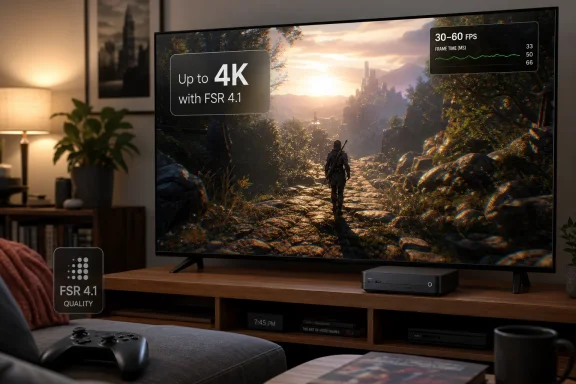 Valve Learns That “4K60” Is a Contract, Not a Vibe
The old phrase did a lot of work. “4K gaming at 60 FPS with FSR” was not the same as saying the Steam Machine could output a 4K signal, or that some games could be configured to reach 60 frames per second, or that upscaling would be part of the story. It implied a mainstream target: buy this box, plug it into the television, and expect the familiar console-era ideal.The new phrase — “up to 4K gaming with FSR 4.1” — is lawyerly in all the ways hardware marketing becomes lawyerly when the benchmarks arrive. “Up to” moves the ceiling into view while quietly refusing to describe the floor. Dropping the frame-rate number removes the part of the claim most likely to collide with modern PC gaming’s messy reality.
Valve’s problem is not that the Steam Machine cannot run games. By most accounts, it can, and in the right circumstances it can look impressive. The problem is that a product pitched as a console-like appliance inherits console-like expectations, and those expectations are unforgiving when the promise is reduced after launch.
The company has been here before in spirit, if not in exactly this form. Steam Deck succeeded partly because Valve under-promised around a small screen, a modest resolution, and a clear handheld use case. The Steam Machine is trying to scale that philosophy into the living room, where the screen is larger, the pixels are more visible, and “4K60” has become less a specification than a cultural shorthand for “this will feel current.”
The Original Pitch Put Console Confidence on PC Hardware
The Steam Machine’s revived identity has always depended on translation. Valve wants PC gaming to feel less like PC maintenance and more like sitting down with a console, while still keeping the library, openness, and pricing chaos that make Steam powerful. That is a compelling proposition, especially for players who like the Steam Deck but want a permanent box under the television.That is also why the 4K60 language was so potent. It placed the Steam Machine into the same mental category as the PlayStation 5 and Xbox Series X, not necessarily as a direct replacement, but as a living-room machine that could speak the same performance language. Consumers do not parse internal render resolution, temporal reconstruction, FSR modes, and variable refresh rate compromises when they see “4K gaming at 60 FPS.” They hear: modern console target achieved.
Valve’s earlier FAQ language softened the claim somewhat, saying that in its testing the majority of Steam titles played well at 4K 60 FPS with FSR, while acknowledging that some games would require heavier upscaling or lower frame rates. That is more careful than a naked 4K60 boast, but it still frames 4K60 as the expected norm across most of the catalog. The phrase “majority of Steam titles” is technically plausible because Steam’s library includes vast numbers of older, lighter, indie, 2D, and esports titles. It is much less helpful as a buying guide for someone imagining 2026 blockbuster games on a big OLED.
This is the oldest trick in PC performance discourse: the average library is not the average buyer’s expectation. A machine that can run thousands of games at 4K60 may still disappoint if the games people use to judge the purchase are Cyberpunk-class stress tests, Unreal Engine 5 showpieces, and ray-traced open worlds. Valve knows this better than almost anyone, because Steam’s own catalog data is both its superpower and its rhetorical escape hatch.
The revised wording acknowledges that gap without saying so directly. “Up to 4K” is not a performance promise; it is a capability boundary. It tells buyers what the box can attempt, not what they should expect.
Upscaling Is the Escape Route, but It Is Not Free
The original claim was never about native 4K, and to Valve’s credit, the company did not pretend otherwise. FSR was in the sentence. The Steam Machine’s pitch always depended on rendering below 4K and reconstructing the final image for a television output.But upscaling is not magic. It is a bargain: trade native pixel cost for algorithmic reconstruction, then hope the game’s art style, motion, user interface, sharpening, and temporal stability cooperate. Sometimes that bargain is excellent. Sometimes it produces a perfectly acceptable couch-distance image. Sometimes it smears fine detail, shimmers in motion, or turns distant geometry into a reminder that the marketing department and the GPU are not the same thing.
FSR 4.1 may improve the equation, and naming it on the product page gives Valve a more specific technology claim than the older generic FSR language. But the underlying math still matters. If a game is internally rendering at 1440p and being reconstructed to 4K, that is one conversation. If it must lean into Performance mode from a much lower base resolution to hold frame rate, that is another.
The distinction is especially important in the living room. On a handheld, lower native resolution is masked by screen size. On a television, the user’s tolerance depends on panel size, seating distance, game type, and how sensitive they are to artifacts. A racing game at couch distance may flatter the hardware; a dense open-world RPG with foliage, particle effects, and thin geometry may not.
This is where Valve’s change becomes more than a marketing cleanup. The company is implicitly admitting that the phrase “4K gaming at 60 FPS” flattened too many variables into one promise. The Steam Machine may be capable, but capability is not consistency.
The Living-Room PC Still Has to Fight PC Physics
The Steam Machine is caught between two brutally different markets. Console buyers expect simplicity and fixed targets. PC buyers expect knobs, compromises, and argument. Valve is trying to sell a device that benefits from PC flexibility while hiding just enough of it to feel approachable.That is harder in 2026 than it was when the first Steam Machines stumbled into the market years ago. Games have become more dependent on reconstruction, shader compilation, CPU-heavy simulation, streaming assets, and engine-specific quirks. “Runs at 60 FPS” is no longer a simple product of GPU horsepower. It is a negotiation among the game, the driver, the OS, the upscaler, the display, and the user’s tolerance for settings cuts.
The result is that a living-room PC has to answer a question consoles avoid by design: whose settings are we talking about? Native resolution or output resolution? High preset or medium? Ray tracing on or off? Frame generation counted or excluded? VRR assumed? FSR Quality, Balanced, Performance, or Ultra Performance? Every one of those choices can turn a headline claim from plausible to ridiculous.
Valve’s best argument is that SteamOS can turn that mess into something more manageable. The Deck already proved the value of a curated, verified, controller-first experience. If Valve can make per-game defaults sane, cloud saves seamless, controller behavior predictable, and updates painless, the Steam Machine does not need to win every benchmark to justify itself.
But the moment the product page says 4K60, the conversation shifts away from experience and toward proof. That is dangerous terrain for a box whose real promise is not raw power but integration.
Reviewers Are Stress-Testing the Marketing More Than the Box
The early criticism around the Steam Machine’s performance has a familiar shape: the hardware is interesting, sometimes impressive, but the price and marketing invite harsher comparisons than the device can always survive. That is not merely reviewer nitpicking. Price defines the competitive set.A cheaper Steam Machine would be judged as a clever console-PC hybrid with limitations. A premium Steam Machine is judged against desktops, laptops, consoles, discounted GPUs, and whatever a user could build or buy during a component market that remains volatile. When the entry price drifts into serious-PC territory, every compromised pixel becomes part of the value argument.
Valve’s counterweight is convenience. A small, quiet, SteamOS-first box with suspend-and-resume behavior, controller-centric navigation, and access to a vast library is not the same product as a self-built tower. The Steam Machine is not trying to beat a desktop on frames per dollar; it is trying to sell a smoother version of PC gaming to people who do not want the desktop part.
Still, performance claims do not get to live in a different reality just because the form factor is elegant. If the experience is best understood as a strong 1080p machine that can stretch toward 4K depending on the title, the product page should say that. Not because enthusiasts enjoy pedantry, but because mismatched expectations are poison for hardware launches.
The Steam Deck survived its own limitations because users understood the target. It was a handheld PC that made compromises obvious and acceptable. The Steam Machine risks a murkier fate if buyers think they are getting a 4K60 console alternative and discover they are actually getting a well-integrated midrange PC that often prefers 1080p or reconstructed output.
“Majority of Steam Titles” Was Always a Convenient Truth
Valve’s earlier defense — that most Steam titles performed well at 4K60 with FSR in its testing — may be technically defensible. Steam is not a catalog of only the last three years of AAA releases. It is an enormous archive of games across generations, engines, budgets, and graphical ambitions.That breadth makes “majority” a slippery word. A lightweight indie platformer, a decade-old strategy game, a pixel-art roguelike, and a modern path-traced blockbuster all count as Steam titles. A performance statement that averages across that universe tells us something about compatibility, but not enough about the experience buyers are likely imagining when comparing the Steam Machine to a current console.
This is where marketing and data part ways. Valve can know, with more precision than almost any company, how thousands of games behave on its hardware. But a customer looking at a living-room gaming box is not buying the median Steam title. They are buying the hope that the machine will handle the games they show friends, the games that justify the television, and the games that make an upgrade feel necessary.
The old language let Valve enjoy the authority of broad catalog testing while benefiting from the emotional force of 4K60. The new language retreats to a more defensible position. It is less exciting, but it is more honest.
That honesty should have been there from the start. A phrase like “designed for 1080p and 1440p gaming, with upscaled 4K support in many titles” would have been less glamorous but more durable. It would also have aligned the Steam Machine with the reality of midrange PC hardware rather than the fantasy that reconstruction can erase every constraint.
Valve’s Silence Makes the Edit Louder
The strangest part of the episode is not the product-page change itself. Companies revise marketing copy all the time, especially after reviews expose ambiguity. The strange part is the lack of explanation.A quiet edit invites users to construct the narrative themselves, and the internet is very good at constructing narratives hostile to corporations. Was the original claim based on internal benchmarks that over-weighted lighter games? Did review coverage force a legal rethink? Did FSR 4.1 expectations change? Did Valve decide the phrase was too easily misread as native 4K? Any of those explanations could be true, and some would be more charitable than others.
The problem is that silence makes the least charitable explanation feel plausible. If Valve believes the new wording better reflects the intended meaning, it should say so. If it believes the Steam Machine still meets the spirit of the original target across much of the catalog, it can explain the conditions. If it simply decided “4K60” was too blunt for a device whose performance varies by title, that would be a reasonable admission.
Valve has earned unusual goodwill among PC gamers because it often behaves less like a conventional platform holder and more like a stubborn engineering culture that ships strange things and iterates. But goodwill is not a substitute for clarity. Enthusiasts forgive limitations more readily than they forgive feeling managed.
A hardware product page is not just branding. It is part of the purchase record. Changing a performance claim after launch without a public note creates exactly the kind of ambiguity that forum threads, refund debates, and class-action-minded speculation feed on.
Windows Vendors Should Be Taking Notes
This story is not only about Valve. It is also a warning to every Windows handheld, mini-PC maker, and living-room gaming vendor trying to sell upscaled performance as if it were a simple resolution number. The market is moving toward small boxes and portable devices that depend on reconstruction, frame generation, dynamic resolution, and per-game tuning to make ambitious claims feel plausible.That trend is not bad. In many cases, it is the only reason compact gaming hardware works at all. But the language has not caught up with the technology. “4K” used to tell buyers something fairly concrete about the image being rendered. Now it may describe output resolution, reconstructed resolution, UI resolution, or the signal sent to the television.
Windows users know this ambiguity well. A gaming laptop’s spec sheet can advertise a high-refresh 1600p panel while the GPU is happiest at 1080p with upscaling. A handheld can claim support for external 4K output while being most comfortable at 720p or 800p internally. A mini-PC can sit under a television and technically run a demanding game at 4K, provided the user accepts low settings, aggressive scaling, or 30 FPS.
Valve is supposed to be better positioned than the average OEM because it controls more of the experience. SteamOS, Gamescope, Proton, controller profiles, shader pre-caching, and verified compatibility all give Valve levers that Windows box makers often lack. That makes the marketing retreat more notable, not less. If even Valve has to soften the sentence, everyone else should be more careful before printing the big number.
The larger lesson is that performance claims need a new grammar. Resolution alone is no longer enough. Frame rate alone is not enough. Upscaler version alone is not enough. The meaningful claim is a bundle: internal resolution range, output target, frame-rate target, settings profile, reconstruction mode, and whether frame generation is included.
Consumers may not want all that in a slogan. But they deserve not to be misled by a slogan that hides it.
The Console Comparison Cuts Both Ways
Valve wants the Steam Machine to sit in the console conversation because that is where the living-room buyer lives. The interface, form factor, and controller-first design all point in that direction. The more console-like the product feels, the easier it is to justify as a household appliance rather than another PC.But consoles benefit from fixed hardware and developer optimization pipelines that a general-purpose Steam box cannot fully replicate. A PlayStation or Xbox game arrives with a finite set of performance modes designed around known hardware. Steam games arrive with settings menus, launchers, driver dependencies, anti-cheat complications, and wildly inconsistent optimization priorities.
That does not make consoles superior in every way. It makes them simpler to market. A console can say “performance mode” and define the compromise internally. A PC box that runs thousands of Windows games through a Linux-based compatibility stack has to cope with a much wider range of outcomes.
Valve’s advantage is that it can apply platform-level polish where PC gaming has historically been chaotic. Its disadvantage is that no amount of polish turns a midrange GPU into a universal 4K60 engine. The Steam Machine can be a console-like product without inheriting console-like certainty.
That is the nuance the old product-page language failed to preserve. The revised wording, bland as it is, at least leaves room for the messy truth.
The Real Target Is Trust, Not Pixels
The Steam Machine does not need to be a native 4K monster to matter. In fact, it probably cannot be one at a price, size, and power envelope that make sense for the living room. Its success depends on whether Valve can make PC gaming feel coherent on a television, not whether every demanding game clears an arbitrary benchmark.That makes trust the central commodity. Users need to trust that Valve’s verified labels mean something. They need to trust that default settings are chosen for experience rather than marketing optics. They need to trust that when the product page says a thing, it describes how the machine behaves for normal people, not how it behaves in a best-case slice of the catalog.
Steam Deck built that trust through transparency. Its limitations were obvious, and its community quickly developed a shared language around 30 FPS caps, 40 Hz modes, battery life, shader stutter, Proton compatibility, and per-game tweaks. The machine was beloved partly because it did not pretend to be a desktop replacement. It was a handheld PC with a clear center of gravity.
The Steam Machine needs the same clarity. If its center of gravity is 1080p with high consistency, say that proudly. If it is 1440p with smart upscaling in many titles, build the pitch around that. If 4K is a bonus tier for lighter games, older games, esports titles, and carefully tuned settings, call it a bonus tier.
There is no shame in a living-room PC that makes Steam libraries accessible, quiet, and controller-friendly. There is shame in letting a buyer discover the real target only after the box is connected.
The Steam Machine’s New Slogan Says the Quiet Part Carefully
The revised product language is not a disaster for Valve, but it is a useful correction for buyers. It narrows the promise from a performance target to a capability range, and it should push users to think about the Steam Machine less as a 4K console rival and more as a compact SteamOS PC with optional upscaled ambitions.- The Steam Machine should be judged primarily by how consistently it delivers smooth living-room play, not by whether it can be forced into 4K output in selected titles.
- Valve’s removal of the 60 FPS language makes the official product page a more cautious guide than the original marketing.
- FSR 4.1 support may improve image reconstruction, but it does not eliminate the performance cost of modern games, ray tracing, high settings, or low internal render resolutions.
- Buyers expecting native or near-native 4K in demanding 2026 releases should treat the revised wording as a warning, not a reassurance.
- Valve’s strongest path forward is to publish clearer per-game expectations and default profiles rather than rely on broad catalog claims.
The Next Steam Machine Fight Will Be About Defaults
The coming argument will not be settled by one edited sentence. It will be settled by the first months of ownership: what settings Valve chooses, what reviewers measure, what users share, and how often the machine feels like an appliance rather than a troubleshooting project. If the Steam Machine consistently makes games feel good on a couch, the lost 4K60 phrase will become a footnote. If buyers feel they were sold a console-class promise and received a settings-management exercise, the quiet edit will become the moment the story turned.Valve still has room to win the living room on its own terms, but those terms need to be stated plainly. The Steam Machine’s best future is not pretending to be a miracle 4K box. It is becoming the most honest version of a living-room PC: capable, flexible, sometimes compromised, and far better when the marketing respects the difference between what a machine can display and what it can reliably deliver.
References
- Primary source: games.gg
Published: Mon, 29 Jun 2026 13:41:25 GMT
Loading…
games.gg - Related coverage: pcgamer.com
Valve wasn't sure it was gonna have any Steam Machines to sell at the start of 2026: 'Things looked really dire' | PC Gamer
Another thing to thank the RAM crisis for.www.pcgamer.com - Related coverage: tomsguide.com
Loading…
www.tomsguide.com - Related coverage: techspot.com
Loading…
www.techspot.com - Related coverage: tweaktown.com
Loading…
www.tweaktown.com - Related coverage: darkhorizons.com
Loading…
www.darkhorizons.com
- Related coverage: twistedvoxel.com
Loading…
twistedvoxel.com - Related coverage: lootsecreto.com
Loading…
lootsecreto.com - Related coverage: numerama.com
Loading…
www.numerama.com - Related coverage: elchapuzasinformatico.com
Loading…
elchapuzasinformatico.com - Related coverage: tomshardware.com
Loading…
www.tomshardware.com - Related coverage: videocardz.com
Loading…
videocardz.com - Related coverage: notebookcheck.net
Loading…
www.notebookcheck.net - Related coverage: frandroid.com
Loading…
www.frandroid.com - Related coverage: windowscentral.com
Steam Machine delayed due to memory and storage shortages | Windows Central
Valve's gaming PC, controller, and VR headset are tentatively scheduled for the first half of 2026, but exact pricing and release plans are in limbo.www.windowscentral.com - Related coverage: techradar.com
Loading…
www.techradar.com