

As of June 30, 2026, Microsoft’s AZ-104 remains the Azure administrator exam, MS-102 remains the Microsoft 365 administrator expert exam, and AI-102 reaches its scheduled retirement date, making the once-straightforward choice between cloud operations, AI engineering, and tenant administration newly time-sensitive. The practical answer is no longer “pick the exam that matches your interests.” It is “pick the credential that matches the job you actually perform, and do not build a 2026 AI study plan around a retiring test.” That distinction matters because certification shopping has become a small industry of recycled guides, exam-dump marketing, and vague career promises.
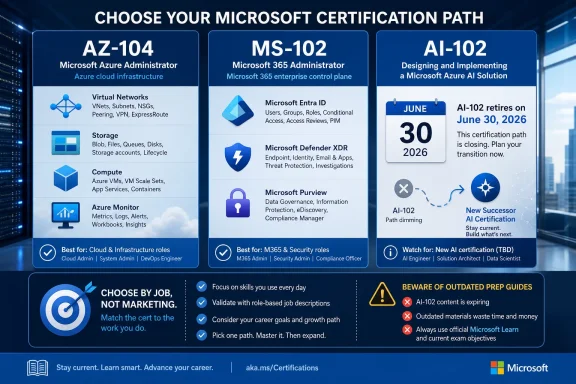
The source article frames AZ-104, AI-102, and MS-102 as three comparable Microsoft certification paths. That was broadly useful advice in the recent past, but it is incomplete on June 30, 2026. Microsoft’s certification map is shifting hardest in AI, while the administrator exams continue to reward the older virtues of infrastructure literacy, identity discipline, and knowing where the tenant’s sharp edges are hidden.
The most common mistake in certification planning is treating Microsoft exams as interchangeable badges. They are not. AZ-104, AI-102, and MS-102 describe three different kinds of work, three different daily toolsets, and three different risks when things go wrong.
AZ-104 is the exam for people who live in Azure infrastructure. It is about identities, subscriptions, storage accounts, virtual networks, compute resources, monitoring, backup, and governance. The exam assumes the candidate can move between the Azure portal, PowerShell, Azure CLI, ARM templates or Bicep, and Microsoft Entra ID without treating any of those as exotic territory.
MS-102 is not simply “Microsoft 365 admin, but harder.” It is the exam for administrators who operate the Microsoft 365 tenant as a security, identity, collaboration, compliance, and governance platform. In 2026, that means Defender XDR, Purview, Entra identity and access, tenant configuration, service health, licensing, data loss prevention, and the increasingly awkward work of governing cloud productivity at enterprise scale.
AI-102 is the outlier because its timing changes the decision. The exam has covered Azure AI solution design and implementation, including generative AI, agentic solutions, computer vision, natural language processing, knowledge mining, and responsible AI concepts. But an exam that retires on June 30, 2026 is not a sensible starting point for most new candidates on June 30, 2026, no matter how many third-party prep pages still present it as a live long-term pathway.
The current skill outline emphasizes five broad domains: Azure identities and governance, storage, compute, virtual networking, and monitoring. That balance is important. Microsoft is not asking the Azure administrator to be a developer, a security architect, or a data engineer, but it is asking the administrator to understand how those worlds collide in production.
That makes AZ-104 a practical certification for WindowsForum’s core audience. If your job already includes virtual machines, DNS, VPNs, role-based access control, storage lifecycle settings, backup policies, network security groups, or alerts that wake someone up at 2 a.m., AZ-104 maps neatly onto the work. It gives structure to skills that many administrators acquire piecemeal while responding to tickets.
The exam also reflects Microsoft’s broader cloud-management philosophy. Azure administration is no longer just “spin up a VM and open RDP.” It is governance through policy, access through roles, deployment through templates, and visibility through Azure Monitor. In other words, AZ-104 rewards the admin who can make Azure boring, repeatable, and auditable.
That is why the right study strategy is not to watch a course end-to-end and then hope practice tests do the rest. A serious AZ-104 plan should include building resources, breaking them, applying policies, moving workloads, configuring backups, testing failover assumptions, and reading logs until Azure Monitor stops feeling like someone else’s dashboard. The pass is useful; the muscle memory is the point.
The current MS-102 outline gives substantial weight to tenant management, Entra identity and access, Defender XDR, and Purview. That distribution says something about the modern Microsoft 365 administrator’s job. The tenant admin is expected to understand user and license management, but the center of gravity has moved toward secure access, incident response, compliance controls, and operational governance.
This is why MS-102 is often underestimated by people who have administered Microsoft 365 casually. Creating users, assigning licenses, and managing groups are only the visible surface. The harder work is knowing how Conditional Access changes the risk model, how Defender alerts map to real incidents, how Purview retention affects legal and operational obligations, and how a tenant’s configuration choices shape user behavior.
MS-102 also has a credentialing wrinkle: it is tied to the Microsoft 365 Certified: Administrator Expert certification and requires an eligible prerequisite certification. That makes it less likely to be a first Microsoft exam and more likely to be part of a deliberate enterprise-administration track. For people already in Microsoft 365 operations, that is a feature rather than a bug.
The candidate who should choose MS-102 is not merely “interested in Microsoft 365.” The right candidate is someone who has administered at least one Microsoft 365 workload and now needs to understand the tenant as a whole. If your organization’s risk posture depends on Entra, Defender, Purview, Exchange Online, SharePoint, Teams, and endpoint signals working together, MS-102 is the exam that speaks your language.
Microsoft’s retirement schedule places AI-102 and the Azure AI Engineer Associate certification at the end of their run on June 30, 2026. The successor direction is toward Azure AI apps and agents, reflecting Microsoft’s pivot from the older Cognitive Services framing to generative AI, agentic workflows, Foundry-style development, and application integration. That does not mean AI-102 skills are useless. It means the credential market is moving.
This is the certification equivalent of buying hardware on the day the platform changes sockets. The components may still work, and the knowledge may still be valuable, but a new learner should not pretend the lifecycle is irrelevant. If you are starting from scratch now, the better strategic move is to investigate Microsoft’s successor AI certification path rather than anchor a multi-week plan to AI-102.
The underlying skills remain important. Developers still need to understand model selection, prompts, evaluation, responsible AI, natural language processing, speech, vision, search, document intelligence, and secure integration with applications. But certifications are signals, and signals have shelf lives. A retiring exam sends a different labor-market message from an active credential aligned to Microsoft’s current product story.
This is also where third-party prep material becomes dangerous. Search results and reposted guides often lag behind Microsoft’s certification lifecycle, and some pages continue to present retired or nearly retired exams as evergreen opportunities. For AI in particular, candidates should treat dates as part of the syllabus. If the training provider cannot keep the retirement calendar straight, it probably should not be trusted to explain the exam.
Microsoft’s own exam-security posture is clear that unauthorized exam content and brain dumps undermine the certification program. Even when a third-party site does not explicitly advertise stolen questions, candidates should be wary of any resource that promises certainty in a test designed to measure applied skill. The more a provider sells memorization as a shortcut, the less it prepares you for the job the certification claims to validate.
There is also a practical downside. Microsoft role-based exams often test judgment in scenarios where several answers are plausible and one is best under the stated constraints. Memorized answer banks are brittle against exam updates, localized changes, reordered scenarios, and lab-style tasks. They also leave candidates exposed once they are asked to perform the work in production.
A safer preparation stack is less glamorous and more effective. Start with the official skills outline, use Microsoft Learn modules to establish coverage, build a lab that resembles the exam domains, and then use practice assessments to identify weak areas. Add reputable instructor-led training if you need structure, but do not outsource your understanding to a question bank.
The certification should be treated as a forcing function for practice. For AZ-104, that means deploying and governing Azure resources. For MS-102, it means navigating tenant, identity, Defender, and Purview controls. For the AI successor path, it means building real applications with Azure AI services rather than merely reciting the names of model families and SDK methods.
In AI-102 and its successor path, the failure mode is different again. A poorly designed AI application may leak data, hallucinate in business-critical workflows, misuse model output, ignore responsible AI principles, or fail because the developer did not understand retrieval, grounding, monitoring, or deployment constraints. The job is closer to software engineering than administration, even when the platform is Azure.
That distinction should drive the decision more than salary tables or generic “cloud is growing” claims. If you spend your week inside Azure subscriptions and infrastructure tickets, AZ-104 is the shortest path from today’s work to a recognized credential. If you spend your week inside Microsoft 365 admin centers, Entra, Defender, and Purview, MS-102 is more relevant. If you write code and build AI-backed applications, the AI path makes sense — but not by starting with a retiring exam at the end of June 2026.
The best certification is the one that creates useful friction. It should force you to learn the parts of your job you have been avoiding. AZ-104 often exposes networking and governance gaps. MS-102 exposes identity and security gaps. AI exams expose the difference between calling an API and engineering an application that behaves responsibly under real conditions.
That is also why “beginner” advice needs nuance. A newcomer to Microsoft cloud technologies may be better served by fundamentals exams before attempting these role-based credentials. But an experienced Windows admin who has touched Azure for years may not need AZ-900 before AZ-104. A help desk technician deeply involved in Microsoft 365 may find MS-102 difficult but conceptually familiar. The calendar, the job role, and the candidate’s hands-on exposure matter more than a universal ladder.
For AZ-104, a sensible plan gives equal respect to identity, storage, compute, networking, and monitoring. Many candidates over-study virtual machines because VMs feel familiar and under-study governance because policy, management groups, and cost controls feel administrative. That is exactly backward for modern Azure operations, where governance is what keeps cloud sprawl from becoming a monthly invoice horror story.
For MS-102, the study plan should be built around tenant-wide thinking. It is not enough to know where to click in the Microsoft 365 admin center. Candidates need to understand identity synchronization, authentication methods, Conditional Access, Defender XDR incidents, email and collaboration protection, endpoint onboarding, Cloud Apps policies, sensitivity labels, retention, and DLP. The exam expects breadth because the job demands breadth.
For the AI path, candidates should avoid confusing product familiarity with engineering competence. Knowing that Azure has language, speech, vision, search, OpenAI, and document intelligence services is table stakes. The real question is whether you can choose the right service, integrate it securely, evaluate results, monitor behavior, and explain the tradeoffs to a stakeholder who cares about risk, cost, and reliability.
Practice assessments are useful only when used diagnostically. Taking them at the end as a confidence ritual is less effective than taking them early enough to reveal weak domains. The goal is not to memorize the practice question. The goal is to discover why a plausible wrong answer was wrong.
For AZ-104, candidates should build a small Azure environment with resource groups, policies, tags, storage accounts, virtual networks, VMs, containers, app services, monitoring, alerts, backup, and recovery. The point is not to create an enterprise-grade lab. The point is to encounter the dependencies that only appear when services touch one another.
For MS-102, hands-on work is more constrained because production tenants are risky and lab tenants may not include every license-dependent feature. Still, candidates should practice user and group management, admin roles, authentication methods, Conditional Access planning, Defender investigation flows, Purview labels, retention policies, and DLP scenarios where possible. Reading about Microsoft 365 security controls is not the same as seeing how they interact.
For AI, the lab should be an application, not a scrapbook of service demos. Build something that accepts input, calls an Azure AI service, handles errors, logs results, respects identity and permissions, and can be explained in terms of cost and risk. A small but complete project teaches more than five disconnected tutorials.
This is where certification prep becomes career development rather than exam preparation. A candidate who builds real labs develops stories for interviews, instincts for troubleshooting, and a better sense of which Microsoft services are elegant and which are merely available. That matters long after the score report disappears into a profile page.
That shift mirrors what enterprise buyers are asking for. Few organizations want an AI engineer who can merely demonstrate a sentiment-analysis API in isolation. They want people who can ship AI features into workflows without creating compliance, security, reliability, or reputational disasters.
This makes AI certification planning more sensitive than infrastructure or Microsoft 365 certification planning. Azure networking and Microsoft 365 tenant administration evolve, but their job functions are stable. AI job definitions are still being negotiated in real time by vendors, customers, regulators, and developers trying to separate durable engineering from demo-stage enthusiasm.
For candidates, that means the AI path should be chosen with extra skepticism. If you are already prepared for AI-102 before its retirement, completing it may have value. If you are starting now, the more rational move is to align with Microsoft’s successor credentialing rather than treating AI-102 as if the retirement notice were a footnote.
The deeper lesson is not that AI-102 was bad. It is that AI certifications age faster than administrator certifications because the product surface is moving faster. The candidate who understands that will make better decisions than the candidate who simply follows a search result from last year.
AZ-104 can help a traditional Windows or systems administrator cross into cloud operations. It signals that the candidate understands Azure beyond screenshots and marketing names. It also gives hiring managers a reason to believe the candidate can work within governance, monitoring, and operational constraints.
MS-102 can help Microsoft 365 administrators move toward senior tenant, security, or collaboration-platform roles. It is especially relevant in organizations that have standardized on Microsoft 365 E5-style security and compliance tooling. But it also carries the expectation that the holder can think across workloads rather than defend a single silo.
The AI path can help developers and engineers demonstrate that they understand Microsoft’s AI platform. But in 2026, the more persuasive evidence may be a working portfolio project plus an active, current Microsoft AI credential aligned with the post-AI-102 roadmap. Employers are becoming more skeptical of AI buzzwords, and candidates should be, too.
The most honest view is that certification opens conversations. It does not close them. Once the interview begins, the candidate still has to explain what they built, broke, fixed, secured, monitored, and learned.
That does not make the original guide useless. Its basic taxonomy still holds: Azure administration, Azure AI engineering, and Microsoft 365 administration are different lanes. But a modern certification guide has to do more than sort lanes. It has to warn readers when one of the roads is closing.
For WindowsForum readers, the practical hierarchy is straightforward:
Microsoft’s role-based certifications remain useful precisely because they are not generic. AZ-104, MS-102, and the successor to AI-102 each describe a different kind of technologist at a different layer of the Microsoft stack. The smart move in 2026 is not to collect the shiniest badge; it is to choose the exam whose failure scenarios already look uncomfortably familiar, then use the study process to become the person your production environment assumes you are.
The source article frames AZ-104, AI-102, and MS-102 as three comparable Microsoft certification paths. That was broadly useful advice in the recent past, but it is incomplete on June 30, 2026. Microsoft’s certification map is shifting hardest in AI, while the administrator exams continue to reward the older virtues of infrastructure literacy, identity discipline, and knowing where the tenant’s sharp edges are hidden.
 Microsoft’s Certification Map Is Now a Career Filter, Not a Trophy Case
The most common mistake in certification planning is treating Microsoft exams as interchangeable badges. They are not. AZ-104, AI-102, and MS-102 describe three different kinds of work, three different daily toolsets, and three different risks when things go wrong.AZ-104 is the exam for people who live in Azure infrastructure. It is about identities, subscriptions, storage accounts, virtual networks, compute resources, monitoring, backup, and governance. The exam assumes the candidate can move between the Azure portal, PowerShell, Azure CLI, ARM templates or Bicep, and Microsoft Entra ID without treating any of those as exotic territory.
MS-102 is not simply “Microsoft 365 admin, but harder.” It is the exam for administrators who operate the Microsoft 365 tenant as a security, identity, collaboration, compliance, and governance platform. In 2026, that means Defender XDR, Purview, Entra identity and access, tenant configuration, service health, licensing, data loss prevention, and the increasingly awkward work of governing cloud productivity at enterprise scale.
AI-102 is the outlier because its timing changes the decision. The exam has covered Azure AI solution design and implementation, including generative AI, agentic solutions, computer vision, natural language processing, knowledge mining, and responsible AI concepts. But an exam that retires on June 30, 2026 is not a sensible starting point for most new candidates on June 30, 2026, no matter how many third-party prep pages still present it as a live long-term pathway.
AZ-104 Is Still the Admin’s First Serious Cloud Exam
AZ-104 remains the cleanest choice for sysadmins, infrastructure engineers, junior cloud administrators, and anyone whose organization has moved enough workloads into Azure that “cloud” now means actual operational responsibility. It is not a fundamentals exam, and candidates who approach it as a vocabulary test tend to learn that quickly. The exam is about whether you can administer an Azure estate without treating every configuration page as a surprise.The current skill outline emphasizes five broad domains: Azure identities and governance, storage, compute, virtual networking, and monitoring. That balance is important. Microsoft is not asking the Azure administrator to be a developer, a security architect, or a data engineer, but it is asking the administrator to understand how those worlds collide in production.
That makes AZ-104 a practical certification for WindowsForum’s core audience. If your job already includes virtual machines, DNS, VPNs, role-based access control, storage lifecycle settings, backup policies, network security groups, or alerts that wake someone up at 2 a.m., AZ-104 maps neatly onto the work. It gives structure to skills that many administrators acquire piecemeal while responding to tickets.
The exam also reflects Microsoft’s broader cloud-management philosophy. Azure administration is no longer just “spin up a VM and open RDP.” It is governance through policy, access through roles, deployment through templates, and visibility through Azure Monitor. In other words, AZ-104 rewards the admin who can make Azure boring, repeatable, and auditable.
That is why the right study strategy is not to watch a course end-to-end and then hope practice tests do the rest. A serious AZ-104 plan should include building resources, breaking them, applying policies, moving workloads, configuring backups, testing failover assumptions, and reading logs until Azure Monitor stops feeling like someone else’s dashboard. The pass is useful; the muscle memory is the point.
MS-102 Is Where Microsoft 365 Becomes an Enterprise Control Plane
MS-102 is the exam for administrators who have discovered that Microsoft 365 is not just Exchange Online, Teams, SharePoint, and Office apps. It is the control plane for identity, endpoints, collaboration data, threat response, retention, discovery, and a growing amount of AI readiness. That makes MS-102 more political than AZ-104 in many organizations, because tenant administration cuts across departments that often pretend they are separate.The current MS-102 outline gives substantial weight to tenant management, Entra identity and access, Defender XDR, and Purview. That distribution says something about the modern Microsoft 365 administrator’s job. The tenant admin is expected to understand user and license management, but the center of gravity has moved toward secure access, incident response, compliance controls, and operational governance.
This is why MS-102 is often underestimated by people who have administered Microsoft 365 casually. Creating users, assigning licenses, and managing groups are only the visible surface. The harder work is knowing how Conditional Access changes the risk model, how Defender alerts map to real incidents, how Purview retention affects legal and operational obligations, and how a tenant’s configuration choices shape user behavior.
MS-102 also has a credentialing wrinkle: it is tied to the Microsoft 365 Certified: Administrator Expert certification and requires an eligible prerequisite certification. That makes it less likely to be a first Microsoft exam and more likely to be part of a deliberate enterprise-administration track. For people already in Microsoft 365 operations, that is a feature rather than a bug.
The candidate who should choose MS-102 is not merely “interested in Microsoft 365.” The right candidate is someone who has administered at least one Microsoft 365 workload and now needs to understand the tenant as a whole. If your organization’s risk posture depends on Entra, Defender, Purview, Exchange Online, SharePoint, Teams, and endpoint signals working together, MS-102 is the exam that speaks your language.
AI-102’s Retirement Changes the Answer More Than the Marketing Does
AI-102 is the certification path that needs the largest asterisk. In older certification guides, it made sense to present AI-102 as the natural choice for developers and engineers building Azure AI solutions. On June 30, 2026, that advice is stale unless the candidate is already at the finish line.Microsoft’s retirement schedule places AI-102 and the Azure AI Engineer Associate certification at the end of their run on June 30, 2026. The successor direction is toward Azure AI apps and agents, reflecting Microsoft’s pivot from the older Cognitive Services framing to generative AI, agentic workflows, Foundry-style development, and application integration. That does not mean AI-102 skills are useless. It means the credential market is moving.
This is the certification equivalent of buying hardware on the day the platform changes sockets. The components may still work, and the knowledge may still be valuable, but a new learner should not pretend the lifecycle is irrelevant. If you are starting from scratch now, the better strategic move is to investigate Microsoft’s successor AI certification path rather than anchor a multi-week plan to AI-102.
The underlying skills remain important. Developers still need to understand model selection, prompts, evaluation, responsible AI, natural language processing, speech, vision, search, document intelligence, and secure integration with applications. But certifications are signals, and signals have shelf lives. A retiring exam sends a different labor-market message from an active credential aligned to Microsoft’s current product story.
This is also where third-party prep material becomes dangerous. Search results and reposted guides often lag behind Microsoft’s certification lifecycle, and some pages continue to present retired or nearly retired exams as evergreen opportunities. For AI in particular, candidates should treat dates as part of the syllabus. If the training provider cannot keep the retirement calendar straight, it probably should not be trusted to explain the exam.
The Prepaway Problem Is Really a Trust Problem
The submitted article includes links to PrepAway pages for AZ-104, AI-102, and MS-102. That detail matters because Microsoft certification candidates routinely encounter a gray market of “verified questions,” “guaranteed pass” claims, and materials that blur the line between practice assessment and brain dump. The issue is not brand snobbery; it is exam integrity and professional credibility.Microsoft’s own exam-security posture is clear that unauthorized exam content and brain dumps undermine the certification program. Even when a third-party site does not explicitly advertise stolen questions, candidates should be wary of any resource that promises certainty in a test designed to measure applied skill. The more a provider sells memorization as a shortcut, the less it prepares you for the job the certification claims to validate.
There is also a practical downside. Microsoft role-based exams often test judgment in scenarios where several answers are plausible and one is best under the stated constraints. Memorized answer banks are brittle against exam updates, localized changes, reordered scenarios, and lab-style tasks. They also leave candidates exposed once they are asked to perform the work in production.
A safer preparation stack is less glamorous and more effective. Start with the official skills outline, use Microsoft Learn modules to establish coverage, build a lab that resembles the exam domains, and then use practice assessments to identify weak areas. Add reputable instructor-led training if you need structure, but do not outsource your understanding to a question bank.
The certification should be treated as a forcing function for practice. For AZ-104, that means deploying and governing Azure resources. For MS-102, it means navigating tenant, identity, Defender, and Purview controls. For the AI successor path, it means building real applications with Azure AI services rather than merely reciting the names of model families and SDK methods.
The Right Exam Depends on the Failure Mode You Own
A useful way to choose between these paths is to ask what breaks when you make a mistake. In AZ-104, the failure might be a misconfigured network, an inaccessible storage account, an over-permissive role assignment, or a missing backup. In MS-102, the failure might be a compromised mailbox, a bad Conditional Access policy, a DLP gap, a retention mistake, or a tenant-wide security blind spot.In AI-102 and its successor path, the failure mode is different again. A poorly designed AI application may leak data, hallucinate in business-critical workflows, misuse model output, ignore responsible AI principles, or fail because the developer did not understand retrieval, grounding, monitoring, or deployment constraints. The job is closer to software engineering than administration, even when the platform is Azure.
That distinction should drive the decision more than salary tables or generic “cloud is growing” claims. If you spend your week inside Azure subscriptions and infrastructure tickets, AZ-104 is the shortest path from today’s work to a recognized credential. If you spend your week inside Microsoft 365 admin centers, Entra, Defender, and Purview, MS-102 is more relevant. If you write code and build AI-backed applications, the AI path makes sense — but not by starting with a retiring exam at the end of June 2026.
The best certification is the one that creates useful friction. It should force you to learn the parts of your job you have been avoiding. AZ-104 often exposes networking and governance gaps. MS-102 exposes identity and security gaps. AI exams expose the difference between calling an API and engineering an application that behaves responsibly under real conditions.
That is also why “beginner” advice needs nuance. A newcomer to Microsoft cloud technologies may be better served by fundamentals exams before attempting these role-based credentials. But an experienced Windows admin who has touched Azure for years may not need AZ-900 before AZ-104. A help desk technician deeply involved in Microsoft 365 may find MS-102 difficult but conceptually familiar. The calendar, the job role, and the candidate’s hands-on exposure matter more than a universal ladder.
Study Plans Should Follow the Exam Blueprint, Not the Influencer Course
The most durable study plan starts with the official skills measured document and works backward. Microsoft changes exam objectives periodically, and the 2026 outlines for AZ-104 and MS-102 include recent updates. Candidates who rely on an old video course without checking the current blueprint are gambling with both exam coverage and preparation time.For AZ-104, a sensible plan gives equal respect to identity, storage, compute, networking, and monitoring. Many candidates over-study virtual machines because VMs feel familiar and under-study governance because policy, management groups, and cost controls feel administrative. That is exactly backward for modern Azure operations, where governance is what keeps cloud sprawl from becoming a monthly invoice horror story.
For MS-102, the study plan should be built around tenant-wide thinking. It is not enough to know where to click in the Microsoft 365 admin center. Candidates need to understand identity synchronization, authentication methods, Conditional Access, Defender XDR incidents, email and collaboration protection, endpoint onboarding, Cloud Apps policies, sensitivity labels, retention, and DLP. The exam expects breadth because the job demands breadth.
For the AI path, candidates should avoid confusing product familiarity with engineering competence. Knowing that Azure has language, speech, vision, search, OpenAI, and document intelligence services is table stakes. The real question is whether you can choose the right service, integrate it securely, evaluate results, monitor behavior, and explain the tradeoffs to a stakeholder who cares about risk, cost, and reliability.
Practice assessments are useful only when used diagnostically. Taking them at the end as a confidence ritual is less effective than taking them early enough to reveal weak domains. The goal is not to memorize the practice question. The goal is to discover why a plausible wrong answer was wrong.
Hands-On Labs Are the Difference Between Passing and Belonging
Microsoft role-based certifications have always had a slight identity crisis. They are multiple-choice and scenario-driven assessments trying to validate work that is tactile, messy, and contextual. The only way to bridge that gap is hands-on practice.For AZ-104, candidates should build a small Azure environment with resource groups, policies, tags, storage accounts, virtual networks, VMs, containers, app services, monitoring, alerts, backup, and recovery. The point is not to create an enterprise-grade lab. The point is to encounter the dependencies that only appear when services touch one another.
For MS-102, hands-on work is more constrained because production tenants are risky and lab tenants may not include every license-dependent feature. Still, candidates should practice user and group management, admin roles, authentication methods, Conditional Access planning, Defender investigation flows, Purview labels, retention policies, and DLP scenarios where possible. Reading about Microsoft 365 security controls is not the same as seeing how they interact.
For AI, the lab should be an application, not a scrapbook of service demos. Build something that accepts input, calls an Azure AI service, handles errors, logs results, respects identity and permissions, and can be explained in terms of cost and risk. A small but complete project teaches more than five disconnected tutorials.
This is where certification prep becomes career development rather than exam preparation. A candidate who builds real labs develops stories for interviews, instincts for troubleshooting, and a better sense of which Microsoft services are elegant and which are merely available. That matters long after the score report disappears into a profile page.
Microsoft’s AI Shift Makes Timing Part of the Syllabus
The AI certification story is changing because the AI platform is changing. Microsoft’s older Azure AI certification framing grew out of Cognitive Services, search, vision, speech, language, and responsible AI. The newer emphasis is on applications and agents, where model orchestration, grounding, tool use, evaluation, and integration sit closer to the center of the work.That shift mirrors what enterprise buyers are asking for. Few organizations want an AI engineer who can merely demonstrate a sentiment-analysis API in isolation. They want people who can ship AI features into workflows without creating compliance, security, reliability, or reputational disasters.
This makes AI certification planning more sensitive than infrastructure or Microsoft 365 certification planning. Azure networking and Microsoft 365 tenant administration evolve, but their job functions are stable. AI job definitions are still being negotiated in real time by vendors, customers, regulators, and developers trying to separate durable engineering from demo-stage enthusiasm.
For candidates, that means the AI path should be chosen with extra skepticism. If you are already prepared for AI-102 before its retirement, completing it may have value. If you are starting now, the more rational move is to align with Microsoft’s successor credentialing rather than treating AI-102 as if the retirement notice were a footnote.
The deeper lesson is not that AI-102 was bad. It is that AI certifications age faster than administrator certifications because the product surface is moving faster. The candidate who understands that will make better decisions than the candidate who simply follows a search result from last year.
The Career Value Is Real, but It Is Not Magic
Microsoft certifications can help careers, but not in the mystical way some prep vendors imply. They are useful because they impose a curriculum, validate a baseline, and give employers a shorthand for skills that are otherwise difficult to compare. They are not a substitute for production judgment.AZ-104 can help a traditional Windows or systems administrator cross into cloud operations. It signals that the candidate understands Azure beyond screenshots and marketing names. It also gives hiring managers a reason to believe the candidate can work within governance, monitoring, and operational constraints.
MS-102 can help Microsoft 365 administrators move toward senior tenant, security, or collaboration-platform roles. It is especially relevant in organizations that have standardized on Microsoft 365 E5-style security and compliance tooling. But it also carries the expectation that the holder can think across workloads rather than defend a single silo.
The AI path can help developers and engineers demonstrate that they understand Microsoft’s AI platform. But in 2026, the more persuasive evidence may be a working portfolio project plus an active, current Microsoft AI credential aligned with the post-AI-102 roadmap. Employers are becoming more skeptical of AI buzzwords, and candidates should be, too.
The most honest view is that certification opens conversations. It does not close them. Once the interview begins, the candidate still has to explain what they built, broke, fixed, secured, monitored, and learned.
The Exam Choice Microsoft’s Marketing Copy Won’t Make for You
The cleanest recommendation is role-first and calendar-aware. AZ-104 is the best fit for Azure infrastructure administrators and cloud operations staff. MS-102 is the best fit for Microsoft 365 tenant administrators moving into broader identity, security, and compliance responsibility. AI-102, on June 30, 2026, is no longer the default recommendation for new AI candidates because retirement changes the return on study time.That does not make the original guide useless. Its basic taxonomy still holds: Azure administration, Azure AI engineering, and Microsoft 365 administration are different lanes. But a modern certification guide has to do more than sort lanes. It has to warn readers when one of the roads is closing.
For WindowsForum readers, the practical hierarchy is straightforward:
- Choose AZ-104 if your daily work involves Azure subscriptions, virtual networks, storage, compute, monitoring, governance, or backup operations.
- Choose MS-102 if your responsibilities center on Microsoft 365 tenant administration, Entra identity, Defender XDR, Purview compliance, licensing, and secure access.
- Do not begin a new AI-102 study plan after June 30, 2026; look to Microsoft’s successor AI certification path instead.
- Treat third-party “guaranteed pass” materials and question banks as a professional risk, not a shortcut.
- Build labs that resemble the job you want, because hands-on fluency is what turns a score report into a usable credential.
- Use the official Microsoft skills outline as the controlling document, and check it again before scheduling any exam.
Microsoft’s role-based certifications remain useful precisely because they are not generic. AZ-104, MS-102, and the successor to AI-102 each describe a different kind of technologist at a different layer of the Microsoft stack. The smart move in 2026 is not to collect the shiniest badge; it is to choose the exam whose failure scenarios already look uncomfortably familiar, then use the study process to become the person your production environment assumes you are.
References
- Primary source: Business News Nigeria
Published: 2026-06-30T14:12:15.326521
Microsoft Certification Guide: Choosing Between AZ-104, AI-102, and MS-102 - Businessday NG
Introduction Microsoft certifications have become an excellent way for IT professionals to validate their technical knowledge and demonstrate expertise inbusinessday.ng - Official source: learn.microsoft.com
Exam MS-102: Microsoft 365 Administrator - Certifications
Exam MS-102: Microsoft 365 Administratorlearn.microsoft.com - Related coverage: azureprep.com
AI-102 Study Guide 2026: Complete Azure AI Engineer Associate Prep | AzurePrep
The AI-102 certification validates your expertise in designing and implementing AI solutions using Azure AI services. This **ai-102 study guide** covers everyth www.azureprep.com
- Related coverage: supportforexams.com
AZ-104 Azure Administrator: Complete 2026 Preparation Guide | Support For Exams Blog
Study guide for the Microsoft Azure Administrator AZ-104 exam. Learn identity management, storage, compute, virtual networking, and monitor tips.supportforexams.com - Related coverage: robustittraining.com
Exam AZ-104: Microsoft Azure Administrator – Skills Measured
PDF documentwww.robustittraining.com
- Related coverage: arch-center.azureedge.net
Microsoft Certified: Azure AI Engineer Associate – Skills Measured
PDF documentarch-center.azureedge.net
- Related coverage: csn.edu