

On June 24, 2026, Nature published a formal critique by physicist Henry F. Legg challenging Microsoft’s 2025 claim that it had measured evidence needed for topological qubits in InAs–Al hybrid devices. The dispute is not a side skirmish over wording; it cuts into the experimental machinery behind Microsoft’s most ambitious quantum-computing pitch. If Legg is right, Microsoft’s “topological” evidence is less a transistor moment than another warning about how easily exotic physics can be inferred from ambiguous measurements. If Microsoft is right, the company has survived another hostile peer-review volley and remains on one of the few credible paths to quantum hardware that might scale.
Microsoft has spent years selling a distinctively Microsoftian quantum story: fewer fragile qubits, more engineering leverage, and a shortcut around the error-correction nightmare that haunts conventional quantum machines. While IBM, Google, Quantinuum, IonQ, and others have pushed superconducting, trapped-ion, neutral-atom, and photonic approaches, Microsoft has stayed committed to topological quantum computing, a more speculative route built around Majorana zero modes.
That commitment is both admirable and dangerous. It is admirable because topological qubits, if realized, could be intrinsically more resistant to local noise than many competing qubit types. It is dangerous because the field has repeatedly produced signatures that look Majorana-shaped without being Majoranas.
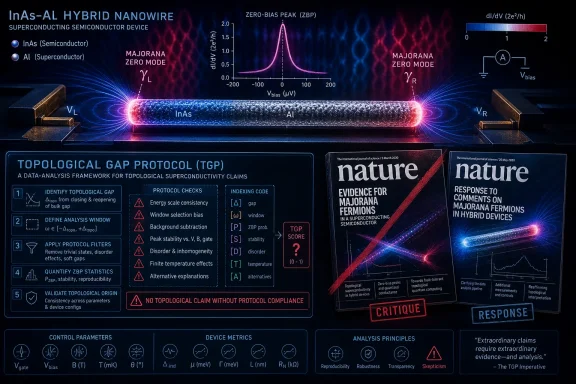
The latest argument turns on Microsoft’s use of a Topological Gap Protocol, or TGP, a procedure meant to determine whether devices show the gapped topological superconducting phase needed for the company’s qubit architecture. Legg’s critique says the protocol is not robust enough, that some data processing was flawed, and that selective interpretation may have made ordinary, non-topological physics look like a milestone.
That is an uncomfortable place for a multibillion-dollar platform company to be. Microsoft’s quantum claim is not merely “we saw an interesting signal.” It has been tied to Majorana 1, Azure Quantum, and the idea that useful quantum computing might arrive in “years, not decades.” When the dispute narrows to array indices, omitted regimes, and whether a tuning protocol really detects a gap, the grand narrative starts to look dependent on very small hinges.
That means many physical qubits are needed to create one useful logical qubit. In the most sobering versions of the scaling story, the machine that breaks through commercially useful workloads requires not just better qubits but enormous overhead. The more overhead grows, the more quantum computing begins to resemble an engineering cliff rather than an engineering roadmap.
Microsoft’s wager is that topology can change that equation. A topological qubit stores information nonlocally, so the information is less exposed to local disturbances. In theory, Majorana zero modes at the ends of specially engineered superconducting structures could provide the building blocks for qubits that are smaller, faster, and more naturally protected.
This is why the company has persisted despite setbacks. A successful topological qubit would not merely be another qubit modality; it would be a strategic escape hatch from the error-correction tax that defines much of quantum engineering. It would also give Microsoft a hardware story that fits neatly into Azure: difficult physics hidden behind cloud services, developer tools, and eventually industry-specific quantum workloads.
But the same abstraction that makes topological qubits attractive makes them difficult to validate. You do not see a Majorana zero mode the way Bell Labs engineers saw a transistor amplify current. You infer it from transport, capacitance, parity behavior, tunneling spectra, magnetic-field response, and the exclusion of less exotic explanations. That gives experimentalists room to build careful arguments — and critics room to ask whether the argument has quietly outrun the evidence.
In 2018, a Microsoft-affiliated group published work in Nature claiming evidence of Majorana particles in nanowire devices. That paper was later retracted after concerns about data selection and interpretation. The retraction did not end Microsoft’s program, but it permanently changed the burden of proof. A company can recover from a failed experiment; it has a much harder time recovering from the perception that its publicity machine gets ahead of its data.
That history matters because the new dispute sounds uncomfortably familiar. Once again, Microsoft says it has detected signatures consistent with the ingredients of topological quantum computing. Once again, outside researchers say the signatures are not definitive and may have mundane explanations. Once again, the argument is less about whether the devices are interesting than whether Microsoft’s strongest public claims are justified.
This is the part that should interest WindowsForum readers who do not spend their evenings reading condensed-matter physics papers. Microsoft is not just a research institution; it is a platform company. When Microsoft talks about quantum breakthroughs, the claim lands inside a broader corporate apparatus that includes Azure, enterprise roadmaps, investor expectations, government partnerships, and the company’s reputation for turning research into infrastructure.
That apparatus can amplify legitimate science. It can also turn preliminary evidence into an implied product timeline. The Majorana story has repeatedly sat at that boundary, where careful physics meets corporate inevitability.
The Topological Gap Protocol was meant to answer an obvious criticism: if researchers are hunting for a rare topological phase in messy semiconductor-superconductor devices, how do they avoid cherry-picking the signals they want? Microsoft’s answer was to define a protocol — a structured way to test whether a device passes conditions expected of a topological superconducting phase.
Legg argues that the protocol can be fooled, that it does not consistently define key concepts, and that some of Microsoft’s own analysis choices turn ambiguous data into supportive evidence. He also points to coding issues, including a reported indexing error, that change how the same measurement data is interpreted. In a field where the signal is indirect and the stakes are enormous, “the code did not quite do what the authors thought” is not a minor editorial correction.
Microsoft’s response is that the critique mischaracterizes the role of TGP in the 2025 Nature paper and fails to reproduce the full physical picture offered by the experiment. The company acknowledges at least one bug but says it does not undermine the conclusions. It also argues that Legg has not provided an alternative model that accounts for the full set of observed behavior.
That rebuttal is not nothing. Scientific criticism is strongest when it can explain the data at least as well as the original model. But Microsoft’s defense also reveals the asymmetry in the debate: the company wants credit for a breakthrough architecture, while critics only need to show that the evidence remains ambiguous. In extraordinary-claim territory, ambiguity is not a neutral result.
This is not a rhetorical gotcha; it is one of the central technical problems in the field. A zero-bias peak, for example, once carried an aura of Majorana promise. Over time, the community learned that zero-bias features can arise from several mechanisms. The burden shifted from “we saw a signature” to “we ruled out the impostors.”
The Microsoft case now sits in that more demanding era. It is not enough for the devices to behave in a way that is compatible with topological superconductivity. They must behave in a way that is difficult to explain without it. Legg’s point is that Microsoft has not cleared that bar.
Microsoft’s reply essentially says the broader phenomenology still hangs together. The capacitance signals, random telegraph behavior, and parity readout results are, in Microsoft’s account, not reducible to the alternatives Legg emphasizes. The company’s position is that the critique attacks a peripheral tune-up method while leaving the core measurement intact.
That disagreement is exactly why the controversy will not be settled by press releases. The devices either produce reproducible, independently verifiable topological behavior under scrutiny, or they do not. Until more groups can build similar systems, run comparable tests, and rule out the same impostors, the debate will remain suspended between “promising evidence” and “premature victory lap.”
Science is less cooperative. A paper can support one narrow claim while a corporate blog post stretches the public meaning of that claim. A measurement can validate an ingredient without validating a full qubit. A device can be significant without being the device people think they were promised.
That distinction became glaring in the Majorana 1 rollout. Microsoft spoke in the language of processors and topological qubits. Critics focused on whether the Nature paper actually demonstrated Majorana zero modes or merely a parity measurement in a device whose topological status remained contested. Those are not semantic differences; they are the difference between a component experiment and an architectural breakthrough.
The new Legg critique sharpens that gap. If the protocol used to support the underlying topological interpretation is flawed, then the marketing tower built above it starts to wobble. Not necessarily collapse — but wobble.
This is a familiar pattern in frontier technology. Companies are rewarded for translating uncertainty into direction. Researchers are rewarded for narrowing uncertainty. The problem comes when a company wants the credibility of peer-reviewed science and the narrative force of a product launch at the same time.
Peer review is a filter, not a verdict. It can catch weak methods, obvious overclaims, and unsupported conclusions, but it does not reproduce the experiment. It does not guarantee that an indirect measurement has only one interpretation. In fast-moving fields with complex instrumentation, peer review often marks the beginning of the serious public argument, not the end.
The Microsoft case is a textbook example. The company’s 2025 paper passed peer review. Legg’s challenge also passed peer review. Microsoft’s reply was published alongside the critique. The literature now contains not a tidy answer but an open conflict about what the measurements mean and how much weight the topological interpretation can bear.
That may frustrate readers who want a simple yes-or-no answer. But it is healthier than the alternative. The worst outcome would be a field where prestige journals, corporate announcements, and investor-friendly terminology combine to lock in a contested claim before replication catches up.
The better outcome is messier: publish the data, publish the code, publish the critique, publish the response, and let other labs try to break the claim. If Microsoft’s devices are genuinely entering a topological regime, the evidence should become more robust over time. If they are not, the ambiguity will become harder to hide.
Azure Quantum is not a hobby project. It sits alongside Microsoft’s efforts in cloud computing, AI infrastructure, developer tooling, cybersecurity, and high-performance computing. The company wants to be the layer through which enterprises access difficult compute: GPUs for AI, cloud instances for data, and eventually quantum backends for chemistry, optimization, cryptography research, and materials science.
That platform ambition changes how quantum claims are consumed. A university group can publish an intriguing but contested result and remain inside the scientific conversation. Microsoft publishes a contested result, and the market hears a roadmap. Enterprise customers hear strategic positioning. Governments hear industrial policy. Competitors hear a claim to architectural advantage.
This does not mean Microsoft should stop doing ambitious physics. It means Microsoft has a higher communication burden. When the company says “topological qubit,” readers need to know whether it means a fully operational, controllable, scalable qubit; a device architecture intended to become one; or a measurement that supports one necessary ingredient under disputed assumptions.
That distinction is not pedantry. It is the difference between planning for a technology and being recruited into a story about one.
Topological quantum computing does not yet have that moment. The field has theories, candidate devices, suggestive measurements, serious labs, and credible physicists on multiple sides of the argument. What it lacks is a demonstration so reproducible and so operationally useful that the debate moves from “is this the phase we think it is?” to “how do we engineer it at scale?”
A topological quantum processor worthy of the name would not merely pass a protocol. It would show controllable qubit behavior, scalable readout, error characteristics that justify the architectural premise, and independent replication by groups not invested in Microsoft’s roadmap. It would make the Majorana interpretation less fragile because the system’s behavior would be richer than any single signature.
That is the bar Microsoft has implicitly set by invoking utility-scale quantum computing. The company does not need to prove a full fault-tolerant machine tomorrow. But it does need to show that its claimed hardware advantage survives the normal brutality of scientific replication.
Until then, the most generous reading is that Microsoft has built intriguing devices and assembled a plausible case that they are seeing physics relevant to topological qubits. The least generous reading is that the company has again mistaken an ambiguous signature for a milestone. The truth may be somewhere in between, but the public claims have leaned closer to the first than the evidence has comfortably allowed.
That tension creates room for inflated narratives. “Quantum advantage” can mean a narrow sampling experiment, not a useful business application. “Logical qubit” can mean an impressive error-corrected demonstration, not a machine ready for production workloads. “Topological qubit” can mean a claimed hardware building block whose physical interpretation remains disputed.
Microsoft’s Majorana story lives inside this larger pattern. The company is not alone in using breakthrough language. The entire sector is full of roadmaps that compress uncertainty into timelines and milestones. What makes Microsoft’s case different is that it chose one of the most elegant and least experimentally settled approaches, then attached it to a polished platform narrative.
There is a business reason for that. Cloud providers want to own the future compute stack before the future arrives. If quantum eventually matters, Microsoft wants developers, researchers, and enterprises already inside Azure. The risk is that platform positioning can reward confidence before nature has granted permission.
For IT pros, the practical response is neither cynicism nor credulity. Quantum computing deserves attention, especially in cryptography planning, high-performance computing strategy, and long-range research partnerships. But procurement-grade belief should wait for reproducible performance, not branding.
That defense should be taken seriously. The history of science is full of contested measurements that looked uncertain before becoming foundational. Early semiconductor work, superconductivity research, gravitational-wave detection, and high-energy physics all required difficult instrumentation and statistical interpretation. Not every ambiguous frontier is hype.
But Microsoft’s weakness is that it keeps presenting ambiguity inside a product-shaped wrapper. “Majorana 1” sounds like a chip generation. “Topological qubit” sounds like an achieved component. “Years, not decades” sounds like a planning horizon. Those phrases do work in the world that papers cannot undo.
The result is a credibility trap. If Microsoft underclaims, it may fail to attract attention, funding, partners, and patience. If it overclaims, every subsequent critique looks like confirmation that the company is selling tomorrow’s physics as today’s platform. The safest path scientifically may be the least satisfying path commercially: slower language, narrower claims, and more emphasis on replication.
That would not make the story less exciting. It would make it more trustworthy. A company that truly believes it has found a scalable route to topological quantum computing should be willing to let the evidence become boringly undeniable.
If that does not happen, Microsoft’s claim will remain vulnerable no matter how elegant the theory or how confident the reply. Frontier physics cannot be settled by institutional prestige alone. A Nature paper is not enough. A Microsoft blog post is certainly not enough. A named chip is not enough.
What would be enough is convergence. Multiple device geometries. Multiple measurement techniques. Publicly inspectable analysis. Stronger exclusion of quantum-dot and Andreev-bound-state impostors. Demonstrations that connect the claimed topological phase to actual qubit operations rather than only precursor signatures.
This matters because topological quantum computing is not just another research branch. It is the branch Microsoft has used to differentiate itself from the rest of the quantum industry. If the branch holds, Microsoft may have made one of the great long bets in computing. If it breaks, the company will have spent years defending a beautiful theory against stubborn devices.
The field will learn either way. But Microsoft’s platform ambitions mean the rest of us are not just spectators. We are the future customers, administrators, developers, and security planners who will be asked to believe the roadmap.
 Microsoft’s Quantum Bet Now Runs Through a Python Script
Microsoft has spent years selling a distinctively Microsoftian quantum story: fewer fragile qubits, more engineering leverage, and a shortcut around the error-correction nightmare that haunts conventional quantum machines. While IBM, Google, Quantinuum, IonQ, and others have pushed superconducting, trapped-ion, neutral-atom, and photonic approaches, Microsoft has stayed committed to topological quantum computing, a more speculative route built around Majorana zero modes.That commitment is both admirable and dangerous. It is admirable because topological qubits, if realized, could be intrinsically more resistant to local noise than many competing qubit types. It is dangerous because the field has repeatedly produced signatures that look Majorana-shaped without being Majoranas.
The latest argument turns on Microsoft’s use of a Topological Gap Protocol, or TGP, a procedure meant to determine whether devices show the gapped topological superconducting phase needed for the company’s qubit architecture. Legg’s critique says the protocol is not robust enough, that some data processing was flawed, and that selective interpretation may have made ordinary, non-topological physics look like a milestone.
That is an uncomfortable place for a multibillion-dollar platform company to be. Microsoft’s quantum claim is not merely “we saw an interesting signal.” It has been tied to Majorana 1, Azure Quantum, and the idea that useful quantum computing might arrive in “years, not decades.” When the dispute narrows to array indices, omitted regimes, and whether a tuning protocol really detects a gap, the grand narrative starts to look dependent on very small hinges.
The Majorana Promise Is Still the Best Version of the Dream
Topological quantum computing remains seductive because it attacks the central weakness of quantum hardware: qubits are exquisitely easy to disturb. A conventional quantum computer must preserve delicate states long enough to run algorithms, while also correcting errors created by noise, imperfect gates, measurement faults, and environmental coupling.That means many physical qubits are needed to create one useful logical qubit. In the most sobering versions of the scaling story, the machine that breaks through commercially useful workloads requires not just better qubits but enormous overhead. The more overhead grows, the more quantum computing begins to resemble an engineering cliff rather than an engineering roadmap.
Microsoft’s wager is that topology can change that equation. A topological qubit stores information nonlocally, so the information is less exposed to local disturbances. In theory, Majorana zero modes at the ends of specially engineered superconducting structures could provide the building blocks for qubits that are smaller, faster, and more naturally protected.
This is why the company has persisted despite setbacks. A successful topological qubit would not merely be another qubit modality; it would be a strategic escape hatch from the error-correction tax that defines much of quantum engineering. It would also give Microsoft a hardware story that fits neatly into Azure: difficult physics hidden behind cloud services, developer tools, and eventually industry-specific quantum workloads.
But the same abstraction that makes topological qubits attractive makes them difficult to validate. You do not see a Majorana zero mode the way Bell Labs engineers saw a transistor amplify current. You infer it from transport, capacitance, parity behavior, tunneling spectra, magnetic-field response, and the exclusion of less exotic explanations. That gives experimentalists room to build careful arguments — and critics room to ask whether the argument has quietly outrun the evidence.
The Ghost of the Retracted Majorana Claim Still Haunts Redmond
Microsoft’s credibility problem is not that quantum physics is hard. Everyone in the field knows it is hard. The problem is that Microsoft has already lived through a very public Majorana reversal.In 2018, a Microsoft-affiliated group published work in Nature claiming evidence of Majorana particles in nanowire devices. That paper was later retracted after concerns about data selection and interpretation. The retraction did not end Microsoft’s program, but it permanently changed the burden of proof. A company can recover from a failed experiment; it has a much harder time recovering from the perception that its publicity machine gets ahead of its data.
That history matters because the new dispute sounds uncomfortably familiar. Once again, Microsoft says it has detected signatures consistent with the ingredients of topological quantum computing. Once again, outside researchers say the signatures are not definitive and may have mundane explanations. Once again, the argument is less about whether the devices are interesting than whether Microsoft’s strongest public claims are justified.
This is the part that should interest WindowsForum readers who do not spend their evenings reading condensed-matter physics papers. Microsoft is not just a research institution; it is a platform company. When Microsoft talks about quantum breakthroughs, the claim lands inside a broader corporate apparatus that includes Azure, enterprise roadmaps, investor expectations, government partnerships, and the company’s reputation for turning research into infrastructure.
That apparatus can amplify legitimate science. It can also turn preliminary evidence into an implied product timeline. The Majorana story has repeatedly sat at that boundary, where careful physics meets corporate inevitability.
Legg’s Critique Attacks the Filter, Not Just the Finding
Legg’s critique is especially damaging because it does not merely say Microsoft has failed to prove a topological qubit. Many physicists have said some version of that. The sharper charge is that Microsoft’s procedure for identifying suitable devices and interpreting data may itself be unreliable.The Topological Gap Protocol was meant to answer an obvious criticism: if researchers are hunting for a rare topological phase in messy semiconductor-superconductor devices, how do they avoid cherry-picking the signals they want? Microsoft’s answer was to define a protocol — a structured way to test whether a device passes conditions expected of a topological superconducting phase.
Legg argues that the protocol can be fooled, that it does not consistently define key concepts, and that some of Microsoft’s own analysis choices turn ambiguous data into supportive evidence. He also points to coding issues, including a reported indexing error, that change how the same measurement data is interpreted. In a field where the signal is indirect and the stakes are enormous, “the code did not quite do what the authors thought” is not a minor editorial correction.
Microsoft’s response is that the critique mischaracterizes the role of TGP in the 2025 Nature paper and fails to reproduce the full physical picture offered by the experiment. The company acknowledges at least one bug but says it does not undermine the conclusions. It also argues that Legg has not provided an alternative model that accounts for the full set of observed behavior.
That rebuttal is not nothing. Scientific criticism is strongest when it can explain the data at least as well as the original model. But Microsoft’s defense also reveals the asymmetry in the debate: the company wants credit for a breakthrough architecture, while critics only need to show that the evidence remains ambiguous. In extraordinary-claim territory, ambiguity is not a neutral result.
Quantum Dots Are the Unwelcome Doppelgängers
One of the reasons Majorana physics is so treacherous is that less exotic states can mimic some of the expected signatures. Quantum dots, Andreev bound states, disorder effects, and device-specific artifacts can produce measurements that resemble the signals researchers hoped would indicate Majorana zero modes.This is not a rhetorical gotcha; it is one of the central technical problems in the field. A zero-bias peak, for example, once carried an aura of Majorana promise. Over time, the community learned that zero-bias features can arise from several mechanisms. The burden shifted from “we saw a signature” to “we ruled out the impostors.”
The Microsoft case now sits in that more demanding era. It is not enough for the devices to behave in a way that is compatible with topological superconductivity. They must behave in a way that is difficult to explain without it. Legg’s point is that Microsoft has not cleared that bar.
Microsoft’s reply essentially says the broader phenomenology still hangs together. The capacitance signals, random telegraph behavior, and parity readout results are, in Microsoft’s account, not reducible to the alternatives Legg emphasizes. The company’s position is that the critique attacks a peripheral tune-up method while leaving the core measurement intact.
That disagreement is exactly why the controversy will not be settled by press releases. The devices either produce reproducible, independently verifiable topological behavior under scrutiny, or they do not. Until more groups can build similar systems, run comparable tests, and rule out the same impostors, the debate will remain suspended between “promising evidence” and “premature victory lap.”
The Nature Fight Exposes the Weakness of Breakthrough Branding
Microsoft’s February 2025 Majorana 1 announcement was designed as a platform moment. It named a chip, framed the result as a new hardware architecture, and connected the science to utility-scale quantum computing. That is how technology companies communicate: a device name, a roadmap, a market implication, and a promise that the hard part is now tractable.Science is less cooperative. A paper can support one narrow claim while a corporate blog post stretches the public meaning of that claim. A measurement can validate an ingredient without validating a full qubit. A device can be significant without being the device people think they were promised.
That distinction became glaring in the Majorana 1 rollout. Microsoft spoke in the language of processors and topological qubits. Critics focused on whether the Nature paper actually demonstrated Majorana zero modes or merely a parity measurement in a device whose topological status remained contested. Those are not semantic differences; they are the difference between a component experiment and an architectural breakthrough.
The new Legg critique sharpens that gap. If the protocol used to support the underlying topological interpretation is flawed, then the marketing tower built above it starts to wobble. Not necessarily collapse — but wobble.
This is a familiar pattern in frontier technology. Companies are rewarded for translating uncertainty into direction. Researchers are rewarded for narrowing uncertainty. The problem comes when a company wants the credibility of peer-reviewed science and the narrative force of a product launch at the same time.
Peer Review Is Not a Seal of Finality
A common mistake in public science debates is treating peer review as a binary truth machine. A paper appears in Nature, therefore the claim is established. A critique appears later, therefore the claim is debunked. Neither version is how science actually works.Peer review is a filter, not a verdict. It can catch weak methods, obvious overclaims, and unsupported conclusions, but it does not reproduce the experiment. It does not guarantee that an indirect measurement has only one interpretation. In fast-moving fields with complex instrumentation, peer review often marks the beginning of the serious public argument, not the end.
The Microsoft case is a textbook example. The company’s 2025 paper passed peer review. Legg’s challenge also passed peer review. Microsoft’s reply was published alongside the critique. The literature now contains not a tidy answer but an open conflict about what the measurements mean and how much weight the topological interpretation can bear.
That may frustrate readers who want a simple yes-or-no answer. But it is healthier than the alternative. The worst outcome would be a field where prestige journals, corporate announcements, and investor-friendly terminology combine to lock in a contested claim before replication catches up.
The better outcome is messier: publish the data, publish the code, publish the critique, publish the response, and let other labs try to break the claim. If Microsoft’s devices are genuinely entering a topological regime, the evidence should become more robust over time. If they are not, the ambiguity will become harder to hide.
The Windows Angle Is Azure, Not Schrödinger’s Cat
For most Windows users, quantum computing can feel like a distant abstraction. It will not change how Windows 11 updates install, how Copilot runs on a laptop, or whether your GPU driver survives the next Patch Tuesday. But Microsoft’s quantum strategy matters because it is part of the same cloud-and-platform logic that now drives the company’s operating-system ecosystem.Azure Quantum is not a hobby project. It sits alongside Microsoft’s efforts in cloud computing, AI infrastructure, developer tooling, cybersecurity, and high-performance computing. The company wants to be the layer through which enterprises access difficult compute: GPUs for AI, cloud instances for data, and eventually quantum backends for chemistry, optimization, cryptography research, and materials science.
That platform ambition changes how quantum claims are consumed. A university group can publish an intriguing but contested result and remain inside the scientific conversation. Microsoft publishes a contested result, and the market hears a roadmap. Enterprise customers hear strategic positioning. Governments hear industrial policy. Competitors hear a claim to architectural advantage.
This does not mean Microsoft should stop doing ambitious physics. It means Microsoft has a higher communication burden. When the company says “topological qubit,” readers need to know whether it means a fully operational, controllable, scalable qubit; a device architecture intended to become one; or a measurement that supports one necessary ingredient under disputed assumptions.
That distinction is not pedantry. It is the difference between planning for a technology and being recruited into a story about one.
The Real Breakthrough Would Be Reproducibility
The transistor analogy is tempting because it offers a clean origin story. Before the transistor, electronics needed bulky vacuum tubes. After the transistor, miniaturization, integrated circuits, and modern computing became inevitable. Every frontier hardware field wants its Bell Labs moment.Topological quantum computing does not yet have that moment. The field has theories, candidate devices, suggestive measurements, serious labs, and credible physicists on multiple sides of the argument. What it lacks is a demonstration so reproducible and so operationally useful that the debate moves from “is this the phase we think it is?” to “how do we engineer it at scale?”
A topological quantum processor worthy of the name would not merely pass a protocol. It would show controllable qubit behavior, scalable readout, error characteristics that justify the architectural premise, and independent replication by groups not invested in Microsoft’s roadmap. It would make the Majorana interpretation less fragile because the system’s behavior would be richer than any single signature.
That is the bar Microsoft has implicitly set by invoking utility-scale quantum computing. The company does not need to prove a full fault-tolerant machine tomorrow. But it does need to show that its claimed hardware advantage survives the normal brutality of scientific replication.
Until then, the most generous reading is that Microsoft has built intriguing devices and assembled a plausible case that they are seeing physics relevant to topological qubits. The least generous reading is that the company has again mistaken an ambiguous signature for a milestone. The truth may be somewhere in between, but the public claims have leaned closer to the first than the evidence has comfortably allowed.
The Hype Cycle Has a Physics Problem
Quantum computing has always had a communication problem because the technology is simultaneously real, limited, and overmarketed. Real quantum devices exist. They can perform operations that are classically difficult to simulate in specific contexts. They are also noisy, expensive, specialized, and far from replacing conventional computers for everyday workloads.That tension creates room for inflated narratives. “Quantum advantage” can mean a narrow sampling experiment, not a useful business application. “Logical qubit” can mean an impressive error-corrected demonstration, not a machine ready for production workloads. “Topological qubit” can mean a claimed hardware building block whose physical interpretation remains disputed.
Microsoft’s Majorana story lives inside this larger pattern. The company is not alone in using breakthrough language. The entire sector is full of roadmaps that compress uncertainty into timelines and milestones. What makes Microsoft’s case different is that it chose one of the most elegant and least experimentally settled approaches, then attached it to a polished platform narrative.
There is a business reason for that. Cloud providers want to own the future compute stack before the future arrives. If quantum eventually matters, Microsoft wants developers, researchers, and enterprises already inside Azure. The risk is that platform positioning can reward confidence before nature has granted permission.
For IT pros, the practical response is neither cynicism nor credulity. Quantum computing deserves attention, especially in cryptography planning, high-performance computing strategy, and long-range research partnerships. But procurement-grade belief should wait for reproducible performance, not branding.
Microsoft’s Strongest Defense Is Also Its Weakness
Microsoft can reasonably argue that hard science invites hard criticism. A serious research program publishes in serious journals, shares data, faces hostile review, and responds. In that sense, the Legg exchange is evidence that the process is working, not proof that Microsoft is acting in bad faith.That defense should be taken seriously. The history of science is full of contested measurements that looked uncertain before becoming foundational. Early semiconductor work, superconductivity research, gravitational-wave detection, and high-energy physics all required difficult instrumentation and statistical interpretation. Not every ambiguous frontier is hype.
But Microsoft’s weakness is that it keeps presenting ambiguity inside a product-shaped wrapper. “Majorana 1” sounds like a chip generation. “Topological qubit” sounds like an achieved component. “Years, not decades” sounds like a planning horizon. Those phrases do work in the world that papers cannot undo.
The result is a credibility trap. If Microsoft underclaims, it may fail to attract attention, funding, partners, and patience. If it overclaims, every subsequent critique looks like confirmation that the company is selling tomorrow’s physics as today’s platform. The safest path scientifically may be the least satisfying path commercially: slower language, narrower claims, and more emphasis on replication.
That would not make the story less exciting. It would make it more trustworthy. A company that truly believes it has found a scalable route to topological quantum computing should be willing to let the evidence become boringly undeniable.
The Majorana Claim Now Has to Survive Outside Microsoft’s Orbit
The next phase of the story should not be another corporate announcement. It should be independent verification. If other labs can produce similar InAs–Al devices, run comparable or stronger protocols, and reproduce the key signatures under conditions that rule out trivial states, the debate will shift in Microsoft’s favor.If that does not happen, Microsoft’s claim will remain vulnerable no matter how elegant the theory or how confident the reply. Frontier physics cannot be settled by institutional prestige alone. A Nature paper is not enough. A Microsoft blog post is certainly not enough. A named chip is not enough.
What would be enough is convergence. Multiple device geometries. Multiple measurement techniques. Publicly inspectable analysis. Stronger exclusion of quantum-dot and Andreev-bound-state impostors. Demonstrations that connect the claimed topological phase to actual qubit operations rather than only precursor signatures.
This matters because topological quantum computing is not just another research branch. It is the branch Microsoft has used to differentiate itself from the rest of the quantum industry. If the branch holds, Microsoft may have made one of the great long bets in computing. If it breaks, the company will have spent years defending a beautiful theory against stubborn devices.
The field will learn either way. But Microsoft’s platform ambitions mean the rest of us are not just spectators. We are the future customers, administrators, developers, and security planners who will be asked to believe the roadmap.
The Signal Microsoft Needs Is No Longer Just in the Lab
The concrete lesson from this latest Nature fight is that Microsoft’s topological quantum story has moved beyond a dispute over a single experiment. It is now a test of how a platform company should communicate uncertain science when the commercial upside of certainty is enormous.- Microsoft’s 2025 Majorana 1 announcement remains scientifically contested because the evidence for topological behavior depends on indirect measurements and disputed interpretation.
- Henry Legg’s 2026 critique challenges not only Microsoft’s conclusion but also the robustness of the Topological Gap Protocol and parts of the data analysis behind it.
- Microsoft rejects the core criticism, acknowledges a limited processing bug, and argues that Legg has not offered an alternative model that explains the full experimental behavior.
- The central technical issue is whether Microsoft’s devices show topological superconductivity with Majorana zero modes or whether more ordinary mechanisms can mimic the observed signatures.
- The practical issue for enterprise and developer audiences is that Azure Quantum’s long-term promise should be judged by reproducible hardware progress, not by breakthrough branding.
- The next meaningful milestone is independent replication that connects claimed Majorana physics to controllable, scalable qubit behavior.
References
- Primary source: Hackaday
Published: Tue, 30 Jun 2026 17:20:00 GMT
Microsoft’s Topological Quantum Computing Claims Once Again In Question | Hackaday
A central problem with the arguably overhyped field of quantum computing remains the difficulty in objectively ascertaining performance and new developments, as much here relies on indirect measure…hackaday.com
- Official source: quantum.microsoft.com
Microsoft Quantum | Topological qubits
Details Microsoft's approach to building topological qubits using Majorana zero modes and superconducting nanowires.quantum.microsoft.com
- Official source: azure.microsoft.com
- Related coverage: scientificamerican.com
Top quantum computer expert claims Microsoft’s ‘topological qubit’ doesn’t hold up | Scientific American
The company has been touting its quantum technology for years, but some experts say these claims just don’t pass musterwww.scientificamerican.com - Related coverage: technews.tw
《自然》刊載物理學家新論文,質疑微軟的量子運算主張 | TechNews 科技新報
由蘇格蘭聖安德魯斯大學(University of St Andrews)物理學家 Henry Legg 撰寫、24 日發表在科學期刊《自然》(Nature)網站上的同儕審查評論文章提出證據,指出微軟宣稱的量子運算「突破」,其實是建立在錯誤的基礎上。 微軟在 2025 年 2 月公開 Majoran...technews.tw - Related coverage: techxplore.com
- Official source: microsoft.com
InAs-Al Hybrid Devices Passing the Topological Gap Protocol - Microsoft Research
We present measurements and simulations of semiconductor-superconductor heterostructure devices that are consistent with the observation of topological superconductivity and Majorana zero modes. The devices are fabricated from high-mobility two-dimensional electron gases in which...www.microsoft.com - Related coverage: phys.org
Loading…
phys.org