

Katie Saez, Truist’s Georgia regional president since 2022, rose from SunTrust’s post-college commercial banking training program to the bank’s top Georgia role after helping integrate systems during the 2019 BB&T-SunTrust merger that created Truist. Her story is not just a corporate ladder profile. It is a neat case study in how modern banking careers are increasingly shaped by systems integration, regional market knowledge, and now the daily use of AI tools like Microsoft Copilot. The executive path still runs through clients and credibility, but the operating system underneath it is changing.
At first glance, Saez’s rise looks like the kind of traditional banking story that regional business pages have been publishing for decades. A graduate joins a training program, learns credit and relationship management, builds trust with clients, and eventually becomes the face of a major institution in a key market. That arc is real, and it still matters.
But the more interesting detail is buried in the middle: Saez played a role in integrating systems when SunTrust and BB&T merged in 2019. For a bank, a merger is not simply a branding exercise or a reshuffling of executives. It is a years-long collision of ledgers, customer records, branch workflows, compliance regimes, desktop environments, authentication systems, and institutional habits.
That matters to WindowsForum readers because large financial institutions are among the most demanding Microsoft shops on earth. Their technology estates are sprawling, conservative, heavily audited, and increasingly cloud-connected. When a senior regional banking leader says she now uses AI “all day long,” that is not a lifestyle anecdote. It is a signal that generative AI has moved from keynote demo to executive workflow.
The banking industry rarely adopts technology because it is fashionable. It adopts technology when the risk calculus changes. Saez’s career, from training-program analyst to state-level executive, tracks the transformation of banking from a relationship business with technology support into a technology-mediated relationship business.
The public conversation at the time focused heavily on the new name. “Truist” became a target of jokes, branding analysis, and regional skepticism almost immediately. That was understandable, but it obscured the deeper operational reality: the hard part of a bank merger is not naming the company. It is making two giant financial machines behave like one.
That is where system integration becomes a career accelerant. Executives who can translate between business needs and technology constraints become indispensable in a merger. They are not necessarily the engineers writing code or the administrators managing identity policy, but they understand enough about the operational stack to know that a bad migration is not an IT inconvenience. It is a customer experience failure, a compliance risk, and a reputational wound.
Saez’s involvement in integration work therefore says something important about modern executive formation. The future regional president was not simply accumulating client contacts. She was learning how the bank actually functions when its machinery is under stress.
But the job has expanded. Regional leadership now requires understanding how national platforms meet local realities. A bank can centralize its systems, standardize its risk models, and deploy shared digital tools, but commercial banking still happens in specific markets with specific industries, clients, and economic rhythms.
That makes the regional president a kind of interpreter. She has to explain Georgia and Alabama to the institution while explaining the institution to clients. She has to sell scale without sounding remote, and she has to sell local knowledge without pretending the bank is still a small-town lender.
This is where technology becomes inseparable from leadership. If client histories, credit data, pipeline notes, email context, and meeting preparation live inside Microsoft 365 and adjacent enterprise systems, then the executive who can use those systems well has an advantage. The executive who cannot is increasingly dependent on someone else’s synthesis.
That is exactly the kind of workflow Microsoft has been promising since it began pushing Copilot across Microsoft 365. The sales pitch has always been that AI will live where work already happens: Outlook, Teams, Word, Excel, PowerPoint, SharePoint, and the graph of organizational data behind them. In a bank, that promise is powerful because so much white-collar work is not the creation of new information but the retrieval, ranking, and presentation of information already scattered across systems.
The practical use case is not “write my strategy.” It is “remind me what matters before I walk into the room.” That distinction matters. In regulated industries, executives are unlikely to hand judgment to a chatbot. But they may absolutely use AI as a briefing assistant, a first-draft generator, or a memory prosthetic.
The phrase agentic AI has become one of the industry’s more overworked buzzwords, but Saez’s comment about wanting AI to proactively push things to her captures the real frontier. Today’s Copilot use is often prompt-driven. Tomorrow’s enterprise AI pitch is anticipatory: it notices the meeting, gathers the context, flags the risk, drafts the prep, and maybe even suggests who else should be in the room.
That does not mean banks are anti-technology. Quite the opposite. Modern banking is one of the most digitized sectors in the economy. But the industry’s technology appetite is filtered through controls, governance, and risk management.
For Microsoft, financial services is both a prize and a proving ground. The company’s AI strategy depends on persuading enterprises that the Microsoft 365 tenant is not just a productivity suite but the safest place to operationalize AI. That argument is strongest when customers already rely on Microsoft identity, compliance tooling, information protection, and endpoint management.
For IT administrators, the implication is clear: AI adoption will not arrive as a single clean project. It will arrive through executives asking why Copilot cannot access a file, why a meeting summary missed a key thread, why an old SharePoint site is invisible, or why permissions prevent the AI from surfacing useful context. The AI rollout becomes a mirror held up to the organization’s data hygiene.
Preparation used to mean reading the file, knowing the client, understanding the numbers, and anticipating the questions. It still means those things. But AI changes the floor. If everyone has access to tools that can summarize email, draft talking points, and scan public information, then showing up merely “prepared” may no longer distinguish anyone.
The differentiator becomes judgment. Did you ask the right question? Did you verify the answer? Did you know what the model could not know? Did you understand when the AI produced a plausible summary that missed the human subtext?
This is a subtle but important shift for early-career workers. AI can reduce the mechanical advantage once held by people with better note systems, faster drafting skills, or institutional memory. But it can also reward people who are curious, skeptical, and disciplined enough to turn machine-generated context into human insight.
That has always been both useful and dangerous. Email is searchable, but not structured. It is personal, but often business-critical. It contains institutional memory, but that memory is fragmented across individuals and retention policies.
Copilot makes that contradiction more visible. If the AI can summarize your inbox, then your inbox is effectively part of the organization’s queryable knowledge fabric. That raises obvious productivity benefits, but it also raises governance questions that IT leaders cannot wave away.
Permissions become destiny. Bad access control becomes bad AI output. A file shared too broadly is no longer merely a file shared too broadly; it may become context for an AI-generated recommendation. A stale document is no longer just clutter; it may become part of a briefing.
The organizations that benefit most from Copilot will not necessarily be those that buy the most licenses. They will be those that have done the unglamorous work of identity governance, data classification, lifecycle management, and user training.
That distribution matters because it undercuts a simplistic view of corporate relocation. Headquarters status is important, but it is not the only measure of influence. A market can lose a headquarters and still remain operationally essential.
For Georgia, Truist’s footprint reflects the broader evolution of Sun Belt banking. Atlanta is a commercial hub, a technology market, a logistics center, and a regional capital for professional services. A bank that wants to serve the Southeast cannot treat Georgia as a satellite.
Saez’s role sits precisely at that intersection. She is not running a nostalgic outpost of SunTrust. She is representing a merged institution in a market where legacy, growth, and competition overlap.
But the technology angle adds another layer. The next generation of leadership profiles will increasingly be stories about how executives use platforms. Not in the shallow sense of which app they prefer, but in the deeper sense of how they manage information, delegate cognition, and make decisions inside digitally mediated institutions.
That means leadership visibility and technology fluency are converging. Executives do not need to become developers, but they do need to understand what tools can and cannot do. They need to model responsible adoption. They need to avoid both reflexive fear and gullible enthusiasm.
Saez’s comments land in the pragmatic middle. She is using AI as an assistant now and thinking about more proactive use in the future. That is not a moonshot manifesto. It is exactly how enterprise technology usually wins: one useful workflow at a time.
But there is another, more plausible story inside high-performing organizations. AI will raise expectations. If an executive can walk into a meeting with a richer summary of client history, recent correspondence, internal documents, and external context, then others will be expected to do the same. The bar moves.
This is where Saez’s old advice becomes newly sharp. “Be the most prepared person in the room” is harder, not easier, when everyone has a summarization engine. The prepared person is no longer the one who merely read the memo. It is the one who knows which memo matters, which AI-generated summary is incomplete, and which human concern is hiding behind a neat bullet point.
For sysadmins and IT pros, that also means user training cannot stop at how to click the Copilot button. Organizations need to teach prompt discipline, verification habits, confidentiality boundaries, and escalation paths for suspicious output. AI literacy is becoming part of professional literacy.
A senior executive using Copilot daily sends a different signal than an innovation team running a pilot in isolation. It tells employees that AI is not a toy reserved for technologists. It is a tool for client work, management preparation, hiring, and personal productivity.
That cultural signal can accelerate adoption, but it can also expose uneven readiness. Some employees will experiment confidently. Others will worry about surveillance, job displacement, or making a compliance mistake. Some managers will use AI to improve coaching; others may use it to generate generic communication at higher volume.
The difference will come down to governance and example. If leaders use AI transparently, verify its output, and acknowledge its limits, employees are more likely to treat it as a serious tool. If leaders treat it as magic, employees will either mimic the recklessness or quietly distrust the whole project.
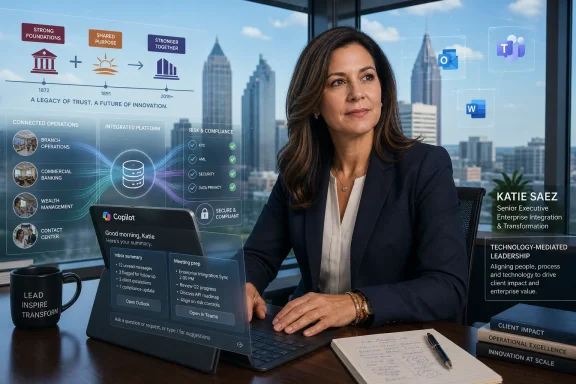 The Bank Career That Became a Technology Story
At first glance, Saez’s rise looks like the kind of traditional banking story that regional business pages have been publishing for decades. A graduate joins a training program, learns credit and relationship management, builds trust with clients, and eventually becomes the face of a major institution in a key market. That arc is real, and it still matters.But the more interesting detail is buried in the middle: Saez played a role in integrating systems when SunTrust and BB&T merged in 2019. For a bank, a merger is not simply a branding exercise or a reshuffling of executives. It is a years-long collision of ledgers, customer records, branch workflows, compliance regimes, desktop environments, authentication systems, and institutional habits.
That matters to WindowsForum readers because large financial institutions are among the most demanding Microsoft shops on earth. Their technology estates are sprawling, conservative, heavily audited, and increasingly cloud-connected. When a senior regional banking leader says she now uses AI “all day long,” that is not a lifestyle anecdote. It is a signal that generative AI has moved from keynote demo to executive workflow.
The banking industry rarely adopts technology because it is fashionable. It adopts technology when the risk calculus changes. Saez’s career, from training-program analyst to state-level executive, tracks the transformation of banking from a relationship business with technology support into a technology-mediated relationship business.
Truist Was Born as a Merger, Not a Rebrand
The 2019 combination of BB&T and SunTrust created Truist, a Charlotte-based financial giant with deep roots in the Southeast. For Georgia, the merger carried special emotional weight because SunTrust was not merely a bank with Atlanta branches. It was part of the city’s corporate identity, with its name attached to towers, civic institutions, and a generation of local banking relationships.The public conversation at the time focused heavily on the new name. “Truist” became a target of jokes, branding analysis, and regional skepticism almost immediately. That was understandable, but it obscured the deeper operational reality: the hard part of a bank merger is not naming the company. It is making two giant financial machines behave like one.
That is where system integration becomes a career accelerant. Executives who can translate between business needs and technology constraints become indispensable in a merger. They are not necessarily the engineers writing code or the administrators managing identity policy, but they understand enough about the operational stack to know that a bad migration is not an IT inconvenience. It is a customer experience failure, a compliance risk, and a reputational wound.
Saez’s involvement in integration work therefore says something important about modern executive formation. The future regional president was not simply accumulating client contacts. She was learning how the bank actually functions when its machinery is under stress.
The Regional President Is Now a Systems Interpreter
A regional bank president once might have been understood chiefly as a civic figure: part rainmaker, part ambassador, part market strategist. That role still exists. Saez represents Truist in Georgia, leads commercial banking teams across Georgia and Alabama, and serves on local boards connected to Atlanta’s business ecosystem.But the job has expanded. Regional leadership now requires understanding how national platforms meet local realities. A bank can centralize its systems, standardize its risk models, and deploy shared digital tools, but commercial banking still happens in specific markets with specific industries, clients, and economic rhythms.
That makes the regional president a kind of interpreter. She has to explain Georgia and Alabama to the institution while explaining the institution to clients. She has to sell scale without sounding remote, and she has to sell local knowledge without pretending the bank is still a small-town lender.
This is where technology becomes inseparable from leadership. If client histories, credit data, pipeline notes, email context, and meeting preparation live inside Microsoft 365 and adjacent enterprise systems, then the executive who can use those systems well has an advantage. The executive who cannot is increasingly dependent on someone else’s synthesis.
Copilot Moves From Party Trick to Executive Briefing Room
The most striking part of Saez’s account is her description of using Microsoft Copilot to prepare for client and candidate meetings. She described prompting AI with a client plan and asking for help framing advice. She also described Copilot drawing on her inbox to identify prior interactions and generate ideas for discussion.That is exactly the kind of workflow Microsoft has been promising since it began pushing Copilot across Microsoft 365. The sales pitch has always been that AI will live where work already happens: Outlook, Teams, Word, Excel, PowerPoint, SharePoint, and the graph of organizational data behind them. In a bank, that promise is powerful because so much white-collar work is not the creation of new information but the retrieval, ranking, and presentation of information already scattered across systems.
The practical use case is not “write my strategy.” It is “remind me what matters before I walk into the room.” That distinction matters. In regulated industries, executives are unlikely to hand judgment to a chatbot. But they may absolutely use AI as a briefing assistant, a first-draft generator, or a memory prosthetic.
The phrase agentic AI has become one of the industry’s more overworked buzzwords, but Saez’s comment about wanting AI to proactively push things to her captures the real frontier. Today’s Copilot use is often prompt-driven. Tomorrow’s enterprise AI pitch is anticipatory: it notices the meeting, gathers the context, flags the risk, drafts the prep, and maybe even suggests who else should be in the room.
Banking Is a Brutal Test Case for Everyday AI
If Copilot can become useful in banking, it can become useful almost anywhere. Banks are hostile environments for sloppy software adoption. They have privacy obligations, retention rules, supervisory expectations, insider-risk concerns, fraud exposure, and a low tolerance for unexplained data leakage.That does not mean banks are anti-technology. Quite the opposite. Modern banking is one of the most digitized sectors in the economy. But the industry’s technology appetite is filtered through controls, governance, and risk management.
For Microsoft, financial services is both a prize and a proving ground. The company’s AI strategy depends on persuading enterprises that the Microsoft 365 tenant is not just a productivity suite but the safest place to operationalize AI. That argument is strongest when customers already rely on Microsoft identity, compliance tooling, information protection, and endpoint management.
For IT administrators, the implication is clear: AI adoption will not arrive as a single clean project. It will arrive through executives asking why Copilot cannot access a file, why a meeting summary missed a key thread, why an old SharePoint site is invisible, or why permissions prevent the AI from surfacing useful context. The AI rollout becomes a mirror held up to the organization’s data hygiene.
The Old Advice Still Works, But the Room Has Changed
Saez’s career advice to younger professionals is almost aggressively old-school: be the most prepared person in the room, even if you are the most junior. That advice survives because it is not really about etiquette. It is about leverage.Preparation used to mean reading the file, knowing the client, understanding the numbers, and anticipating the questions. It still means those things. But AI changes the floor. If everyone has access to tools that can summarize email, draft talking points, and scan public information, then showing up merely “prepared” may no longer distinguish anyone.
The differentiator becomes judgment. Did you ask the right question? Did you verify the answer? Did you know what the model could not know? Did you understand when the AI produced a plausible summary that missed the human subtext?
This is a subtle but important shift for early-career workers. AI can reduce the mechanical advantage once held by people with better note systems, faster drafting skills, or institutional memory. But it can also reward people who are curious, skeptical, and disciplined enough to turn machine-generated context into human insight.
The Inbox Is Becoming a Corporate Knowledge Base
Saez’s example of Copilot going through email to identify prior client interactions will sound familiar to anyone who has spent years inside Outlook. The inbox has long functioned as an unofficial system of record. It contains decisions, promises, attachments, exceptions, introductions, conflicts, and the real texture of business relationships.That has always been both useful and dangerous. Email is searchable, but not structured. It is personal, but often business-critical. It contains institutional memory, but that memory is fragmented across individuals and retention policies.
Copilot makes that contradiction more visible. If the AI can summarize your inbox, then your inbox is effectively part of the organization’s queryable knowledge fabric. That raises obvious productivity benefits, but it also raises governance questions that IT leaders cannot wave away.
Permissions become destiny. Bad access control becomes bad AI output. A file shared too broadly is no longer merely a file shared too broadly; it may become context for an AI-generated recommendation. A stale document is no longer just clutter; it may become part of a briefing.
The organizations that benefit most from Copilot will not necessarily be those that buy the most licenses. They will be those that have done the unglamorous work of identity governance, data classification, lifecycle management, and user training.
Atlanta Remains Central Even When Headquarters Move
Truist’s headquarters are in Charlotte, but Atlanta remains central to the bank’s identity and operations. The AJC profile notes that Truist still has thousands of employees in Georgia, roughly 205 branches, and two important Atlanta corporate offices. Truist Plaza houses commercial banking, wealth management, and corporate functions including finance, marketing, and technology, while Truist Securities maintains a major presence near Truist Park.That distribution matters because it undercuts a simplistic view of corporate relocation. Headquarters status is important, but it is not the only measure of influence. A market can lose a headquarters and still remain operationally essential.
For Georgia, Truist’s footprint reflects the broader evolution of Sun Belt banking. Atlanta is a commercial hub, a technology market, a logistics center, and a regional capital for professional services. A bank that wants to serve the Southeast cannot treat Georgia as a satellite.
Saez’s role sits precisely at that intersection. She is not running a nostalgic outpost of SunTrust. She is representing a merged institution in a market where legacy, growth, and competition overlap.
Women’s Leadership Stories Are Now Also Platform Stories
The AJC published Saez’s profile as part of a women’s leadership series, and that framing is important. Banking leadership has historically been male-dominated, especially in senior commercial and executive roles. A woman rising to a top state-level banking position remains notable, even if it should not be exceptional.But the technology angle adds another layer. The next generation of leadership profiles will increasingly be stories about how executives use platforms. Not in the shallow sense of which app they prefer, but in the deeper sense of how they manage information, delegate cognition, and make decisions inside digitally mediated institutions.
That means leadership visibility and technology fluency are converging. Executives do not need to become developers, but they do need to understand what tools can and cannot do. They need to model responsible adoption. They need to avoid both reflexive fear and gullible enthusiasm.
Saez’s comments land in the pragmatic middle. She is using AI as an assistant now and thinking about more proactive use in the future. That is not a moonshot manifesto. It is exactly how enterprise technology usually wins: one useful workflow at a time.
The Copilot Era Will Reward the Prepared, Not the Passive
There is a lazy version of the AI story that says tools like Copilot will make workers less prepared because the machine will do the prep for them. That will be true for some people. Every productivity tool creates new forms of laziness.But there is another, more plausible story inside high-performing organizations. AI will raise expectations. If an executive can walk into a meeting with a richer summary of client history, recent correspondence, internal documents, and external context, then others will be expected to do the same. The bar moves.
This is where Saez’s old advice becomes newly sharp. “Be the most prepared person in the room” is harder, not easier, when everyone has a summarization engine. The prepared person is no longer the one who merely read the memo. It is the one who knows which memo matters, which AI-generated summary is incomplete, and which human concern is hiding behind a neat bullet point.
For sysadmins and IT pros, that also means user training cannot stop at how to click the Copilot button. Organizations need to teach prompt discipline, verification habits, confidentiality boundaries, and escalation paths for suspicious output. AI literacy is becoming part of professional literacy.
The Real AI Rollout Is Cultural
Microsoft and its competitors tend to describe AI adoption in product terms: licenses, features, integrations, security boundaries, admin controls. Those details matter enormously. But the harder part is cultural.A senior executive using Copilot daily sends a different signal than an innovation team running a pilot in isolation. It tells employees that AI is not a toy reserved for technologists. It is a tool for client work, management preparation, hiring, and personal productivity.
That cultural signal can accelerate adoption, but it can also expose uneven readiness. Some employees will experiment confidently. Others will worry about surveillance, job displacement, or making a compliance mistake. Some managers will use AI to improve coaching; others may use it to generate generic communication at higher volume.
The difference will come down to governance and example. If leaders use AI transparently, verify its output, and acknowledge its limits, employees are more likely to treat it as a serious tool. If leaders treat it as magic, employees will either mimic the recklessness or quietly distrust the whole project.
What Saez’s Rise Says About the Next Windows Workplace
Saez’s path through Truist is ultimately a reminder that the future of enterprise work will not be split cleanly between “business people” and “technology people.” The most effective leaders will be the ones who can move between those worlds without pretending they are the same.- Katie Saez became Truist’s Georgia regional president in 2022 after beginning her career in SunTrust’s commercial banking training program.
- Her experience during the BB&T-SunTrust integration highlights how major bank mergers turn operational technology work into executive-grade experience.
- Truist’s continued Atlanta presence shows that regional influence can survive even when corporate headquarters move elsewhere.
- Her daily use of Microsoft Copilot illustrates how generative AI is moving into ordinary executive preparation, not just experimental innovation labs.
- The biggest enterprise AI challenge is likely to be data governance, permissions, and professional judgment rather than access to the chatbot itself.
- The old career advice to be prepared still applies, but AI raises the standard for what preparation means.
References
- Primary source: Atlanta Journal-Constitution
Published: 2026-06-30T09:50:16.566084
Loading…
www.ajc.com - Related coverage: media.truist.com
Loading…
media.truist.com - Related coverage: gpb.org
Loading…
www.gpb.org - Related coverage: athensceo.com
Loading…
athensceo.com - Related coverage: metroatlantaceo.com
Loading…
metroatlantaceo.com - Related coverage: nationalmortgageprofessional.com
Loading…
nationalmortgageprofessional.com