

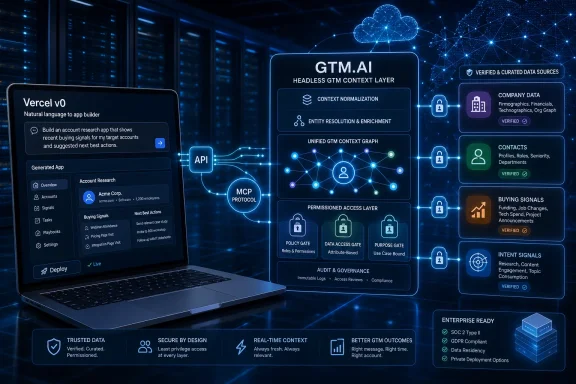
ZoomInfo confirmed on June 30, 2026, that applications built in Vercel v0 can now read ZoomInfo’s verified company, contact, buying-signal, and intent data through GTM.AI, the company’s API and Model Context Protocol layer for go-to-market systems. The headline sounds like another AI integration in a season full of them, but the more interesting claim is architectural. ZoomInfo is not merely trying to appear inside another workflow; it is trying to become the data substrate underneath AI-built business software. For WindowsForum readers, the story is less about sales software glamour and more about what happens when “vibe-coded” internal apps start touching governed enterprise data.
Vercel v0 has become one of the emblematic tools of the natural-language development wave: describe a product, dashboard, workflow, or interface, and the system generates a working web application that can move quickly toward deployment. That speed is the attraction. It also creates the obvious problem: a generated app is only as useful as the systems it can safely and accurately talk to.
The ZoomInfo integration attacks that problem from the data side. Instead of asking teams to export records from CRM, upload CSV files, or wire demo apps to stale internal tables, the v0-built application can call GTM.AI and pull from ZoomInfo’s identity-resolved go-to-market graph. ZoomInfo says that graph includes data on more than 100 million companies, hundreds of millions of contacts, and billions of signals.
That matters because the failure mode of AI app builders is rarely that they cannot produce a plausible screen. They can. The failure comes later, when the app has to make a routing decision, score an account, enrich a lead, or recommend the next sales action using records that may already be wrong.
The promise here is that a RevOps team can ask for an account-scoring dashboard or routing workflow in plain English and end up with a tool that is not just visually complete but connected to live commercial context. That is a meaningful step beyond prototype theater, even if the hard parts of governance, integration testing, and user trust do not magically disappear.
That is a familiar move in enterprise software. Once a vendor believes its core asset is not the screen but the graph, API, permissions model, and audit trail behind the screen, it starts trying to live everywhere. The browser tab becomes optional. The data service becomes the product.
GTM.AI exposes ZoomInfo’s GTM Context Graph through an API and an MCP endpoint. MCP, or Model Context Protocol, has quickly become a favored way to connect AI assistants and agents to external tools and data sources. In practical terms, it gives an AI-enabled app a standardized way to ask for context rather than depending on a brittle one-off connector.
The important distinction is that ZoomInfo is positioning this as the same data foundation used by its own platform, not a secondary export. If that is true in production, it reduces one of the oldest enterprise integration headaches: the analytics app, sales workflow, and source-of-truth system all telling slightly different stories about the same account.
The risk is equally familiar. Once a vendor becomes the context layer, it becomes more embedded than a dashboard ever was. Enterprises gain convenience, but they also deepen their dependency on a single provider’s data definitions, enrichment logic, permission model, and commercial roadmap.
But enterprise software does not fail only because it is slow to build. It fails because nobody can agree which records are authoritative, which users should see what, which action changed which field, and who is responsible when automation makes a bad call. AI generation shortens the path to a working interface; it does not eliminate the institutional mess underneath.
That is why this integration is more serious than a cosmetic plug-in. ZoomInfo is trying to move the AI app-builder conversation away from “look what I generated” and toward “what does the generated thing know, and under whose authority does it act?” Those are the questions IT departments care about.
For Windows admins and enterprise architects, the analogy is obvious. A slick front end connected to a spreadsheet is not an enterprise application. A generated workflow that respects identity, permissions, lineage, retention, and auditability at least begins to look like one.
The trouble is that go-to-market data decays quickly. People change jobs, companies merge, departments reorganize, phone numbers disappear, email addresses bounce, and buying committees shift. An AI tool that looks brilliant against last quarter’s export can become actively harmful when it starts assigning accounts or recommending outreach in the real world.
This is where ZoomInfo’s argument is strongest. If AI applications are increasingly going to reason over business data, the freshness and identity resolution of that data become core application qualities. They are not back-office hygiene concerns. They determine whether the app deserves user trust.
The phrase “grounded in verified data” has become overused across the AI industry, but in this case it points to a concrete production issue. Models hallucinate, but databases also lie by aging. A business app can be wrong without inventing anything; it can simply rely on a record whose truth expired months ago.
Connecting v0-built applications to GTM.AI gives Vercel a stronger story in one lucrative niche: revenue operations and go-to-market tooling. These are domains where business teams constantly need dashboards, routing logic, scoring tools, enrichment views, and workflow glue. They are also domains where engineering teams often have bigger priorities.
That makes the fit commercially sensible. A RevOps team may not need a bespoke software product in the traditional sense. It may need a half-dozen small internal tools that adapt as territories, campaigns, and account strategies change. v0 promises speed; GTM.AI promises context.
Still, “production-ready” should be read carefully. Generated code connected to live data still needs review, testing, security assessment, and lifecycle management. The fact that an application can be produced from a natural-language prompt does not mean it should bypass the boring disciplines that keep enterprise systems alive after the demo.
The enterprise fear around AI agents is not just that they will be wrong. It is that they will be wrong with access. A badly scoped assistant can expose customer records, enrich the wrong lead, generate noncompliant outreach, or trigger workflows that no human fully understood. Audit trails and permission inheritance are not nice-to-have features in that environment.
If the integration works as described, GTM.AI becomes a control point. Instead of every v0-generated app managing its own view of ZoomInfo data, organizations can apply one governance posture across multiple AI surfaces. That is the kind of centralization security teams usually prefer, even if they remain skeptical of the applications being generated above it.
The deeper question is whether enterprises will trust business users to create more of these apps in the first place. A governed data layer reduces risk, but it does not answer every question about code quality, dependency management, secret handling, deployment boundaries, or change control. In other words, the data layer can be enterprise-grade while the app lifecycle still needs adult supervision.
For Windows-heavy organizations, Copilot has already normalized the idea that AI assistants will sit close to work data. The remaining fight is over which data sources those assistants can query, how permissions are enforced, and whether the results can be trusted enough to drive action. GTM.AI is ZoomInfo’s attempt to make its commercial intelligence available wherever that AI work happens.
That also means the competitive terrain is shifting. The old SaaS battle was fought through dashboards, seats, and workflow ownership. The new one is fought through context availability: which vendor’s graph is reachable from the tools employees actually use?
Microsoft, Salesforce, HubSpot, Vercel, OpenAI, Anthropic, Google, and others all want to be the place where work gets done. ZoomInfo’s bet is that it does not need to win every interface battle if it can become the trusted go-to-market context behind many of them.
That does not mean MCP is magic. Standardizing the door does not guarantee that the room behind it is clean, secure, or well-governed. It also does not remove the need to inspect what an AI agent is allowed to request and what the system returns.
But MCP does give integrations like this a clearer shape. A v0-built app can call into GTM.AI through a defined endpoint rather than relying on a one-off import. That makes the app easier to reason about, easier to govern, and potentially easier to swap or extend later.
For IT pros, the most practical question will be visibility. If more business apps are generated outside traditional development pipelines, administrators will need to know which MCP servers are connected, what scopes are granted, where logs live, and how access is revoked. The protocol can enable order, but only if organizations treat it as infrastructure rather than a toy.
AI app builders are moving through that cycle at high speed. They lower the barrier to creation dramatically, which is both the point and the problem. A company that previously had 20 internal tools may soon have 200 generated ones, each connected to data, models, and third-party services.
ZoomInfo’s v0 integration is interesting because it acknowledges this reality. It does not pretend that generated apps can live on vibes alone. It says, in effect, that if business users are going to build more software, the data layer must arrive with enterprise controls already attached.
That is a better story than uncontrolled CSV uploads. It is not a complete governance model. Enterprises will still need policies for who can build, who can deploy, who can connect production data, and who owns the tool after the original prompt has been forgotten.
That is not inherently bad. Enterprise buyers often prefer fewer, deeper integrations when they reduce reconciliation work and user confusion. A single context layer can make business logic more consistent across teams.
But lock-in becomes more subtle when it lives at the context layer. It is one thing to replace a dashboard. It is another to replace the data graph that powers account scoring, lead enrichment, routing workflows, territory planning, and AI-generated recommendations across multiple tools. The more successful GTM.AI becomes, the more migration planning becomes a strategic concern rather than a procurement chore.
This is why buyers should treat context-layer decisions with the same seriousness they bring to identity providers, CRM platforms, and data warehouses. The integration may start with a convenient v0 app. Over time, it can become part of the organization’s operational nervous system.
Those examples also show why the integration matters to more than sales leaders. Internal tools are where organizations encode process. When those tools are generated faster, connected to richer data, and deployed more broadly, they become part of how work actually happens.
The Windows and Microsoft ecosystem angle is not that this is a Windows feature. It is that the same organizations evaluating Copilot, Power Platform, Azure AI, Salesforce, HubSpot, and Vercel are now being asked to think about context as a shared layer across all of them. The desktop is no longer the boundary of enterprise computing; the permissioned data graph may be.
ZoomInfo’s claim is that GTM.AI can provide that graph for go-to-market work. The claim is plausible, but enterprises should test it against the unglamorous details: latency, data accuracy, audit completeness, permission inheritance, failure behavior, export rights, and cost at scale.
For teams experimenting with v0 and similar tools, the lesson is not to connect every generated app to production systems tomorrow. It is to stop treating data plumbing as an afterthought. The faster the app is created, the more deliberate the organization must be about the systems underneath it.
 The App Builder Was Never the Whole Product
Vercel v0 has become one of the emblematic tools of the natural-language development wave: describe a product, dashboard, workflow, or interface, and the system generates a working web application that can move quickly toward deployment. That speed is the attraction. It also creates the obvious problem: a generated app is only as useful as the systems it can safely and accurately talk to.The ZoomInfo integration attacks that problem from the data side. Instead of asking teams to export records from CRM, upload CSV files, or wire demo apps to stale internal tables, the v0-built application can call GTM.AI and pull from ZoomInfo’s identity-resolved go-to-market graph. ZoomInfo says that graph includes data on more than 100 million companies, hundreds of millions of contacts, and billions of signals.
That matters because the failure mode of AI app builders is rarely that they cannot produce a plausible screen. They can. The failure comes later, when the app has to make a routing decision, score an account, enrich a lead, or recommend the next sales action using records that may already be wrong.
The promise here is that a RevOps team can ask for an account-scoring dashboard or routing workflow in plain English and end up with a tool that is not just visually complete but connected to live commercial context. That is a meaningful step beyond prototype theater, even if the hard parts of governance, integration testing, and user trust do not magically disappear.
ZoomInfo Is Selling the Context Layer, Not Just the Database
ZoomInfo’s phrasing around GTM.AI is revealing. The company calls it a “headless GTM context layer,” which is vendor language, but the concept is straightforward enough: separate the intelligence layer from the user interface, then let many different apps, agents, and workflows call into it.That is a familiar move in enterprise software. Once a vendor believes its core asset is not the screen but the graph, API, permissions model, and audit trail behind the screen, it starts trying to live everywhere. The browser tab becomes optional. The data service becomes the product.
GTM.AI exposes ZoomInfo’s GTM Context Graph through an API and an MCP endpoint. MCP, or Model Context Protocol, has quickly become a favored way to connect AI assistants and agents to external tools and data sources. In practical terms, it gives an AI-enabled app a standardized way to ask for context rather than depending on a brittle one-off connector.
The important distinction is that ZoomInfo is positioning this as the same data foundation used by its own platform, not a secondary export. If that is true in production, it reduces one of the oldest enterprise integration headaches: the analytics app, sales workflow, and source-of-truth system all telling slightly different stories about the same account.
The risk is equally familiar. Once a vendor becomes the context layer, it becomes more embedded than a dashboard ever was. Enterprises gain convenience, but they also deepen their dependency on a single provider’s data definitions, enrichment logic, permission model, and commercial roadmap.
AI-Built Internal Tools Are Running Into the Old Enterprise Wall
The AI app-builder pitch has often sounded like liberation from the development backlog. A product manager, sales operations analyst, or marketing lead can describe the tool they need and get something usable without waiting months for engineering prioritization. That is powerful, especially for internal software that never justified a full application team.But enterprise software does not fail only because it is slow to build. It fails because nobody can agree which records are authoritative, which users should see what, which action changed which field, and who is responsible when automation makes a bad call. AI generation shortens the path to a working interface; it does not eliminate the institutional mess underneath.
That is why this integration is more serious than a cosmetic plug-in. ZoomInfo is trying to move the AI app-builder conversation away from “look what I generated” and toward “what does the generated thing know, and under whose authority does it act?” Those are the questions IT departments care about.
For Windows admins and enterprise architects, the analogy is obvious. A slick front end connected to a spreadsheet is not an enterprise application. A generated workflow that respects identity, permissions, lineage, retention, and auditability at least begins to look like one.
The Static Export Is the Villain of the Story
ZoomInfo’s announcement takes direct aim at a common shortcut: building AI tools around static data. That shortcut is understandable. When a team is experimenting, a spreadsheet or CRM dump is faster than a production integration. It makes the demo sing.The trouble is that go-to-market data decays quickly. People change jobs, companies merge, departments reorganize, phone numbers disappear, email addresses bounce, and buying committees shift. An AI tool that looks brilliant against last quarter’s export can become actively harmful when it starts assigning accounts or recommending outreach in the real world.
This is where ZoomInfo’s argument is strongest. If AI applications are increasingly going to reason over business data, the freshness and identity resolution of that data become core application qualities. They are not back-office hygiene concerns. They determine whether the app deserves user trust.
The phrase “grounded in verified data” has become overused across the AI industry, but in this case it points to a concrete production issue. Models hallucinate, but databases also lie by aging. A business app can be wrong without inventing anything; it can simply rely on a record whose truth expired months ago.
Vercel Gets a More Enterprise-Friendly Story
For Vercel, the integration helps v0 answer a critique that has followed AI app builders from the beginning. They are excellent at scaffolding, prototyping, and generating polished interfaces, but they can feel less convincing when the conversation turns to regulated data, enterprise systems, and operational workflows.Connecting v0-built applications to GTM.AI gives Vercel a stronger story in one lucrative niche: revenue operations and go-to-market tooling. These are domains where business teams constantly need dashboards, routing logic, scoring tools, enrichment views, and workflow glue. They are also domains where engineering teams often have bigger priorities.
That makes the fit commercially sensible. A RevOps team may not need a bespoke software product in the traditional sense. It may need a half-dozen small internal tools that adapt as territories, campaigns, and account strategies change. v0 promises speed; GTM.AI promises context.
Still, “production-ready” should be read carefully. Generated code connected to live data still needs review, testing, security assessment, and lifecycle management. The fact that an application can be produced from a natural-language prompt does not mean it should bypass the boring disciplines that keep enterprise systems alive after the demo.
Governance Is the Real Sales Pitch
ZoomInfo says authentication and governance remain tied to existing ZoomInfo permissions. Calls made by a v0 application through GTM.AI inherit access control, data lineage, AI policy, and audit logging. That part of the announcement deserves more attention than the natural-language app-building angle.The enterprise fear around AI agents is not just that they will be wrong. It is that they will be wrong with access. A badly scoped assistant can expose customer records, enrich the wrong lead, generate noncompliant outreach, or trigger workflows that no human fully understood. Audit trails and permission inheritance are not nice-to-have features in that environment.
If the integration works as described, GTM.AI becomes a control point. Instead of every v0-generated app managing its own view of ZoomInfo data, organizations can apply one governance posture across multiple AI surfaces. That is the kind of centralization security teams usually prefer, even if they remain skeptical of the applications being generated above it.
The deeper question is whether enterprises will trust business users to create more of these apps in the first place. A governed data layer reduces risk, but it does not answer every question about code quality, dependency management, secret handling, deployment boundaries, or change control. In other words, the data layer can be enterprise-grade while the app lifecycle still needs adult supervision.
Microsoft Copilot Is Part of the Same Pattern
ZoomInfo lists Microsoft Copilot among the surfaces connected to GTM.AI, alongside Salesforce Agentforce, HubSpot Breeze, Gong, LeanData, Glean, Claude, ChatGPT, Google Workspace, and now Vercel v0. That list is not incidental. It shows that ZoomInfo wants GTM.AI to be a common substrate across both productivity assistants and purpose-built business workflows.For Windows-heavy organizations, Copilot has already normalized the idea that AI assistants will sit close to work data. The remaining fight is over which data sources those assistants can query, how permissions are enforced, and whether the results can be trusted enough to drive action. GTM.AI is ZoomInfo’s attempt to make its commercial intelligence available wherever that AI work happens.
That also means the competitive terrain is shifting. The old SaaS battle was fought through dashboards, seats, and workflow ownership. The new one is fought through context availability: which vendor’s graph is reachable from the tools employees actually use?
Microsoft, Salesforce, HubSpot, Vercel, OpenAI, Anthropic, Google, and others all want to be the place where work gets done. ZoomInfo’s bet is that it does not need to win every interface battle if it can become the trusted go-to-market context behind many of them.
The Model Context Protocol Is Becoming Enterprise Plumbing
MCP has moved quickly from developer curiosity to enterprise integration buzzword because it solves a real problem. AI systems need structured, permissioned access to external tools and data, and every bespoke connector becomes a maintenance burden. A common protocol gives vendors a way to expose capabilities without rebuilding the wheel for every assistant.That does not mean MCP is magic. Standardizing the door does not guarantee that the room behind it is clean, secure, or well-governed. It also does not remove the need to inspect what an AI agent is allowed to request and what the system returns.
But MCP does give integrations like this a clearer shape. A v0-built app can call into GTM.AI through a defined endpoint rather than relying on a one-off import. That makes the app easier to reason about, easier to govern, and potentially easier to swap or extend later.
For IT pros, the most practical question will be visibility. If more business apps are generated outside traditional development pipelines, administrators will need to know which MCP servers are connected, what scopes are granted, where logs live, and how access is revoked. The protocol can enable order, but only if organizations treat it as infrastructure rather than a toy.
The No-Code Dream Keeps Rediscovering the Need for IT
There is an old rhythm to software platform shifts. First comes the promise that business users can build what they need without IT. Then comes the realization that the organization still needs identity, security, compliance, documentation, monitoring, cost controls, and incident response. Finally, the platform matures into another thing IT must govern.AI app builders are moving through that cycle at high speed. They lower the barrier to creation dramatically, which is both the point and the problem. A company that previously had 20 internal tools may soon have 200 generated ones, each connected to data, models, and third-party services.
ZoomInfo’s v0 integration is interesting because it acknowledges this reality. It does not pretend that generated apps can live on vibes alone. It says, in effect, that if business users are going to build more software, the data layer must arrive with enterprise controls already attached.
That is a better story than uncontrolled CSV uploads. It is not a complete governance model. Enterprises will still need policies for who can build, who can deploy, who can connect production data, and who owns the tool after the original prompt has been forgotten.
The Commercial Upside Is Obvious, but So Is the Lock-In
From ZoomInfo’s perspective, GTM.AI extends the value of its data beyond the core application. If a sales team uses ZoomInfo inside its CRM, productivity suite, agentic assistant, and now v0-built internal tools, the platform becomes harder to remove. The data graph turns into operational muscle memory.That is not inherently bad. Enterprise buyers often prefer fewer, deeper integrations when they reduce reconciliation work and user confusion. A single context layer can make business logic more consistent across teams.
But lock-in becomes more subtle when it lives at the context layer. It is one thing to replace a dashboard. It is another to replace the data graph that powers account scoring, lead enrichment, routing workflows, territory planning, and AI-generated recommendations across multiple tools. The more successful GTM.AI becomes, the more migration planning becomes a strategic concern rather than a procurement chore.
This is why buyers should treat context-layer decisions with the same seriousness they bring to identity providers, CRM platforms, and data warehouses. The integration may start with a convenient v0 app. Over time, it can become part of the organization’s operational nervous system.
The Useful Future Is Smaller Than the Hype and Bigger Than the Demo
The most believable use cases are not science-fiction agents replacing sales teams. They are narrower, more practical tools that remove friction from messy revenue operations. An account-scoring view that pulls fresh firmographic and intent data is useful. A territory dashboard that reflects current company relationships is useful. A routing workflow that enriches and assigns leads without a separate data pipeline is useful.Those examples also show why the integration matters to more than sales leaders. Internal tools are where organizations encode process. When those tools are generated faster, connected to richer data, and deployed more broadly, they become part of how work actually happens.
The Windows and Microsoft ecosystem angle is not that this is a Windows feature. It is that the same organizations evaluating Copilot, Power Platform, Azure AI, Salesforce, HubSpot, and Vercel are now being asked to think about context as a shared layer across all of them. The desktop is no longer the boundary of enterprise computing; the permissioned data graph may be.
ZoomInfo’s claim is that GTM.AI can provide that graph for go-to-market work. The claim is plausible, but enterprises should test it against the unglamorous details: latency, data accuracy, audit completeness, permission inheritance, failure behavior, export rights, and cost at scale.
The Practical Read for Builders and Admins
This integration should be read as a signal that AI app builders are entering a more serious phase. The conversation is shifting from “can it generate a usable interface?” to “can it safely operate against live enterprise data?” That is the right shift.For teams experimenting with v0 and similar tools, the lesson is not to connect every generated app to production systems tomorrow. It is to stop treating data plumbing as an afterthought. The faster the app is created, the more deliberate the organization must be about the systems underneath it.
- ZoomInfo’s v0 integration gives AI-built applications a direct path to verified company, contact, buying-signal, and intent data through GTM.AI.
- The announcement matters because static exports and stale CRM snapshots are a weak foundation for production AI workflows.
- Governance is the most important enterprise claim, since GTM.AI is supposed to preserve ZoomInfo permissions, lineage, policy, and audit logging across connected apps.
- Vercel gains a stronger enterprise story for v0 by pairing fast application generation with a live go-to-market data layer.
- IT teams should treat MCP endpoints, generated apps, and context-layer permissions as infrastructure that requires inventory, review, and revocation processes.
- Buyers should weigh the productivity upside against deeper dependency on ZoomInfo’s graph, definitions, and commercial ecosystem.
References
- Primary source: 01net
Published: 2026-06-30T17:50:16.568145
Loading…
www.01net.it - Related coverage: nasdaq.com
Loading…
www.nasdaq.com - Related coverage: marketscreener.com
Loading…
www.marketscreener.com - Related coverage: vercel.com
Loading…
vercel.com - Related coverage: businesswire.com
Loading…
www.businesswire.com - Related coverage: aiwiki.ai
Loading…
aiwiki.ai
- Related coverage: natlawreview.com
Loading…
natlawreview.com - Related coverage: businesstimesjournal.com
Loading…
www.businesstimesjournal.com - Related coverage: einpresswire.com
Loading…
www.einpresswire.com - Related coverage: sacra-pdfs.s3.us-east-2.amazonaws.com
Loading…
sacra-pdfs.s3.us-east-2.amazonaws.com