

Microsoft said on June 30, 2026, that it is accelerating its Quantum Safe Program so critical products and services move to post-quantum cryptography by 2029, folding the effort into its Secure Future Initiative as governments press for earlier quantum-resistant security deadlines. The announcement is less a prediction about one magic machine than a concession that cryptographic migration is now a calendar problem. If the old industry posture was “watch the standards,” the new one is “inventory everything before the standards become procurement requirements.” For Windows shops, cloud tenants, software vendors, and security teams, that means quantum safety has moved from the research slide deck into the migration backlog.
For years, post-quantum cryptography lived in the strange middle ground between science fiction and compliance planning. Everyone serious about security knew that sufficiently capable quantum computers would threaten RSA, elliptic-curve cryptography, and the public-key machinery behind much of the modern internet. Almost nobody wanted to own the spreadsheet showing where all that machinery was embedded.
Microsoft’s new timeline is a signal that the spreadsheet era has arrived. The company is not saying that a cryptographically relevant quantum computer will appear tomorrow, nor is it claiming that every Windows endpoint is about to become obsolete. It is saying that the lead time required to replace cryptography across products, services, identities, certificates, signing systems, update channels, and customer integrations is long enough that waiting for certainty would be negligent.
That distinction matters. Security vendors have often abused quantum rhetoric, using Q-Day as a marketing accelerant for products that may or may not solve the hard operational problem. Microsoft’s framing is more sober and, for that reason, more consequential. The company is treating quantum risk as an infrastructure modernization problem, not a single-algorithm shopping trip.
The 2029 date gives the announcement its edge. Microsoft is setting a target for critical products and services that lands before several of the public-sector deadlines now forming around 2030. In enterprise procurement terms, that is the difference between “we are studying this” and “we expect our platforms to be ready before your auditors ask.”
That is the sound of cryptography becoming policy. Once governments start connecting PQC to certification, acquisition, and critical infrastructure, the market follows whether or not every CIO has a quantum strategy memo. Vendors that sell into government, defense, healthcare, telecom, energy, finance, and industrial environments now have to assume that quantum-readiness language will enter contracts faster than their legacy products can be re-architected.
Microsoft’s 2029 target is therefore not merely a security milestone. It is a market positioning move. By saying its critical products and services will transition by then, Microsoft is giving large customers a planning anchor and telling regulators it wants to be upstream of the deadline rather than dragged behind it.
For WindowsForum readers, the practical implication is blunt: if you administer Microsoft-heavy environments, you should expect PQC readiness to start appearing in baselines, documentation, certificate guidance, TLS expectations, compliance mappings, and eventually procurement questionnaires. The first wave will not feel like a dramatic operating-system upgrade. It will feel like one more security control that suddenly has dates attached.
But standards do not automatically migrate systems. They do not find a hard-coded RSA dependency in an old line-of-business app. They do not rewrite a vendor appliance that only supports outdated TLS configurations. They do not update a firmware signing pipeline designed a decade ago by a team that has since reorganized twice.
This is why Microsoft’s blog emphasizes TLS 1.3, crypto-agility, and trust chains rather than simply celebrating PQC algorithms. The algorithm names matter, but they are not the bottleneck for most organizations. The bottleneck is knowing where cryptography lives and whether those systems can change without breaking production.
That is also why the “harvest now, decrypt later” problem keeps reappearing in official guidance. An attacker does not need a mature quantum computer today if the attacker can collect encrypted traffic or data now and decrypt it later. Data with long confidentiality lifetimes — state secrets, medical records, intellectual property, legal archives, financial records, identity material — creates risk before the quantum computer arrives.
Microsoft is effectively saying that the transition clock starts from the lifespan of the data and the complexity of the migration, not from the publication date of a future quantum benchmark.
This is an important corrective to the fantasy version of PQC migration. You cannot simply sprinkle post-quantum dust onto brittle protocol stacks and expect resilience. If an environment still depends on obsolete protocol versions, inconsistent cipher configurations, ancient middleware, or unmanaged inspection boxes, the first quantum-safe action may look suspiciously like ordinary hygiene.
That will frustrate teams looking for a shiny new control, but it is good security engineering. Protocol modernization reduces present-day attack surface while preparing for future key-exchange changes. It also gives administrators a narrower compatibility matrix when PQC-capable implementations arrive across clients, servers, proxies, gateways, and cloud services.
Windows environments are especially exposed to the messy middle here. Enterprises often run modern Microsoft 365 and Azure services alongside old Windows Server workloads, third-party VPNs, legacy domain integrations, embedded systems, and appliances whose firmware lifecycles are measured in geological time. The Microsoft-controlled portion may move quickly; the customer-controlled edge rarely does.
That is why the phrase critical endpoints negotiate TLS 1.3 by default is more consequential than it first appears. Defaults are how platform companies move the ecosystem. Once the default shifts, exceptions become visible, measurable, and eventually embarrassing.
Hard-coded algorithms, bespoke key handling, undocumented certificate dependencies, and application-level assumptions about cryptographic primitives are common. They are common because they worked. A development team made a reasonable choice years ago, shipped the product, moved on, and left behind a cryptographic decision that now behaves like structural concrete.
Microsoft’s emphasis on configurable cryptographic settings, standardized key management, and rotation is not novel, but the quantum deadline changes its urgency. Crypto-agility used to sound like architectural virtue. Now it is the difference between an orderly migration and a multi-year exception register.
Data at rest is also where organizations will discover that “encrypted” is not a sufficient inventory category. Encrypted how? With what key length? Managed by which service? Rotated on what schedule? Wrapped by what root? Stored in what hardware? Backed up where? Restored by whom? Dependent on which vendor?
Those questions are tedious, which is why they matter. Quantum-safe planning turns cryptography from an abstraction into an asset-management problem. The organizations that already struggle to maintain software bills of materials will find that cryptographic bills of materials are even more scattered.
Changing those systems is harder than changing a web server cipher suite. A broken TLS configuration can cause an outage. A broken signing or certificate hierarchy can brick devices, block updates, invalidate software, or undermine the trust model of an entire platform.
This is where Microsoft’s Secure Future Initiative becomes relevant. After years of bruising security incidents and public criticism, Microsoft has been trying to impose more disciplined security engineering across the company. By placing PQC requirements inside SFI, Microsoft is presenting quantum safety as part of the same internal accountability structure: ownership, milestones, measurable progress, and executive visibility.
That is smart politics inside a company as large as Microsoft. Without a central forcing function, quantum-safe work would be easy to fragment across Windows, Azure, Microsoft 365, identity, developer tools, gaming, hardware, and supply-chain systems. Each team could plausibly wait for another dependency to move first. SFI gives the company a way to turn “important someday” into “assigned now.”
Customers should still be careful not to confuse a program with completion. Microsoft has announced a goal, not finished the migration. The hard details will come later: which products count as critical, which services move first, how hybrid modes are exposed, what breaks compatibility, how administrators audit readiness, and how quickly on-premises products inherit the work.
Hybrid deployments are reassuring in theory and awkward in practice. They can increase message sizes, stress protocol assumptions, complicate certificate chains, and expose brittle middleboxes. They also require careful interoperability testing, because the internet and enterprise networks are full of devices that do creative things to traffic they barely understand.
This is another reason Microsoft’s platform role matters. If Windows, Azure, Entra, Edge, .NET, Schannel, certificate services, management tooling, and cloud endpoints gradually absorb PQC-capable patterns, customers get a migration path that is at least partially paved. If the burden falls entirely on individual administrators and app teams, the result will be inconsistent and slow.
Developers will also need to unlearn some casual habits. Cryptographic libraries that made old choices easy may need new APIs, new defaults, and new failure modes. Application owners will need to test not only whether a connection succeeds, but whether it negotiates the intended protections under policy. Security teams will need telemetry that says more than “TLS is enabled.”
The uncomfortable truth is that crypto-agility is observability by another name. If you cannot see what algorithms, protocols, certificates, and keys are in use, you cannot change them with confidence.
Network teams know some of the TLS landscape. PKI teams know some of the certificate estate. Application teams know some of the code-level dependencies. Cloud teams know some of the managed service defaults. Security teams know some of the policy requirements. Vendors know some of the embedded behavior they may not document clearly.
That fragmentation is the real enemy. A quantum-safe transition is not just about replacing algorithms; it is about finding every place where an algorithm choice became someone else’s hidden dependency. Organizations that cannot answer those questions will be forced into either dangerous assumptions or expensive emergency consulting.
The inventory also needs to be living, not a one-time assessment. Cryptography changes when applications are upgraded, certificates renew, vendors patch appliances, developers import libraries, cloud providers alter defaults, and merger activity drops another environment into the estate. A static report produced in 2026 will not save an organization from a 2030 procurement requirement.
For Windows-heavy shops, the inventory should span both Microsoft-native and non-Microsoft components. Group Policy, Intune, Defender, Entra, Azure Key Vault, AD CS, IIS, SQL Server, RDP exposure, VPN clients, third-party agents, backup products, EDR tools, and firmware update systems may all contain relevant cryptographic dependencies. The weakest link may be the appliance that nobody thinks about until the renewal quote arrives.
This is the part that should appeal to pragmatic administrators. The quantum threat may be uncertain in timing, but cryptographic sprawl is already real. Expired certificates still cause outages. Weak protocol support still creates exposure. Poor key rotation still increases blast radius. Unknown dependencies still turn routine upgrades into incident calls.
In that sense, PQC is becoming the forcing function for a cleanup the industry needed anyway. Much like zero trust absorbed a broad set of identity and segmentation reforms, quantum safety may become the banner under which organizations finally modernize cryptographic lifecycle management.
There is a risk, however, that the term becomes too broad to be useful. If every security vendor relabels ordinary key management as quantum-safe readiness, buyers will struggle to distinguish meaningful preparation from brochure compliance. Microsoft’s advantage is that it controls enough platform surface area to make actual changes. Its burden is that customers will expect proof.
That proof should come in the form of defaults, dashboards, policy controls, compatibility documentation, migration guides, and clear product timelines. A 2029 goal is useful, but administrators need intermediate signals long before then.
The first operational changes may look mundane. A vendor questionnaire asks whether a product supports NIST-approved PQC algorithms. A government customer demands a roadmap. A security baseline discourages older TLS. A certificate authority announces future changes. A cloud service exposes a preview mode. A compliance team adds “cryptographic inventory” to the annual evidence request.
Then the exceptions begin. A legacy app cannot handle TLS 1.3. A middlebox breaks hybrid key exchange. A device vendor has no firmware plan. A code-signing process uses a token or HSM that cannot support future algorithms. A backup archive contains data with a confidentiality lifetime longer than the cryptography protecting it.
None of this will feel like quantum computing. It will feel like enterprise IT.
That is why Microsoft’s timing matters for the Windows ecosystem. When Microsoft moves platform defaults, software vendors follow. When Microsoft bakes PQC requirements into its own security initiative, partners and customers adjust their roadmaps. When Microsoft says 2029, administrators should hear: your dependency chain needs to be understood before then.
This creates a new kind of third-party risk. It is not enough to ask whether a vendor encrypts data. Buyers will need to ask whether the vendor can change encryption schemes, whether it has inventoried its own dependencies, whether it supports modern protocols, whether its signing and update process has a PQC roadmap, and whether its hardware roots of trust can survive the transition.
Microsoft will be both a vendor under scrutiny and a vendor applying scrutiny. Its own procurement, partner, and certification ecosystems could become powerful levers for adoption. If Microsoft requires PQC readiness from suppliers tied to critical services, the effect will ripple well beyond Redmond.
The awkward middle will be on-premises and long-lived systems. Cloud services can be upgraded centrally, though not painlessly. Installed software, appliances, industrial systems, and embedded devices move at the speed of customer change windows and vendor support contracts. Those are the places where 2030 is closer than it looks.
The lesson from past migrations is that deprecation deadlines do not fail at the shiny edge. They fail in the forgotten corner that still performs a business-critical function and has not had a clean owner since 2014.
The value is that Microsoft has converted uncertainty into a work plan. The plan says to modernize network cryptography, build crypto-agility for stored data, and harden the trust chains that make software, devices, identities, and services reliable. It says to start with inventory and prioritize systems based on sensitivity, lifespan, and operational importance.
That is a defensible strategy because it does not require betting the company on a precise quantum arrival date. If quantum capabilities accelerate, the organization is better prepared. If they take longer, the organization still gets better cryptographic hygiene, better visibility, and less technical debt.
There will be costs. PQC migration will consume engineering time, testing capacity, vendor-management attention, and change-control bandwidth. It may expose uncomfortable truths about legacy estates. It may force upgrades that organizations would rather defer.
But delay has a cost too, and it compounds. The longer cryptographic dependencies remain invisible, the more expensive they become to replace under pressure. Microsoft’s message is that the cheap phase of the migration is the phase before everyone is doing it at once.
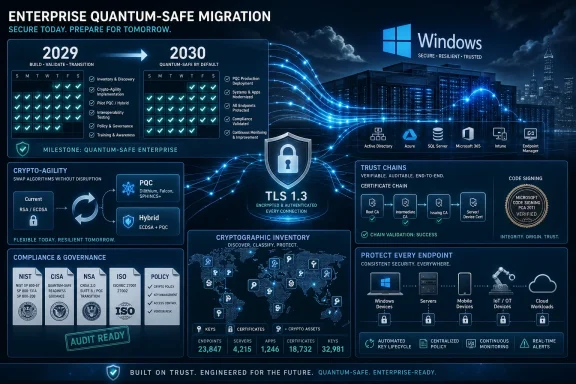 Microsoft Moves Quantum Safety Out of the Futures Lab
For years, post-quantum cryptography lived in the strange middle ground between science fiction and compliance planning. Everyone serious about security knew that sufficiently capable quantum computers would threaten RSA, elliptic-curve cryptography, and the public-key machinery behind much of the modern internet. Almost nobody wanted to own the spreadsheet showing where all that machinery was embedded.Microsoft’s new timeline is a signal that the spreadsheet era has arrived. The company is not saying that a cryptographically relevant quantum computer will appear tomorrow, nor is it claiming that every Windows endpoint is about to become obsolete. It is saying that the lead time required to replace cryptography across products, services, identities, certificates, signing systems, update channels, and customer integrations is long enough that waiting for certainty would be negligent.
That distinction matters. Security vendors have often abused quantum rhetoric, using Q-Day as a marketing accelerant for products that may or may not solve the hard operational problem. Microsoft’s framing is more sober and, for that reason, more consequential. The company is treating quantum risk as an infrastructure modernization problem, not a single-algorithm shopping trip.
The 2029 date gives the announcement its edge. Microsoft is setting a target for critical products and services that lands before several of the public-sector deadlines now forming around 2030. In enterprise procurement terms, that is the difference between “we are studying this” and “we expect our platforms to be ready before your auditors ask.”
The 2030 Wall Is Becoming Real
The timing is not happening in a vacuum. The United States has now moved to accelerate federal migration toward NIST-approved post-quantum cryptography, with high-value and high-impact systems facing earlier transition expectations than many agencies and contractors had likely budgeted for. France, through ANSSI, has also reportedly tied security product certification to quantum-safe encryption, with a 2027 certification pressure point and a 2030 procurement expectation for affected buyers.That is the sound of cryptography becoming policy. Once governments start connecting PQC to certification, acquisition, and critical infrastructure, the market follows whether or not every CIO has a quantum strategy memo. Vendors that sell into government, defense, healthcare, telecom, energy, finance, and industrial environments now have to assume that quantum-readiness language will enter contracts faster than their legacy products can be re-architected.
Microsoft’s 2029 target is therefore not merely a security milestone. It is a market positioning move. By saying its critical products and services will transition by then, Microsoft is giving large customers a planning anchor and telling regulators it wants to be upstream of the deadline rather than dragged behind it.
For WindowsForum readers, the practical implication is blunt: if you administer Microsoft-heavy environments, you should expect PQC readiness to start appearing in baselines, documentation, certificate guidance, TLS expectations, compliance mappings, and eventually procurement questionnaires. The first wave will not feel like a dramatic operating-system upgrade. It will feel like one more security control that suddenly has dates attached.
Standards Changed the Debate, but Not the Work
The post-quantum conversation became more concrete when NIST finalized its first PQC standards in 2024. ML-KEM became the primary key-establishment mechanism, while ML-DSA and SLH-DSA became signature standards for different deployment needs. That gave vendors something they had lacked for years: a standards-backed target.But standards do not automatically migrate systems. They do not find a hard-coded RSA dependency in an old line-of-business app. They do not rewrite a vendor appliance that only supports outdated TLS configurations. They do not update a firmware signing pipeline designed a decade ago by a team that has since reorganized twice.
This is why Microsoft’s blog emphasizes TLS 1.3, crypto-agility, and trust chains rather than simply celebrating PQC algorithms. The algorithm names matter, but they are not the bottleneck for most organizations. The bottleneck is knowing where cryptography lives and whether those systems can change without breaking production.
That is also why the “harvest now, decrypt later” problem keeps reappearing in official guidance. An attacker does not need a mature quantum computer today if the attacker can collect encrypted traffic or data now and decrypt it later. Data with long confidentiality lifetimes — state secrets, medical records, intellectual property, legal archives, financial records, identity material — creates risk before the quantum computer arrives.
Microsoft is effectively saying that the transition clock starts from the lifespan of the data and the complexity of the migration, not from the publication date of a future quantum benchmark.
TLS 1.3 Becomes the Boring Doorway to a Less Boring Future
Microsoft’s first practical priority is network cryptography: data in transit. That begins with modernization work many organizations already know they should have done, especially reducing or eliminating legacy protocol use and moving critical endpoints to TLS 1.3 by default. In the quantum-safe story, TLS 1.3 is not the destination; it is the cleaner foundation on which hybrid and post-quantum key exchange can be deployed as standards and implementations mature.This is an important corrective to the fantasy version of PQC migration. You cannot simply sprinkle post-quantum dust onto brittle protocol stacks and expect resilience. If an environment still depends on obsolete protocol versions, inconsistent cipher configurations, ancient middleware, or unmanaged inspection boxes, the first quantum-safe action may look suspiciously like ordinary hygiene.
That will frustrate teams looking for a shiny new control, but it is good security engineering. Protocol modernization reduces present-day attack surface while preparing for future key-exchange changes. It also gives administrators a narrower compatibility matrix when PQC-capable implementations arrive across clients, servers, proxies, gateways, and cloud services.
Windows environments are especially exposed to the messy middle here. Enterprises often run modern Microsoft 365 and Azure services alongside old Windows Server workloads, third-party VPNs, legacy domain integrations, embedded systems, and appliances whose firmware lifecycles are measured in geological time. The Microsoft-controlled portion may move quickly; the customer-controlled edge rarely does.
That is why the phrase critical endpoints negotiate TLS 1.3 by default is more consequential than it first appears. Defaults are how platform companies move the ecosystem. Once the default shifts, exceptions become visible, measurable, and eventually embarrassing.
Crypto-Agility Is the Part Everyone Praises and Few Have
The second priority is crypto-agility for stored data. In plain English, that means systems should be able to change cryptographic algorithms and parameters without being redesigned. In enterprise reality, it means many systems are not ready.Hard-coded algorithms, bespoke key handling, undocumented certificate dependencies, and application-level assumptions about cryptographic primitives are common. They are common because they worked. A development team made a reasonable choice years ago, shipped the product, moved on, and left behind a cryptographic decision that now behaves like structural concrete.
Microsoft’s emphasis on configurable cryptographic settings, standardized key management, and rotation is not novel, but the quantum deadline changes its urgency. Crypto-agility used to sound like architectural virtue. Now it is the difference between an orderly migration and a multi-year exception register.
Data at rest is also where organizations will discover that “encrypted” is not a sufficient inventory category. Encrypted how? With what key length? Managed by which service? Rotated on what schedule? Wrapped by what root? Stored in what hardware? Backed up where? Restored by whom? Dependent on which vendor?
Those questions are tedious, which is why they matter. Quantum-safe planning turns cryptography from an abstraction into an asset-management problem. The organizations that already struggle to maintain software bills of materials will find that cryptographic bills of materials are even more scattered.
Trust Chains Are Where the Migration Gets Political
Microsoft’s third priority — modernizing cryptographic trust chains — is the most difficult because it touches authority. Code signing, certificate issuance, key protection, update pipelines, identity systems, device trust, and hardware-backed keys are not just technical parts. They are the mechanisms by which platforms decide what is allowed to run, update, authenticate, and be believed.Changing those systems is harder than changing a web server cipher suite. A broken TLS configuration can cause an outage. A broken signing or certificate hierarchy can brick devices, block updates, invalidate software, or undermine the trust model of an entire platform.
This is where Microsoft’s Secure Future Initiative becomes relevant. After years of bruising security incidents and public criticism, Microsoft has been trying to impose more disciplined security engineering across the company. By placing PQC requirements inside SFI, Microsoft is presenting quantum safety as part of the same internal accountability structure: ownership, milestones, measurable progress, and executive visibility.
That is smart politics inside a company as large as Microsoft. Without a central forcing function, quantum-safe work would be easy to fragment across Windows, Azure, Microsoft 365, identity, developer tools, gaming, hardware, and supply-chain systems. Each team could plausibly wait for another dependency to move first. SFI gives the company a way to turn “important someday” into “assigned now.”
Customers should still be careful not to confuse a program with completion. Microsoft has announced a goal, not finished the migration. The hard details will come later: which products count as critical, which services move first, how hybrid modes are exposed, what breaks compatibility, how administrators audit readiness, and how quickly on-premises products inherit the work.
Hybrid Cryptography Will Be a Compatibility Era, Not a Moment
The industry is unlikely to leap cleanly from classical public-key cryptography to pure post-quantum deployments overnight. The more realistic path is hybrid cryptography, where classical and post-quantum mechanisms operate together during a transition period. That approach hedges against both quantum risk and the possibility that a newer algorithm encounters unforeseen cryptanalytic trouble.Hybrid deployments are reassuring in theory and awkward in practice. They can increase message sizes, stress protocol assumptions, complicate certificate chains, and expose brittle middleboxes. They also require careful interoperability testing, because the internet and enterprise networks are full of devices that do creative things to traffic they barely understand.
This is another reason Microsoft’s platform role matters. If Windows, Azure, Entra, Edge, .NET, Schannel, certificate services, management tooling, and cloud endpoints gradually absorb PQC-capable patterns, customers get a migration path that is at least partially paved. If the burden falls entirely on individual administrators and app teams, the result will be inconsistent and slow.
Developers will also need to unlearn some casual habits. Cryptographic libraries that made old choices easy may need new APIs, new defaults, and new failure modes. Application owners will need to test not only whether a connection succeeds, but whether it negotiates the intended protections under policy. Security teams will need telemetry that says more than “TLS is enabled.”
The uncomfortable truth is that crypto-agility is observability by another name. If you cannot see what algorithms, protocols, certificates, and keys are in use, you cannot change them with confidence.
The Inventory Is the Product
Microsoft’s customer guidance starts with inventory, and that is the right place to start. It is also the place where many programs will stall. Cryptographic inventory is not glamorous, and it does not map neatly to a single owner in most organizations.Network teams know some of the TLS landscape. PKI teams know some of the certificate estate. Application teams know some of the code-level dependencies. Cloud teams know some of the managed service defaults. Security teams know some of the policy requirements. Vendors know some of the embedded behavior they may not document clearly.
That fragmentation is the real enemy. A quantum-safe transition is not just about replacing algorithms; it is about finding every place where an algorithm choice became someone else’s hidden dependency. Organizations that cannot answer those questions will be forced into either dangerous assumptions or expensive emergency consulting.
The inventory also needs to be living, not a one-time assessment. Cryptography changes when applications are upgraded, certificates renew, vendors patch appliances, developers import libraries, cloud providers alter defaults, and merger activity drops another environment into the estate. A static report produced in 2026 will not save an organization from a 2030 procurement requirement.
For Windows-heavy shops, the inventory should span both Microsoft-native and non-Microsoft components. Group Policy, Intune, Defender, Entra, Azure Key Vault, AD CS, IIS, SQL Server, RDP exposure, VPN clients, third-party agents, backup products, EDR tools, and firmware update systems may all contain relevant cryptographic dependencies. The weakest link may be the appliance that nobody thinks about until the renewal quote arrives.
The Security Upside Arrives Before the Quantum Computer
One of the strongest arguments for starting now is that the work pays dividends even if quantum timelines slip. Cleaning up obsolete TLS, standardizing key management, reducing hard-coded cryptography, shortening certificate lifetimes where appropriate, improving signing auditability, and mapping cryptographic dependencies all improve current security posture.This is the part that should appeal to pragmatic administrators. The quantum threat may be uncertain in timing, but cryptographic sprawl is already real. Expired certificates still cause outages. Weak protocol support still creates exposure. Poor key rotation still increases blast radius. Unknown dependencies still turn routine upgrades into incident calls.
In that sense, PQC is becoming the forcing function for a cleanup the industry needed anyway. Much like zero trust absorbed a broad set of identity and segmentation reforms, quantum safety may become the banner under which organizations finally modernize cryptographic lifecycle management.
There is a risk, however, that the term becomes too broad to be useful. If every security vendor relabels ordinary key management as quantum-safe readiness, buyers will struggle to distinguish meaningful preparation from brochure compliance. Microsoft’s advantage is that it controls enough platform surface area to make actual changes. Its burden is that customers will expect proof.
That proof should come in the form of defaults, dashboards, policy controls, compatibility documentation, migration guides, and clear product timelines. A 2029 goal is useful, but administrators need intermediate signals long before then.
Windows Administrators Will Feel This as Policy Before They Feel It as Math
Most IT pros will not spend the next few years debating lattice assumptions or hash-based signature tradeoffs. They will encounter PQC through baselines, warnings, procurement language, and compatibility matrices. That is how deep cryptographic shifts usually reach operations teams.The first operational changes may look mundane. A vendor questionnaire asks whether a product supports NIST-approved PQC algorithms. A government customer demands a roadmap. A security baseline discourages older TLS. A certificate authority announces future changes. A cloud service exposes a preview mode. A compliance team adds “cryptographic inventory” to the annual evidence request.
Then the exceptions begin. A legacy app cannot handle TLS 1.3. A middlebox breaks hybrid key exchange. A device vendor has no firmware plan. A code-signing process uses a token or HSM that cannot support future algorithms. A backup archive contains data with a confidentiality lifetime longer than the cryptography protecting it.
None of this will feel like quantum computing. It will feel like enterprise IT.
That is why Microsoft’s timing matters for the Windows ecosystem. When Microsoft moves platform defaults, software vendors follow. When Microsoft bakes PQC requirements into its own security initiative, partners and customers adjust their roadmaps. When Microsoft says 2029, administrators should hear: your dependency chain needs to be understood before then.
The Vendor Timeline Is Now Part of the Risk Register
The largest customers will not be able to solve this entirely inside their own walls. Quantum-safe migration depends on vendor readiness, and vendor readiness is uneven by definition. Some suppliers will have serious cryptographic engineering teams. Others will discover the requirement when a customer adds it to a renewal clause.This creates a new kind of third-party risk. It is not enough to ask whether a vendor encrypts data. Buyers will need to ask whether the vendor can change encryption schemes, whether it has inventoried its own dependencies, whether it supports modern protocols, whether its signing and update process has a PQC roadmap, and whether its hardware roots of trust can survive the transition.
Microsoft will be both a vendor under scrutiny and a vendor applying scrutiny. Its own procurement, partner, and certification ecosystems could become powerful levers for adoption. If Microsoft requires PQC readiness from suppliers tied to critical services, the effect will ripple well beyond Redmond.
The awkward middle will be on-premises and long-lived systems. Cloud services can be upgraded centrally, though not painlessly. Installed software, appliances, industrial systems, and embedded devices move at the speed of customer change windows and vendor support contracts. Those are the places where 2030 is closer than it looks.
The lesson from past migrations is that deprecation deadlines do not fail at the shiny edge. They fail in the forgotten corner that still performs a business-critical function and has not had a clean owner since 2014.
Microsoft’s 2029 Promise Turns Quantum Safety Into a Work Plan
The near-term value of Microsoft’s announcement is not that it settles the quantum debate. It does not. Experts still disagree on when a cryptographically relevant quantum computer will arrive, and there is no single countdown clock that can make the uncertainty vanish.The value is that Microsoft has converted uncertainty into a work plan. The plan says to modernize network cryptography, build crypto-agility for stored data, and harden the trust chains that make software, devices, identities, and services reliable. It says to start with inventory and prioritize systems based on sensitivity, lifespan, and operational importance.
That is a defensible strategy because it does not require betting the company on a precise quantum arrival date. If quantum capabilities accelerate, the organization is better prepared. If they take longer, the organization still gets better cryptographic hygiene, better visibility, and less technical debt.
There will be costs. PQC migration will consume engineering time, testing capacity, vendor-management attention, and change-control bandwidth. It may expose uncomfortable truths about legacy estates. It may force upgrades that organizations would rather defer.
But delay has a cost too, and it compounds. The longer cryptographic dependencies remain invisible, the more expensive they become to replace under pressure. Microsoft’s message is that the cheap phase of the migration is the phase before everyone is doing it at once.
The Calendar Now Belongs in Every Crypto Conversation
Microsoft’s accelerated timeline gives administrators and security leaders several concrete planning points to carry into the next budget cycle. The details will evolve, but the direction is now clear enough to act.- Microsoft is targeting 2029 for transitioning critical products and services in its Quantum Safe Program to post-quantum cryptography.
- Government pressure is converging around earlier action, with 2030 becoming a practical deadline for high-risk systems, procurement, and certification in multiple jurisdictions.
- TLS 1.3 adoption is a near-term prerequisite for cleaner post-quantum and hybrid cryptographic deployment across data-in-transit scenarios.
- The hardest enterprise task is building and maintaining a cryptographic inventory that spans applications, services, certificates, identities, hardware, and vendors.
- Crypto-agility should be treated as an architectural requirement for new systems, not as a retrofit project postponed until a quantum computer arrives.
- Trust-chain modernization, including signing, certificate issuance, hardware-backed keys, and update pipelines, is likely to be the slowest and most sensitive part of the transition.
References
- Primary source: Microsoft
Published: 2026-06-30T19:45:07.521089
Loading…
www.microsoft.com - Related coverage: marketscreener.com
Loading…
www.marketscreener.com - Related coverage: arstechnica.com
Loading…
arstechnica.com - Related coverage: cryptobriefing.com
Loading…
cryptobriefing.com - Related coverage: uk.investing.com
Loading…
uk.investing.com - Related coverage: whitehouse.gov
Loading…
www.whitehouse.gov
- Related coverage: tomshardware.com
Microsoft announces Majorana 2 quantum computing chip — claims a practical machine will come in 2029 | Tom's Hardware
With new materials, Microsoft is accelerating its quantum roadmap.www.tomshardware.com - Related coverage: techradar.com
Loading…
www.techradar.com - Related coverage: philadelphiafed.org
Loading…
www.philadelphiafed.org - Official source: nist.gov
Loading…
www.nist.gov - Related coverage: kaspersky.com
Loading…
www.kaspersky.com - Related coverage: cipherready.com
Loading…
cipherready.com - Official source: csrc.nist.gov
Loading…
csrc.nist.gov - Related coverage: nsa.gov
Loading…
www.nsa.gov - Related coverage: threatbasis.io
Loading…
threatbasis.io