

CalendarBridge announced on June 30, 2026, that its calendar synchronization service now supports Microsoft 365 GCC High tenants, extending cross-calendar availability syncing to U.S. government contractors, public sector partners, and regulated organizations working inside Microsoft’s higher-assurance government cloud. The feature is narrow on paper and more interesting in practice: it tackles one of the least glamorous problems in secure collaboration, the calendar boundary. In regulated Microsoft 365 environments, that boundary is not an inconvenience to be engineered away; it is the point of the architecture. CalendarBridge is betting that availability can move across those walls without dragging sensitive meeting data along with it.
Calendar synchronization rarely gets treated as infrastructure. It is usually filed under productivity, somewhere between scheduling links and inbox hygiene, the sort of software category that executives notice only when their assistants complain. But in GCC High environments, the humble calendar becomes a compliance object because the details inside it can reveal contracts, programs, partners, locations, travel, investigations, and internal decision rhythms.
That is why CalendarBridge’s announcement is not just another integration badge. Microsoft 365 GCC High exists for organizations that operate under stricter U.S. government and defense-related security expectations than ordinary commercial tenants. It is used by agencies, defense contractors, and parts of the Defense Industrial Base that need controls aligned with federal compliance regimes and data-handling requirements.
The immediate pitch is simple: users with calendars spread across Microsoft 365, Google, Outlook, iCloud, standard Microsoft 365 tenants, and now Microsoft 365 GCC High can keep availability accurate without merging accounts or exposing more than necessary. The bigger claim is that secure collaboration should not require people to choose between tenant separation and basic operational sanity.
That is a real problem. Anyone who has worked with consultants, cleared contractors, systems integrators, law firms, public sector customers, or heavily regulated programs knows the pattern. A worker may have a corporate calendar, one or more client-issued calendars, a personal calendar, and perhaps a separate tenant used for a specific project enclave. Each calendar is “correct” within its own domain, but no single calendar tells the truth.
GCC High sits in the particularly awkward middle of modern collaboration. It is not the fully isolated DoD cloud, but it is also not ordinary Microsoft 365 with a government label slapped on the invoice. It is designed for organizations that handle sensitive U.S. government-related workloads, including defense contractors and entities subject to heightened compliance demands.
That distinction matters because many third-party SaaS products stumble not on user interface but on cloud boundary. An app that works against commercial Microsoft Graph endpoints does not automatically behave correctly in national cloud environments. Authentication endpoints, service availability, permissions, tenant policies, conditional access, and administrative consent flows can all vary.
The result is that government cloud users often live with a delayed or diminished version of the SaaS ecosystem. Features arrive later, integrations are missing, and vendors sometimes quietly avoid the market because the compliance, engineering, and support burden is disproportionate to the number of eligible customers. For small vendors, supporting GCC High is less like flipping a feature flag and more like agreeing to operate in a different climate.
CalendarBridge’s announcement therefore reads as a marker of intent. The company is saying it wants to sell into a market where customers ask harder questions about data flow, authorization, retention, and exposure. That does not make the product automatically compliant with every customer’s obligations, but it does move calendar sync from “probably unavailable” to “available for assessment.”
A meeting title can disclose a pursuit, a bid, an incident, a vulnerability, a merger, a contract vehicle, a legal matter, or the name of a government customer. Attendee lists can map relationships. Locations can identify secure facilities or travel plans. Recurring meetings can reveal program cadence. Even a “harmless” forwarded invite can push sensitive context into a tenant that was never meant to receive it.
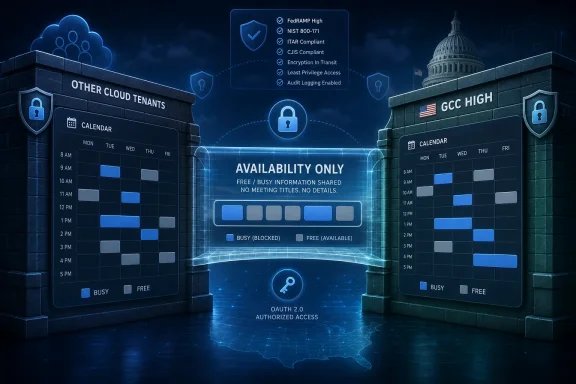
That is why the CalendarBridge emphasis on configurable privacy is central to the announcement. The company says organizations can choose what information is shared, including busy-only synchronization, so other calendars know a person is unavailable without seeing the meeting subject, attendees, location, or confidential details. In the regulated world, that is not merely a convenience feature; it is the product’s claim to legitimacy.
The alternative is often worse. Workers create manual holds, duplicate events, forward invites, or maintain shadow calendars. Those workarounds are familiar because they are easy, but they also undermine the very separation that GCC High tenants are meant to enforce. Manual duplication turns human judgment into the access-control layer, and human judgment is a terrible long-term security boundary.
This is the quiet practical value of automation in regulated environments. A well-designed sync tool can reduce the number of times users must decide what is safe to copy, paste, forward, rename, or conceal. The goal is not to eliminate risk. The goal is to make the safe path less tedious than the unsafe one.
The old enterprise collaboration fantasy was consolidation. Put everyone in one domain, one directory, one calendar system, one governance model, and one administrative perimeter. That was never fully realistic, and it is even less realistic for contractors and public sector partners. The modern enterprise is a federation of organizations that cooperate without becoming one organization.
Microsoft has invested heavily in cross-tenant collaboration across Entra ID, Teams, SharePoint, and Microsoft 365 more broadly. But cross-tenant collaboration does not magically solve every workflow. In fact, it can create new administrative questions about what exactly should be shared, with whom, under which policy, and for how long.
Calendars are one of the places where this gets painfully mundane. A consultant embedded in a client program may have a client-issued Microsoft 365 account because that is the only acceptable way to access Teams meetings, SharePoint sites, or project communications. That same person still has obligations to their employer, other clients, and perhaps internal delivery teams. Each party wants availability to be accurate, but none wants to inherit the full data exhaust of the others.
A sync product that preserves tenant separation while sharing only availability is an attempt to align software behavior with organizational reality. It accepts that accounts will remain separate. It accepts that tenants will remain separate. It accepts that identity and compliance boundaries are not defects. Then it tries to make the user’s day less ridiculous anyway.
OAuth does not mean “safe” by itself. It means the product is asking for delegated access through a formal authorization flow rather than asking users to hand over credentials. The real security questions are about scopes, admin consent, data retention, logging, revocation, conditional access behavior, and what the service does after it receives authorization.
The company’s positioning is clearly meant to answer some of those questions before administrators ask them. CalendarBridge says it does not require domain merges, tenant consolidation, or software installation on end-user devices. It also says it does not access email, files, contacts, or global address books, and that calendar data passes through transiently for synchronization without storing event details.
Those claims will matter to IT reviewers, but they will not end the review. In GCC High environments, procurement and security teams will still want documentation, contractual commitments, architecture diagrams, incident-response language, data-processing details, and clarity around where the service itself runs. A product can support GCC High authentication and still require careful customer-side risk assessment.
That is not a criticism of CalendarBridge so much as the reality of this market. Government contractors do not buy integrations the way a startup buys a scheduling app. They need to know whether a tool’s operating model matches their policies and whether its data path creates obligations they did not already have.
A worker blocks time manually on a second calendar. An executive assistant forwards a meeting invite to a personal or company account. A contractor renames sensitive meetings as “busy.” A project manager tells everyone to maintain duplicate holds for a recurring call. None of these actions feels like a system design decision, but collectively they form an unofficial integration layer.
The danger is that unofficial integration layers lack policy. They do not have consistent privacy controls. They do not generate clean administrative artifacts. They depend on users remembering which details can cross which boundary on which day. When they fail, they fail quietly until someone discovers a disclosure, a missed meeting, or a compliance headache.
Automated availability sync can be safer precisely because it is less imaginative. The system can be configured to move only the minimum useful signal: this person is busy at this time. That is not glamorous, but it is often exactly what scheduling requires.
This is why CalendarBridge’s expansion into GCC High has an understated but practical importance. It does not promise to unify government collaboration. It promises to stop calendars from lying. In the lived reality of multi-tenant work, that is a more valuable promise than it sounds.
Commercial Microsoft 365 users take this ecosystem for granted. They expect scheduling tools, CRM systems, ticketing platforms, compliance tools, analytics products, and workflow automation services to integrate with Microsoft identity and calendar data. GCC High customers cannot assume the same coverage.
This creates a productivity tax on regulated organizations. They often pay more for cloud services, face tighter controls, and then discover that common add-ons either do not support their environment or support it only partially. The penalty is not just financial. It is operational, because missing integrations push users back toward manual workarounds.
CalendarBridge is entering that gap with a narrow product, but narrow products matter in high-friction environments. A contractor does not need every SaaS vendor in the world to support GCC High on the same day. It needs the few tools that remove daily pain without undermining compliance assumptions.
The lesson for vendors is equally clear. Government cloud support is no longer a prestige checkbox reserved for the largest enterprise platforms. As more contractors modernize around Microsoft 365 government environments, smaller workflow tools will be judged by whether they understand national cloud realities. “Works with Microsoft 365” is no longer specific enough.
An IT team evaluating this kind of product should start with data classification. If busy-only synchronization is sufficient, the risk profile is very different from a configuration that syncs subjects, locations, notes, or attendees. The default should be minimum disclosure, especially when one side of the sync touches a GCC High tenant.
The next issue is consent. In a regulated tenant, delegated access should not be a casual user decision. Administrators will want to control who can authorize the application, what scopes it receives, and whether access can be limited to specific users or groups. They will also want a clean revocation process for offboarding, contract completion, or incident response.
Logging and monitoring matter as well. Calendar synchronization is easy to ignore once it works, which is precisely why administrators should understand what events are recorded, where logs live, and how anomalies would be detected. A sync loop that touches multiple calendars can become part of the organization’s operational truth; it should not be administratively invisible.
Finally, organizations should treat the service as part of their broader collaboration architecture, not as a personal productivity app. If the business case is cross-tenant availability, then policy should say which cross-tenant patterns are acceptable. Otherwise, every user invents their own version of “safe enough.”
Control means deciding how much calendar information crosses a boundary. Control means avoiding tenant consolidation just to fix scheduling. Control means using OAuth rather than credential collection. Control means not requiring endpoint software that expands the device-management problem. Control means keeping account ownership where it belongs.
This is especially relevant for contractors who receive accounts inside customer environments. A client-issued account is often a tool of governance as much as a convenience. It allows the client to apply its own access policies, retention expectations, and collaboration boundaries. But the user behind that account still has a life outside the client tenant.
That tension is not going away. If anything, it will become more common as public sector programs, defense contractors, consultants, and specialized vendors collaborate through controlled cloud enclaves. The future of enterprise software is not one universal workspace. It is many controlled workspaces stitched together by carefully limited signals.
CalendarBridge is positioning calendar availability as one of those signals. That is a modest ambition, but it fits the moment. The safest integration is often not the one that shares the most data. It is the one that shares just enough to remove the incentive for worse behavior.
Every enterprise has a shadow workflow economy. Users develop rituals to bridge the gaps between official systems. They forward emails to themselves, save files locally, paste data into spreadsheets, screenshot dashboards, and duplicate calendar entries. These behaviors are not always malicious; usually they are rational responses to broken workflows.
The compliance challenge is to make sanctioned workflows good enough that users do not need shadow ones. That is why small integrations can have outsized importance. A better calendar sync tool will not satisfy a CMMC assessment by itself, and it will not turn an unmanaged process into a governed program overnight. But it can remove one common reason users mishandle information.
There is also a cultural point here. When security teams say no to every convenience, users learn to route around them. When security teams provide controlled ways to accomplish ordinary work, they build credibility. Availability synchronization is ordinary work, but in GCC High contexts it needs an extraordinary amount of restraint.
CalendarBridge’s bet is that restraint can be productized. Not by pretending all calendars should become one calendar, but by letting separate calendars behave as if they understand each other’s free-busy reality. That is a subtle distinction, and it is the distinction on which the whole announcement rests.
The strongest fit appears to be contractors and professional services organizations that work across multiple client tenants. It also makes sense for public sector partners whose staff must maintain accurate availability across internal and customer-issued accounts. The value rises with every additional calendar a person is expected to monitor.
The weakest fit is an organization that has not yet defined its cross-tenant data-sharing rules. A tool like this can enforce choices, but it cannot make governance decisions on behalf of the business. If nobody knows whether meeting titles may cross from one tenant to another, the product configuration becomes a policy debate disguised as a setup screen.
Administrators should also resist the temptation to treat “busy-only” as a universal solvent. Busy-only synchronization reduces exposure, but it still reveals patterns of availability and unavailability. In most business contexts that is acceptable and necessary. In some highly sensitive roles or programs, even timing metadata may deserve additional scrutiny.
That nuance is what separates useful adoption from checkbox adoption. CalendarBridge’s GCC High support creates a new option. It does not eliminate the need to decide when that option is appropriate.
 Calendar Sync Becomes a Compliance Story
Calendar synchronization rarely gets treated as infrastructure. It is usually filed under productivity, somewhere between scheduling links and inbox hygiene, the sort of software category that executives notice only when their assistants complain. But in GCC High environments, the humble calendar becomes a compliance object because the details inside it can reveal contracts, programs, partners, locations, travel, investigations, and internal decision rhythms.That is why CalendarBridge’s announcement is not just another integration badge. Microsoft 365 GCC High exists for organizations that operate under stricter U.S. government and defense-related security expectations than ordinary commercial tenants. It is used by agencies, defense contractors, and parts of the Defense Industrial Base that need controls aligned with federal compliance regimes and data-handling requirements.
The immediate pitch is simple: users with calendars spread across Microsoft 365, Google, Outlook, iCloud, standard Microsoft 365 tenants, and now Microsoft 365 GCC High can keep availability accurate without merging accounts or exposing more than necessary. The bigger claim is that secure collaboration should not require people to choose between tenant separation and basic operational sanity.
That is a real problem. Anyone who has worked with consultants, cleared contractors, systems integrators, law firms, public sector customers, or heavily regulated programs knows the pattern. A worker may have a corporate calendar, one or more client-issued calendars, a personal calendar, and perhaps a separate tenant used for a specific project enclave. Each calendar is “correct” within its own domain, but no single calendar tells the truth.
GCC High Was Built to Keep Walls Standing
Microsoft’s government cloud lineup is not just a marketing segmentation exercise. GCC, GCC High, and DoD environments exist because certain customers cannot simply use the same cloud assumptions as the commercial market. They need different residency commitments, different operational controls, different endpoint behavior, and different eligibility boundaries.GCC High sits in the particularly awkward middle of modern collaboration. It is not the fully isolated DoD cloud, but it is also not ordinary Microsoft 365 with a government label slapped on the invoice. It is designed for organizations that handle sensitive U.S. government-related workloads, including defense contractors and entities subject to heightened compliance demands.
That distinction matters because many third-party SaaS products stumble not on user interface but on cloud boundary. An app that works against commercial Microsoft Graph endpoints does not automatically behave correctly in national cloud environments. Authentication endpoints, service availability, permissions, tenant policies, conditional access, and administrative consent flows can all vary.
The result is that government cloud users often live with a delayed or diminished version of the SaaS ecosystem. Features arrive later, integrations are missing, and vendors sometimes quietly avoid the market because the compliance, engineering, and support burden is disproportionate to the number of eligible customers. For small vendors, supporting GCC High is less like flipping a feature flag and more like agreeing to operate in a different climate.
CalendarBridge’s announcement therefore reads as a marker of intent. The company is saying it wants to sell into a market where customers ask harder questions about data flow, authorization, retention, and exposure. That does not make the product automatically compliant with every customer’s obligations, but it does move calendar sync from “probably unavailable” to “available for assessment.”
The Calendar Is a Metadata Leak Waiting to Happen
The security argument for busy-only calendar synchronization is stronger than it first appears. Meeting metadata can be enormously revealing. A calendar entry does not need to include classified material or controlled technical information to expose sensitive patterns.A meeting title can disclose a pursuit, a bid, an incident, a vulnerability, a merger, a contract vehicle, a legal matter, or the name of a government customer. Attendee lists can map relationships. Locations can identify secure facilities or travel plans. Recurring meetings can reveal program cadence. Even a “harmless” forwarded invite can push sensitive context into a tenant that was never meant to receive it.
That is why the CalendarBridge emphasis on configurable privacy is central to the announcement. The company says organizations can choose what information is shared, including busy-only synchronization, so other calendars know a person is unavailable without seeing the meeting subject, attendees, location, or confidential details. In the regulated world, that is not merely a convenience feature; it is the product’s claim to legitimacy.
The alternative is often worse. Workers create manual holds, duplicate events, forward invites, or maintain shadow calendars. Those workarounds are familiar because they are easy, but they also undermine the very separation that GCC High tenants are meant to enforce. Manual duplication turns human judgment into the access-control layer, and human judgment is a terrible long-term security boundary.
This is the quiet practical value of automation in regulated environments. A well-designed sync tool can reduce the number of times users must decide what is safe to copy, paste, forward, rename, or conceal. The goal is not to eliminate risk. The goal is to make the safe path less tedious than the unsafe one.
Tenant Separation Is Not the Enemy of Productivity
CalendarBridge founder Paul Everton framed the announcement around organizations that work across multiple tenants and security boundaries. That is the right framing because the problem is not that GCC High customers have too many walls. The problem is that work increasingly happens across walls that must remain intact.The old enterprise collaboration fantasy was consolidation. Put everyone in one domain, one directory, one calendar system, one governance model, and one administrative perimeter. That was never fully realistic, and it is even less realistic for contractors and public sector partners. The modern enterprise is a federation of organizations that cooperate without becoming one organization.
Microsoft has invested heavily in cross-tenant collaboration across Entra ID, Teams, SharePoint, and Microsoft 365 more broadly. But cross-tenant collaboration does not magically solve every workflow. In fact, it can create new administrative questions about what exactly should be shared, with whom, under which policy, and for how long.
Calendars are one of the places where this gets painfully mundane. A consultant embedded in a client program may have a client-issued Microsoft 365 account because that is the only acceptable way to access Teams meetings, SharePoint sites, or project communications. That same person still has obligations to their employer, other clients, and perhaps internal delivery teams. Each party wants availability to be accurate, but none wants to inherit the full data exhaust of the others.
A sync product that preserves tenant separation while sharing only availability is an attempt to align software behavior with organizational reality. It accepts that accounts will remain separate. It accepts that tenants will remain separate. It accepts that identity and compliance boundaries are not defects. Then it tries to make the user’s day less ridiculous anyway.
OAuth Is Necessary, but It Is Not a Magic Word
CalendarBridge says its Microsoft 365 integration uses OAuth2-based authorization and does not collect or store passwords. That is table stakes for a modern cloud integration, but it is still worth stating because password-based calendar sync is exactly the sort of legacy pattern security teams should reject.OAuth does not mean “safe” by itself. It means the product is asking for delegated access through a formal authorization flow rather than asking users to hand over credentials. The real security questions are about scopes, admin consent, data retention, logging, revocation, conditional access behavior, and what the service does after it receives authorization.
The company’s positioning is clearly meant to answer some of those questions before administrators ask them. CalendarBridge says it does not require domain merges, tenant consolidation, or software installation on end-user devices. It also says it does not access email, files, contacts, or global address books, and that calendar data passes through transiently for synchronization without storing event details.
Those claims will matter to IT reviewers, but they will not end the review. In GCC High environments, procurement and security teams will still want documentation, contractual commitments, architecture diagrams, incident-response language, data-processing details, and clarity around where the service itself runs. A product can support GCC High authentication and still require careful customer-side risk assessment.
That is not a criticism of CalendarBridge so much as the reality of this market. Government contractors do not buy integrations the way a startup buys a scheduling app. They need to know whether a tool’s operating model matches their policies and whether its data path creates obligations they did not already have.
The Real Competitor Is the Workaround
CalendarBridge’s biggest competitor may not be another calendar sync vendor. It may be the copy-and-paste calendar culture that already exists in every fragmented organization. That culture survives because it is free, immediate, and invisible to procurement.A worker blocks time manually on a second calendar. An executive assistant forwards a meeting invite to a personal or company account. A contractor renames sensitive meetings as “busy.” A project manager tells everyone to maintain duplicate holds for a recurring call. None of these actions feels like a system design decision, but collectively they form an unofficial integration layer.
The danger is that unofficial integration layers lack policy. They do not have consistent privacy controls. They do not generate clean administrative artifacts. They depend on users remembering which details can cross which boundary on which day. When they fail, they fail quietly until someone discovers a disclosure, a missed meeting, or a compliance headache.
Automated availability sync can be safer precisely because it is less imaginative. The system can be configured to move only the minimum useful signal: this person is busy at this time. That is not glamorous, but it is often exactly what scheduling requires.
This is why CalendarBridge’s expansion into GCC High has an understated but practical importance. It does not promise to unify government collaboration. It promises to stop calendars from lying. In the lived reality of multi-tenant work, that is a more valuable promise than it sounds.
Microsoft’s Government Cloud Ecosystem Still Has a Long Tail Problem
The announcement also highlights a persistent weakness in the Microsoft government cloud ecosystem: third-party support often arrives unevenly. Microsoft can build the cloud, publish the endpoints, document the compliance posture, and sell the licenses. But the day-to-day usefulness of that environment depends heavily on whether the surrounding SaaS universe shows up.Commercial Microsoft 365 users take this ecosystem for granted. They expect scheduling tools, CRM systems, ticketing platforms, compliance tools, analytics products, and workflow automation services to integrate with Microsoft identity and calendar data. GCC High customers cannot assume the same coverage.
This creates a productivity tax on regulated organizations. They often pay more for cloud services, face tighter controls, and then discover that common add-ons either do not support their environment or support it only partially. The penalty is not just financial. It is operational, because missing integrations push users back toward manual workarounds.
CalendarBridge is entering that gap with a narrow product, but narrow products matter in high-friction environments. A contractor does not need every SaaS vendor in the world to support GCC High on the same day. It needs the few tools that remove daily pain without undermining compliance assumptions.
The lesson for vendors is equally clear. Government cloud support is no longer a prestige checkbox reserved for the largest enterprise platforms. As more contractors modernize around Microsoft 365 government environments, smaller workflow tools will be judged by whether they understand national cloud realities. “Works with Microsoft 365” is no longer specific enough.
The Feature Is Small, the Governance Question Is Not
For administrators, the practical question is not whether calendar sync is useful. It is how to govern it. The announcement’s appeal will be strongest for organizations where users already juggle multiple tenants and where manual calendar copying has become normalized.An IT team evaluating this kind of product should start with data classification. If busy-only synchronization is sufficient, the risk profile is very different from a configuration that syncs subjects, locations, notes, or attendees. The default should be minimum disclosure, especially when one side of the sync touches a GCC High tenant.
The next issue is consent. In a regulated tenant, delegated access should not be a casual user decision. Administrators will want to control who can authorize the application, what scopes it receives, and whether access can be limited to specific users or groups. They will also want a clean revocation process for offboarding, contract completion, or incident response.
Logging and monitoring matter as well. Calendar synchronization is easy to ignore once it works, which is precisely why administrators should understand what events are recorded, where logs live, and how anomalies would be detected. A sync loop that touches multiple calendars can become part of the organization’s operational truth; it should not be administratively invisible.
Finally, organizations should treat the service as part of their broader collaboration architecture, not as a personal productivity app. If the business case is cross-tenant availability, then policy should say which cross-tenant patterns are acceptable. Otherwise, every user invents their own version of “safe enough.”
The Vendor Message Is Privacy, but the Buyer Message Is Control
CalendarBridge’s press language emphasizes privacy-conscious synchronization. That is the right public message, and it maps well to user anxiety about exposing meeting details. But for IT buyers, the deeper message is control.Control means deciding how much calendar information crosses a boundary. Control means avoiding tenant consolidation just to fix scheduling. Control means using OAuth rather than credential collection. Control means not requiring endpoint software that expands the device-management problem. Control means keeping account ownership where it belongs.
This is especially relevant for contractors who receive accounts inside customer environments. A client-issued account is often a tool of governance as much as a convenience. It allows the client to apply its own access policies, retention expectations, and collaboration boundaries. But the user behind that account still has a life outside the client tenant.
That tension is not going away. If anything, it will become more common as public sector programs, defense contractors, consultants, and specialized vendors collaborate through controlled cloud enclaves. The future of enterprise software is not one universal workspace. It is many controlled workspaces stitched together by carefully limited signals.
CalendarBridge is positioning calendar availability as one of those signals. That is a modest ambition, but it fits the moment. The safest integration is often not the one that shares the most data. It is the one that shares just enough to remove the incentive for worse behavior.
The Scheduling Layer Moves Into the Compliance Stack
The easy way to dismiss this announcement is to say that calendar sync is not security infrastructure. That misses how security failures often emerge. They do not always begin with a dramatic exploit or a zero-day. Sometimes they begin with a user trying to avoid missing a meeting.Every enterprise has a shadow workflow economy. Users develop rituals to bridge the gaps between official systems. They forward emails to themselves, save files locally, paste data into spreadsheets, screenshot dashboards, and duplicate calendar entries. These behaviors are not always malicious; usually they are rational responses to broken workflows.
The compliance challenge is to make sanctioned workflows good enough that users do not need shadow ones. That is why small integrations can have outsized importance. A better calendar sync tool will not satisfy a CMMC assessment by itself, and it will not turn an unmanaged process into a governed program overnight. But it can remove one common reason users mishandle information.
There is also a cultural point here. When security teams say no to every convenience, users learn to route around them. When security teams provide controlled ways to accomplish ordinary work, they build credibility. Availability synchronization is ordinary work, but in GCC High contexts it needs an extraordinary amount of restraint.
CalendarBridge’s bet is that restraint can be productized. Not by pretending all calendars should become one calendar, but by letting separate calendars behave as if they understand each other’s free-busy reality. That is a subtle distinction, and it is the distinction on which the whole announcement rests.
Where the Announcement Leaves IT Buyers
The new support is available now to eligible CalendarBridge customers with Microsoft 365 GCC High tenant requirements, according to the company’s announcement. That wording is important. This is not a universal invitation for any consumer user to wire up a government cloud tenant. It is aimed at organizations that already have GCC High requirements and the administrative maturity to evaluate a third-party integration.The strongest fit appears to be contractors and professional services organizations that work across multiple client tenants. It also makes sense for public sector partners whose staff must maintain accurate availability across internal and customer-issued accounts. The value rises with every additional calendar a person is expected to monitor.
The weakest fit is an organization that has not yet defined its cross-tenant data-sharing rules. A tool like this can enforce choices, but it cannot make governance decisions on behalf of the business. If nobody knows whether meeting titles may cross from one tenant to another, the product configuration becomes a policy debate disguised as a setup screen.
Administrators should also resist the temptation to treat “busy-only” as a universal solvent. Busy-only synchronization reduces exposure, but it still reveals patterns of availability and unavailability. In most business contexts that is acceptable and necessary. In some highly sensitive roles or programs, even timing metadata may deserve additional scrutiny.
That nuance is what separates useful adoption from checkbox adoption. CalendarBridge’s GCC High support creates a new option. It does not eliminate the need to decide when that option is appropriate.
The Calendar Boundary Finally Gets Its Due
CalendarBridge’s GCC High announcement is worth paying attention to because it turns a daily annoyance into an architectural question. The most concrete lessons are not about one vendor’s product page, but about how regulated collaboration actually works when people have too many calendars and too few safe bridges.- CalendarBridge now supports Microsoft 365 GCC High tenants for organizations that need secure availability synchronization across separate calendar systems.
- The most important privacy feature is the ability to share availability without exposing meeting subjects, attendees, locations, or other sensitive details.
- GCC High support matters because national cloud environments require different assumptions than ordinary commercial Microsoft 365 integrations.
- The practical alternative to controlled sync is often manual duplication, forwarded invites, and shadow calendar practices that are harder to govern.
- IT teams should evaluate authorization scopes, consent controls, logging, retention, revocation, and data-flow documentation before approving use in regulated environments.
- The feature is most compelling for contractors, consultants, public sector partners, and multi-tenant organizations whose users already work across separate Microsoft 365 boundaries.
References
- Primary source: The Manila Times
Published: Tue, 30 Jun 2026 13:07:15 GMT
Loading…
www.manilatimes.net - Official source: learn.microsoft.com
Loading…
learn.microsoft.com - Official source: support.microsoft.com
GCC information | Microsoft Support
This article answers the most Frequently Asked Questions about GCC information for Microsoft Forms.support.microsoft.com - Official source: microsoft.com
Your request has been blocked. This could be due to several reasons.
www.microsoft.com
- Related coverage: help.calendarbridge.com
Loading…
help.calendarbridge.com - Official source: devblogs.microsoft.com
Loading…
devblogs.microsoft.com
- Related coverage: techtarget.com
Understanding Microsoft 365 GCC High and other licenses | TechTarget
Microsoft 365 GCC High provides many of the same services as the public versions of Microsoft 365. Learn the security benefits that help it stand out.www.techtarget.com - Official source: download.microsoft.com
- Official source: cdn-dynmedia-1.microsoft.com
Loading…
cdn-dynmedia-1.microsoft.com