

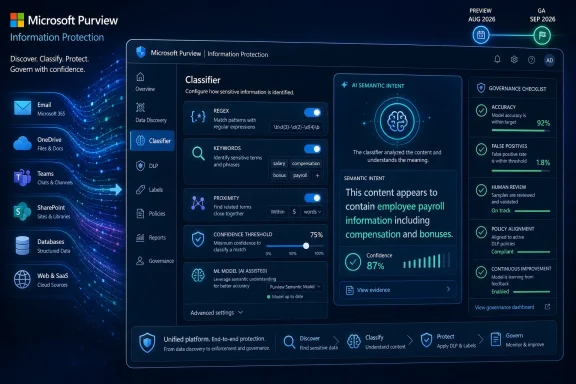
Microsoft added Microsoft Purview Information Protection roadmap item 560708 on April 21, 2026, and updated it on June 30, promising an AI-powered feature that will generate human-readable “semantic intent” descriptions for custom Sensitive Information Types in the Purview web experience, with preview planned for August 2026 and general availability in September 2026. The feature sounds small, almost clerical: a classifier gets an explanation. But in Microsoft’s data-security stack, that explanation is the thin line between policy engineering and guesswork. If it works, Purview will not merely detect sensitive data; it will start telling administrators what their own rules appear to mean.
The most revealing phrase in the roadmap entry is not “AI-powered.” It is “human-readable.” Microsoft is acknowledging a problem that every compliance team eventually meets: a custom classifier can be technically valid and operationally useless if nobody can explain, with confidence, what business intent it encodes.
Sensitive Information Types, or SITs, sit underneath many Purview scenarios. They help identify data such as credit card numbers, government identifiers, health information, employee IDs, customer numbers, contract references, and the many strange local formats that only a particular enterprise understands. Microsoft ships a large catalog of built-in SITs, but the real work begins when organizations create their own.
That custom layer is where theory meets the mess of the enterprise. A bank may need to detect internal account references that look like ordinary numbers. A hospital may need to distinguish patient identifiers from appointment codes. A manufacturer may care about part numbers, supplier IDs, export-control phrases, and design-document markings that have accumulated over decades.
Purview already gives administrators a rule language for this. A SIT can combine a primary element, such as a regular expression or keyword dictionary, with supporting elements, proximity settings, confidence levels, and validators. The feature now on the roadmap appears designed to stand over that machinery and answer a deceptively simple question: What is this classifier trying to find?
That is not documentation in the old sense. It is interpretation. And interpretation is where AI has become most useful in administrative software: not by replacing the policy owner, but by translating brittle configuration into a sentence that a human can challenge.
A nine-digit number by itself may be nothing. A nine-digit number near “SSN” is more likely to be a Social Security number. A customer reference near “account holder” may be regulated data in one company and harmless metadata in another. The same string can be noise, evidence, or a red flag depending on context.
Purview’s confidence model is built around that reality. Low-confidence matches catch more but generate more noise. High-confidence matches reduce false positives but risk missing edge cases. Supporting elements improve the odds that the classifier has found what the business actually cares about. Proximity rules try to make context measurable.
The trouble is that these mechanics can become opaque even to the people who created them. A custom SIT built during a privacy project in 2023 may still be driving DLP decisions in 2026, long after the author has moved teams. Its name might say “Customer ID,” but its regex may match invoice numbers, CRM exports, legacy database keys, or all of the above.
That opacity has practical consequences. False positives train users to ignore warnings. False negatives give administrators false comfort. Overbroad classifiers can create alert storms, slow endpoint classification, or cause files and emails to be labeled in ways that make employees distrust the entire system. The risk is not simply that Purview misses data; it is that the organization loses confidence in Purview.
An AI-generated intent description attacks that failure mode directly. Instead of making an admin reverse-engineer a SIT from regexes, dictionaries, validators, and confidence settings, Purview can summarize what the classifier appears semantically designed to detect. That makes the classifier reviewable.
Enterprises do not only need controls. They need controls they can explain to auditors, business owners, privacy officers, and incident responders. A DLP policy that blocks documents containing “Confidential Project Orion” may be easy to describe. A policy driven by five custom SITs, three copied templates, two aging keyword dictionaries, and a dozen proximity decisions is harder.
The semantic-intent feature could create a bridge between policy builders and policy approvers. A compliance analyst could look at a generated description and see whether it matches the intended business rule. A security engineer could spot that a classifier meant to detect employee IDs is actually broad enough to match procurement numbers. A legal reviewer could understand why a policy is touching certain documents without learning Purview’s internal grammar.
This is also where Microsoft’s timing matters. Purview is no longer only about classic DLP and retention. Microsoft has been pushing it as the data-security layer for the AI era, especially as organizations deploy Microsoft 365 Copilot and other generative AI tools across large document estates. The more AI systems can reason over enterprise content, the more important accurate classification becomes.
Bad classification used to mean a misplaced label or a noisy alert. In an AI-enabled workplace, bad classification can also mean sensitive data is made available to summarization, search, prompt workflows, or downstream governance reports in ways the organization did not intend. Microsoft has an obvious incentive to make Purview’s classification layer more legible before customers discover that their AI ambitions rest on shaky metadata.
The new feature therefore fits a broader arc: Microsoft is turning Purview from a compliance console into a data-risk operating system. The problem is that operating systems need introspection. Administrators need to know not only what policies exist, but what those policies are doing and why.
A classifier behaves according to its configuration and the content it scans. If a regex is overbroad, if a keyword dictionary is stale, if proximity is too generous, or if confidence levels are poorly chosen, the classifier will still do what those settings dictate. The AI-generated sentence may help reveal that mismatch, but it could also create a false sense of clarity.
This is the familiar danger of AI summaries in administrative systems. They are seductive because they compress complexity into language. But language has a way of sounding more certain than the underlying evidence deserves. A generated description that says a classifier detects “employee identification numbers in HR documents” may be directionally useful, yet the classifier may still match ticket IDs in IT logs or account numbers in finance exports.
That distinction matters for administrators. The AI’s explanation should be treated as a review artifact, not an authority. It can help humans ask better questions, but it should not become the only evidence that a SIT is fit for production.
Microsoft’s own language leaves room for that interpretation. The feature is described as helping customers refine classifiers for accuracy and fewer false positives. It is not described as automatically fixing them. That is the right boundary. The best version of this feature is not an autopilot; it is a diagnostic lens.
The worst version would be a confidence theater: a neat summary beside a messy classifier, encouraging teams to approve policies faster because the UI now speaks in complete sentences. In security and compliance, fluent explanations can be as risky as bad defaults if they are not tied to testing.
The built-in catalog can cover passports, tax identifiers, credit card numbers, health record formats, and many national or regional data types. But no vendor can predefine every sensitive pattern inside a multinational company. The most valuable identifiers are often local: a shipment code that reveals a defense customer, a grant number tied to medical research, a supplier phrase that indicates a pending acquisition, or a legacy database key that has escaped into spreadsheets.
That is why custom SITs are powerful. It is also why they are fragile. They often begin as urgent fixes. Someone notices that a DLP policy misses a critical pattern, so an admin creates a regex. Then another team asks for a keyword. Then the classifier is copied, modified, and reused in a sensitivity-labeling policy. Months later, it is part of the organization’s compliance posture.
The documentation debt compounds quickly. Names drift from behavior. Descriptions become aspirational. Supporting elements are added without removing obsolete ones. Confidence levels are chosen based on a test set that no longer resembles the production content estate.
AI-generated intent descriptions could help expose that drift. If the classifier’s generated purpose does not match the team’s memory of why it exists, that is a signal. If two different custom SITs generate nearly identical intent, that suggests duplication. If a classifier’s intent sounds broader than its name, it may be overmatching. If it sounds narrower, it may be under-detecting.
This is the kind of administrative AI that may actually earn its keep. It does not need to be magical. It needs to make accumulated configuration debt visible.
Generative AI changes that bargain. A tool that can summarize, search, reason across documents, and answer questions from corporate content puts more pressure on the access-control and classification layers beneath it. If a sensitive document is overshared, mislabeled, or misunderstood by policy, AI does not create the underlying governance failure. It reveals and accelerates it.
Microsoft knows this, which is why Purview has become central to its Copilot security story. The company wants customers to believe that existing information protection controls carry forward into AI experiences. That claim depends on organizations having controls worth carrying forward.
This is where the roadmap item becomes more than a UI nicety. If an enterprise is preparing Copilot rollout, building DLP policies for AI prompts, reviewing overshared content, or mapping sensitive data across Microsoft 365, it needs to trust its classifiers. Custom SITs are often the bridge between generic compliance and the organization’s actual risk model.
A readable intent summary gives administrators another way to validate that bridge. It can support governance reviews before broader AI enablement. It can help security teams explain why certain content should be labeled or blocked. It can also reveal uncomfortable truths: the classifier library may be messier, older, and less precise than anyone thought.
That kind of discomfort is useful. The first step in governing AI access to enterprise data is admitting that many enterprises do not fully understand their own data-detection rules.
The security team may understand DLP enforcement but not the business meaning of a project code. Legal may know the regulatory category but not the regex. HR may know the identifier but not the Purview policy chain. A business owner may know what must be protected but not how to express it in classifiers.
A human-readable semantic intent can become a shared object in that conversation. It lets a non-specialist say, “Yes, that is what this classifier is supposed to detect,” or “No, that description is too broad.” That feedback loop is difficult when the only artifact is a policy screen full of patterns and confidence settings.
This is one of the more promising uses of AI in enterprise software: turning machine configuration into organizational language. The value is not simply convenience. It changes who can participate in governance.
Still, Microsoft will need to be careful about presentation. If the generated intent is buried as a tooltip, it may become another ignored UI flourish. If it appears in classifier review workflows, policy creation, testing results, or change history, it could become part of the operating model. The difference matters.
A useful implementation would make the intent visible during creation and modification, show when it was generated, and prompt administrators to compare it against sample matches. An even better implementation would preserve intent changes over time, because a classifier whose generated intent shifts after edits deserves review.
The scope appears focused. Microsoft is not promising a new classifier engine, a new DLP model, or automated policy remediation. It is promising generated semantic intent for custom SITs. If the feature is mainly an explanatory layer over existing classifier definitions, the schedule is plausible.
But customers should read roadmap dates as directional, not contractual. Microsoft 365 roadmap items move, slip, split, and occasionally change shape before release. The June 30 update indicates the item is active, but it does not guarantee that every tenant will see the feature at the same moment or with the same behavior.
Administrators should also notice the cloud-instance limitation. The roadmap calls out worldwide standard multi-tenant availability. It does not list GCC, GCC High, DoD, or other sovereign and specialized clouds. For heavily regulated organizations, that absence matters. The customers most sensitive to classifier explainability are often the same customers that wait longest for cloud-parity features.
That said, Microsoft’s initial target makes sense. The company can validate the experience in the broad commercial cloud before extending it elsewhere. For a feature that may use AI to inspect classifier definitions, Microsoft will likely face additional questions from regulated customers about data handling, model boundaries, and whether classifier metadata is processed outside the tenant’s expected compliance commitments.
Imagine a custom SIT named “Client Matter Number.” The AI intent says it detects legal matter identifiers associated with client records. That is useful. But an administrator also needs to know why the system reached that conclusion. Did it infer intent from the name? From the description? From keywords such as “matter,” “client,” and “case”? From regex structure? From sample matches? From policy usage?
Without that context, the generated intent risks becoming decorative. With it, the feature becomes explainability.
Microsoft does not need to reveal proprietary model internals to make this useful. It could show which classifier elements influenced the generated intent, flag ambiguous patterns, identify overly generic supporting keywords, or warn when the generated intent relies heavily on the admin-provided name rather than meaningful detection logic.
That last point is crucial. Many classifiers are named optimistically. If the AI simply paraphrases the name and description, it will not solve the underlying problem. The value comes from comparing stated intent against actual detection structure.
The best administrative AI tools are adversarial in a mild way. They do not merely summarize what the user hoped to build. They point out when the configuration contradicts that hope. If Microsoft wants this feature to matter, Purview should be willing to tell administrators, in effect, “Your classifier is named one thing, but its pattern suggests another.”
When users see too many incorrect warnings, they learn workarounds. When analysts see too many low-value alerts, they stop trusting the queue. When executives hear too many stories about blocked legitimate work, they pressure security teams to loosen policies. A noisy classifier can weaken the entire control environment.
AI-generated intent could reduce false positives by making bad classifier design easier to spot before deployment. If the generated description is unexpectedly broad, an admin may tighten the regex, add supporting keywords, reduce proximity, raise confidence thresholds, or split one classifier into several narrower ones. If the description reveals that the classifier is looking for the wrong semantic category, the team can fix the design rather than endlessly tuning thresholds.
But false positives are only half the story. False negatives are the quieter failure. A classifier that misses sensitive data may never generate a complaint. Nobody opens a ticket for the alert that did not happen.
Intent generation could help there too. If a classifier’s semantic summary is narrower than the business requirement, the team may realize it is missing variants. A healthcare organization may discover that a custom SIT aimed at one patient identifier format does not cover another. A manufacturer may find that a supplier-code classifier ignores older document conventions. A government contractor may see that export-control markings are only partially represented.
The roadmap’s wording focuses on accuracy, and accuracy must include both sides of the error model. Enterprises should not let the convenience of fewer false positives overshadow the harder question: what sensitive data is still invisible?
The first task is inventory. Many tenants have accumulated custom SITs without a clean owner, review date, or business justification. Some are actively used in DLP and labeling policies. Others are abandoned but still present. Some may be referenced by older rules that nobody wants to touch because nobody fully understands them.
The second task is test data. A generated intent description is most useful when compared against known positive and negative examples. If a team cannot say what a classifier should match and what it should ignore, AI will not rescue the policy. It will only make the uncertainty sound more polished.
The third task is ownership. A custom SIT should have a business owner as well as a technical owner. The technical owner understands implementation; the business owner understands meaning. Semantic intent generation makes that split easier to operationalize, because the business owner can review natural language rather than XML or regex.
Finally, teams should decide how they will treat the AI output. Is it advisory? Is it required during classifier reviews? Does a mismatch between generated intent and stated purpose trigger change control? Does the generated description get exported into governance documentation? Those decisions are policy choices, not product features.
This is the quiet work that determines whether Microsoft’s feature becomes useful. The button may arrive in Purview, but the discipline has to arrive in the organization.
 Microsoft Is Turning the Classifier Into a Witness
The most revealing phrase in the roadmap entry is not “AI-powered.” It is “human-readable.” Microsoft is acknowledging a problem that every compliance team eventually meets: a custom classifier can be technically valid and operationally useless if nobody can explain, with confidence, what business intent it encodes.Sensitive Information Types, or SITs, sit underneath many Purview scenarios. They help identify data such as credit card numbers, government identifiers, health information, employee IDs, customer numbers, contract references, and the many strange local formats that only a particular enterprise understands. Microsoft ships a large catalog of built-in SITs, but the real work begins when organizations create their own.
That custom layer is where theory meets the mess of the enterprise. A bank may need to detect internal account references that look like ordinary numbers. A hospital may need to distinguish patient identifiers from appointment codes. A manufacturer may care about part numbers, supplier IDs, export-control phrases, and design-document markings that have accumulated over decades.
Purview already gives administrators a rule language for this. A SIT can combine a primary element, such as a regular expression or keyword dictionary, with supporting elements, proximity settings, confidence levels, and validators. The feature now on the roadmap appears designed to stand over that machinery and answer a deceptively simple question: What is this classifier trying to find?
That is not documentation in the old sense. It is interpretation. And interpretation is where AI has become most useful in administrative software: not by replacing the policy owner, but by translating brittle configuration into a sentence that a human can challenge.
The Old Purview Problem Was Not Detection, It Was Meaning
For years, Microsoft’s compliance tooling has been very good at accumulating knobs. Administrators can define patterns, attach keywords, tune confidence levels, and decide how close supporting evidence must be to a primary match. Those controls matter because sensitive-data detection is rarely binary.A nine-digit number by itself may be nothing. A nine-digit number near “SSN” is more likely to be a Social Security number. A customer reference near “account holder” may be regulated data in one company and harmless metadata in another. The same string can be noise, evidence, or a red flag depending on context.
Purview’s confidence model is built around that reality. Low-confidence matches catch more but generate more noise. High-confidence matches reduce false positives but risk missing edge cases. Supporting elements improve the odds that the classifier has found what the business actually cares about. Proximity rules try to make context measurable.
The trouble is that these mechanics can become opaque even to the people who created them. A custom SIT built during a privacy project in 2023 may still be driving DLP decisions in 2026, long after the author has moved teams. Its name might say “Customer ID,” but its regex may match invoice numbers, CRM exports, legacy database keys, or all of the above.
That opacity has practical consequences. False positives train users to ignore warnings. False negatives give administrators false comfort. Overbroad classifiers can create alert storms, slow endpoint classification, or cause files and emails to be labeled in ways that make employees distrust the entire system. The risk is not simply that Purview misses data; it is that the organization loses confidence in Purview.
An AI-generated intent description attacks that failure mode directly. Instead of making an admin reverse-engineer a SIT from regexes, dictionaries, validators, and confidence settings, Purview can summarize what the classifier appears semantically designed to detect. That makes the classifier reviewable.
The AI Layer Is a Governance Feature Wearing a Usability Costume
Microsoft’s roadmap wording frames the new capability as a way to “better understand” classifiers and refine them for “higher accuracy and fewer false positives.” That sounds like a quality-of-life enhancement, but the strategic importance is larger. This is governance infrastructure.Enterprises do not only need controls. They need controls they can explain to auditors, business owners, privacy officers, and incident responders. A DLP policy that blocks documents containing “Confidential Project Orion” may be easy to describe. A policy driven by five custom SITs, three copied templates, two aging keyword dictionaries, and a dozen proximity decisions is harder.
The semantic-intent feature could create a bridge between policy builders and policy approvers. A compliance analyst could look at a generated description and see whether it matches the intended business rule. A security engineer could spot that a classifier meant to detect employee IDs is actually broad enough to match procurement numbers. A legal reviewer could understand why a policy is touching certain documents without learning Purview’s internal grammar.
This is also where Microsoft’s timing matters. Purview is no longer only about classic DLP and retention. Microsoft has been pushing it as the data-security layer for the AI era, especially as organizations deploy Microsoft 365 Copilot and other generative AI tools across large document estates. The more AI systems can reason over enterprise content, the more important accurate classification becomes.
Bad classification used to mean a misplaced label or a noisy alert. In an AI-enabled workplace, bad classification can also mean sensitive data is made available to summarization, search, prompt workflows, or downstream governance reports in ways the organization did not intend. Microsoft has an obvious incentive to make Purview’s classification layer more legible before customers discover that their AI ambitions rest on shaky metadata.
The new feature therefore fits a broader arc: Microsoft is turning Purview from a compliance console into a data-risk operating system. The problem is that operating systems need introspection. Administrators need to know not only what policies exist, but what those policies are doing and why.
A Sentence Can Be More Dangerous Than a Regex
There is a catch, and it is a serious one. A generated semantic intent is not the same as the classifier’s actual behavior.A classifier behaves according to its configuration and the content it scans. If a regex is overbroad, if a keyword dictionary is stale, if proximity is too generous, or if confidence levels are poorly chosen, the classifier will still do what those settings dictate. The AI-generated sentence may help reveal that mismatch, but it could also create a false sense of clarity.
This is the familiar danger of AI summaries in administrative systems. They are seductive because they compress complexity into language. But language has a way of sounding more certain than the underlying evidence deserves. A generated description that says a classifier detects “employee identification numbers in HR documents” may be directionally useful, yet the classifier may still match ticket IDs in IT logs or account numbers in finance exports.
That distinction matters for administrators. The AI’s explanation should be treated as a review artifact, not an authority. It can help humans ask better questions, but it should not become the only evidence that a SIT is fit for production.
Microsoft’s own language leaves room for that interpretation. The feature is described as helping customers refine classifiers for accuracy and fewer false positives. It is not described as automatically fixing them. That is the right boundary. The best version of this feature is not an autopilot; it is a diagnostic lens.
The worst version would be a confidence theater: a neat summary beside a messy classifier, encouraging teams to approve policies faster because the UI now speaks in complete sentences. In security and compliance, fluent explanations can be as risky as bad defaults if they are not tied to testing.
Custom SITs Are Where Enterprise Reality Defeats Templates
Built-in classifiers are Microsoft’s view of the world. Custom SITs are the customer’s world pushing back.The built-in catalog can cover passports, tax identifiers, credit card numbers, health record formats, and many national or regional data types. But no vendor can predefine every sensitive pattern inside a multinational company. The most valuable identifiers are often local: a shipment code that reveals a defense customer, a grant number tied to medical research, a supplier phrase that indicates a pending acquisition, or a legacy database key that has escaped into spreadsheets.
That is why custom SITs are powerful. It is also why they are fragile. They often begin as urgent fixes. Someone notices that a DLP policy misses a critical pattern, so an admin creates a regex. Then another team asks for a keyword. Then the classifier is copied, modified, and reused in a sensitivity-labeling policy. Months later, it is part of the organization’s compliance posture.
The documentation debt compounds quickly. Names drift from behavior. Descriptions become aspirational. Supporting elements are added without removing obsolete ones. Confidence levels are chosen based on a test set that no longer resembles the production content estate.
AI-generated intent descriptions could help expose that drift. If the classifier’s generated purpose does not match the team’s memory of why it exists, that is a signal. If two different custom SITs generate nearly identical intent, that suggests duplication. If a classifier’s intent sounds broader than its name, it may be overmatching. If it sounds narrower, it may be under-detecting.
This is the kind of administrative AI that may actually earn its keep. It does not need to be magical. It needs to make accumulated configuration debt visible.
The Feature Arrives Just as AI Makes Classification Less Optional
The old enterprise bargain with data classification was procrastination. Organizations could get away with partial labeling, uneven DLP, and policy exceptions because most users still found documents through folders, search, email threads, and tribal knowledge. The blast radius of bad classification was real, but often local.Generative AI changes that bargain. A tool that can summarize, search, reason across documents, and answer questions from corporate content puts more pressure on the access-control and classification layers beneath it. If a sensitive document is overshared, mislabeled, or misunderstood by policy, AI does not create the underlying governance failure. It reveals and accelerates it.
Microsoft knows this, which is why Purview has become central to its Copilot security story. The company wants customers to believe that existing information protection controls carry forward into AI experiences. That claim depends on organizations having controls worth carrying forward.
This is where the roadmap item becomes more than a UI nicety. If an enterprise is preparing Copilot rollout, building DLP policies for AI prompts, reviewing overshared content, or mapping sensitive data across Microsoft 365, it needs to trust its classifiers. Custom SITs are often the bridge between generic compliance and the organization’s actual risk model.
A readable intent summary gives administrators another way to validate that bridge. It can support governance reviews before broader AI enablement. It can help security teams explain why certain content should be labeled or blocked. It can also reveal uncomfortable truths: the classifier library may be messier, older, and less precise than anyone thought.
That kind of discomfort is useful. The first step in governing AI access to enterprise data is admitting that many enterprises do not fully understand their own data-detection rules.
Microsoft Is Also Solving a People Problem
Purview administrators are not the only audience for this feature. In many organizations, classifier design sits awkwardly between security, compliance, legal, records management, HR, finance, and business-unit data owners. Each group understands a different part of the problem.The security team may understand DLP enforcement but not the business meaning of a project code. Legal may know the regulatory category but not the regex. HR may know the identifier but not the Purview policy chain. A business owner may know what must be protected but not how to express it in classifiers.
A human-readable semantic intent can become a shared object in that conversation. It lets a non-specialist say, “Yes, that is what this classifier is supposed to detect,” or “No, that description is too broad.” That feedback loop is difficult when the only artifact is a policy screen full of patterns and confidence settings.
This is one of the more promising uses of AI in enterprise software: turning machine configuration into organizational language. The value is not simply convenience. It changes who can participate in governance.
Still, Microsoft will need to be careful about presentation. If the generated intent is buried as a tooltip, it may become another ignored UI flourish. If it appears in classifier review workflows, policy creation, testing results, or change history, it could become part of the operating model. The difference matters.
A useful implementation would make the intent visible during creation and modification, show when it was generated, and prompt administrators to compare it against sample matches. An even better implementation would preserve intent changes over time, because a classifier whose generated intent shifts after edits deserves review.
Preview in August, GA in September Is Ambitious but Plausible
The roadmap lists preview availability for August 2026 and general availability for September 2026, limited to the worldwide standard multi-tenant cloud and the web platform. That is a short preview window by enterprise governance standards, though not unusual for incremental Purview features.The scope appears focused. Microsoft is not promising a new classifier engine, a new DLP model, or automated policy remediation. It is promising generated semantic intent for custom SITs. If the feature is mainly an explanatory layer over existing classifier definitions, the schedule is plausible.
But customers should read roadmap dates as directional, not contractual. Microsoft 365 roadmap items move, slip, split, and occasionally change shape before release. The June 30 update indicates the item is active, but it does not guarantee that every tenant will see the feature at the same moment or with the same behavior.
Administrators should also notice the cloud-instance limitation. The roadmap calls out worldwide standard multi-tenant availability. It does not list GCC, GCC High, DoD, or other sovereign and specialized clouds. For heavily regulated organizations, that absence matters. The customers most sensitive to classifier explainability are often the same customers that wait longest for cloud-parity features.
That said, Microsoft’s initial target makes sense. The company can validate the experience in the broad commercial cloud before extending it elsewhere. For a feature that may use AI to inspect classifier definitions, Microsoft will likely face additional questions from regulated customers about data handling, model boundaries, and whether classifier metadata is processed outside the tenant’s expected compliance commitments.
The Real Test Is Whether Purview Shows Its Work
The most important unanswered question is how much evidence the generated intent will expose. A sentence alone is helpful. A sentence connected to the classifier components that produced it would be much more powerful.Imagine a custom SIT named “Client Matter Number.” The AI intent says it detects legal matter identifiers associated with client records. That is useful. But an administrator also needs to know why the system reached that conclusion. Did it infer intent from the name? From the description? From keywords such as “matter,” “client,” and “case”? From regex structure? From sample matches? From policy usage?
Without that context, the generated intent risks becoming decorative. With it, the feature becomes explainability.
Microsoft does not need to reveal proprietary model internals to make this useful. It could show which classifier elements influenced the generated intent, flag ambiguous patterns, identify overly generic supporting keywords, or warn when the generated intent relies heavily on the admin-provided name rather than meaningful detection logic.
That last point is crucial. Many classifiers are named optimistically. If the AI simply paraphrases the name and description, it will not solve the underlying problem. The value comes from comparing stated intent against actual detection structure.
The best administrative AI tools are adversarial in a mild way. They do not merely summarize what the user hoped to build. They point out when the configuration contradicts that hope. If Microsoft wants this feature to matter, Purview should be willing to tell administrators, in effect, “Your classifier is named one thing, but its pattern suggests another.”
Fewer False Positives Is the Right Promise, but Not the Whole One
Microsoft’s roadmap text emphasizes fewer false positives, and that will resonate with anyone who has run DLP at scale. False positives are not just annoying. They are corrosive.When users see too many incorrect warnings, they learn workarounds. When analysts see too many low-value alerts, they stop trusting the queue. When executives hear too many stories about blocked legitimate work, they pressure security teams to loosen policies. A noisy classifier can weaken the entire control environment.
AI-generated intent could reduce false positives by making bad classifier design easier to spot before deployment. If the generated description is unexpectedly broad, an admin may tighten the regex, add supporting keywords, reduce proximity, raise confidence thresholds, or split one classifier into several narrower ones. If the description reveals that the classifier is looking for the wrong semantic category, the team can fix the design rather than endlessly tuning thresholds.
But false positives are only half the story. False negatives are the quieter failure. A classifier that misses sensitive data may never generate a complaint. Nobody opens a ticket for the alert that did not happen.
Intent generation could help there too. If a classifier’s semantic summary is narrower than the business requirement, the team may realize it is missing variants. A healthcare organization may discover that a custom SIT aimed at one patient identifier format does not cover another. A manufacturer may find that a supplier-code classifier ignores older document conventions. A government contractor may see that export-control markings are only partially represented.
The roadmap’s wording focuses on accuracy, and accuracy must include both sides of the error model. Enterprises should not let the convenience of fewer false positives overshadow the harder question: what sensitive data is still invisible?
The Admin Work Starts Before the Preview Switch Appears
Organizations that rely on Purview do not need to wait until August 2026 to prepare. The arrival of semantic intent should be a reason to audit classifier hygiene now.The first task is inventory. Many tenants have accumulated custom SITs without a clean owner, review date, or business justification. Some are actively used in DLP and labeling policies. Others are abandoned but still present. Some may be referenced by older rules that nobody wants to touch because nobody fully understands them.
The second task is test data. A generated intent description is most useful when compared against known positive and negative examples. If a team cannot say what a classifier should match and what it should ignore, AI will not rescue the policy. It will only make the uncertainty sound more polished.
The third task is ownership. A custom SIT should have a business owner as well as a technical owner. The technical owner understands implementation; the business owner understands meaning. Semantic intent generation makes that split easier to operationalize, because the business owner can review natural language rather than XML or regex.
Finally, teams should decide how they will treat the AI output. Is it advisory? Is it required during classifier reviews? Does a mismatch between generated intent and stated purpose trigger change control? Does the generated description get exported into governance documentation? Those decisions are policy choices, not product features.
This is the quiet work that determines whether Microsoft’s feature becomes useful. The button may arrive in Purview, but the discipline has to arrive in the organization.
The Classifier Library Is About to Get a Mirror
The concrete lesson of roadmap item 560708 is that Microsoft is adding an explanatory layer to one of Purview’s most consequential but least glamorous components. That matters because custom SITs often decide what gets labeled, blocked, audited, or exposed to broader data-security workflows.- Microsoft plans to preview AI-generated semantic intent for custom Sensitive Information Types in August 2026, with general availability planned for September 2026.
- The feature is aimed at Microsoft Purview Information Protection on the web and is currently listed for worldwide standard multi-tenant cloud customers.
- The practical value is not that AI will replace classifier design, but that it may help administrators understand and challenge what existing classifiers actually detect.
- The biggest operational payoff could come from reducing false positives, but mature teams should also use the feature to hunt for false negatives and stale classifier assumptions.
- The feature will be most useful when paired with sample testing, ownership reviews, and change control rather than treated as a decorative summary.
- Regulated and sovereign-cloud customers should watch availability closely, because the roadmap entry does not list specialized Microsoft cloud environments.
References
- Primary source: Microsoft 365 Roadmap
Published: 2026-06-30T22:57:58.6723014Z
Loading…
www.microsoft.com - Official source: learn.microsoft.com
Loading…
learn.microsoft.com - Official source: directionsonmicrosoft.com
Loading…
www.directionsonmicrosoft.com - Official source: techcommunity.microsoft.com
Loading…
techcommunity.microsoft.com - Official source: download.microsoft.com
PDF_MSFT_Cloud_architecture_information protection for GDPR.vsdx
PDF documentdownload.microsoft.com
- Official source: cdn-dynmedia-1htbprolmicrosofthtbprolcom-s.evpn.library.nenu.edu.cn
Loading…
cdn-dynmedia-1htbprolmicrosofthtbprolcom-s.evpn.library.nenu.edu.cn
- Related coverage: 00040131fbf8fd8894bd-9cf2bcc53faec38589bd9b16d497132e.ssl.cf1.rackcdn.com
Loading…
00040131fbf8fd8894bd-9cf2bcc53faec38589bd9b16d497132e.ssl.cf1.rackcdn.com - Related coverage: fe5e0932bbdbee188a67-ade54de1bba9a4fe61c120942a09245b.ssl.cf1.rackcdn.com
Loading…
fe5e0932bbdbee188a67-ade54de1bba9a4fe61c120942a09245b.ssl.cf1.rackcdn.com