

Cinema HD, the once-dominant third-party streaming APK for Fire TV and Android TV devices, effectively stopped working for many users in early 2026 as both stable and beta builds failed to return streams and support appeared to end. That matters because Cinema HD was not just another sideloaded app; it was a habit, a shortcut, and for many cord-cutters a replacement interface for the modern streaming maze. Its collapse has pushed users toward Stremio, OnStream, Nuvio, STRMR, Cinema HQ, and similar apps, but the real story is not which clone wins the week. It is that the APK era’s biggest weakness was always the same thing that made it convenient: no durable accountability.
Cinema HD became popular because legal streaming became annoying. Not impossible, not useless, not even necessarily overpriced in every case — just fragmented enough that ordinary viewers started looking for something that behaved like the service they thought the internet had already promised them. One search box, one watchlist, one remote-friendly interface, and no need to remember whether a show lived on Netflix, Hulu, Disney+, Max, Prime Video, Peacock, Paramount+, or whatever bundle was being pushed that quarter.
That demand was real. Cinema HD answered it with the blunt efficiency of the third-party APK ecosystem: scrape sources, surface links, and let the user press play. It was not elegant in the way a polished commercial service is elegant, but it was fast, familiar, and optimized for the couch rather than the boardroom.
The problem is that Cinema HD’s convenience sat on top of infrastructure the user did not control and rights the app did not clearly possess. When the app worked, that distinction felt abstract. When the sources dried up, fake download pages multiplied, and the app stopped returning streams, the abstraction became the entire story.
Cinema HD did not fail like a normal product. There was no orderly end-of-life notice, no migration tool, no subscription refund, no official transition path. It failed the way unsupported software usually fails: suddenly for users, gradually in hindsight.
Cinema HD had pieces of that without the durable structure underneath. That is why the end has been messy. Some users report older builds partially working under narrow conditions. Others see no streams at all. Some are greeted by messages indicating support has ended. Many encounter websites and app-store imposters claiming to offer new versions, “official” revivals, or patched releases.
That ambiguity is dangerous because it creates the perfect market for malware. When a popular app dies without a trusted distribution channel, search engines and social feeds become the new installer. Users who just want their old setup back are pushed toward APK files of unknown origin, repackaged builds, and copycat branding.
This is where the WindowsForum audience should be especially clear-eyed. The risk is not merely that a stream might fail. The risk is that a living-room device signed into Amazon, Google, or a home network becomes a casual malware target because someone downloaded a “Cinema HD 2026” APK from a site that looked plausible enough on a phone screen.
Stremio has become the most visible alternative because it is less a one-off APK than a media hub. It has official apps across major platforms, account syncing, an addon model, and a cleaner separation between the shell and the sources users choose to add. That does not make every addon safe, licensed, or reliable, but it does make the model more transparent than a mysterious APK returning links from who-knows-where.
For many former Cinema HD users, Stremio is both better and more complicated. It can sync libraries across devices, organize content elegantly, and work well on TV hardware. But the setup burden moves from “install app and search” to “understand addons, sources, accounts, and sometimes debrid integrations.” That is not a small shift for households that treated Cinema HD as an appliance.
OnStream represents the opposite instinct. It aims to preserve the one-click feel: open the app, pick a movie or show, press play. That makes it attractive for users who do not want to manage addons or build a media stack. But convenience without transparency carries the same old questions: who maintains it, where do its sources come from, how is the APK distributed, and what happens when it stops working?
That does not mean it wins every household. Stremio’s strength is also its friction. Addons are powerful because they make the app flexible, but that flexibility forces users to make choices Cinema HD largely hid. Which addons are safe? Which are legal? Which work on Fire TV? Which are maintained? Which disappear after an update?
This is the bargain power users tend to accept and casual users tend to resent. Windows enthusiasts and sysadmins are comfortable with modularity because modularity is how most serious software survives. The average living-room viewer wants the remote to behave as if licensing, indexing, caching, and source availability are not their problem.
Stremio’s rise therefore says less about casual streaming than about the maturing of the cord-cutter underground. The users still in this world in 2026 are being asked to think more like administrators. That may be healthier from a security standpoint, but it is not the same as being easier.
The most important question is not whether any one of them works today. The important question is whether users can verify what they are installing tomorrow. Third-party APK culture rewards speed: new app, new build, new downloader code, new mirror, new workaround. Security rewards provenance: official signing, repeatable distribution, changelogs, reputation, and the ability to walk away when something looks wrong.
Those values collide on devices like Fire TV sticks, Android TV boxes, and low-cost streaming dongles. They are designed to be appliances, but APK sideloading turns them into unmanaged endpoints. In a home network, that may sound dramatic until one remembers how many people use the same Google account, Wi-Fi network, browser session, and cloud storage across phones, PCs, tablets, and TV devices.
A compromised streaming box is not automatically a catastrophe, but it is not nothing. It is a Linux- or Android-based computer with network access, storage, credentials, and user behavior data. Treating it as disposable because it sits behind a television is exactly the kind of assumption attackers love.
The security checklist for third-party streaming apps should start before the VPN enters the conversation. Users should ask where the APK came from, whether the developer is identifiable, whether the file has been scanned, whether the permissions make sense, and whether the app requires credentials it has no business requesting. They should also assume that fake “official” pages are part of the threat model, not an edge case.
VirusTotal and similar scanning services can help, but they are not magic either. A clean scan does not prove an APK is safe; it only says known engines did not flag it at that moment. A malicious developer can also change behavior after installation, fetch payloads later, or abuse permissions in ways that look normal until they are not.
The better principle is boring and durable: install less, trust less, and separate risky devices from sensitive accounts where practical. That is not the advice people want when they are trying to watch a film on Friday night, but it is the advice that survives contact with reality.
It often is not. Some apps and addons may surface public-domain works, trailers, freely distributed content, or links from legitimate sources. Others may provide access to copyrighted movies and shows without permission. The user does not get to outsource that distinction to a nice poster wall.
This is especially relevant for WindowsForum readers who manage devices for families, small businesses, classrooms, or shared housing. The question is not whether everyone becomes a copyright lawyer before watching television. The question is whether the person installing the app understands that “available” and “authorized” are different words.
There is also a practical consequence. Apps that operate in legally gray or plainly infringing territory are more likely to disappear, change domains, lose sources, attract imposters, or become malware bait. Legal uncertainty and technical unreliability are not separate problems. In this market, they feed each other.
These services do not solve everything. They still involve ads, rotating catalogs, regional restrictions, and uneven search. They rarely provide the magical “everything in one place” experience that drove users to Cinema HD in the first place. But they do offer something the APK ecosystem rarely can: predictable distribution, app-store vetting, support channels, and clear licensing.
That tradeoff matters more as streaming hardware becomes more integrated into the home. The TV is no longer just a display. It is a voice-assistant endpoint, a shopping surface, a casting target, a smart-home panel, and an advertising node. Installing untrusted software on it carries a different risk profile than installing a weird video player on an old tablet with no accounts attached.
The uncomfortable truth for cord-cutters is that the legal market has become less elegant while becoming more defensible. The unofficial market has remained elegant in bursts while becoming harder to trust.
That hardware democratized cord-cutting, but it also democratized endpoint management without calling it that. Enabling unknown sources, granting installer permissions, downloading APKs through browser-like tools, and ignoring warnings are administrative actions. They just happen to be performed with a remote control from a couch.
For IT pros, this is familiar territory. The weakest point in a system is often not the exploit but the workflow. If a guide tells users to click through warnings, install an app store from outside the official store, and then install another APK through that app store, users learn that warnings are obstacles rather than information.
Cinema HD’s decline is a reminder that consumer platforms still have not solved the trusted-distribution problem for enthusiast use. Lock platforms down too hard and users revolt. Open them up too casually and the average household becomes its own underfunded security department.
But debrid integrations also complicate the story. They can make unofficial apps feel more stable and premium, blurring the line between a hobbyist setup and a paid media pipeline. When users pay for a service that improves access to files but not necessarily the rights to the underlying content, they may mistake technical reliability for legitimacy.
From a user-experience standpoint, this is why Cinema HD had such staying power. It could be made to feel dependable enough that the underlying legal and technical fragility disappeared into the background. Once the app stopped working, that hidden fragility returned all at once.
The lesson is not that every debrid user is malicious or that every integration is identical. The lesson is that reliability layers do not settle rights questions. They merely make the experience smoother, which can make the eventual failure more surprising.
That is why “Cinema HD official,” “Cinema HD new version,” and “Cinema HD 2026” should now trigger skepticism rather than hope. A familiar icon is easy to copy. A changelog is easy to invent. A download page is easy to decorate with fake trust badges, comments, and installation screenshots.
The app-store angle is just as troubling. Users often assume that anything in a mainstream store has been thoroughly vetted, but low-quality copycats and misleadingly named apps can slip through review systems. Even when they are not outright malware, they can be ad traps, data harvesters, or useless wrappers designed to monetize confusion.
This is where nostalgia becomes an attack surface. The safer assumption is that Cinema HD is over as a dependable app. Anything claiming otherwise should have to prove itself against a high bar, not benefit from the goodwill earned by the old name.
A risky APK on a television device can coexist with Windows PCs that hold tax records, work documents, saved browser sessions, and password managers. It may not directly compromise those systems, but it expands the environment administrators and power users need to think about. The old boundary between “computer” and “appliance” is mostly psychological now.
There is also a cultural connection. Windows power users have long lived with the tension between openness and safety. The ability to install what you want is a feature until the installation chain becomes untrustworthy. The Cinema HD saga is that same debate translated to the streaming stick.
For families, the practical policy should be simple. If a device is used for experimental APKs, do not treat it like a trusted endpoint. Keep accounts minimal, avoid storing sensitive credentials, keep firmware updated, and consider network segmentation if your router makes it easy. That may sound excessive for watching movies, but it is ordinary hygiene for unmanaged software.
This frustration does not excuse piracy or unsafe software, but it explains the demand. Cinema HD was a symptom of a market that trained users to expect abundance and then fractured that abundance across silos. The legal industry has spent years improving catalogs and apps while still making discovery worse than it should be.
There are better answers. Platform-level search could be more honest. Subscription portability could improve. Bundles could become less hostile. Watchlists could become open standards rather than platform traps. Public libraries and ad-supported services could be better integrated into mainstream TV interfaces.
Until that happens, unofficial apps will continue to sell the fantasy of a unified library. Some will be clever. Some will be malicious. Most will be temporary.
The structured-media-hub path is best for users who are willing to learn the system and maintain it. It rewards patience and skepticism. It is less suitable for someone who wants an app that works forever without understanding why.
The one-click APK path is best for convenience and worst for trust. It may feel closest to Cinema HD, but that is precisely why users should be careful. If the old model failed through opacity, copying the old model does not fix the underlying problem.
The legal-services path is the least glamorous and the easiest to defend. It may be more fragmented, and it may require ads or subscriptions, but it avoids the cycle of dead APKs, sketchy mirrors, and uncertain rights. For many households, that tradeoff will look better after one too many failed sideloading sessions.
That distinction is the lesson. The replacement should not merely be whichever app returns the most links this month. It should be a more deliberate approach to media devices, accounts, software sources, and legal exposure.
For WindowsForum readers, the practical take is not moral panic. It is operational caution. The same instincts that apply to unsigned Windows utilities, browser extensions, cracked installers, and mystery driver packages apply here too. If the source is unclear, the permissions are broad, the claims are too convenient, and the project’s status is murky, assume the risk is real.
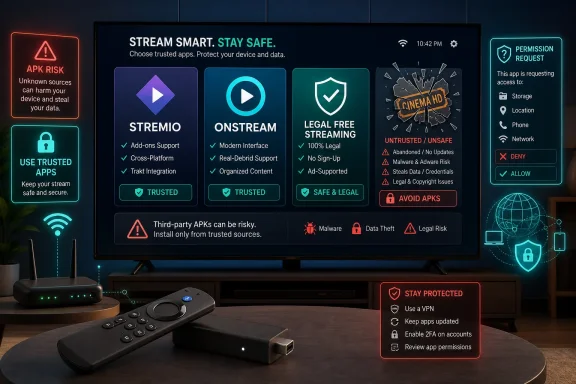 Cinema HD Was a Product of Streaming’s Frustration Economy
Cinema HD became popular because legal streaming became annoying. Not impossible, not useless, not even necessarily overpriced in every case — just fragmented enough that ordinary viewers started looking for something that behaved like the service they thought the internet had already promised them. One search box, one watchlist, one remote-friendly interface, and no need to remember whether a show lived on Netflix, Hulu, Disney+, Max, Prime Video, Peacock, Paramount+, or whatever bundle was being pushed that quarter.That demand was real. Cinema HD answered it with the blunt efficiency of the third-party APK ecosystem: scrape sources, surface links, and let the user press play. It was not elegant in the way a polished commercial service is elegant, but it was fast, familiar, and optimized for the couch rather than the boardroom.
The problem is that Cinema HD’s convenience sat on top of infrastructure the user did not control and rights the app did not clearly possess. When the app worked, that distinction felt abstract. When the sources dried up, fake download pages multiplied, and the app stopped returning streams, the abstraction became the entire story.
Cinema HD did not fail like a normal product. There was no orderly end-of-life notice, no migration tool, no subscription refund, no official transition path. It failed the way unsupported software usually fails: suddenly for users, gradually in hindsight.
The Shutdown Exposed the Difference Between an App and an Ecosystem
For years, Cinema HD felt like an ecosystem because it had a community, update chatter, sideloading guides, Real-Debrid-style integrations, and a familiar place on home screens. But an ecosystem has governance. It has maintainers, distribution channels, update trust, security practices, and a clear relationship between the interface and the content it presents.Cinema HD had pieces of that without the durable structure underneath. That is why the end has been messy. Some users report older builds partially working under narrow conditions. Others see no streams at all. Some are greeted by messages indicating support has ended. Many encounter websites and app-store imposters claiming to offer new versions, “official” revivals, or patched releases.
That ambiguity is dangerous because it creates the perfect market for malware. When a popular app dies without a trusted distribution channel, search engines and social feeds become the new installer. Users who just want their old setup back are pushed toward APK files of unknown origin, repackaged builds, and copycat branding.
This is where the WindowsForum audience should be especially clear-eyed. The risk is not merely that a stream might fail. The risk is that a living-room device signed into Amazon, Google, or a home network becomes a casual malware target because someone downloaded a “Cinema HD 2026” APK from a site that looked plausible enough on a phone screen.
The Best Replacement Is Not Always the Most Cinema-Like
The immediate temptation is to ask which app is the “new Cinema HD.” That is understandable, but it is the wrong standard. Cinema HD’s appeal was simplicity, yet its failure was also the failure of a black-box app that users treated as stable infrastructure.Stremio has become the most visible alternative because it is less a one-off APK than a media hub. It has official apps across major platforms, account syncing, an addon model, and a cleaner separation between the shell and the sources users choose to add. That does not make every addon safe, licensed, or reliable, but it does make the model more transparent than a mysterious APK returning links from who-knows-where.
For many former Cinema HD users, Stremio is both better and more complicated. It can sync libraries across devices, organize content elegantly, and work well on TV hardware. But the setup burden moves from “install app and search” to “understand addons, sources, accounts, and sometimes debrid integrations.” That is not a small shift for households that treated Cinema HD as an appliance.
OnStream represents the opposite instinct. It aims to preserve the one-click feel: open the app, pick a movie or show, press play. That makes it attractive for users who do not want to manage addons or build a media stack. But convenience without transparency carries the same old questions: who maintains it, where do its sources come from, how is the APK distributed, and what happens when it stops working?
Stremio Wins the Architecture Argument, Not Every Living Room
If this were purely a systems-design contest, Stremio would be the obvious winner among the commonly named replacements. Its architecture is more modular, its interface is more polished, and its account-based syncing feels closer to what commercial streaming should have become. It is not just a Cinema HD substitute; it is a different idea of how to organize media discovery.That does not mean it wins every household. Stremio’s strength is also its friction. Addons are powerful because they make the app flexible, but that flexibility forces users to make choices Cinema HD largely hid. Which addons are safe? Which are legal? Which work on Fire TV? Which are maintained? Which disappear after an update?
This is the bargain power users tend to accept and casual users tend to resent. Windows enthusiasts and sysadmins are comfortable with modularity because modularity is how most serious software survives. The average living-room viewer wants the remote to behave as if licensing, indexing, caching, and source availability are not their problem.
Stremio’s rise therefore says less about casual streaming than about the maturing of the cord-cutter underground. The users still in this world in 2026 are being asked to think more like administrators. That may be healthier from a security standpoint, but it is not the same as being easier.
The New APK Wave Repeats the Old Trust Problem
Nuvio, STRMR, Cinema HQ, OnStream, FilmPlus, BeeTV, TeaTV, and other names now circulate through the same recommendation loops Cinema HD once dominated. Some are media hubs. Some are direct-play apps. Some support debrid services. Some are in beta. Some have slick interfaces and active communities. Some will vanish.The most important question is not whether any one of them works today. The important question is whether users can verify what they are installing tomorrow. Third-party APK culture rewards speed: new app, new build, new downloader code, new mirror, new workaround. Security rewards provenance: official signing, repeatable distribution, changelogs, reputation, and the ability to walk away when something looks wrong.
Those values collide on devices like Fire TV sticks, Android TV boxes, and low-cost streaming dongles. They are designed to be appliances, but APK sideloading turns them into unmanaged endpoints. In a home network, that may sound dramatic until one remembers how many people use the same Google account, Wi-Fi network, browser session, and cloud storage across phones, PCs, tablets, and TV devices.
A compromised streaming box is not automatically a catastrophe, but it is not nothing. It is a Linux- or Android-based computer with network access, storage, credentials, and user behavior data. Treating it as disposable because it sits behind a television is exactly the kind of assumption attackers love.
The VPN Pitch Is Too Simple for the Real Risk
The old advice around apps like Cinema HD usually collapses into one line: use a VPN. That advice is not useless, but it is incomplete to the point of being misleading. A VPN can hide traffic from an ISP and change the apparent network path. It cannot make a malicious APK benign, grant content rights, verify a developer, or prevent an app from harvesting data once installed.The security checklist for third-party streaming apps should start before the VPN enters the conversation. Users should ask where the APK came from, whether the developer is identifiable, whether the file has been scanned, whether the permissions make sense, and whether the app requires credentials it has no business requesting. They should also assume that fake “official” pages are part of the threat model, not an edge case.
VirusTotal and similar scanning services can help, but they are not magic either. A clean scan does not prove an APK is safe; it only says known engines did not flag it at that moment. A malicious developer can also change behavior after installation, fetch payloads later, or abuse permissions in ways that look normal until they are not.
The better principle is boring and durable: install less, trust less, and separate risky devices from sensitive accounts where practical. That is not the advice people want when they are trying to watch a film on Friday night, but it is the advice that survives contact with reality.
Legality Is Not a Footnote, Even If the Interface Looks Harmless
Cinema HD and its replacements occupy a space where many users separate the app from the content. The interface looks like a catalog. The artwork looks like any other media app. The act of pressing play feels indistinguishable from using a licensed service. That design familiarity can lull users into thinking the legal status is equally ordinary.It often is not. Some apps and addons may surface public-domain works, trailers, freely distributed content, or links from legitimate sources. Others may provide access to copyrighted movies and shows without permission. The user does not get to outsource that distinction to a nice poster wall.
This is especially relevant for WindowsForum readers who manage devices for families, small businesses, classrooms, or shared housing. The question is not whether everyone becomes a copyright lawyer before watching television. The question is whether the person installing the app understands that “available” and “authorized” are different words.
There is also a practical consequence. Apps that operate in legally gray or plainly infringing territory are more likely to disappear, change domains, lose sources, attract imposters, or become malware bait. Legal uncertainty and technical unreliability are not separate problems. In this market, they feed each other.
Verified Free Streaming Has Improved While APK Trust Has Gotten Worse
One reason the Cinema HD story feels different in 2026 is that legal free streaming is no longer a wasteland. Ad-supported services have matured. Freevee-style catalogs, Pluto TV-style channels, Tubi-like libraries, broadcaster apps, library-linked services, and public-domain platforms have made legitimate no-cost viewing more viable than it was when many users first discovered APK streaming.These services do not solve everything. They still involve ads, rotating catalogs, regional restrictions, and uneven search. They rarely provide the magical “everything in one place” experience that drove users to Cinema HD in the first place. But they do offer something the APK ecosystem rarely can: predictable distribution, app-store vetting, support channels, and clear licensing.
That tradeoff matters more as streaming hardware becomes more integrated into the home. The TV is no longer just a display. It is a voice-assistant endpoint, a shopping surface, a casting target, a smart-home panel, and an advertising node. Installing untrusted software on it carries a different risk profile than installing a weird video player on an old tablet with no accounts attached.
The uncomfortable truth for cord-cutters is that the legal market has become less elegant while becoming more defensible. The unofficial market has remained elegant in bursts while becoming harder to trust.
Fire TV and Android TV Turn Sideloading Into a Consumer Security Test
Amazon’s Fire TV devices and Google’s Android TV ecosystem are central to the Cinema HD story because they made sideloading accessible to non-technical users. A Fire Stick is cheap, portable, and powerful enough to run a living-room media setup. Android TV boxes range from polished mainstream devices to bargain hardware with uncertain update histories.That hardware democratized cord-cutting, but it also democratized endpoint management without calling it that. Enabling unknown sources, granting installer permissions, downloading APKs through browser-like tools, and ignoring warnings are administrative actions. They just happen to be performed with a remote control from a couch.
For IT pros, this is familiar territory. The weakest point in a system is often not the exploit but the workflow. If a guide tells users to click through warnings, install an app store from outside the official store, and then install another APK through that app store, users learn that warnings are obstacles rather than information.
Cinema HD’s decline is a reminder that consumer platforms still have not solved the trusted-distribution problem for enthusiast use. Lock platforms down too hard and users revolt. Open them up too casually and the average household becomes its own underfunded security department.
Debrid Services Add Reliability While Complicating the Ethics
Many Cinema HD users paired the app with debrid services to obtain higher-quality links and reduce buffering. That same pattern continues with replacements such as Stremio configurations, Cinema HQ-like apps, and other media hubs. Technically, the appeal is obvious: better sources, fewer dead links, smoother playback, and less frustration.But debrid integrations also complicate the story. They can make unofficial apps feel more stable and premium, blurring the line between a hobbyist setup and a paid media pipeline. When users pay for a service that improves access to files but not necessarily the rights to the underlying content, they may mistake technical reliability for legitimacy.
From a user-experience standpoint, this is why Cinema HD had such staying power. It could be made to feel dependable enough that the underlying legal and technical fragility disappeared into the background. Once the app stopped working, that hidden fragility returned all at once.
The lesson is not that every debrid user is malicious or that every integration is identical. The lesson is that reliability layers do not settle rights questions. They merely make the experience smoother, which can make the eventual failure more surprising.
Fake Cinema HD Apps Are the Inevitable Afterlife of a Famous APK
The most predictable part of Cinema HD’s decline is the rise of fake Cinema HD apps and websites. Popular abandoned software almost always develops a shadow market. The brand still has search value, users still want it, and there is no trusted authority loudly enough telling everyone what is real.That is why “Cinema HD official,” “Cinema HD new version,” and “Cinema HD 2026” should now trigger skepticism rather than hope. A familiar icon is easy to copy. A changelog is easy to invent. A download page is easy to decorate with fake trust badges, comments, and installation screenshots.
The app-store angle is just as troubling. Users often assume that anything in a mainstream store has been thoroughly vetted, but low-quality copycats and misleadingly named apps can slip through review systems. Even when they are not outright malware, they can be ad traps, data harvesters, or useless wrappers designed to monetize confusion.
This is where nostalgia becomes an attack surface. The safer assumption is that Cinema HD is over as a dependable app. Anything claiming otherwise should have to prove itself against a high bar, not benefit from the goodwill earned by the old name.
Windows Users Should Care Because the Living Room Is Now Part of the Network
At first glance, Cinema HD is not a Windows story. It is an Android APK story, a Fire TV story, a cord-cutter story. But WindowsForum readers know better: the modern home and small-office network is a messy blend of PCs, phones, tablets, consoles, smart TVs, NAS boxes, routers, and streaming sticks.A risky APK on a television device can coexist with Windows PCs that hold tax records, work documents, saved browser sessions, and password managers. It may not directly compromise those systems, but it expands the environment administrators and power users need to think about. The old boundary between “computer” and “appliance” is mostly psychological now.
There is also a cultural connection. Windows power users have long lived with the tension between openness and safety. The ability to install what you want is a feature until the installation chain becomes untrustworthy. The Cinema HD saga is that same debate translated to the streaming stick.
For families, the practical policy should be simple. If a device is used for experimental APKs, do not treat it like a trusted endpoint. Keep accounts minimal, avoid storing sensitive credentials, keep firmware updated, and consider network segmentation if your router makes it easy. That may sound excessive for watching movies, but it is ordinary hygiene for unmanaged software.
The Cord-Cutter Dream Still Has a User-Interface Problem
The reason apps like Cinema HD keep appearing is that the official market still fails at aggregation. People do not want eight billing relationships and ten watchlists. They do not want search results that say a title exists but hide whether it is included, rented, region-locked, expiring, or only available through an add-on subscription. They do not want to reassemble the cable bundle one app at a time.This frustration does not excuse piracy or unsafe software, but it explains the demand. Cinema HD was a symptom of a market that trained users to expect abundance and then fractured that abundance across silos. The legal industry has spent years improving catalogs and apps while still making discovery worse than it should be.
There are better answers. Platform-level search could be more honest. Subscription portability could improve. Bundles could become less hostile. Watchlists could become open standards rather than platform traps. Public libraries and ad-supported services could be better integrated into mainstream TV interfaces.
Until that happens, unofficial apps will continue to sell the fantasy of a unified library. Some will be clever. Some will be malicious. Most will be temporary.
The Post-Cinema HD Playbook Is Narrower Than It Looks
The practical choices after Cinema HD are less varied than the app lists suggest. A user can move toward a more structured media hub such as Stremio, experiment with newer APKs such as Nuvio or STRMR, choose simpler one-click apps such as OnStream, or retreat toward verified legal services and accept the inconvenience of fragmentation. Each path has a cost.The structured-media-hub path is best for users who are willing to learn the system and maintain it. It rewards patience and skepticism. It is less suitable for someone who wants an app that works forever without understanding why.
The one-click APK path is best for convenience and worst for trust. It may feel closest to Cinema HD, but that is precisely why users should be careful. If the old model failed through opacity, copying the old model does not fix the underlying problem.
The legal-services path is the least glamorous and the easiest to defend. It may be more fragmented, and it may require ads or subscriptions, but it avoids the cycle of dead APKs, sketchy mirrors, and uncertain rights. For many households, that tradeoff will look better after one too many failed sideloading sessions.
The Real Cinema HD Replacement Is Better Judgment
Cinema HD’s disappearance does not have to turn every cord-cutter into a security researcher, but it should change the default posture. The app’s decline is a useful moment to separate what users wanted from what they actually installed. They wanted one interface for movies and shows. They installed an unsupported third-party APK whose reliability depended on forces outside their control.That distinction is the lesson. The replacement should not merely be whichever app returns the most links this month. It should be a more deliberate approach to media devices, accounts, software sources, and legal exposure.
For WindowsForum readers, the practical take is not moral panic. It is operational caution. The same instincts that apply to unsigned Windows utilities, browser extensions, cracked installers, and mystery driver packages apply here too. If the source is unclear, the permissions are broad, the claims are too convenient, and the project’s status is murky, assume the risk is real.
Cinema HD’s Exit Leaves a Short List of Hard Truths
The post-Cinema HD landscape is crowded, but the useful lessons are compact. Users do not need to memorize every APK name; they need to understand the tradeoffs that decide whether a setup is merely convenient or actually sustainable.- Cinema HD should be treated as effectively unsupported in 2026, even if some old builds appear to work for some users under limited conditions.
- Stremio is the strongest general replacement for users who want a more organized media-hub model, but its addon system requires more judgment than Cinema HD ever asked of casual viewers.
- One-click replacements such as OnStream or Cinema HQ-style apps may feel more familiar, but they recreate many of the same trust and longevity problems.
- Fake Cinema HD apps and download sites are now a predictable malware and data-harvesting risk, not an occasional nuisance.
- A VPN can protect some network privacy, but it cannot make an untrusted APK safe or make unauthorized content legal.
- Verified free and paid streaming services remain less elegant than the unofficial dream, but they are far more durable for households that value security and predictability.
References
- Primary source: TROYPOINT
Published: 2026-07-01T00:38:10.536268
Loading…
troypoint.com - Related coverage: comfortskillz.com
Loading…
www.comfortskillz.com - Related coverage: techedubyte.com
Loading…
www.techedubyte.com - Related coverage: iptvwire.org
Loading…
iptvwire.org - Related coverage: toptvtricks.com
Loading…
www.toptvtricks.com - Related coverage: firesticktvstream.com
Loading…
www.firesticktvstream.com