

Clarity: The Seven Demons of Vanguardia launched digitally on July 1, 2026 for Xbox One, Xbox Series X|S, Windows PC, PlayStation 4, PlayStation 5, and Nintendo Switch, with Eastasiasoft publishing Team Quantum Games’ hand-drawn side-scrolling action platformer at a budget price. That makes it less a surprise drop than a carefully placed second life for a small PC game that first arrived on Steam in October 2024. The Xbox hook is not just availability; it is Microsoft’s cross-device pitch in miniature, with Smart Delivery, cloud saves, achievements, and Xbox Play Anywhere turning a modest indie release into a test case for the platform’s current identity.
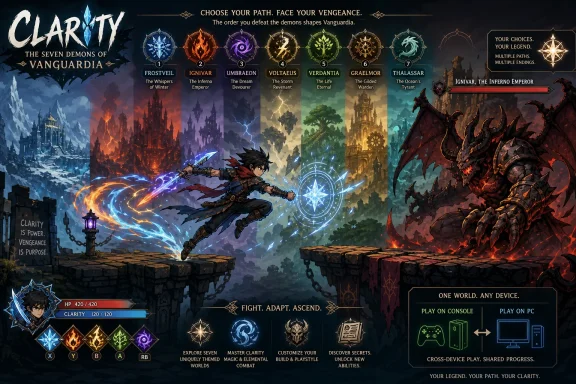
There is a familiar rhythm to Eastasiasoft releases: compact games, broad platform coverage, digital-first distribution, and a price low enough to invite curiosity rather than demand commitment. Clarity fits that template neatly. It is a one-player action platformer about a young hero seeking revenge after a lightning demon kills their father, and its mechanical promise is equally direct: run, jump, air dash, slash, cast spells, defeat seven bosses, and use their powers against the next threat.
What makes the Xbox listing interesting is not that another indie platformer has reached the store. The Xbox storefront is full of them, many chasing the same nostalgia for 16-bit structure and modern accessibility. What matters is how Microsoft’s ecosystem now packages even a small side-scroller as a multi-device product by default.
On Xbox, Clarity is listed for Xbox One, Xbox Series X|S, and PC. It supports Smart Delivery, Xbox cloud saves, achievements, presence, 60 fps or better, and Xbox Play Anywhere. In plain terms, a player can buy once and move between console and Windows PC with less friction than the old console generation would have allowed.
That is the strategic backdrop. Clarity is not a blockbuster, but it shows how the Xbox business increasingly depends on making the store feel less like a console shelf and more like a rights locker that follows the player.
The Steam version’s reception was small but positive, with only a limited number of user reviews. That is often the reality for independent PC games outside the algorithmic blast radius of Steam’s biggest launches. A good small game can exist, earn favorable comments from early players, and still need a publisher or platform push to find a wider audience.
The 2026 console release is therefore not just a port. It is a relaunch under a more visible publishing umbrella. Eastasiasoft’s role is to put Clarity where console players actually browse: the Xbox Store, PlayStation Store, and Nintendo eShop.
That move also reframes the game. On Steam, Clarity was one of thousands of PC indies. On Xbox, it becomes part of a narrower weekly cadence of digital releases, where achievements, Play Anywhere support, and store placement can give a small title a cleaner identity.
The appeal of this format is not simply that bosses have weaknesses. It is that the player is allowed to turn knowledge into power. A stage that feels brutal on a first attempt may become manageable once the right sword or spell is in hand, and that change makes progress feel earned rather than merely granted.
Clarity’s twist is its namesake resource. The hero gathers demon magic called Clarity from fallen enemies and spends it on staff-based spells and skills. That gives the combat loop a familiar tension: melee attacks are reliable, but magic asks the player to manage a resource and choose when to spend it.
This is the kind of design that lives or dies on tuning. If elemental advantages are too obvious, the game becomes a checklist. If they are too obscure, the freedom of stage selection becomes a trap. The store description’s emphasis on “thoughtful reward” suggests the developers understand that the pleasure is supposed to come from routing, learning, and applying the right tool at the right time.
This is where Microsoft’s current gaming strategy shows up in small print. Xbox is no longer merely a box under the television. It is a storefront, a save system, an achievement layer, a PC launcher, and a console identity all wrapped together. A budget indie game with Play Anywhere support becomes another brick in that argument.
For players, the practical benefit is straightforward. Start on a Series X in the living room, continue on a Windows handheld or desktop, and let cloud saves carry the progress. That convenience is not glamorous, but it is exactly the sort of platform feature that becomes hard to give up once it works reliably.
For developers and publishers, the calculus is different. Supporting Microsoft’s PC-console entitlement model can make a small release feel more generous without lowering the sticker price. It also makes the Xbox version easier to recommend, especially when the same game is available on competing storefronts.
That is where Clarity’s premise helps. Seven worlds, seven demons, multiple difficulty settings, hand-drawn HD presentation, and a selectable boss order all communicate scope without pretending to be endless. The game is selling a weekend-sized platforming quest, not a forever game.
This matters because the digital storefront economy often punishes modesty. Games can look disposable if they are too cheap, but overpromise if they chase a price their scope cannot support. Clarity seems to occupy a more honest middle ground: a small action adventure with a clear loop and a low barrier to entry.
The risk, of course, is visibility. A $9.99 game can be an impulse buy, but only if players see it at the right moment. That is why platform features and publisher cadence matter so much for releases like this.
Clarity fits that model almost too well. It is small enough to benefit from publisher amplification, visually distinct enough to survive a store thumbnail, and mechanically familiar enough to explain in a sentence. That is exactly the sort of game that can find a second audience through console discoverability.
There is also a preservation angle here, even if nobody markets it that way. When a small PC game expands to Xbox, PlayStation, and Switch, it becomes less dependent on a single storefront’s attention economy. It also becomes easier for future players to stumble onto it through sales, achievement hunting, recommendation rows, or platform libraries.
That does not guarantee success. But it does give the game more chances to be encountered, and for indie releases, second and third chances are often the difference between obscurity and a durable niche.
Clarity’s setup is dark on paper: a murdered father, a child on a revenge quest, seven demons, elemental combat, and a final showdown. But the presentation appears to soften that premise with colorful, animated, approachable visuals. That combination places it closer to family-friendly fantasy adventure than grimdark demon slaying.
The rating reinforces that positioning. Fantasy violence and an Everyone 10+ classification suggest a game meant to be accessible to younger players as well as older platforming fans. That widens the audience and aligns with the Steam reviews that described the game as suitable for children and adults.
This is an underappreciated lane. Many modern action platformers chase difficulty prestige or pixel-art austerity. Clarity appears to chase readability, color, and approachable challenge instead. That may not thrill players looking for a brutal test, but it gives the game a clearer household niche.
That is especially important for a game with free stage selection. If a player chooses a poor route, difficulty settings can soften the penalty while preserving the discovery. The design can still reward strategic boss ordering without forcing every player into the same performance ceiling.
Accessibility here is not the same as a full suite of assistive options. The listing does not suggest that level of customization. But difficulty selection is still a meaningful signal that the developers are not treating frustration as the only path to satisfaction.
This is also good business. The $9.99 platformer audience is broad: younger players, nostalgic adults, achievement hunters, casual console browsers, and PC users looking for a short adventure. A rigid difficulty philosophy would narrow that audience for little obvious gain.
That can be a double-edged sword. Achievement attention can boost visibility and sales, but it can also reduce a game to completion time and Gamerscore efficiency. The best outcome is when that audience brings early traction without defining the entire conversation.
Clarity has a better shot than many budget releases because its actual structure sounds substantial. Seven worlds, bosses, magic, swords, and stage order imply a real platforming campaign rather than a barebones achievement vehicle. If the list is fair and the play feels good, the achievement crowd may become an amplifier rather than a distortion.
For Windows users, achievements also reinforce the cross-device value. A Play Anywhere title that tracks progress and unlocks across PC and console feels more integrated than a standalone PC release. That is exactly the kind of subtle ecosystem stickiness Microsoft wants.
That discrepancy is not necessarily sinister. Storefront genres are marketing tools as much as taxonomies, and “Metroidvania” has become a catch-all label for side-scrollers with exploration, maps, and ability-driven progression. But it does create an expectations problem.
If a player buys Clarity expecting a dense interconnected map with deep backtracking, they may be judging the wrong game. The more accurate pitch appears to be a stage-based action platformer with selectable worlds, boss rewards, and some dungeon exploration. That is adjacent to Metroidvania language, but not identical to it.
This is where small games suffer from big genre words. “Metroidvania” sells, but it also brings baggage. Clarity’s strongest pitch may be simpler: it is a colorful boss-order platformer with magic, swords, and seven themed worlds.
That matters for the Windows ecosystem. Microsoft has spent years trying to make its store and Xbox app more relevant to PC gaming, with mixed results. Steam remains the gravitational center of PC game buying, but Play Anywhere gives Microsoft a feature Steam cannot exactly replicate: console-PC entitlement under one first-party account.
The catch is that users have to trust the Microsoft Store and Xbox app enough to care. For many PC players, that trust has been uneven. Installation paths, app behavior, library management, and modding expectations have historically made Microsoft’s PC gaming experience feel more constrained than Steam.
Still, the value proposition is stronger for games like Clarity than it is for some larger titles. A compact action platformer does not need extensive mod support or elaborate launcher features. It benefits most from simple ownership, cloud saves, controller support, and quick access across devices.
For Clarity, that means the same purchase covers both generations of Xbox consoles. That is useful because the Xbox One is still present in many households, especially for younger players and secondary rooms. A game with modest technical demands can serve that installed base without making Series X|S owners feel ignored.
The listing’s 4K Ultra HD and 60 fps-plus capabilities are also worth noting, though expectations should be calibrated to the genre. A hand-drawn 2D platformer is not a showcase for ray tracing or physics simulation. But high resolution and smooth animation matter in platforming, where readability and input feel are central to the experience.
Smart Delivery’s real achievement is that players rarely have to think about it. In an industry addicted to edition confusion, that remains a virtue.
The elemental weakness system adds another layer. Once players discover that one demon sword or spell gives an advantage against another boss, the campaign becomes a puzzle of sequencing. Even if the player can technically fight any demon first, the game encourages experimentation, memory, and planning.
That is a smart fit for a family-friendly platformer. Younger players can enjoy the action at face value, while older players can optimize route order and resource use. A good version of this design scales with attention: casual players can finish it, engaged players can master it.
The danger is repetition. Seven worlds need distinct hazards, enemy patterns, and boss identities to justify the structure. If each stage feels like a reskin, the elemental system will not save it. But if the worlds have mechanical personality, Clarity’s simple framework could be exactly enough.
That is good for players, provided they can find the good games amid the flood. The challenge of abundance is curation. When dozens of small releases arrive every month, the difference between a hidden gem and a forgotten listing can be a trailer, a sale, a recommendation row, or a single post in a community forum.
For WindowsForum’s audience, that makes these smaller releases worth watching. They reveal what the Xbox platform is becoming at street level, away from executive presentations. Microsoft’s strategy is not only visible in acquisitions and cloud slogans; it is visible in whether a $9.99 platformer supports Play Anywhere and cloud saves on day one.
Clarity’s presence on Xbox says that the technical and commercial pipes are open. The harder question is whether the store can help players distinguish worthwhile compact games from digital noise.
But the release is also a snapshot of the current indie-console economy. A 2024 PC game gets a 2026 multiplatform push. A small developer gets broader reach through Eastasiasoft. Xbox users get Smart Delivery, achievements, cloud saves, and Play Anywhere. Windows PC users get another reason to see the Xbox library as something more than a console appendage.
None of that makes Clarity a must-buy by itself. Platform features do not replace level design, animation feel, boss variety, or combat tuning. The game still has to be good moment to moment.
Still, the packaging matters. In 2026, even a modest indie platformer arrives as part of a platform argument. Microsoft wants players to think less about which device they are on and more about where their library lives. Clarity is a small but tidy example of that ambition.
 A Small Game Arrives Carrying a Much Bigger Platform Message
There is a familiar rhythm to Eastasiasoft releases: compact games, broad platform coverage, digital-first distribution, and a price low enough to invite curiosity rather than demand commitment. Clarity fits that template neatly. It is a one-player action platformer about a young hero seeking revenge after a lightning demon kills their father, and its mechanical promise is equally direct: run, jump, air dash, slash, cast spells, defeat seven bosses, and use their powers against the next threat.What makes the Xbox listing interesting is not that another indie platformer has reached the store. The Xbox storefront is full of them, many chasing the same nostalgia for 16-bit structure and modern accessibility. What matters is how Microsoft’s ecosystem now packages even a small side-scroller as a multi-device product by default.
On Xbox, Clarity is listed for Xbox One, Xbox Series X|S, and PC. It supports Smart Delivery, Xbox cloud saves, achievements, presence, 60 fps or better, and Xbox Play Anywhere. In plain terms, a player can buy once and move between console and Windows PC with less friction than the old console generation would have allowed.
That is the strategic backdrop. Clarity is not a blockbuster, but it shows how the Xbox business increasingly depends on making the store feel less like a console shelf and more like a rights locker that follows the player.
The Steam Launch Was the First Draft
Clarity did not begin life as a console-first product. Team Quantum Games released it on Windows via Steam in October 2024, where it was presented as a casual 2D platforming adventure rather than a hard-edged Metroidvania or Soulslike. That distinction matters because the game borrows the stage-order freedom and boss-weapon logic of older action platformers without necessarily promising a punishing gauntlet.The Steam version’s reception was small but positive, with only a limited number of user reviews. That is often the reality for independent PC games outside the algorithmic blast radius of Steam’s biggest launches. A good small game can exist, earn favorable comments from early players, and still need a publisher or platform push to find a wider audience.
The 2026 console release is therefore not just a port. It is a relaunch under a more visible publishing umbrella. Eastasiasoft’s role is to put Clarity where console players actually browse: the Xbox Store, PlayStation Store, and Nintendo eShop.
That move also reframes the game. On Steam, Clarity was one of thousands of PC indies. On Xbox, it becomes part of a narrower weekly cadence of digital releases, where achievements, Play Anywhere support, and store placement can give a small title a cleaner identity.
Seven Demons, Seven Worlds, One Very Old Design Contract
The structure is instantly legible to anyone raised on boss-order action games. Clarity lets players choose which stage to tackle first, defeat bosses, collect demon swords, and exploit elemental weaknesses. That is not an accident; it is a design contract with decades of platforming history behind it.The appeal of this format is not simply that bosses have weaknesses. It is that the player is allowed to turn knowledge into power. A stage that feels brutal on a first attempt may become manageable once the right sword or spell is in hand, and that change makes progress feel earned rather than merely granted.
Clarity’s twist is its namesake resource. The hero gathers demon magic called Clarity from fallen enemies and spends it on staff-based spells and skills. That gives the combat loop a familiar tension: melee attacks are reliable, but magic asks the player to manage a resource and choose when to spend it.
This is the kind of design that lives or dies on tuning. If elemental advantages are too obvious, the game becomes a checklist. If they are too obscure, the freedom of stage selection becomes a trap. The store description’s emphasis on “thoughtful reward” suggests the developers understand that the pleasure is supposed to come from routing, learning, and applying the right tool at the right time.
Xbox Play Anywhere Is the Quietly Important Feature
For WindowsForum readers, the most consequential checkbox on the Xbox page may be Xbox Play Anywhere. It means Clarity is not just an Xbox console purchase; it also belongs to the player on Windows PC through Microsoft’s ecosystem. That makes the release more relevant to PC users than a simple console port would be.This is where Microsoft’s current gaming strategy shows up in small print. Xbox is no longer merely a box under the television. It is a storefront, a save system, an achievement layer, a PC launcher, and a console identity all wrapped together. A budget indie game with Play Anywhere support becomes another brick in that argument.
For players, the practical benefit is straightforward. Start on a Series X in the living room, continue on a Windows handheld or desktop, and let cloud saves carry the progress. That convenience is not glamorous, but it is exactly the sort of platform feature that becomes hard to give up once it works reliably.
For developers and publishers, the calculus is different. Supporting Microsoft’s PC-console entitlement model can make a small release feel more generous without lowering the sticker price. It also makes the Xbox version easier to recommend, especially when the same game is available on competing storefronts.
The Budget Price Changes the Standard of Judgment
At US$9.99 or €9.99, Clarity enters a very different critical category than a premium indie at three or four times the price. Players will still expect polish, but the value proposition is built around a compact adventure rather than a sprawling campaign. The question becomes whether the game has a clean idea, executes it consistently, and respects the player’s time.That is where Clarity’s premise helps. Seven worlds, seven demons, multiple difficulty settings, hand-drawn HD presentation, and a selectable boss order all communicate scope without pretending to be endless. The game is selling a weekend-sized platforming quest, not a forever game.
This matters because the digital storefront economy often punishes modesty. Games can look disposable if they are too cheap, but overpromise if they chase a price their scope cannot support. Clarity seems to occupy a more honest middle ground: a small action adventure with a clear loop and a low barrier to entry.
The risk, of course, is visibility. A $9.99 game can be an impulse buy, but only if players see it at the right moment. That is why platform features and publisher cadence matter so much for releases like this.
Eastasiasoft Knows the Console Long Tail
Eastasiasoft has built a recognizable business around bringing niche, retro, anime-adjacent, and independently developed games to consoles. The company’s catalog is not defined by one genre so much as by a publishing pattern: take games that might otherwise live quietly on PC or in regional niches, package them for modern consoles, and release them across as many storefronts as practical.Clarity fits that model almost too well. It is small enough to benefit from publisher amplification, visually distinct enough to survive a store thumbnail, and mechanically familiar enough to explain in a sentence. That is exactly the sort of game that can find a second audience through console discoverability.
There is also a preservation angle here, even if nobody markets it that way. When a small PC game expands to Xbox, PlayStation, and Switch, it becomes less dependent on a single storefront’s attention economy. It also becomes easier for future players to stumble onto it through sales, achievement hunting, recommendation rows, or platform libraries.
That does not guarantee success. But it does give the game more chances to be encountered, and for indie releases, second and third chances are often the difference between obscurity and a durable niche.
The Hand-Drawn Look Is Doing More Than Decoration
The store page leans heavily on Clarity’s hand-drawn HD style, and that is not just aesthetic garnish. In crowded platformer territory, art direction often does the first round of persuasion before mechanics get a hearing. A game needs to signal its tone instantly.Clarity’s setup is dark on paper: a murdered father, a child on a revenge quest, seven demons, elemental combat, and a final showdown. But the presentation appears to soften that premise with colorful, animated, approachable visuals. That combination places it closer to family-friendly fantasy adventure than grimdark demon slaying.
The rating reinforces that positioning. Fantasy violence and an Everyone 10+ classification suggest a game meant to be accessible to younger players as well as older platforming fans. That widens the audience and aligns with the Steam reviews that described the game as suitable for children and adults.
This is an underappreciated lane. Many modern action platformers chase difficulty prestige or pixel-art austerity. Clarity appears to chase readability, color, and approachable challenge instead. That may not thrill players looking for a brutal test, but it gives the game a clearer household niche.
The Store Page Sells Accessibility Without Saying the Word
Multiple difficulty settings are a small line item, but they matter. Side-scrolling action games often inherit assumptions about precision, punishment, and repetition. Difficulty options let a game keep its structure while opening the door to players who want the adventure more than the ordeal.That is especially important for a game with free stage selection. If a player chooses a poor route, difficulty settings can soften the penalty while preserving the discovery. The design can still reward strategic boss ordering without forcing every player into the same performance ceiling.
Accessibility here is not the same as a full suite of assistive options. The listing does not suggest that level of customization. But difficulty selection is still a meaningful signal that the developers are not treating frustration as the only path to satisfaction.
This is also good business. The $9.99 platformer audience is broad: younger players, nostalgic adults, achievement hunters, casual console browsers, and PC users looking for a short adventure. A rigid difficulty philosophy would narrow that audience for little obvious gain.
The Achievement Crowd Will Notice
Any small Xbox release with achievements has a secondary audience that developers and publishers understand very well. Achievement hunters often scan weekly releases for manageable completion lists, low-cost games, and clean genre experiences. Clarity’s Xbox achievements support means it enters that economy immediately.That can be a double-edged sword. Achievement attention can boost visibility and sales, but it can also reduce a game to completion time and Gamerscore efficiency. The best outcome is when that audience brings early traction without defining the entire conversation.
Clarity has a better shot than many budget releases because its actual structure sounds substantial. Seven worlds, bosses, magic, swords, and stage order imply a real platforming campaign rather than a barebones achievement vehicle. If the list is fair and the play feels good, the achievement crowd may become an amplifier rather than a distortion.
For Windows users, achievements also reinforce the cross-device value. A Play Anywhere title that tracks progress and unlocks across PC and console feels more integrated than a standalone PC release. That is exactly the kind of subtle ecosystem stickiness Microsoft wants.
The Genre Label Tells Its Own Story
One oddity in the broader listings around Clarity is the way the genre shifts depending on where you look. The Xbox page emphasizes platformer and action-adventure. Eastasiasoft’s fact sheet includes action, adventure, Metroidvania, and platform. Steam’s own description explicitly says the game is casual and “not a Metroidvania or Souls like game.”That discrepancy is not necessarily sinister. Storefront genres are marketing tools as much as taxonomies, and “Metroidvania” has become a catch-all label for side-scrollers with exploration, maps, and ability-driven progression. But it does create an expectations problem.
If a player buys Clarity expecting a dense interconnected map with deep backtracking, they may be judging the wrong game. The more accurate pitch appears to be a stage-based action platformer with selectable worlds, boss rewards, and some dungeon exploration. That is adjacent to Metroidvania language, but not identical to it.
This is where small games suffer from big genre words. “Metroidvania” sells, but it also brings baggage. Clarity’s strongest pitch may be simpler: it is a colorful boss-order platformer with magic, swords, and seven themed worlds.
Windows PC Is No Longer the Afterthought in Xbox Releases
For years, console store listings treated PC as a separate universe. That wall has been crumbling for a long time, but releases like Clarity show how normalized the new model has become. A small Xbox game can arrive with PC support built into the purchase identity.That matters for the Windows ecosystem. Microsoft has spent years trying to make its store and Xbox app more relevant to PC gaming, with mixed results. Steam remains the gravitational center of PC game buying, but Play Anywhere gives Microsoft a feature Steam cannot exactly replicate: console-PC entitlement under one first-party account.
The catch is that users have to trust the Microsoft Store and Xbox app enough to care. For many PC players, that trust has been uneven. Installation paths, app behavior, library management, and modding expectations have historically made Microsoft’s PC gaming experience feel more constrained than Steam.
Still, the value proposition is stronger for games like Clarity than it is for some larger titles. A compact action platformer does not need extensive mod support or elaborate launcher features. It benefits most from simple ownership, cloud saves, controller support, and quick access across devices.
Smart Delivery Still Solves a Problem Players Forget They Had
Smart Delivery is no longer new, but it remains one of Microsoft’s better console-era ideas. The point is simple: buy the game and get the right version for the Xbox hardware you are using. No confusion over Xbox One versus Series X|S editions, no duplicate purchases, and less storefront clutter.For Clarity, that means the same purchase covers both generations of Xbox consoles. That is useful because the Xbox One is still present in many households, especially for younger players and secondary rooms. A game with modest technical demands can serve that installed base without making Series X|S owners feel ignored.
The listing’s 4K Ultra HD and 60 fps-plus capabilities are also worth noting, though expectations should be calibrated to the genre. A hand-drawn 2D platformer is not a showcase for ray tracing or physics simulation. But high resolution and smooth animation matter in platforming, where readability and input feel are central to the experience.
Smart Delivery’s real achievement is that players rarely have to think about it. In an industry addicted to edition confusion, that remains a virtue.
The Seven-Boss Formula Still Works Because It Gives Players a Plan
There is a reason the boss-weapon loop refuses to die. It gives players agency without overwhelming them. Seven stages is enough to create meaningful choice, but not so many that the structure collapses into indecision.The elemental weakness system adds another layer. Once players discover that one demon sword or spell gives an advantage against another boss, the campaign becomes a puzzle of sequencing. Even if the player can technically fight any demon first, the game encourages experimentation, memory, and planning.
That is a smart fit for a family-friendly platformer. Younger players can enjoy the action at face value, while older players can optimize route order and resource use. A good version of this design scales with attention: casual players can finish it, engaged players can master it.
The danger is repetition. Seven worlds need distinct hazards, enemy patterns, and boss identities to justify the structure. If each stage feels like a reskin, the elemental system will not save it. But if the worlds have mechanical personality, Clarity’s simple framework could be exactly enough.
The Xbox Store Has Become a Stage for Modest Games With Complete Feature Sets
The modern Xbox Store is often judged by Game Pass headlines and first-party drama, but its quieter function is as a distribution layer for games that would once have struggled to reach console audiences. Clarity is not arriving as a subscription centerpiece or a hardware showcase. It is arriving as a complete, low-cost digital product with the platform checkboxes that now define a serious Xbox release.That is good for players, provided they can find the good games amid the flood. The challenge of abundance is curation. When dozens of small releases arrive every month, the difference between a hidden gem and a forgotten listing can be a trailer, a sale, a recommendation row, or a single post in a community forum.
For WindowsForum’s audience, that makes these smaller releases worth watching. They reveal what the Xbox platform is becoming at street level, away from executive presentations. Microsoft’s strategy is not only visible in acquisitions and cloud slogans; it is visible in whether a $9.99 platformer supports Play Anywhere and cloud saves on day one.
Clarity’s presence on Xbox says that the technical and commercial pipes are open. The harder question is whether the store can help players distinguish worthwhile compact games from digital noise.
The Clarity Launch Says More Than Its Store Page Admits
Clarity: The Seven Demons of Vanguardia is easy to summarize, which is a strength. A child avenges a fallen father, fights seven demons, collects swords and magic, and uses elemental weaknesses to survive a hand-drawn side-scrolling quest. That is the elevator pitch, and it works.But the release is also a snapshot of the current indie-console economy. A 2024 PC game gets a 2026 multiplatform push. A small developer gets broader reach through Eastasiasoft. Xbox users get Smart Delivery, achievements, cloud saves, and Play Anywhere. Windows PC users get another reason to see the Xbox library as something more than a console appendage.
None of that makes Clarity a must-buy by itself. Platform features do not replace level design, animation feel, boss variety, or combat tuning. The game still has to be good moment to moment.
Still, the packaging matters. In 2026, even a modest indie platformer arrives as part of a platform argument. Microsoft wants players to think less about which device they are on and more about where their library lives. Clarity is a small but tidy example of that ambition.
The Demon Hunt Leaves a Useful Paper Trail
The concrete story here is simple enough, but the details are what make the Xbox release worth noting. Clarity is not a mystery drop, not a Game Pass surprise, and not a next-gen showcase. It is a small multiplatform relaunch with unusually clean ecosystem support on Microsoft hardware and Windows PCs.- Clarity: The Seven Demons of Vanguardia launched on July 1, 2026 for Xbox One, Xbox Series X|S, Windows PC, PlayStation 4, PlayStation 5, and Nintendo Switch.
- The Xbox version supports Smart Delivery, Xbox Play Anywhere, cloud saves, achievements, Xbox presence, 4K Ultra HD, and 60 fps-plus capability.
- The game first appeared on Windows via Steam in October 2024 before Eastasiasoft brought it to consoles and the Microsoft Store.
- The core design centers on seven selectable worlds, demon bosses, collectible swords, elemental weaknesses, melee combat, and Clarity-powered magic.
- The budget price places it in impulse-buy territory, but its success will depend on whether the platforming, boss routing, and combat tuning deliver more than a checklist.
- The genre messaging is slightly muddy, with some listings invoking Metroidvania language while the Steam page frames the game more plainly as a casual side-scrolling platforming adventure.
References
- Primary source: Microsoft
Published: 2026-07-01T01:42:08.337016
Kjøp Clarity: The Seven Demons of Vanguardia | Xbox
Slay demons to avenge your fallen father in side-scrolling action platforming style! When a boy’s father is suddenly slain by a terrifying lightning demon, he courageously sets out on a quest of vengeance. Take the role of this young hero as he learns to gather and wield powerful demon magic...www.microsoft.com - Related coverage: xbox.com
Buy Clarity: The Seven Demons of Vanguardia | Xbox
Slay demons to avenge your fallen father in side-scrolling action platforming style! When a boy’s father is suddenly slain by a terrifying lightning demon, he courageously sets out on a quest of vengeance. Take the role of this young hero as he learns to gather and wield powerful demon magic...www.xbox.com - Related coverage: store.steampowered.com
Clarity: The Seven Demons of Vanguardia on Steam
Clarity is a 2D side scrolling platforming adventure. Choose to face seven demons and acquire their demon sword and demon magic. Each sword and spell, has an elemental strength against a corresponding demon.store.steampowered.com
- Related coverage: gamegrin.com
Clarity: The Seven Demons of Vanguardia - Game | GameGrin
 www.gamegrin.com
- Related coverage: nintendo.com
Clarity: The Seven Demons of Vanguardia | Programas descargables Nintendo Switch | Juegos | Nintendo ES
¡Acaba con los demonios para vengar a tu padre caído en un juego de plataformas de acción con desplazamiento lateral!www.nintendo.com
- Related coverage: xboxachievements.com
Clarity: The Seven Demons of Vanguardia - Game Overview
Check out all the Clarity: The Seven Demons of Vanguardia achievements, latest news, previews, interviews, videos, screenshots and review from your number one Xbox One resource site.www.xboxachievements.com
- Related coverage: steambase.io
- Related coverage: eastasiasoft.com
eastasiasoft - Clarity: The Seven Demons of Vanguardia | PC, PS4, PS5, Switch, Xbox One, Xbox Series X|S
Clarity: The Seven Demons of Vanguardia - Slay demons and avenge your family!www.eastasiasoft.com