

Intel says its Arc G3 Extreme handheld processor will shut off both Performance cores whenever total SoC power falls to 14 watts or below, using Intelligent Bias Control 3.5 to hand more of the power budget to integrated graphics during low-power gaming. The claim is not just a footnote in a spec sheet. It is Intel admitting that, in a handheld, the fastest CPU cores may be the least useful silicon on the package. If the numbers survive independent testing, Arc G3 could mark a real shift in how Windows gaming handhelds are designed.
For decades, PC performance marketing trained buyers to look first at CPU cores, boost clocks, and peak-threaded horsepower. Handheld gaming PCs punish that habit. A chip inside a small Windows device does not live in a desktop tower fantasy; it lives inside a battery-powered thermal envelope where a few wasted watts can become fan noise, hot grips, or a sagging frame rate.
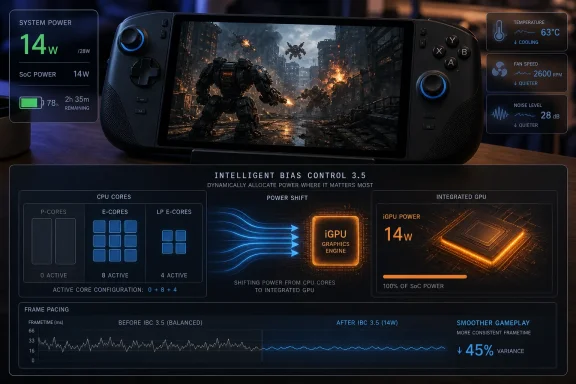
That is the logic behind Intel’s newly detailed Intelligent Bias Control 3.5. At 14 watts or below, Arc G3 Extreme does not merely prefer Efficiency cores or nudge threads away from the big cores. It powers down both P-cores and runs in a 0+8+4 arrangement: eight E-cores, four low-power E-cores, and no Performance cores at all.
That is a striking choice because Intel’s hybrid CPU strategy has often been sold as a hierarchy: big cores for serious work, smaller cores for background tasks and efficiency. Arc G3 turns that hierarchy sideways. In a handheld running a game at low power, the GPU is the scarce resource, and the CPU’s job is often to get out of the way.
This is the most interesting part of the disclosure. Intel is not saying the P-cores are bad. It is saying they are contextually expensive. In the cramped economics of a 12W or 14W handheld gaming session, even an idle-ish P-core complex can be a budget line item the GPU would rather reclaim.
The CPU configuration tells the story before the firmware does. Intel’s handheld chips use two P-cores, eight E-cores, and four LP E-cores, for 14 total CPU cores. Compared with fuller Panther Lake mobile designs, Intel has already cut back the big-core count, reportedly because extra P-cores did not pay their rent in gaming handheld scenarios.
That makes sense. Modern games can use several CPU threads, but handheld gaming is often constrained by graphics throughput, memory bandwidth, display targets, and power limits long before it needs a laptop-class CPU configuration. The Steam Deck proved that lesson in AMD form years ago: a balanced, predictable SoC can feel better than a hotter chip chasing benchmark peaks.
Intel’s version is more explicit. Arc G3 Extreme is not simply a laptop processor squeezed into a portable chassis. It is Intel trying to make the scheduler, the power controller, and the silicon configuration agree on the same priority: frame pacing first, CPU bravado second.
Intel says IBC 3.5 improves average gaming performance by 13 percent at a 12W limit, with some individual titles improving by as much as 31 percent. The company also claims Arc G3 Extreme is 37 percent faster on average than AMD’s Ryzen Z2 Extreme when both are set to 12W. Those are vendor-supplied numbers, so they should be treated as a starting point, not a verdict.
Still, the direction of the claim is believable. If a game is GPU-limited at low power, and the CPU has enough small-core capacity to feed frames consistently, turning off big cores can produce a real gain. Not because disabling hardware magically creates performance, but because power that was previously reserved, leaked, or opportunistically consumed by CPU blocks can instead sustain graphics clocks.
The catch is that “average gaming performance” is doing a lot of work. Some games are CPU-sensitive. Some engines punish thread scheduling weirdness. Some anti-cheat stacks, launchers, overlays, shader compilation events, and Windows background behaviors can disrupt the tidy world implied by a benchmark slide. The real test will be not just average FPS, but one-percent lows, frame-time consistency, resume behavior, and how quickly the system exits low-power bias when a game suddenly needs more CPU.
Arc G3 is a more serious challenge because it targets the part of the experience where AMD’s lead has mattered most: efficient gaming at handheld power levels. Intel’s claimed 37 percent advantage over Ryzen Z2 Extreme at 12W and 42 percent at 35W sounds aggressive, but the more important claim may be that Arc G3 Extreme at 17W can approach the Ryzen Z2 Extreme at 35W. If true across real devices, that would change the battery-life conversation.
The word if is doing necessary work. AMD’s handheld strength is not only silicon; it is platform familiarity. OEMs know how to tune AMD handhelds, reviewers know what to expect, and users have years of driver behavior to compare against. Intel must beat not just a chip, but an ecosystem that has become the default answer for portable Windows gaming.
That is why Intel’s IBC 3.5 disclosure feels like a calculated move. Raw GPU size is not enough. Intel needs a story that says its platform understands handheld constraints better than a general-purpose mobile processor does. Disabling P-cores below 14W is a clean, memorable way to make that argument.
That makes Intel’s scheduling strategy more important than it might look. If the OS and firmware can keep gaming threads fed by E-cores while preventing stray work from waking expensive P-cores, the handheld feels calmer. If Windows keeps dragging the system out of its intended low-power mode, the whole efficiency promise becomes harder to sustain.
Microsoft has improved Windows’ awareness of hybrid CPU designs, and Intel has years of Thread Director experience behind it. But handhelds create a nastier version of the problem. The device is not merely balancing foreground performance and background efficiency; it is balancing game responsiveness, GPU clocks, thermals, battery life, controller input latency, sleep behavior, and a full desktop operating system.
That is why the 0+8+4 mode is more than a silicon trick. It is a bet that Intel can make Windows behave like it is running on a purpose-built gaming appliance without losing the breadth of PC compatibility. The best version of Arc G3 makes the complexity invisible. The worst version turns it into another layer of tuning menus and firmware updates.
That is why shifting budget from CPU to integrated graphics makes architectural sense. The GPU usually carries the visible burden: resolution scaling, texture throughput, shader load, upscaling, frame generation, and the brute work of rendering. The CPU still matters, especially in simulation-heavy games or open-world titles with messy streaming behavior, but it does not always need big cores to matter enough.
This is also where Intel’s Arc branding becomes important. The company is not naming these chips as conventional Core Ultra parts first and graphics parts second. Arc G3 is presented as a gaming handheld platform, and that framing lets Intel talk about the GPU as the center of gravity rather than an integrated afterthought.
For Windows users, this could be a welcome correction. The handheld market has too often borrowed laptop language: TDP sliders, boost behavior, turbo limits, and opaque vendor profiles. Intel’s approach is at least conceptually cleaner. Below a certain power line, the system chooses the GPU and stops hedging.
The unanswered questions are the ones reviewers and early buyers will have to answer the hard way. Which games were tested? At what resolutions and quality presets? Was upscaling enabled? Were frame generation technologies involved? Were drivers final? Was the Ryzen Z2 Extreme system equally tuned, cooled, and configured? Did the comparison use identical memory speeds, handheld power policies, and OS versions?
Those details matter because handheld performance is unusually sensitive to implementation. A great SoC can be kneecapped by weak cooling, conservative firmware, slow memory, a poor fan curve, or an overambitious display resolution. A mediocre chip can look surprisingly good if the device maker tunes it honestly and ships stable drivers.
Intel’s 35W comparisons are especially interesting but less central to the handheld thesis. If Arc G3 Extreme beats Core Ultra 7 258V at 35W sustained power by 44 percent in gaming, that suggests the handheld-specific design has real graphics advantages over Lunar Lake. But a handheld that needs 35W to impress is not solving the most important problem. The real prize is credible performance in the teens.
The lesson from the current handheld market is blunt: balance wins. A gorgeous high-resolution panel can become a liability if the GPU spends its life upscaling to feed it. A massive battery helps only if the power policy is sane. A thin chassis looks good in renders until it turns fan noise into the soundtrack.
Intel’s IBC 3.5 strategy gives OEMs a useful tool, but not a magic wand. The SoC can bias power toward the GPU, yet device makers still have to choose memory, battery capacity, thermal design, display resolution, controls, storage, BIOS defaults, and Windows image quality. The chip can create headroom; the product has to preserve it.
This is where WindowsForum readers should keep their skepticism calibrated. The correct response is not to dismiss Intel’s claims because they are internal. It is to wait for full-system reviews that measure the device as users will actually hold it: unplugged, warm, updated, and running the messy catalog of PC games rather than a neat subset of benchmark-friendly titles.
Windows handhelds often win on compatibility and raw performance, then lose points on friction. Users get more games, more launchers, more modding, and more settings, but also more driver drama, more desktop UI awkwardness, and more ways for battery life to disappear. Intel’s Arc G3 strategy is an attempt to solve one important slice of that problem at the silicon level.
But silicon alone cannot turn Windows into SteamOS. Microsoft’s own handheld gaming work will need to become more than a launcher layer if Windows devices are going to feel purpose-built. The OS must get better at power states, controller-first navigation, background restraint, update timing, and predictable performance profiles.
Arc G3 could give Windows handhelds a stronger hardware foundation. Whether that foundation becomes a better product category depends on Intel, Microsoft, and OEMs acting like they are building appliances, not just small laptops with thumbsticks.
 Intel Stops Pretending Every Watt Belongs to the CPU
For decades, PC performance marketing trained buyers to look first at CPU cores, boost clocks, and peak-threaded horsepower. Handheld gaming PCs punish that habit. A chip inside a small Windows device does not live in a desktop tower fantasy; it lives inside a battery-powered thermal envelope where a few wasted watts can become fan noise, hot grips, or a sagging frame rate.That is the logic behind Intel’s newly detailed Intelligent Bias Control 3.5. At 14 watts or below, Arc G3 Extreme does not merely prefer Efficiency cores or nudge threads away from the big cores. It powers down both P-cores and runs in a 0+8+4 arrangement: eight E-cores, four low-power E-cores, and no Performance cores at all.
That is a striking choice because Intel’s hybrid CPU strategy has often been sold as a hierarchy: big cores for serious work, smaller cores for background tasks and efficiency. Arc G3 turns that hierarchy sideways. In a handheld running a game at low power, the GPU is the scarce resource, and the CPU’s job is often to get out of the way.
This is the most interesting part of the disclosure. Intel is not saying the P-cores are bad. It is saying they are contextually expensive. In the cramped economics of a 12W or 14W handheld gaming session, even an idle-ish P-core complex can be a budget line item the GPU would rather reclaim.
Panther Lake Becomes a Handheld Argument, Not Just a Laptop Architecture
Arc G3 and Arc G3 Extreme are based on Intel’s Panther Lake platform and manufactured around the company’s 18A process ambitions. In normal laptop form, Panther Lake is a broad platform story: CPU tiles, graphics tiles, AI acceleration, and the usual claims of better performance per watt. In Arc G3 form, it becomes something sharper: a handheld-specific argument about where power should go.The CPU configuration tells the story before the firmware does. Intel’s handheld chips use two P-cores, eight E-cores, and four LP E-cores, for 14 total CPU cores. Compared with fuller Panther Lake mobile designs, Intel has already cut back the big-core count, reportedly because extra P-cores did not pay their rent in gaming handheld scenarios.
That makes sense. Modern games can use several CPU threads, but handheld gaming is often constrained by graphics throughput, memory bandwidth, display targets, and power limits long before it needs a laptop-class CPU configuration. The Steam Deck proved that lesson in AMD form years ago: a balanced, predictable SoC can feel better than a hotter chip chasing benchmark peaks.
Intel’s version is more explicit. Arc G3 Extreme is not simply a laptop processor squeezed into a portable chassis. It is Intel trying to make the scheduler, the power controller, and the silicon configuration agree on the same priority: frame pacing first, CPU bravado second.
The 14-Watt Line Is Where Marketing Meets Reality
The 14W threshold matters because it sits right in the behavioral zone that handheld owners actually care about. Many devices can run impressively at 25W or 30W when plugged in, screaming through battery and cooling headroom. The more interesting fight is around 10W to 17W, where a handheld can plausibly be portable rather than merely transportable.Intel says IBC 3.5 improves average gaming performance by 13 percent at a 12W limit, with some individual titles improving by as much as 31 percent. The company also claims Arc G3 Extreme is 37 percent faster on average than AMD’s Ryzen Z2 Extreme when both are set to 12W. Those are vendor-supplied numbers, so they should be treated as a starting point, not a verdict.
Still, the direction of the claim is believable. If a game is GPU-limited at low power, and the CPU has enough small-core capacity to feed frames consistently, turning off big cores can produce a real gain. Not because disabling hardware magically creates performance, but because power that was previously reserved, leaked, or opportunistically consumed by CPU blocks can instead sustain graphics clocks.
The catch is that “average gaming performance” is doing a lot of work. Some games are CPU-sensitive. Some engines punish thread scheduling weirdness. Some anti-cheat stacks, launchers, overlays, shader compilation events, and Windows background behaviors can disrupt the tidy world implied by a benchmark slide. The real test will be not just average FPS, but one-percent lows, frame-time consistency, resume behavior, and how quickly the system exits low-power bias when a game suddenly needs more CPU.
AMD Now Has to Defend the Middle of the Power Curve
AMD owns the current Windows handheld conversation for a reason. Ryzen Z-series chips, and the broader Ryzen APU ecosystem behind devices from Asus, Lenovo, and others, arrived with strong integrated graphics, mature drivers, and a relatively clear value proposition. Intel’s first MSI Claw generation, built around Meteor Lake, did not dislodge that story.Arc G3 is a more serious challenge because it targets the part of the experience where AMD’s lead has mattered most: efficient gaming at handheld power levels. Intel’s claimed 37 percent advantage over Ryzen Z2 Extreme at 12W and 42 percent at 35W sounds aggressive, but the more important claim may be that Arc G3 Extreme at 17W can approach the Ryzen Z2 Extreme at 35W. If true across real devices, that would change the battery-life conversation.
The word if is doing necessary work. AMD’s handheld strength is not only silicon; it is platform familiarity. OEMs know how to tune AMD handhelds, reviewers know what to expect, and users have years of driver behavior to compare against. Intel must beat not just a chip, but an ecosystem that has become the default answer for portable Windows gaming.
That is why Intel’s IBC 3.5 disclosure feels like a calculated move. Raw GPU size is not enough. Intel needs a story that says its platform understands handheld constraints better than a general-purpose mobile processor does. Disabling P-cores below 14W is a clean, memorable way to make that argument.
Windows Is Both Intel’s Advantage and Its Problem
A Windows handheld is never just a console with a different logo. It is a PC, which means flexibility, compatibility, and an operating system that can also be spectacularly indifferent to the fact that the user is trying to play a game on battery. Background services, launchers, cloud sync, driver helpers, RGB utilities, telemetry, browser tabs, and update checks all compete for attention.That makes Intel’s scheduling strategy more important than it might look. If the OS and firmware can keep gaming threads fed by E-cores while preventing stray work from waking expensive P-cores, the handheld feels calmer. If Windows keeps dragging the system out of its intended low-power mode, the whole efficiency promise becomes harder to sustain.
Microsoft has improved Windows’ awareness of hybrid CPU designs, and Intel has years of Thread Director experience behind it. But handhelds create a nastier version of the problem. The device is not merely balancing foreground performance and background efficiency; it is balancing game responsiveness, GPU clocks, thermals, battery life, controller input latency, sleep behavior, and a full desktop operating system.
That is why the 0+8+4 mode is more than a silicon trick. It is a bet that Intel can make Windows behave like it is running on a purpose-built gaming appliance without losing the breadth of PC compatibility. The best version of Arc G3 makes the complexity invisible. The worst version turns it into another layer of tuning menus and firmware updates.
The GPU-First Handheld Was Inevitable
The most refreshing thing about Intel’s disclosure is that it says the quiet part out loud. Handheld gaming is not about maximizing CPU glory. It is about delivering the most stable frame rate the device can sustain before the battery and cooling system revolt.That is why shifting budget from CPU to integrated graphics makes architectural sense. The GPU usually carries the visible burden: resolution scaling, texture throughput, shader load, upscaling, frame generation, and the brute work of rendering. The CPU still matters, especially in simulation-heavy games or open-world titles with messy streaming behavior, but it does not always need big cores to matter enough.
This is also where Intel’s Arc branding becomes important. The company is not naming these chips as conventional Core Ultra parts first and graphics parts second. Arc G3 is presented as a gaming handheld platform, and that framing lets Intel talk about the GPU as the center of gravity rather than an integrated afterthought.
For Windows users, this could be a welcome correction. The handheld market has too often borrowed laptop language: TDP sliders, boost behavior, turbo limits, and opaque vendor profiles. Intel’s approach is at least conceptually cleaner. Below a certain power line, the system chooses the GPU and stops hedging.
Independent Testing Will Decide Whether This Is Engineering or Slideware
Intel’s internal figures are impressive, but vendor benchmarks are designed to show a product at its best. That does not make them false. It does mean they are incomplete.The unanswered questions are the ones reviewers and early buyers will have to answer the hard way. Which games were tested? At what resolutions and quality presets? Was upscaling enabled? Were frame generation technologies involved? Were drivers final? Was the Ryzen Z2 Extreme system equally tuned, cooled, and configured? Did the comparison use identical memory speeds, handheld power policies, and OS versions?
Those details matter because handheld performance is unusually sensitive to implementation. A great SoC can be kneecapped by weak cooling, conservative firmware, slow memory, a poor fan curve, or an overambitious display resolution. A mediocre chip can look surprisingly good if the device maker tunes it honestly and ships stable drivers.
Intel’s 35W comparisons are especially interesting but less central to the handheld thesis. If Arc G3 Extreme beats Core Ultra 7 258V at 35W sustained power by 44 percent in gaming, that suggests the handheld-specific design has real graphics advantages over Lunar Lake. But a handheld that needs 35W to impress is not solving the most important problem. The real prize is credible performance in the teens.
OEMs Will Decide How Much of Intel’s Promise Survives Contact With Plastic
The first wave of Arc G3 handhelds will matter as much as the silicon itself. Acer, MSI, OneXPlayer, and other partners can build devices that validate Intel’s efficiency claims, or they can bury them under too much screen, too little cooling, too high a price, and too many preinstalled utilities.The lesson from the current handheld market is blunt: balance wins. A gorgeous high-resolution panel can become a liability if the GPU spends its life upscaling to feed it. A massive battery helps only if the power policy is sane. A thin chassis looks good in renders until it turns fan noise into the soundtrack.
Intel’s IBC 3.5 strategy gives OEMs a useful tool, but not a magic wand. The SoC can bias power toward the GPU, yet device makers still have to choose memory, battery capacity, thermal design, display resolution, controls, storage, BIOS defaults, and Windows image quality. The chip can create headroom; the product has to preserve it.
This is where WindowsForum readers should keep their skepticism calibrated. The correct response is not to dismiss Intel’s claims because they are internal. It is to wait for full-system reviews that measure the device as users will actually hold it: unplugged, warm, updated, and running the messy catalog of PC games rather than a neat subset of benchmark-friendly titles.
The Real Competition Is Against the Steam Deck’s Coherence
Intel and AMD are fighting over Windows handheld silicon, but the shadow over the category remains Valve’s Steam Deck. The Deck is not the fastest handheld and has not been for some time. Its advantage is coherence: hardware, software, suspend behavior, performance profiles, shader management, and store integration all pull in the same direction.Windows handhelds often win on compatibility and raw performance, then lose points on friction. Users get more games, more launchers, more modding, and more settings, but also more driver drama, more desktop UI awkwardness, and more ways for battery life to disappear. Intel’s Arc G3 strategy is an attempt to solve one important slice of that problem at the silicon level.
But silicon alone cannot turn Windows into SteamOS. Microsoft’s own handheld gaming work will need to become more than a launcher layer if Windows devices are going to feel purpose-built. The OS must get better at power states, controller-first navigation, background restraint, update timing, and predictable performance profiles.
Arc G3 could give Windows handhelds a stronger hardware foundation. Whether that foundation becomes a better product category depends on Intel, Microsoft, and OEMs acting like they are building appliances, not just small laptops with thumbsticks.
The 14-Watt Switch Is the Spec Sheet Line to Watch
Intel’s Arc G3 Extreme story is not complicated, but it is unusually revealing. The company is telling buyers that less CPU can mean more gaming, provided the power saved is handed to the graphics engine at the right moment.- Intel’s Intelligent Bias Control 3.5 disables both P-cores when total SoC power is at or below 14W.
- Arc G3 Extreme then runs on eight E-cores and four LP E-cores, leaving the GPU with more room inside the power budget.
- Intel claims a 13 percent average gaming uplift at 12W, with some individual games gaining up to 31 percent.
- Intel’s comparisons against Ryzen Z2 Extreme and Core Ultra 7 258V are promising but still need independent validation.
- Real handheld results will depend heavily on cooling, firmware, memory, display choices, drivers, and Windows power behavior.
- The most important benchmarks will be low-power frame pacing and battery life, not peak plugged-in performance.
References
- Primary source: www.guru3d.com
Published: Tue, 30 Jun 2026 05:19:00 GMT
Loading…
www.guru3d.com - Related coverage: tomshardware.com
Intel challenges AMD’s handheld dominance with new Arc G3 chips — Panther Lake silicon brings up to 14 cores, Arc B390 graphics to handhelds | Tom's Hardware
Intel has lined up partners for the range, including Acer and OneXPlayer.www.tomshardware.com - Related coverage: newsroom.intel.com
Intel Arc G-Series Processors Set a New Standard for Handheld PC Gaming - Intel Newsroom
Intel® Arc™ G-Series processors combine leadership performance and power efficiency to deliver smooth, immersive gameplay with exceptional battery lifenewsroom.intel.com - Related coverage: notebookcheck.net
Loading…
www.notebookcheck.net - Related coverage: tech.sportskeeda.com
Intel Core/Arc G3 Panther Lake CPUs for gaming handhelds reportedly coming in Q2 2026
Reports of Panther Lake CPUs for gaming handhelds aren't new. At CES 2026, Intel officially announced that it plans to launch the Panther Lake chip for handheld devices soon.tech.sportskeeda.com - Related coverage: tech-insider.org
Loading…
tech-insider.org
- Related coverage: games.gg
Loading…
games.gg - Related coverage: pcgamer.com
Intel has announced two new handheld gaming PC chips pre-Computex, and they look like beauties
Smooth gaming and power efficient handhelds? Yes please.www.pcgamer.com
- Related coverage: tomsguide.com
Loading…
www.tomsguide.com - Related coverage: lttlabs.com
Loading…
www.lttlabs.com - Related coverage: bottleneckcalcs.com
Loading…
bottleneckcalcs.com - Related coverage: windowscentral.com
Intel's new Arc G-Series chips threaten AMD's Ryzen mobile supremacy — Gaming handhelds are about to get a lot more interesting
Intel has unveiled its new Arc G-Series CPUs ahead of Computex 2026, and they're designed specifically for gaming handhelds. With AMD Ryzen holding such a strong share, I expect this new hardware to seriously shake up the handheld market. www.windowscentral.com
- Related coverage: download.intel.com