

Nokia has signed a multi-year agreement with SAP, concluded at the end of 2025 and announced in 2026, to move more of its SAP S/4HANA environment into the RISE with SAP model, with Microsoft Azure serving as the cloud foundation for the migration. The deal is not a flashy product launch, nor is it a new AI gadget for telecom networks. It is a reminder that the next phase of enterprise AI is being built inside the unglamorous systems that close books, route inventory, manage trade compliance, and decide whether the business can actually execute. For Microsoft, the win is less about one customer logo than about Azure becoming the default landing zone for the ERP workloads that large companies are finally willing to move.
Enterprise AI has spent the past two years living in demos. It writes emails, drafts summaries, chats with documents, and promises to make every white-collar workflow feel less like drudgery. But the hard version of enterprise AI is not a bot that can summarize a meeting; it is software that understands the business context behind a purchase order, a warehouse exception, a customs document, or a financial close.
That is why Nokia’s agreement with SAP and Microsoft matters. The headline says cloud and AI transformation, but the substrate is ERP modernization. Before a company like Nokia can safely embed AI into core operations, it has to decide where its data lives, how processes are standardized, and which operating model governs changes to systems that thousands of employees depend on.
RISE with SAP is SAP’s answer to that problem. It packages cloud ERP, migration methodology, tooling, and managed operations into a transformation framework rather than a traditional software license refresh. In Nokia’s case, SAP will operate and manage the SAP S/4HANA environment in the cloud, while Azure provides the hyperscale infrastructure underneath.
That division of labor is the real architecture of the announcement. SAP wants control of the application transformation journey. Microsoft wants Azure to be the platform on which mission-critical SAP estates run. Nokia wants fewer ERP fragments, more predictable operations, and a foundation that can absorb AI features without turning every upgrade into a bespoke integration project.
That matters because the biggest risk in ERP transformation is not the database migration. It is the gap between what the business thinks it is standardizing and what IT discovers is actually embedded in decades of custom code, regional process exceptions, and organizational workarounds. Large enterprises often describe these programs as technology modernization, but they are closer to corporate archaeology.
Nokia’s stated scope includes finance and key logistics capabilities, supported by SAP S/4HANA for central finance, SAP Master Data Governance, SAP Extended Warehouse Management, SAP Global Trade Services, and SAP S/4HANA Cloud for advanced ATP. That is not a peripheral workload list. It cuts across the systems that determine how a multinational company accounts for itself, moves goods, checks availability, and complies with cross-border trade obligations.
The decision to host the environment on Azure aligns with Nokia’s broader cloud and data strategy, according to the announcement. It also reflects a pragmatic enterprise reality: companies do not want their ERP modernization to create another isolated island. They want it close to the rest of their identity, security, analytics, integration, and AI investments.
The unromantic phrase here is operating model. Nokia is not merely moving servers from one place to another. It is shifting more of the responsibility for SAP platform operation to SAP, while relying on Microsoft’s cloud infrastructure and enterprise ecosystem. That can free internal teams from some infrastructure work, but it also changes where control, escalation, and architectural decision-making sit.
SAP workloads have always been a prestige category for cloud providers. They are expensive, sticky, performance-sensitive, and deeply tied to business operations. A company that moves SAP to a hyperscaler is not just buying compute; it is making a long-term architectural bet.
Microsoft and SAP have been tightening that bet for years. Microsoft itself selected RISE with SAP for its own SAP transformation, and the companies have built joint programs around RISE with SAP on Azure to support migrations, architecture reviews, go-live readiness, and escalation paths. In 2026, SAP said the global RISE with SAP on Microsoft Azure initiative would expand substantially, with more customers admitted into a program designed to provide technical expertise and coordinated support.
That context makes Nokia’s deal look less like an isolated procurement decision and more like a datapoint in a broader market pattern. Azure is not simply competing on virtual machine specifications. It is competing on the promise that Microsoft can wrap SAP estates in adjacent services: Entra identity, Defender and Sentinel security operations, Azure networking, Fabric and analytics, Teams and Copilot integration, and the increasingly unavoidable AI layer.
This is where Microsoft has an advantage that is difficult for rivals to copy in full. Many enterprises already use Microsoft as their productivity, identity, endpoint, and collaboration backbone. Putting SAP on Azure does not eliminate integration work, but it can make the cloud ERP estate feel less alien to the rest of the Microsoft-managed enterprise.
That is the optimistic version. The more skeptical version is that RISE also gives SAP more leverage over how customers modernize, where they run, and how they consume future capabilities. Both things can be true at once.
For Nokia, the structure has appeal. A single methodology, integrated tooling, managed cloud operations, and access to embedded AI capabilities all address familiar pain points in ERP transformation. The company can focus on business outcomes rather than managing the underlying infrastructure stack.
But RISE does not magically erase complexity. It changes its shape. Networking, identity, data residency, integration with non-SAP systems, security monitoring, role design, extension strategy, and operational handoffs still have to be engineered carefully. Microsoft’s own guidance for integrating Azure with SAP RISE emphasizes that SAP manages the RISE architecture in SAP’s subscription and tenant, while customers still need to design the connections into their own Azure environment and third-party systems.
That boundary is critical. In a traditional self-managed model, enterprise IT may have more direct control over the infrastructure. In RISE, some of that control moves into SAP’s managed environment. The trade-off is potentially better standardization and supportability, but less freedom to treat the ERP stack as a private kingdom of custom infrastructure decisions.
For AI, that matters enormously. Generative AI and autonomous agents are only as useful as the business rules, data definitions, and process semantics underneath them. If every region, business unit, and legacy system has its own version of reality, AI becomes another layer of expensive ambiguity.
Nokia’s adoption of RISE with SAP methodology is therefore best understood as an AI-readiness move, not simply an ERP hosting decision. The announcement says AI-enabled functionality embedded in SAP’s cloud applications will be progressively adopted as part of the journey. The word “progressively” is doing important work.
No responsible enterprise drops AI into finance, logistics, trade, and warehouse processes overnight. The first phase is standardization. The second is trustworthy data. The third is governance. Only then do AI features have a chance to improve operations without creating compliance, audit, or security problems at scale.
SAP’s broader 2026 messaging around the autonomous enterprise points in the same direction. The company is positioning Business AI, governed agents, and cloud ERP as parts of one architecture. That pitch only works if customers accept SAP’s premise that AI belongs close to the systems of record, not just floating above them as a chatbot layer.
That could create tension, but for now the companies are presenting complementarity. SAP brings business process depth and ERP semantics. Microsoft brings cloud infrastructure, AI services, security operations, identity, developer tooling, and a vast enterprise footprint.
For Nokia, the appeal is straightforward. If SAP S/4HANA runs on Azure, the surrounding Microsoft ecosystem becomes easier to exploit. Data pipelines, analytics, monitoring, network connectivity, and security tooling can be aligned around a single hyperscale platform. The announcement specifically cites performance, security, latency, and operational resilience as expected benefits from consolidating workloads on Azure.
The hard part will be proving that “single platform” does not become a polite term for lock-in. A consolidated Azure foundation can simplify operations, but it also concentrates dependency. Outages, commercial terms, regional capacity, compliance requirements, and architectural constraints all become more important when core ERP is part of the cloud estate.
This is the strategic bargain modern enterprises are making. They are trading some of the messiness of owning everything for the scale and velocity of managed cloud platforms. The savings are not automatic, and neither is the innovation. But the old model of infinitely customized on-prem ERP is increasingly incompatible with the speed at which vendors are shipping AI and cloud-native capabilities.
A telecom equipment company’s ERP environment touches forecasting, procurement, logistics, trade compliance, customer commitments, inventory availability, and financial planning. If those systems are fragmented, the business pays in latency long before any packet crosses a network. Decisions slow down because the organization is reconciling systems instead of acting on shared information.
That is why this agreement has strategic significance even though it sits in the back office. Nokia’s ability to simplify and standardize its ERP landscape can affect how quickly it responds to demand shifts, supply chain pressure, regulatory changes, and product transitions. In a market defined by long infrastructure cycles and geopolitical sensitivity, operational coherence is not a nice-to-have.
The AI layer raises the stakes. AI-driven process automation in logistics or finance can be powerful, but only if the underlying controls are mature. In telecom, where customers often include critical infrastructure operators, the tolerance for opaque automation is limited. An AI feature that speeds a warehouse decision is useful; an AI feature that creates audit uncertainty around trade compliance is a liability.
Nokia’s language about “securing how we run our core business operations” is therefore more revealing than the generic transformation slogans. The company is not promising AI magic. It is trying to establish a safer runway for AI-enabled processes by modernizing the systems those processes depend on.
The modern Microsoft admin is increasingly responsible for identity, conditional access, endpoint posture, cloud networking, observability, data governance, and security operations across SaaS and cloud platforms. SAP RISE on Azure sits squarely in that expanded world. Even when SAP manages the application environment, the customer’s IT teams still have to make the surrounding enterprise architecture work.
That includes how users authenticate, how traffic is routed, how integrations reach SAP systems, how logs are collected, how suspicious activity is detected, how privileged access is controlled, and how incidents are escalated across vendors. These are not minor details. They define whether a cloud ERP migration feels like modernization or like a multi-year exercise in ticket choreography.
Microsoft has been explicit that integrating SAP RISE with a customer’s own Azure ecosystem requires careful documentation of network address spaces, firewalls, routing, file shares, Azure services, DNS, and ownership boundaries. In plain English: when something breaks, everyone needs to know which cloud, tenant, subscription, team, and vendor owns the next move.
That is a different skill set from the old server room era, but it is not a less technical one. The infrastructure is more abstracted; the dependencies are more distributed. The admin’s job becomes less about racking hardware and more about governing trust between systems.
Together, that can be stronger than a fragmented legacy estate. A unified platform can improve visibility, reduce unsupported infrastructure, standardize patching responsibilities, and give security teams better signals across enterprise systems. Microsoft Sentinel’s SAP monitoring capabilities, for example, are part of a broader push to correlate SAP activity with other enterprise telemetry.
But consolidation changes risk. When more critical systems depend on a smaller number of platforms and vendors, failures become more consequential. A misconfigured network route, identity policy, integration path, or privileged account can have business-wide impact. The blast radius of a mistake is no longer confined to a single legacy system in a single region.
This is where the partnership model must prove itself. SAP, Microsoft, and Nokia each own different pieces of the operational chain. The success of the program depends on whether those pieces behave like a coherent service during incidents, upgrades, and change windows.
Enterprise IT leaders should resist the temptation to treat vendor-managed cloud as a reason to shrink internal expertise too aggressively. The skills required change, but the need for in-house architectural authority does not disappear. Someone inside the customer organization must still understand how ERP, identity, security, data, and business process risk fit together.
The harder story begins after the migration. How quickly can Nokia adopt new SAP capabilities without destabilizing core processes? How clean will the core remain when business units ask for exceptions? How well will Azure integration support analytics, automation, and security without creating parallel data silos? How effectively will SAP and Microsoft coordinate when performance or availability issues cross platform boundaries?
These questions determine whether the agreement produces lasting value. RISE with SAP promises continuous access to innovation, but continuous innovation is only useful if the organization can absorb it. Otherwise, the cloud becomes a more expensive delivery vehicle for the same old change-management bottlenecks.
This is especially true for embedded AI. Vendors can ship AI capabilities quickly, but enterprises adopt them slowly when the workflows are mission-critical. Finance, logistics, procurement, and trade processes carry audit and compliance obligations. The more autonomous the software becomes, the more important explainability, approval design, logging, and rollback procedures become.
Nokia’s advantage is that it appears to be treating the move as a structured transformation rather than a lift-and-shift. The agreement emphasizes processes, data, applications, and operating models. That is the right vocabulary. The question is execution.
Nokia’s deal sits at the intersection. SAP gets to keep ERP transformation anchored in its methodology and cloud application portfolio. Microsoft gets Azure deeper into the mission-critical estate. Nokia gets a path that aligns ERP modernization with its broader cloud and data strategy.
This triangular model is becoming the default shape of large enterprise technology. Few companies want a single vendor to do everything, but fewer still want to assemble every layer themselves. The winning architecture is often a managed partnership, provided the customer can keep enough control to avoid becoming a passenger.
For SAP, RISE is the vehicle for moving customers out of legacy ERP and into a world where upgrades, AI, and business data services are delivered more continuously. For Microsoft, Azure is the venue where those workloads become part of the broader enterprise cloud. For Nokia, the bet is that this combination reduces complexity rather than merely relocating it.
That is the unresolved tension behind the announcement. Cloud transformation simplifies some things and formalizes others. The vendor pitch emphasizes acceleration. The sysadmin’s experience often emphasizes dependency maps, escalation paths, and the uncomfortable discovery that abstraction does not eliminate complexity; it hides it until something fails.
If the project succeeds, the benefits will not look like a viral demo. They will look like faster closes, cleaner master data, better inventory visibility, improved trade compliance handling, more reliable availability checks, and fewer bespoke systems dragging against global process standardization. Those are not glamorous outcomes, but they are the outcomes enterprises pay for.
The most credible AI gains will likely be incremental. Embedded recommendations in finance. Exception handling in logistics. Better forecasting inputs. Guided workflows. Automated document interpretation. Improved controls around business process anomalies. In ERP, small improvements at scale can matter more than dramatic demos at the edge.
The danger is that AI becomes a justification for rushing standardization or underestimating governance. A cloud ERP foundation can enable AI, but it cannot compensate for unclear process ownership or poor data discipline. If the business cannot define what “correct” looks like, AI will only help it be wrong faster.
That is why the clean-core and methodology language deserves attention. It signals that SAP and Nokia understand the dependency chain. AI comes last in the marketing sentence, but first it needs architecture, governance, and operational discipline.
Azure’s appeal is strongest when the customer already lives in Microsoft’s ecosystem. If identity, collaboration, security operations, endpoint management, and data analytics are already Microsoft-heavy, then hosting SAP on Azure can reduce the number of seams IT has to defend. The business hears “simplification.” The architect hears “fewer integration patterns to govern.”
AWS and Google Cloud are not absent from this market, and SAP supports multiple hyperscalers. But Microsoft’s SAP story has a particular resonance because of its enterprise installed base. Azure is not just a cloud provider in these deals; it is the extension of an enterprise environment many customers already operate.
For Nokia, the announcement says parts of the SAP landscape already run on Azure. That detail matters. The agreement is not a cold start. It is a consolidation move, and consolidation is often where cloud strategies become real. The first workload proves feasibility; the later workloads determine whether the platform becomes strategic.
The broader market signal is that the next wave of cloud adoption will be measured less by easy migrations and more by core-system commitments. Moving a website is one thing. Moving ERP finance and logistics is another. Microsoft wants Azure to be trusted for the latter.
Still, the deal offers a useful map for IT leaders watching SAP, Azure, and enterprise AI converge.
Nokia’s agreement with SAP and Microsoft is a reminder that the AI era for large enterprises will be built less like a consumer app boom and more like a long infrastructure campaign: standardize the core, move the systems of record, govern the data, secure the seams, and only then let automation closer to the work that actually runs the company. For Microsoft, that makes Azure not just a cloud platform but a staging ground for the next generation of enterprise operations; for Nokia, it makes ERP modernization part of competing in a market where connectivity, resilience, and AI are becoming the same conversation.
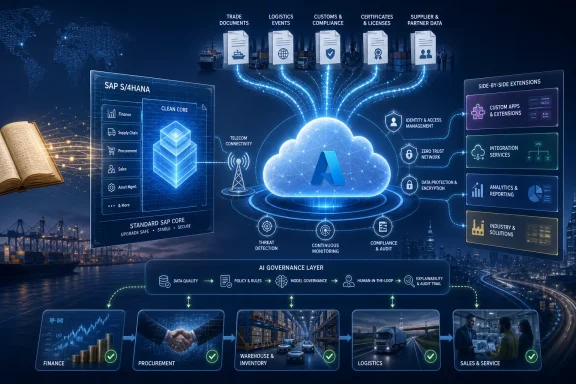 The AI Story Starts in the Ledger, Not the Lab
Enterprise AI has spent the past two years living in demos. It writes emails, drafts summaries, chats with documents, and promises to make every white-collar workflow feel less like drudgery. But the hard version of enterprise AI is not a bot that can summarize a meeting; it is software that understands the business context behind a purchase order, a warehouse exception, a customs document, or a financial close.That is why Nokia’s agreement with SAP and Microsoft matters. The headline says cloud and AI transformation, but the substrate is ERP modernization. Before a company like Nokia can safely embed AI into core operations, it has to decide where its data lives, how processes are standardized, and which operating model governs changes to systems that thousands of employees depend on.
RISE with SAP is SAP’s answer to that problem. It packages cloud ERP, migration methodology, tooling, and managed operations into a transformation framework rather than a traditional software license refresh. In Nokia’s case, SAP will operate and manage the SAP S/4HANA environment in the cloud, while Azure provides the hyperscale infrastructure underneath.
That division of labor is the real architecture of the announcement. SAP wants control of the application transformation journey. Microsoft wants Azure to be the platform on which mission-critical SAP estates run. Nokia wants fewer ERP fragments, more predictable operations, and a foundation that can absorb AI features without turning every upgrade into a bespoke integration project.
Nokia Chooses the Boring Path Because the Boring Path Is the Strategic One
Nokia is not new to SAP. The company has used SAP systems for decades and has already been consolidating multiple ERP environments into a unified SAP S/4HANA landscape through its next-generation ERP program. The new agreement formalizes and extends that journey under the RISE with SAP methodology.That matters because the biggest risk in ERP transformation is not the database migration. It is the gap between what the business thinks it is standardizing and what IT discovers is actually embedded in decades of custom code, regional process exceptions, and organizational workarounds. Large enterprises often describe these programs as technology modernization, but they are closer to corporate archaeology.
Nokia’s stated scope includes finance and key logistics capabilities, supported by SAP S/4HANA for central finance, SAP Master Data Governance, SAP Extended Warehouse Management, SAP Global Trade Services, and SAP S/4HANA Cloud for advanced ATP. That is not a peripheral workload list. It cuts across the systems that determine how a multinational company accounts for itself, moves goods, checks availability, and complies with cross-border trade obligations.
The decision to host the environment on Azure aligns with Nokia’s broader cloud and data strategy, according to the announcement. It also reflects a pragmatic enterprise reality: companies do not want their ERP modernization to create another isolated island. They want it close to the rest of their identity, security, analytics, integration, and AI investments.
The unromantic phrase here is operating model. Nokia is not merely moving servers from one place to another. It is shifting more of the responsibility for SAP platform operation to SAP, while relying on Microsoft’s cloud infrastructure and enterprise ecosystem. That can free internal teams from some infrastructure work, but it also changes where control, escalation, and architectural decision-making sit.
Microsoft Wins When ERP Stops Being Special Infrastructure
For WindowsForum readers, the Microsoft angle is obvious but easy to understate. This is not about Windows Server in the traditional sense, and it is not about a desktop upgrade cycle. It is about Azure’s bid to become the control plane for the enterprise workloads that used to sit deep inside corporate data centers, insulated from the rest of the cloud conversation because they were too critical to touch.SAP workloads have always been a prestige category for cloud providers. They are expensive, sticky, performance-sensitive, and deeply tied to business operations. A company that moves SAP to a hyperscaler is not just buying compute; it is making a long-term architectural bet.
Microsoft and SAP have been tightening that bet for years. Microsoft itself selected RISE with SAP for its own SAP transformation, and the companies have built joint programs around RISE with SAP on Azure to support migrations, architecture reviews, go-live readiness, and escalation paths. In 2026, SAP said the global RISE with SAP on Microsoft Azure initiative would expand substantially, with more customers admitted into a program designed to provide technical expertise and coordinated support.
That context makes Nokia’s deal look less like an isolated procurement decision and more like a datapoint in a broader market pattern. Azure is not simply competing on virtual machine specifications. It is competing on the promise that Microsoft can wrap SAP estates in adjacent services: Entra identity, Defender and Sentinel security operations, Azure networking, Fabric and analytics, Teams and Copilot integration, and the increasingly unavoidable AI layer.
This is where Microsoft has an advantage that is difficult for rivals to copy in full. Many enterprises already use Microsoft as their productivity, identity, endpoint, and collaboration backbone. Putting SAP on Azure does not eliminate integration work, but it can make the cloud ERP estate feel less alien to the rest of the Microsoft-managed enterprise.
RISE with SAP Is a Contractual Cloud Migration Wearing a Transformation Suit
SAP describes RISE as a business transformation framework, and that framing is not just marketing fluff. It is a way to steer customers away from the old habit of treating ERP as a heavily customized, once-a-decade engineering project. SAP wants customers on a cleaner core, a more standardized upgrade path, and a consumption model that keeps innovation flowing through the cloud portfolio.That is the optimistic version. The more skeptical version is that RISE also gives SAP more leverage over how customers modernize, where they run, and how they consume future capabilities. Both things can be true at once.
For Nokia, the structure has appeal. A single methodology, integrated tooling, managed cloud operations, and access to embedded AI capabilities all address familiar pain points in ERP transformation. The company can focus on business outcomes rather than managing the underlying infrastructure stack.
But RISE does not magically erase complexity. It changes its shape. Networking, identity, data residency, integration with non-SAP systems, security monitoring, role design, extension strategy, and operational handoffs still have to be engineered carefully. Microsoft’s own guidance for integrating Azure with SAP RISE emphasizes that SAP manages the RISE architecture in SAP’s subscription and tenant, while customers still need to design the connections into their own Azure environment and third-party systems.
That boundary is critical. In a traditional self-managed model, enterprise IT may have more direct control over the infrastructure. In RISE, some of that control moves into SAP’s managed environment. The trade-off is potentially better standardization and supportability, but less freedom to treat the ERP stack as a private kingdom of custom infrastructure decisions.
The Clean Core Is Where AI Becomes Governable
SAP’s “clean core” language can sound like consultancy wallpaper, but it has a concrete meaning. The idea is to keep the ERP core as standard as possible, moving extensions and customizations to approved side-by-side models rather than modifying the heart of the system. This reduces upgrade friction and makes it easier to adopt new capabilities.For AI, that matters enormously. Generative AI and autonomous agents are only as useful as the business rules, data definitions, and process semantics underneath them. If every region, business unit, and legacy system has its own version of reality, AI becomes another layer of expensive ambiguity.
Nokia’s adoption of RISE with SAP methodology is therefore best understood as an AI-readiness move, not simply an ERP hosting decision. The announcement says AI-enabled functionality embedded in SAP’s cloud applications will be progressively adopted as part of the journey. The word “progressively” is doing important work.
No responsible enterprise drops AI into finance, logistics, trade, and warehouse processes overnight. The first phase is standardization. The second is trustworthy data. The third is governance. Only then do AI features have a chance to improve operations without creating compliance, audit, or security problems at scale.
SAP’s broader 2026 messaging around the autonomous enterprise points in the same direction. The company is positioning Business AI, governed agents, and cloud ERP as parts of one architecture. That pitch only works if customers accept SAP’s premise that AI belongs close to the systems of record, not just floating above them as a chatbot layer.
Azure Becomes the Place Where SAP’s AI Ambitions Meet Microsoft’s
The Nokia agreement also reflects a subtle but important balance of power. SAP wants customers to consume AI through its business applications and data models. Microsoft wants Azure to be the platform for enterprise AI, whether the workload is SAP, Microsoft 365, custom applications, or industry-specific systems.That could create tension, but for now the companies are presenting complementarity. SAP brings business process depth and ERP semantics. Microsoft brings cloud infrastructure, AI services, security operations, identity, developer tooling, and a vast enterprise footprint.
For Nokia, the appeal is straightforward. If SAP S/4HANA runs on Azure, the surrounding Microsoft ecosystem becomes easier to exploit. Data pipelines, analytics, monitoring, network connectivity, and security tooling can be aligned around a single hyperscale platform. The announcement specifically cites performance, security, latency, and operational resilience as expected benefits from consolidating workloads on Azure.
The hard part will be proving that “single platform” does not become a polite term for lock-in. A consolidated Azure foundation can simplify operations, but it also concentrates dependency. Outages, commercial terms, regional capacity, compliance requirements, and architectural constraints all become more important when core ERP is part of the cloud estate.
This is the strategic bargain modern enterprises are making. They are trading some of the messiness of owning everything for the scale and velocity of managed cloud platforms. The savings are not automatic, and neither is the innovation. But the old model of infinitely customized on-prem ERP is increasingly incompatible with the speed at which vendors are shipping AI and cloud-native capabilities.
The Telecom Context Makes the Deal More Than an IT Modernization Story
Nokia’s business is built around connectivity infrastructure at a time when telecom networks are being recast as platforms for AI-era computing. The company sells into carriers, enterprises, and governments that care deeply about resilience, security, supply chains, and predictable execution. Its internal systems are not separate from that market posture.A telecom equipment company’s ERP environment touches forecasting, procurement, logistics, trade compliance, customer commitments, inventory availability, and financial planning. If those systems are fragmented, the business pays in latency long before any packet crosses a network. Decisions slow down because the organization is reconciling systems instead of acting on shared information.
That is why this agreement has strategic significance even though it sits in the back office. Nokia’s ability to simplify and standardize its ERP landscape can affect how quickly it responds to demand shifts, supply chain pressure, regulatory changes, and product transitions. In a market defined by long infrastructure cycles and geopolitical sensitivity, operational coherence is not a nice-to-have.
The AI layer raises the stakes. AI-driven process automation in logistics or finance can be powerful, but only if the underlying controls are mature. In telecom, where customers often include critical infrastructure operators, the tolerance for opaque automation is limited. An AI feature that speeds a warehouse decision is useful; an AI feature that creates audit uncertainty around trade compliance is a liability.
Nokia’s language about “securing how we run our core business operations” is therefore more revealing than the generic transformation slogans. The company is not promising AI magic. It is trying to establish a safer runway for AI-enabled processes by modernizing the systems those processes depend on.
The Windows Admin’s World Moves Up the Stack
For many traditional Microsoft administrators, SAP-on-Azure stories can feel remote. They do not resemble the Windows ecosystem of domain controllers, file shares, Group Policy, WSUS, SCCM, Hyper-V clusters, and desktop images. But the center of gravity has moved.The modern Microsoft admin is increasingly responsible for identity, conditional access, endpoint posture, cloud networking, observability, data governance, and security operations across SaaS and cloud platforms. SAP RISE on Azure sits squarely in that expanded world. Even when SAP manages the application environment, the customer’s IT teams still have to make the surrounding enterprise architecture work.
That includes how users authenticate, how traffic is routed, how integrations reach SAP systems, how logs are collected, how suspicious activity is detected, how privileged access is controlled, and how incidents are escalated across vendors. These are not minor details. They define whether a cloud ERP migration feels like modernization or like a multi-year exercise in ticket choreography.
Microsoft has been explicit that integrating SAP RISE with a customer’s own Azure ecosystem requires careful documentation of network address spaces, firewalls, routing, file shares, Azure services, DNS, and ownership boundaries. In plain English: when something breaks, everyone needs to know which cloud, tenant, subscription, team, and vendor owns the next move.
That is a different skill set from the old server room era, but it is not a less technical one. The infrastructure is more abstracted; the dependencies are more distributed. The admin’s job becomes less about racking hardware and more about governing trust between systems.
The Security Promise Is Real, but So Is the Blast Radius
Security is one of the main reasons enterprises move to managed cloud platforms, and it is also one of the reasons they hesitate. Azure gives customers access to mature security tooling, regional infrastructure, identity integration, monitoring, and resilience capabilities that are difficult to replicate in a private data center. SAP brings application-level controls and managed operational experience around ERP.Together, that can be stronger than a fragmented legacy estate. A unified platform can improve visibility, reduce unsupported infrastructure, standardize patching responsibilities, and give security teams better signals across enterprise systems. Microsoft Sentinel’s SAP monitoring capabilities, for example, are part of a broader push to correlate SAP activity with other enterprise telemetry.
But consolidation changes risk. When more critical systems depend on a smaller number of platforms and vendors, failures become more consequential. A misconfigured network route, identity policy, integration path, or privileged account can have business-wide impact. The blast radius of a mistake is no longer confined to a single legacy system in a single region.
This is where the partnership model must prove itself. SAP, Microsoft, and Nokia each own different pieces of the operational chain. The success of the program depends on whether those pieces behave like a coherent service during incidents, upgrades, and change windows.
Enterprise IT leaders should resist the temptation to treat vendor-managed cloud as a reason to shrink internal expertise too aggressively. The skills required change, but the need for in-house architectural authority does not disappear. Someone inside the customer organization must still understand how ERP, identity, security, data, and business process risk fit together.
The Migration Is the Easy Story; the Operating Model Is the Hard One
Most cloud transformation announcements focus on migration because migration is visible. There is a before state and an after state. Systems move, milestones are hit, go-live dates are celebrated, and executives get to talk about modernization.The harder story begins after the migration. How quickly can Nokia adopt new SAP capabilities without destabilizing core processes? How clean will the core remain when business units ask for exceptions? How well will Azure integration support analytics, automation, and security without creating parallel data silos? How effectively will SAP and Microsoft coordinate when performance or availability issues cross platform boundaries?
These questions determine whether the agreement produces lasting value. RISE with SAP promises continuous access to innovation, but continuous innovation is only useful if the organization can absorb it. Otherwise, the cloud becomes a more expensive delivery vehicle for the same old change-management bottlenecks.
This is especially true for embedded AI. Vendors can ship AI capabilities quickly, but enterprises adopt them slowly when the workflows are mission-critical. Finance, logistics, procurement, and trade processes carry audit and compliance obligations. The more autonomous the software becomes, the more important explainability, approval design, logging, and rollback procedures become.
Nokia’s advantage is that it appears to be treating the move as a structured transformation rather than a lift-and-shift. The agreement emphasizes processes, data, applications, and operating models. That is the right vocabulary. The question is execution.
SAP and Microsoft Are Selling the Same Future From Different Ends
SAP’s enterprise AI strategy starts from the application layer. It argues that AI needs business context, governed data, and process integration. Microsoft’s strategy starts from the platform layer. It argues that AI needs cloud scale, developer tooling, security, productivity integration, and infrastructure reach.Nokia’s deal sits at the intersection. SAP gets to keep ERP transformation anchored in its methodology and cloud application portfolio. Microsoft gets Azure deeper into the mission-critical estate. Nokia gets a path that aligns ERP modernization with its broader cloud and data strategy.
This triangular model is becoming the default shape of large enterprise technology. Few companies want a single vendor to do everything, but fewer still want to assemble every layer themselves. The winning architecture is often a managed partnership, provided the customer can keep enough control to avoid becoming a passenger.
For SAP, RISE is the vehicle for moving customers out of legacy ERP and into a world where upgrades, AI, and business data services are delivered more continuously. For Microsoft, Azure is the venue where those workloads become part of the broader enterprise cloud. For Nokia, the bet is that this combination reduces complexity rather than merely relocating it.
That is the unresolved tension behind the announcement. Cloud transformation simplifies some things and formalizes others. The vendor pitch emphasizes acceleration. The sysadmin’s experience often emphasizes dependency maps, escalation paths, and the uncomfortable discovery that abstraction does not eliminate complexity; it hides it until something fails.
The Real Test Will Be Whether AI Improves Process, Not Presentation
The phrase “AI-driven enterprise transformation” risks becoming meaningless through repetition. Every vendor now attaches AI to every program, whether or not the deployment changes how the business actually runs. Nokia’s SAP-on-Azure agreement will be worth watching precisely because the AI claims are tied to process systems rather than presentation software.If the project succeeds, the benefits will not look like a viral demo. They will look like faster closes, cleaner master data, better inventory visibility, improved trade compliance handling, more reliable availability checks, and fewer bespoke systems dragging against global process standardization. Those are not glamorous outcomes, but they are the outcomes enterprises pay for.
The most credible AI gains will likely be incremental. Embedded recommendations in finance. Exception handling in logistics. Better forecasting inputs. Guided workflows. Automated document interpretation. Improved controls around business process anomalies. In ERP, small improvements at scale can matter more than dramatic demos at the edge.
The danger is that AI becomes a justification for rushing standardization or underestimating governance. A cloud ERP foundation can enable AI, but it cannot compensate for unclear process ownership or poor data discipline. If the business cannot define what “correct” looks like, AI will only help it be wrong faster.
That is why the clean-core and methodology language deserves attention. It signals that SAP and Nokia understand the dependency chain. AI comes last in the marketing sentence, but first it needs architecture, governance, and operational discipline.
Nokia’s Deal Shows Where the Cloud Wars Have Moved
The cloud wars are no longer just about who can host the most virtual machines or offer the cheapest storage. At the high end of the enterprise market, the contest is about who can host systems of record and surround them with enough services to become indispensable. SAP workloads are among the clearest examples of that shift.Azure’s appeal is strongest when the customer already lives in Microsoft’s ecosystem. If identity, collaboration, security operations, endpoint management, and data analytics are already Microsoft-heavy, then hosting SAP on Azure can reduce the number of seams IT has to defend. The business hears “simplification.” The architect hears “fewer integration patterns to govern.”
AWS and Google Cloud are not absent from this market, and SAP supports multiple hyperscalers. But Microsoft’s SAP story has a particular resonance because of its enterprise installed base. Azure is not just a cloud provider in these deals; it is the extension of an enterprise environment many customers already operate.
For Nokia, the announcement says parts of the SAP landscape already run on Azure. That detail matters. The agreement is not a cold start. It is a consolidation move, and consolidation is often where cloud strategies become real. The first workload proves feasibility; the later workloads determine whether the platform becomes strategic.
The broader market signal is that the next wave of cloud adoption will be measured less by easy migrations and more by core-system commitments. Moving a website is one thing. Moving ERP finance and logistics is another. Microsoft wants Azure to be trusted for the latter.
The Nokia-SAP-Microsoft Triangle Leaves IT With Five Practical Lessons
This agreement is not a template every enterprise can copy blindly. Nokia has the scale, vendor relationships, and transformation history to make a multi-year RISE with SAP on Azure program plausible. Smaller organizations may face different economics, skills gaps, and negotiating leverage.Still, the deal offers a useful map for IT leaders watching SAP, Azure, and enterprise AI converge.
- A RISE with SAP migration should be treated as a business operating-model change, not merely as a hosting decision.
- Azure’s value in SAP programs depends heavily on integration with identity, networking, security, monitoring, and data services already used across the enterprise.
- Embedded AI in ERP will only be useful where process standardization, clean data, and governance are mature enough to support it.
- Vendor-managed cloud reduces some infrastructure burdens, but it increases the importance of clear ownership boundaries and escalation paths.
- Consolidating mission-critical workloads on one hyperscale platform can improve resilience and visibility, but it also concentrates dependency and demands disciplined architecture.
Nokia’s agreement with SAP and Microsoft is a reminder that the AI era for large enterprises will be built less like a consumer app boom and more like a long infrastructure campaign: standardize the core, move the systems of record, govern the data, secure the seams, and only then let automation closer to the work that actually runs the company. For Microsoft, that makes Azure not just a cloud platform but a staging ground for the next generation of enterprise operations; for Nokia, it makes ERP modernization part of competing in a market where connectivity, resilience, and AI are becoming the same conversation.
References
- Primary source: The Fast Mode
Published: 2026-07-01T02:30:09.629274
Loading…
www.thefastmode.com - Related coverage: news.sap.com
Loading…
news.sap.com - Official source: azure.microsoft.com
Loading…
azure.microsoft.com - Official source: learn.microsoft.com
Integrating Azure with SAP RISE | Microsoft Learn
Describes integrating SAP RISE managed virtual network with customer's own Azure environmentlearn.microsoft.com - Official source: info.microsoft.com
Loading…
info.microsoft.com - Official source: microsoft.com
Loading…
www.microsoft.com