

Ferrari and BMW are adding aluminium wiring to new vehicles in 2026, joining Tesla and Chinese EV makers in a broader industry shift away from copper as automakers chase lower weight, lower material costs, and insulation from a tightening global copper market. The move is not a gimmick from the fringe of the car business; it is a signal from the premium end, the mass-market end, and the world’s most aggressive EV supply chains at once. For WindowsForum readers, the story matters because the same metal bottleneck runs through cars, grids, data centers, chargers, cooling systems, and the hardware stack behind AI. Copper is becoming too strategically important to be used casually, and manufacturers are starting to design around that fact.
For more than a century, copper has been the default answer whenever an engineer needed to move electrons reliably. It is conductive, ductile, familiar, easy to terminate, and backed by a vast ecosystem of standards, suppliers, tooling, and repair knowledge. In cars, that made copper the quiet infrastructure behind everything from headlights to battery packs.
But the EV era has changed what a wiring harness means. A modern electric vehicle is not just a car with a different motor; it is a rolling high-voltage electrical system with power electronics, thermal loops, battery management, sensors, infotainment, driver-assistance computers, and increasingly centralized compute. Wiring is no longer just a background cost. It is mass, packaging volume, assembly complexity, and exposure to a commodity whose price now reflects the ambitions of the entire electrified economy.
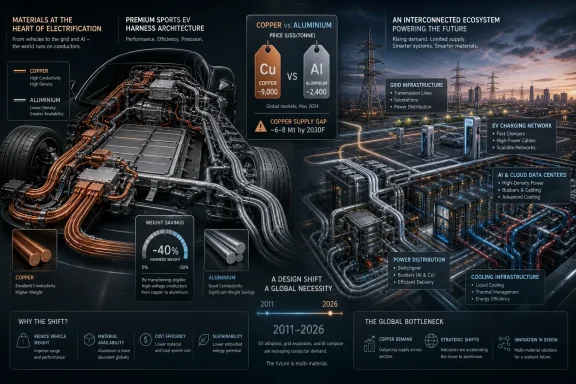
That is why Ferrari and BMW matter here. Ferrari said it began using aluminium power cables in the 296 hybrid and has expanded the approach into other models, including its first EV. BMW said it has been using aluminium conductors since 2011 and has expanded their use in high- and low-voltage systems in its latest eDrive technology. Tesla’s Model Y and Cybertruck, along with Chinese EVs from companies reportedly including AVATR, XPeng, and Xiaomi, have already pushed the idea into the competitive mainstream.
The industry is not replacing every copper wire overnight. It is picking spots where aluminium’s lower density and lower price can offset its weaker conductivity and more demanding connection design. That distinction is important: this is not a nostalgic replay of bad residential aluminium wiring from decades ago. It is a controlled engineering substitution in vehicles designed from the outset for the material.
The Reuters reporting that triggered this latest round of attention pointed to JPMorgan’s estimate that aluminium substitution could affect roughly 2% of global copper demand this year, with a scenario in which about 6% of annual copper demand is replaced by aluminium by 2030. Those percentages sound small until you remember that copper is a giant market measured in tens of millions of tons. A few percentage points of substitution can represent a meaningful industrial redesign.
The price relationship explains the urgency. Copper was reported near more than four times the price of aluminium, and the industry rule of thumb cited by cable executives is that manufacturers begin looking harder at aluminium when copper reaches roughly three-and-a-half times the aluminium price. Once that threshold is crossed, procurement teams stop treating substitution as a laboratory curiosity and start treating it as margin defense.
This is where the story leaves the auto page and enters the infrastructure beat. The same copper squeeze pressuring vehicle harnesses is also pressuring grid upgrades, building electrification, heat pumps, charging depots, and AI data center expansions. Every sector can argue that its use of copper is essential. The market does not care. It simply raises the price until somebody finds a substitute, delays a project, or absorbs the hit.
But aluminium is much lighter. For vehicles, especially EVs, weight is not an accounting abstraction. Every kilogram taken out of a harness can be reinvested in range, battery size, structure, comfort features, or cost savings. Ferrari reportedly said aluminium can save up to 20% of total wiring weight in some uses, and even if that figure varies by model and system, the direction is obvious.
The tradeoff is packaging. Aluminium may need more volume, but cars are increasingly being redesigned around new electrical architectures anyway. Centralized compute, zonal controllers, high-voltage battery systems, and simplified harness routing all create moments when engineers can reconsider materials rather than merely swapping one wire for another in an old layout.
That is why Tesla’s role looms large. Tesla has spent years treating manufacturing simplification as a product feature, not merely a factory concern. If a harness can be redesigned for automated assembly, simpler routing, or lower material exposure, Tesla will examine it. Chinese EV makers, locked in brutal price competition, have every incentive to follow or improve on that playbook.
For Ferrari, aluminium fits a long-running lightweighting philosophy. The company already uses aluminium extensively in bodies, engines, and chassis. Extending aluminium into power cabling is consistent with a brand that sells performance and wants every component to justify its mass. When Ferrari says it is choosing aluminium for performance, not simply cost, that is brand positioning — but it is not necessarily empty.
The deeper point is that premium engineering and cost pressure are now pointing in the same direction. A supercar maker can talk about response, weight, and driving dynamics. A Chinese EV maker can talk about price. A German automaker can talk about scalable platform engineering. All three can arrive at aluminium conductors for different reasons.
That convergence is what makes the shift durable. If aluminium wiring were only a desperation move during a copper spike, buyers would expect a retreat when prices soften. But when the material also supports lighter vehicles, lower exposure to supply shocks, and redesigned electrical architectures, it becomes part of the next platform cycle.
That slow adoption curve tells us something about automotive risk. Carmakers do not casually change materials in electrical systems that must survive vibration, heat cycles, moisture, salt, crashes, repairs, and warranty claims. A conductor is only one part of the system. Terminals, crimps, coatings, routing, insulation, inspection, service procedures, and supplier quality all have to match.
Aluminium’s history in residential wiring gives it a reputational burden, especially in North America. But the failures associated with older building wiring were not simply “aluminium conducts electricity.” They involved terminations, thermal expansion, oxidation, installation practices, and compatibility problems. Modern vehicles can be engineered with controlled connectors and purpose-built assemblies rather than improvised field practices.
Still, serviceability will matter. Independent mechanics, collision repair shops, fleet operators, and salvage rebuilders will need to know which conductors they are handling. Mixing materials, using the wrong terminal hardware, or treating aluminium cables like copper cables could turn a factory optimization into a repair headache. The engineering may be sound; the ecosystem still has to catch up.
Chinese EV makers have particular reasons to move fast. The domestic EV market remains intensely competitive, with price cuts, thin margins, and rapid product cycles. A cheaper wiring material that also reduces weight is exactly the kind of change suppliers can sell to automakers trying to preserve range and features while cutting cost.
Parts suppliers are already seeing the shift. Reuters reported that Chinese EV parts supplier JONVER has seen aluminium wiring products grow to about 30% of sales this year, up from about 20% in 2023. That is the kind of supplier-side detail that makes the trend more concrete than a consulting forecast.
There is also a strategic resource logic. If China can reduce copper intensity in power, autos, and appliances, it can redirect scarce or expensive copper toward sectors where substitution is harder. That does not eliminate copper dependence. It makes copper use more selective, which is exactly what mature industrial systems do when a critical input becomes constrained.
That matters because copper demand from data centers is part of the same pressure wave pushing automakers toward aluminium. AI infrastructure does not merely consume GPUs. It demands power delivery at scale, and power delivery is metal-intensive. The more hyperscalers build, the more they compete indirectly with automakers, utilities, homebuilders, and appliance manufacturers.
This is the overlooked connection between a Ferrari wiring harness and a Windows administrator’s world. The server rack, the charging station, the office heat pump, and the EV all draw from overlapping material markets. IT has spent years thinking about semiconductors as the hard limit. The next decade may teach buyers to think just as carefully about transformers, switchgear, copper busbars, and grid queues.
The substitution story is therefore not anti-electrification. It is what electrification looks like when it becomes real. Early narratives often assumed that scaling clean energy, EVs, and AI infrastructure was mostly a matter of demand and software. In practice, scale forces engineering substitutions, material triage, and ugly tradeoffs between performance, cost, and availability.
But the tradeoffs can surface in subtle ways. Aluminium conductors may influence connector size, harness routing, repair procedures, inspection requirements, and long-term corrosion protection. None of these are dealbreakers. All of them require discipline.
The automotive industry has experience here. Aluminium body panels once raised repair concerns, and now they are ordinary in many segments. High-voltage EV systems once seemed exotic, and now dealer networks and independent shops are gradually building competence. The same pattern can work for aluminium wiring, provided automakers do not hide behind vague sustainability language while leaving repair ecosystems underprepared.
There is a software parallel. A platform change can be perfectly rational for the vendor and still painful for administrators if tooling, documentation, and diagnostics lag behind. Aluminium wiring is a hardware platform change. Its success will depend not only on physics, but on whether the broader ecosystem can identify, test, repair, and recycle it without guesswork.
That means automakers cannot credibly present aluminium wiring as an automatic climate win. It may reduce mass, cost, and copper dependence while increasing embodied emissions if sourced from carbon-heavy smelters. Hydro and other producers will naturally emphasize lower-carbon aluminium supply, but buyers should watch the sourcing details rather than the material name.
Copper has its own environmental and social burdens. Mining expansion can be slow, capital-intensive, water-intensive, and politically contentious. Declining ore grades and permitting delays add to the pressure. The green transition is not escaping extraction; it is rearranging which extraction problems society accepts.
The honest conclusion is that substitution is a tool, not a virtue. Aluminium can be the right material in a specific electrical system for weight, cost, and supply reasons. That does not make it universally superior. The best engineering answer will be selective: copper where compactness and conductivity matter most, aluminium where weight and cost dominate, and better architecture where fewer conductors are needed at all.
This is exactly what happened in chips during the supply shocks of the early 2020s. Automakers discovered that low-cost microcontrollers could halt high-value vehicles. PC makers, server vendors, and IT buyers learned that component availability could matter as much as headline specifications. Supply-chain resilience became a design constraint.
Copper is entering a similar mental category. It will not disappear, and it will not be replaced wholesale. But the days of copper-by-default are fading in sectors where aluminium, optical links, wireless links, higher-voltage architectures, or simplified layouts can reduce exposure.
In vehicles, that may accelerate the move toward zonal architectures, where shorter cable runs and smarter local controllers reduce harness complexity. In buildings, it may revive debates over aluminium conductors in carefully specified applications. In data centers, it may push more attention toward power efficiency, busbar design, cooling layout, and grid-side planning. The common theme is discipline: fewer electrons wasted, fewer meters of conductor used thoughtlessly, and fewer assumptions that material supply will stretch infinitely.
The car industry is arriving at the same logic under more pressure. A vehicle wiring harness is a massive, complex, labor-intensive component. It affects assembly time, repairability, diagnostics, and weight distribution. As EVs become more software-defined, the physical network beneath the software becomes more important, not less.
That is why the copper-to-aluminium transition should not be judged only by commodity charts. The better question is whether it enables cleaner architecture. If an automaker simply swaps copper for aluminium in a messy harness, it may save money while creating new headaches. If it redesigns the electrical system around shorter runs, better connectors, and automated assembly, aluminium becomes part of a larger modernization.
This is also where luxury, mass-market, and Chinese competition intersect. Ferrari wants performance. BMW wants scalable premium EV platforms. Tesla wants manufacturing simplification. Chinese brands want cost, speed, and domestic supply-chain advantage. Aluminium wiring sits at the crossing point of all four incentives.
Optionality does not mean abandoning copper. It means preserving copper for the roles where its properties are hardest to replace. It means qualifying aluminium where it works. It means designing systems so future material changes do not require a full architectural rewrite. It means making supply chains less brittle.
That is a lesson IT departments should recognize. Sensible administrators do not design around a single vendor, a single region, or a single fragile dependency unless there is no alternative. Industrial manufacturers are now applying the same principle to metals. Copper remains excellent, but excellence is not the same as abundance.
The irony is that electrification’s critics have often treated copper scarcity as a reason the transition cannot scale. The industry’s answer is more pragmatic: use less copper where possible, redesign systems, tolerate tradeoffs, and keep moving. That does not make the resource problem vanish. It makes it an engineering problem instead of a slogan.
 The Wiring Harness Has Become a Commodity-Market Sensor
For more than a century, copper has been the default answer whenever an engineer needed to move electrons reliably. It is conductive, ductile, familiar, easy to terminate, and backed by a vast ecosystem of standards, suppliers, tooling, and repair knowledge. In cars, that made copper the quiet infrastructure behind everything from headlights to battery packs.But the EV era has changed what a wiring harness means. A modern electric vehicle is not just a car with a different motor; it is a rolling high-voltage electrical system with power electronics, thermal loops, battery management, sensors, infotainment, driver-assistance computers, and increasingly centralized compute. Wiring is no longer just a background cost. It is mass, packaging volume, assembly complexity, and exposure to a commodity whose price now reflects the ambitions of the entire electrified economy.
That is why Ferrari and BMW matter here. Ferrari said it began using aluminium power cables in the 296 hybrid and has expanded the approach into other models, including its first EV. BMW said it has been using aluminium conductors since 2011 and has expanded their use in high- and low-voltage systems in its latest eDrive technology. Tesla’s Model Y and Cybertruck, along with Chinese EVs from companies reportedly including AVATR, XPeng, and Xiaomi, have already pushed the idea into the competitive mainstream.
The industry is not replacing every copper wire overnight. It is picking spots where aluminium’s lower density and lower price can offset its weaker conductivity and more demanding connection design. That distinction is important: this is not a nostalgic replay of bad residential aluminium wiring from decades ago. It is a controlled engineering substitution in vehicles designed from the outset for the material.
Copper Is No Longer Just an Input Cost
Copper’s problem is not that it suddenly became a bad material. Its problem is that everyone wants it at the same time. EVs need it. Charging networks need it. Power grids need it. Wind and solar installations need it. Data centers need it in power distribution, cooling infrastructure, backup systems, and the utility buildout around them.The Reuters reporting that triggered this latest round of attention pointed to JPMorgan’s estimate that aluminium substitution could affect roughly 2% of global copper demand this year, with a scenario in which about 6% of annual copper demand is replaced by aluminium by 2030. Those percentages sound small until you remember that copper is a giant market measured in tens of millions of tons. A few percentage points of substitution can represent a meaningful industrial redesign.
The price relationship explains the urgency. Copper was reported near more than four times the price of aluminium, and the industry rule of thumb cited by cable executives is that manufacturers begin looking harder at aluminium when copper reaches roughly three-and-a-half times the aluminium price. Once that threshold is crossed, procurement teams stop treating substitution as a laboratory curiosity and start treating it as margin defense.
This is where the story leaves the auto page and enters the infrastructure beat. The same copper squeeze pressuring vehicle harnesses is also pressuring grid upgrades, building electrification, heat pumps, charging depots, and AI data center expansions. Every sector can argue that its use of copper is essential. The market does not care. It simply raises the price until somebody finds a substitute, delays a project, or absorbs the hit.
Aluminium Wins Where Weight and Cost Beat Compactness
Aluminium is not a magic replacement for copper. Copper conducts electricity better, which means an aluminium conductor generally needs a larger cross-section to carry the same current with comparable losses. That can make aluminium less attractive where space is tight, where connectors are difficult, or where thermal margins are already constrained.But aluminium is much lighter. For vehicles, especially EVs, weight is not an accounting abstraction. Every kilogram taken out of a harness can be reinvested in range, battery size, structure, comfort features, or cost savings. Ferrari reportedly said aluminium can save up to 20% of total wiring weight in some uses, and even if that figure varies by model and system, the direction is obvious.
The tradeoff is packaging. Aluminium may need more volume, but cars are increasingly being redesigned around new electrical architectures anyway. Centralized compute, zonal controllers, high-voltage battery systems, and simplified harness routing all create moments when engineers can reconsider materials rather than merely swapping one wire for another in an old layout.
That is why Tesla’s role looms large. Tesla has spent years treating manufacturing simplification as a product feature, not merely a factory concern. If a harness can be redesigned for automated assembly, simpler routing, or lower material exposure, Tesla will examine it. Chinese EV makers, locked in brutal price competition, have every incentive to follow or improve on that playbook.
Ferrari’s Move Gives the Trend a Different Kind of Legitimacy
Ferrari is not usually the company people cite when discussing low-cost manufacturing. Its customers do not buy cars because the wiring harness saved a few euros. That makes Ferrari’s adoption of aluminium useful evidence that the argument is not only about cheapening the bill of materials.For Ferrari, aluminium fits a long-running lightweighting philosophy. The company already uses aluminium extensively in bodies, engines, and chassis. Extending aluminium into power cabling is consistent with a brand that sells performance and wants every component to justify its mass. When Ferrari says it is choosing aluminium for performance, not simply cost, that is brand positioning — but it is not necessarily empty.
The deeper point is that premium engineering and cost pressure are now pointing in the same direction. A supercar maker can talk about response, weight, and driving dynamics. A Chinese EV maker can talk about price. A German automaker can talk about scalable platform engineering. All three can arrive at aluminium conductors for different reasons.
That convergence is what makes the shift durable. If aluminium wiring were only a desperation move during a copper spike, buyers would expect a retreat when prices soften. But when the material also supports lighter vehicles, lower exposure to supply shocks, and redesigned electrical architectures, it becomes part of the next platform cycle.
BMW Shows This Was a Long Transition, Not a Sudden Fashion
BMW’s timeline is a useful corrective to the idea that automakers woke up this year and discovered aluminium. The company says it first used aluminium conductors in the 1 Series in 2011. Since then, it has expanded substitution through hybrids and EVs, with broader use in its latest eDrive systems.That slow adoption curve tells us something about automotive risk. Carmakers do not casually change materials in electrical systems that must survive vibration, heat cycles, moisture, salt, crashes, repairs, and warranty claims. A conductor is only one part of the system. Terminals, crimps, coatings, routing, insulation, inspection, service procedures, and supplier quality all have to match.
Aluminium’s history in residential wiring gives it a reputational burden, especially in North America. But the failures associated with older building wiring were not simply “aluminium conducts electricity.” They involved terminations, thermal expansion, oxidation, installation practices, and compatibility problems. Modern vehicles can be engineered with controlled connectors and purpose-built assemblies rather than improvised field practices.
Still, serviceability will matter. Independent mechanics, collision repair shops, fleet operators, and salvage rebuilders will need to know which conductors they are handling. Mixing materials, using the wrong terminal hardware, or treating aluminium cables like copper cables could turn a factory optimization into a repair headache. The engineering may be sound; the ecosystem still has to catch up.
China Is Turning Substitution Into Industrial Policy
The Chinese angle is not just that Chinese EV makers are adopting aluminium. It is that China reportedly encouraged broader copper-to-aluminium substitution in a March 2025 policy paper. In the world’s largest metals-consuming economy, that matters. Industrial policy can turn what would otherwise be a company-by-company procurement decision into a coordinated supply-chain direction.Chinese EV makers have particular reasons to move fast. The domestic EV market remains intensely competitive, with price cuts, thin margins, and rapid product cycles. A cheaper wiring material that also reduces weight is exactly the kind of change suppliers can sell to automakers trying to preserve range and features while cutting cost.
Parts suppliers are already seeing the shift. Reuters reported that Chinese EV parts supplier JONVER has seen aluminium wiring products grow to about 30% of sales this year, up from about 20% in 2023. That is the kind of supplier-side detail that makes the trend more concrete than a consulting forecast.
There is also a strategic resource logic. If China can reduce copper intensity in power, autos, and appliances, it can redirect scarce or expensive copper toward sectors where substitution is harder. That does not eliminate copper dependence. It makes copper use more selective, which is exactly what mature industrial systems do when a critical input becomes constrained.
The Data Center Boom Is Competing With Your Car
WindowsForum readers do not need to be told that AI has physical consequences. The cloud is not ethereal; it is warehouses full of servers, accelerators, power gear, cooling systems, transformers, cables, and grid interconnections. Every Copilot prompt, model training run, and enterprise AI deployment ultimately depends on a chain of materials and electricity.That matters because copper demand from data centers is part of the same pressure wave pushing automakers toward aluminium. AI infrastructure does not merely consume GPUs. It demands power delivery at scale, and power delivery is metal-intensive. The more hyperscalers build, the more they compete indirectly with automakers, utilities, homebuilders, and appliance manufacturers.
This is the overlooked connection between a Ferrari wiring harness and a Windows administrator’s world. The server rack, the charging station, the office heat pump, and the EV all draw from overlapping material markets. IT has spent years thinking about semiconductors as the hard limit. The next decade may teach buyers to think just as carefully about transformers, switchgear, copper busbars, and grid queues.
The substitution story is therefore not anti-electrification. It is what electrification looks like when it becomes real. Early narratives often assumed that scaling clean energy, EVs, and AI infrastructure was mostly a matter of demand and software. In practice, scale forces engineering substitutions, material triage, and ugly tradeoffs between performance, cost, and availability.
The Engineering Tradeoffs Will Not Stay Hidden Forever
Consumers rarely ask what metal is inside a wiring harness. They care whether the car charges quickly, drives far, avoids recalls, and survives ownership without weird electrical faults. If aluminium wiring does its job, buyers may never notice it.But the tradeoffs can surface in subtle ways. Aluminium conductors may influence connector size, harness routing, repair procedures, inspection requirements, and long-term corrosion protection. None of these are dealbreakers. All of them require discipline.
The automotive industry has experience here. Aluminium body panels once raised repair concerns, and now they are ordinary in many segments. High-voltage EV systems once seemed exotic, and now dealer networks and independent shops are gradually building competence. The same pattern can work for aluminium wiring, provided automakers do not hide behind vague sustainability language while leaving repair ecosystems underprepared.
There is a software parallel. A platform change can be perfectly rational for the vendor and still painful for administrators if tooling, documentation, and diagnostics lag behind. Aluminium wiring is a hardware platform change. Its success will depend not only on physics, but on whether the broader ecosystem can identify, test, repair, and recycle it without guesswork.
Sustainability Is the Argument Automakers Will Have to Earn
Aluminium’s environmental case is complicated. It is lighter in use, which can improve vehicle efficiency. It is abundant and recyclable. But primary aluminium production is energy-intensive, and the emissions profile depends heavily on the electricity used to make it.That means automakers cannot credibly present aluminium wiring as an automatic climate win. It may reduce mass, cost, and copper dependence while increasing embodied emissions if sourced from carbon-heavy smelters. Hydro and other producers will naturally emphasize lower-carbon aluminium supply, but buyers should watch the sourcing details rather than the material name.
Copper has its own environmental and social burdens. Mining expansion can be slow, capital-intensive, water-intensive, and politically contentious. Declining ore grades and permitting delays add to the pressure. The green transition is not escaping extraction; it is rearranging which extraction problems society accepts.
The honest conclusion is that substitution is a tool, not a virtue. Aluminium can be the right material in a specific electrical system for weight, cost, and supply reasons. That does not make it universally superior. The best engineering answer will be selective: copper where compactness and conductivity matter most, aluminium where weight and cost dominate, and better architecture where fewer conductors are needed at all.
The Copper Supercycle Is Forcing Design Discipline
For years, manufacturers could treat copper as expensive but available. That assumption is weakening. Once a material becomes strategically constrained, engineers must justify its use more carefully.This is exactly what happened in chips during the supply shocks of the early 2020s. Automakers discovered that low-cost microcontrollers could halt high-value vehicles. PC makers, server vendors, and IT buyers learned that component availability could matter as much as headline specifications. Supply-chain resilience became a design constraint.
Copper is entering a similar mental category. It will not disappear, and it will not be replaced wholesale. But the days of copper-by-default are fading in sectors where aluminium, optical links, wireless links, higher-voltage architectures, or simplified layouts can reduce exposure.
In vehicles, that may accelerate the move toward zonal architectures, where shorter cable runs and smarter local controllers reduce harness complexity. In buildings, it may revive debates over aluminium conductors in carefully specified applications. In data centers, it may push more attention toward power efficiency, busbar design, cooling layout, and grid-side planning. The common theme is discipline: fewer electrons wasted, fewer meters of conductor used thoughtlessly, and fewer assumptions that material supply will stretch infinitely.
The Auto Industry Is Relearning an Old PC Lesson
PC builders have long understood that material substitutions are not inherently bad. Aluminium cases, copper heat pipes, graphite pads, vapor chambers, plastic structural parts, magnesium frames, and composite materials all have places where they make sense. The trick is matching the material to the job rather than treating one material as morally superior.The car industry is arriving at the same logic under more pressure. A vehicle wiring harness is a massive, complex, labor-intensive component. It affects assembly time, repairability, diagnostics, and weight distribution. As EVs become more software-defined, the physical network beneath the software becomes more important, not less.
That is why the copper-to-aluminium transition should not be judged only by commodity charts. The better question is whether it enables cleaner architecture. If an automaker simply swaps copper for aluminium in a messy harness, it may save money while creating new headaches. If it redesigns the electrical system around shorter runs, better connectors, and automated assembly, aluminium becomes part of a larger modernization.
This is also where luxury, mass-market, and Chinese competition intersect. Ferrari wants performance. BMW wants scalable premium EV platforms. Tesla wants manufacturing simplification. Chinese brands want cost, speed, and domestic supply-chain advantage. Aluminium wiring sits at the crossing point of all four incentives.
The Real Signal Is Not Aluminium; It Is Optionality
The most important word in this story is not aluminium. It is optionality. Automakers, cable suppliers, appliance makers, and infrastructure builders are trying to avoid being trapped by a single metal whose price and availability are increasingly shaped by global electrification.Optionality does not mean abandoning copper. It means preserving copper for the roles where its properties are hardest to replace. It means qualifying aluminium where it works. It means designing systems so future material changes do not require a full architectural rewrite. It means making supply chains less brittle.
That is a lesson IT departments should recognize. Sensible administrators do not design around a single vendor, a single region, or a single fragile dependency unless there is no alternative. Industrial manufacturers are now applying the same principle to metals. Copper remains excellent, but excellence is not the same as abundance.
The irony is that electrification’s critics have often treated copper scarcity as a reason the transition cannot scale. The industry’s answer is more pragmatic: use less copper where possible, redesign systems, tolerate tradeoffs, and keep moving. That does not make the resource problem vanish. It makes it an engineering problem instead of a slogan.
Ferrari’s Cable Choice Turns a Metals Story Into a Platform Story
The practical message is narrower than the headlines but more durable than a one-day commodity story. Aluminium wiring is not coming for every conductor in every car, but it is moving from edge case to platform option. That means buyers, repairers, suppliers, and infrastructure planners should treat it as part of the next normal.- Ferrari has expanded aluminium power cabling from the 296 hybrid into additional models, including its first EV, making the material shift visible at the premium-performance end of the market.
- BMW’s use of aluminium conductors dates back to 2011 and has widened into newer hybrid and EV systems, showing that this is a long engineering transition rather than a sudden fad.
- Tesla and Chinese EV makers helped push aluminium wiring into the competitive mainstream, where lower weight and lower cost matter directly to range, pricing, and manufacturing efficiency.
- Copper’s high price relative to aluminium is forcing manufacturers to reconsider old defaults, especially where larger aluminium conductors are acceptable.
- The same copper squeeze affects cars, chargers, grids, data centers, appliances, and cooling systems, which means this is an infrastructure story as much as an automotive one.
- The success of aluminium wiring will depend on connectors, repair procedures, corrosion control, documentation, and recycling systems, not just on the raw metal price.
References
- Primary source: WHTC
Published: 2026-07-01T01:20:20.566106
Analysis-Ferrari and BMW join Tesla, China in switch from copper to cheaper aluminium | 1450 AM 99.7 FM WHTC | Holland
By Eric Onstad, Amy Lv, Ju-min Park and Kalea Hall LONDON/SHANGHAI/BEIJING/DETROIT, June 30 (Reuters) - Ferrari and BMW are rolling out new models featuring lightweight, cost-effective aluminium wiring, accelerating a shift away from copper, the domina...whtc.com - Independent coverage: CBT News
Published: Tue, 30 Jun 2026 15:36:21 GMT
Ferrari and BMW join Tesla in shift from copper to aluminum wiring
Ferrari and BMW join Tesla in using aluminum wiring as automakers look to reduce weight, manage copper costs and improve EV efficiency.www.cbtnews.com - Related coverage: investing.com
Analysis-Ferrari and BMW join Tesla, China in switch from copper to cheaper aluminium By Reuters
Analysis-Ferrari and BMW join Tesla, China in switch from copper to cheaper aluminiumwww.investing.com - Related coverage: energynews.oedigital.com
Tesla and BMW switch to aluminum from cheaper copper
Ferrari and BMW have introduced new models with lightweight, cost-effective aluminum wiring. This is accelerating the shift away from copper as the dominant material for electric wiring ever since the invention two centuries ago of the electric batteries. JPMorgan predicts that the decisions...energynews.oedigital.com - Related coverage: thesheffieldpress.com
Ferrari and BMW switch to aluminium wiring as copper demand shifts | The Sheffield Press
Ferrari and BMW have moved to aluminium wiring, a cost and weight shift that could trim copper demand and reshape supply chains across autos and beyond.thesheffieldpress.com - Related coverage: marketscreener.com
- Related coverage: kz.kursiv.media
Ferrari, BMW and Tesla embrace new way to make EVs cheaper
Ferrari, BMW and Tesla are switching to aluminum wiring to make EVs cheaper and lighter as copper prices soarkz.kursiv.media - Related coverage: astreka.com
- Related coverage: mezha.net
Ferrari and BMW adopt aluminum wiring, cutting weight and copper demand | Ukraine news - #Mezha
Major carmakers are replacing copper with lighter aluminum in vehicle wiring, shaving weight and costs while shaking copper markets and supply chains. According to Reuters London, Shanghai, Beijing, Detroit – Ferrari and BMW are releasing new models using lightweight aluminum wiring, reducing... mezha.net
- Related coverage: idnfinancials.com
Following Tesla’s trend, Ferrari and BMW switch to aluminium cables | IDNFinancials
Ferrari and BMW are moving to aluminium cables, following Tesla’s lead in the global EV industry.www.idnfinancials.com - Related coverage: finimize.com
Ferrari And BMW Start Swapping Copper For Aluminum Wiring - Finimize
Reuters says higher copper prices and EV weight goals are pushing carmakers toward aluminum, a shift JPMorgan sees touching 2% of global copper demand this year. finimize.com
- Related coverage: theoregongroup.com
Can copper hit $15,000 in 2026? - The Oregon Group - Critical Minerals and Energy Intelligence
Benchmark copper prices on the London Metal Exchange (LME) breached $13,000 per metric ton on January 5, 2026 — with a 16% rise alone just since start oftheoregongroup.com - Related coverage: autos.yahoo.com
Ferrari and BMW switch to aluminum wiring in new car models
The shift follows similar moves by Tesla and Chinese EV makers, driven by copper prices running more than 4 times the cost of aluminumautos.yahoo.com