

TransAct Technologies said on June 30, 2026, from Hamden, Connecticut, that it has launched a next-generation BOHA! SaaS platform for enterprise foodservice operators after migrating the back-of-house system from legacy hosted infrastructure to Microsoft Azure. The announcement is not just another cloud victory lap. It is a small but revealing example of where Azure’s enterprise gravity is strongest: the operational software that sits far from glossy consumer apps but close to daily business risk.
For restaurants, convenience stores, grocery chains, and contract dining operators, back-of-house software is no longer a clipboard replacement. It is the place where food safety, labor execution, labeling, inventory-adjacent workflows, and compliance evidence increasingly converge. By moving BOHA! to Azure, TransAct is betting that the next phase of foodservice digitization will be won less by point features and more by platform trust.
TransAct’s announcement frames Azure as infrastructure, but the migration is better understood as a product reset. BOHA! has long been positioned as a combination of SaaS software and purpose-built hardware for foodservice operations, including labeling and workflow automation. Moving that foundation onto Azure gives TransAct a cleaner story for large chains that care less about cloud branding than about deployment predictability across thousands of locations.
That distinction matters. A single restaurant can tolerate rough edges in a niche app if the app solves an immediate operational problem. A national operator cannot. At enterprise scale, software must survive uneven connectivity, staff turnover, regional outages, new integrations, compliance audits, and the ordinary chaos of kitchens.
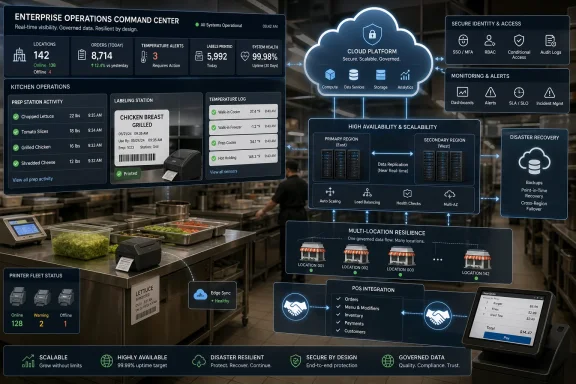
The company says the Azure migration improves scalability, security, resiliency, performance, uptime, high availability, and disaster recovery. Those are familiar cloud nouns, but they are not empty ones in this market. Foodservice operators are increasingly managed like distributed technology estates, and the back office is now part of that estate.
The move also gives TransAct a more credible path to faster product iteration. The press release emphasizes customer-requested enhancements, integrations with systems such as POS, and future AI-enabled workflows. That is the language of a vendor trying to move from appliance-and-app provider to enterprise platform.
Azure offers regions, availability zones, redundancy models, monitoring, backup services, identity controls, and disaster recovery patterns that a smaller hosted environment would struggle to match at equivalent breadth. But Microsoft’s own reliability guidance is careful about the shared-responsibility model: the cloud provider supplies capabilities, while the application owner must choose, configure, test, and operate them properly. That caveat is central to how IT pros should read TransAct’s announcement.
A migration to Azure does not automatically make BOHA! highly available in every meaningful sense. Architecture still matters. So do service tiers, deployment topology, monitoring, recovery objectives, identity configuration, incident response, and whether failover procedures are tested under real pressure.
Still, the cloud move changes the ceiling. A legacy hosted environment may be adequate for a smaller SaaS footprint, but it can become a constraint when customers demand real-time visibility, AI-assisted workflows, and integrations across multiple operational systems. Azure gives TransAct more room to build, even if execution remains the hard part.
Back-of-house systems used to be treated as operational accessories. Label printers, checklists, temperature logs, and prep workflows were important, but they often lived outside the strategic software map. That world is fading. When a foodborne illness investigation, labor shortage, labeling error, or failed store rollout can become a brand-level issue, back-of-house execution becomes boardroom-adjacent.
BOHA! sits in that space. TransAct says the platform helps operators digitize and automate food safety compliance, streamline labeling workflows, and improve labor efficiency across enterprise environments. The company also says its BOHA! solutions serve 19,000 foodservice locations worldwide, which gives the Azure migration more weight than a greenfield SaaS launch.
At that scale, consistency becomes the product. A platform that works well in 50 stores but struggles in 5,000 is not an enterprise platform. The challenge is not merely adding features; it is making every workflow deployable, observable, supportable, and governable.
This is why Azure matters to the story even if Microsoft is not the protagonist. The move gives TransAct a more familiar operating environment for enterprise customers that already run Microsoft-heavy estates. It also potentially eases conversations around security reviews, disaster recovery posture, identity integration, and data access patterns.
Foodservice is full of AI-adjacent use cases that sound simple until they meet real operations. A system might flag unusual waste patterns, suggest prep adjustments, identify missed safety tasks, automate exception reporting, or help managers interpret location-level performance. But those features depend on timely data, clean integrations, and a platform that can handle distributed usage.
The Azure migration therefore reads less like an AI launch than an AI prerequisite. TransAct is not announcing a finished AI suite. It is saying that BOHA!’s architecture is now better positioned for AI-enabled solutions, IoT integrations, real-time data access, and more seamless workflows across its ecosystem.
That is the right order. The industry has seen too many vendors staple AI language onto brittle architectures. If TransAct can use Azure to modernize its data and integration layer first, the AI claims may become more than decorative.
The prize is not simply connecting BOHA! to POS. The prize is making operational context available across systems without turning every customer deployment into a custom integration slog. Enterprise foodservice companies are often mosaics of inherited systems, franchise requirements, regional vendors, and operational exceptions.
Cloud-native integration patterns can help, but they do not eliminate complexity. APIs still need governance. Data definitions still need agreement. Security teams still need to decide which systems can talk to which systems, under what conditions, and with what audit trail.
If TransAct can make BOHA! a more dependable integration hub for back-of-house data, the Azure migration becomes strategically meaningful. If the migration only improves hosting economics while integrations remain slow and bespoke, the platform story will be less convincing.
The issue is that customer expectations move. Enterprise buyers now expect rapid feature delivery, strong uptime commitments, security posture documentation, data recovery planning, observability, and integration readiness. A hosted environment that once seemed practical can become a drag when the vendor wants to serve larger, more complex customers.
TransAct’s language suggests exactly that transition. The company says it has invested heavily in upgrading BOHA!’s platform architecture leading up to the Azure migration. That phrasing matters because it implies the move was not just a lift-and-shift hosting change but part of a broader refactoring or modernization effort.
The real test will be whether customers experience fewer constraints. Faster enhancement cycles, better performance across multi-location deployments, and smoother integrations are measurable outcomes. Enterprise customers will not grade the migration by the elegance of the architecture diagram.
Enterprise customers evaluating BOHA! should ask how the platform uses Azure capabilities in practice. Are workloads deployed across availability zones where appropriate? What are the recovery time and recovery point objectives? How are backups tested? What identity model governs administrative access? How are logs retained and exposed to customers? What service-level commitments exist, and which exclusions apply?
They should also ask how TransAct handles edge conditions in stores. Foodservice locations are not clean-room data centers. Connectivity can fail. Staff can power-cycle devices. Printers jam. Tablets disappear. Networks get segmented by local IT policy. A cloud platform is only as good as the operational design that bridges cloud services and store reality.
That store reality is where TransAct’s hardware background may help. Vendors that understand both SaaS and physical workflow equipment often have a better chance of designing systems that survive real-world abuse. But the hybrid nature of BOHA! also raises the stakes: software uptime is only one component of a customer’s actual workflow uptime.
Vertical SaaS vendors bring industry-specific workflows that Microsoft does not necessarily want to build itself. When those vendors standardize on Azure, Microsoft benefits from compute consumption, data services, AI services, identity adjacency, and the broader customer comfort that comes from seeing Azure embedded in operational software.
This is especially important as AI becomes part of enterprise application roadmaps. If BOHA! eventually adds AI-assisted foodservice workflows, Microsoft has an opportunity to pull more usage toward Azure AI services, data platforms, observability tools, and security products. The initial migration is infrastructure; the downstream opportunity is platform expansion.
That does not mean TransAct becomes a Microsoft dependency story overnight. Customers will still judge BOHA! on operational usefulness, support quality, pricing, roadmap credibility, and integration depth. But Azure gives TransAct a stronger enterprise backdrop than a generic hosted infrastructure could provide.
There is also a commercial risk. Enterprise-grade architecture often brings enterprise-grade complexity and cost. If the platform becomes more capable but also harder to buy, deploy, or administer, smaller and midmarket customers may feel the trade-off. TransAct will need to preserve the practical workflow simplicity that likely made BOHA! attractive in the first place.
Security claims deserve similar restraint. Azure provides a deep security toolbox, but SaaS security still depends on tenant isolation, access controls, secure development practices, vulnerability management, logging, incident response, and customer configuration choices. The press release says security is enhanced; the market will eventually want evidence.
The strongest version of this announcement is not “BOHA! is better because Azure.” It is “BOHA! can now evolve faster because TransAct has rebuilt the foundation on a cloud platform that large customers already understand.” That is a more modest claim, and a more credible one.
For restaurants, convenience stores, grocery chains, and contract dining operators, back-of-house software is no longer a clipboard replacement. It is the place where food safety, labor execution, labeling, inventory-adjacent workflows, and compliance evidence increasingly converge. By moving BOHA! to Azure, TransAct is betting that the next phase of foodservice digitization will be won less by point features and more by platform trust.
 The Cloud Migration Is the Product Strategy
TransAct’s announcement frames Azure as infrastructure, but the migration is better understood as a product reset. BOHA! has long been positioned as a combination of SaaS software and purpose-built hardware for foodservice operations, including labeling and workflow automation. Moving that foundation onto Azure gives TransAct a cleaner story for large chains that care less about cloud branding than about deployment predictability across thousands of locations.That distinction matters. A single restaurant can tolerate rough edges in a niche app if the app solves an immediate operational problem. A national operator cannot. At enterprise scale, software must survive uneven connectivity, staff turnover, regional outages, new integrations, compliance audits, and the ordinary chaos of kitchens.
The company says the Azure migration improves scalability, security, resiliency, performance, uptime, high availability, and disaster recovery. Those are familiar cloud nouns, but they are not empty ones in this market. Foodservice operators are increasingly managed like distributed technology estates, and the back office is now part of that estate.
The move also gives TransAct a more credible path to faster product iteration. The press release emphasizes customer-requested enhancements, integrations with systems such as POS, and future AI-enabled workflows. That is the language of a vendor trying to move from appliance-and-app provider to enterprise platform.
Azure Wins Where Boring Reliability Becomes a Selling Point
Microsoft Azure is not being chosen here because foodservice workers are asking for Azure by name. It is being chosen because CIOs, security teams, procurement departments, and operations executives understand what a major cloud platform can promise — and what it cannot.Azure offers regions, availability zones, redundancy models, monitoring, backup services, identity controls, and disaster recovery patterns that a smaller hosted environment would struggle to match at equivalent breadth. But Microsoft’s own reliability guidance is careful about the shared-responsibility model: the cloud provider supplies capabilities, while the application owner must choose, configure, test, and operate them properly. That caveat is central to how IT pros should read TransAct’s announcement.
A migration to Azure does not automatically make BOHA! highly available in every meaningful sense. Architecture still matters. So do service tiers, deployment topology, monitoring, recovery objectives, identity configuration, incident response, and whether failover procedures are tested under real pressure.
Still, the cloud move changes the ceiling. A legacy hosted environment may be adequate for a smaller SaaS footprint, but it can become a constraint when customers demand real-time visibility, AI-assisted workflows, and integrations across multiple operational systems. Azure gives TransAct more room to build, even if execution remains the hard part.
Foodservice Technology Is Becoming Enterprise Infrastructure
The least surprising part of this announcement is that TransAct uses the phrase “enterprise-grade.” The most interesting part is that, in foodservice, the phrase is becoming less absurd.Back-of-house systems used to be treated as operational accessories. Label printers, checklists, temperature logs, and prep workflows were important, but they often lived outside the strategic software map. That world is fading. When a foodborne illness investigation, labor shortage, labeling error, or failed store rollout can become a brand-level issue, back-of-house execution becomes boardroom-adjacent.
BOHA! sits in that space. TransAct says the platform helps operators digitize and automate food safety compliance, streamline labeling workflows, and improve labor efficiency across enterprise environments. The company also says its BOHA! solutions serve 19,000 foodservice locations worldwide, which gives the Azure migration more weight than a greenfield SaaS launch.
At that scale, consistency becomes the product. A platform that works well in 50 stores but struggles in 5,000 is not an enterprise platform. The challenge is not merely adding features; it is making every workflow deployable, observable, supportable, and governable.
This is why Azure matters to the story even if Microsoft is not the protagonist. The move gives TransAct a more familiar operating environment for enterprise customers that already run Microsoft-heavy estates. It also potentially eases conversations around security reviews, disaster recovery posture, identity integration, and data access patterns.
The AI Pitch Needs the Cloud Foundation First
TransAct’s CEO John Dillon tied the Azure move to faster innovation and AI-powered workflows. That is now the mandatory line in almost every enterprise software announcement, but in this case the sequencing is worth noting. Before vendors can credibly sell AI for operational workflows, they need reliable data flows, consistent APIs, secure access controls, and enough platform elasticity to process events without turning every rollout into a bespoke engineering project.Foodservice is full of AI-adjacent use cases that sound simple until they meet real operations. A system might flag unusual waste patterns, suggest prep adjustments, identify missed safety tasks, automate exception reporting, or help managers interpret location-level performance. But those features depend on timely data, clean integrations, and a platform that can handle distributed usage.
The Azure migration therefore reads less like an AI launch than an AI prerequisite. TransAct is not announcing a finished AI suite. It is saying that BOHA!’s architecture is now better positioned for AI-enabled solutions, IoT integrations, real-time data access, and more seamless workflows across its ecosystem.
That is the right order. The industry has seen too many vendors staple AI language onto brittle architectures. If TransAct can use Azure to modernize its data and integration layer first, the AI claims may become more than decorative.
The POS Integration Line Is Doing Quiet Heavy Lifting
Among the announcement’s claims, the reference to integrations with in-house applications such as POS deserves more attention than it will probably get. POS systems are the transactional center of restaurant and retail foodservice operations, but they are only one part of the operational picture. Back-of-house workflows produce a different kind of data: prep timing, labeling actions, compliance events, task completion, equipment-adjacent activity, and labor execution signals.The prize is not simply connecting BOHA! to POS. The prize is making operational context available across systems without turning every customer deployment into a custom integration slog. Enterprise foodservice companies are often mosaics of inherited systems, franchise requirements, regional vendors, and operational exceptions.
Cloud-native integration patterns can help, but they do not eliminate complexity. APIs still need governance. Data definitions still need agreement. Security teams still need to decide which systems can talk to which systems, under what conditions, and with what audit trail.
If TransAct can make BOHA! a more dependable integration hub for back-of-house data, the Azure migration becomes strategically meaningful. If the migration only improves hosting economics while integrations remain slow and bespoke, the platform story will be less convincing.
Legacy Hosting Was Not a Scandal, but It Was a Ceiling
There is a tendency in tech marketing to treat anything “legacy” as a confession of failure. That is too easy. Many hosted systems began as reasonable architectures for their time, especially in vertical markets where the first job was to digitize a practical workflow rather than satisfy a cloud architecture review board.The issue is that customer expectations move. Enterprise buyers now expect rapid feature delivery, strong uptime commitments, security posture documentation, data recovery planning, observability, and integration readiness. A hosted environment that once seemed practical can become a drag when the vendor wants to serve larger, more complex customers.
TransAct’s language suggests exactly that transition. The company says it has invested heavily in upgrading BOHA!’s platform architecture leading up to the Azure migration. That phrasing matters because it implies the move was not just a lift-and-shift hosting change but part of a broader refactoring or modernization effort.
The real test will be whether customers experience fewer constraints. Faster enhancement cycles, better performance across multi-location deployments, and smoother integrations are measurable outcomes. Enterprise customers will not grade the migration by the elegance of the architecture diagram.
For IT Pros, the Interesting Questions Start After the Press Release
WindowsForum readers know the pattern. A vendor announces a move to Azure, attaches claims about resiliency and security, and leaves out the details that administrators would need to judge the architecture. That does not make the announcement unimportant; it means the technical due diligence begins where the press release ends.Enterprise customers evaluating BOHA! should ask how the platform uses Azure capabilities in practice. Are workloads deployed across availability zones where appropriate? What are the recovery time and recovery point objectives? How are backups tested? What identity model governs administrative access? How are logs retained and exposed to customers? What service-level commitments exist, and which exclusions apply?
They should also ask how TransAct handles edge conditions in stores. Foodservice locations are not clean-room data centers. Connectivity can fail. Staff can power-cycle devices. Printers jam. Tablets disappear. Networks get segmented by local IT policy. A cloud platform is only as good as the operational design that bridges cloud services and store reality.
That store reality is where TransAct’s hardware background may help. Vendors that understand both SaaS and physical workflow equipment often have a better chance of designing systems that survive real-world abuse. But the hybrid nature of BOHA! also raises the stakes: software uptime is only one component of a customer’s actual workflow uptime.
Microsoft Gets Another Vertical Workload Without Needing the Spotlight
From Microsoft’s perspective, announcements like this are the quiet machinery of Azure growth. They do not generate the attention of a massive AI model partnership or a marquee cloud migration by a global bank. But they are strategically useful because they move vertical SaaS workloads into Microsoft’s cloud orbit.Vertical SaaS vendors bring industry-specific workflows that Microsoft does not necessarily want to build itself. When those vendors standardize on Azure, Microsoft benefits from compute consumption, data services, AI services, identity adjacency, and the broader customer comfort that comes from seeing Azure embedded in operational software.
This is especially important as AI becomes part of enterprise application roadmaps. If BOHA! eventually adds AI-assisted foodservice workflows, Microsoft has an opportunity to pull more usage toward Azure AI services, data platforms, observability tools, and security products. The initial migration is infrastructure; the downstream opportunity is platform expansion.
That does not mean TransAct becomes a Microsoft dependency story overnight. Customers will still judge BOHA! on operational usefulness, support quality, pricing, roadmap credibility, and integration depth. But Azure gives TransAct a stronger enterprise backdrop than a generic hosted infrastructure could provide.
The Risk Is Overpromising the Platform Before It Proves the Operations
Every cloud modernization story contains a temptation: once the platform has moved, the vendor starts selling the destination as if it has already delivered the outcomes. That is where TransAct will need discipline. Azure can improve the conditions for scalability, resiliency, and innovation, but customers will care about observed reliability and feature velocity, not inherited cloud prestige.There is also a commercial risk. Enterprise-grade architecture often brings enterprise-grade complexity and cost. If the platform becomes more capable but also harder to buy, deploy, or administer, smaller and midmarket customers may feel the trade-off. TransAct will need to preserve the practical workflow simplicity that likely made BOHA! attractive in the first place.
Security claims deserve similar restraint. Azure provides a deep security toolbox, but SaaS security still depends on tenant isolation, access controls, secure development practices, vulnerability management, logging, incident response, and customer configuration choices. The press release says security is enhanced; the market will eventually want evidence.
The strongest version of this announcement is not “BOHA! is better because Azure.” It is “BOHA! can now evolve faster because TransAct has rebuilt the foundation on a cloud platform that large customers already understand.” That is a more modest claim, and a more credible one.
The Real BOHA! Story Is Whether Azure Turns Kitchen Data Into Governed Data
For operators and IT teams, the practical meaning of this launch is less about the cloud logo and more about whether TransAct can convert back-of-house activity into a reliable enterprise data layer. The announcement gives customers several concrete things to watch.- TransAct has moved BOHA! from legacy hosted infrastructure to Microsoft Azure as part of a next-generation SaaS platform launch announced on June 30, 2026.
- The company is positioning the migration as a foundation for scalability, high availability, disaster recovery, faster enhancements, POS-adjacent integrations, AI-enabled workflows, IoT integrations, and real-time data access.
- BOHA! remains a vertical foodservice platform, not a generic enterprise app, with workflows aimed at food safety compliance, labeling, labor efficiency, and multi-location operational control.
- Azure improves the available reliability and security toolkit, but TransAct still has to prove architecture, testing, monitoring, support, and operational execution.
- Enterprise customers should evaluate the platform by measurable outcomes such as uptime, recovery objectives, integration speed, enhancement cadence, and store-level resilience.
- The migration strengthens Microsoft’s position in vertical SaaS by putting another operational workload onto Azure without requiring Microsoft to own the application layer.
References
- Primary source: Stock Titan
Published: 2026-06-30T12:30:21.603697
Loading…
www.stocktitan.net - Related coverage: streetinsider.com
Loading…
www.streetinsider.com - Related coverage: ca.marketscreener.com
Loading…
ca.marketscreener.com - Related coverage: marketscreener.com
Loading…
www.marketscreener.com - Related coverage: zonebourse.com
Loading…
www.zonebourse.com - Related coverage: nasdaq.com
Loading…
www.nasdaq.com
- Related coverage: uk.investing.com
Loading…
uk.investing.com - Related coverage: in.marketscreener.com
Loading…
in.marketscreener.com - Related coverage: es.marketscreener.com
Loading…
es.marketscreener.com - Related coverage: app.dealroom.co
Loading…
app.dealroom.co - Related coverage: transacttech.gcs-web.com
Loading…
transacttech.gcs-web.com