

Tieto announced on July 1, 2026, that it has achieved Microsoft Copilot specialization under its Solutions Partner for Modern Work status, positioning the Nordic technology services company as a certified delivery partner for enterprise Copilot deployments. The announcement is not a product launch, a new model, or a licensing change. It is something more prosaic and arguably more important for CIOs: another sign that Microsoft’s AI strategy is moving from executive keynote theater into the partner machinery that actually touches customer tenants.
That distinction matters. Copilot is no longer just a feature set sprinkled across Word, Excel, Teams, Outlook, Windows, GitHub, and the Microsoft 365 admin stack. It is becoming a services market, and Microsoft is quietly sorting that market into partners that can prove deployment experience and partners that merely talk convincingly about AI transformation.
The first phase of enterprise generative AI was noisy by design. Microsoft put Copilot branding on nearly every surface it could plausibly connect to a model, while competitors raced to prove they had their own assistants, agents, copilots, or “AI-native” workflows. The result was a market full of demos and a customer base full of pilot programs.
The second phase is less glamorous. It is about identity, data access, tenant hygiene, change management, compliance boundaries, workflow redesign, and adoption measurement. That is where companies like Tieto enter the story, because large organizations rarely turn on Microsoft 365 Copilot at scale by simply buying licenses and sending a cheerful email to staff.
Microsoft’s partner specializations exist for exactly this middle layer. They give Microsoft a way to signal which partners have cleared specific capability bars, and they give customers a shorthand for distinguishing general Microsoft familiarity from tested delivery competence. In that sense, Tieto’s new Copilot specialization is a credential, but it is also a market signal.
The company says the achievement recognizes proven expertise in deploying and scaling Microsoft Copilot solutions. The phrase is standard partner-program language, but the implication is concrete: Microsoft wants Copilot adoption to be less dependent on direct Microsoft field teams and more dependent on a certified ecosystem capable of doing the messy implementation work.
For customers, the practical value is not that Tieto now has another badge for a slide deck. It is that Copilot projects tend to expose uncomfortable organizational questions before they produce polished productivity gains. Who can see which documents? Which SharePoint sites are over-permissioned? Which Teams channels contain sensitive material? Which workflows are actually ready for automation?
A services partner cannot solve those problems by promising “AI adoption” in the abstract. It has to understand Microsoft 365 governance, Entra identity, endpoint management, data classification, retention policies, security posture, and user behavior. The Copilot specialization is therefore less about prompt-writing cleverness than about whether a partner can operate across the Microsoft estate without making a customer’s risk profile worse.
That is why Tieto’s language around “secure, responsible, and scalable AI adoption” is more than corporate ballast. Those words map to the actual friction in enterprise Copilot rollouts. The customers most likely to pay for Copilot at scale are also the customers least able to tolerate accidental data exposure, poor adoption, or an expensive assistant that becomes a novelty after the first month.
Copilot is being routed through the same machine. The company does not merely need customers to buy AI licenses; it needs them to make those licenses useful enough to renew. That requires a services layer that can translate Copilot from a licensing SKU into business outcomes that executives can defend.
The Solutions Partner for Modern Work designation is part of this scaffolding. It identifies partners with capability around Microsoft 365 productivity, collaboration, hybrid work, and related services. The Copilot specialization narrows that further, placing AI adoption inside the Modern Work partner lane rather than treating it as a vague innovation exercise detached from daily productivity systems.
That is a sensible move. For most employees, Copilot will not arrive as an independent AI platform. It will appear inside the tools they already use: composing in Outlook, summarizing Teams meetings, drafting Word documents, building PowerPoint decks, searching across work content, and increasingly coordinating actions through agents. If those experiences are not grounded in a well-managed Microsoft 365 environment, the AI layer inherits the mess underneath it.
That is where the early Copilot hype has run into predictable resistance. Many organizations see obvious potential in AI-assisted knowledge work, but potential is not the same as usable capacity. A tool that can summarize a meeting is helpful; a tool that summarizes the wrong meeting for the wrong person because permissions are sloppy is a governance incident.
The same is true of document generation and enterprise search. Copilot can surface information that technically exists inside a tenant, but the usefulness and safety of that retrieval depend on whether the underlying information architecture is sane. Companies that treated SharePoint and Teams sprawl as a tolerable nuisance may discover that generative AI turns nuisance into visibility.
This is why partner specialization matters more than it might appear. Customers need help not only with enabling Copilot but with preparing the environment into which Copilot is being enabled. The sales motion says “AI transformation”; the project plan says “permissions review, information lifecycle cleanup, identity hardening, user education, and adoption analytics.”
Microsoft’s AI partner ecosystem is global, but Copilot adoption is local in practice. Regulatory expectations, labor norms, language support, data residency concerns, procurement models, and sector-specific compliance obligations all shape how an organization deploys AI. A multinational consultancy can offer scale; a regional heavyweight can offer familiarity with local operating constraints.
Tieto’s announcement leans into that trust position. It frames the specialization as a strengthening of the company’s ability to help customers accelerate AI adoption and business transformation. The phrasing is broad, but the market context makes it more specific: many organizations want AI help from firms that already understand their Microsoft estate and their governance environment.
That is especially relevant for customers that do not want Copilot to become a shadow experiment run by individual departments. The long-term value of Microsoft 365 Copilot depends on coherent governance across the business. A partner with Modern Work credentials and Copilot specialization is pitching itself as the adult supervision layer between Microsoft’s platform ambitions and the customer’s operational reality.
The confusion is not accidental so much as structural. Microsoft is trying to inject AI into an enormous software portfolio while also creating new surfaces for custom agents and business automation. The company wants Copilot to be both a user-facing assistant and a platform for process redesign. Those are related ambitions, but they are not the same project.
Partners can help customers navigate that sprawl, but only if they understand where the boundaries are. Microsoft 365 Copilot is not GitHub Copilot. Copilot Studio is not the same thing as the chat experience in Word. Windows Copilot experiences are not a substitute for enterprise data governance. Security Copilot has a different operational audience and risk profile from a Teams meeting recap.
This is where specialization acts as a filter. It does not guarantee perfection, and customers should still scrutinize any partner’s real-world experience. But it does suggest that Microsoft sees the partner as aligned with a defined Copilot delivery motion rather than merely enthusiastic about AI branding.
That evidence will not look the same in every organization. A law firm may care about drafting speed and research support. A bank may care about controlled knowledge retrieval and compliance-safe productivity. A manufacturer may care about field service workflows, engineering documentation, and multilingual collaboration. A public-sector agency may care about case handling and citizen service processes.
The common thread is that Copilot value has to be attached to work patterns, not generic AI enthusiasm. If employees use it only for occasional summaries, the economics become harder to justify. If it becomes embedded in repeatable workflows that reduce cycle time, improve documentation quality, or make knowledge easier to find, the business case becomes more durable.
This is another reason Microsoft needs partners. Its own product teams can build capabilities, and its sellers can explain licensing. But the work of identifying where AI actually changes a process often happens inside customer workshops, adoption programs, department pilots, and change-management sessions. That is consulting territory, not just software territory.
The AI layer increases pressure on those foundations. If device compliance is weak, identity controls are inconsistent, or sensitive content is scattered across unmanaged collaboration spaces, Copilot adoption will expose the gaps. The assistant does not create the underlying governance problem, but it can make the consequences more visible.
Admins should also expect more executive attention. Copilot has boardroom visibility in a way that many infrastructure projects do not. That can be useful if it unlocks budget for long-delayed governance improvements, but it can also produce unrealistic timelines. “Turn on AI” is a phrase that fits neatly in a strategy deck and poorly in a tenant with years of accumulated permissions debt.
A certified partner can help, but it should not replace internal ownership. Organizations still need their own policies for acceptable use, sensitive data handling, lifecycle management, and audit readiness. The best partner engagements will make the customer more capable over time, not more dependent on outside consultants for every AI-related decision.
Pilots tend to be forgiving. They involve motivated users, limited scope, and a high tolerance for novelty. Programs are harsher. They require support models, training plans, success metrics, escalation paths, and a way to handle the inevitable gap between what the tool can do in a demo and what employees expect it to do in real work.
That gap is already one of the defining problems of enterprise AI. Generative systems are impressive enough to raise expectations but inconsistent enough to require judgment. Users must learn where to trust them, where to verify them, and where not to use them at all. That kind of behavioral change does not happen because a license appears in the app launcher.
Tieto’s specialization is therefore part of a broader maturation story. The market is moving from “Can we use Copilot?” to “Can we operationalize Copilot without creating chaos?” That is a healthier question, and probably a more profitable one for Microsoft’s partner ecosystem.
The most important question is whether the partner can connect Copilot capabilities to business processes. A generic rollout plan that trains users on prompts and meeting summaries may produce early excitement, but it will not necessarily change organizational performance. The better engagements will identify specific workflows where Copilot can reduce friction and then measure whether that reduction actually occurs.
Customers should also watch for overpromising around automation. The current Copilot and agent ecosystem is powerful, but it is not magic. Human review, policy boundaries, and process discipline remain essential, especially in regulated environments or high-consequence workflows. The more a partner talks about replacing work wholesale, the more skeptical a customer should become.
Tieto’s public language is appropriately cautious. It emphasizes trusted expertise, proven delivery, responsible adoption, and lasting business value. Those are not flashy claims, but they are the right claims for a market that has had enough AI theater and now needs implementation competence.
That distinction matters. Copilot is no longer just a feature set sprinkled across Word, Excel, Teams, Outlook, Windows, GitHub, and the Microsoft 365 admin stack. It is becoming a services market, and Microsoft is quietly sorting that market into partners that can prove deployment experience and partners that merely talk convincingly about AI transformation.
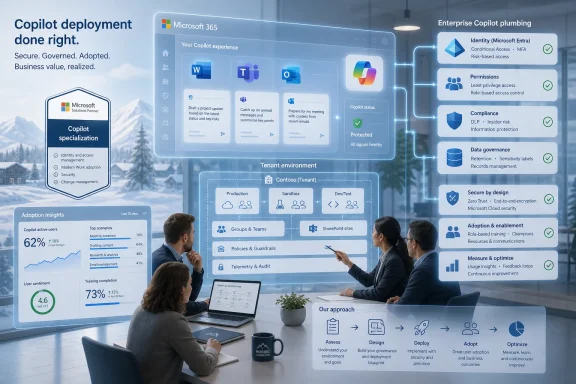 Microsoft’s Copilot Bet Has Entered Its Plumbing Phase
The first phase of enterprise generative AI was noisy by design. Microsoft put Copilot branding on nearly every surface it could plausibly connect to a model, while competitors raced to prove they had their own assistants, agents, copilots, or “AI-native” workflows. The result was a market full of demos and a customer base full of pilot programs.The second phase is less glamorous. It is about identity, data access, tenant hygiene, change management, compliance boundaries, workflow redesign, and adoption measurement. That is where companies like Tieto enter the story, because large organizations rarely turn on Microsoft 365 Copilot at scale by simply buying licenses and sending a cheerful email to staff.
Microsoft’s partner specializations exist for exactly this middle layer. They give Microsoft a way to signal which partners have cleared specific capability bars, and they give customers a shorthand for distinguishing general Microsoft familiarity from tested delivery competence. In that sense, Tieto’s new Copilot specialization is a credential, but it is also a market signal.
The company says the achievement recognizes proven expertise in deploying and scaling Microsoft Copilot solutions. The phrase is standard partner-program language, but the implication is concrete: Microsoft wants Copilot adoption to be less dependent on direct Microsoft field teams and more dependent on a certified ecosystem capable of doing the messy implementation work.
Tieto Is Selling Trust as Much as Technical Skill
Tieto’s announcement lands in the wake of a strategic partnership with Microsoft announced earlier in 2026 to bring AI capabilities and solutions to customers. That timing is not incidental. A strategic partnership says the companies want to go to market together; a specialization says Tieto has met a defined Microsoft bar inside that go-to-market machinery.For customers, the practical value is not that Tieto now has another badge for a slide deck. It is that Copilot projects tend to expose uncomfortable organizational questions before they produce polished productivity gains. Who can see which documents? Which SharePoint sites are over-permissioned? Which Teams channels contain sensitive material? Which workflows are actually ready for automation?
A services partner cannot solve those problems by promising “AI adoption” in the abstract. It has to understand Microsoft 365 governance, Entra identity, endpoint management, data classification, retention policies, security posture, and user behavior. The Copilot specialization is therefore less about prompt-writing cleverness than about whether a partner can operate across the Microsoft estate without making a customer’s risk profile worse.
That is why Tieto’s language around “secure, responsible, and scalable AI adoption” is more than corporate ballast. Those words map to the actual friction in enterprise Copilot rollouts. The customers most likely to pay for Copilot at scale are also the customers least able to tolerate accidental data exposure, poor adoption, or an expensive assistant that becomes a novelty after the first month.
The Badge Is a Doorway Into a Larger Microsoft Channel Strategy
Microsoft has spent decades turning platform shifts into partner economies. Windows deployment, Exchange migrations, SharePoint consulting, Teams rollouts, Azure modernization, endpoint security, and business applications all became businesses not only for Microsoft but for consultancies, managed service providers, system integrators, and independent software vendors.Copilot is being routed through the same machine. The company does not merely need customers to buy AI licenses; it needs them to make those licenses useful enough to renew. That requires a services layer that can translate Copilot from a licensing SKU into business outcomes that executives can defend.
The Solutions Partner for Modern Work designation is part of this scaffolding. It identifies partners with capability around Microsoft 365 productivity, collaboration, hybrid work, and related services. The Copilot specialization narrows that further, placing AI adoption inside the Modern Work partner lane rather than treating it as a vague innovation exercise detached from daily productivity systems.
That is a sensible move. For most employees, Copilot will not arrive as an independent AI platform. It will appear inside the tools they already use: composing in Outlook, summarizing Teams meetings, drafting Word documents, building PowerPoint decks, searching across work content, and increasingly coordinating actions through agents. If those experiences are not grounded in a well-managed Microsoft 365 environment, the AI layer inherits the mess underneath it.
Enterprise AI Adoption Is Becoming an Operations Problem
The enterprise AI conversation often begins with model capability and ends with return on investment. The difficult middle is operations. Someone has to decide how Copilot is licensed, which employee groups get access first, how training is delivered, how risky prompts are handled, how data boundaries are explained, and how success is measured.That is where the early Copilot hype has run into predictable resistance. Many organizations see obvious potential in AI-assisted knowledge work, but potential is not the same as usable capacity. A tool that can summarize a meeting is helpful; a tool that summarizes the wrong meeting for the wrong person because permissions are sloppy is a governance incident.
The same is true of document generation and enterprise search. Copilot can surface information that technically exists inside a tenant, but the usefulness and safety of that retrieval depend on whether the underlying information architecture is sane. Companies that treated SharePoint and Teams sprawl as a tolerable nuisance may discover that generative AI turns nuisance into visibility.
This is why partner specialization matters more than it might appear. Customers need help not only with enabling Copilot but with preparing the environment into which Copilot is being enabled. The sales motion says “AI transformation”; the project plan says “permissions review, information lifecycle cleanup, identity hardening, user education, and adoption analytics.”
Tieto’s Nordic Base Gives the Announcement a Specific Flavor
Tieto is not a Silicon Valley AI startup trying to attach itself to the Copilot boom. It is a long-established technology services company with roots in the Nordic market and a customer base that includes public-sector, financial, industrial, and enterprise clients. That matters because European and Nordic customers often bring a particular emphasis on governance, sovereignty, privacy, and responsible technology adoption.Microsoft’s AI partner ecosystem is global, but Copilot adoption is local in practice. Regulatory expectations, labor norms, language support, data residency concerns, procurement models, and sector-specific compliance obligations all shape how an organization deploys AI. A multinational consultancy can offer scale; a regional heavyweight can offer familiarity with local operating constraints.
Tieto’s announcement leans into that trust position. It frames the specialization as a strengthening of the company’s ability to help customers accelerate AI adoption and business transformation. The phrasing is broad, but the market context makes it more specific: many organizations want AI help from firms that already understand their Microsoft estate and their governance environment.
That is especially relevant for customers that do not want Copilot to become a shadow experiment run by individual departments. The long-term value of Microsoft 365 Copilot depends on coherent governance across the business. A partner with Modern Work credentials and Copilot specialization is pitching itself as the adult supervision layer between Microsoft’s platform ambitions and the customer’s operational reality.
Microsoft’s AI Sprawl Makes Certified Guides More Valuable
Copilot has become both Microsoft’s strongest AI brand and one of its most confusing. There are Copilot experiences in Microsoft 365, Windows, Edge, GitHub, Security, Power Platform, Dynamics, Azure, and a growing set of agent-building and orchestration tools. For enthusiasts, that breadth can be exciting. For administrators, it can feel like a taxonomy problem wearing a productivity costume.The confusion is not accidental so much as structural. Microsoft is trying to inject AI into an enormous software portfolio while also creating new surfaces for custom agents and business automation. The company wants Copilot to be both a user-facing assistant and a platform for process redesign. Those are related ambitions, but they are not the same project.
Partners can help customers navigate that sprawl, but only if they understand where the boundaries are. Microsoft 365 Copilot is not GitHub Copilot. Copilot Studio is not the same thing as the chat experience in Word. Windows Copilot experiences are not a substitute for enterprise data governance. Security Copilot has a different operational audience and risk profile from a Teams meeting recap.
This is where specialization acts as a filter. It does not guarantee perfection, and customers should still scrutinize any partner’s real-world experience. But it does suggest that Microsoft sees the partner as aligned with a defined Copilot delivery motion rather than merely enthusiastic about AI branding.
The Business Case Is Shifting From Novelty to Measurable Work
Tieto’s announcement uses the phrase “measurable value,” and that may be the most important language in the entire release. The first wave of Copilot deployments could survive on curiosity, executive sponsorship, and the intuitive appeal of saving time in email and meetings. The next wave will need evidence.That evidence will not look the same in every organization. A law firm may care about drafting speed and research support. A bank may care about controlled knowledge retrieval and compliance-safe productivity. A manufacturer may care about field service workflows, engineering documentation, and multilingual collaboration. A public-sector agency may care about case handling and citizen service processes.
The common thread is that Copilot value has to be attached to work patterns, not generic AI enthusiasm. If employees use it only for occasional summaries, the economics become harder to justify. If it becomes embedded in repeatable workflows that reduce cycle time, improve documentation quality, or make knowledge easier to find, the business case becomes more durable.
This is another reason Microsoft needs partners. Its own product teams can build capabilities, and its sellers can explain licensing. But the work of identifying where AI actually changes a process often happens inside customer workshops, adoption programs, department pilots, and change-management sessions. That is consulting territory, not just software territory.
Windows and Microsoft 365 Admins Should Read Between the Lines
For WindowsForum readers, the temptation is to treat this as a partner-channel story with limited practical relevance. That would be a mistake. Copilot rollouts often land on the desks of the same administrators responsible for Microsoft 365, Windows endpoints, Intune, Defender, Entra, Teams, and the daily compromises of enterprise IT.The AI layer increases pressure on those foundations. If device compliance is weak, identity controls are inconsistent, or sensitive content is scattered across unmanaged collaboration spaces, Copilot adoption will expose the gaps. The assistant does not create the underlying governance problem, but it can make the consequences more visible.
Admins should also expect more executive attention. Copilot has boardroom visibility in a way that many infrastructure projects do not. That can be useful if it unlocks budget for long-delayed governance improvements, but it can also produce unrealistic timelines. “Turn on AI” is a phrase that fits neatly in a strategy deck and poorly in a tenant with years of accumulated permissions debt.
A certified partner can help, but it should not replace internal ownership. Organizations still need their own policies for acceptable use, sensitive data handling, lifecycle management, and audit readiness. The best partner engagements will make the customer more capable over time, not more dependent on outside consultants for every AI-related decision.
The Services Market Will Separate Pilots From Programs
The Copilot specialization also highlights a larger split in the AI services market. Many firms can run a pilot. Fewer can help a customer turn that pilot into a governed program across thousands of users, multiple business units, and diverse regulatory requirements.Pilots tend to be forgiving. They involve motivated users, limited scope, and a high tolerance for novelty. Programs are harsher. They require support models, training plans, success metrics, escalation paths, and a way to handle the inevitable gap between what the tool can do in a demo and what employees expect it to do in real work.
That gap is already one of the defining problems of enterprise AI. Generative systems are impressive enough to raise expectations but inconsistent enough to require judgment. Users must learn where to trust them, where to verify them, and where not to use them at all. That kind of behavioral change does not happen because a license appears in the app launcher.
Tieto’s specialization is therefore part of a broader maturation story. The market is moving from “Can we use Copilot?” to “Can we operationalize Copilot without creating chaos?” That is a healthier question, and probably a more profitable one for Microsoft’s partner ecosystem.
The Real Test Is Not Certification but Customer Outcomes
A specialization is useful, but it is not a trophy that settles the matter. Customers evaluating Tieto or any other Copilot partner should still ask hard questions about actual deployments, sector experience, security controls, data governance methods, and adoption results. Microsoft’s validation narrows the field; it does not eliminate due diligence.The most important question is whether the partner can connect Copilot capabilities to business processes. A generic rollout plan that trains users on prompts and meeting summaries may produce early excitement, but it will not necessarily change organizational performance. The better engagements will identify specific workflows where Copilot can reduce friction and then measure whether that reduction actually occurs.
Customers should also watch for overpromising around automation. The current Copilot and agent ecosystem is powerful, but it is not magic. Human review, policy boundaries, and process discipline remain essential, especially in regulated environments or high-consequence workflows. The more a partner talks about replacing work wholesale, the more skeptical a customer should become.
Tieto’s public language is appropriately cautious. It emphasizes trusted expertise, proven delivery, responsible adoption, and lasting business value. Those are not flashy claims, but they are the right claims for a market that has had enough AI theater and now needs implementation competence.
The Copilot Gold Rush Now Belongs to the Firms That Can Clean Up the Tenant
The practical message from Tieto’s announcement is that Copilot is becoming a deployment discipline, not just a Microsoft feature. For organizations planning or expanding adoption, the credential is a useful signal — but the harder work remains inside the customer environment.- Tieto has achieved Microsoft Copilot specialization as part of its Solutions Partner for Modern Work status.
- The specialization reinforces Tieto’s 2026 strategic partnership with Microsoft around AI capabilities and customer solutions.
- The most immediate customer impact is likely to be in Microsoft 365 Copilot planning, deployment, governance, adoption, and scaling.
- The credential matters because enterprise Copilot value depends heavily on identity, permissions, data hygiene, compliance, and change management.
- Windows and Microsoft 365 administrators should expect Copilot projects to increase scrutiny on tenant governance, endpoint compliance, and information architecture.
- The long-term test for Tieto and other specialized partners will be whether customers can prove durable productivity and process gains after the initial AI enthusiasm fades.
References
- Primary source: Tieto
Published: Wed, 01 Jul 2026 08:33:08 GMT
Loading…
www.tieto.com - Official source: learn.microsoft.com
Loading…
learn.microsoft.com - Official source: news.microsoft.com
- Official source: devicepartner.microsoft.com
Loading…
devicepartner.microsoft.com - Official source: partner.microsoft.com
Loading…
partner.microsoft.com - Official source: microsoft.com
Your request has been blocked. This could be due to several reasons.
www.microsoft.com

- Related coverage: techmarketview.com
Loading…
www.techmarketview.com - Official source: blogs.microsoft.com
Accelerating Frontier Transformation with Microsoft partners - The Official Microsoft Blog
AI has moved quickly from experimentation to production. Customers want measurable business outcomes, along with security, governance and responsible AI built in from day one. Microsoft partners are a meaningful differentiator to deliver these objectives. They turn ideas into deployable...blogs.microsoft.com - Related coverage: windowscentral.com
Microsoft Copilot Changes: Moving Away From OpenAI? | Windows Central
Ex-SnapChat exec takes over Copilot AI experiences as Microsoft AI CEO doubles down on in-house modelswww.windowscentral.com - Related coverage: tomsguide.com
Biggest Microsoft Build 2026 announcements — agentic AI, RTX Spark Dev Box, GitHub Copilot app, new MAI models, and more | Tom's Guide
All the big news from Microsoft's AI-focused eventwww.tomsguide.com - Related coverage: news.cognizant.com
Cognizant and Microsoft Expand Partnership to Advance AI Transformation and Frontier Firm Experiences - Dec 18, 2025
PDF documentnews.cognizant.com
- Official source: microsoft.github.io
Loading…
microsoft.github.io - Related coverage: softwareone.com
Loading…
www.softwareone.com - Related coverage: press.spglobal.com
S&P Global Launches AI-Ready Commodities Data Integrated With Microsoft 365 Copilot - Apr 21, 2025
PDF documentpress.spglobal.com
- Official source: techcommunity.microsoft.com
Loading…
techcommunity.microsoft.com