

American Express on June 30, 2026 enabled eligible U.S. Membership Rewards cardholders to redeem points directly inside Apple Pay checkouts for online and in-app purchases on iPhone and iPad. The move sounds like a small convenience feature, but it is really another step in turning the digital wallet from a card container into the front door of consumer finance. For Windows users, the most interesting part is not that Amex points now appear in Apple’s checkout sheet; it is that Apple Pay’s reach has already begun creeping beyond Apple-only shopping sessions. The rewards program is becoming less a destination and more a payment rail.
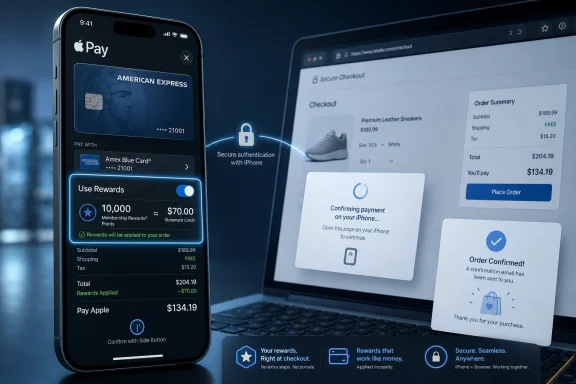
The feature is simple enough on its face. A shopper chooses Apple Pay, selects an eligible American Express Membership Rewards card, taps a “Use Rewards” option, enters how many points to apply, and completes the transaction without leaving the checkout flow. That is the entire pitch: no separate Amex login, no post-purchase statement credit ritual, no hunt through a rewards portal, and no mental conversion exercise until Apple Pay itself asks how much of the bill should be covered.
But simplicity is often where platform control hides. Apple Pay has spent more than a decade persuading users that the best payment interface is the one they barely notice. Amex is now using that invisible layer to put its own loyalty currency at the moment of purchase, and the result is a subtle but important reshuffling of power among banks, card networks, merchants, wallets, and operating-system vendors.
When Apple Pay launched, the magic was mostly about replacing a physical card swipe with a biometric tap. The phone stood in for plastic, the Secure Element stood in for the chip, and the merchant still received a card-network transaction that looked familiar enough to slot into the existing payments stack. Apple’s genius was to make that old machinery feel newly trustworthy.
Over time, Apple Pay has become less like a safer card and more like a checkout operating system. It can carry payment credentials, shipping information, billing addresses, transit permissions, merchant tokens, installments, and now, in this Amex implementation, loyalty value. The wallet is no longer merely asking which card should pay; it is asking which balance sheet should absorb the purchase.
That distinction matters. A card in a leather wallet is passive until the user pulls it out. A card in Apple Wallet can be surrounded by software decisions, notifications, authentication prompts, merchant metadata, and now a redemption offer. The customer still thinks they are paying, but the system is quietly shaping how they pay.
American Express is not new to “Pay with Points.” The company has long let customers redeem Membership Rewards at select retailers, and it has built a sprawling menu of travel transfers, gift cards, statement credits, shopping options, and partner checkouts. What is new here is the placement. Amex is moving points from a rewards environment into the most compressed and impulsive phase of commerce: the confirmation screen.
This is the central tension in the product. Amex is offering frictionless liquidity, not maximum value. The less work a redemption requires, the more likely it is to price the customer’s points conservatively.
That is not necessarily sinister. Some users do not want to study award charts, wait for transfer bonuses, or build a vacation around saver availability. A parent buying school supplies, a freelancer buying software, or a traveler paying for a last-minute accessory may reasonably prefer instant relief over theoretical optimization. The point is not that using Amex points through Apple Pay is foolish; it is that the user should understand what kind of bargain they are making.
The deeper business logic is obvious. Dormant points are a liability and a retention tool. Spent points are engagement, breakage management, and habit formation. If Amex can make points feel like cash at checkout, even at a relatively modest conversion rate, it keeps cardholders inside the Membership Rewards ecosystem while reducing the chance that those users shop around for a different payment method.
Pay-with-points at checkout fits perfectly into that pattern. It reduces cognitive friction at the exact moment when a customer is most likely to accept the default. If the Apple Pay sheet offers a neat toggle that trims a purchase by $20 or $50, many users will not pause to compare cents-per-point valuations against airline transfers.
For Amex, that is a feature, not a bug. Rewards programs are designed to feel aspirational when points are earned and practical when points are spent. The issuer benefits when the same point can be marketed as a premium travel currency but redeemed as a lower-value checkout subsidy.
This also exposes a recurring truth about loyalty economics: the advertised value of a rewards currency and the realized value for ordinary users are often different things. Power users extract outsized returns through transfers and timing. Everyone else is increasingly nudged toward redemptions that look like cash but behave like discounted store credit.
Still, the Windows angle is not imaginary. Apple began broadening Apple Pay on the web beyond the old Safari-only mental model, including flows where a user shopping in a desktop browser can complete an Apple Pay transaction by authenticating on an iPhone. That makes Apple Pay less a device-local feature and more a cross-device checkout credential.
In practice, this means a Windows user who owns an iPhone may increasingly encounter Apple Pay as a payment option while shopping from Edge, Chrome, or another desktop browser. The authentication and wallet state still live in Apple’s ecosystem, but the shopping context may not. Apple does not need Windows to host Wallet if it can use the iPhone as the approval device and the browser as the storefront.
That is a familiar platform strategy. Apple keeps the secure credential and user relationship on its hardware while allowing just enough interoperability to follow the customer into mixed-device environments. Windows users are not being invited into Apple Pay as equals; they are being treated as Apple Pay users who happen to be sitting at a PC.
But there is a tradeoff. The more value and decision-making Apple Pay packs into its sheet, the more the merchant’s own checkout becomes a stage for somebody else’s customer relationship. The merchant may still sell the product, but Apple and Amex increasingly shape the payment experience, the financing options, the perceived discount, and the user’s sense of reward.
That matters for retailers that have their own loyalty programs. If the customer is prompted to burn Amex points inside Apple Pay, that moment may compete with store points, coupons, private-label cards, and merchant financing. Checkout real estate is finite, and Apple’s sheet is premium territory.
This is one reason payment buttons are more strategic than they look. A checkout button is not just an acceptance mark; it is a distribution channel. Whoever owns the button gets to decide which financial products appear when the customer is ready to spend.
Amex’s own Apple Pay documentation emphasizes that a digital version of the card is created and associated with the device. It also notes that American Express shares certain card-related information with Apple to deliver the Apple Pay experience, including data such as the digital number, the last four digits of the physical card, and recent purchase information for cards selected in Apple Pay. That is not a scandal, but it is the kind of detail users should remember whenever a payment product is marketed as almost magically private.
Pay-with-points adds another layer of data sensitivity. The wallet flow is no longer just authorizing a charge; it is displaying and applying a rewards balance. That makes the checkout sheet a richer financial interface, and richer interfaces always create more questions about data sharing, customer profiling, and dispute handling.
The practical security advice remains boring but important. Users should protect their Apple ID, keep device passcodes strong, avoid sharing unlocked devices, review wallet notifications, and treat rewards balances as real value. Points are not cash in the legal or economic sense, but losing control of a rewards account can still hurt.
The new integration gives Amex a way to make its card feel different at the point of use. If one card in Apple Pay can surface a rewards balance and another cannot, the premium product regains some of its identity inside Apple’s interface. The card is no longer just a funding source; it is a bundle of spendable benefits.
This is especially important as younger consumers become comfortable treating wallets as the primary payment interface. A user who rarely touches a physical card may not develop the same relationship with card design, metal weight, or brand ritual that Amex historically cultivated. The brand has to show up in software.
That is why this move should not be dismissed as a minor rewards convenience. It is part of the broader contest to decide whether banks and issuers remain visible in a world where the wallet, browser, phone, and merchant app mediate every transaction.
The Amex integration reinforces that model. Apple does not need to invent a new rewards currency if it can make existing currencies easier to spend through Apple Pay. It does not need to replace Amex if it can make Amex more dependent on Apple’s checkout layer.
That dependency cuts both ways. Amex gets access to a polished, high-trust payment surface used by millions of iPhone and iPad owners. Apple gets another reason for users to choose Apple Pay instead of entering a card manually, using a merchant wallet, or selecting a competing checkout button. Both companies win if the customer stops thinking of payment as a merchant decision and starts thinking of it as an Apple Pay decision.
The risk for everyone else is that the wallet becomes the hierarchy. Cards that integrate deeply get richer experiences. Cards that do not become dumb funding sources. Merchants that support the latest APIs get smoother conversion. Merchants that lag look clunky. Users may benefit from convenience, but the market becomes more dependent on a small number of platform-controlled checkout surfaces.
The most important technology shifts often arrive as options that seem harmless. A new button here, a toggle there, a smoother authentication prompt, a balance shown at just the right moment. Over time, these small interface decisions teach users where financial decisions are supposed to happen.
For years, banks trained customers to visit account portals. Then card apps trained them to manage benefits on phones. Now wallets are training them to make financing, rewards, identity, and authentication decisions inside the checkout itself. That is a profound shift in where consumer finance lives.
It also raises a familiar platform question: who gets to innovate at the edge of the transaction? If Apple controls the sheet, issuers must partner with Apple to appear there. If merchants want the conversion lift, they accept the wallet’s framing. If users want convenience, they accept that more of their financial life is mediated through a device ecosystem.
Amex and Apple will need to make the interface obvious enough that users know when they are burning points, how many they are using, and what dollar value they are receiving. If the system feels like a hidden default or a slippery upsell, the backlash will be predictable. Rewards enthusiasts are already alert to the possibility that convenience can become a trap.
There are also edge cases. Refunds, partial refunds, split tenders, pending charges, merchant adjustments, and disputes can all become more complicated when points are applied at checkout. Mature payment systems can handle these scenarios, but user trust depends on the explanation being intelligible.
That is where the polished Apple Pay interface can become a liability. Minimalism is wonderful until something goes wrong. When a transaction involves both dollars and points, users need more than a beautiful confirmation animation; they need a clear audit trail.
The feature is simple enough on its face. A shopper chooses Apple Pay, selects an eligible American Express Membership Rewards card, taps a “Use Rewards” option, enters how many points to apply, and completes the transaction without leaving the checkout flow. That is the entire pitch: no separate Amex login, no post-purchase statement credit ritual, no hunt through a rewards portal, and no mental conversion exercise until Apple Pay itself asks how much of the bill should be covered.
But simplicity is often where platform control hides. Apple Pay has spent more than a decade persuading users that the best payment interface is the one they barely notice. Amex is now using that invisible layer to put its own loyalty currency at the moment of purchase, and the result is a subtle but important reshuffling of power among banks, card networks, merchants, wallets, and operating-system vendors.
 Apple Pay Stops Being Just the Plastic Card’s Digital Twin
When Apple Pay launched, the magic was mostly about replacing a physical card swipe with a biometric tap. The phone stood in for plastic, the Secure Element stood in for the chip, and the merchant still received a card-network transaction that looked familiar enough to slot into the existing payments stack. Apple’s genius was to make that old machinery feel newly trustworthy.Over time, Apple Pay has become less like a safer card and more like a checkout operating system. It can carry payment credentials, shipping information, billing addresses, transit permissions, merchant tokens, installments, and now, in this Amex implementation, loyalty value. The wallet is no longer merely asking which card should pay; it is asking which balance sheet should absorb the purchase.
That distinction matters. A card in a leather wallet is passive until the user pulls it out. A card in Apple Wallet can be surrounded by software decisions, notifications, authentication prompts, merchant metadata, and now a redemption offer. The customer still thinks they are paying, but the system is quietly shaping how they pay.
American Express is not new to “Pay with Points.” The company has long let customers redeem Membership Rewards at select retailers, and it has built a sprawling menu of travel transfers, gift cards, statement credits, shopping options, and partner checkouts. What is new here is the placement. Amex is moving points from a rewards environment into the most compressed and impulsive phase of commerce: the confirmation screen.
The Redemption Rate Is the Catch Hiding in Plain Sight
The reported value of the new Apple Pay redemption is 0.7 cents per Membership Rewards point, which means 10,000 points offset about $70 of spending. That is convenient, but it is not generous by the standards of the points-and-miles world. Many Amex users prize Membership Rewards precisely because transfers to airline and hotel partners can produce substantially higher value, especially for premium travel redemptions.This is the central tension in the product. Amex is offering frictionless liquidity, not maximum value. The less work a redemption requires, the more likely it is to price the customer’s points conservatively.
That is not necessarily sinister. Some users do not want to study award charts, wait for transfer bonuses, or build a vacation around saver availability. A parent buying school supplies, a freelancer buying software, or a traveler paying for a last-minute accessory may reasonably prefer instant relief over theoretical optimization. The point is not that using Amex points through Apple Pay is foolish; it is that the user should understand what kind of bargain they are making.
The deeper business logic is obvious. Dormant points are a liability and a retention tool. Spent points are engagement, breakage management, and habit formation. If Amex can make points feel like cash at checkout, even at a relatively modest conversion rate, it keeps cardholders inside the Membership Rewards ecosystem while reducing the chance that those users shop around for a different payment method.
Convenience Is the New Rewards Devaluation
The payments industry has learned that users will often trade value for ease if the interface is clean enough. That is the bargain behind one-click checkout, stored cards, buy now, pay later buttons, and app-store billing. Apple Pay’s role has been to wrap that bargain in biometric authentication and privacy language, making the transaction feel both faster and safer.Pay-with-points at checkout fits perfectly into that pattern. It reduces cognitive friction at the exact moment when a customer is most likely to accept the default. If the Apple Pay sheet offers a neat toggle that trims a purchase by $20 or $50, many users will not pause to compare cents-per-point valuations against airline transfers.
For Amex, that is a feature, not a bug. Rewards programs are designed to feel aspirational when points are earned and practical when points are spent. The issuer benefits when the same point can be marketed as a premium travel currency but redeemed as a lower-value checkout subsidy.
This also exposes a recurring truth about loyalty economics: the advertised value of a rewards currency and the realized value for ordinary users are often different things. Power users extract outsized returns through transfers and timing. Everyone else is increasingly nudged toward redemptions that look like cash but behave like discounted store credit.
The Windows Angle Runs Through the Browser, Not the Wallet App
For WindowsForum readers, the immediate limitation is clear: this new Amex feature is described for Apple Pay checkouts online or in apps on iPhone and iPad. There is no Apple Wallet app for Windows, and nobody should read this announcement as Apple bringing a native wallet experience to the Windows desktop.Still, the Windows angle is not imaginary. Apple began broadening Apple Pay on the web beyond the old Safari-only mental model, including flows where a user shopping in a desktop browser can complete an Apple Pay transaction by authenticating on an iPhone. That makes Apple Pay less a device-local feature and more a cross-device checkout credential.
In practice, this means a Windows user who owns an iPhone may increasingly encounter Apple Pay as a payment option while shopping from Edge, Chrome, or another desktop browser. The authentication and wallet state still live in Apple’s ecosystem, but the shopping context may not. Apple does not need Windows to host Wallet if it can use the iPhone as the approval device and the browser as the storefront.
That is a familiar platform strategy. Apple keeps the secure credential and user relationship on its hardware while allowing just enough interoperability to follow the customer into mixed-device environments. Windows users are not being invited into Apple Pay as equals; they are being treated as Apple Pay users who happen to be sitting at a PC.
Merchants Get a Cleaner Checkout and Less Control Over the Moment
Merchants tend to like checkout methods that reduce abandonment, and Apple Pay has a strong pitch: fewer fields, fewer card-entry errors, less visible exposure of card numbers, and faster confirmation. Adding Amex points to that flow may make purchases feel cheaper without requiring the merchant to fund a discount. From the merchant’s perspective, that can be an attractive psychological lever.But there is a tradeoff. The more value and decision-making Apple Pay packs into its sheet, the more the merchant’s own checkout becomes a stage for somebody else’s customer relationship. The merchant may still sell the product, but Apple and Amex increasingly shape the payment experience, the financing options, the perceived discount, and the user’s sense of reward.
That matters for retailers that have their own loyalty programs. If the customer is prompted to burn Amex points inside Apple Pay, that moment may compete with store points, coupons, private-label cards, and merchant financing. Checkout real estate is finite, and Apple’s sheet is premium territory.
This is one reason payment buttons are more strategic than they look. A checkout button is not just an acceptance mark; it is a distribution channel. Whoever owns the button gets to decide which financial products appear when the customer is ready to spend.
Security Remains Apple Pay’s Strongest Argument
The security story here is still comparatively strong. Apple Pay transactions use device-based authentication such as Face ID, Touch ID, Optic ID on supported devices, or passcode, and card credentials in Apple Pay are represented by device-specific digital account numbers rather than the physical card number being handed directly to every merchant. For ordinary users, that is a meaningful improvement over typing a card into random checkout pages.Amex’s own Apple Pay documentation emphasizes that a digital version of the card is created and associated with the device. It also notes that American Express shares certain card-related information with Apple to deliver the Apple Pay experience, including data such as the digital number, the last four digits of the physical card, and recent purchase information for cards selected in Apple Pay. That is not a scandal, but it is the kind of detail users should remember whenever a payment product is marketed as almost magically private.
Pay-with-points adds another layer of data sensitivity. The wallet flow is no longer just authorizing a charge; it is displaying and applying a rewards balance. That makes the checkout sheet a richer financial interface, and richer interfaces always create more questions about data sharing, customer profiling, and dispute handling.
The practical security advice remains boring but important. Users should protect their Apple ID, keep device passcodes strong, avoid sharing unlocked devices, review wallet notifications, and treat rewards balances as real value. Points are not cash in the legal or economic sense, but losing control of a rewards account can still hurt.
Amex Is Defending the Premium Card in a Wallet-Centric World
American Express has always sold more than payment acceptance. It sells status, service, rewards, dispute confidence, travel benefits, and a sense that the card itself is a membership product. Apple Pay, by contrast, tends to flatten cards into tiles. That flattening is dangerous for premium issuers, because a $695-a-year card and a no-fee debit card can look oddly similar inside a wallet carousel.The new integration gives Amex a way to make its card feel different at the point of use. If one card in Apple Pay can surface a rewards balance and another cannot, the premium product regains some of its identity inside Apple’s interface. The card is no longer just a funding source; it is a bundle of spendable benefits.
This is especially important as younger consumers become comfortable treating wallets as the primary payment interface. A user who rarely touches a physical card may not develop the same relationship with card design, metal weight, or brand ritual that Amex historically cultivated. The brand has to show up in software.
That is why this move should not be dismissed as a minor rewards convenience. It is part of the broader contest to decide whether banks and issuers remain visible in a world where the wallet, browser, phone, and merchant app mediate every transaction.
Apple Gains Without Becoming the Bank
Apple’s payments strategy has always walked a careful line. The company wants the customer relationship and the interface leverage without necessarily becoming the regulated financial institution behind every product. Apple Card was the most visible exception, but Apple Pay’s broader success comes from making banks, networks, and issuers more useful inside Apple’s environment.The Amex integration reinforces that model. Apple does not need to invent a new rewards currency if it can make existing currencies easier to spend through Apple Pay. It does not need to replace Amex if it can make Amex more dependent on Apple’s checkout layer.
That dependency cuts both ways. Amex gets access to a polished, high-trust payment surface used by millions of iPhone and iPad owners. Apple gets another reason for users to choose Apple Pay instead of entering a card manually, using a merchant wallet, or selecting a competing checkout button. Both companies win if the customer stops thinking of payment as a merchant decision and starts thinking of it as an Apple Pay decision.
The risk for everyone else is that the wallet becomes the hierarchy. Cards that integrate deeply get richer experiences. Cards that do not become dumb funding sources. Merchants that support the latest APIs get smoother conversion. Merchants that lag look clunky. Users may benefit from convenience, but the market becomes more dependent on a small number of platform-controlled checkout surfaces.
The Feature Is Small Because the Strategy Is Big
There is a temptation in tech coverage to treat payment features as either revolutionary or trivial. This one is neither. It will not change how most people shop overnight, and many savvy Amex users will avoid it because the redemption rate is not compelling compared with travel transfers. But it is still strategically meaningful because it places rewards redemption at the point of biometric checkout.The most important technology shifts often arrive as options that seem harmless. A new button here, a toggle there, a smoother authentication prompt, a balance shown at just the right moment. Over time, these small interface decisions teach users where financial decisions are supposed to happen.
For years, banks trained customers to visit account portals. Then card apps trained them to manage benefits on phones. Now wallets are training them to make financing, rewards, identity, and authentication decisions inside the checkout itself. That is a profound shift in where consumer finance lives.
It also raises a familiar platform question: who gets to innovate at the edge of the transaction? If Apple controls the sheet, issuers must partner with Apple to appear there. If merchants want the conversion lift, they accept the wallet’s framing. If users want convenience, they accept that more of their financial life is mediated through a device ecosystem.
The Real Test Comes After the First Accidental Redemption
The most immediate user concern is not security; it is accidental or low-value redemption. Any feature that lets people spend points as if they were cash needs clear confirmation, reversible handling where possible, and transparent valuation. A bad redemption experience can sour users quickly, especially in a rewards community that treats points like a quasi-investment portfolio.Amex and Apple will need to make the interface obvious enough that users know when they are burning points, how many they are using, and what dollar value they are receiving. If the system feels like a hidden default or a slippery upsell, the backlash will be predictable. Rewards enthusiasts are already alert to the possibility that convenience can become a trap.
There are also edge cases. Refunds, partial refunds, split tenders, pending charges, merchant adjustments, and disputes can all become more complicated when points are applied at checkout. Mature payment systems can handle these scenarios, but user trust depends on the explanation being intelligible.
That is where the polished Apple Pay interface can become a liability. Minimalism is wonderful until something goes wrong. When a transaction involves both dollars and points, users need more than a beautiful confirmation animation; they need a clear audit trail.
A Rewards Button Becomes a Platform Signal
The practical implications are straightforward, but the strategic implications are larger than the checkout screen suggests.- Eligible American Express Membership Rewards cardholders can now apply points directly during Apple Pay checkout for online and in-app purchases on iPhone and iPad.
- The reported redemption value is convenience-oriented rather than maximization-oriented, so many users will get better value from travel transfers than from Apple Pay redemptions.
- Windows users should view this as part of Apple Pay’s broader web expansion, because desktop browser shopping can still route authentication through an iPhone even without a native Windows Wallet app.
- Merchants may benefit from faster checkout and perceived discounts, but they also surrender more of the payment moment to Apple and the issuer.
- Users should pay close attention to confirmation screens, refund behavior, and point valuation before treating rewards as interchangeable with cash.
- The larger trend is that digital wallets are becoming financial decision layers, not merely safer ways to present card numbers.
References
- Primary source: pymnts.com
Published: Wed, 01 Jul 2026 02:11:41 GMT
Loading…
www.pymnts.com - Independent coverage: MacRumors
Published: Tue, 30 Jun 2026 17:27:02 GMT
Loading…
www.macrumors.com - Related coverage: thepointsguy.com
Loading…
thepointsguy.com - Related coverage: americanexpress.com
Loading…
www.americanexpress.com - Related coverage: techradar.com
Loading…
www.techradar.com - Related coverage: time.com
Loading…
time.com
- Related coverage: t3.com
Loading…
www.t3.com - Official source: apple.com
Loading…
www.apple.com - Official source: support.apple.com
Loading…
support.apple.com - Official source: apps.apple.com
Loading…
apps.apple.com - Related coverage: notebookcheck.com
Loading…
www.notebookcheck.com - Related coverage: windowscentral.com
Loading…
www.windowscentral.com - Official source: developer.apple.com
Loading…
developer.apple.com - Official source: ma-kobol-public-prod.apple.com
Loading…
ma-kobol-public-prod.apple.com - Related coverage: solidgate.com
Loading…
solidgate.com - Related coverage: assets.ctfassets.net
Loading…
assets.ctfassets.net - Related coverage: centralohio.foldsofhonor.org
Loading…
centralohio.foldsofhonor.org