

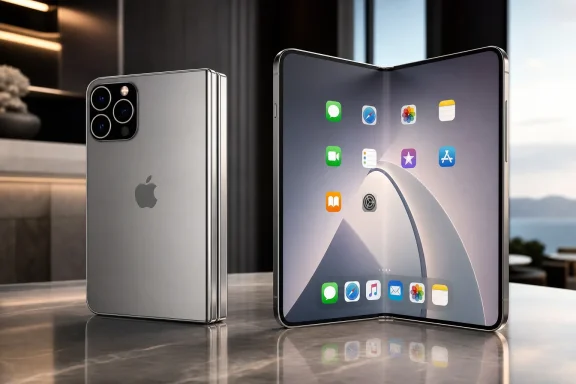
Apple is reportedly preparing its first foldable iPhone for a September 2026 debut alongside the iPhone 18 Pro line, with current rumors pointing to a book-style device possibly branded iPhone Ultra, priced above $2,000, and built around an iPad-mini-like inner display. That is the plain version of the story; the more interesting one is that Apple may be entering foldables only after the category has stopped looking experimental. If the rumors are right, Cupertino is not trying to invent the hinge-phone market. It is trying to civilize it, premium-price it, and make everyone else’s compromises look temporary.
The easiest joke about a foldable iPhone is that Apple is late. Samsung has spent years iterating the Galaxy Z Fold and Z Flip lines, Motorola has revived the Razr as a modern clamshell, and Google has already taken two public swings at the tablet-phone hybrid. In most consumer-tech narratives, that makes Apple the laggard.
But Apple’s history argues for a different reading. The company rarely needs to be first when it can wait until a component stack, developer story, and retail pitch become coherent enough to support Apple margins. MP3 players existed before the iPod, smartphones before the iPhone, tablets before the iPad, and watches before the Apple Watch. The company’s instinct is not to bless every new shape immediately; it waits for the point at which a new shape can be sold as inevitable.
Foldables have only recently approached that point. The first wave asked buyers to tolerate fragile screens, thick bodies, awkward app layouts, visible creases, odd aspect ratios, and luxury pricing. That was a difficult bargain outside enthusiast circles, even when the hardware was impressive. The later wave is better, but still defined by trade-offs that ordinary iPhone buyers have not been trained to accept.
That is why the rumored iPhone Ultra matters less as a single device than as a vote of confidence. Apple does not need foldables to prove that hinges can work. It needs to prove that a folding iPhone can feel like a normal iPhone when closed, a small iPad when open, and a status product at checkout.
That distinction matters. A product called iPhone Fold invites comparison with Samsung’s Galaxy Z Fold on mechanics: hinge, crease, thickness, display size, durability. A product called iPhone Ultra invites comparison with Apple’s own hierarchy: iPhone, iPhone Pro, iPhone Pro Max, and then something beyond. The fold becomes one part of the pitch, not the whole pitch.
Apple has already taught its customers what “Ultra” means on the Watch: bigger, more expensive, more capable, and unapologetically niche. It does not have to be the model everyone buys. It has to be the model that stretches the top of the range and makes the rest of the line feel more accessible by comparison.
That would also help Apple solve a pricing problem. A foldable iPhone expected to cost more than $2,000 cannot be marketed like a slightly different iPhone 18 Pro Max. It needs a name that makes the price feel like category expansion rather than inflation. “Ultra” gives Apple a premium shelf to place the product on before anyone even opens it.
A book-style foldable does. It lets Apple sell the idea of an iPhone that becomes something adjacent to an iPad mini. That is not just a bigger phone; it is a new place for Mail, Photos, Safari, Notes, Messages, FaceTime, games, streaming video, and productivity apps to breathe. The hinge becomes a way to smuggle a tablet into a pocket.
The rumored shape also avoids one of the foldable market’s recurring problems: the tall, narrow outer display paired with a squarish inner one. Some modern book-style foldables are marvels of engineering, but their inner screens can feel awkward for video and some app layouts. If Apple chooses a wider, more tablet-like footprint, it may sacrifice some one-handed elegance in favor of a display that feels more natural when opened.
That would be a very Apple trade. The company is unlikely to chase the thinnest possible foldable merely to win a spec-sheet contest. It will care about whether the device feels intentional in common use: reading, watching, editing, messaging, gaming, and moving between apps. A slightly less dramatic silhouette can be forgiven if the opened device feels like it has a reason to exist.
For Apple, that may not be enough. The crease is not just a visual artifact; it is a symbol of compromise. It tells the buyer, every time the display catches light at the wrong angle, that this expensive futuristic object still contains a visible concession to its own ambition.
That is why rumors about Apple focusing on crease reduction are easy to believe. Apple’s product culture is unusually sensitive to the way a device feels in the hand and looks under showroom lighting. A folding iPhone with a pronounced trough down the middle would be a gift to competitors and a risk to Apple’s own mystique.
Durability sits in the same bucket. Foldables are no longer delicate science projects, but they are still mechanically more complex than slab phones. Hinges collect anxiety. Flexible displays invite doubt. Repair costs loom larger because the device itself is expensive. If Apple wants mainstream iPhone owners to cross over, it has to make the hinge feel less like a dare.
Apple has an advantage because it controls iOS, iPadOS, developer frameworks, app review expectations, and the commercial incentives of a massive App Store economy. If the company tells developers to support more fluid layouts and a wider range of aspect ratios, many will listen. Not because developers enjoy extra work, but because being broken on a flagship iPhone is bad business.
The rumor that the foldable will run iOS rather than iPadOS is important. Apple does not appear to be preparing a pocket iPad in the strict operating-system sense. It is more likely preparing an iPhone that borrows iPad-like layout ideas when unfolded. That preserves the iPhone identity while giving Apple room to introduce larger-screen behaviors selectively.
Side-by-side apps would be the obvious minimum. A foldable iPhone that cannot show Messages and Safari together, or Notes beside Mail, would feel artificially constrained. But Apple will probably resist turning the device into a tiny Mac or a fully windowed iPad. The company’s bias is toward controlled complexity, and that may frustrate power users while reassuring everyone else.
The answer is mobility. The iPad mini is portable, but not pocketable in the way a phone is. A foldable iPhone promises the one thing every small tablet lacks: it is always with you because it is also your phone. That changes the emotional math.
Still, Apple will need to manage cannibalization. The company has lived with overlap for years — MacBook Air and iPad Pro, iPad and iPhone Plus, Watch and iPhone fitness features — but a folding iPhone could be the most direct collision yet between iPhone and iPad. The more convincing the inner display becomes, the more pressure it places on the smallest iPad.
That may be acceptable. The iPad mini is beloved but not central to Apple’s revenue story. The iPhone is. If Apple can sell a $2,000-plus device that absorbs some small-tablet use while raising the average selling price of the iPhone line, the business case writes itself.
Apple understands the theater of premium scarcity. The first foldable iPhone does not have to become the default iPhone any more than the first Apple Watch Ultra had to become the default Apple Watch. It has to be desirable, visible, and difficult enough to obtain that early adopters feel they bought into a new tier.
The price also gives Apple room to absorb the real costs of the category. Foldable displays are expensive. Hinges are complex. The enclosure tolerances are brutal. Battery design is harder. Repair logistics are uglier. If Apple is pushing for a thinner, more durable, less creased device, it is not going to do that at midrange pricing.
For WindowsForum readers, the pricing story has a familiar echo from the PC world. Early ultrabooks, OLED laptops, dual-screen devices, and premium convertibles all carried a tax for being first to a new form factor. Over time, the ideas that worked moved downmarket. Apple’s foldable may begin as a luxury object, but its real impact will be measured by which assumptions eventually become normal.
That gives Samsung a real advantage. It knows the repair patterns, customer complaints, hinge tolerances, display suppliers, and software pain points of foldables at scale. It also has a broader foldable portfolio, spanning book-style and flip-style designs. Apple’s first device will not erase that experience overnight.
But Apple changes markets by changing expectations. Once an iPhone folds, millions of users who treated foldables as an Android curiosity will reassess the category. Accessory makers will pile in. Developers will adapt layouts. Carriers will promote trade-in math. Reviewers will compare every crease, hinge, app transition, and camera compromise against Apple’s interpretation.
That is the danger for Samsung. It may remain technically ahead in some areas while losing control of the cultural narrative. The foldable market could shift from “Samsung’s weird premium experiment” to “the next iPhone shape,” and that is exactly the kind of reframing Apple has pulled off before.
The Duo’s problem was not simply that it used two screens instead of one folding display. It was that the software never made the hardware feel inevitable. Too many interactions reminded users that they were participating in an experiment. The device asked for patience before it delivered enough reward.
Apple’s rumored foldable is likely to avoid the Duo’s most obvious trap by using one continuous inner display. But it still faces the deeper challenge: the opened state must be more than a demo. If users unfold the device only to watch a video once a week, the premium collapses. If they unfold it constantly because ordinary tasks feel better, Apple has a category-defining product.
That is the hinge lesson Microsoft taught the industry by failing in public. Novel hardware cannot survive on novelty. It has to make the old way feel cramped.
The best version would make many apps feel quietly ready on day one. Mail could show more context. Calendar could become more useful. Photos could combine browsing and editing more naturally. Safari could feel less cramped. Games could adopt larger canvases without abandoning touch-first design.
Enterprise apps matter too. A foldable iPhone could be useful for field workers, clinicians, sales teams, technicians, and executives who want more screen without carrying another device. But those scenarios depend on app makers doing the unglamorous work of adaptive layouts, state preservation, and sensible multitasking behavior.
Apple can pressure that ecosystem more effectively than most vendors. A premium iPhone creates a target developers cannot ignore. If the device is called Ultra, the message becomes even clearer: this is not a side quest. This is Apple’s new top shelf.
That could create a strange hierarchy problem. Apple’s most expensive iPhone might not be the best iPhone camera. For some buyers, that would be fine; the folding display is the point. For others, especially Pro Max loyalists, it could complicate the upgrade path.
Apple has dealt with this kind of segmentation before. The MacBook Air is not the most powerful MacBook. The Apple Watch Ultra is not the smallest or dressiest Watch. The iPad Pro is not always the most practical iPad. The foldable iPhone could be the most futuristic iPhone without being the best at every traditional iPhone metric.
Still, Apple will need to be careful. If “Ultra” implies absolute superiority, the camera cannot feel obviously compromised. A foldable that costs more than a Pro Max but takes worse photos in common conditions would give critics an easy opening.
The problem is behavioral. A larger inner display invites longer sessions: reading, watching, editing, gaming, navigating, multitasking. If the device encourages users to do more but cannot last through the day, the magic drains out quickly. A foldable that must be babied is not an Ultra product; it is a portable liability.
Apple’s silicon efficiency helps. Its control over hardware and software helps. But physics still gets a vote. Thin foldables have less room for battery, and buyers who pay ultra-premium prices rarely enjoy being told they must choose between elegance and endurance.
This is one reason the first generation may be less mainstream than the hype suggests. Apple can solve many perception problems with industrial design, but battery life will be judged brutally by ordinary use. If the foldable iPhone becomes a device people love at 10 a.m. and worry about at 5 p.m., the second generation will matter more than the first.
Apple’s better move may be restraint. The company can make the foldable iPhone succeed by doing a smaller number of things exceptionally well: phone closed, tablet-like apps open, smooth transitions between states, reliable durability, strong battery life, and a display that does not constantly remind users it bends.
That restraint will annoy some power users, especially those who look at Android foldables and see more adventurous multitasking. But Apple does not need to win every feature comparison. It needs to win the trust comparison. Many iPhone buyers will accept fewer knobs if the experience feels stable, polished, and obvious.
The risk is that Apple underdoes it. A foldable iPhone that behaves too much like a big iPhone could feel timid. The company must find the line between simplicity and artificial limitation. That line has defined Apple products for decades, and it will be especially visible on a device whose entire premise is transformation.
 Apple Arrives Late Only If You Think the Race Started With Samsung
The easiest joke about a foldable iPhone is that Apple is late. Samsung has spent years iterating the Galaxy Z Fold and Z Flip lines, Motorola has revived the Razr as a modern clamshell, and Google has already taken two public swings at the tablet-phone hybrid. In most consumer-tech narratives, that makes Apple the laggard.But Apple’s history argues for a different reading. The company rarely needs to be first when it can wait until a component stack, developer story, and retail pitch become coherent enough to support Apple margins. MP3 players existed before the iPod, smartphones before the iPhone, tablets before the iPad, and watches before the Apple Watch. The company’s instinct is not to bless every new shape immediately; it waits for the point at which a new shape can be sold as inevitable.
Foldables have only recently approached that point. The first wave asked buyers to tolerate fragile screens, thick bodies, awkward app layouts, visible creases, odd aspect ratios, and luxury pricing. That was a difficult bargain outside enthusiast circles, even when the hardware was impressive. The later wave is better, but still defined by trade-offs that ordinary iPhone buyers have not been trained to accept.
That is why the rumored iPhone Ultra matters less as a single device than as a vote of confidence. Apple does not need foldables to prove that hinges can work. It needs to prove that a folding iPhone can feel like a normal iPhone when closed, a small iPad when open, and a status product at checkout.
The Name Is a Strategy, Not a Sticker
The “iPhone Fold” name has always sounded too obvious for Apple. It describes the mechanism, not the promise. “iPhone Ultra,” if Apple uses it, would be a more revealing choice because it positions the device above the Pro line rather than beside it as a novelty variant.That distinction matters. A product called iPhone Fold invites comparison with Samsung’s Galaxy Z Fold on mechanics: hinge, crease, thickness, display size, durability. A product called iPhone Ultra invites comparison with Apple’s own hierarchy: iPhone, iPhone Pro, iPhone Pro Max, and then something beyond. The fold becomes one part of the pitch, not the whole pitch.
Apple has already taught its customers what “Ultra” means on the Watch: bigger, more expensive, more capable, and unapologetically niche. It does not have to be the model everyone buys. It has to be the model that stretches the top of the range and makes the rest of the line feel more accessible by comparison.
That would also help Apple solve a pricing problem. A foldable iPhone expected to cost more than $2,000 cannot be marketed like a slightly different iPhone 18 Pro Max. It needs a name that makes the price feel like category expansion rather than inflation. “Ultra” gives Apple a premium shelf to place the product on before anyone even opens it.
The Book-Style Rumor Is the One That Makes Sense
The most credible reports point away from a clamshell design and toward a book-style foldable, opening horizontally into a larger internal display. That choice says a lot about what Apple likely thinks the opportunity is. A flip-style iPhone would be fun, fashionable, and compact, but it would not create a meaningfully new software canvas.A book-style foldable does. It lets Apple sell the idea of an iPhone that becomes something adjacent to an iPad mini. That is not just a bigger phone; it is a new place for Mail, Photos, Safari, Notes, Messages, FaceTime, games, streaming video, and productivity apps to breathe. The hinge becomes a way to smuggle a tablet into a pocket.
The rumored shape also avoids one of the foldable market’s recurring problems: the tall, narrow outer display paired with a squarish inner one. Some modern book-style foldables are marvels of engineering, but their inner screens can feel awkward for video and some app layouts. If Apple chooses a wider, more tablet-like footprint, it may sacrifice some one-handed elegance in favor of a display that feels more natural when opened.
That would be a very Apple trade. The company is unlikely to chase the thinnest possible foldable merely to win a spec-sheet contest. It will care about whether the device feels intentional in common use: reading, watching, editing, messaging, gaming, and moving between apps. A slightly less dramatic silhouette can be forgiven if the opened device feels like it has a reason to exist.
The Crease Is the Symbol Apple Has to Beat
Every foldable phone review eventually comes back to the crease. Some users stop noticing it. Others never do. Manufacturers have reduced it, softened it, hidden it better under bright content, and insisted that it is simply part of the physics of folding glass and polymer layers.For Apple, that may not be enough. The crease is not just a visual artifact; it is a symbol of compromise. It tells the buyer, every time the display catches light at the wrong angle, that this expensive futuristic object still contains a visible concession to its own ambition.
That is why rumors about Apple focusing on crease reduction are easy to believe. Apple’s product culture is unusually sensitive to the way a device feels in the hand and looks under showroom lighting. A folding iPhone with a pronounced trough down the middle would be a gift to competitors and a risk to Apple’s own mystique.
Durability sits in the same bucket. Foldables are no longer delicate science projects, but they are still mechanically more complex than slab phones. Hinges collect anxiety. Flexible displays invite doubt. Repair costs loom larger because the device itself is expensive. If Apple wants mainstream iPhone owners to cross over, it has to make the hinge feel less like a dare.
The Software Story Is Where Apple Can Actually Win
Hardware will get the launch-day attention, but software is where Apple has the best chance to make a foldable feel less like a trick. Android foldables have improved enormously, yet the experience still depends on a patchwork of app behavior, manufacturer multitasking systems, and developer enthusiasm. Some apps look great; some stretch awkwardly; some behave as if the larger screen is an accident.Apple has an advantage because it controls iOS, iPadOS, developer frameworks, app review expectations, and the commercial incentives of a massive App Store economy. If the company tells developers to support more fluid layouts and a wider range of aspect ratios, many will listen. Not because developers enjoy extra work, but because being broken on a flagship iPhone is bad business.
The rumor that the foldable will run iOS rather than iPadOS is important. Apple does not appear to be preparing a pocket iPad in the strict operating-system sense. It is more likely preparing an iPhone that borrows iPad-like layout ideas when unfolded. That preserves the iPhone identity while giving Apple room to introduce larger-screen behaviors selectively.
Side-by-side apps would be the obvious minimum. A foldable iPhone that cannot show Messages and Safari together, or Notes beside Mail, would feel artificially constrained. But Apple will probably resist turning the device into a tiny Mac or a fully windowed iPad. The company’s bias is toward controlled complexity, and that may frustrate power users while reassuring everyone else.
The iPad Mini Problem Cuts Both Ways
If the foldable iPhone opens into something roughly iPad-mini-sized, Apple creates an internal comparison it cannot avoid. Why buy an iPad mini if your iPhone already becomes one? Why buy a foldable iPhone if a cheaper iPad mini offers a larger, more durable, less compromised screen?The answer is mobility. The iPad mini is portable, but not pocketable in the way a phone is. A foldable iPhone promises the one thing every small tablet lacks: it is always with you because it is also your phone. That changes the emotional math.
Still, Apple will need to manage cannibalization. The company has lived with overlap for years — MacBook Air and iPad Pro, iPad and iPhone Plus, Watch and iPhone fitness features — but a folding iPhone could be the most direct collision yet between iPhone and iPad. The more convincing the inner display becomes, the more pressure it places on the smallest iPad.
That may be acceptable. The iPad mini is beloved but not central to Apple’s revenue story. The iPhone is. If Apple can sell a $2,000-plus device that absorbs some small-tablet use while raising the average selling price of the iPhone line, the business case writes itself.
The Price Will Be Offensive, and That Is Part of the Plan
A foldable iPhone priced above $2,000 will produce predictable outrage. It will also probably sell out at launch if supplies are constrained and the product looks polished. Both things can be true.Apple understands the theater of premium scarcity. The first foldable iPhone does not have to become the default iPhone any more than the first Apple Watch Ultra had to become the default Apple Watch. It has to be desirable, visible, and difficult enough to obtain that early adopters feel they bought into a new tier.
The price also gives Apple room to absorb the real costs of the category. Foldable displays are expensive. Hinges are complex. The enclosure tolerances are brutal. Battery design is harder. Repair logistics are uglier. If Apple is pushing for a thinner, more durable, less creased device, it is not going to do that at midrange pricing.
For WindowsForum readers, the pricing story has a familiar echo from the PC world. Early ultrabooks, OLED laptops, dual-screen devices, and premium convertibles all carried a tax for being first to a new form factor. Over time, the ideas that worked moved downmarket. Apple’s foldable may begin as a luxury object, but its real impact will be measured by which assumptions eventually become normal.
Samsung Should Worry, But Not Panic
Samsung has earned its lead in foldables the hard way: by shipping, breaking, revising, and shipping again. The Galaxy Z Fold line is not an accident. It is the result of years of public iteration Apple chose not to endure.That gives Samsung a real advantage. It knows the repair patterns, customer complaints, hinge tolerances, display suppliers, and software pain points of foldables at scale. It also has a broader foldable portfolio, spanning book-style and flip-style designs. Apple’s first device will not erase that experience overnight.
But Apple changes markets by changing expectations. Once an iPhone folds, millions of users who treated foldables as an Android curiosity will reassess the category. Accessory makers will pile in. Developers will adapt layouts. Carriers will promote trade-in math. Reviewers will compare every crease, hinge, app transition, and camera compromise against Apple’s interpretation.
That is the danger for Samsung. It may remain technically ahead in some areas while losing control of the cultural narrative. The foldable market could shift from “Samsung’s weird premium experiment” to “the next iPhone shape,” and that is exactly the kind of reframing Apple has pulled off before.
Microsoft’s Ghost Still Haunts the Hinge
Windows enthusiasts have a special reason to watch this launch with skepticism. Microsoft already tried to make a pocketable dual-screen device feel like the future, and the Surface Duo became a cautionary tale. It was clever, thin, beautiful in some ways, and deeply compromised in others.The Duo’s problem was not simply that it used two screens instead of one folding display. It was that the software never made the hardware feel inevitable. Too many interactions reminded users that they were participating in an experiment. The device asked for patience before it delivered enough reward.
Apple’s rumored foldable is likely to avoid the Duo’s most obvious trap by using one continuous inner display. But it still faces the deeper challenge: the opened state must be more than a demo. If users unfold the device only to watch a video once a week, the premium collapses. If they unfold it constantly because ordinary tasks feel better, Apple has a category-defining product.
That is the hinge lesson Microsoft taught the industry by failing in public. Novel hardware cannot survive on novelty. It has to make the old way feel cramped.
Developers Are the Real Launch Partners
Apple’s developer messaging around flexible layouts and dynamic aspect ratios may sound like routine platform hygiene, but it is also the groundwork a foldable needs. The worst version of a foldable iPhone would be a beautiful device filled with apps that behave like stretched phone screens. That would make the hardware feel ahead of the ecosystem.The best version would make many apps feel quietly ready on day one. Mail could show more context. Calendar could become more useful. Photos could combine browsing and editing more naturally. Safari could feel less cramped. Games could adopt larger canvases without abandoning touch-first design.
Enterprise apps matter too. A foldable iPhone could be useful for field workers, clinicians, sales teams, technicians, and executives who want more screen without carrying another device. But those scenarios depend on app makers doing the unglamorous work of adaptive layouts, state preservation, and sensible multitasking behavior.
Apple can pressure that ecosystem more effectively than most vendors. A premium iPhone creates a target developers cannot ignore. If the device is called Ultra, the message becomes even clearer: this is not a side quest. This is Apple’s new top shelf.
The Camera Compromise Could Be the Sleeper Issue
Foldables often struggle to match the camera systems of the best slab flagships. Space is the enemy. Hinges, dual batteries, thin halves, and display layers all compete for internal volume. If Apple’s foldable is extremely thin, the camera system may not equal the iPhone 18 Pro Max in every respect.That could create a strange hierarchy problem. Apple’s most expensive iPhone might not be the best iPhone camera. For some buyers, that would be fine; the folding display is the point. For others, especially Pro Max loyalists, it could complicate the upgrade path.
Apple has dealt with this kind of segmentation before. The MacBook Air is not the most powerful MacBook. The Apple Watch Ultra is not the smallest or dressiest Watch. The iPad Pro is not always the most practical iPad. The foldable iPhone could be the most futuristic iPhone without being the best at every traditional iPhone metric.
Still, Apple will need to be careful. If “Ultra” implies absolute superiority, the camera cannot feel obviously compromised. A foldable that costs more than a Pro Max but takes worse photos in common conditions would give critics an easy opening.
Battery Life Will Decide Whether the Magic Lasts Past Lunch
A foldable iPhone has to power more screen, more sensors, and more complex usage patterns in a body split by a hinge. That is not trivial. Battery life may be less glamorous than crease reduction, but it will shape the daily reputation of the device.The problem is behavioral. A larger inner display invites longer sessions: reading, watching, editing, gaming, navigating, multitasking. If the device encourages users to do more but cannot last through the day, the magic drains out quickly. A foldable that must be babied is not an Ultra product; it is a portable liability.
Apple’s silicon efficiency helps. Its control over hardware and software helps. But physics still gets a vote. Thin foldables have less room for battery, and buyers who pay ultra-premium prices rarely enjoy being told they must choose between elegance and endurance.
This is one reason the first generation may be less mainstream than the hype suggests. Apple can solve many perception problems with industrial design, but battery life will be judged brutally by ordinary use. If the foldable iPhone becomes a device people love at 10 a.m. and worry about at 5 p.m., the second generation will matter more than the first.
The Foldable iPhone Is Really a Test of Apple’s Restraint
The temptation with a first foldable is to do everything. Add desktop-style multitasking. Add stylus support. Add floating windows. Add laptop-like productivity modes. Add every feature that makes the device feel worthy of its price.Apple’s better move may be restraint. The company can make the foldable iPhone succeed by doing a smaller number of things exceptionally well: phone closed, tablet-like apps open, smooth transitions between states, reliable durability, strong battery life, and a display that does not constantly remind users it bends.
That restraint will annoy some power users, especially those who look at Android foldables and see more adventurous multitasking. But Apple does not need to win every feature comparison. It needs to win the trust comparison. Many iPhone buyers will accept fewer knobs if the experience feels stable, polished, and obvious.
The risk is that Apple underdoes it. A foldable iPhone that behaves too much like a big iPhone could feel timid. The company must find the line between simplicity and artificial limitation. That line has defined Apple products for decades, and it will be especially visible on a device whose entire premise is transformation.
The Rumors Worth Carrying Into September
The noise around Apple’s foldable will only get louder as the expected launch window approaches. Some rumors will be supply-chain tea leaves, some will be plausible, and some will be fantasy wearing an analyst note as a costume. The useful way to read them is not as a checklist of guaranteed specs, but as a map of Apple’s likely priorities.- Apple is expected to frame its first foldable as a premium iPhone tier, not as a mass-market replacement for the standard iPhone.
- The most credible design rumors point to a book-style foldable that opens into a small-tablet experience rather than a Razr-like clamshell.
- The strongest case for the device rests on display quality, crease reduction, durability, and software polish, not on being first to market.
- The rumored price above $2,000 would make the product a luxury flagship whose early audience is enthusiasts, professionals, and status buyers.
- The biggest practical risks are battery life, camera compromise, app adaptation, repair cost, and whether the opened screen becomes habit-forming.
- Samsung’s lead in foldables remains real, but Apple’s entry could reset consumer expectations around what a foldable is supposed to feel like.
References
- Primary source: PCMag UK
Published: 2026-07-01T13:52:07.940010
Loading…
uk.pcmag.com - Related coverage: tomsguide.com
iPhone 18 Pro launch date just tipped in new Gurman report — and we have a fresh look at the design | Tom's Guide
The iPhone 18 Pro and iPhone 18 Pro Max are tipped to launch Sept. 8 at the Apple event. Here's what to expect.www.tomsguide.com - Related coverage: macrumors.com
Foldable iPhone 'Ultra' Still on Track for September Debut
Apple's first foldable iPhone remains on track for a September debut, despite rumors to the contrary, based on a new report by China Securities Journal (via DigiTimes). According to the report, which cites a source at an Apple supplier, the company recently started delivering components in...www.macrumors.com - Related coverage: techcrunch.com
Loading…
techcrunch.com - Related coverage: 9to5mac.com
Loading…
9to5mac.com - Related coverage: livemint.com
Loading…
www.livemint.com
- Related coverage: macworld.com
iPhone Fold 'on track' for fall launch, despite delay rumors | Macworld
Should launch and ship in September as planned, although production issues remain.www.macworld.com - Related coverage: notebookcheck.net
Loading…
www.notebookcheck.net - Related coverage: phonearena.com
Loading…
www.phonearena.com - Related coverage: techradar.com
- Related coverage: creativebloq.com
Apple's folding iPhone suddenly doesn't sound so 'Ultra' | Creative Bloq
It's set to lose one of the iPhone's most familiar features.www.creativebloq.com - Related coverage: t3.com
Hold on, we've been looking at the iPhone Ultra all wrong – it's not a foldable iPhone after all | T3
Apple might have pulled the wool over our eyeswww.t3.com - Related coverage: ashgabattimes.com
Loading…
ashgabattimes.com - Official source: apple.com