

GeekWire’s latest Tech Moves roundup reports that Amazon Music has hired longtime Google executive Hrishikesh Aradhye as vice president of product and technology, while Microsoft is seeing both a security leadership departure and continued Copilot executive churn as of late June 2026. The item reads at first like a familiar Pacific Northwest personnel digest, but the pattern underneath is more interesting than the résumés. AI is not merely creating new products; it is redrawing the org charts around them.
Microsoft, Amazon, Veeam, Five9, and a cluster of Seattle-area institutions are all using leadership changes to signal the same thing: the next phase of enterprise technology is being organized around AI as an operating principle rather than a product feature. That does not mean every new hire is an AI hire, or every departure is a referendum on strategy. But in 2026, executive movement has become one of the clearer ways to see where platform companies think leverage, risk, and customer lock-in will come from next.
There was a time when executive moves stories mostly belonged to the business pages: who got promoted, who left, who joined a board, who raised a fund. In the current AI cycle, they have become product signals. A company can say “AI-first” in a press release; it shows what that means by deciding who gets budget, headcount, and direct reporting lines.
That is why the Amazon Music hire matters beyond the streaming wars. Hrishikesh Aradhye spent nearly 19 years at Google, most recently leading engineering for YouTube Music and Podcasts, according to GeekWire. Amazon is not just hiring a music executive; it is hiring someone with deep experience at the intersection of recommendation systems, media consumption, machine learning, and creator-scale infrastructure.
Aradhye’s quoted remark that the music industry is undergoing a “tectonic shift” driven by AI is the kind of executive language that can sound inflated until one remembers what music streaming already is. Discovery, playlisting, rights management, personalization, search, mood-based listening, podcast surfacing, ads, and creator analytics are all algorithmic battlegrounds. Generative AI simply makes that battlefield more visible.
Amazon Music has long lived in the shadow of Spotify’s cultural dominance and Apple Music’s ecosystem gravity. But Amazon has a different asset: a retail, devices, Alexa, Prime, and cloud stack that can turn music into one more node in a larger ambient computing system. Putting a YouTube Music veteran into a product-and-tech role suggests Amazon wants more than a better app; it wants an AI-mediated listening layer that can follow customers across speakers, cars, phones, and commerce.
The Pacific Northwest angle is not incidental. Seattle’s tech economy has always been defined by infrastructure companies that eventually became consumer companies, and consumer companies that eventually became infrastructure companies. Music, security, data protection, productivity software, and contact centers may look like separate beats. AI is making them variations on the same story.
Some of this reflects a March 2026 reorganization Microsoft had already announced publicly, when it unified consumer and commercial Copilot efforts under Andreou. But the newer personnel details sharpen the picture. Microsoft is placing Copilot under leadership with a strong consumer-product pedigree, including Snap and Discord backgrounds, rather than treating it solely as an Office feature, Windows assistant, or Azure workload.
That is a revealing choice. Microsoft’s Copilot problem has never been a lack of distribution. It has Windows, Office, Teams, Edge, Outlook, GitHub, Azure, and the enterprise licensing machinery that can put a button in front of hundreds of millions of users almost overnight. The harder problem is habit formation: making Copilot feel like a daily behavior rather than an imposed pane, sidebar, or procurement line item.
That is where Andreou and Sellis make strategic sense. Snap and Discord are not enterprise productivity companies; they are products where engagement, onboarding, social loops, interface pacing, and user retention are existential. If Microsoft wants Copilot to become what internal rhetoric has reportedly described as a “super app,” it needs leaders who understand why people come back to a product voluntarily.
The phrase super app deserves scrutiny. In a Windows and Microsoft 365 context, it cannot simply mean a giant container full of shortcuts. Microsoft already has too many surfaces, too many admin centers, too many Copilot-branded experiences, and too many overlapping promises. A real super app would need to collapse work context, memory, search, automation, communications, and third-party tools into something coherent enough that users stop thinking about which app they are in.
That is a tall order for a company whose AI interfaces still often feel like strategy documents rendered as UI. The Copilot brand is everywhere, but ubiquity is not the same as clarity. Leadership churn suggests Microsoft knows the next phase is not about adding more Copilot buttons; it is about making the experience legible, useful, and sticky.
Microsoft has spent the last several years positioning Copilot as the AI layer for work. The sales pitch is elegant: your company already lives in Microsoft 365, your data already sits in Exchange, SharePoint, OneDrive, Teams, and the Microsoft Graph, and Copilot can turn that organizational exhaust into productivity. In theory, no standalone chatbot can match that context.
In practice, enterprises have been more cautious. IT leaders want to know whether Copilot can justify per-user licensing costs, whether it respects permissions, whether it creates data leakage risks, whether employees will use it enough to matter, and whether promised productivity gains survive contact with real workflows. Those are not philosophical objections. They are deployment objections.
That makes the Microsoft 365 Copilot role strategically sensitive. The person responsible for product experiences has to translate models, permissions, user interface, business process, and admin policy into something a sales team can defend and an employee can understand. If that role turns over during a broader Copilot unification, customers will watch closely.
The more interesting reading is not that Microsoft is in crisis, but that it is moving from phase one of AI distribution to phase two of AI discipline. Phase one was about shipping fast, branding everything, and proving that Microsoft could put generative AI into the software people already use. Phase two is about retention, governance, workflow depth, and measurable business outcomes. Different phases reward different executives.
Jakkal’s tenure coincided with Microsoft’s push to frame itself as a security platform provider rather than a collection of security products. That positioning mattered because Microsoft’s enterprise footprint gives it an enormous advantage in telemetry and integration. It also creates an enormous burden: when Microsoft security fails, it fails at the center of customer environments.
Her departure comes at a moment when the security conversation is shifting from defending human users and conventional workloads to defending agentic systems. AI agents introduce new problems that map awkwardly onto old controls. They can act across applications, retrieve sensitive data, invoke tools, summarize privileged content, and make mistakes at machine speed.
For Windows administrators, the practical question is no longer just whether Defender catches malware or whether Entra ID enforces conditional access. It is whether an AI assistant should be treated like a user, a service principal, an application, a workflow engine, or something else entirely. The answer may be “all of the above,” which is precisely why Microsoft’s security leadership matters.
Jakkal had become one of Microsoft’s more visible voices on the need for observability and governance in the agentic era. Whoever fills the vacuum will inherit a portfolio that has to secure not only Windows endpoints and cloud tenants but also the AI abstractions Microsoft is now layering across them. Security is becoming the trust tax on every AI promise.
Veeam sells into one of the least forgiving parts of IT. Backup and recovery products are judged in the moment of failure: a ransomware event, a cloud outage, a botched migration, a corrupted database, a compliance audit. Customers do not want poetry about transformation when production systems are down; they want clean restores, predictable recovery time, and confidence that their backups were not compromised.
AI changes that conversation in two directions. First, attackers are using automation and AI-assisted techniques to scale phishing, reconnaissance, and social engineering. Second, defenders want AI to help detect anomalies, prioritize recovery actions, explain risk, and simplify operational complexity. The result is that backup vendors can no longer talk only about storage efficiency and recovery points. They have to talk about intelligence.
Yamamoto’s background across F5, Microsoft, SAP, and BlackLine gives Veeam a leader familiar with enterprise buyers, partner ecosystems, and complex software categories. CEO Anand Eswaran’s statement emphasizing customer and partner focus is standard executive-hire language, but it also points to the real challenge. The AI story in backup cannot be allowed to become vapor; it has to map to customer trust.
This is especially important as Veeam competes in a market where ransomware recovery has become a board-level concern. Data protection used to be an insurance policy bought by infrastructure teams. Now it is part of cyber resilience, regulatory posture, and business continuity. AI may help Veeam explain that shift, but the product still has to work at 3 a.m. when the domain controllers are in trouble.
That makes it irresistible to AI vendors. It also makes it dangerous. A bad AI assistant in a document editor wastes time; a bad AI agent in customer service can lose a sale, violate policy, mishandle sensitive information, or inflame an already unhappy customer. The contact center is where AI’s promise of automation collides with human frustration.
Vijayaragavan’s background at Nintex, Avalara, and Expedia Group suggests experience with workflow, tax and compliance complexity, and large-scale digital operations. Five9 needs that kind of product-and-platform discipline because the future contact center is not just a phone queue with smarter transcripts. It is becoming an orchestration layer between customers, agents, knowledge bases, CRM systems, identity verification, payments, and analytics.
The phrase “AI reshapes how companies engage with their customers,” used in the company’s statement, is both true and incomplete. AI will reshape customer engagement only if companies can avoid turning support into a maze of synthetic empathy and unresolved escalations. The winners will not be the vendors that deflect the most calls; they will be the ones that resolve the most intent with the least damage to trust.
For IT pros, this matters because contact-center AI touches identity, data retention, compliance, network architecture, and integration strategy. It is not merely a SaaS purchase made by customer support. It is another example of AI moving from experimental sidecar to operational core.
Not all of these are AI stories, and forcing them into that mold would flatten the region’s economy. But they do show how executive expertise circulates across sectors that are increasingly technology-mediated: education, aviation fuel, cybersecurity, financial systems, call-center AI, data integration, and health strategy. The Pacific Northwest’s advantage is not just that it has Amazon and Microsoft. It has a dense labor market of people who have learned how platforms scale.
That density matters because AI strategy is now as much about institutional translation as technical invention. Universities must decide how to teach and govern AI. Aviation sustainability groups must coordinate policy, energy infrastructure, and industrial supply chains. Health organizations must use data without losing public trust. Boards must understand cyber risk as a business risk, not a technical afterthought.
The Seattle region has repeatedly produced executives who move between large platforms, startups, enterprise software companies, public institutions, and civic organizations. That mobility can look like résumé restlessness. In practice, it is how playbooks spread.
The risk is groupthink. When every organization hires leaders fluent in the same platform language, they can also inherit the same blind spots: overconfidence in scale, underinvestment in usability, a tendency to treat social consequences as change-management issues, and a belief that integration solves everything. AI will reward experience, but it will punish institutional autopilot.
Large technology companies are always renewing themselves. People leave, divisions reorganize, product priorities change, and new technical eras demand new skills. But Microsoft’s current transition is unusually compressed because AI is being treated not as a new business line but as a new basis for nearly every business line.
For longtime Microsoft employees, that can produce a strange inversion. Institutional knowledge that once made someone invaluable can start to look, on a spreadsheet, like cost and inertia. Meanwhile, new hires with consumer AI, growth, model, or agent experience may appear better aligned with where the company wants to go. The danger is that the company confuses freshness with wisdom.
Microsoft has survived multiple platform transitions because it retained enough institutional muscle to absorb shocks. Windows, Office, enterprise licensing, developer tools, cloud services, Xbox, security, and partner ecosystems are not simply products; they are accumulated systems of customer expectation. If AI leadership displaces too much of that memory, Microsoft could move faster while understanding less.
That is not an argument against change. Microsoft cannot defend its future by preserving every past structure. But the company’s hardest task is not hiring AI talent; it is integrating that talent with the people who understand why enterprise customers distrust magical demos, why admins hate surprise defaults, why compliance teams slow deployments, and why Windows users resent features that feel imposed rather than earned.
Microsoft’s consumer-product hires imply that delight and engagement are now board-level concerns. That is sensible, but enterprise software does not become essential the same way a social app does. A workplace AI tool becomes essential when employees quietly incorporate it into routine tasks and administrators stop fearing what it might do behind the scenes.
This is where Microsoft’s dual identity becomes both advantage and burden. The company can bring Copilot to consumer Windows users, enterprise Microsoft 365 tenants, developers in GitHub, analysts in Excel, and security teams in Defender. But each audience has different tolerance for experimentation. A playful assistant in a consumer context can become a governance problem in a regulated tenant.
The “super app” ambition therefore runs into a classic Microsoft tension. Integration is powerful when it removes friction. It is oppressive when it turns every product into a feeder system for the same corporate priority. If Copilot becomes the connective tissue of Microsoft’s ecosystem, users will need clear controls, visible value, and the ability to say no without fighting the operating system.
For WindowsForum readers, this is the part to watch. The future of Windows will not be determined solely by kernel work, UI polish, or hardware requirements. It will be determined by whether Microsoft can make AI feel native to the PC rather than bolted onto it for investor-day optics.
Amazon Music needs users to trust that AI-driven music experiences enhance discovery rather than cheapen art. Microsoft needs enterprises to trust that Copilot can act on corporate data without becoming a liability. Veeam needs customers to trust that AI will improve resilience rather than decorate backup dashboards. Five9 needs businesses and consumers to trust that automated customer engagement will solve problems instead of hiding humans.
Trust is not built by titles, but titles reveal where companies think trust must be manufactured. A chief customer AI officer, an EVP of Copilot, a security leader focused on agent governance, a CTO for AI-shaped contact centers: these are not ornamental roles. They are institutional attempts to make AI accountable to customers, regulators, and revenue.
The uncomfortable truth is that the AI boom has so far been better at generating demos than durable habits. The products are improving quickly, but the organizational work is harder. Companies have to decide who owns model behavior, who owns user experience, who owns safety, who owns data permissions, who owns cost overruns, and who gets blamed when automation makes a confident mistake.
That is why these moves matter. They show companies trying to turn AI from a laboratory and marketing category into a chain of command. The chain of command may still be messy, but at least it tells us where responsibility is supposed to land.
Microsoft, Amazon, Veeam, Five9, and a cluster of Seattle-area institutions are all using leadership changes to signal the same thing: the next phase of enterprise technology is being organized around AI as an operating principle rather than a product feature. That does not mean every new hire is an AI hire, or every departure is a referendum on strategy. But in 2026, executive movement has become one of the clearer ways to see where platform companies think leverage, risk, and customer lock-in will come from next.
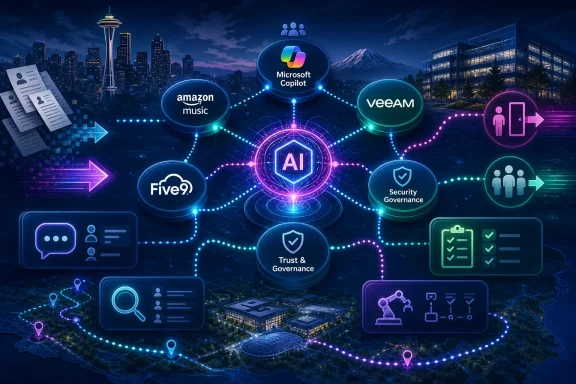 The Org Chart Is Now a Product Roadmap
There was a time when executive moves stories mostly belonged to the business pages: who got promoted, who left, who joined a board, who raised a fund. In the current AI cycle, they have become product signals. A company can say “AI-first” in a press release; it shows what that means by deciding who gets budget, headcount, and direct reporting lines.That is why the Amazon Music hire matters beyond the streaming wars. Hrishikesh Aradhye spent nearly 19 years at Google, most recently leading engineering for YouTube Music and Podcasts, according to GeekWire. Amazon is not just hiring a music executive; it is hiring someone with deep experience at the intersection of recommendation systems, media consumption, machine learning, and creator-scale infrastructure.
Aradhye’s quoted remark that the music industry is undergoing a “tectonic shift” driven by AI is the kind of executive language that can sound inflated until one remembers what music streaming already is. Discovery, playlisting, rights management, personalization, search, mood-based listening, podcast surfacing, ads, and creator analytics are all algorithmic battlegrounds. Generative AI simply makes that battlefield more visible.
Amazon Music has long lived in the shadow of Spotify’s cultural dominance and Apple Music’s ecosystem gravity. But Amazon has a different asset: a retail, devices, Alexa, Prime, and cloud stack that can turn music into one more node in a larger ambient computing system. Putting a YouTube Music veteran into a product-and-tech role suggests Amazon wants more than a better app; it wants an AI-mediated listening layer that can follow customers across speakers, cars, phones, and commerce.
The Pacific Northwest angle is not incidental. Seattle’s tech economy has always been defined by infrastructure companies that eventually became consumer companies, and consumer companies that eventually became infrastructure companies. Music, security, data protection, productivity software, and contact centers may look like separate beats. AI is making them variations on the same story.
Microsoft’s Copilot Shuffle Shows the Consumer Problem Inside the Enterprise Giant
The Microsoft portion of the roundup is the most consequential for WindowsForum readers because it touches the company’s highest-stakes product bet: Copilot. GeekWire notes that Jacob Andreou has moved from corporate vice president at Microsoft AI to executive vice president of Copilot, while Peter Sellis has been named Copilot’s lead of design, growth, and engineering. Trevor O’Brien, formerly vice president of product for Microsoft 365 Copilot experiences, has resigned.Some of this reflects a March 2026 reorganization Microsoft had already announced publicly, when it unified consumer and commercial Copilot efforts under Andreou. But the newer personnel details sharpen the picture. Microsoft is placing Copilot under leadership with a strong consumer-product pedigree, including Snap and Discord backgrounds, rather than treating it solely as an Office feature, Windows assistant, or Azure workload.
That is a revealing choice. Microsoft’s Copilot problem has never been a lack of distribution. It has Windows, Office, Teams, Edge, Outlook, GitHub, Azure, and the enterprise licensing machinery that can put a button in front of hundreds of millions of users almost overnight. The harder problem is habit formation: making Copilot feel like a daily behavior rather than an imposed pane, sidebar, or procurement line item.
That is where Andreou and Sellis make strategic sense. Snap and Discord are not enterprise productivity companies; they are products where engagement, onboarding, social loops, interface pacing, and user retention are existential. If Microsoft wants Copilot to become what internal rhetoric has reportedly described as a “super app,” it needs leaders who understand why people come back to a product voluntarily.
The phrase super app deserves scrutiny. In a Windows and Microsoft 365 context, it cannot simply mean a giant container full of shortcuts. Microsoft already has too many surfaces, too many admin centers, too many Copilot-branded experiences, and too many overlapping promises. A real super app would need to collapse work context, memory, search, automation, communications, and third-party tools into something coherent enough that users stop thinking about which app they are in.
That is a tall order for a company whose AI interfaces still often feel like strategy documents rendered as UI. The Copilot brand is everywhere, but ubiquity is not the same as clarity. Leadership churn suggests Microsoft knows the next phase is not about adding more Copilot buttons; it is about making the experience legible, useful, and sticky.
The Departure That Matters Is Not Always the Loudest One
Trevor O’Brien’s resignation from Microsoft 365 Copilot experiences may or may not indicate internal disagreement; GeekWire reports that he did not state his next move. It would be irresponsible to treat one executive departure as a proxy war without evidence. Still, the timing is notable because Microsoft 365 Copilot is the commercial heart of the company’s AI monetization effort.Microsoft has spent the last several years positioning Copilot as the AI layer for work. The sales pitch is elegant: your company already lives in Microsoft 365, your data already sits in Exchange, SharePoint, OneDrive, Teams, and the Microsoft Graph, and Copilot can turn that organizational exhaust into productivity. In theory, no standalone chatbot can match that context.
In practice, enterprises have been more cautious. IT leaders want to know whether Copilot can justify per-user licensing costs, whether it respects permissions, whether it creates data leakage risks, whether employees will use it enough to matter, and whether promised productivity gains survive contact with real workflows. Those are not philosophical objections. They are deployment objections.
That makes the Microsoft 365 Copilot role strategically sensitive. The person responsible for product experiences has to translate models, permissions, user interface, business process, and admin policy into something a sales team can defend and an employee can understand. If that role turns over during a broader Copilot unification, customers will watch closely.
The more interesting reading is not that Microsoft is in crisis, but that it is moving from phase one of AI distribution to phase two of AI discipline. Phase one was about shipping fast, branding everything, and proving that Microsoft could put generative AI into the software people already use. Phase two is about retention, governance, workflow depth, and measurable business outcomes. Different phases reward different executives.
Security Loses a Visible Evangelist as AI Raises the Stakes
Vasu Jakkal’s departure as Microsoft’s corporate vice president of Security, Compliance, Identity, Management, and Privacy is another personnel change that lands differently in 2026 than it would have five years ago. Microsoft Security is not a side business. It is one of the company’s most strategically important franchises, spanning identity, endpoint protection, cloud security, compliance, threat intelligence, and now AI governance.Jakkal’s tenure coincided with Microsoft’s push to frame itself as a security platform provider rather than a collection of security products. That positioning mattered because Microsoft’s enterprise footprint gives it an enormous advantage in telemetry and integration. It also creates an enormous burden: when Microsoft security fails, it fails at the center of customer environments.
Her departure comes at a moment when the security conversation is shifting from defending human users and conventional workloads to defending agentic systems. AI agents introduce new problems that map awkwardly onto old controls. They can act across applications, retrieve sensitive data, invoke tools, summarize privileged content, and make mistakes at machine speed.
For Windows administrators, the practical question is no longer just whether Defender catches malware or whether Entra ID enforces conditional access. It is whether an AI assistant should be treated like a user, a service principal, an application, a workflow engine, or something else entirely. The answer may be “all of the above,” which is precisely why Microsoft’s security leadership matters.
Jakkal had become one of Microsoft’s more visible voices on the need for observability and governance in the agentic era. Whoever fills the vacuum will inherit a portfolio that has to secure not only Windows endpoints and cloud tenants but also the AI abstractions Microsoft is now layering across them. Security is becoming the trust tax on every AI promise.
Veeam’s New Marketing Role Admits That Recovery Is Now an AI Conversation
Veeam’s appointment of Mika Yamamoto as chief marketing and customer AI officer is another telling move. The title itself is a sign of the times: marketing and customer AI now sit close enough together to become a single executive remit. That may sound like branding gymnastics, but for a data protection company it has a clear logic.Veeam sells into one of the least forgiving parts of IT. Backup and recovery products are judged in the moment of failure: a ransomware event, a cloud outage, a botched migration, a corrupted database, a compliance audit. Customers do not want poetry about transformation when production systems are down; they want clean restores, predictable recovery time, and confidence that their backups were not compromised.
AI changes that conversation in two directions. First, attackers are using automation and AI-assisted techniques to scale phishing, reconnaissance, and social engineering. Second, defenders want AI to help detect anomalies, prioritize recovery actions, explain risk, and simplify operational complexity. The result is that backup vendors can no longer talk only about storage efficiency and recovery points. They have to talk about intelligence.
Yamamoto’s background across F5, Microsoft, SAP, and BlackLine gives Veeam a leader familiar with enterprise buyers, partner ecosystems, and complex software categories. CEO Anand Eswaran’s statement emphasizing customer and partner focus is standard executive-hire language, but it also points to the real challenge. The AI story in backup cannot be allowed to become vapor; it has to map to customer trust.
This is especially important as Veeam competes in a market where ransomware recovery has become a board-level concern. Data protection used to be an insurance policy bought by infrastructure teams. Now it is part of cyber resilience, regulatory posture, and business continuity. AI may help Veeam explain that shift, but the product still has to work at 3 a.m. when the domain controllers are in trouble.
Five9’s CTO Hire Shows AI Moving From Back Office to Front Line
Niranjan Vijayaragavan’s move to become CTO at Five9 fits the same pattern from another angle. Five9 operates in cloud contact-center software, a category that has rapidly become one of the clearest proving grounds for AI in production. Customer service has structured workflows, measurable outcomes, high labor costs, large volumes of repetitive interactions, and plenty of messy human edge cases.That makes it irresistible to AI vendors. It also makes it dangerous. A bad AI assistant in a document editor wastes time; a bad AI agent in customer service can lose a sale, violate policy, mishandle sensitive information, or inflame an already unhappy customer. The contact center is where AI’s promise of automation collides with human frustration.
Vijayaragavan’s background at Nintex, Avalara, and Expedia Group suggests experience with workflow, tax and compliance complexity, and large-scale digital operations. Five9 needs that kind of product-and-platform discipline because the future contact center is not just a phone queue with smarter transcripts. It is becoming an orchestration layer between customers, agents, knowledge bases, CRM systems, identity verification, payments, and analytics.
The phrase “AI reshapes how companies engage with their customers,” used in the company’s statement, is both true and incomplete. AI will reshape customer engagement only if companies can avoid turning support into a maze of synthetic empathy and unresolved escalations. The winners will not be the vendors that deflect the most calls; they will be the ones that resolve the most intent with the least damage to trust.
For IT pros, this matters because contact-center AI touches identity, data retention, compliance, network architecture, and integration strategy. It is not merely a SaaS purchase made by customer support. It is another example of AI moving from experimental sidecar to operational core.
Seattle’s Talent Market Is Becoming a Circulation System for AI Strategy
The rest of the GeekWire roundup widens the frame. Maura Mast becomes president of Seattle University. Jake Gentry takes over the Cascadia Sustainable Aviation Accelerator. F5 adds Gavin Munroe to its board. Harini Gokul joins Afiniti’s board. Safe Software names Nabil Lodey to lead EMEA expansion. Cambia Health Foundation appoints Allison Gruber to a leadership role.Not all of these are AI stories, and forcing them into that mold would flatten the region’s economy. But they do show how executive expertise circulates across sectors that are increasingly technology-mediated: education, aviation fuel, cybersecurity, financial systems, call-center AI, data integration, and health strategy. The Pacific Northwest’s advantage is not just that it has Amazon and Microsoft. It has a dense labor market of people who have learned how platforms scale.
That density matters because AI strategy is now as much about institutional translation as technical invention. Universities must decide how to teach and govern AI. Aviation sustainability groups must coordinate policy, energy infrastructure, and industrial supply chains. Health organizations must use data without losing public trust. Boards must understand cyber risk as a business risk, not a technical afterthought.
The Seattle region has repeatedly produced executives who move between large platforms, startups, enterprise software companies, public institutions, and civic organizations. That mobility can look like résumé restlessness. In practice, it is how playbooks spread.
The risk is groupthink. When every organization hires leaders fluent in the same platform language, they can also inherit the same blind spots: overconfidence in scale, underinvestment in usability, a tendency to treat social consequences as change-management issues, and a belief that integration solves everything. AI will reward experience, but it will punish institutional autopilot.
Microsoft’s Retirement Wave Adds a Human Cost to the AI Pivot
GeekWire also notes that more Microsoft employees are retiring, following reporting on the company’s first-ever voluntary retirement program. That detail belongs beside the Copilot and security moves, not below them. Executive reshuffles are glamorous; retirement programs are where strategy becomes personal.Large technology companies are always renewing themselves. People leave, divisions reorganize, product priorities change, and new technical eras demand new skills. But Microsoft’s current transition is unusually compressed because AI is being treated not as a new business line but as a new basis for nearly every business line.
For longtime Microsoft employees, that can produce a strange inversion. Institutional knowledge that once made someone invaluable can start to look, on a spreadsheet, like cost and inertia. Meanwhile, new hires with consumer AI, growth, model, or agent experience may appear better aligned with where the company wants to go. The danger is that the company confuses freshness with wisdom.
Microsoft has survived multiple platform transitions because it retained enough institutional muscle to absorb shocks. Windows, Office, enterprise licensing, developer tools, cloud services, Xbox, security, and partner ecosystems are not simply products; they are accumulated systems of customer expectation. If AI leadership displaces too much of that memory, Microsoft could move faster while understanding less.
That is not an argument against change. Microsoft cannot defend its future by preserving every past structure. But the company’s hardest task is not hiring AI talent; it is integrating that talent with the people who understand why enterprise customers distrust magical demos, why admins hate surprise defaults, why compliance teams slow deployments, and why Windows users resent features that feel imposed rather than earned.
Copilot Has to Become Boring Before It Becomes Essential
The next era of Copilot will likely be judged less by keynote moments and more by mundane success. Can it find the right document without exposing the wrong one? Can it summarize meetings accurately enough that people trust it? Can it automate repetitive work without creating audit nightmares? Can it live in Windows without feeling like another promotional surface?Microsoft’s consumer-product hires imply that delight and engagement are now board-level concerns. That is sensible, but enterprise software does not become essential the same way a social app does. A workplace AI tool becomes essential when employees quietly incorporate it into routine tasks and administrators stop fearing what it might do behind the scenes.
This is where Microsoft’s dual identity becomes both advantage and burden. The company can bring Copilot to consumer Windows users, enterprise Microsoft 365 tenants, developers in GitHub, analysts in Excel, and security teams in Defender. But each audience has different tolerance for experimentation. A playful assistant in a consumer context can become a governance problem in a regulated tenant.
The “super app” ambition therefore runs into a classic Microsoft tension. Integration is powerful when it removes friction. It is oppressive when it turns every product into a feeder system for the same corporate priority. If Copilot becomes the connective tissue of Microsoft’s ecosystem, users will need clear controls, visible value, and the ability to say no without fighting the operating system.
For WindowsForum readers, this is the part to watch. The future of Windows will not be determined solely by kernel work, UI polish, or hardware requirements. It will be determined by whether Microsoft can make AI feel native to the PC rather than bolted onto it for investor-day optics.
The Real Competition Is for Trust, Not Talent
It is tempting to treat every executive hire as a trophy and every departure as a wound. That is too simple. The more useful reading is that major technology companies are now competing for trust through personnel, not just product claims.Amazon Music needs users to trust that AI-driven music experiences enhance discovery rather than cheapen art. Microsoft needs enterprises to trust that Copilot can act on corporate data without becoming a liability. Veeam needs customers to trust that AI will improve resilience rather than decorate backup dashboards. Five9 needs businesses and consumers to trust that automated customer engagement will solve problems instead of hiding humans.
Trust is not built by titles, but titles reveal where companies think trust must be manufactured. A chief customer AI officer, an EVP of Copilot, a security leader focused on agent governance, a CTO for AI-shaped contact centers: these are not ornamental roles. They are institutional attempts to make AI accountable to customers, regulators, and revenue.
The uncomfortable truth is that the AI boom has so far been better at generating demos than durable habits. The products are improving quickly, but the organizational work is harder. Companies have to decide who owns model behavior, who owns user experience, who owns safety, who owns data permissions, who owns cost overruns, and who gets blamed when automation makes a confident mistake.
That is why these moves matter. They show companies trying to turn AI from a laboratory and marketing category into a chain of command. The chain of command may still be messy, but at least it tells us where responsibility is supposed to land.
The Week’s Moves Point to One Uncomfortable Microsoft Truth
The most concrete lesson from this personnel cycle is that AI strategy has moved from announcement to accountability. The companies in GeekWire’s roundup are no longer merely saying they will add AI; they are reorganizing leadership around the assumption that AI will shape product design, customer relationships, security, and recovery.- Microsoft is consolidating Copilot leadership under executives with consumer-product experience because distribution alone has not solved the adoption challenge.
- Vasu Jakkal’s departure leaves Microsoft Security facing a leadership transition just as agentic AI makes identity, observability, and governance more important.
- Amazon Music’s hire of Hrishikesh Aradhye signals that streaming competition is shifting toward AI-mediated discovery, personalization, and cross-platform experience.
- Veeam’s appointment of Mika Yamamoto shows that ransomware recovery and data protection vendors now have to explain AI in terms of resilience, not hype.
- Five9’s CTO hire underscores that contact centers are becoming a front-line test of whether AI can improve customer experience without eroding trust.
- The broader Seattle-area moves show a regional talent market where enterprise, cloud, data, security, education, and civic infrastructure are increasingly connected by AI strategy.
References
- Primary source: GeekWire
Published: Wed, 01 Jul 2026 17:08:28 GMT
Tech Moves: Amazon Music names VP; Microsoft departures and a Copilot shakeup; Veeam adds exec – GeekWire
Amazon Music names VP of product and tech; Microsoft's corporate VP of Security, Compliance, Identity, Management & Privacy steps down while its Copilot platform undergoes a shakeup; Veeam appoints a chief marketing and customer AI officer; andwww.geekwire.com - Related coverage: crn.com
Microsoft’s Vasu Jakkal Reveals Security Leadership Role Departure
Vasu Jakkal exits Microsoft, leaving its fast-growing security unit and vast partner ecosystem as the AI and cloud vendor enters FY2027.www.crn.com - Official source: blogs.microsoft.com
Announcing Copilot leadership update - The Official Microsoft Blog
Satya Nadella, Chairman and CEO, and Mustafa Suleyman, Executive Vice President and CEO of Microsoft AI, shared the below communications with Microsoft employees this morning. SATYA NADELLA MESSAGE I want to share two org changes we’re making to our Copilot org and superintelligence effort. It’s...blogs.microsoft.com - Related coverage: windowscentral.com
Microsoft Copilot Changes: Moving Away From OpenAI? | Windows Central
Ex-SnapChat exec takes over Copilot AI experiences as Microsoft AI CEO doubles down on in-house modelswww.windowscentral.com - Official source: microsoft.com
RSAC 2026 Cybersecurity Recap Video | Security Insider
Gain key RSAC 2026 insights as Microsoft leaders unpack frontier‑level risks, RSAC cybersecurity themes, and how organizations can prepare for what’s next.www.microsoft.com
- Related coverage: computerworld.es
Microsoft cambia su equipo directivo | Computerworld.es
Jacob Andreou dirigirá la nueva división de IA, mientras que Mustafa Suleyman, vicepresidente ejecutivo y director general de Microsoft AI, se centrará ahora en los proyectos de superinteligencia de la empresa. www.computerworld.es
- Related coverage: tweakpc.de
Microsoft ordnet Copilot-Struktur personell um
Microsoft stellt seine KI-Organisation neu auf und verschiebt die Verantwortung für Copilot. Die operative Führung übernimmt künftig Jacob Andreou, der Copilot über alle Consumer- und Commercial-Bereiche hinweg steuern soll.www.tweakpc.de - Related coverage: samexpert.com
Inside Microsoft's March 2026 Copilot Reorg | SAMexpert Blog
SAMexpert on Microsoft's Copilot reorg: consumer and commercial Copilot unified, Suleyman pivots to in-house AI models, Jha retires after 35 years.samexpert.com - Related coverage: itpro.com
Observability will be key to agentic AI safety, says Microsoft Security exec | IT Pro
Agentic AI adoption will require a re-evaluation of enterprise risk management, according to Microsoft corporate VPwww.itpro.com - Related coverage: nextepinvestimentos.com.br
Microsoft Offers Its First Ever Buyouts to Shape Workforce Around AI Push - WSJ
PDF documentnextepinvestimentos.com.br
- Related coverage: techxplore.com
- Related coverage: networksplus.com
- Related coverage: jstoppa.com