

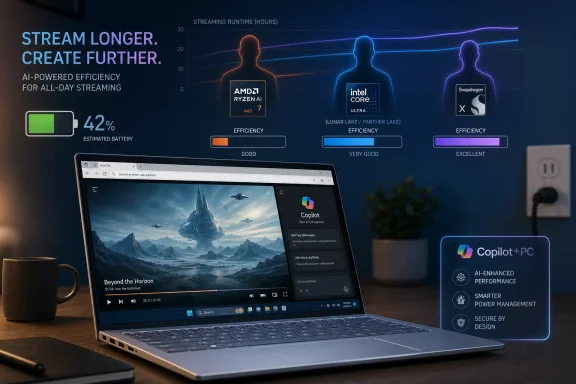
PCWorld’s July 2026 battery testing found AMD’s Ryzen AI 7 445 trailing Intel and Qualcomm rivals in both raw streaming runtime and battery-size-adjusted efficiency on an Acer Swift Go 14 AI laptop. That is an awkward result for AMD because the Ryzen AI 400 family is not some boutique experiment; it is the silicon that will appear in a meaningful slice of mainstream productivity machines. The finding does not prove every Ryzen AI 400 laptop will disappoint, but it does puncture a marketing story that has become central to the Windows PC business. In the Copilot+ era, battery life is no longer a nice-to-have spec buried below the keyboard travel and port count — it is the proof that a platform belongs in the mobile future.
AMD has spent the better part of a decade rebuilding credibility in PCs by doing the thing Intel used to do automatically: delivering obvious, measurable generational progress. Ryzen made AMD relevant again on desktops, then genuinely dangerous in laptops. For many buyers, especially enthusiasts who remember the bad old days of hot, slow AMD notebooks, the modern default assumption has flipped from suspicion to confidence.
That is why the Ryzen AI 7 445 result lands with more force than a single chart normally deserves. This is not an obscure chip in a gaming brick with a tiny battery and a 240Hz display. It is a midrange member of AMD’s new Ryzen AI 400 mobile lineup, tested in the sort of thin productivity laptop that Windows buyers actually cross-shop against Intel Lunar Lake, Panther Lake previews, and Qualcomm Snapdragon X machines.
The problem is not that AMD lost a benchmark. Somebody always loses a benchmark. The problem is that it lost the one test that increasingly defines whether a Windows laptop feels modern: unplugged endurance while doing ordinary, connected work.
PCWorld’s shift from a local video loop to a streaming rundown is important here. Old battery tests were useful because they were repeatable, but they increasingly resembled a lab ritual rather than a workday. Streaming video keeps Wi-Fi active, exercises modern browsers and DRM paths, and forces the machine to behave more like it does on a couch, train, campus, or conference table.
That does not make streaming the only battery test that matters. It does make it a useful proxy for a world in which laptops rarely sit offline playing the same local file for 15 hours. If AMD’s newest mainstream AI-branded mobile processor struggles there, the concern is practical rather than theoretical.
AMD’s Ryzen AI 7 445 is not a flagship monster. It is a six-core, twelve-thread part, reportedly built with a mix of Zen 5 and Zen 5c cores, and positioned below higher-end Ryzen AI 400 chips such as the Ryzen AI 9 HX 475. In other words, it is exactly the kind of processor that should be judged by balance rather than brute force.
That makes the PCWorld result more damaging. If a midrange mobile chip cannot make a strong efficiency case, the user has less reason to accept trade-offs. Performance can be “good enough” in a productivity laptop, but battery life has to be obviously competitive because it is the feature users feel every afternoon.
The industry’s AI fixation has also created a branding fog. A buyer walking into a store or browsing online sees Ryzen AI, Core Ultra, Snapdragon X, Copilot+, NPU TOPS, and maybe a sticker promising all-day use. The hierarchy is difficult enough for enthusiasts; for normal buyers it is close to meaningless. Battery tests cut through that fog because they answer the ancient laptop question: how long can I stay away from the charger?
That is why this result should worry AMD more than a middling CPU score would. A slightly slower productivity chip can be forgiven if the machine is quiet, cool, and long-lived. A short-lived productivity chip is harder to defend, because the whole category exists to be carried.
In PCWorld’s battery efficiency comparison, the Snapdragon X Elite reportedly took the top spot after accounting for battery capacity. That matters because raw runtime can be distorted by brute-force battery size. A laptop with a 99Wh pack has a structural advantage over one with a 65Wh pack, just as a car with a bigger fuel tank can drive farther even if it burns more fuel per mile.
Efficiency per watt-hour is the more interesting measure. It tells us how much useful runtime the platform extracts from the battery it has. On that basis, Qualcomm’s showing reinforces the central Snapdragon pitch: if your workload fits, Arm-based Windows laptops can deliver excellent unplugged behavior.
The phrase “if your workload fits” still does a lot of work. Windows on Arm remains a compatibility story as much as a battery story, especially for users with niche drivers, old utilities, VPN clients, plug-ins, development toolchains, or x86-only corporate software. For many WindowsForum readers, that is not a footnote; it is the whole deployment blocker.
But the market does not need Qualcomm to win every user to pressure AMD. It only needs Qualcomm to win enough mainstream productivity buyers that battery life becomes a visible differentiator on every shelf. Once buyers have seen a Windows laptop that behaves more like a MacBook Air in standby and runtime, “pretty good for x86” becomes less persuasive.
That is the trap AMD faces. It can rightly argue that x86 compatibility remains a strength. It can rightly point out that a single laptop design does not define an entire processor family. But it cannot wish away the fact that Windows battery expectations are being reset from both sides: Apple from outside the Windows ecosystem, and Qualcomm from within it.
Core Ultra, particularly the Lunar Lake generation, was Intel’s public admission that old laptop habits had to change. The company emphasized integrated memory, a redesigned graphics architecture, NPU capability, and efficiency-oriented cores because the market was moving away from benchmark bursts as the only measure of merit. Panther Lake, which PCWorld included in pre-release or early testing context, appears to continue that fight with the benefit of a large battery in the tested machine.
The 99Wh detail is important. A giant battery can make any platform look better in raw runtime, and PCWorld correctly adjusted for watt-hours to avoid confusing battery capacity with processor efficiency. But even after that adjustment, the broader narrative is uncomfortable for AMD: Intel is at least visibly competing in the right arena.
For IT buyers, Intel also has an incumbency advantage that AMD and Qualcomm must overcome in different ways. Enterprises know Intel’s driver stack, management story, imaging patterns, and support expectations. Qualcomm has to convince IT that Windows on Arm is worth the compatibility audit. AMD has to convince IT that its machines will offer a better combination of price, performance, endurance, and manageability than the Intel default.
Battery life is one of the few features that can make that conversation easy. If AMD systems are cheaper and last longer, the pitch is simple. If they are cheaper but die sooner, the savings become more ambiguous. If they are similarly priced and less efficient, the buyer’s path of least resistance leads back to Intel.
That caveat is real, and it matters. Reviewers sometimes find that two machines with the same processor deliver wildly different endurance because one vendor tuned aggressively for responsiveness while another chased idle power. Even panel choice can distort the result; OLED, high-refresh IPS, touch layers, and brightness targets all impose different costs.
But caveats should not become a hiding place. When a mainstream chip performs poorly in a mainstream chassis on a modern, networked battery test, the burden shifts to the platform vendor and OEMs to show better examples. AMD does not need to apologize for one laptop, but it does need to explain why buyers should expect different behavior from the next one.
This is where processor branding becomes a liability. The average buyer does not know whether the Ryzen AI 7 445 is a cut-down part, a refresh, a rebadge, a new architecture variant, or a carefully segmented SKU. They see “Ryzen AI 7” and reasonably expect a premium-ish mainstream experience. If the machine then trails alternatives in the most visible mobility metric, the brand takes the hit.
AMD also suffers from its own success. Because Ryzen has been strong for so long in value and multicore performance, reviewers and enthusiasts now expect AMD to be competitive everywhere. The company is no longer graded on a comeback curve. It is judged as a leading platform vendor, and leading platform vendors do not get to shrug off battery life in productivity laptops.
Streaming is messier, but messier in a useful way. It keeps the network stack alive, makes the browser and media pipeline part of the test, and exposes platform behavior under a light but continuous real-world workload. For a productivity notebook, that is closer to the daily rhythm of web apps, meetings, documents, chat, and video than a local 1080p file looping in airplane mode.
The choice of One Piece is amusing, but the workload is not. Modern laptops spend enormous amounts of time decoding video, rendering web pages, syncing cloud data, and waking radios. A chip that looks efficient in a synthetic idle condition can still disappoint if platform-level power management is not tuned for connected use.
That distinction is especially important for Windows. Microsoft and its silicon partners have spent years trying to make Windows laptops behave more like appliances when sleeping, waking, and sipping power. Connected standby, modern sleep, background tasks, and driver behavior have all been recurring pain points. A streaming rundown is not just a CPU test; it is a platform test with the screen on.
This is also why buyers should be cautious about vendor battery claims. “Up to” numbers are usually built from idealized conditions: low brightness, local playback, controlled networks, and power-saving modes that may not resemble a normal day. Independent streaming tests are less flattering precisely because they leave fewer places for marketing to hide.
That is the worst place to have a battery-life problem. Enthusiasts may tolerate a hungry chip if it delivers exceptional performance. Gamers expect to plug in. Workstation users understand that sustained CPU and GPU loads consume power. Mainstream productivity buyers are less forgiving because their workloads do not feel demanding enough to justify battery anxiety.
For these users, the laptop’s emotional contract is simple. It should survive the workday, or at least enough of it that the charger is not a constant companion. It should not turn a two-hour meeting block into a percentage-watching exercise. It should not make a cross-country flight feel like a power-management challenge.
That is why efficiency scores matter more than peak benchmarks in this segment. A laptop that is 10 percent faster in a short CPU test but 25 percent worse in practical runtime is not necessarily the better productivity machine. In many offices, schools, and households, it is simply the more annoying one.
The risk for AMD is that retail buyers rarely distinguish between one Ryzen AI 400 chip and another. If early or visible systems disappoint on battery life, the reputation can spread across the family, fairly or not. Laptop platforms are judged by anecdotes as much as charts, and “my Ryzen AI laptop dies too fast” is the kind of anecdote that sticks.
Still, OEM tuning has limits. If the processor and platform consume more power under common workloads than rivals, firmware can only do so much before the machine feels sluggish or unstable. The best laptop designs amplify good silicon; they rarely transform mediocre efficiency into class-leading endurance.
The AMD-Intel-Qualcomm comparison also highlights how hard this generation is for OEMs. They are not just choosing between chips; they are choosing between platform stories. Intel offers familiarity and a renewed efficiency push. Qualcomm offers standout battery potential with Arm compatibility questions. AMD offers x86 continuity, strong integrated graphics heritage, and often attractive pricing, but it now needs to prove the mobility story at the lower and middle tiers.
That proof has to come through shipping systems, not slide decks. Review samples, retail configurations, BIOS updates, and long-term user reports will decide whether Ryzen AI 400 is seen as a sensible mainstream platform or a spec-sheet compromise wrapped in AI branding. The difference may come down to details most buyers never see: power tables, panel bins, sleep states, memory speeds, and cooling curves.
For sysadmins, those details are not academic. A fleet laptop that loses an hour or two of practical runtime can affect meeting rooms, travel days, hot-desking setups, and help-desk complaints. Battery degradation over two or three years compounds the issue, turning a merely average new laptop into a frustrating old one faster than expected.
“Ryzen AI” tells the buyer there is an NPU story. “7” suggests a higher mainstream tier. “445” suggests a newer or better part than lower-numbered chips. None of that tells the buyer how the chip behaves in sustained web use, whether the integrated graphics are meaningfully cut down, how many high-performance cores it has, or how much cache was sacrificed.
This matters because Windows laptop shopping is increasingly done through filters. Buyers sort by price, RAM, storage, screen size, and processor family. A system with a Ryzen AI 7 label may sit next to Intel Core Ultra and Snapdragon X machines at similar prices, but the meaningful differences are buried several clicks deep, if they are disclosed clearly at all.
The AI label also risks becoming a distraction from the basics. NPUs are useful for certain local workloads and may become more important as software support improves. But in mid-2026, many users still get more daily value from long battery life than from theoretical TOPS capacity.
That does not mean the NPU race is fake. It means platform vendors have to walk and chew gum. A laptop can be ready for local AI workloads and still fail as a mobile PC if it spends too much time near an outlet.
Buyers should look for reviews of the exact laptop configuration they plan to purchase, including display type and battery capacity. A Ryzen AI 400 system with a lower-power panel, careful firmware, and a larger battery may behave very differently from the Acer tested by PCWorld. Conversely, an Intel or Qualcomm machine can squander a good platform with a power-hungry display or poor tuning.
Battery-size-adjusted efficiency is especially useful when comparing machines across classes. A laptop with a huge battery may last longer simply because it is carrying more energy. That may still be the right purchase if weight and airline limits are acceptable, but it is not the same thing as having a more efficient platform.
For WindowsForum readers, the deeper lesson is to separate three ideas that marketing tends to blend together: processor performance, platform efficiency, and system battery life. The CPU matters, but so does the rest of the laptop. The laptop’s advertised runtime matters, but so does the workload used to produce it. The architecture matters, but compatibility and manageability may matter more in a real deployment.
The good news is that competition is finally forcing Windows laptops to improve where users notice. The bad news is that the old shorthand — buy the latest chip and expect the best outcome — is less reliable than ever.
 AMD’s Mobile Comeback Runs Into the Wall Outlet
AMD has spent the better part of a decade rebuilding credibility in PCs by doing the thing Intel used to do automatically: delivering obvious, measurable generational progress. Ryzen made AMD relevant again on desktops, then genuinely dangerous in laptops. For many buyers, especially enthusiasts who remember the bad old days of hot, slow AMD notebooks, the modern default assumption has flipped from suspicion to confidence.That is why the Ryzen AI 7 445 result lands with more force than a single chart normally deserves. This is not an obscure chip in a gaming brick with a tiny battery and a 240Hz display. It is a midrange member of AMD’s new Ryzen AI 400 mobile lineup, tested in the sort of thin productivity laptop that Windows buyers actually cross-shop against Intel Lunar Lake, Panther Lake previews, and Qualcomm Snapdragon X machines.
The problem is not that AMD lost a benchmark. Somebody always loses a benchmark. The problem is that it lost the one test that increasingly defines whether a Windows laptop feels modern: unplugged endurance while doing ordinary, connected work.
PCWorld’s shift from a local video loop to a streaming rundown is important here. Old battery tests were useful because they were repeatable, but they increasingly resembled a lab ritual rather than a workday. Streaming video keeps Wi-Fi active, exercises modern browsers and DRM paths, and forces the machine to behave more like it does on a couch, train, campus, or conference table.
That does not make streaming the only battery test that matters. It does make it a useful proxy for a world in which laptops rarely sit offline playing the same local file for 15 hours. If AMD’s newest mainstream AI-branded mobile processor struggles there, the concern is practical rather than theoretical.
The AI Badge Does Not Recharge the Battery
The most revealing part of the Ryzen AI 400 story is how little the “AI” branding helps explain what buyers actually need from the machine. Microsoft’s Copilot+ PC requirements pushed the industry toward NPUs and TOPS claims, and vendors were only too happy to slap AI language across product pages. But the typical productivity laptop still wins or loses on display quality, keyboard comfort, standby behavior, fan noise, compatibility, and battery life.AMD’s Ryzen AI 7 445 is not a flagship monster. It is a six-core, twelve-thread part, reportedly built with a mix of Zen 5 and Zen 5c cores, and positioned below higher-end Ryzen AI 400 chips such as the Ryzen AI 9 HX 475. In other words, it is exactly the kind of processor that should be judged by balance rather than brute force.
That makes the PCWorld result more damaging. If a midrange mobile chip cannot make a strong efficiency case, the user has less reason to accept trade-offs. Performance can be “good enough” in a productivity laptop, but battery life has to be obviously competitive because it is the feature users feel every afternoon.
The industry’s AI fixation has also created a branding fog. A buyer walking into a store or browsing online sees Ryzen AI, Core Ultra, Snapdragon X, Copilot+, NPU TOPS, and maybe a sticker promising all-day use. The hierarchy is difficult enough for enthusiasts; for normal buyers it is close to meaningless. Battery tests cut through that fog because they answer the ancient laptop question: how long can I stay away from the charger?
That is why this result should worry AMD more than a middling CPU score would. A slightly slower productivity chip can be forgiven if the machine is quiet, cool, and long-lived. A short-lived productivity chip is harder to defend, because the whole category exists to be carried.
Qualcomm’s Advantage Is No Longer Hypothetical
For years, Windows on Arm was the platform of almost. It almost had the battery life story. It almost had the app compatibility. It almost had the performance. It almost had the vendor commitment. Qualcomm’s Snapdragon X generation did not solve every problem, but it changed the conversation from “why would anyone buy this?” to “which compromises matter to this buyer?”In PCWorld’s battery efficiency comparison, the Snapdragon X Elite reportedly took the top spot after accounting for battery capacity. That matters because raw runtime can be distorted by brute-force battery size. A laptop with a 99Wh pack has a structural advantage over one with a 65Wh pack, just as a car with a bigger fuel tank can drive farther even if it burns more fuel per mile.
Efficiency per watt-hour is the more interesting measure. It tells us how much useful runtime the platform extracts from the battery it has. On that basis, Qualcomm’s showing reinforces the central Snapdragon pitch: if your workload fits, Arm-based Windows laptops can deliver excellent unplugged behavior.
The phrase “if your workload fits” still does a lot of work. Windows on Arm remains a compatibility story as much as a battery story, especially for users with niche drivers, old utilities, VPN clients, plug-ins, development toolchains, or x86-only corporate software. For many WindowsForum readers, that is not a footnote; it is the whole deployment blocker.
But the market does not need Qualcomm to win every user to pressure AMD. It only needs Qualcomm to win enough mainstream productivity buyers that battery life becomes a visible differentiator on every shelf. Once buyers have seen a Windows laptop that behaves more like a MacBook Air in standby and runtime, “pretty good for x86” becomes less persuasive.
That is the trap AMD faces. It can rightly argue that x86 compatibility remains a strength. It can rightly point out that a single laptop design does not define an entire processor family. But it cannot wish away the fact that Windows battery expectations are being reset from both sides: Apple from outside the Windows ecosystem, and Qualcomm from within it.
Intel Has Found a Cleaner Laptop Argument
Intel’s own mobile history is messy enough that nobody should declare permanent victory after one round of tests. The company spent years pushing performance into thermal envelopes that thin laptops could not always tame, and Windows ultrabooks have often promised more battery life than they delivered. Still, Intel’s recent mobile strategy has become easier to understand: split the work, lower platform power, and make the everyday experience feel less frantic.Core Ultra, particularly the Lunar Lake generation, was Intel’s public admission that old laptop habits had to change. The company emphasized integrated memory, a redesigned graphics architecture, NPU capability, and efficiency-oriented cores because the market was moving away from benchmark bursts as the only measure of merit. Panther Lake, which PCWorld included in pre-release or early testing context, appears to continue that fight with the benefit of a large battery in the tested machine.
The 99Wh detail is important. A giant battery can make any platform look better in raw runtime, and PCWorld correctly adjusted for watt-hours to avoid confusing battery capacity with processor efficiency. But even after that adjustment, the broader narrative is uncomfortable for AMD: Intel is at least visibly competing in the right arena.
For IT buyers, Intel also has an incumbency advantage that AMD and Qualcomm must overcome in different ways. Enterprises know Intel’s driver stack, management story, imaging patterns, and support expectations. Qualcomm has to convince IT that Windows on Arm is worth the compatibility audit. AMD has to convince IT that its machines will offer a better combination of price, performance, endurance, and manageability than the Intel default.
Battery life is one of the few features that can make that conversation easy. If AMD systems are cheaper and last longer, the pitch is simple. If they are cheaper but die sooner, the savings become more ambiguous. If they are similarly priced and less efficient, the buyer’s path of least resistance leads back to Intel.
One Laptop Is Not a Verdict, but It Is a Warning Shot
There is a fair objection to the panic: laptops are systems, not processors with screens attached. Firmware, display panels, memory configuration, battery size, cooling policy, wireless radios, OEM power tuning, browser behavior, and Windows updates can all move battery results. A bad showing in an Acer Swift Go 14 AI does not mean every Ryzen AI 400 laptop will behave the same way.That caveat is real, and it matters. Reviewers sometimes find that two machines with the same processor deliver wildly different endurance because one vendor tuned aggressively for responsiveness while another chased idle power. Even panel choice can distort the result; OLED, high-refresh IPS, touch layers, and brightness targets all impose different costs.
But caveats should not become a hiding place. When a mainstream chip performs poorly in a mainstream chassis on a modern, networked battery test, the burden shifts to the platform vendor and OEMs to show better examples. AMD does not need to apologize for one laptop, but it does need to explain why buyers should expect different behavior from the next one.
This is where processor branding becomes a liability. The average buyer does not know whether the Ryzen AI 7 445 is a cut-down part, a refresh, a rebadge, a new architecture variant, or a carefully segmented SKU. They see “Ryzen AI 7” and reasonably expect a premium-ish mainstream experience. If the machine then trails alternatives in the most visible mobility metric, the brand takes the hit.
AMD also suffers from its own success. Because Ryzen has been strong for so long in value and multicore performance, reviewers and enthusiasts now expect AMD to be competitive everywhere. The company is no longer graded on a comeback curve. It is judged as a leading platform vendor, and leading platform vendors do not get to shrug off battery life in productivity laptops.
The Streaming Test Is a Better Mirror for Modern Windows
The local video loop survived for a reason. It is repeatable, easy to automate, and relatively fair across machines. But it increasingly measures how efficiently a laptop can perform a narrow offline task that many users rarely perform anymore.Streaming is messier, but messier in a useful way. It keeps the network stack alive, makes the browser and media pipeline part of the test, and exposes platform behavior under a light but continuous real-world workload. For a productivity notebook, that is closer to the daily rhythm of web apps, meetings, documents, chat, and video than a local 1080p file looping in airplane mode.
The choice of One Piece is amusing, but the workload is not. Modern laptops spend enormous amounts of time decoding video, rendering web pages, syncing cloud data, and waking radios. A chip that looks efficient in a synthetic idle condition can still disappoint if platform-level power management is not tuned for connected use.
That distinction is especially important for Windows. Microsoft and its silicon partners have spent years trying to make Windows laptops behave more like appliances when sleeping, waking, and sipping power. Connected standby, modern sleep, background tasks, and driver behavior have all been recurring pain points. A streaming rundown is not just a CPU test; it is a platform test with the screen on.
This is also why buyers should be cautious about vendor battery claims. “Up to” numbers are usually built from idealized conditions: low brightness, local playback, controlled networks, and power-saving modes that may not resemble a normal day. Independent streaming tests are less flattering precisely because they leave fewer places for marketing to hide.
The Practical Risk Lands on the Middle of the Market
The Ryzen AI 7 445 is not aimed at workstation buyers compiling huge codebases all day or gamers chasing frame rates. It belongs in the broad middle of the laptop market: students, office workers, frequent travelers, home users, and professionals who mostly live in browsers, productivity suites, Teams, Slack, Outlook, PDFs, and video streams.That is the worst place to have a battery-life problem. Enthusiasts may tolerate a hungry chip if it delivers exceptional performance. Gamers expect to plug in. Workstation users understand that sustained CPU and GPU loads consume power. Mainstream productivity buyers are less forgiving because their workloads do not feel demanding enough to justify battery anxiety.
For these users, the laptop’s emotional contract is simple. It should survive the workday, or at least enough of it that the charger is not a constant companion. It should not turn a two-hour meeting block into a percentage-watching exercise. It should not make a cross-country flight feel like a power-management challenge.
That is why efficiency scores matter more than peak benchmarks in this segment. A laptop that is 10 percent faster in a short CPU test but 25 percent worse in practical runtime is not necessarily the better productivity machine. In many offices, schools, and households, it is simply the more annoying one.
The risk for AMD is that retail buyers rarely distinguish between one Ryzen AI 400 chip and another. If early or visible systems disappoint on battery life, the reputation can spread across the family, fairly or not. Laptop platforms are judged by anecdotes as much as charts, and “my Ryzen AI laptop dies too fast” is the kind of anecdote that sticks.
OEMs Cannot Tune Their Way Out of Every Silicon Trade-Off
It would be easy to blame Acer and move on. OEMs make countless decisions that affect endurance, and thin laptops often balance battery size, weight, thermals, display cost, and price targets with ruthless precision. A 65Wh battery is not tiny, but it is not the maximum either, and a vendor chasing a lighter machine may leave runtime on the table.Still, OEM tuning has limits. If the processor and platform consume more power under common workloads than rivals, firmware can only do so much before the machine feels sluggish or unstable. The best laptop designs amplify good silicon; they rarely transform mediocre efficiency into class-leading endurance.
The AMD-Intel-Qualcomm comparison also highlights how hard this generation is for OEMs. They are not just choosing between chips; they are choosing between platform stories. Intel offers familiarity and a renewed efficiency push. Qualcomm offers standout battery potential with Arm compatibility questions. AMD offers x86 continuity, strong integrated graphics heritage, and often attractive pricing, but it now needs to prove the mobility story at the lower and middle tiers.
That proof has to come through shipping systems, not slide decks. Review samples, retail configurations, BIOS updates, and long-term user reports will decide whether Ryzen AI 400 is seen as a sensible mainstream platform or a spec-sheet compromise wrapped in AI branding. The difference may come down to details most buyers never see: power tables, panel bins, sleep states, memory speeds, and cooling curves.
For sysadmins, those details are not academic. A fleet laptop that loses an hour or two of practical runtime can affect meeting rooms, travel days, hot-desking setups, and help-desk complaints. Battery degradation over two or three years compounds the issue, turning a merely average new laptop into a frustrating old one faster than expected.
The Name on the Sticker Is Doing Too Much Work
AMD is hardly alone in confusing laptop buyers with names. Intel’s Core Ultra stack, Qualcomm’s Snapdragon X tiers, and Microsoft’s Copilot+ badge all ask consumers to interpret labels that are partly technical and partly promotional. But Ryzen AI 7 445 is a particularly good example of how modern processor naming can imply more clarity than it provides.“Ryzen AI” tells the buyer there is an NPU story. “7” suggests a higher mainstream tier. “445” suggests a newer or better part than lower-numbered chips. None of that tells the buyer how the chip behaves in sustained web use, whether the integrated graphics are meaningfully cut down, how many high-performance cores it has, or how much cache was sacrificed.
This matters because Windows laptop shopping is increasingly done through filters. Buyers sort by price, RAM, storage, screen size, and processor family. A system with a Ryzen AI 7 label may sit next to Intel Core Ultra and Snapdragon X machines at similar prices, but the meaningful differences are buried several clicks deep, if they are disclosed clearly at all.
The AI label also risks becoming a distraction from the basics. NPUs are useful for certain local workloads and may become more important as software support improves. But in mid-2026, many users still get more daily value from long battery life than from theoretical TOPS capacity.
That does not mean the NPU race is fake. It means platform vendors have to walk and chew gum. A laptop can be ready for local AI workloads and still fail as a mobile PC if it spends too much time near an outlet.
Windows Buyers Should Read Battery Charts Like Fine Print
The immediate buying advice is not “never buy Ryzen AI 400.” That would be too broad and too early. The smarter advice is to stop treating processor family alone as a battery-life guarantee.Buyers should look for reviews of the exact laptop configuration they plan to purchase, including display type and battery capacity. A Ryzen AI 400 system with a lower-power panel, careful firmware, and a larger battery may behave very differently from the Acer tested by PCWorld. Conversely, an Intel or Qualcomm machine can squander a good platform with a power-hungry display or poor tuning.
Battery-size-adjusted efficiency is especially useful when comparing machines across classes. A laptop with a huge battery may last longer simply because it is carrying more energy. That may still be the right purchase if weight and airline limits are acceptable, but it is not the same thing as having a more efficient platform.
For WindowsForum readers, the deeper lesson is to separate three ideas that marketing tends to blend together: processor performance, platform efficiency, and system battery life. The CPU matters, but so does the rest of the laptop. The laptop’s advertised runtime matters, but so does the workload used to produce it. The architecture matters, but compatibility and manageability may matter more in a real deployment.
The good news is that competition is finally forcing Windows laptops to improve where users notice. The bad news is that the old shorthand — buy the latest chip and expect the best outcome — is less reliable than ever.
The Acer Test Turns Ryzen AI 400 Into a Buyer-Beware Moment
The practical reading of PCWorld’s result is narrower than a brand panic and broader than a one-off curiosity. It says AMD’s new midrange AI-branded mobile silicon cannot be assumed to deliver top-tier unplugged performance, even in the kind of laptop where that performance matters most.- Buyers should compare reviews of the exact laptop model and configuration, not just the processor name.
- Battery capacity should be weighed separately from efficiency because a larger pack can hide a hungrier platform.
- Snapdragon X laptops remain compelling for battery-sensitive users whose apps and peripherals work well on Windows on Arm.
- Intel’s recent mobile platforms deserve renewed consideration from buyers who had written the company off during less efficient generations.
- AMD needs stronger retail examples of Ryzen AI 400 endurance before the lineup can be treated as a safe default for productivity laptops.
References
- Primary source: PCWorld
Published: 2026-07-01T11:52:12.013690
Loading…
www.pcworld.com - Related coverage: notebookcheck.net
Loading…
www.notebookcheck.net - Related coverage: nanoreview.net
Loading…
nanoreview.net - Related coverage: amd.com
Loading…
www.amd.com - Related coverage: laptopmedia.com
Loading…
laptopmedia.com - Related coverage: fpsbench.com
Loading…
fpsbench.com