

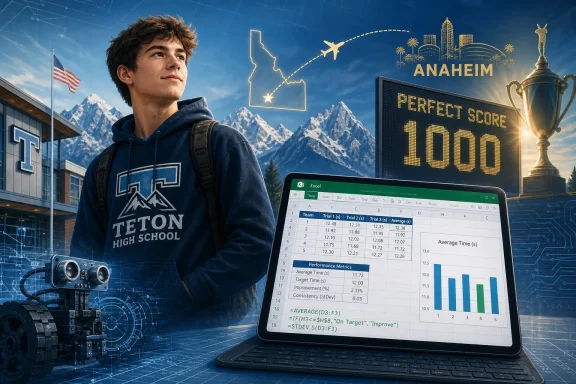
Ethan Strayer, a rising senior at Teton High School in Idaho, was named the 2026 U.S. champion in Microsoft Excel for Microsoft 365 Apps at Certiport’s Microsoft Office Specialist U.S. National Championship in Nashville, Tennessee, and is now headed to the world championship in Anaheim, California. His win is a local student success story, but it is also a reminder that the humble spreadsheet remains one of the most durable technical proving grounds in computing. In an era obsessed with AI copilots, cloud platforms, and coding boot camps, Strayer won with the application many office workers still underestimate until it breaks a budget, a lab schedule, or a production plan.
The details are almost comically clean. Strayer reportedly posted a perfect score, won the Excel 365 national title, earned a $3,000 prize and a Microsoft Surface Pro, and qualified for the Microsoft Office Specialist World Championship in late July. That is the sort of achievement that can be flattened into a school-board applause line, but it deserves a wider reading: Microsoft Office skills, particularly Excel, are not merely clerical anymore. They sit at the strange intersection of business logic, data literacy, automation, and problem-solving — exactly the terrain where tomorrow’s sysadmins, analysts, engineers, and developers will spend much of their working lives.
Excel has survived every prediction of its irrelevance because it is not really one product. It is a calculator, a database, a reporting layer, a modeling tool, a scripting surface, and a shared language for people who do not all speak Python, SQL, or Power BI. That flexibility is why it remains both beloved and dangerous.
For students, the appeal is more practical than romantic. Excel rewards the same habits that good programming rewards: decomposing a problem, testing assumptions, watching for edge cases, and iterating when the first answer fails. The difference is that the feedback loop is visible in cells, formulas, tables, and charts instead of a terminal window.
That makes Strayer’s win more interesting than a badge in “office productivity.” The Microsoft Office Specialist competition does not ask students to recite menu locations from memory. It gives them a task, a spreadsheet, and a clock. In that format, speed matters, but judgment matters more.
A perfect score in that environment suggests more than comfort with the ribbon. It suggests fluency — the ability to look at a messy prompt and quickly translate intent into structure. Anyone who has watched a finance team, research lab, school district, or small business run on spreadsheets knows how valuable that skill can be.
That structure matters because it ties classroom instruction to an external standard. A teacher can say a student is good at Excel; a certification exam tries to make that claim portable. It gives colleges, employers, and scholarship committees a recognizable signal, even if they still need to understand what the credential does and does not prove.
Strayer’s path began in a Business Computer Applications class taught by Molley Alles at Teton High School. According to the local report, students completed learning for Microsoft Excel 365 and were then challenged to take the certification exam. Strayer finished so quickly that his teacher initially thought something had gone wrong.
That anecdote has the ring of every good classroom discovery. A student who appears to be moving too fast is not always skipping steps. Sometimes he has internalized the workflow so thoroughly that the exam has become a review session.
The official national results list Strayer as first in Microsoft Excel for Microsoft 365 Apps, ahead of competitors from Tennessee and Kansas. Pearson said the 2026 U.S. championship drew 140 finalists from thousands of students ages 13 to 22 who had qualified through certification exams. That context is important: this was not a one-school showcase or a regional fair. It was a national funnel with a narrow mouth.
But Strayer’s story is more revealing if we see the classroom as the launchpad. Alles did not merely teach a unit and move on. She pushed students toward a nationally recognized certification, turning a course assignment into an external opportunity.
That is how technical talent often gets found in smaller communities. Not through expensive accelerators or elite summer programs, but through a teacher who knows that a classroom skill can become a credential, a competition berth, or a scholarship line. The machinery is mundane, but the effect can be life-changing.
Teton High School’s role also complicates the assumption that deep technical preparation has to happen in big metro districts or specialized magnet schools. Strayer is not being described as a student who lucked into a tech pipeline. He is a student who found overlapping pathways: business applications, robotics, dual-credit coursework, AP classes, and community mentorship.
That layering matters. In workforce terms, it is the difference between knowing an application and learning how systems fit together. Excel may have been the contest surface, but the broader skill is computational confidence.
That experience maps surprisingly well onto spreadsheet work. A formula can be syntactically valid and still encode the wrong assumption. A table can look clean and still hide bad input. A chart can be technically correct and still mislead the person reading it.
Strayer’s own description of programming is telling: fail as many times as you can until you succeed in making a better product. That is not just a teenager repeating startup folklore. It is the engineering method in plain language.
Excel rewards that same loop. Build, test, inspect, revise. The best users do not simply know functions; they know how to distrust their first answer until the model has earned confidence.
That is why competitive Excel is a better proxy for technical aptitude than many people assume. It compresses analysis, interface knowledge, data handling, and deadline pressure into a single performance. It is not software engineering, but it is close enough to share some of the same cognitive muscles.
That strategy is no longer just about local documents. Microsoft 365 is a cloud-connected work platform wrapped around identity, collaboration, storage, compliance, analytics, and increasingly AI. Excel remains a familiar face inside that much larger machine.
For WindowsForum readers, this is where the student competition intersects with the enterprise world. The modern Excel user may be working with OneDrive, SharePoint, Teams, Power Query, sensitivity labels, and Copilot-adjacent workflows. Even when a certification exam focuses on core application proficiency, the surrounding ecosystem has changed.
The old joke was that Excel was the world’s most widely deployed database. The modern version is sharper: Excel is often the first interface where non-developers encounter structured data, automation, and governance. If they learn good habits there, every downstream system benefits. If they learn bad habits, IT inherits the mess.
That distinction matters because certifications are often misunderstood in both directions. Skeptics dismiss them as box-checking. Credential enthusiasts treat them as proof of job readiness. The truth is more useful: a good certification can validate fundamentals, create motivation, and open doors, but it must sit inside a larger pattern of practice.
Strayer appears to have that larger pattern. He is pursuing dual-credit and AP coursework, aiming to graduate with both a high school diploma and an associate’s degree, and considering fields such as neuroscience and medical robotics. That is not a narrow “Excel kid” profile. It is a profile of someone using every available rung on the ladder.
The local report notes that he has already accumulated 30 credits and is studying Spanish online through CLEP preparation to earn more. That detail says as much about his operating style as the trophy does. He is optimizing the system in front of him, not waiting for a perfect one to appear.
This is where the competition becomes less predictable. A U.S. champion enters with proof of excellence, but the global field brings different educational systems, training cultures, and exam-preparation pipelines. In some countries, office-skills competitions are treated with the intensity of math olympiads or esports qualifiers.
That does not diminish Strayer’s chances; it clarifies the scale. The national title proves he belongs in the room. The world championship will test how his speed, accuracy, and composure hold up against peers who have also climbed their own national ladders.
For a student from Teton High School, that is a remarkable jump in stage size. One month he is the standout in a classroom certification story. The next, he is representing the United States in a Microsoft productivity competition with global honors on the line.
None of that sounds like the glossy version of STEM talent development. There is no exotic lab, no venture-backed academy, no expensive private boot camp. Yet the result is a student who can win a national Microsoft competition and credibly talk about medical robotics as a future path.
That should be a useful corrective for educators and policymakers. The pipeline does not always begin with advanced AI coursework or a dedicated cybersecurity lab. Sometimes it begins with giving students a spreadsheet, a certification target, and a teacher who notices when one of them finishes impossibly fast.
The same is true for communities. Teton High School’s robotics program reportedly benefits from teacher leadership and volunteer mentors from the Teton Valley area. Those mentors may not appear in the headline, but they are part of the infrastructure that makes stories like this possible.
Technology education is often discussed as if it were primarily a hardware problem. Buy devices, deploy platforms, license software, and results will follow. Strayer’s path suggests a different order of operations: put motivated adults around motivated students, then give them credible challenges.
That does not mean Excel should be the final destination for every workflow. Many spreadsheet systems outgrow themselves and need proper databases, version control, application logic, or business intelligence tooling. But the person who can see that boundary clearly is often the person who first learned to reason inside Excel.
This is why Microsoft Office Specialist certifications still matter in 2026. They are not glamorous in the way cloud architect credentials or AI engineering badges are glamorous. They are foundational. They tell the world that a student can operate competently in the productivity environment where real organizations still conduct an enormous amount of work.
The rise of Microsoft 365 Copilot and other AI assistants may actually make these fundamentals more important, not less. An AI tool can suggest a formula, summarize a table, or draft a chart, but the user still has to know whether the output is right. Automation without judgment is just faster error propagation.
Strayer’s achievement lands precisely in that tension. He is winning at a traditional productivity skill at the moment Microsoft is trying to reinvent productivity around AI. The lesson is not that old skills beat new tools. The lesson is that new tools are only as useful as the human model behind the prompt.
The details are almost comically clean. Strayer reportedly posted a perfect score, won the Excel 365 national title, earned a $3,000 prize and a Microsoft Surface Pro, and qualified for the Microsoft Office Specialist World Championship in late July. That is the sort of achievement that can be flattened into a school-board applause line, but it deserves a wider reading: Microsoft Office skills, particularly Excel, are not merely clerical anymore. They sit at the strange intersection of business logic, data literacy, automation, and problem-solving — exactly the terrain where tomorrow’s sysadmins, analysts, engineers, and developers will spend much of their working lives.
 Excel Still Refuses to Become Boring
Excel has survived every prediction of its irrelevance because it is not really one product. It is a calculator, a database, a reporting layer, a modeling tool, a scripting surface, and a shared language for people who do not all speak Python, SQL, or Power BI. That flexibility is why it remains both beloved and dangerous.For students, the appeal is more practical than romantic. Excel rewards the same habits that good programming rewards: decomposing a problem, testing assumptions, watching for edge cases, and iterating when the first answer fails. The difference is that the feedback loop is visible in cells, formulas, tables, and charts instead of a terminal window.
That makes Strayer’s win more interesting than a badge in “office productivity.” The Microsoft Office Specialist competition does not ask students to recite menu locations from memory. It gives them a task, a spreadsheet, and a clock. In that format, speed matters, but judgment matters more.
A perfect score in that environment suggests more than comfort with the ribbon. It suggests fluency — the ability to look at a messy prompt and quickly translate intent into structure. Anyone who has watched a finance team, research lab, school district, or small business run on spreadsheets knows how valuable that skill can be.
A National Championship Built on Certification Infrastructure
Certiport’s Microsoft Office Specialist U.S. National Championship is built on a familiar but often underappreciated model: certification first, competition second. Students qualify by taking Microsoft Office Specialist exams in Word, Excel, or PowerPoint, with separate tracks for Office 2019 and Microsoft 365 Apps. The national event brings together top scorers from around the country and turns credentialing into a live contest.That structure matters because it ties classroom instruction to an external standard. A teacher can say a student is good at Excel; a certification exam tries to make that claim portable. It gives colleges, employers, and scholarship committees a recognizable signal, even if they still need to understand what the credential does and does not prove.
Strayer’s path began in a Business Computer Applications class taught by Molley Alles at Teton High School. According to the local report, students completed learning for Microsoft Excel 365 and were then challenged to take the certification exam. Strayer finished so quickly that his teacher initially thought something had gone wrong.
That anecdote has the ring of every good classroom discovery. A student who appears to be moving too fast is not always skipping steps. Sometimes he has internalized the workflow so thoroughly that the exam has become a review session.
The official national results list Strayer as first in Microsoft Excel for Microsoft 365 Apps, ahead of competitors from Tennessee and Kansas. Pearson said the 2026 U.S. championship drew 140 finalists from thousands of students ages 13 to 22 who had qualified through certification exams. That context is important: this was not a one-school showcase or a regional fair. It was a national funnel with a narrow mouth.
The Local Classroom Was the Real Launchpad
There is a tendency in tech culture to treat student achievement as a story of individual genius. That framing is tempting because it is simple. A student is “good with computers,” wins a contest, and the narrative writes itself.But Strayer’s story is more revealing if we see the classroom as the launchpad. Alles did not merely teach a unit and move on. She pushed students toward a nationally recognized certification, turning a course assignment into an external opportunity.
That is how technical talent often gets found in smaller communities. Not through expensive accelerators or elite summer programs, but through a teacher who knows that a classroom skill can become a credential, a competition berth, or a scholarship line. The machinery is mundane, but the effect can be life-changing.
Teton High School’s role also complicates the assumption that deep technical preparation has to happen in big metro districts or specialized magnet schools. Strayer is not being described as a student who lucked into a tech pipeline. He is a student who found overlapping pathways: business applications, robotics, dual-credit coursework, AP classes, and community mentorship.
That layering matters. In workforce terms, it is the difference between knowing an application and learning how systems fit together. Excel may have been the contest surface, but the broader skill is computational confidence.
Robotics Gave the Spreadsheet Champion His Operating System
Strayer is also the lead student programmer for the Teton High School robotics team, and that detail should not be treated as extracurricular decoration. Robotics teaches a particular kind of humility. Code that looks correct can fail when a wheel slips, a sensor jitters, or a mechanism binds under load.That experience maps surprisingly well onto spreadsheet work. A formula can be syntactically valid and still encode the wrong assumption. A table can look clean and still hide bad input. A chart can be technically correct and still mislead the person reading it.
Strayer’s own description of programming is telling: fail as many times as you can until you succeed in making a better product. That is not just a teenager repeating startup folklore. It is the engineering method in plain language.
Excel rewards that same loop. Build, test, inspect, revise. The best users do not simply know functions; they know how to distrust their first answer until the model has earned confidence.
That is why competitive Excel is a better proxy for technical aptitude than many people assume. It compresses analysis, interface knowledge, data handling, and deadline pressure into a single performance. It is not software engineering, but it is close enough to share some of the same cognitive muscles.
The Microsoft 365 Track Makes This More Than a Legacy Office Story
The distinction between Office 2019 and Microsoft 365 Apps is not trivia. Office 2019 represents a fixed-product generation; Microsoft 365 Apps represents the continually updated subscription world that most enterprises now inhabit. Strayer won in the Excel track for Microsoft 365 Apps, which places his achievement in the version of Office most closely aligned with Microsoft’s current productivity strategy.That strategy is no longer just about local documents. Microsoft 365 is a cloud-connected work platform wrapped around identity, collaboration, storage, compliance, analytics, and increasingly AI. Excel remains a familiar face inside that much larger machine.
For WindowsForum readers, this is where the student competition intersects with the enterprise world. The modern Excel user may be working with OneDrive, SharePoint, Teams, Power Query, sensitivity labels, and Copilot-adjacent workflows. Even when a certification exam focuses on core application proficiency, the surrounding ecosystem has changed.
The old joke was that Excel was the world’s most widely deployed database. The modern version is sharper: Excel is often the first interface where non-developers encounter structured data, automation, and governance. If they learn good habits there, every downstream system benefits. If they learn bad habits, IT inherits the mess.
A Perfect Score Is a Signal, Not a Destination
A perfect certification score is impressive, but the healthier way to read it is as a signal rather than an endpoint. It says Strayer has mastered a defined body of skills under timed conditions. It does not say he is finished learning, and nothing in his own comments suggests he thinks he is.That distinction matters because certifications are often misunderstood in both directions. Skeptics dismiss them as box-checking. Credential enthusiasts treat them as proof of job readiness. The truth is more useful: a good certification can validate fundamentals, create motivation, and open doors, but it must sit inside a larger pattern of practice.
Strayer appears to have that larger pattern. He is pursuing dual-credit and AP coursework, aiming to graduate with both a high school diploma and an associate’s degree, and considering fields such as neuroscience and medical robotics. That is not a narrow “Excel kid” profile. It is a profile of someone using every available rung on the ladder.
The local report notes that he has already accumulated 30 credits and is studying Spanish online through CLEP preparation to earn more. That detail says as much about his operating style as the trophy does. He is optimizing the system in front of him, not waiting for a perfect one to appear.
The World Championship Turns a Local Win Into a Global Test
Strayer’s next stop is Anaheim, where the Microsoft Office Specialist World Championship will gather national winners and top competitors from around the world. The event is scheduled for late July, with the broader Pearson world championship programming taking place at Disney’s Grand Californian Hotel in Anaheim. The top prize for the world championship is advertised as $8,000.This is where the competition becomes less predictable. A U.S. champion enters with proof of excellence, but the global field brings different educational systems, training cultures, and exam-preparation pipelines. In some countries, office-skills competitions are treated with the intensity of math olympiads or esports qualifiers.
That does not diminish Strayer’s chances; it clarifies the scale. The national title proves he belongs in the room. The world championship will test how his speed, accuracy, and composure hold up against peers who have also climbed their own national ladders.
For a student from Teton High School, that is a remarkable jump in stage size. One month he is the standout in a classroom certification story. The next, he is representing the United States in a Microsoft productivity competition with global honors on the line.
The Small-Town Tech Pipeline Is Hiding in Plain Sight
One of the more encouraging parts of Strayer’s story is how ordinary the ingredients are. A high school business applications class. A robotics team. Volunteer mentors. Dual-credit courses. A motivated student with a parent who helped spark an interest in computers.None of that sounds like the glossy version of STEM talent development. There is no exotic lab, no venture-backed academy, no expensive private boot camp. Yet the result is a student who can win a national Microsoft competition and credibly talk about medical robotics as a future path.
That should be a useful corrective for educators and policymakers. The pipeline does not always begin with advanced AI coursework or a dedicated cybersecurity lab. Sometimes it begins with giving students a spreadsheet, a certification target, and a teacher who notices when one of them finishes impossibly fast.
The same is true for communities. Teton High School’s robotics program reportedly benefits from teacher leadership and volunteer mentors from the Teton Valley area. Those mentors may not appear in the headline, but they are part of the infrastructure that makes stories like this possible.
Technology education is often discussed as if it were primarily a hardware problem. Buy devices, deploy platforms, license software, and results will follow. Strayer’s path suggests a different order of operations: put motivated adults around motivated students, then give them credible challenges.
Microsoft’s Productivity Stack Still Creates Careers
For all the attention paid to AI-native tools, Office skills remain unusually career-dense. Excel in particular is a bridge between nontechnical and technical work. It is where business users begin to understand variables, dependencies, data cleaning, formulas, and repeatable processes.That does not mean Excel should be the final destination for every workflow. Many spreadsheet systems outgrow themselves and need proper databases, version control, application logic, or business intelligence tooling. But the person who can see that boundary clearly is often the person who first learned to reason inside Excel.
This is why Microsoft Office Specialist certifications still matter in 2026. They are not glamorous in the way cloud architect credentials or AI engineering badges are glamorous. They are foundational. They tell the world that a student can operate competently in the productivity environment where real organizations still conduct an enormous amount of work.
The rise of Microsoft 365 Copilot and other AI assistants may actually make these fundamentals more important, not less. An AI tool can suggest a formula, summarize a table, or draft a chart, but the user still has to know whether the output is right. Automation without judgment is just faster error propagation.
Strayer’s achievement lands precisely in that tension. He is winning at a traditional productivity skill at the moment Microsoft is trying to reinvent productivity around AI. The lesson is not that old skills beat new tools. The lesson is that new tools are only as useful as the human model behind the prompt.
A Few Cells Tell the Larger Story
Strayer’s national title is easy to celebrate, but the concrete lessons are broader than one trophy. They point to the durable value of practical digital fluency, especially when it is paired with programming, robotics, and academic ambition.- Ethan Strayer won the 2026 U.S. championship in Microsoft Excel for Microsoft 365 Apps and advanced to the Microsoft Office Specialist World Championship in Anaheim.
- His path began with a classroom certification exam, showing how ordinary coursework can become a national opportunity when schools connect students to external credentials.
- The competition format rewards applied problem-solving under time pressure, not merely familiarity with Office menus.
- His robotics background helps explain the mindset behind the win: test, fail, revise, and keep searching for a better solution.
- The Microsoft 365 Apps track places the achievement inside the modern cloud-connected Office ecosystem rather than a purely legacy desktop context.
- For schools and IT-minded families, the story is a reminder that Excel proficiency can be a serious technical foundation, especially when combined with broader STEM experience.
References
- Primary source: Teton Valley News
Published: 2026-07-01T17:52:09.469099
Loading…
www.tetonvalleynews.net - Related coverage: pearsonvue.com
Loading…
www.pearsonvue.com - Related coverage: moschampionship.certiport.com
Loading…
moschampionship.certiport.com - Related coverage: vendordirectory.shrm.org
Loading…
vendordirectory.shrm.org - Related coverage: certiport.ccilearning.com
Loading…
certiport.ccilearning.com