

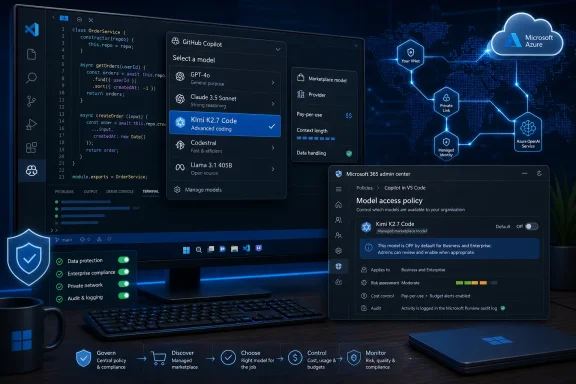
GitHub made Kimi K2.7 Code generally available in GitHub Copilot on July 1, 2026, adding the open-weight coding model to Copilot’s model picker first for Pro, Pro+, and Max users, with Business and Enterprise access planned over the coming weeks. The announcement is easy to read as just another model dropdown entry, but it is more consequential than that. GitHub is turning Copilot from a single assistant into a managed marketplace of model behavior, price, provenance, and risk. For developers and administrators, the model picker is becoming less like a preference menu and more like a policy boundary.
For most of Copilot’s life, the product’s value proposition was deliberately simple: install the extension, authenticate, and let the assistant autocomplete or chat inside the tools developers already use. The model underneath mattered, but it was mostly abstracted away. GitHub sold Copilot as a product experience, not as a tour through the AI supplier chain.
Kimi K2.7 Code changes the emphasis. GitHub says it is the first open-weight model offered as a selectable option in the Copilot model picker, and that status matters because it gives developers a visible alternative to the closed flagship models that have dominated enterprise coding assistants. The pitch is choice, but the subtext is leverage.
The model is hosted by GitHub on Microsoft Azure, which keeps the operational story inside the Microsoft cloud perimeter rather than turning Copilot into a generic bring-your-own-endpoint client. That detail will be reassuring to some buyers and insufficient for others. Either way, it shows GitHub threading a needle: expanding model diversity while keeping deployment, billing, and policy centralized.
The most important change is not that Copilot now supports another model. It is that GitHub is normalizing the idea that developers should choose models by task, cost, and governance posture. Once that habit forms, Copilot becomes less a single AI assistant and more a broker for specialized coding intelligence.
GitHub’s implementation keeps Kimi K2.7 Code firmly inside Copilot’s managed experience. Users are not downloading weights into VS Code, running inference on a workstation, or bypassing GitHub’s service controls. They are selecting a hosted model that GitHub operates on Azure and bills through Copilot’s usage-based model pricing.
That distinction matters for security teams. An open-weight model may be easier to evaluate in theory, but the practical risk surface inside Copilot is shaped by hosting, telemetry, data handling, retention policies, access control, and administrative configuration. A model’s licensing philosophy does not magically answer those questions.
GitHub appears to understand that. The company is leaving Kimi K2.7 Code off by default for Copilot Business and Copilot Enterprise, requiring administrators to enable a specific policy before anyone in the organization can use it. That is not just a cautious rollout tactic; it is an acknowledgement that model provenance has become part of enterprise AI governance.
This is where the practical appeal is obvious. Not every coding task needs the most expensive reasoning model available. Boilerplate generation, test scaffolding, code explanation, simple refactors, and routine command-line assistance may be good fits for cheaper models if latency, accuracy, and context handling are acceptable.
The catch is that lower cost can also create new management headaches. If developers are given more model choices, organizations need clearer rules about which models are appropriate for which repositories, languages, compliance regimes, and data classifications. A cheap model that is fine for a public JavaScript utility may not be acceptable for regulated financial code, proprietary firmware, or security-sensitive infrastructure automation.
GitHub’s decision to gate Business and Enterprise access behind an admin policy is therefore the right default. It lets individual subscribers experiment first while enterprises evaluate whether Kimi K2.7 Code fits their internal security, compliance, and data-governance requirements. In the Copilot era, shadow AI is not just employees pasting code into random websites; it can also be sanctioned tooling configured too casually.
The minimum version is notable: Visual Studio Code 1.127.0 or later. Visual Studio support requires version 17.14.6 or later. JetBrains users need version 1.9.1-251 or later, while GitHub also lists Copilot CLI, GitHub Copilot cloud agent, the GitHub Copilot App, github.com, GitHub Mobile on iOS and Android, Xcode, and Eclipse among the surfaces where the model will be selectable.
For WindowsForum readers, the interesting split is between VS Code and Visual Studio. VS Code gets the cultural spotlight because it is where GitHub can move quickly, but Visual Studio remains the center of gravity for many Windows, .NET, C++, and enterprise line-of-business developers. If Kimi K2.7 Code proves useful in Visual Studio rather than merely available there, it could become part of everyday Windows-native development rather than a curiosity for web developers.
The Copilot CLI angle is just as important. Model choice in a chat pane is one thing; model choice in an agentic terminal workflow is another. When a model can inspect a project, propose commands, and help execute multi-step changes, administrators will care less about the romance of open weights and more about auditability, rollback, and blast radius.
Administrators are being asked to review open-weight models against their own policies before enabling them. That review will be uneven across companies. Some organizations will welcome an open-weight option because it gives them more transparency and potentially better cost control; others will hesitate because a new model adds another vendor-dependent component to an already complicated AI governance stack.
The default-off posture is the most consequential administrative detail in the announcement. It means an enterprise user cannot simply discover Kimi K2.7 Code in the picker unless an administrator has made an explicit decision. That is how AI model rollout should work in serious environments: opt-in, policy-backed, and documented.
Still, default-off is not the same as frictionless governance. Organizations will need to decide who owns the approval process for new Copilot models. If that responsibility is unclear, the model picker can become a recurring argument between developers who want speed and risk teams who want control.
The problem is not that developers cannot be trusted. The problem is that developer tooling has access to extraordinarily sensitive context. A coding assistant may see proprietary source, internal APIs, secrets that should not have been committed, architectural patterns, customer identifiers in test data, and operational scripts that reveal how production systems are maintained.
A model picker turns that context into a routing decision. Which model sees the prompt? Which model sees the repository excerpt? Which model is allowed to power agentic changes? Which model’s output is acceptable for code review, test generation, or security remediation?
GitHub’s managed approach gives administrators a place to enforce these decisions, but it also means Copilot is becoming a control plane for model governance. That is a powerful position. It also makes Copilot settings more important than many organizations currently treat them.
This is the same strategic logic that has guided much of Microsoft’s AI platform work: bring many models into Azure, wrap them in enterprise controls, and sell the management layer as much as the intelligence. GitHub is applying that logic at the developer-tooling layer. The model may be open-weight, but the experience is cloud-managed.
That will not satisfy everyone. Some organizations want local inference for sensitive code. Others want the ability to self-host open-weight models inside their own networks or sovereign environments. GitHub’s announcement does not make Copilot that product.
But for mainstream Copilot customers, Azure hosting is likely part of the reassurance package. It says the model is not an unmanaged external experiment bolted onto the side of Copilot. It is part of the same operational platform GitHub already uses to deliver AI features at scale.
A lower-cost model can win a place in daily use even if it is not the absolute strongest model on hard reasoning tasks. If it is fast, predictable, and good enough for common coding chores, it can become the model developers leave selected for routine work. Premium models then become escalation paths rather than defaults.
That is likely why GitHub is rolling Kimi K2.7 Code into the model picker rather than presenting it as a separate product. The company wants model switching to feel normal. Today a developer might choose a model for cost; tomorrow Copilot may choose automatically based on task, policy, or latency.
The broader implication is that coding assistants are becoming orchestration layers. The assistant’s value will come from knowing when to use a cheaper model, when to use a stronger one, when to invoke tools, when to ask for clarification, and when to stop before making a mess. Kimi K2.7 Code is one piece in that orchestration puzzle.
Those questions are especially important for organizations that already struggle with Copilot policy sprawl. GitHub now spans IDE chat, code completions, CLI workflows, cloud agents, mobile surfaces, and web experiences. A model policy that makes sense in VS Code may not be sufficient for an autonomous cloud agent that can operate on a repository.
There is also a documentation burden. Developers need to know which model they are using and why. If output quality varies across models, teams need norms for code review and testing that do not assume all AI-generated code carries the same risk profile.
This is where Windows shops with mature software delivery practices have an advantage. If they already enforce pull requests, branch protection, dependency scanning, secret scanning, CI tests, and deployment gates, model diversity is manageable. If Copilot output is flowing directly into production with weak review, the model picker is not the problem; it is merely exposing one.
That means Copilot administration should move closer to the same governance process used for identity, endpoint management, developer platforms, and cloud services. Model availability should be reviewed, approved, documented, and revisited. Cost controls should be paired with usage monitoring so that “lower-cost” does not become “unbounded.”
Developers also need room to experiment. If administrators respond to every new model by freezing the picker permanently, teams will route around official tools. The better path is controlled enablement: pilot groups, measured usage, documented findings, and clear rules for sensitive repositories.
The arrival of Kimi K2.7 Code gives organizations a relatively contained way to practice that muscle. It is a single model, off by default for enterprise plans, exposed through familiar Copilot surfaces. That makes it a useful test case for the much larger wave of model choice that is almost certainly coming.
 GitHub Turns the Model Picker Into a Competitive Surface
For most of Copilot’s life, the product’s value proposition was deliberately simple: install the extension, authenticate, and let the assistant autocomplete or chat inside the tools developers already use. The model underneath mattered, but it was mostly abstracted away. GitHub sold Copilot as a product experience, not as a tour through the AI supplier chain.Kimi K2.7 Code changes the emphasis. GitHub says it is the first open-weight model offered as a selectable option in the Copilot model picker, and that status matters because it gives developers a visible alternative to the closed flagship models that have dominated enterprise coding assistants. The pitch is choice, but the subtext is leverage.
The model is hosted by GitHub on Microsoft Azure, which keeps the operational story inside the Microsoft cloud perimeter rather than turning Copilot into a generic bring-your-own-endpoint client. That detail will be reassuring to some buyers and insufficient for others. Either way, it shows GitHub threading a needle: expanding model diversity while keeping deployment, billing, and policy centralized.
The most important change is not that Copilot now supports another model. It is that GitHub is normalizing the idea that developers should choose models by task, cost, and governance posture. Once that habit forms, Copilot becomes less a single AI assistant and more a broker for specialized coding intelligence.
Open-Weight Does Not Mean Unmanaged
The phrase open-weight can do a lot of work in a press release, and not all of it is obvious to the average Visual Studio Code user. It usually means model weights are available under some form of open or source-available terms, allowing inspection, adaptation, or independent deployment depending on the license. It does not automatically mean the model is open source in the way developers understand an Apache-licensed library.GitHub’s implementation keeps Kimi K2.7 Code firmly inside Copilot’s managed experience. Users are not downloading weights into VS Code, running inference on a workstation, or bypassing GitHub’s service controls. They are selecting a hosted model that GitHub operates on Azure and bills through Copilot’s usage-based model pricing.
That distinction matters for security teams. An open-weight model may be easier to evaluate in theory, but the practical risk surface inside Copilot is shaped by hosting, telemetry, data handling, retention policies, access control, and administrative configuration. A model’s licensing philosophy does not magically answer those questions.
GitHub appears to understand that. The company is leaving Kimi K2.7 Code off by default for Copilot Business and Copilot Enterprise, requiring administrators to enable a specific policy before anyone in the organization can use it. That is not just a cautious rollout tactic; it is an acknowledgement that model provenance has become part of enterprise AI governance.
The Cheap Model Is Also a Governance Test
GitHub describes Kimi K2.7 Code as a lower-cost option for coding workflows, billed at provider list pricing under usage-based billing. That phrasing is carefully chosen. It invites developers to think about model selection not as a quality ladder, but as a cost-performance trade.This is where the practical appeal is obvious. Not every coding task needs the most expensive reasoning model available. Boilerplate generation, test scaffolding, code explanation, simple refactors, and routine command-line assistance may be good fits for cheaper models if latency, accuracy, and context handling are acceptable.
The catch is that lower cost can also create new management headaches. If developers are given more model choices, organizations need clearer rules about which models are appropriate for which repositories, languages, compliance regimes, and data classifications. A cheap model that is fine for a public JavaScript utility may not be acceptable for regulated financial code, proprietary firmware, or security-sensitive infrastructure automation.
GitHub’s decision to gate Business and Enterprise access behind an admin policy is therefore the right default. It lets individual subscribers experiment first while enterprises evaluate whether Kimi K2.7 Code fits their internal security, compliance, and data-governance requirements. In the Copilot era, shadow AI is not just employees pasting code into random websites; it can also be sanctioned tooling configured too casually.
Windows Developers Get the First Practical Signal in VS Code
The initial rollout starts with Copilot Pro, Pro+, and Max plans, with Visual Studio Code named as the place users will be able to select the model in the picker. That order is unsurprising. VS Code remains the fastest-moving Copilot surface and the most natural place to test developer appetite for model switching.The minimum version is notable: Visual Studio Code 1.127.0 or later. Visual Studio support requires version 17.14.6 or later. JetBrains users need version 1.9.1-251 or later, while GitHub also lists Copilot CLI, GitHub Copilot cloud agent, the GitHub Copilot App, github.com, GitHub Mobile on iOS and Android, Xcode, and Eclipse among the surfaces where the model will be selectable.
For WindowsForum readers, the interesting split is between VS Code and Visual Studio. VS Code gets the cultural spotlight because it is where GitHub can move quickly, but Visual Studio remains the center of gravity for many Windows, .NET, C++, and enterprise line-of-business developers. If Kimi K2.7 Code proves useful in Visual Studio rather than merely available there, it could become part of everyday Windows-native development rather than a curiosity for web developers.
The Copilot CLI angle is just as important. Model choice in a chat pane is one thing; model choice in an agentic terminal workflow is another. When a model can inspect a project, propose commands, and help execute multi-step changes, administrators will care less about the romance of open weights and more about auditability, rollback, and blast radius.
The Enterprise Rollout Is Deliberately Slower
GitHub says Business, Enterprise, and additional surfaces will expand over the coming weeks. That staggered approach is not merely a capacity-management detail. It is a recognition that enterprise Copilot deployments now involve procurement, legal, security, platform engineering, and developer-experience teams.Administrators are being asked to review open-weight models against their own policies before enabling them. That review will be uneven across companies. Some organizations will welcome an open-weight option because it gives them more transparency and potentially better cost control; others will hesitate because a new model adds another vendor-dependent component to an already complicated AI governance stack.
The default-off posture is the most consequential administrative detail in the announcement. It means an enterprise user cannot simply discover Kimi K2.7 Code in the picker unless an administrator has made an explicit decision. That is how AI model rollout should work in serious environments: opt-in, policy-backed, and documented.
Still, default-off is not the same as frictionless governance. Organizations will need to decide who owns the approval process for new Copilot models. If that responsibility is unclear, the model picker can become a recurring argument between developers who want speed and risk teams who want control.
Model Choice Is Becoming the New IDE Extension Problem
Veteran Windows administrators have seen this pattern before. Browser extensions, Visual Studio extensions, VS Code extensions, package feeds, PowerShell modules, and container images all began as developer convenience layers before turning into governance problems. AI models are following the same path, only faster.The problem is not that developers cannot be trusted. The problem is that developer tooling has access to extraordinarily sensitive context. A coding assistant may see proprietary source, internal APIs, secrets that should not have been committed, architectural patterns, customer identifiers in test data, and operational scripts that reveal how production systems are maintained.
A model picker turns that context into a routing decision. Which model sees the prompt? Which model sees the repository excerpt? Which model is allowed to power agentic changes? Which model’s output is acceptable for code review, test generation, or security remediation?
GitHub’s managed approach gives administrators a place to enforce these decisions, but it also means Copilot is becoming a control plane for model governance. That is a powerful position. It also makes Copilot settings more important than many organizations currently treat them.
The Azure Hosting Detail Is Doing Political Work
GitHub’s note that Kimi K2.7 Code is hosted by GitHub on Microsoft Azure is short, but it carries a lot of enterprise meaning. Microsoft wants customers to see Copilot model diversity as compatible with Microsoft cloud governance. GitHub wants developers to see model choice without worrying that every option requires a new account, endpoint, or vendor contract.This is the same strategic logic that has guided much of Microsoft’s AI platform work: bring many models into Azure, wrap them in enterprise controls, and sell the management layer as much as the intelligence. GitHub is applying that logic at the developer-tooling layer. The model may be open-weight, but the experience is cloud-managed.
That will not satisfy everyone. Some organizations want local inference for sensitive code. Others want the ability to self-host open-weight models inside their own networks or sovereign environments. GitHub’s announcement does not make Copilot that product.
But for mainstream Copilot customers, Azure hosting is likely part of the reassurance package. It says the model is not an unmanaged external experiment bolted onto the side of Copilot. It is part of the same operational platform GitHub already uses to deliver AI features at scale.
The Real Competition Is Over Workflow, Not Benchmarks
There will be a temptation to reduce Kimi K2.7 Code to benchmark comparisons against other coding models. That is useful up to a point, but it misses where the market is moving. Developers do not experience models as leaderboard entries; they experience them as latency, code quality, context retention, tool use, formatting discipline, and the number of times they have to say “no, not like that.”A lower-cost model can win a place in daily use even if it is not the absolute strongest model on hard reasoning tasks. If it is fast, predictable, and good enough for common coding chores, it can become the model developers leave selected for routine work. Premium models then become escalation paths rather than defaults.
That is likely why GitHub is rolling Kimi K2.7 Code into the model picker rather than presenting it as a separate product. The company wants model switching to feel normal. Today a developer might choose a model for cost; tomorrow Copilot may choose automatically based on task, policy, or latency.
The broader implication is that coding assistants are becoming orchestration layers. The assistant’s value will come from knowing when to use a cheaper model, when to use a stronger one, when to invoke tools, when to ask for clarification, and when to stop before making a mess. Kimi K2.7 Code is one piece in that orchestration puzzle.
The Open-Weight Label Will Force Better Buyer Questions
The best thing about Kimi K2.7 Code’s arrival may be that it forces more precise conversations. “Is this model open?” is not enough. Buyers should ask what the license permits, how the hosted service handles prompts, whether customer code is used for training, how retention works, what audit logs are available, and whether administrators can restrict usage by organization, team, repository, or surface.Those questions are especially important for organizations that already struggle with Copilot policy sprawl. GitHub now spans IDE chat, code completions, CLI workflows, cloud agents, mobile surfaces, and web experiences. A model policy that makes sense in VS Code may not be sufficient for an autonomous cloud agent that can operate on a repository.
There is also a documentation burden. Developers need to know which model they are using and why. If output quality varies across models, teams need norms for code review and testing that do not assume all AI-generated code carries the same risk profile.
This is where Windows shops with mature software delivery practices have an advantage. If they already enforce pull requests, branch protection, dependency scanning, secret scanning, CI tests, and deployment gates, model diversity is manageable. If Copilot output is flowing directly into production with weak review, the model picker is not the problem; it is merely exposing one.
The Model Picker Now Belongs in the Change Advisory Meeting
For IT pros, the immediate action is not to panic about Kimi K2.7 Code. It is to treat the arrival of selectable open-weight models as a change in the Copilot operating model. The relevant question is no longer “Do we have Copilot?” but “Which Copilot models are allowed, where, for whom, and under what evidence?”That means Copilot administration should move closer to the same governance process used for identity, endpoint management, developer platforms, and cloud services. Model availability should be reviewed, approved, documented, and revisited. Cost controls should be paired with usage monitoring so that “lower-cost” does not become “unbounded.”
Developers also need room to experiment. If administrators respond to every new model by freezing the picker permanently, teams will route around official tools. The better path is controlled enablement: pilot groups, measured usage, documented findings, and clear rules for sensitive repositories.
The arrival of Kimi K2.7 Code gives organizations a relatively contained way to practice that muscle. It is a single model, off by default for enterprise plans, exposed through familiar Copilot surfaces. That makes it a useful test case for the much larger wave of model choice that is almost certainly coming.
What Kimi K2.7 Code Quietly Changes for Copilot Shops
The concrete news is simple, but the operational consequences are broader. GitHub is making model selection a first-class part of Copilot, and administrators should assume this will not be the last new model to arrive behind a policy toggle.- GitHub has added Kimi K2.7 Code as the first open-weight model selectable in the Copilot model picker.
- The rollout begins with Copilot Pro, Pro+, and Max users, while Business and Enterprise support is expected to expand over the coming weeks.
- Copilot Business and Enterprise administrators must explicitly enable the Kimi K2.7 Code policy before users in their organizations can select it.
- The model is hosted by GitHub on Microsoft Azure and billed at provider list pricing under usage-based billing.
- Supported surfaces include Visual Studio Code 1.127.0 or later, Visual Studio 17.14.6 or later, Copilot CLI, GitHub’s agent experiences, JetBrains, Xcode, Eclipse, GitHub Mobile, and github.com.
- Security and platform teams should evaluate the model as part of broader AI governance rather than treating it as a harmless editor preference.
References
- Primary source: The GitHub Blog
Published: Wed, 01 Jul 2026 19:00:21 GMT
Loading…
github.blog