

NVIDIA has reportedly canceled or indefinitely delayed a 9 GB GeForce RTX 5050 desktop graphics card after bringing the 12 GB GeForce RTX 3060 back into the budget GPU channel in June 2026, according to leaker MEGAsizeGPU and subsequent industry reporting. The move is not official, and NVIDIA has not announced a 9 GB RTX 5050 in the first place, which gives the company an easy escape hatch. But the logic is brutally plausible: in the low-end GPU market, memory capacity has become a marketing weapon, a bill-of-materials problem, and a product-line trap all at once.
The interesting part is not that a rumored SKU may have vanished. Rumored GPUs vanish constantly. The interesting part is that NVIDIA appears willing to let a five-year-old Ampere card do a job that, on paper, should belong to Blackwell.
The GeForce RTX 5050 was supposed to be the floor of the Blackwell generation: the card for entry-level gaming PCs, cheap prebuilts, compact desktops, esports boxes, and buyers who know they want NVIDIA features but do not want NVIDIA flagship pricing. That category used to be defined by shader count, power consumption, and whether a card could credibly run current games at 1080p.
In 2026, it is increasingly defined by VRAM.
That is awkward for NVIDIA because the company has spent several generations threading a narrow needle at the bottom of the stack. It wants entry-level GeForce cards to look modern enough to justify their place in the lineup, but not generous enough to cannibalize higher-margin products. An 8 GB card is cheaper to build, easier to position, and less threatening to the next model up. It is also increasingly difficult to defend to PC gamers watching modern games spill beyond 8 GB at higher texture settings.
The rumored RTX 5050 9 GB was a strange compromise. It reportedly used 3 GB GDDR7 memory chips on a 96-bit bus, yielding 9 GB of VRAM rather than the more conventional 8 GB arrangement. That would not have made it a dream card, but it would have given NVIDIA a headline improvement: more memory, newer memory, and enough novelty to argue that the entry tier had moved forward.
Then the RTX 3060 12 GB walked back into the room.
But it has one devastatingly simple feature: 12 GB of VRAM.
For budget gamers, that number does more work than NVIDIA probably wants to admit. A cheap RTX 3060 12 GB may not beat a newer low-end Blackwell card in every benchmark, especially when newer frame-generation or efficiency features enter the conversation. But it feels safer. It looks less compromised on a spec sheet. It answers the most common complaint about low-end GPUs before the argument even begins.
That matters because buyers in this segment are often not upgrading every year. They are stretching a build, replacing an old GTX card, buying a first gaming PC, or choosing from whatever prebuilts happen to be discounted. A 12 GB label on the box gives them permission to believe the card will age better, even if the full performance story is messier.
The reappearance of fresh RTX 3060 12 GB stock, reportedly including new production runs and retailer listings in Europe and elsewhere, therefore changes the RTX 5050 calculation. If NVIDIA can fill the affordable-VRAM slot with a mature Ampere part, it can avoid spending Blackwell silicon and GDDR7 capacity on a product whose margins are likely thin.
That kind of configuration is elegant in the way only GPU segmentation can be elegant: technically defensible, commercially motivated, and guaranteed to annoy enthusiasts.
Nine gigabytes is better than eight, but it is not twelve. A 96-bit bus is cheaper and simpler than wider memory interfaces, but it is also the sort of number that triggers instant suspicion among PC hardware buyers. The same customers who have spent years complaining about 8 GB cards were never likely to greet 9 GB as a heroic concession. They were going to ask why the card was not 12 GB.
That is the trap. If NVIDIA ships an RTX 5050 9 GB, it admits 8 GB is beginning to look weak. But it still does not satisfy the buyers who have made VRAM capacity a litmus test. If NVIDIA ships a revived RTX 3060 12 GB instead, it can say very little and let the old card’s memory spec do the selling.
The older card may be less elegant, but it is easier to explain.
That does not mean NVIDIA is abandoning gamers. It means the opportunity cost of every chip has changed.
A low-end Blackwell GPU sold into a bargain desktop card is not competing only with AMD or Intel at retail. It is competing internally with higher-margin uses of silicon, board capacity, memory supply, and partner attention. If a mature Ampere product can hold a price band without consuming newer resources, that is an attractive option.
The RTX 3060 12 GB also benefits from maturity. Board partners know how to build it. Drivers are stable. Yields are understood. The platform has years of validation behind it. For OEMs and system integrators, boring can be a virtue.
The result is a strange but rational market: a new generation exists, but an old product may be the better commercial tool for a specific tier. That is not technological progress in the romantic sense. It is inventory logic.
Gamers remember cards that had enough compute but not enough memory. They remember texture pop-in, sudden frame-time spikes, and settings menus that quietly punish smaller frame buffers. They remember being told that a capacity was enough, only to watch console ports and high-resolution asset packs shift the goalposts.
That is why the RTX 3060 12 GB remains unusually resilient. It was never a perfect card, but its memory configuration gave it a kind of long-tail credibility. In a market full of narrow buses and carefully rationed VRAM, the 3060’s 12 GB looks almost generous by accident.
For NVIDIA, that creates a messaging problem. A newer RTX 5050 8 GB can be more efficient and feature-rich than the old card, yet still lose the argument in a retailer comparison table. A 9 GB revision helps, but only slightly. The revived RTX 3060 simply bypasses the debate.
Those things are not trivial. NVIDIA has spent years turning GeForce from a rasterization product into a software-and-ecosystem product. DLSS, Reflex, Broadcast, RTX video features, CUDA compatibility, creator acceleration, and AI-adjacent workflows are part of the pitch.
But the lower the price goes, the more brutally practical the buyer becomes. If the choice is between a newer 8 GB or 9 GB card and an older 12 GB card at a similar price, many budget shoppers will ask which one lets them keep textures higher and worry less. They may not model the whole performance stack. They may not care about every feature generation. They will see 12 GB.
That is especially true in prebuilts, where GPU model names and VRAM capacity are often the only specs casual buyers recognize. A system advertised with an RTX 3060 12 GB can look more reassuring than one with an RTX 5050 8 GB, even if the newer card is more current. Marketing does not always reward nuance.
The problem is that NVIDIA’s ecosystem advantage remains stubbornly real. Driver reputation, game support, creator software compatibility, CUDA, and sheer brand familiarity still matter. Many buyers who might complain about NVIDIA’s VRAM choices will still default to GeForce when money is actually on the table.
That is why the RTX 3060 is such a useful fallback. It lets NVIDIA concede just enough on memory without conceding the platform. It gives budget buyers the GeForce badge and the VRAM number they want, while keeping newer Blackwell products positioned elsewhere.
AMD and Intel can still exploit the moment, but they need more than a spec-sheet win. They need cards in stock, at the right price, with convincing performance, and with enough trust that buyers will cross the aisle. That is a taller order than enthusiasts sometimes admit.
A 12 GB RTX 3060 in 2026 is not suddenly a high-end card. It will not transform demanding ray-traced games into effortless experiences. But it may allow budget systems to avoid the ugliest failure mode of smaller cards: running out of memory before the GPU core itself feels exhausted.
That is particularly relevant for players at 1080p who want high textures, for modded games that consume VRAM aggressively, and for users who keep background applications open while gaming. Windows itself is not the villain here, but the modern PC is a multitasking environment. Games, launchers, overlays, browsers, streaming tools, and capture software all compete for resources.
The revived RTX 3060 does not solve every problem. It does, however, align with how many real people use PCs: imperfectly, messily, and without wanting to tune every setting like a benchmark reviewer.
What has changed is the margin for subtlety. When games visibly punish insufficient VRAM, the old segmentation tricks become harder to hide. A buyer may not understand memory bandwidth, cache behavior, shader occupancy, or compression techniques. But they understand that 8 GB is less than 12 GB, and they increasingly suspect that less means risk.
The rumored 9 GB RTX 5050 sits right at that uncomfortable boundary. It looks like a workaround designed to preserve segmentation while acknowledging market pressure. That does not make it bad. It makes it revealing.
If the card is truly canceled or permanently delayed, the decision suggests NVIDIA decided the compromise was not worth the confusion. A 9 GB Blackwell card would invite comparison with the 12 GB RTX 3060 and might still lose the emotional argument. An old 12 GB card keeps the lineup untidy, but it keeps the sales pitch simple.
A revived RTX 3060 12 GB is familiar territory. Existing cooler designs, PCB knowledge, validation experience, and retailer expectations all reduce friction. If demand exists, partners can move units without explaining why a new RTX 5050 has 9 GB on a 96-bit bus and how that compares to every other card in the cabinet.
The board partner angle matters because the bottom of the GPU market is brutally sensitive to small cost changes. A few dollars in memory, cooling, PCB complexity, or warranty exposure can change whether a card makes sense. Mature designs are not glamorous, but they can be profitable and predictable.
That predictability may be exactly what NVIDIA wants while memory supply remains tight and demand for more profitable products stays high.
The RTX 3060 12 GB has become less a relic than a known quantity. It is the card people understand, benchmark databases are full of it, used-market pricing has normalized around it, and forum advice has years of accumulated experience behind it. In a confusing market, familiarity is a feature.
That does not mean NVIDIA deserves applause for leaning on Ampere in 2026. A healthier GPU market would offer genuinely modern low-end cards with generous memory, strong efficiency, and prices that do not feel engineered to push buyers upward. But the market we have is not that tidy.
The likely cancellation of the RTX 5050 9 GB is therefore not just a leak about one missing SKU. It is a signal that NVIDIA believes the low-end buyer’s memory anxiety can be managed with old silicon better than with a compromised new design.
But the broader pattern is now hard to ignore.
The interesting part is not that a rumored SKU may have vanished. Rumored GPUs vanish constantly. The interesting part is that NVIDIA appears willing to let a five-year-old Ampere card do a job that, on paper, should belong to Blackwell.
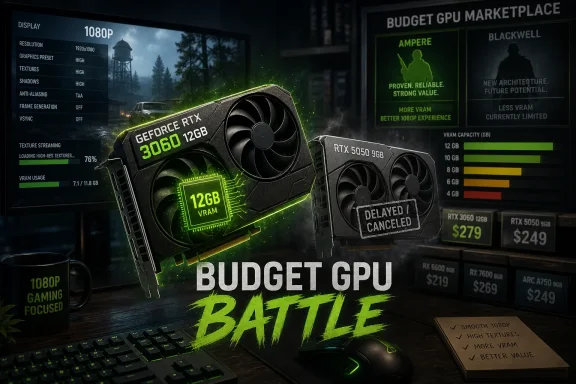 NVIDIA’s Budget Problem Is Now a Memory Problem
The GeForce RTX 5050 was supposed to be the floor of the Blackwell generation: the card for entry-level gaming PCs, cheap prebuilts, compact desktops, esports boxes, and buyers who know they want NVIDIA features but do not want NVIDIA flagship pricing. That category used to be defined by shader count, power consumption, and whether a card could credibly run current games at 1080p.In 2026, it is increasingly defined by VRAM.
That is awkward for NVIDIA because the company has spent several generations threading a narrow needle at the bottom of the stack. It wants entry-level GeForce cards to look modern enough to justify their place in the lineup, but not generous enough to cannibalize higher-margin products. An 8 GB card is cheaper to build, easier to position, and less threatening to the next model up. It is also increasingly difficult to defend to PC gamers watching modern games spill beyond 8 GB at higher texture settings.
The rumored RTX 5050 9 GB was a strange compromise. It reportedly used 3 GB GDDR7 memory chips on a 96-bit bus, yielding 9 GB of VRAM rather than the more conventional 8 GB arrangement. That would not have made it a dream card, but it would have given NVIDIA a headline improvement: more memory, newer memory, and enough novelty to argue that the entry tier had moved forward.
Then the RTX 3060 12 GB walked back into the room.
The RTX 3060 Refuses to Leave Because It Solves a Simple Problem
The RTX 3060 12 GB is not a modern GPU by architectural standards. It is Ampere, launched in 2021, manufactured on Samsung’s 8 nm-class process, and missing the newer hardware and software advantages NVIDIA has layered into Ada and Blackwell. It is not the card you would design from scratch for 2026.But it has one devastatingly simple feature: 12 GB of VRAM.
For budget gamers, that number does more work than NVIDIA probably wants to admit. A cheap RTX 3060 12 GB may not beat a newer low-end Blackwell card in every benchmark, especially when newer frame-generation or efficiency features enter the conversation. But it feels safer. It looks less compromised on a spec sheet. It answers the most common complaint about low-end GPUs before the argument even begins.
That matters because buyers in this segment are often not upgrading every year. They are stretching a build, replacing an old GTX card, buying a first gaming PC, or choosing from whatever prebuilts happen to be discounted. A 12 GB label on the box gives them permission to believe the card will age better, even if the full performance story is messier.
The reappearance of fresh RTX 3060 12 GB stock, reportedly including new production runs and retailer listings in Europe and elsewhere, therefore changes the RTX 5050 calculation. If NVIDIA can fill the affordable-VRAM slot with a mature Ampere part, it can avoid spending Blackwell silicon and GDDR7 capacity on a product whose margins are likely thin.
The 9 GB RTX 5050 Was Clever, but Not Necessarily Attractive
The rumored 9 GB RTX 5050 was an engineering answer to a business problem. Three 3 GB GDDR7 chips on a 96-bit interface would give NVIDIA a way to advertise more memory while potentially using fewer memory packages than a conventional four-chip layout. Faster GDDR7 could also offset some of the bandwidth loss from a narrower bus.That kind of configuration is elegant in the way only GPU segmentation can be elegant: technically defensible, commercially motivated, and guaranteed to annoy enthusiasts.
Nine gigabytes is better than eight, but it is not twelve. A 96-bit bus is cheaper and simpler than wider memory interfaces, but it is also the sort of number that triggers instant suspicion among PC hardware buyers. The same customers who have spent years complaining about 8 GB cards were never likely to greet 9 GB as a heroic concession. They were going to ask why the card was not 12 GB.
That is the trap. If NVIDIA ships an RTX 5050 9 GB, it admits 8 GB is beginning to look weak. But it still does not satisfy the buyers who have made VRAM capacity a litmus test. If NVIDIA ships a revived RTX 3060 12 GB instead, it can say very little and let the old card’s memory spec do the selling.
The older card may be less elegant, but it is easier to explain.
Blackwell Silicon Is Too Valuable to Waste on the Bottom Shelf
NVIDIA’s incentives in 2026 are not hard to read. The company is still operating in a world where advanced packaging, memory supply, AI demand, and wafer allocation shape what gaming products actually make sense. Even when the GeForce business remains important, the company’s most profitable opportunities are not found in low-end desktop graphics cards.That does not mean NVIDIA is abandoning gamers. It means the opportunity cost of every chip has changed.
A low-end Blackwell GPU sold into a bargain desktop card is not competing only with AMD or Intel at retail. It is competing internally with higher-margin uses of silicon, board capacity, memory supply, and partner attention. If a mature Ampere product can hold a price band without consuming newer resources, that is an attractive option.
The RTX 3060 12 GB also benefits from maturity. Board partners know how to build it. Drivers are stable. Yields are understood. The platform has years of validation behind it. For OEMs and system integrators, boring can be a virtue.
The result is a strange but rational market: a new generation exists, but an old product may be the better commercial tool for a specific tier. That is not technological progress in the romantic sense. It is inventory logic.
The VRAM Debate Has Become a Proxy War Over Trust
The most revealing part of this story is how much emotional weight now sits on memory capacity. VRAM is not the only determinant of gaming performance, and plenty of games still run well on 8 GB at 1080p with sensible settings. But the market has learned to distrust low-end GPU compromises because those compromises tend to age badly.Gamers remember cards that had enough compute but not enough memory. They remember texture pop-in, sudden frame-time spikes, and settings menus that quietly punish smaller frame buffers. They remember being told that a capacity was enough, only to watch console ports and high-resolution asset packs shift the goalposts.
That is why the RTX 3060 12 GB remains unusually resilient. It was never a perfect card, but its memory configuration gave it a kind of long-tail credibility. In a market full of narrow buses and carefully rationed VRAM, the 3060’s 12 GB looks almost generous by accident.
For NVIDIA, that creates a messaging problem. A newer RTX 5050 8 GB can be more efficient and feature-rich than the old card, yet still lose the argument in a retailer comparison table. A 9 GB revision helps, but only slightly. The revived RTX 3060 simply bypasses the debate.
Modern Features Still Matter, but They Do Not Always Win at $250
There is a real cost to choosing Ampere over Blackwell. Buyers lose access to the latest generation of NVIDIA’s feature stack, and that can matter. Newer GPUs typically bring better media engines, improved efficiency, stronger AI acceleration, newer ray-tracing hardware, and more advanced frame-generation capabilities.Those things are not trivial. NVIDIA has spent years turning GeForce from a rasterization product into a software-and-ecosystem product. DLSS, Reflex, Broadcast, RTX video features, CUDA compatibility, creator acceleration, and AI-adjacent workflows are part of the pitch.
But the lower the price goes, the more brutally practical the buyer becomes. If the choice is between a newer 8 GB or 9 GB card and an older 12 GB card at a similar price, many budget shoppers will ask which one lets them keep textures higher and worry less. They may not model the whole performance stack. They may not care about every feature generation. They will see 12 GB.
That is especially true in prebuilts, where GPU model names and VRAM capacity are often the only specs casual buyers recognize. A system advertised with an RTX 3060 12 GB can look more reassuring than one with an RTX 5050 8 GB, even if the newer card is more current. Marketing does not always reward nuance.
AMD and Intel Get an Opening, but Not a Free One
This should be an opening for NVIDIA’s rivals. AMD has often been more willing to put larger memory pools on midrange cards, and Intel has been aggressive at times in trying to win attention with value-oriented Arc products. If NVIDIA is relying on a revived RTX 3060 to patch the low-end stack, competitors should be able to argue that GeForce buyers are being sold yesterday’s hardware.The problem is that NVIDIA’s ecosystem advantage remains stubbornly real. Driver reputation, game support, creator software compatibility, CUDA, and sheer brand familiarity still matter. Many buyers who might complain about NVIDIA’s VRAM choices will still default to GeForce when money is actually on the table.
That is why the RTX 3060 is such a useful fallback. It lets NVIDIA concede just enough on memory without conceding the platform. It gives budget buyers the GeForce badge and the VRAM number they want, while keeping newer Blackwell products positioned elsewhere.
AMD and Intel can still exploit the moment, but they need more than a spec-sheet win. They need cards in stock, at the right price, with convincing performance, and with enough trust that buyers will cross the aisle. That is a taller order than enthusiasts sometimes admit.
Windows Gamers Will Feel This in the Settings Menu
For Windows users, the practical impact is not abstract. The GPU market’s memory squeeze shows up in game settings, driver panels, capture workflows, and whether a system feels stable under modern workloads. It also affects how long a modest gaming PC remains comfortable before every new release becomes a negotiation.A 12 GB RTX 3060 in 2026 is not suddenly a high-end card. It will not transform demanding ray-traced games into effortless experiences. But it may allow budget systems to avoid the ugliest failure mode of smaller cards: running out of memory before the GPU core itself feels exhausted.
That is particularly relevant for players at 1080p who want high textures, for modded games that consume VRAM aggressively, and for users who keep background applications open while gaming. Windows itself is not the villain here, but the modern PC is a multitasking environment. Games, launchers, overlays, browsers, streaming tools, and capture software all compete for resources.
The revived RTX 3060 does not solve every problem. It does, however, align with how many real people use PCs: imperfectly, messily, and without wanting to tune every setting like a benchmark reviewer.
The 5050 Rumor Shows How Fragile GPU Segmentation Has Become
NVIDIA’s product stack has always depended on careful separation. A little less memory here, a narrower bus there, fewer cores in the next tier down. Enthusiasts complain, but segmentation is the business model.What has changed is the margin for subtlety. When games visibly punish insufficient VRAM, the old segmentation tricks become harder to hide. A buyer may not understand memory bandwidth, cache behavior, shader occupancy, or compression techniques. But they understand that 8 GB is less than 12 GB, and they increasingly suspect that less means risk.
The rumored 9 GB RTX 5050 sits right at that uncomfortable boundary. It looks like a workaround designed to preserve segmentation while acknowledging market pressure. That does not make it bad. It makes it revealing.
If the card is truly canceled or permanently delayed, the decision suggests NVIDIA decided the compromise was not worth the confusion. A 9 GB Blackwell card would invite comparison with the 12 GB RTX 3060 and might still lose the emotional argument. An old 12 GB card keeps the lineup untidy, but it keeps the sales pitch simple.
Board Partners May Prefer the Boring Card Too
Add-in board partners are often the forgotten characters in these stories. They have to build, price, market, and support whatever GPU mix NVIDIA sends their way. A low-end new-generation card with unusual memory configuration is not automatically a gift.A revived RTX 3060 12 GB is familiar territory. Existing cooler designs, PCB knowledge, validation experience, and retailer expectations all reduce friction. If demand exists, partners can move units without explaining why a new RTX 5050 has 9 GB on a 96-bit bus and how that compares to every other card in the cabinet.
The board partner angle matters because the bottom of the GPU market is brutally sensitive to small cost changes. A few dollars in memory, cooling, PCB complexity, or warranty exposure can change whether a card makes sense. Mature designs are not glamorous, but they can be profitable and predictable.
That predictability may be exactly what NVIDIA wants while memory supply remains tight and demand for more profitable products stays high.
The GeForce Brand Is Strong Enough to Sell the Past as a Stopgap
There is an irony here that should not be missed. NVIDIA’s brand is so strong that it can plausibly reinsert an old card into the market and have buyers treat it not as a failure of progress, but as a pragmatic answer to a bad price environment. That is a luxury few hardware companies enjoy.The RTX 3060 12 GB has become less a relic than a known quantity. It is the card people understand, benchmark databases are full of it, used-market pricing has normalized around it, and forum advice has years of accumulated experience behind it. In a confusing market, familiarity is a feature.
That does not mean NVIDIA deserves applause for leaning on Ampere in 2026. A healthier GPU market would offer genuinely modern low-end cards with generous memory, strong efficiency, and prices that do not feel engineered to push buyers upward. But the market we have is not that tidy.
The likely cancellation of the RTX 5050 9 GB is therefore not just a leak about one missing SKU. It is a signal that NVIDIA believes the low-end buyer’s memory anxiety can be managed with old silicon better than with a compromised new design.
The Card NVIDIA Did Not Launch Says Plenty About the One It Did Revive
The lesson for buyers is not that the RTX 3060 12 GB is automatically the best budget GPU in 2026. Price still decides everything. So do local availability, power requirements, case size, warranty, and the games or workloads a user actually cares about.But the broader pattern is now hard to ignore.
- NVIDIA has reportedly shelved or indefinitely delayed the rumored RTX 5050 9 GB because the revived RTX 3060 12 GB covers the same budget-VRAM niche more cleanly.
- The rumored 9 GB RTX 5050 would have improved on 8 GB models, but it still would have looked awkward next to a cheaper or similarly priced 12 GB card.
- The RTX 3060 12 GB remains attractive because VRAM capacity has become a trust signal for budget gamers, even when the underlying architecture is old.
- Blackwell silicon and GDDR7 memory are more valuable when used in products with stronger margins, making Ampere a rational stopgap for the low end.
- Buyers should compare real prices and benchmarks rather than assuming either the newer model or the higher-VRAM model is automatically superior.
- The episode shows that the entry-level GPU market is no longer constrained only by performance; it is constrained by memory economics, supply priorities, and consumer skepticism.
References
- Primary source: Mezha
Published: 2026-07-01T16:00:32.385838
Loading…
mezha.ua - Related coverage: techradar.com
Loading…
www.techradar.com - Related coverage: tomshardware.com
Loading…
www.tomshardware.com - Related coverage: tweaktown.com
Loading…
www.tweaktown.com - Related coverage: igorslab.de
Loading…
www.igorslab.de - Related coverage: notebookcheck.net
Loading…
www.notebookcheck.net