

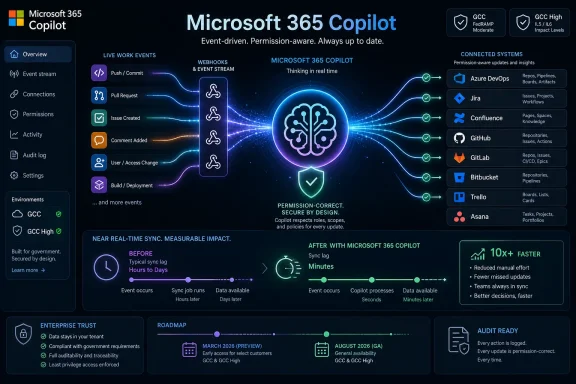
Microsoft plans to improve Microsoft 365 Copilot connector freshness for Azure DevOps, Jira Cloud, Confluence Cloud, Trello, Asana, Bitbucket, GitHub, and GitLab by using webhook-led update notifications, with preview listed for March 2026 and general availability for August 2026 in GCC and GCC High. The change sounds narrow, but it cuts to one of Copilot’s most important enterprise weaknesses: an assistant that reasons over stale work data is not really an assistant. Microsoft is not merely adding another integration checkbox; it is trying to make Copilot’s memory behave more like the systems where work actually happens. For IT, that makes this roadmap item less about convenience and more about trust.
The promise of Microsoft 365 Copilot has always depended on a deceptively simple assumption: the information Copilot sees is close enough to reality to be useful. That assumption breaks quickly in software teams, project offices, security groups, and operations departments, where a ticket can move from open to resolved, a pull request can change state, or a Confluence page can be rewritten while someone is still composing a status update.
Today’s connector model is powerful but inherently bounded by synchronization. A synced connector brings external content into Microsoft Graph, indexes it, applies permissions, and makes it discoverable to Microsoft Search and Copilot. That architecture is sensible for enterprise scale, but every crawl-based system has a freshness problem because it must repeatedly ask, in effect, “Has anything changed yet?”
Webhook-led notifications reverse that posture. Instead of relying only on scheduled checks, supported source systems can notify Microsoft’s connector pipeline when something changes. The practical result should be more frequent updates, shorter windows of stale answers, and less dependence on manual recrawls or conservative sync schedules.
That matters because Copilot is increasingly being positioned not as a fancy search box but as an interface to work. If users ask it what shipped, which bugs are blocking release, or what changed in a project plan, freshness becomes the difference between acceleration and misinformation.
That makes them a more difficult class of content than a static document library. A SharePoint file may change occasionally; a Jira issue can change dozens of times across status, assignee, comments, labels, links, and attachments. A GitHub repository is not simply a folder of code but a living graph of commits, issues, pull requests, discussions, and automation signals.
Microsoft’s roadmap language points to “more frequent sync of updates,” not full real-time parity. That distinction is important. Webhooks can tell the connector service that change has occurred, but Microsoft still has to ingest, process, index, secure, and expose that change in a way Copilot can use. The feature is better understood as an event-driven freshness boost rather than a guarantee that Copilot will always mirror the source system second by second.
Even so, the selected connectors hit the sweet spot where freshness has outsized value. If Copilot can summarize a sprint using information that is minutes old rather than hours or days old, the assistant becomes more credible in daily standups, executive updates, and cross-team triage.
Microsoft’s answer has been to ground Copilot in the Microsoft 365 tenant and, increasingly, in external business systems through connectors. That is the right strategic move. Most companies do not keep their most important operational truth in Word documents; they keep it in tickets, repos, wikis, CRM systems, ERP workflows, security tools, and line-of-business databases.
But grounding is not a one-time ingestion event. It is an operational contract. Admins need to know how fast new content appears, how quickly deletions are honored, whether permissions remain accurate, and whether Copilot can explain where its answers came from well enough for users to judge them.
Webhook-led notifications attack one part of that contract. They do not solve every governance issue, but they reduce the obvious mismatch between dynamic systems and periodic crawling. For a product sold as a work assistant, that is not an edge enhancement; it is core plumbing.
GCC and GCC High availability suggests Microsoft sees connector freshness as a government and regulated-enterprise requirement, not merely a commercial productivity flourish. Agencies and contractors often depend on issue trackers, source repositories, and project systems whose contents can be sensitive, time-bound, or tied to compliance workflows. A stale status report in that context is not just annoying; it can distort decision-making.
The government-cloud angle also implies that Microsoft will have to make the operational behavior of this feature understandable to administrators. Event-driven sync is only as trustworthy as its failure modes. If a webhook delivery fails, if a source API throttles requests, or if an index update lags, admins will want visibility into what happened and how far behind the connector is.
That is where many AI features still feel immature. The demo shows a confident answer; the admin center must show the machinery behind it. Enterprise trust is built less by the best-case answer than by what the platform does when the pipeline is delayed, incomplete, or wrong.
For Copilot connectors, that distinction is especially important because the volume and velocity of changes can be uneven. A repository may be quiet all weekend and then explode with commits and pull requests before a release. A Jira project may have little activity until an incident sends issue updates flying across teams. A scheduled sync treats time as the organizing principle; a webhook treats change as the organizing principle.
That does not remove complexity. Webhooks can be duplicated, delayed, dropped, or delivered out of order. Source platforms vary in what events they expose, how they authenticate webhook delivery, what payloads they include, and how aggressively they enforce rate limits. Microsoft’s connector layer will still need reconciliation logic, retry handling, and periodic checks to ensure the index has not drifted from the source.
The likely end state is hybrid. Webhooks provide fast notification of changes, while periodic sync remains the safety net that catches missed events and validates state. That is not a weakness; it is how resilient event-driven systems are usually built.
This is where AI assistants differ from classic search. Search results expose a list of items, timestamps, and sources; users can often spot that something looks old. Copilot synthesizes. It turns many items into one answer, and in doing so it can hide the staleness of one ingredient inside a confident paragraph.
Improved freshness reduces that risk, but it also makes source hygiene more important. If the underlying system is chaotic, Copilot will surface chaos faster. If teams leave old tickets open, duplicate issues across tools, or use comments as unofficial decision logs, better sync will not magically create organizational clarity.
That may be the uncomfortable truth of Copilot deployments. Microsoft can improve the transport layer, but customers still own the quality of the knowledge estate. Webhooks make Copilot quicker to learn what changed; they do not decide whether what changed was meaningful, accurate, or well-governed.
The webhook freshness update belongs to the synced connector world. It makes indexed data more current, but it still depends on moving external content into Microsoft’s search and semantic infrastructure. That model is valuable when organizations want broad discoverability, ranking, and cross-source synthesis.
Federated connectors answer a different concern: some data is too dynamic, sensitive, or source-bound to index broadly. For that material, query-time access can be preferable because data remains in the source system and is retrieved when needed. Microsoft’s broader connector strategy is therefore not one-size-fits-all; it is becoming a menu of tradeoffs between speed, indexing, governance, and source control.
The webhook item is important because it narrows the gap. If synced connectors become fresher, fewer customers will need to choose between the richness of indexing and the immediacy of live retrieval. That does not erase the need for federated access, but it makes the indexed model more credible for fast-moving work systems.
The July 1, 2026 update timestamp suggests this item is actively maintained rather than forgotten. That matters, but it does not answer the operational questions customers will ask before relying on it. How will admins enable webhook-led sync? Will existing connector deployments gain the capability automatically? Will each source require new permissions or webhook registrations? Will there be dashboards for event health and indexing delay?
The most important unknown may be per-connector behavior. “GitHub” and “Confluence Cloud” sound like comparable entries on a roadmap line, but their APIs, event models, permission structures, and content semantics differ significantly. The improvement users feel may vary depending on the source platform and the kinds of objects being synchronized.
That is why pilot testing matters. Admins should not assume that this feature uniformly changes the freshness profile of every supported connector. They should measure it against real workflows: issue updates, wiki edits, pull request merges, deleted content, permission changes, and high-volume bursts.
For developers, a fresher Copilot can be useful in mundane but high-friction moments. It can help assemble a release summary from merged pull requests and closed issues. It can produce a more accurate handoff note after an incident. It can answer a manager’s “where are we?” prompt without forcing someone to manually cross-check three tools.
But there is a cultural risk. If Copilot becomes better at summarizing engineering systems, organizations may be tempted to use it as a management abstraction layer over teams. That can be helpful when it reduces status-report toil. It can become corrosive if leaders treat AI summaries as a substitute for technical judgment, direct communication, or understanding the difference between “closed” and actually fixed.
Freshness makes Copilot more useful, but it also makes it more influential. The closer the assistant gets to the operational heartbeat of engineering work, the more care organizations need in deciding who relies on its summaries and for what decisions.
In a slow-sync world, permissions mistakes are already dangerous. In a faster event-driven world, they can spread into Copilot answers sooner. If a user gains or loses access in Jira, GitHub, or Confluence, the connector pipeline must reflect that accurately. Fresh content with stale permissions is worse than stale content with correct permissions.
This is particularly important for Git platforms and work management systems because they often contain sensitive material: vulnerability discussions, customer-impacting bugs, unreleased product plans, credentials accidentally pasted into tickets, or legal and procurement details embedded in project comments. Copilot’s ability to synthesize across tools can amplify accidental exposure if governance is not tight.
Microsoft will emphasize inherited permissions, and rightly so. But enterprises should test not only content freshness but permission freshness. The question is not merely “Does Copilot know about the new issue?” It is also “Does Copilot know who should no longer know about it?”
That is not an argument against the feature. It is an argument for treating connector deployment as an information-architecture project rather than a toggle. Teams should decide which repositories, projects, boards, and spaces deserve to be indexed. They should retire abandoned areas, clean up permissions, and define where authoritative status lives.
The supported connector list makes this especially urgent because many organizations use overlapping tools. A team may track roadmap work in Asana, engineering execution in Jira, code in GitHub, and architecture notes in Confluence. Copilot can bridge those systems, but it cannot automatically determine which one wins when they disagree.
Freshness may even make contradictions more obvious. If a Jira ticket says a feature is blocked, a GitHub pull request says it merged, and a Confluence page says the design changed, Copilot needs enough signal to explain the conflict rather than flatten it into a misleading answer. That is where metadata, descriptions, ownership, and disciplined work practices still matter.
That shift changes the competitive frame. If Copilot can reliably reason across Microsoft 365, code platforms, project systems, and knowledge bases, Microsoft strengthens its argument that the enterprise AI assistant belongs inside the productivity suite rather than beside it. The value is not just model access; it is context access.
But context access is messy. Every connector adds administrative surface area, audit concerns, API dependencies, and user expectations. Every freshness improvement raises the bar for observability. Once users believe Copilot is current, they will blame Copilot when it is not.
That is the platform bargain Microsoft is making. It wants Copilot to be the front door to work, and front doors must open onto reality. Webhook-led connector updates are one of the less glamorous pieces of that ambition, but they may prove more important than another prompt template or chat interface redesign.
Admins should also think about ownership. Connector configuration often lives with Microsoft 365 administrators, while source systems are owned by engineering, PMO, security, or departmental SaaS admins. Webhook-led synchronization will likely require closer coordination between those groups because event delivery, source permissions, and API behavior sit outside Microsoft 365 alone.
The preview period should be used to define freshness expectations in plain language. If a ticket status changes, should Copilot reflect that within minutes, an hour, or by the next business day? Different workflows need different answers. A daily executive summary can tolerate more lag than an incident response assistant.
Most importantly, organizations should document where Copilot is allowed to be used as a decision aid and where users must verify directly in the source system. Faster sync reduces the need for verification in some scenarios, but it does not eliminate it. The source system remains the system of record.
 Microsoft Is Trying to Fix the Lag Between Work and Knowledge
The promise of Microsoft 365 Copilot has always depended on a deceptively simple assumption: the information Copilot sees is close enough to reality to be useful. That assumption breaks quickly in software teams, project offices, security groups, and operations departments, where a ticket can move from open to resolved, a pull request can change state, or a Confluence page can be rewritten while someone is still composing a status update.Today’s connector model is powerful but inherently bounded by synchronization. A synced connector brings external content into Microsoft Graph, indexes it, applies permissions, and makes it discoverable to Microsoft Search and Copilot. That architecture is sensible for enterprise scale, but every crawl-based system has a freshness problem because it must repeatedly ask, in effect, “Has anything changed yet?”
Webhook-led notifications reverse that posture. Instead of relying only on scheduled checks, supported source systems can notify Microsoft’s connector pipeline when something changes. The practical result should be more frequent updates, shorter windows of stale answers, and less dependence on manual recrawls or conservative sync schedules.
That matters because Copilot is increasingly being positioned not as a fancy search box but as an interface to work. If users ask it what shipped, which bugs are blocking release, or what changed in a project plan, freshness becomes the difference between acceleration and misinformation.
The Connector List Reveals the Real Target: Work Management, Not Documents
The initial scope is revealing. Azure DevOps, Jira Cloud, Confluence Cloud, Trello, Asana, Bitbucket, GitHub, and GitLab are not just repositories of files. They are systems of record for modern work: engineering decisions, sprint status, incidents, code review, project planning, backlog health, and implementation history.That makes them a more difficult class of content than a static document library. A SharePoint file may change occasionally; a Jira issue can change dozens of times across status, assignee, comments, labels, links, and attachments. A GitHub repository is not simply a folder of code but a living graph of commits, issues, pull requests, discussions, and automation signals.
Microsoft’s roadmap language points to “more frequent sync of updates,” not full real-time parity. That distinction is important. Webhooks can tell the connector service that change has occurred, but Microsoft still has to ingest, process, index, secure, and expose that change in a way Copilot can use. The feature is better understood as an event-driven freshness boost rather than a guarantee that Copilot will always mirror the source system second by second.
Even so, the selected connectors hit the sweet spot where freshness has outsized value. If Copilot can summarize a sprint using information that is minutes old rather than hours or days old, the assistant becomes more credible in daily standups, executive updates, and cross-team triage.
Copilot’s Grounding Problem Has Always Been an Operations Problem
The public conversation around generative AI often focuses on hallucination, model quality, and prompt craft. In the enterprise, the quieter problem is grounding. A model can be fluent, careful, and mathematically impressive, yet still produce the wrong answer if the material it receives is old, incomplete, or permission-skewed.Microsoft’s answer has been to ground Copilot in the Microsoft 365 tenant and, increasingly, in external business systems through connectors. That is the right strategic move. Most companies do not keep their most important operational truth in Word documents; they keep it in tickets, repos, wikis, CRM systems, ERP workflows, security tools, and line-of-business databases.
But grounding is not a one-time ingestion event. It is an operational contract. Admins need to know how fast new content appears, how quickly deletions are honored, whether permissions remain accurate, and whether Copilot can explain where its answers came from well enough for users to judge them.
Webhook-led notifications attack one part of that contract. They do not solve every governance issue, but they reduce the obvious mismatch between dynamic systems and periodic crawling. For a product sold as a work assistant, that is not an edge enhancement; it is core plumbing.
Government Cloud Availability Raises the Stakes
The roadmap lists GCC and GCC High as the cloud instances for this feature. That is notable because government cloud customers tend to be more conservative about data movement, identity boundaries, compliance obligations, and auditability. They are also exactly the sort of customers who cannot afford an AI assistant casually summarizing obsolete operational data.GCC and GCC High availability suggests Microsoft sees connector freshness as a government and regulated-enterprise requirement, not merely a commercial productivity flourish. Agencies and contractors often depend on issue trackers, source repositories, and project systems whose contents can be sensitive, time-bound, or tied to compliance workflows. A stale status report in that context is not just annoying; it can distort decision-making.
The government-cloud angle also implies that Microsoft will have to make the operational behavior of this feature understandable to administrators. Event-driven sync is only as trustworthy as its failure modes. If a webhook delivery fails, if a source API throttles requests, or if an index update lags, admins will want visibility into what happened and how far behind the connector is.
That is where many AI features still feel immature. The demo shows a confident answer; the admin center must show the machinery behind it. Enterprise trust is built less by the best-case answer than by what the platform does when the pipeline is delayed, incomplete, or wrong.
Webhooks Are Not Magic, but They Are the Right Primitive
There is a reason developers and SaaS platforms have relied on webhooks for years. Polling is wasteful and laggy: a service wakes up on a schedule, checks for changes, and often finds nothing. Webhooks are event-driven: when the source system sees a relevant change, it sends a notification so downstream systems can respond.For Copilot connectors, that distinction is especially important because the volume and velocity of changes can be uneven. A repository may be quiet all weekend and then explode with commits and pull requests before a release. A Jira project may have little activity until an incident sends issue updates flying across teams. A scheduled sync treats time as the organizing principle; a webhook treats change as the organizing principle.
That does not remove complexity. Webhooks can be duplicated, delayed, dropped, or delivered out of order. Source platforms vary in what events they expose, how they authenticate webhook delivery, what payloads they include, and how aggressively they enforce rate limits. Microsoft’s connector layer will still need reconciliation logic, retry handling, and periodic checks to ensure the index has not drifted from the source.
The likely end state is hybrid. Webhooks provide fast notification of changes, while periodic sync remains the safety net that catches missed events and validates state. That is not a weakness; it is how resilient event-driven systems are usually built.
The Real Win Is Fewer Confidently Wrong Summaries
The danger of stale connector data is not that Copilot refuses to answer. The danger is that it answers smoothly using yesterday’s truth. A status summary that omits a newly opened blocker can mislead a manager; a release note draft that ignores a merged fix can waste developer time; a project risk assessment that misses a Confluence update can send a team down the wrong path.This is where AI assistants differ from classic search. Search results expose a list of items, timestamps, and sources; users can often spot that something looks old. Copilot synthesizes. It turns many items into one answer, and in doing so it can hide the staleness of one ingredient inside a confident paragraph.
Improved freshness reduces that risk, but it also makes source hygiene more important. If the underlying system is chaotic, Copilot will surface chaos faster. If teams leave old tickets open, duplicate issues across tools, or use comments as unofficial decision logs, better sync will not magically create organizational clarity.
That may be the uncomfortable truth of Copilot deployments. Microsoft can improve the transport layer, but customers still own the quality of the knowledge estate. Webhooks make Copilot quicker to learn what changed; they do not decide whether what changed was meaningful, accurate, or well-governed.
Microsoft’s Two Connector Models Are Starting to Look Like a Strategy
Microsoft now talks about synced connectors and federated connectors as distinct patterns. Synced connectors index external data into Microsoft 365, where it becomes available to search and Copilot with permissions applied. Federated connectors, by contrast, fetch data from the source in real time without indexing the content into Microsoft Graph.The webhook freshness update belongs to the synced connector world. It makes indexed data more current, but it still depends on moving external content into Microsoft’s search and semantic infrastructure. That model is valuable when organizations want broad discoverability, ranking, and cross-source synthesis.
Federated connectors answer a different concern: some data is too dynamic, sensitive, or source-bound to index broadly. For that material, query-time access can be preferable because data remains in the source system and is retrieved when needed. Microsoft’s broader connector strategy is therefore not one-size-fits-all; it is becoming a menu of tradeoffs between speed, indexing, governance, and source control.
The webhook item is important because it narrows the gap. If synced connectors become fresher, fewer customers will need to choose between the richness of indexing and the immediacy of live retrieval. That does not erase the need for federated access, but it makes the indexed model more credible for fast-moving work systems.
Admins Should Read “In Development” as a Planning Signal, Not a Deployment Promise
The roadmap status is “in development,” with preview availability listed for March 2026 and general availability for August 2026. Those dates are useful, but Microsoft 365 roadmap dates are not contractual delivery guarantees. They are planning signals, and experienced admins know to treat them as directional until the feature appears in their tenant, documentation, and message center communications.The July 1, 2026 update timestamp suggests this item is actively maintained rather than forgotten. That matters, but it does not answer the operational questions customers will ask before relying on it. How will admins enable webhook-led sync? Will existing connector deployments gain the capability automatically? Will each source require new permissions or webhook registrations? Will there be dashboards for event health and indexing delay?
The most important unknown may be per-connector behavior. “GitHub” and “Confluence Cloud” sound like comparable entries on a roadmap line, but their APIs, event models, permission structures, and content semantics differ significantly. The improvement users feel may vary depending on the source platform and the kinds of objects being synchronized.
That is why pilot testing matters. Admins should not assume that this feature uniformly changes the freshness profile of every supported connector. They should measure it against real workflows: issue updates, wiki edits, pull request merges, deleted content, permission changes, and high-volume bursts.
Developers Will Notice This First in the Messy Middle of Delivery
Software teams are likely to be among the earliest beneficiaries because the scoped connectors map directly onto developer workflows. Azure DevOps, GitHub, GitLab, Bitbucket, and Jira are where implementation reality lives. They record what was planned, what changed, what broke, what merged, and what still blocks release.For developers, a fresher Copilot can be useful in mundane but high-friction moments. It can help assemble a release summary from merged pull requests and closed issues. It can produce a more accurate handoff note after an incident. It can answer a manager’s “where are we?” prompt without forcing someone to manually cross-check three tools.
But there is a cultural risk. If Copilot becomes better at summarizing engineering systems, organizations may be tempted to use it as a management abstraction layer over teams. That can be helpful when it reduces status-report toil. It can become corrosive if leaders treat AI summaries as a substitute for technical judgment, direct communication, or understanding the difference between “closed” and actually fixed.
Freshness makes Copilot more useful, but it also makes it more influential. The closer the assistant gets to the operational heartbeat of engineering work, the more care organizations need in deciding who relies on its summaries and for what decisions.
Permissions Remain the Line Microsoft Cannot Afford to Blur
Connector freshness is only valuable if permission boundaries remain intact. Microsoft’s connector model relies on access control lists and permission-based filtering so users see only content they are allowed to access in the source system. That principle becomes even more important when updates flow more quickly.In a slow-sync world, permissions mistakes are already dangerous. In a faster event-driven world, they can spread into Copilot answers sooner. If a user gains or loses access in Jira, GitHub, or Confluence, the connector pipeline must reflect that accurately. Fresh content with stale permissions is worse than stale content with correct permissions.
This is particularly important for Git platforms and work management systems because they often contain sensitive material: vulnerability discussions, customer-impacting bugs, unreleased product plans, credentials accidentally pasted into tickets, or legal and procurement details embedded in project comments. Copilot’s ability to synthesize across tools can amplify accidental exposure if governance is not tight.
Microsoft will emphasize inherited permissions, and rightly so. But enterprises should test not only content freshness but permission freshness. The question is not merely “Does Copilot know about the new issue?” It is also “Does Copilot know who should no longer know about it?”
Better Sync Will Expose Bad Information Architecture
There is a seductive belief that AI can compensate for poor information management. In practice, Copilot often exposes it. If a company has five project trackers, three competing wiki spaces, inconsistent repository naming, and unclear ownership, a faster connector pipeline will simply make that mess visible faster.That is not an argument against the feature. It is an argument for treating connector deployment as an information-architecture project rather than a toggle. Teams should decide which repositories, projects, boards, and spaces deserve to be indexed. They should retire abandoned areas, clean up permissions, and define where authoritative status lives.
The supported connector list makes this especially urgent because many organizations use overlapping tools. A team may track roadmap work in Asana, engineering execution in Jira, code in GitHub, and architecture notes in Confluence. Copilot can bridge those systems, but it cannot automatically determine which one wins when they disagree.
Freshness may even make contradictions more obvious. If a Jira ticket says a feature is blocked, a GitHub pull request says it merged, and a Confluence page says the design changed, Copilot needs enough signal to explain the conflict rather than flatten it into a misleading answer. That is where metadata, descriptions, ownership, and disciplined work practices still matter.
This Is a Small Roadmap Item With Platform-Sized Implications
On paper, Roadmap ID 505442 is a service improvement. In practice, it reflects Microsoft’s larger bet that Copilot becomes more valuable as it gets closer to the daily systems where work is planned and executed. The assistant is moving from Office documents toward operational substrate.That shift changes the competitive frame. If Copilot can reliably reason across Microsoft 365, code platforms, project systems, and knowledge bases, Microsoft strengthens its argument that the enterprise AI assistant belongs inside the productivity suite rather than beside it. The value is not just model access; it is context access.
But context access is messy. Every connector adds administrative surface area, audit concerns, API dependencies, and user expectations. Every freshness improvement raises the bar for observability. Once users believe Copilot is current, they will blame Copilot when it is not.
That is the platform bargain Microsoft is making. It wants Copilot to be the front door to work, and front doors must open onto reality. Webhook-led connector updates are one of the less glamorous pieces of that ambition, but they may prove more important than another prompt template or chat interface redesign.
The Calendar Now Belongs in the Admin’s Deployment Plan
The preview date of March 2026 and the general availability target of August 2026 give IT teams a practical window. Organizations that already use the scoped connectors should begin by inventorying which connections exist, which business processes depend on them, and where stale Copilot answers would create material risk. That work is not glamorous, but it is the difference between a useful preview and a confused one.Admins should also think about ownership. Connector configuration often lives with Microsoft 365 administrators, while source systems are owned by engineering, PMO, security, or departmental SaaS admins. Webhook-led synchronization will likely require closer coordination between those groups because event delivery, source permissions, and API behavior sit outside Microsoft 365 alone.
The preview period should be used to define freshness expectations in plain language. If a ticket status changes, should Copilot reflect that within minutes, an hour, or by the next business day? Different workflows need different answers. A daily executive summary can tolerate more lag than an incident response assistant.
Most importantly, organizations should document where Copilot is allowed to be used as a decision aid and where users must verify directly in the source system. Faster sync reduces the need for verification in some scenarios, but it does not eliminate it. The source system remains the system of record.
The August Bet Comes Down to Trust, Not Throughput
The most concrete lesson from this roadmap item is that Microsoft understands freshness is not an implementation detail. For Copilot to move deeper into enterprise work, it has to know what changed, not just what existed when the crawler last ran. That is the difference between a helpful assistant and an eloquent archive.- Microsoft is targeting webhook-led freshness improvements for Azure DevOps, Jira Cloud, Confluence Cloud, Trello, Asana, Bitbucket, GitHub, and GitLab connectors.
- The feature is listed for preview in March 2026 and general availability in August 2026 for GCC and GCC High.
- The practical value is likely to be strongest in fast-moving project, engineering, and operations workflows where stale summaries can mislead users.
- Webhooks should reduce sync lag, but they will not guarantee perfect real-time behavior across every source, event type, or tenant.
- Administrators should test both content freshness and permission freshness before relying on Copilot summaries for operational decisions.
- Better connector sync will reward organizations with clean source systems and expose those with fragmented ownership, stale tickets, and inconsistent knowledge practices.
References
- Primary source: Microsoft 365 Roadmap
Published: 2026-07-01T23:03:18.2442931Z
Microsoft 365 Roadmap | Microsoft 365
The Microsoft 365 Roadmap lists updates that are currently planned for applicable subscribers. Check here for more information on the status of new features and updates.www.microsoft.com
- Official source: learn.microsoft.com
Federated connectors overview - Microsoft 365 Copilot connectors | Microsoft Learn
Get an overview of MCP-based Microsoft 365 Copilot federated connectors.learn.microsoft.com - Official source: developer.microsoft.com
Microsoft 365 Copilot Connectors | Connect external data sources
Connect content from external data services into Microsoft Graph to power experiences such as Microsoft 365 Copilot, Copilot Search, and Microsoft Search.developer.microsoft.com - Related coverage: m365admin.handsontek.net
Microsoft Copilot (Microsoft 365): Improved content freshness using Copilot connectors with webhooks-led notifications - M365 Admin
Copilot connectors will offer improved content freshness with more frequent sync of updates using webhook event notifications. The following connectors are in scope – Azure DevOps, Jira cloud, Confluence cloud, Trello, Asana, Bitbucket, GitHub and Gitlab. Product Release phase Preview...m365admin.handsontek.net - Official source: cdn-dynmedia-1.microsoft.com