

Apple’s next Apple TV 4K is reportedly now expected in 2026 rather than 2025, with rumor coverage pointing to a faster A17 Pro-class chip, Apple-designed wireless silicon, possible Wi-Fi 7 support, and a launch tied to Apple’s delayed next-generation Siri work. The shock is not that Apple may refresh a three-year-old streaming box. The shock is that the humble Apple TV has become a proxy battle for Apple’s larger smart-home and AI ambitions. A product once judged by playback quality and remote-control ergonomics is now being measured against Siri, Apple Intelligence, Thread, Wi-Fi 7, and the company’s ability to make the living room feel strategic again.
The latest round of Apple TV speculation arrives dressed like the usual consumer-electronics leak cycle: a dramatic release-date claim, a grab bag of expected specs, and the implication that buyers should freeze their carts until Cupertino moves. But the substance underneath the noise is more interesting than the packaging. Apple TV 4K has not been meaningfully refreshed since 2022, and the longer Apple waits, the more every minor rumor begins to carry the weight of a platform reset.
That is why the 2025-to-2026 shift matters. A missed hardware window is not unusual for Apple, especially in categories that sit below the iPhone, Mac, and iPad in corporate priority. But Apple TV occupies a strange position in the company’s ecosystem: it is a streaming device, a gaming appliance, a HomeKit hub, a Fitness+ screen, a FaceTime accessory when paired with an iPhone, and an increasingly important anchor for Apple’s smart-home story.
The Mshale posts circulating under “Apple TV 2026 leaks” and “New Apple TV 2025 leaks” are best read as part of that broader rumor economy, not as confirmed road maps. Their framing is sensational, and the odd title fragments attached to them do not inspire confidence as primary sourcing. But they reflect a real tension in the Apple world: the next Apple TV has been expected for long enough that delay itself has become the story.
The useful question is not whether a particular leak video or aggregator post got the month right. The useful question is why Apple would hold back a seemingly simple streaming-box refresh at all. The most plausible answer is that the next Apple TV is no longer just a streaming-box refresh.
Apple’s AI problem is especially visible in the living room because voice is supposed to be the natural interface there. Nobody wants to type a long command into a TV search field with a glass-and-aluminum remote. Nobody wants to navigate a smart-home dashboard from ten feet away if a conversational assistant can dim the lights, pull up a camera feed, find a show, and resume playback by voice.
That is the experience Apple has gestured toward for years without fully delivering. Siri on Apple TV can launch apps, search supported catalogs, control playback, and handle basic smart-home requests. But it has not become the ambient household agent Apple needs if the company wants to compete seriously with Amazon’s Alexa ecosystem, Google’s Nest devices, and the increasingly AI-forward assistants being embedded into TVs and speakers.
This is where an A17 Pro-class chip starts to make strategic sense. The A17 Pro is not just “faster” in the generic spec-sheet way. It is part of the family of Apple silicon capable of supporting Apple Intelligence features, and that line now matters across Apple’s product segmentation. If the next Apple TV is meant to participate in Apple’s new AI architecture, a chip bump becomes less about app loading times and more about eligibility.
The irony is that Apple TV users may not immediately care. The current Apple TV 4K is already fast by streaming-device standards, often comically so compared with sluggish smart-TV interfaces and budget HDMI sticks. The product’s problem is not that Netflix opens too slowly. The problem is that Apple wants the living room to become an AI-and-home-control surface, and the current Siri experience is not strong enough to make that feel inevitable.
Apple TV is one of the few devices that can fix that. It is always plugged in, always connected, frequently located near the household’s largest screen, and already trusted as a home hub. Unlike an iPhone, it is not personal and transient. Unlike a HomePod mini, it has visual output. Unlike an iPad mounted to a wall, it does not require a user to invent a use case that Apple itself has not fully productized.
That makes the next Apple TV more consequential than its size suggests. If Apple adds stronger local intelligence, improved wireless networking, and deeper Home integration, the box could become the quiet coordinator for a much larger domestic computing system. It could broker cameras, locks, sensors, automations, media, shared family calendars, FaceTime calls, and contextual notifications.
But Apple’s smart-home approach has always been constrained by its own standards. The company prioritizes privacy, local control, device authentication, and polished user experience. Those are strengths, but they also make Apple less willing to ship messy, experimental home features that competitors might push into the market sooner. The result is a familiar Apple pattern: the company waits until it thinks the full-stack experience is ready, then risks looking late.
The Apple TV delay, if that is what we are seeing, fits that pattern. Apple may have the hardware. It may have the wireless chip. It may have the industrial design. What it may not yet have is the assistant layer that makes the hardware feel like more than a faster version of the same black puck.
Still, dismissing the wireless upgrade would be a mistake. Apple is moving toward more in-house connectivity silicon across its product lines, and Apple TV is an obvious place to extend that strategy. A home hub benefits from reliability, low latency, strong coexistence with other radios, and better behavior in crowded networks. The spec on the box is less important than how well the device behaves as part of an Apple-controlled mesh of experiences.
Wi-Fi 6E or Wi-Fi 7 support would also align Apple TV with newer routers and the 6GHz band, which can be useful in dense apartment buildings and households crowded with phones, laptops, tablets, speakers, cameras, consoles, and work devices. For sysadmins and networking enthusiasts, the living room has become another endpoint jungle. The set-top box is no longer isolated from the rest of the home network; it is a participant in a multi-device topology that includes streaming, gaming, automation, casting, conferencing, and surveillance.
The more interesting possibility is Thread and smart-home coordination. Apple TV already plays a home-hub role, and improved wireless silicon could make that role more stable and power-efficient. In the Matter era, where the industry is trying to make smart-home devices less brand-fragmented, Apple’s box could become a more important bridge between consumer simplicity and network-level complexity.
But Apple should be careful not to overmarket connectivity as transformation. A new Apple TV with Wi-Fi 7 will not make a bad ISP good, a poorly placed router sensible, or a broken streaming app elegant. The real value will come if the connectivity upgrade supports a bigger living-room architecture that users can feel without learning a radio standard.
The answer, for now, remains the latter. Apple Arcade has value, and tvOS can host polished casual and controller-friendly titles. Apple silicon is powerful enough to embarrass older assumptions about mobile gaming hardware. But the console market is not won by theoretical teraflops or ray-tracing support. It is won by libraries, developer economics, controller expectations, multiplayer culture, and a reason for players to choose the platform first.
Apple has some of those ingredients and lacks others. It has a massive developer ecosystem, strong hardware, family payment infrastructure, and the ability to place games across iPhone, iPad, Mac, and TV. It does not have the same living-room gaming identity as PlayStation, Xbox, Nintendo, or PC handhelds. Nor has it shown the kind of sustained first-party publishing ambition that would make Apple TV feel like a gaming destination rather than an accessory.
Still, a stronger chip matters. It lengthens the useful life of the device, allows more ambitious tvOS apps, and gives Apple optionality. If the company ever decides to push harder into premium games across Apple silicon, the Apple TV cannot be the weak link sitting under the television.
For WindowsForum readers, the comparison to PC gaming is instructive. Hardware capability is necessary but never sufficient. The reason Windows remains central to gaming is not just GPU support; it is the ecosystem gravity around storefronts, drivers, mods, peripherals, anti-cheat systems, streaming tools, and user expectations. Apple TV can become a better game box in 2026, but becoming a serious gaming platform would require Apple to change its posture, not just its processor.
That creates a purchasing dilemma. Buyers who need a streaming device today can still justify the current model. Enthusiasts who follow Apple rumors closely, however, have been told for so long that a new model is imminent that buying one can feel irrational. This is how leak culture distorts normal product evaluation: a good current device becomes psychologically obsolete before Apple has announced anything.
The Windows world knows this syndrome well. Users delay PC purchases for the next CPU generation, the next GPU cycle, the next Windows feature update, or the next AI PC certification badge. Sometimes waiting is wise. Often, it is just a way to let vendors and rumor sites occupy your decision-making process rent-free.
The practical advice is boring but durable. If you need an Apple TV now, the current Apple TV 4K is unlikely to become useless when a new one appears. If your current setup is fine and you care about Apple Intelligence, Siri, Wi-Fi 7, or future-proofing the smart home, waiting makes sense. The worst outcome is not buying the “wrong” Apple TV; it is buying into the fantasy that every incremental hardware refresh will transform your living room overnight.
Apple benefits from this ambiguity. The company’s products tend to age well, which makes older models safer purchases. But its ecosystem strategy also rewards patience, especially when new software features are gated by silicon. The next Apple TV may be a modest upgrade on day one and a more meaningful one over time if Apple’s AI and home features mature.
The television is a difficult endpoint because it is shared. A phone belongs to one person; a TV belongs to a household. That complicates personalization, permissions, recommendations, photos, messages, calendar data, smart-home controls, and purchases. The assistant on a TV has to understand not only what a user asked, but which user asked it and what the household should be allowed to see.
Apple is unusually well positioned for that problem because it already has individual identity through Apple ID, proximity through iPhone and Watch, family structures through iCloud, and a privacy narrative that can make shared-home intelligence less creepy. But positioning is not execution. A living-room AI that surfaces the wrong private photo album, reads the wrong message preview, or unlocks the wrong home control would be worse than no AI at all.
That may explain Apple’s caution. In the living room, “move fast and break things” becomes “move fast and embarrass someone in front of their family.” The stakes are lower than enterprise security but higher than a chatbot hallucinating a recipe. Apple’s brand promise depends on making the shared screen feel controlled, respectful, and predictable.
If the next Apple TV is waiting for better Siri, that is not necessarily a sign of dysfunction. It may be a sign that Apple understands the device’s next role. The risk is that competitors will keep normalizing AI in the home while Apple perfects the version it is willing to ship.
Hybrid work blurred the boundary between home and office networks. A household streaming box may sit on the same LAN as a work laptop, a NAS, a printer, a child’s school device, an Xbox, several IoT gadgets, and a router that has not had a firmware update in months. When devices become home hubs, they deserve more scrutiny than ordinary entertainment appliances.
Apple’s approach is relevant because it represents one model for consumer endpoint trust. The company wants tight hardware-software integration, controlled app distribution, strong account binding, privacy-forward processing, and long-lived device support. Microsoft’s world is more open, more diverse, and more administratively flexible, but it is also messier. The contrast matters as AI agents and smart-home bridges become more capable.
There is also a media-platform angle. Apple TV competes not only with Roku, Fire TV, Google TV, and smart-TV operating systems, but with Xbox, Windows PCs connected to televisions, and browser-based entertainment. Microsoft has never turned the Windows living-room PC into a mainstream appliance, and the Xbox has evolved into a gaming-and-services brand more than a general home-computing hub. Apple’s persistence with Apple TV shows that the living room remains strategically valuable even when the unit economics of a set-top box look modest.
For administrators, the lesson is broader than Apple. Devices that look consumer-grade can become identity-aware, network-persistent, microphone-equipped, camera-adjacent, and automation-capable. That makes them part of the threat surface and part of the user-experience surface. The next Apple TV is a reminder that the endpoint perimeter keeps expanding into places IT used to ignore.
That is what appears to be happening around Apple TV. Some reports are grounded in credible supply-chain or newsletter sourcing. Others recycle the same claims with escalating certainty. Still others wrap thin speculation in dramatic language designed for clicks. The result is a fog of “expected,” “reportedly,” “tipped,” “imminent,” and “shocked” that can make a modest product refresh feel like a geopolitical event.
Consumers should be skeptical of any release-date claim that is not tied to Apple’s own announcement. Apple can and does shift product timing. Software readiness, supply constraints, event planning, certification, manufacturing schedules, and strategic bundling can all move the calendar. A device can be “ready” in one sense and still not ready for launch in the sense that matters to Apple.
But Apple also bears responsibility for the vacuum. The company has made Apple Intelligence central to its platform narrative while shipping pieces unevenly and delaying some of the most important assistant capabilities. If Apple TV is now waiting on Siri, then the hardware rumor cycle is really a symptom of a software credibility gap.
That is the uncomfortable truth for Apple. The next Apple TV does not need to be revolutionary to be good. But if it arrives as merely faster hardware after years of AI and smart-home positioning, it will reinforce the sense that Apple’s living-room strategy is still waiting for its defining software moment.
That gives buyers and IT-minded observers a few grounded conclusions:
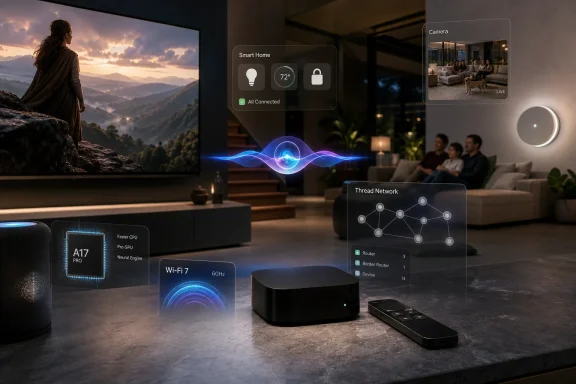 The Apple TV Rumor Mill Has Outgrown the Box
The latest round of Apple TV speculation arrives dressed like the usual consumer-electronics leak cycle: a dramatic release-date claim, a grab bag of expected specs, and the implication that buyers should freeze their carts until Cupertino moves. But the substance underneath the noise is more interesting than the packaging. Apple TV 4K has not been meaningfully refreshed since 2022, and the longer Apple waits, the more every minor rumor begins to carry the weight of a platform reset.That is why the 2025-to-2026 shift matters. A missed hardware window is not unusual for Apple, especially in categories that sit below the iPhone, Mac, and iPad in corporate priority. But Apple TV occupies a strange position in the company’s ecosystem: it is a streaming device, a gaming appliance, a HomeKit hub, a Fitness+ screen, a FaceTime accessory when paired with an iPhone, and an increasingly important anchor for Apple’s smart-home story.
The Mshale posts circulating under “Apple TV 2026 leaks” and “New Apple TV 2025 leaks” are best read as part of that broader rumor economy, not as confirmed road maps. Their framing is sensational, and the odd title fragments attached to them do not inspire confidence as primary sourcing. But they reflect a real tension in the Apple world: the next Apple TV has been expected for long enough that delay itself has become the story.
The useful question is not whether a particular leak video or aggregator post got the month right. The useful question is why Apple would hold back a seemingly simple streaming-box refresh at all. The most plausible answer is that the next Apple TV is no longer just a streaming-box refresh.
Siri, Not Silicon, Is the Calendar Problem
The most consistent thread in recent reporting is that Apple’s next Apple TV refresh is entangled with the company’s delayed Siri overhaul. That should tell us where Apple thinks the living-room fight is moving. A faster chip is useful, and better networking is welcome, but neither explains why a product apparently ready for routine modernization would slip into a later window.Apple’s AI problem is especially visible in the living room because voice is supposed to be the natural interface there. Nobody wants to type a long command into a TV search field with a glass-and-aluminum remote. Nobody wants to navigate a smart-home dashboard from ten feet away if a conversational assistant can dim the lights, pull up a camera feed, find a show, and resume playback by voice.
That is the experience Apple has gestured toward for years without fully delivering. Siri on Apple TV can launch apps, search supported catalogs, control playback, and handle basic smart-home requests. But it has not become the ambient household agent Apple needs if the company wants to compete seriously with Amazon’s Alexa ecosystem, Google’s Nest devices, and the increasingly AI-forward assistants being embedded into TVs and speakers.
This is where an A17 Pro-class chip starts to make strategic sense. The A17 Pro is not just “faster” in the generic spec-sheet way. It is part of the family of Apple silicon capable of supporting Apple Intelligence features, and that line now matters across Apple’s product segmentation. If the next Apple TV is meant to participate in Apple’s new AI architecture, a chip bump becomes less about app loading times and more about eligibility.
The irony is that Apple TV users may not immediately care. The current Apple TV 4K is already fast by streaming-device standards, often comically so compared with sluggish smart-TV interfaces and budget HDMI sticks. The product’s problem is not that Netflix opens too slowly. The problem is that Apple wants the living room to become an AI-and-home-control surface, and the current Siri experience is not strong enough to make that feel inevitable.
Apple’s Smart-Home Strategy Keeps Waiting for a Center of Gravity
Apple has spent years building the bones of a credible smart-home platform while struggling to make it feel like a consumer movement. HomeKit, Matter support, Thread networking, HomePod, Apple TV, iPhone, iPad, and Watch all fit together logically on paper. In practice, the ecosystem often feels more like a well-secured toolkit than a mainstream home platform with obvious momentum.Apple TV is one of the few devices that can fix that. It is always plugged in, always connected, frequently located near the household’s largest screen, and already trusted as a home hub. Unlike an iPhone, it is not personal and transient. Unlike a HomePod mini, it has visual output. Unlike an iPad mounted to a wall, it does not require a user to invent a use case that Apple itself has not fully productized.
That makes the next Apple TV more consequential than its size suggests. If Apple adds stronger local intelligence, improved wireless networking, and deeper Home integration, the box could become the quiet coordinator for a much larger domestic computing system. It could broker cameras, locks, sensors, automations, media, shared family calendars, FaceTime calls, and contextual notifications.
But Apple’s smart-home approach has always been constrained by its own standards. The company prioritizes privacy, local control, device authentication, and polished user experience. Those are strengths, but they also make Apple less willing to ship messy, experimental home features that competitors might push into the market sooner. The result is a familiar Apple pattern: the company waits until it thinks the full-stack experience is ready, then risks looking late.
The Apple TV delay, if that is what we are seeing, fits that pattern. Apple may have the hardware. It may have the wireless chip. It may have the industrial design. What it may not yet have is the assistant layer that makes the hardware feel like more than a faster version of the same black puck.
Wi-Fi 7 Is a Nice Upgrade, but It Is Not the Main Event
Rumors around Apple-designed wireless silicon and Wi-Fi 7 support have generated plenty of attention, partly because networking specs are easy to put in headlines. For a streaming box, though, the practical value is more nuanced. Most 4K streaming does not require anything close to Wi-Fi 7’s theoretical ceiling, and many Apple TV owners sensibly use Ethernet where available.Still, dismissing the wireless upgrade would be a mistake. Apple is moving toward more in-house connectivity silicon across its product lines, and Apple TV is an obvious place to extend that strategy. A home hub benefits from reliability, low latency, strong coexistence with other radios, and better behavior in crowded networks. The spec on the box is less important than how well the device behaves as part of an Apple-controlled mesh of experiences.
Wi-Fi 6E or Wi-Fi 7 support would also align Apple TV with newer routers and the 6GHz band, which can be useful in dense apartment buildings and households crowded with phones, laptops, tablets, speakers, cameras, consoles, and work devices. For sysadmins and networking enthusiasts, the living room has become another endpoint jungle. The set-top box is no longer isolated from the rest of the home network; it is a participant in a multi-device topology that includes streaming, gaming, automation, casting, conferencing, and surveillance.
The more interesting possibility is Thread and smart-home coordination. Apple TV already plays a home-hub role, and improved wireless silicon could make that role more stable and power-efficient. In the Matter era, where the industry is trying to make smart-home devices less brand-fragmented, Apple’s box could become a more important bridge between consumer simplicity and network-level complexity.
But Apple should be careful not to overmarket connectivity as transformation. A new Apple TV with Wi-Fi 7 will not make a bad ISP good, a poorly placed router sensible, or a broken streaming app elegant. The real value will come if the connectivity upgrade supports a bigger living-room architecture that users can feel without learning a radio standard.
The Gaming Dream Refuses to Die
Every Apple TV hardware rumor eventually returns to gaming, because Apple keeps putting enough silicon into its devices to make the idea plausible and then never quite follows through. An A17 Pro-class Apple TV would again raise the question: is Apple building a console competitor, or merely a very capable streaming box that happens to run games?The answer, for now, remains the latter. Apple Arcade has value, and tvOS can host polished casual and controller-friendly titles. Apple silicon is powerful enough to embarrass older assumptions about mobile gaming hardware. But the console market is not won by theoretical teraflops or ray-tracing support. It is won by libraries, developer economics, controller expectations, multiplayer culture, and a reason for players to choose the platform first.
Apple has some of those ingredients and lacks others. It has a massive developer ecosystem, strong hardware, family payment infrastructure, and the ability to place games across iPhone, iPad, Mac, and TV. It does not have the same living-room gaming identity as PlayStation, Xbox, Nintendo, or PC handhelds. Nor has it shown the kind of sustained first-party publishing ambition that would make Apple TV feel like a gaming destination rather than an accessory.
Still, a stronger chip matters. It lengthens the useful life of the device, allows more ambitious tvOS apps, and gives Apple optionality. If the company ever decides to push harder into premium games across Apple silicon, the Apple TV cannot be the weak link sitting under the television.
For WindowsForum readers, the comparison to PC gaming is instructive. Hardware capability is necessary but never sufficient. The reason Windows remains central to gaming is not just GPU support; it is the ecosystem gravity around storefronts, drivers, mods, peripherals, anti-cheat systems, streaming tools, and user expectations. Apple TV can become a better game box in 2026, but becoming a serious gaming platform would require Apple to change its posture, not just its processor.
The Current Apple TV 4K Is Still Too Good for Apple’s Own Rumor Cycle
One reason the rumor cycle feels absurd is that the 2022 Apple TV 4K remains an excellent device. It is fast, clean, relatively ad-light compared with many smart-TV interfaces, and tightly integrated with Apple services. It supports major streaming apps, works well with AirPods, handles Apple Fitness+, syncs with iCloud Photos, and functions as a home hub.That creates a purchasing dilemma. Buyers who need a streaming device today can still justify the current model. Enthusiasts who follow Apple rumors closely, however, have been told for so long that a new model is imminent that buying one can feel irrational. This is how leak culture distorts normal product evaluation: a good current device becomes psychologically obsolete before Apple has announced anything.
The Windows world knows this syndrome well. Users delay PC purchases for the next CPU generation, the next GPU cycle, the next Windows feature update, or the next AI PC certification badge. Sometimes waiting is wise. Often, it is just a way to let vendors and rumor sites occupy your decision-making process rent-free.
The practical advice is boring but durable. If you need an Apple TV now, the current Apple TV 4K is unlikely to become useless when a new one appears. If your current setup is fine and you care about Apple Intelligence, Siri, Wi-Fi 7, or future-proofing the smart home, waiting makes sense. The worst outcome is not buying the “wrong” Apple TV; it is buying into the fantasy that every incremental hardware refresh will transform your living room overnight.
Apple benefits from this ambiguity. The company’s products tend to age well, which makes older models safer purchases. But its ecosystem strategy also rewards patience, especially when new software features are gated by silicon. The next Apple TV may be a modest upgrade on day one and a more meaningful one over time if Apple’s AI and home features mature.
A Streaming Box Becomes an AI Endpoint
The bigger story is that every screen is becoming an AI endpoint. Microsoft is putting Copilot across Windows and Microsoft 365. Google is weaving Gemini into Android, Workspace, search, and home devices. Amazon is trying to rebuild Alexa for the generative AI era. Apple, after a slow and uneven start, is trying to make Apple Intelligence feel like a private, personal layer across its devices.The television is a difficult endpoint because it is shared. A phone belongs to one person; a TV belongs to a household. That complicates personalization, permissions, recommendations, photos, messages, calendar data, smart-home controls, and purchases. The assistant on a TV has to understand not only what a user asked, but which user asked it and what the household should be allowed to see.
Apple is unusually well positioned for that problem because it already has individual identity through Apple ID, proximity through iPhone and Watch, family structures through iCloud, and a privacy narrative that can make shared-home intelligence less creepy. But positioning is not execution. A living-room AI that surfaces the wrong private photo album, reads the wrong message preview, or unlocks the wrong home control would be worse than no AI at all.
That may explain Apple’s caution. In the living room, “move fast and break things” becomes “move fast and embarrass someone in front of their family.” The stakes are lower than enterprise security but higher than a chatbot hallucinating a recipe. Apple’s brand promise depends on making the shared screen feel controlled, respectful, and predictable.
If the next Apple TV is waiting for better Siri, that is not necessarily a sign of dysfunction. It may be a sign that Apple understands the device’s next role. The risk is that competitors will keep normalizing AI in the home while Apple perfects the version it is willing to ship.
Windows Users Should Care More Than They Think
At first glance, Apple TV rumors may seem peripheral to a Windows audience. Many WindowsForum readers run Windows desktops, manage Microsoft 365 tenants, test Insider builds, deploy Intune policies, and think of Apple TV as a consumer gadget for another ecosystem. But the living room is increasingly part of the same device-management, identity, networking, and security story that IT pros deal with elsewhere.Hybrid work blurred the boundary between home and office networks. A household streaming box may sit on the same LAN as a work laptop, a NAS, a printer, a child’s school device, an Xbox, several IoT gadgets, and a router that has not had a firmware update in months. When devices become home hubs, they deserve more scrutiny than ordinary entertainment appliances.
Apple’s approach is relevant because it represents one model for consumer endpoint trust. The company wants tight hardware-software integration, controlled app distribution, strong account binding, privacy-forward processing, and long-lived device support. Microsoft’s world is more open, more diverse, and more administratively flexible, but it is also messier. The contrast matters as AI agents and smart-home bridges become more capable.
There is also a media-platform angle. Apple TV competes not only with Roku, Fire TV, Google TV, and smart-TV operating systems, but with Xbox, Windows PCs connected to televisions, and browser-based entertainment. Microsoft has never turned the Windows living-room PC into a mainstream appliance, and the Xbox has evolved into a gaming-and-services brand more than a general home-computing hub. Apple’s persistence with Apple TV shows that the living room remains strategically valuable even when the unit economics of a set-top box look modest.
For administrators, the lesson is broader than Apple. Devices that look consumer-grade can become identity-aware, network-persistent, microphone-equipped, camera-adjacent, and automation-capable. That makes them part of the threat surface and part of the user-experience surface. The next Apple TV is a reminder that the endpoint perimeter keeps expanding into places IT used to ignore.
Leak Culture Is Filling the Silence Apple Created
Apple’s secrecy used to be a competitive advantage because the company could arrive with a finished product and reset expectations. In the AI era, silence has become more complicated. When Apple delays or declines to explain its roadmap, leakers, aggregators, YouTubers, and search-optimized sites fill the vacuum.That is what appears to be happening around Apple TV. Some reports are grounded in credible supply-chain or newsletter sourcing. Others recycle the same claims with escalating certainty. Still others wrap thin speculation in dramatic language designed for clicks. The result is a fog of “expected,” “reportedly,” “tipped,” “imminent,” and “shocked” that can make a modest product refresh feel like a geopolitical event.
Consumers should be skeptical of any release-date claim that is not tied to Apple’s own announcement. Apple can and does shift product timing. Software readiness, supply constraints, event planning, certification, manufacturing schedules, and strategic bundling can all move the calendar. A device can be “ready” in one sense and still not ready for launch in the sense that matters to Apple.
But Apple also bears responsibility for the vacuum. The company has made Apple Intelligence central to its platform narrative while shipping pieces unevenly and delaying some of the most important assistant capabilities. If Apple TV is now waiting on Siri, then the hardware rumor cycle is really a symptom of a software credibility gap.
That is the uncomfortable truth for Apple. The next Apple TV does not need to be revolutionary to be good. But if it arrives as merely faster hardware after years of AI and smart-home positioning, it will reinforce the sense that Apple’s living-room strategy is still waiting for its defining software moment.
The Living Room Upgrade Worth Waiting For Is Not Just a Faster Puck
The most concrete reading of the rumor landscape is also the least theatrical. Apple is likely to refresh the Apple TV 4K after an unusually long gap, and the next version will probably include a much faster chip, improved wireless connectivity, and tighter alignment with Apple Intelligence and future Siri features. The timing appears to have shifted from 2025 expectations into 2026, with the software roadmap now looking like the key variable.That gives buyers and IT-minded observers a few grounded conclusions:
- The current Apple TV 4K remains a strong purchase for users who need a reliable streaming box now and do not care about future Apple Intelligence features on day one.
- The next Apple TV is likely to matter most to households invested in Apple Home, Siri, Thread, HomePod, FaceTime, Fitness+, and other Apple ecosystem services.
- A faster chip will be less important for ordinary streaming than for device longevity, gaming headroom, AI eligibility, and future tvOS features.
- Wi-Fi 7 or Apple-designed wireless silicon would be useful, but it should be understood as infrastructure for a broader home strategy rather than a standalone reason to upgrade.
- The rumored delay says more about Apple’s Siri and smart-home readiness than about the difficulty of building another small black streaming box.
- Leak-driven release-date claims should be treated as provisional until Apple announces the product, especially when the same device has already slipped through multiple expected windows.
References
- Primary source: Mshale
Published: 2026-07-01T22:20:31.362293
Loading…
mshale.com - Related coverage: macrumors.com
New Apple TV 4K and HomePod Likely Won't Launch Until New Siri is Ready
Apple has a new version of the HomePod and a new Apple TV 4K ready to go, but the devices may be tied to the Siri update that's been continually postponed, according to Bloomberg's Mark Gurman. In a report on a planned September launch for new Siri capabilities and the home hub...www.macrumors.com - Related coverage: tomsguide.com
Loading…
www.tomsguide.com - Related coverage: notebookcheck.com
Loading…
www.notebookcheck.com - Related coverage: appleinsider.com
Loading…
appleinsider.com - Related coverage: apple.gadgethacks.com
Loading…
apple.gadgethacks.com