

Google released Android 17 QPR1 Beta 6 for supported Pixel phones on July 1, 2026, delivering build CP31.260618.005 to Pixel 6 through Pixel 10-series devices, including the Pixel 10a, with the June 5, 2026 security patch and Google Play services 26.20.31. The headline is not the bug list, although the bug list matters. The real story is that QPR1 has now reached Platform Stability, which turns this from another enthusiast beta into a signal about Google’s increasingly compressed Android release calendar. For Pixel owners, developers, and IT shops that treat Android as an endpoint platform rather than a hobby, Beta 6 is less a surprise drop than a warning flare: the Android train is moving faster, and the maintenance window is getting narrower.
For years, Android betas had a familiar rhythm. Google would preview the next annual platform release, developers would chase API changes, Pixel owners would decide whether they felt adventurous, and the finished version would arrive when the calendar and carriers allowed. Quarterly Platform Releases, or QPRs, were supposed to be the quieter part of that story: maintenance releases with Pixel feature drops, platform refinements, and the occasional surprise.
Android 17 QPR1 Beta 6 makes that distinction feel much thinner. Google is not merely polishing a release that already exists in users’ hands; it is pushing the first quarterly update stream with the urgency of a platform launch. Droid Life’s observation that Beta 5 landed only a week earlier is the right instinct: this does not feel like a leisurely beta cycle.
That acceleration matters because QPR builds sit in an awkward middle ground. They are not full-number Android releases, but they can still carry new APIs, behavior changes, and device-specific fixes that affect real apps and workflows. When Google says the QPR1 beta has reached Platform Stability, developers hear that the API surface is locked enough to target. Administrators hear something else: the experimental branch is getting close enough to production that they need to decide whether to test it now or be surprised later.
The timing also complicates the old advice to “just wait for stable.” If the stable QPR1 build is expected around September, then July is not early in the cycle anymore. It is the practical beginning of the final validation period.
That does not mean the beta is bug-free. It does not mean your banking app, VPN client, authenticator, smartwatch companion, device management agent, or enterprise launcher will behave perfectly. It means the moving parts that developers are expected to code against have stopped moving in the ways that matter most.
This is why Beta 6 is bigger than its patch notes. The fixed issues are mundane by design: spell checker language selection, Clock app volume-button behavior, Quick Settings media carousel glitches, an app-crashing WindowManagerGlobal issue, and Wi-Fi hotspot names reverting to a generic default SSID. None of those sounds like the sort of feature that sells a phone. All of them are the sort of rough edges that make a platform feel unfinished when they appear in daily use.
The Wi-Fi hotspot fix is a particularly good example. A saved custom SSID displaying incorrectly is not just cosmetic for every user. In travel, field work, small-business environments, and temporary device setups, hotspot names become part of a workflow. When the phone forgets the identity the user assigned to it, the system has broken a small but real contract.
The WindowManagerGlobal crash fix is more opaque but arguably more important. Window management bugs are the plumbing failures of modern mobile operating systems: most users do not know what subsystem failed, only that an app crashed or the interface behaved strangely. Fixes like that rarely make marketing decks, but they are what separate a beta that feels clever from a release that feels trustworthy.
Pixel phones have always played a double role. They are consumer devices, but they are also Google’s reference hardware for Android. The farther Google stretches update support, the more important that second role becomes. A QPR beta has to tell Google whether the platform behaves consistently not just on the newest flagship, but on phones that have lived through years of updates, app cruft, battery aging, and accumulated user settings.
That is why the Pixel 6 remains an interesting line in the sand. It is old enough to represent the long tail of modern Pixel ownership, yet new enough to remain in the mainstream Android update conversation. If QPR1 Beta 6 is shipping across that range, Google is testing not just the next Pixel feature drop but the credibility of its extended-support story.
For WindowsForum readers, the comparison to Windows Insider builds is hard to avoid. Microsoft learned the hard way that an enthusiast testing ring becomes far more complicated when the same operating system serves consumers, businesses, developers, and regulated environments. Google’s Pixel beta program is smaller and cleaner than the Windows ecosystem, but the same tension applies: the people most willing to test early builds are not always representative of the people most likely to be hurt by regressions.
The Pixel program gives Google faster telemetry and tighter hardware control than most Android OEMs can dream of. It also concentrates risk. A bad Pixel beta may be optional, but the fixes and behaviors it validates eventually ripple outward into stable builds, OEM integrations, and app compatibility assumptions.
The spell checker language issue is the sort of bug that disproportionately affects multilingual users, a group Android should be especially good at serving. The ability to select multiple spell checker languages is not glamorous, but it sits at the intersection of accessibility, productivity, and global usability. A phone that handles cameras, AI summaries, and satellite features but stumbles over multilingual text input is not a mature platform.
The Clock app volume-button fix is another example of how small regressions can feel larger than they look. Volume buttons are physical controls, and physical controls carry muscle memory. When pressing them inside an app fails to trigger the expected interface action, the device feels less predictable, even if the bug is confined to one app.
The Quick Settings media carousel glitch may be the most visually obvious bug in the list. Rapid swiping through media controls causing layout and icon artifacts is exactly the kind of issue that beta testers notice, screenshot, and amplify. It does not necessarily corrupt data or break apps, but it damages the impression of stability because it happens in one of Android’s most frequently accessed surfaces.
That is the quiet value of a Beta 6 release. It gives Google a chance to sand down bugs that would otherwise appear in reviews, support threads, and workplace complaints. A platform can survive missing a flashy feature. It has a harder time surviving the perception that its core surfaces are twitchy.
The Platform Stability label changes the nature of the work. Developers can no longer reasonably treat QPR1 as a moving target too unstable to care about. If an app has layout issues, permission handling quirks, input problems, or compatibility warnings on Beta 6, the clock has started.
That applies especially to apps that live close to the system. Launchers, accessibility tools, keyboards, VPNs, endpoint security agents, password managers, device admin tools, camera apps, media apps, and apps that rely heavily on overlays or window behavior should be paying attention. A fix to WindowManagerGlobal suggests that the windowing layer has been an active area of concern, and anything that depends on presentation behavior should be tested rather than assumed safe.
For ordinary Pixel users, the calculus is different. Beta 6 may be more stable than earlier builds, but “Platform Stability” is not the same as “daily-driver guarantee.” Google’s beta program remains a beta program, and opting in can still create friction when users later want to exit without wiping their devices.
The safest advice remains boring: install it on a secondary device if you are curious, or wait for stable if the phone is mission-critical. But boring advice is not the same as irrelevant advice. The closer Google gets to release, the more tempting it becomes for enthusiasts to treat the beta as basically finished. That is exactly when the remaining bugs tend to be the ones that matter to specific workflows.
Android 17 QPR1 Beta 6 shows how far that model has advanced. The build includes a dated security patch level, a specific Play services version, a named beta milestone, and eligibility across a large Pixel range. It is not simply “the next Android.” It is one layer in a stack of update mechanisms that now define the Android experience.
There are benefits to this model. Bugs can be fixed faster. New platform capabilities can reach developers without waiting a full year. Pixel owners can get feature improvements on a predictable cadence. Google can respond to hardware realities and app ecosystem changes with more precision.
There are costs, too. The update story becomes harder to explain. Users may know they are on Android 17 but not know whether they are on a QPR beta, a stable QPR, a monthly patch, or a Play system update that changes behavior independently of the OS build. Administrators have to track more version identifiers, and support forums fill with people comparing build numbers like forensic evidence.
That complexity is familiar to anyone who has managed Windows in the modern era. The version number is no longer the whole story. Build numbers, enablement packages, cumulative updates, feature flags, servicing channels, and staged rollouts all matter. Android is not copying Windows, but it is converging on the same operational reality: the operating system is now a service pipeline.
Android’s enterprise management tools are better than they used to be, and many organizations rely on OEMConfig, Android Enterprise controls, managed Google Play, and EMM policies to keep devices predictable. But predictability depends on knowing what to test. A QPR that includes new APIs and meaningful behavior fixes deserves more than a shrug.
The bug list in Beta 6 may look consumer-focused, but enterprise impact often hides in consumer bugs. A hotspot SSID issue can affect field technicians. A window-management crash can affect line-of-business apps. Input-language problems can affect multinational workforces. Quick Settings glitches can affect training and support documentation when the interface does not behave as expected.
This is where Google’s faster cadence should push IT departments toward a more formal Android validation process. Not a massive lab, not a bureaucratic ritual, but a small ring of representative devices enrolled early enough to catch obvious problems. If an organization treats mobile endpoints as serious computing devices, it cannot afford to learn about platform changes only when executives complain.
The irony is that Google’s beta program gives IT exactly the tool it needs. The question is whether organizations will use it. Windows administrators eventually learned to respect release rings because Windows forced the issue. Android may now be entering the same phase.
It also reinforces why Pixel phones remain attractive to a certain kind of user. Samsung may dominate Android volume in many markets, and other OEMs may beat Google on charging, hardware variety, or regional pricing. But Pixel remains the place where Android’s next platform decisions show up first, with the least mediation.
That has always been both selling point and warning label. Pixel owners get the new bits early, but they also experience the seams in Google’s platform strategy early. A QPR beta can bring clever features, useful fixes, and inexplicable regressions in the same package.
The naming does not help. “Android 17 QPR1 Beta 6” is accurate, but it is not friendly. Add build CP31.260618.005, a June security patch, and Play services 26.20.31, and the release becomes legible mainly to people who already know why those identifiers matter. Google’s public-facing Android brand increasingly lives in tension with its engineering-facing release machinery.
That tension is manageable as long as stable releases feel stable. Users will tolerate confusing labels if their phones improve quietly. They will not tolerate confusing labels if updates create uncertainty about whether their device is production-ready.
That is not a criticism. Mature software platforms need pre-release channels. Developers need early builds. Google needs telemetry. Enthusiasts want access. The problem comes when the casual language of “try the beta” collides with the operational reality of build tracks, wipe requirements, and QPR timing.
Users who enroll should understand that they are not merely previewing a feature drop. They are placing their device on a different update path. Getting off that path may require waiting for a compatible stable release or accepting a wipe, depending on timing and build state. That is a reasonable trade for developers and testers, but it is not a trivial one for normal users.
Google has improved the beta experience over the years, but the company still benefits from making the boundaries clearer. If QPR betas are now a major part of Android’s public testing strategy, the program needs to communicate risk in language that matches how people actually use their phones. A phone is not a spare browser profile. It is authentication, payments, messaging, navigation, photos, work access, and emergency communication.
Beta 6 may be close to stable, but the principle remains: the more important the device, the less romantic early access should look.
The fixes in this build touch language, physical controls, visual polish, app stability, and network identity. That is a broad cross-section of everyday phone behavior. None of it screams keynote material, but all of it affects trust.
Trust is the currency Google needs most as Android becomes more modular and more frequently updated. Users are being asked to accept that their phone will change continuously. Developers are being asked to track more moving parts. IT departments are being asked to treat mobile operating systems with the same discipline they bring to desktop servicing.
Platform Stability is Google’s way of saying the shape of QPR1 is now firm. The next test is whether the lived experience matches that claim. If Beta 6 reduces visible roughness without introducing new regressions, September’s stable release can land as a routine improvement. If not, the accelerated cadence will look less like agility and more like impatience.
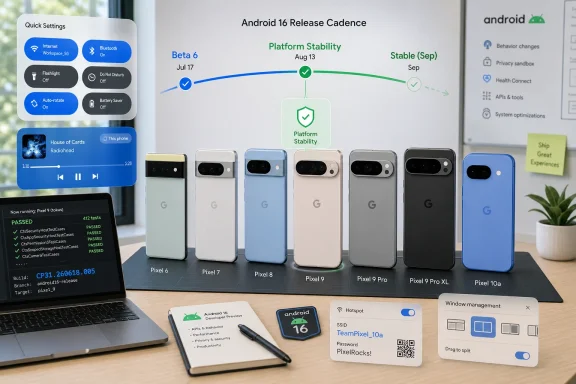 Google’s Beta Cadence Is No Longer Just for Enthusiasts
For years, Android betas had a familiar rhythm. Google would preview the next annual platform release, developers would chase API changes, Pixel owners would decide whether they felt adventurous, and the finished version would arrive when the calendar and carriers allowed. Quarterly Platform Releases, or QPRs, were supposed to be the quieter part of that story: maintenance releases with Pixel feature drops, platform refinements, and the occasional surprise.Android 17 QPR1 Beta 6 makes that distinction feel much thinner. Google is not merely polishing a release that already exists in users’ hands; it is pushing the first quarterly update stream with the urgency of a platform launch. Droid Life’s observation that Beta 5 landed only a week earlier is the right instinct: this does not feel like a leisurely beta cycle.
That acceleration matters because QPR builds sit in an awkward middle ground. They are not full-number Android releases, but they can still carry new APIs, behavior changes, and device-specific fixes that affect real apps and workflows. When Google says the QPR1 beta has reached Platform Stability, developers hear that the API surface is locked enough to target. Administrators hear something else: the experimental branch is getting close enough to production that they need to decide whether to test it now or be surprised later.
The timing also complicates the old advice to “just wait for stable.” If the stable QPR1 build is expected around September, then July is not early in the cycle anymore. It is the practical beginning of the final validation period.
Platform Stability Is a Developer Milestone With User Consequences
Platform Stability sounds like a phrase designed to make normal people stop reading, but it is one of the more important checkpoints in Android’s release process. It means Google considers the developer-facing APIs and platform behaviors stable enough that app makers can begin final compatibility work without expecting the ground to shift under them.That does not mean the beta is bug-free. It does not mean your banking app, VPN client, authenticator, smartwatch companion, device management agent, or enterprise launcher will behave perfectly. It means the moving parts that developers are expected to code against have stopped moving in the ways that matter most.
This is why Beta 6 is bigger than its patch notes. The fixed issues are mundane by design: spell checker language selection, Clock app volume-button behavior, Quick Settings media carousel glitches, an app-crashing WindowManagerGlobal issue, and Wi-Fi hotspot names reverting to a generic default SSID. None of those sounds like the sort of feature that sells a phone. All of them are the sort of rough edges that make a platform feel unfinished when they appear in daily use.
The Wi-Fi hotspot fix is a particularly good example. A saved custom SSID displaying incorrectly is not just cosmetic for every user. In travel, field work, small-business environments, and temporary device setups, hotspot names become part of a workflow. When the phone forgets the identity the user assigned to it, the system has broken a small but real contract.
The WindowManagerGlobal crash fix is more opaque but arguably more important. Window management bugs are the plumbing failures of modern mobile operating systems: most users do not know what subsystem failed, only that an app crashed or the interface behaved strangely. Fixes like that rarely make marketing decks, but they are what separate a beta that feels clever from a release that feels trustworthy.
The Pixel Line Is Now Google’s Rolling Test Fleet
The supported device span is also notable. Build CP31.260618.005 is listed for Pixel 6 through the Pixel 10 series, including the Pixel 10a. That is a wide enough range to capture multiple Tensor generations, different modem stacks, different display configurations, and very different user expectations.Pixel phones have always played a double role. They are consumer devices, but they are also Google’s reference hardware for Android. The farther Google stretches update support, the more important that second role becomes. A QPR beta has to tell Google whether the platform behaves consistently not just on the newest flagship, but on phones that have lived through years of updates, app cruft, battery aging, and accumulated user settings.
That is why the Pixel 6 remains an interesting line in the sand. It is old enough to represent the long tail of modern Pixel ownership, yet new enough to remain in the mainstream Android update conversation. If QPR1 Beta 6 is shipping across that range, Google is testing not just the next Pixel feature drop but the credibility of its extended-support story.
For WindowsForum readers, the comparison to Windows Insider builds is hard to avoid. Microsoft learned the hard way that an enthusiast testing ring becomes far more complicated when the same operating system serves consumers, businesses, developers, and regulated environments. Google’s Pixel beta program is smaller and cleaner than the Windows ecosystem, but the same tension applies: the people most willing to test early builds are not always representative of the people most likely to be hurt by regressions.
The Pixel program gives Google faster telemetry and tighter hardware control than most Android OEMs can dream of. It also concentrates risk. A bad Pixel beta may be optional, but the fixes and behaviors it validates eventually ripple outward into stable builds, OEM integrations, and app compatibility assumptions.
The Bug Fixes Tell a Story About Polish, Not Reinvention
There is no evidence from this drop that Android 17 QPR1 Beta 6 is meant to reinvent the phone. The fixes described are about fit and finish, and that is exactly what a late beta should be about. If Google were still landing major user-facing features at this stage, Platform Stability would look less like a milestone and more like a branding exercise.The spell checker language issue is the sort of bug that disproportionately affects multilingual users, a group Android should be especially good at serving. The ability to select multiple spell checker languages is not glamorous, but it sits at the intersection of accessibility, productivity, and global usability. A phone that handles cameras, AI summaries, and satellite features but stumbles over multilingual text input is not a mature platform.
The Clock app volume-button fix is another example of how small regressions can feel larger than they look. Volume buttons are physical controls, and physical controls carry muscle memory. When pressing them inside an app fails to trigger the expected interface action, the device feels less predictable, even if the bug is confined to one app.
The Quick Settings media carousel glitch may be the most visually obvious bug in the list. Rapid swiping through media controls causing layout and icon artifacts is exactly the kind of issue that beta testers notice, screenshot, and amplify. It does not necessarily corrupt data or break apps, but it damages the impression of stability because it happens in one of Android’s most frequently accessed surfaces.
That is the quiet value of a Beta 6 release. It gives Google a chance to sand down bugs that would otherwise appear in reviews, support threads, and workplace complaints. A platform can survive missing a flashy feature. It has a harder time surviving the perception that its core surfaces are twitchy.
September Is Closer Than It Looks
Droid Life frames the stable QPR1 release as something not expected until September, and that timeline fits the traditional shape of a quarterly release. But in software calendars, September is not far away. For developers who need to test app behavior, submit updates, wait for review, and field user feedback, July is already late.The Platform Stability label changes the nature of the work. Developers can no longer reasonably treat QPR1 as a moving target too unstable to care about. If an app has layout issues, permission handling quirks, input problems, or compatibility warnings on Beta 6, the clock has started.
That applies especially to apps that live close to the system. Launchers, accessibility tools, keyboards, VPNs, endpoint security agents, password managers, device admin tools, camera apps, media apps, and apps that rely heavily on overlays or window behavior should be paying attention. A fix to WindowManagerGlobal suggests that the windowing layer has been an active area of concern, and anything that depends on presentation behavior should be tested rather than assumed safe.
For ordinary Pixel users, the calculus is different. Beta 6 may be more stable than earlier builds, but “Platform Stability” is not the same as “daily-driver guarantee.” Google’s beta program remains a beta program, and opting in can still create friction when users later want to exit without wiping their devices.
The safest advice remains boring: install it on a secondary device if you are curious, or wait for stable if the phone is mission-critical. But boring advice is not the same as irrelevant advice. The closer Google gets to release, the more tempting it becomes for enthusiasts to treat the beta as basically finished. That is exactly when the remaining bugs tend to be the ones that matter to specific workflows.
Google Is Training Users to Expect Continuous Android
The deeper shift is that Android is becoming less of an annual event and more of a continuous delivery platform. That has been true in pieces for years. Google Play services updates, Play system updates, app updates, Pixel Drops, security patches, and QPRs have all chipped away at the idea that “Android version” means one big yearly package.Android 17 QPR1 Beta 6 shows how far that model has advanced. The build includes a dated security patch level, a specific Play services version, a named beta milestone, and eligibility across a large Pixel range. It is not simply “the next Android.” It is one layer in a stack of update mechanisms that now define the Android experience.
There are benefits to this model. Bugs can be fixed faster. New platform capabilities can reach developers without waiting a full year. Pixel owners can get feature improvements on a predictable cadence. Google can respond to hardware realities and app ecosystem changes with more precision.
There are costs, too. The update story becomes harder to explain. Users may know they are on Android 17 but not know whether they are on a QPR beta, a stable QPR, a monthly patch, or a Play system update that changes behavior independently of the OS build. Administrators have to track more version identifiers, and support forums fill with people comparing build numbers like forensic evidence.
That complexity is familiar to anyone who has managed Windows in the modern era. The version number is no longer the whole story. Build numbers, enablement packages, cumulative updates, feature flags, servicing channels, and staged rollouts all matter. Android is not copying Windows, but it is converging on the same operational reality: the operating system is now a service pipeline.
The Enterprise Risk Is Not the Beta, It Is the Surprise
Most enterprises are not enrolling production Pixel fleets into Android betas. That is not the concern. The concern is that QPR changes can arrive quickly enough that organizations without a testing habit discover problems only when stable builds begin rolling out.Android’s enterprise management tools are better than they used to be, and many organizations rely on OEMConfig, Android Enterprise controls, managed Google Play, and EMM policies to keep devices predictable. But predictability depends on knowing what to test. A QPR that includes new APIs and meaningful behavior fixes deserves more than a shrug.
The bug list in Beta 6 may look consumer-focused, but enterprise impact often hides in consumer bugs. A hotspot SSID issue can affect field technicians. A window-management crash can affect line-of-business apps. Input-language problems can affect multinational workforces. Quick Settings glitches can affect training and support documentation when the interface does not behave as expected.
This is where Google’s faster cadence should push IT departments toward a more formal Android validation process. Not a massive lab, not a bureaucratic ritual, but a small ring of representative devices enrolled early enough to catch obvious problems. If an organization treats mobile endpoints as serious computing devices, it cannot afford to learn about platform changes only when executives complain.
The irony is that Google’s beta program gives IT exactly the tool it needs. The question is whether organizations will use it. Windows administrators eventually learned to respect release rings because Windows forced the issue. Android may now be entering the same phase.
The Enthusiast Upside Is Real, Even If the Naming Is Exhausting
For Pixel enthusiasts, this release is mostly good news. A sixth beta arriving quickly after the fifth suggests Google is actively closing issues rather than letting them linger until the next scheduled milestone. The arrival of Platform Stability gives app developers a firmer target. The broad device list means older Pixel owners are not being treated as an afterthought.It also reinforces why Pixel phones remain attractive to a certain kind of user. Samsung may dominate Android volume in many markets, and other OEMs may beat Google on charging, hardware variety, or regional pricing. But Pixel remains the place where Android’s next platform decisions show up first, with the least mediation.
That has always been both selling point and warning label. Pixel owners get the new bits early, but they also experience the seams in Google’s platform strategy early. A QPR beta can bring clever features, useful fixes, and inexplicable regressions in the same package.
The naming does not help. “Android 17 QPR1 Beta 6” is accurate, but it is not friendly. Add build CP31.260618.005, a June security patch, and Play services 26.20.31, and the release becomes legible mainly to people who already know why those identifiers matter. Google’s public-facing Android brand increasingly lives in tension with its engineering-facing release machinery.
That tension is manageable as long as stable releases feel stable. Users will tolerate confusing labels if their phones improve quietly. They will not tolerate confusing labels if updates create uncertainty about whether their device is production-ready.
The Beta Program Is Becoming a Contract
Opting into the Android Beta Program used to feel like a casual enthusiast move. You clicked a button, accepted some risk, and got early access. Today it feels more like entering a servicing channel with consequences.That is not a criticism. Mature software platforms need pre-release channels. Developers need early builds. Google needs telemetry. Enthusiasts want access. The problem comes when the casual language of “try the beta” collides with the operational reality of build tracks, wipe requirements, and QPR timing.
Users who enroll should understand that they are not merely previewing a feature drop. They are placing their device on a different update path. Getting off that path may require waiting for a compatible stable release or accepting a wipe, depending on timing and build state. That is a reasonable trade for developers and testers, but it is not a trivial one for normal users.
Google has improved the beta experience over the years, but the company still benefits from making the boundaries clearer. If QPR betas are now a major part of Android’s public testing strategy, the program needs to communicate risk in language that matches how people actually use their phones. A phone is not a spare browser profile. It is authentication, payments, messaging, navigation, photos, work access, and emergency communication.
Beta 6 may be close to stable, but the principle remains: the more important the device, the less romantic early access should look.
The Small Fixes Point to a Bigger Android 17 Test
Android 17 QPR1 Beta 6 is easy to underestimate because it does not arrive with a dazzling list of new features. That is exactly why it is important. Late-cycle releases reveal whether a platform team is chasing novelty or doing the unglamorous work of making the system coherent.The fixes in this build touch language, physical controls, visual polish, app stability, and network identity. That is a broad cross-section of everyday phone behavior. None of it screams keynote material, but all of it affects trust.
Trust is the currency Google needs most as Android becomes more modular and more frequently updated. Users are being asked to accept that their phone will change continuously. Developers are being asked to track more moving parts. IT departments are being asked to treat mobile operating systems with the same discipline they bring to desktop servicing.
Platform Stability is Google’s way of saying the shape of QPR1 is now firm. The next test is whether the lived experience matches that claim. If Beta 6 reduces visible roughness without introducing new regressions, September’s stable release can land as a routine improvement. If not, the accelerated cadence will look less like agility and more like impatience.
The Build Number Worth Writing Down
The practical readout from this release is narrow but important. Android 17 QPR1 Beta 6 is not a must-install update for everyone, but it is a must-not-ignore update for anyone who builds, manages, or troubleshoots Android at scale.- Android 17 QPR1 Beta 6 arrived on July 1, 2026, as build CP31.260618.005 for Pixel 6 through Pixel 10-series devices, including the Pixel 10a.
- The release carries the June 5, 2026 security patch level and Google Play services 26.20.31.
- Google says QPR1 has reached Platform Stability with this beta, making it a meaningful checkpoint for developers preparing app updates.
- The fixed issues focus on polish and reliability, including spell checker language selection, Clock app volume-button behavior, Quick Settings media carousel glitches, app crashes tied to WindowManagerGlobal, and custom hotspot SSID handling.
- Pixel enthusiasts can install through the Android Beta Program or by flashing OTA images, but primary-device users should still treat the build as pre-release software.
- IT teams that support Pixel devices should use the beta window to validate critical apps and policies before the expected stable QPR1 release window later this year.
References
- Primary source: Droid Life
Published: Wed, 01 Jul 2026 20:30:28 GMT
Loading…
www.droid-life.com - Related coverage: androidcentral.com
Loading…
www.androidcentral.com - Related coverage: sammyfans.com
Loading…
www.sammyfans.com - Related coverage: jetstream.blog
Loading…
jetstream.blog - Related coverage: techadvisor.com
Android 17 QPR1 Beta 1 Update Released For Pixel Phones - Tech Advisor
Android 17's first major update is being tested through a QPR1 beta release for Pixel phoneswww.techadvisor.com - Related coverage: developer.android.com
Loading…
developer.android.com
- Related coverage: androidauthority.com
Android 17 stable is officially rolling out to Google Pixels, here's what's new!
Google launches Android 17 stable for Pixel 6 and newer, bringing App Bubbles, enhanced privacy controls, and security improvements.www.androidauthority.com - Related coverage: androidnewswire.com
Loading…
androidnewswire.com - Related coverage: androidsage.com
Loading…
www.androidsage.com - Related coverage: techradar.com
A new Android 17 beta has landed — and it brings an exciting Screen Reactions feature for social media creators | TechRadar
Record yourself and your screenwww.techradar.com - Related coverage: tomsguide.com
Loading…
www.tomsguide.com - Related coverage: fosdem.org
Loading…
fosdem.org - Related coverage: nxp.com
Loading…
www.nxp.com