

June 2026 turned mobile gaming’s usual monthly churn into a referendum on platform ambition, as publishers used Android and iOS for new launches, relaunches, pre-registration campaigns, cross-platform bets, World Cup tie-ins, and one of the year’s loudest community revolts. The story was not simply that many games arrived. It was that mobile again looked less like a secondary market and more like the place where every major gaming business model is stress-tested first. By the end of the month, the phone was simultaneously a console, a live-service battlefield, an anime fandom pressure cooker, and the industry’s most unforgiving storefront.
The easy version of June’s mobile gaming story is a list: Game of Thrones: Dragonfire, CookieRun Classic, Pokémon Champions, DAVE THE DIVER, BanG Dream! Our Notes, Ni no Kuni: Cross Worlds, Love and Deepspace, and a small army of new releases, soft launches, closed betas, and pre-registration campaigns. The more useful version is that mobile publishers spent the month behaving as if the second half of 2026 will be won or lost before many players ever press “install.”
That is why June felt so busy. A mobile launch is no longer a launch in the old sense; it is the public middle of a much longer funnel. Soft launch, closed beta, pre-registration, regional rollout, influencer beat, live-service patch, community backlash, and store featuring now blur into a single campaign that can last months.
The industry has learned to make anticipation itself playable. June’s biggest stories were often not games people could fully play everywhere, but games people could reserve, test, speculate about, or rage against. That is a very mobile kind of momentum: measured not only in downloads, but in wishlists, beta cohorts, Discord arguments, store-page screenshots, and angry posts translated across regions overnight.
For WindowsForum readers, the Windows angle is not merely whether these games will get PC clients. The more important question is how mobile habits keep bending the rest of gaming. Cross-save expectations, short-session design, live-service economics, platform exclusivity, and community management practices increasingly travel from mobile back to PC and console.
The sheer variety matters. Mobile used to be caricatured as a market of match-three games, idle RPGs, and gacha banners. Those genres still dominate large parts of the business, but June showed how quickly the storefront has become a dumping ground and proving ground for almost every kind of game that can be compressed into touch controls or paired with a controller.
Pre-registration told the other half of the story. Pokémon Champions, Lost Twins 2, and CookieRun Classic all moved into the “not yet, but soon” phase that mobile publishers love because it turns marketing into measurable intent. A player who pre-registers has not bought anything, but they have entered the machine.
Closed beta activity around Marblebound and Wrestling Manager reinforced the same point. Mobile developers now treat limited testing as part QA, part community recruitment, part market research. For smaller studios, a closed beta can be the difference between a quiet launch and a visible one; for bigger publishers, it is a way to spot monetization friction before a global audience does.
The first week also included broader industry signals. HoYoverse’s defamation lawsuit win became a reminder that the largest mobile-adjacent studios now operate with the legal posture of entertainment conglomerates, not scrappy game makers. Meanwhile, Among Us expanding with an animated series showed how successful mobile-first or mobile-friendly properties increasingly become transmedia brands.
Sports games are especially revealing on mobile because they sit at the intersection of licensing, live operations, seasonal events, and habitual play. The World Cup is not just a tournament for publishers; it is a retention opportunity. It gives developers a natural reason to schedule login events, themed packs, limited-time modes, and cross-promotions without having to invent a narrative excuse.
But June’s second week was not all football. The Blood of Youth: New World, God Rivals: RPG Roguelike, and Quack Quack Attack launched, while Driftfall, Flot Shelter, and Hoverboard Party entered soft launch in select regions. That mix again showed the split personality of mobile gaming: huge IP-driven campaigns on one side, nimble genre experiments on the other.
Testing also accelerated. Global closed beta announcements for Aniimo and Chasing Kaleidorider suggested that publishers still see early access-style feedback as essential before global mobile exposure. That exposure is brutal; a bad first week on app stores can attach itself to a game’s reputation long after the worst issues are patched.
Announcements for Don’t Starve Together, Choo-Choo Charles, BATTLE IN HELL’S PARADISE, ONE PIECE: Grand Gourmet, GigaBash, Godzilla Defense Force: X, and Operation Defuse added to the sense that recognizable IP and PC/console-adjacent brands are being fed into mobile’s pipeline at industrial scale. Some will become strong adaptations. Others will become cautionary tales about forcing games into formats they were not built for.
The week’s darker notes were just as important. Girls’ Frontline: Fire Control confirmed its shutdown, Snowbreak: Containment Zone faced another delay, and concern around Project GT continued. Mobile can make games look immortal because their icons linger on phones and stores, but live-service games are only alive as long as the server, publisher, and revenue curve agree.
That list is almost comically broad, but the breadth is the point. Mobile’s middle market is now a strange place where children’s brands, nostalgic platformers, MMORPGs, physics racers, puzzle defense games, and romance titles compete in the same app-store scroll. The storefront does not care whether a game took six years or six months to build; it reduces both to an icon, rating, title, and install button.
Pre-registration for Football Pro FC and Dawn’s Edge continued the month’s pipeline-building, while announcements for ARES: THE IRON VANGUARD, Kingdom Rush 6: Genesis, Case Solved, Aika Mobile, and Discounty pointed in different strategic directions. Some publishers are chasing fidelity and spectacle. Others are betting that smart genre execution still matters more than brand volume.
The return of Global Chat in Clash of Clans was one of the more interesting live-service developments because it touched a nerve older than most current mobile hits. Social features are powerful retention tools, but they are also moderation liabilities. Bringing back a broad chat feature in a major mobile game suggests Supercell sees community texture as worth the operational headache, or at least believes it can manage the risk better than before.
Legal trouble around Brawl Stars in France showed the other side of that maturity. The biggest mobile games are now large enough to attract sustained regulatory, legal, and consumer scrutiny. That scrutiny does not stay confined to mobile; debates over loot boxes, player safety, child protection, and digital ownership keep reshaping the wider games business.
Xbox reportedly exploring native mobile ports fit neatly into this broader picture. Microsoft has spent years talking about meeting players where they are, often through cloud streaming and subscriptions. Native mobile ports are a different admission: cloud is useful, but many players still want software that runs directly on the device in their hands.
The arrivals alone would have made for a busy week, but the announcement slate was louder. MISTBOUND, Chainsaw Man’s first mobile game, Suikoden STAR LEAP, Marvel Project Comet, VA-11 Hall-A, a Caves of Qud mobile port, Clone Drone, Unhinged, and ColorSweeper all pushed into the mobile conversation. That is not a single trend; it is a land rush.
The Chainsaw Man and Marvel announcements are the obvious attention magnets. Big IP gives mobile publishers a head start in a market where discovery is punishing. But IP is not a substitute for trust, and mobile players have become adept at separating a beloved logo from a tolerable daily routine.
The more intriguing names may be VA-11 Hall-A and Caves of Qud. These are not the usual mobile-first brands, and their presence points to a quieter but important movement: phones and tablets as homes for deep, niche, text-heavy, or systems-driven games. That does not mean every cult PC title belongs on a touchscreen, but it does mean the old distinction between “mobile game” and “real game” is increasingly useless.
Google Play’s Mega Game Sale 2026 added a platform-level beat to the week. Sales are not glamorous, but they shape user habits. A major store promotion can revive older games, elevate indies, and train players to browse mobile storefronts with something closer to the curiosity PC players bring to Steam sales.
Then came the Ni no Kuni: Cross Worlds service-closure news ahead of a unified relaunch. That story captured the ambiguity of modern live-service operations. On paper, a unified global server model can improve matchmaking, consolidate fragmented regions, and simplify updates. To players, however, any shutdown-adjacent announcement sounds like a warning siren, even when migration paths and relaunch plans are promised.
For publishers, this can be a rational operational move. Fragmented regional services are expensive to maintain, especially when player populations thin unevenly. A unified client may make technical and business sense, particularly for MMORPG-style games that depend on visible population density.
For players, the emotional math is different. They remember purchases, guilds, cosmetics, time-limited rewards, and the sunk cost of routine. Even when account transfer systems are offered, a relaunch implies uncertainty: what carries over, what loses value, what changes in monetization, and whether the new version is truly an improvement or simply a reset with better messaging.
This is where mobile gaming’s greatest strength becomes its weakness. Live-service games promise continuity, but their business reality is constant revision. A boxed PC game can age, but it remains legible. A mobile MMO can become inaccessible, reconfigured, or reissued under a new service plan.
The industry has not solved the trust problem here. It has learned to soften it with transition rewards, migration windows, compensation packages, and carefully worded notices. But each closure or relaunch teaches players to be more skeptical about permanence, especially in games built around collection and long-term progression.
The appeal is obvious. A free-to-play Pokémon battler with mobile access can lower the barrier for players who may not own Nintendo hardware or who prefer short competitive sessions on a phone. Cross-platform save support further reinforces the idea that the account, not the device, is the center of the experience.
But Pokémon also brings scrutiny that many mobile games never face. Monetization that might be accepted in a lesser-known gacha battler feels different when attached to a franchise with decades of player attachment and a large younger audience. Bugs, missing features, or aggressive economy design become brand issues, not just launch issues.
That is the broader lesson for major IP holders entering mobile. Phones offer reach, but they also compress judgment. Players can install quickly, complain quickly, uninstall quickly, and broadcast screenshots of every perceived misstep. The bigger the brand, the less patience there is for mobile excuses.
The most durable mobile adaptations will not be the ones that merely shrink console concepts into touch-friendly menus. They will be the ones that understand why players use phones differently while still respecting the identity of the original franchise. That is a hard balance, and June showed several publishers trying to find it in public.
DAVE THE DIVER is a particularly telling mobile candidate. Its mix of exploration, restaurant management, progression, and charm maps neatly onto portable play, but it also carries expectations from its success on other platforms. Players will be watching not only whether it runs well, but whether its pacing and monetization preserve the original’s appeal.
BanG Dream! Our Notes is a different kind of case. Rhythm and idol games thrive on mobile because the platform matches the ritual: daily play, event schedules, character attachment, and music libraries that expand over time. A closed beta in August gives Bilibili Game time to tune the experience before a wider 2026 launch, but the global audience will bring its own expectations about rewards, latency, localization, and account systems.
Zeus: God of Arrogance showed another familiar strategy: launch with PC and mobile in mind from the beginning. Cross-platform MMORPGs are no longer unusual, but they remain technically and socially difficult. PC players often want deeper controls and longer sessions; mobile players often expect automation, convenience, and shorter loops. Designing one economy and one combat system to satisfy both groups is much easier in a trailer than in a live game.
Then Love and Deepspace swallowed the conversation. The controversy around the newly revealed love interest escalated from online backlash into reports of real-world protest items being sent to Papergames or Infold offices, including funeral flowers, cow dung, and ritual objects. The details were surreal, but the underlying dynamic was not: a live-service fandom believed a developer had violated the emotional contract of the game.
Otome and romance-adjacent live-service games sell more than content. They sell intimacy, exclusivity, continuity, and the feeling that the player’s attachment is being recognized. When a new love interest enters that ecosystem, it is not equivalent to adding a new weapon or map. It can be perceived as reallocating narrative attention, event budgets, and emotional priority.
That does not justify harassment or real-world intimidation. It does explain why a character reveal could trigger a reaction far larger than outsiders expected. In these games, a roster change is a business decision wrapped in an emotional promise.
The reported cancellation or reversal around the new character also creates a dangerous precedent. On one hand, live-service developers must listen to their communities; ignoring core players can kill a game faster than any competitor. On the other hand, if extreme backlash appears to produce immediate creative concessions, the next controversy may begin at the level where the last one ended.
This is the trap mobile publishers have built for themselves. They cultivate daily dependency, emotional investment, limited-time fear, and identity-based fandom because those forces drive revenue. Then they act surprised when the same forces turn volatile. June’s mess was not an aberration; it was an outcome the business model makes more likely.
Mobile gaming is often covered as a growth machine, but it is also an attrition machine. Every new launch enters a market already crowded with games that demand daily logins, seasonal spending, social obligation, and storage space. Players do not have infinite attention, and publishers do not have infinite patience.
The economics are unforgiving. If a game cannot sustain acquisition costs, retention curves, and spending targets, sentiment alone rarely saves it. Mobile communities may be passionate, but passion is not always evenly distributed across paying users, new users, and lapsed users.
Regional exits add another layer. Games operate inside app-store rules, payment systems, sanctions regimes, licensing constraints, and local regulations. A mobile title can be global in branding while still being deeply vulnerable to national and platform-specific decisions.
For IT pros, there is a familiar operational lesson here. Cloud services, SaaS tools, and mobile games all depend on continuity promises that are only as strong as the provider’s incentives. The consumer version has cuter icons and more anime characters, but the underlying risk is recognizable: when access is service-based, ownership becomes conditional.
That model rewards speed. Developers can test in one region, adjust monetization, open pre-registration globally, trigger influencer campaigns, and update weekly. The downside is that every stage creates public evidence. Players now follow soft launches the way PC players follow early access builds, and they judge half-finished systems accordingly.
The model also rewards recognizable brands. Game of Thrones, Pokémon, Captain Tsubasa, Chainsaw Man, Marvel, Suikoden, Transformers, Godzilla, BanG Dream!, and DAVE THE DIVER all carried preexisting awareness into June’s mobile conversation. That is not a coincidence. In a crowded storefront, IP is the closest thing to paid search with a soul.
Yet the month also showed why IP cannot carry a bad service indefinitely. Players may arrive for the name, but they stay for economy design, update cadence, technical performance, and community trust. A famous franchise can make disappointment louder, not quieter.
This is why mobile gaming coverage increasingly resembles enterprise software coverage. The interesting questions are about lifecycle, account portability, regional availability, platform fees, regulatory exposure, identity systems, content cadence, and crisis response. The phone may be a consumer device, but the business behind it is industrial.
But vibrancy is not the same as health. A month this crowded creates discovery problems for developers and attention fatigue for players. The same calendar that makes mobile look unstoppable also makes individual games feel disposable.
The winners are likely to be publishers with strong operations, patient community teams, flexible infrastructure, and enough brand power to survive a rough week. The losers will be games that launch into the noise without a clear identity, or live services that mistake player attachment for player obedience.
June also reinforced a truth many mobile veterans already know: community management is product management. A controversial character, a delayed update, a shutdown notice, or a migration plan can matter as much as a combat system. In mobile, the game is the service, and the service is the relationship.
That relationship is getting harder to manage because players are more organized, more multilingual, and more willing to escalate. The next great mobile success will need more than monetization science. It will need political instincts.
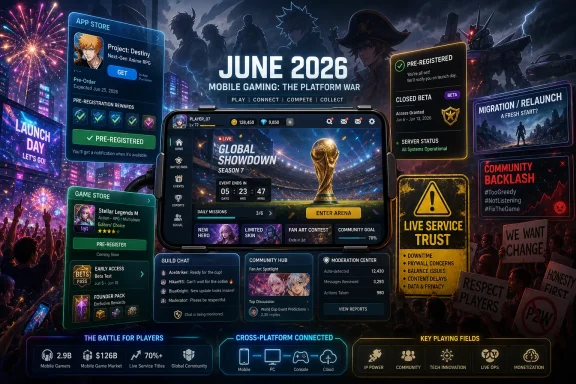 June Proved the Phone Is No Longer the Afterthought
The easy version of June’s mobile gaming story is a list: Game of Thrones: Dragonfire, CookieRun Classic, Pokémon Champions, DAVE THE DIVER, BanG Dream! Our Notes, Ni no Kuni: Cross Worlds, Love and Deepspace, and a small army of new releases, soft launches, closed betas, and pre-registration campaigns. The more useful version is that mobile publishers spent the month behaving as if the second half of 2026 will be won or lost before many players ever press “install.”That is why June felt so busy. A mobile launch is no longer a launch in the old sense; it is the public middle of a much longer funnel. Soft launch, closed beta, pre-registration, regional rollout, influencer beat, live-service patch, community backlash, and store featuring now blur into a single campaign that can last months.
The industry has learned to make anticipation itself playable. June’s biggest stories were often not games people could fully play everywhere, but games people could reserve, test, speculate about, or rage against. That is a very mobile kind of momentum: measured not only in downloads, but in wishlists, beta cohorts, Discord arguments, store-page screenshots, and angry posts translated across regions overnight.
For WindowsForum readers, the Windows angle is not merely whether these games will get PC clients. The more important question is how mobile habits keep bending the rest of gaming. Cross-save expectations, short-session design, live-service economics, platform exclusivity, and community management practices increasingly travel from mobile back to PC and console.
The First Week Set the Pattern: Launch Fast, Register Faster
The opening week of June came in hot, with a crowded slate that included Game of Thrones: Dragonfire, Dragonfall Kingdom, Soul Land: Awakening World, Gungrave G.O.R.E. UEE Mobile, Ever Night: Reawakening, Blue Fire, Matchday: Soccer Card Game, Skeletor: Until Next Time, and Star Blaster Offline Roguelike. That is a wide spread even by mobile standards: licensed strategy, anime RPG, action adaptation, football card game, offline roguelike, and experimental smaller releases all jostling for attention.The sheer variety matters. Mobile used to be caricatured as a market of match-three games, idle RPGs, and gacha banners. Those genres still dominate large parts of the business, but June showed how quickly the storefront has become a dumping ground and proving ground for almost every kind of game that can be compressed into touch controls or paired with a controller.
Pre-registration told the other half of the story. Pokémon Champions, Lost Twins 2, and CookieRun Classic all moved into the “not yet, but soon” phase that mobile publishers love because it turns marketing into measurable intent. A player who pre-registers has not bought anything, but they have entered the machine.
Closed beta activity around Marblebound and Wrestling Manager reinforced the same point. Mobile developers now treat limited testing as part QA, part community recruitment, part market research. For smaller studios, a closed beta can be the difference between a quiet launch and a visible one; for bigger publishers, it is a way to spot monetization friction before a global audience does.
The first week also included broader industry signals. HoYoverse’s defamation lawsuit win became a reminder that the largest mobile-adjacent studios now operate with the legal posture of entertainment conglomerates, not scrappy game makers. Meanwhile, Among Us expanding with an animated series showed how successful mobile-first or mobile-friendly properties increasingly become transmedia brands.
Football Took Over the Second Week, but It Wasn’t the Whole Match
The second week arrived with World Cup energy, and mobile publishers did what mobile publishers do best: they chased the calendar. Striker’s Instinct launched into a sports-hungry window, Captain Tsubasa: My Golden XI opened pre-registration, and Roblox’s FIFA World Cup 2026 collaboration underlined the gravitational pull of global football.Sports games are especially revealing on mobile because they sit at the intersection of licensing, live operations, seasonal events, and habitual play. The World Cup is not just a tournament for publishers; it is a retention opportunity. It gives developers a natural reason to schedule login events, themed packs, limited-time modes, and cross-promotions without having to invent a narrative excuse.
But June’s second week was not all football. The Blood of Youth: New World, God Rivals: RPG Roguelike, and Quack Quack Attack launched, while Driftfall, Flot Shelter, and Hoverboard Party entered soft launch in select regions. That mix again showed the split personality of mobile gaming: huge IP-driven campaigns on one side, nimble genre experiments on the other.
Testing also accelerated. Global closed beta announcements for Aniimo and Chasing Kaleidorider suggested that publishers still see early access-style feedback as essential before global mobile exposure. That exposure is brutal; a bad first week on app stores can attach itself to a game’s reputation long after the worst issues are patched.
Announcements for Don’t Starve Together, Choo-Choo Charles, BATTLE IN HELL’S PARADISE, ONE PIECE: Grand Gourmet, GigaBash, Godzilla Defense Force: X, and Operation Defuse added to the sense that recognizable IP and PC/console-adjacent brands are being fed into mobile’s pipeline at industrial scale. Some will become strong adaptations. Others will become cautionary tales about forcing games into formats they were not built for.
The week’s darker notes were just as important. Girls’ Frontline: Fire Control confirmed its shutdown, Snowbreak: Containment Zone faced another delay, and concern around Project GT continued. Mobile can make games look immortal because their icons linger on phones and stores, but live-service games are only alive as long as the server, publisher, and revenue curve agree.
The Mid-Month Rush Showed How Crowded the Middle Has Become
By the third week, June had settled into a rhythm: launches, pre-registrations, announcements, and live-service turbulence all arriving at once. Edge Breakers, Orange Pop!, Light and Night, Barbie Horse Ride & Rescue, Monster Boy, Wizzy Animals: Defense, Cascadou, and DK Mobile: Reborn all reached mobile players, while Hill Climb Racing 3 expanded its soft launch.That list is almost comically broad, but the breadth is the point. Mobile’s middle market is now a strange place where children’s brands, nostalgic platformers, MMORPGs, physics racers, puzzle defense games, and romance titles compete in the same app-store scroll. The storefront does not care whether a game took six years or six months to build; it reduces both to an icon, rating, title, and install button.
Pre-registration for Football Pro FC and Dawn’s Edge continued the month’s pipeline-building, while announcements for ARES: THE IRON VANGUARD, Kingdom Rush 6: Genesis, Case Solved, Aika Mobile, and Discounty pointed in different strategic directions. Some publishers are chasing fidelity and spectacle. Others are betting that smart genre execution still matters more than brand volume.
The return of Global Chat in Clash of Clans was one of the more interesting live-service developments because it touched a nerve older than most current mobile hits. Social features are powerful retention tools, but they are also moderation liabilities. Bringing back a broad chat feature in a major mobile game suggests Supercell sees community texture as worth the operational headache, or at least believes it can manage the risk better than before.
Legal trouble around Brawl Stars in France showed the other side of that maturity. The biggest mobile games are now large enough to attract sustained regulatory, legal, and consumer scrutiny. That scrutiny does not stay confined to mobile; debates over loot boxes, player safety, child protection, and digital ownership keep reshaping the wider games business.
Xbox reportedly exploring native mobile ports fit neatly into this broader picture. Microsoft has spent years talking about meeting players where they are, often through cloud streaming and subscriptions. Native mobile ports are a different admission: cloud is useful, but many players still want software that runs directly on the device in their hands.
The Fourth Week Was the Month’s Real Inflection Point
The fourth week was where June’s noise became unmistakably structural. Soccer Clash, Project Requiem: Survival, Pocket Legions, ONOMATOPIA, Pocket Horse: Racing Champion, Guild Wars Reforged, Crownlings, CookieRun Classic, and Zero Gunner 2 launched, while Transformers: Eternal War and Totally Mall entered soft launch.The arrivals alone would have made for a busy week, but the announcement slate was louder. MISTBOUND, Chainsaw Man’s first mobile game, Suikoden STAR LEAP, Marvel Project Comet, VA-11 Hall-A, a Caves of Qud mobile port, Clone Drone, Unhinged, and ColorSweeper all pushed into the mobile conversation. That is not a single trend; it is a land rush.
The Chainsaw Man and Marvel announcements are the obvious attention magnets. Big IP gives mobile publishers a head start in a market where discovery is punishing. But IP is not a substitute for trust, and mobile players have become adept at separating a beloved logo from a tolerable daily routine.
The more intriguing names may be VA-11 Hall-A and Caves of Qud. These are not the usual mobile-first brands, and their presence points to a quieter but important movement: phones and tablets as homes for deep, niche, text-heavy, or systems-driven games. That does not mean every cult PC title belongs on a touchscreen, but it does mean the old distinction between “mobile game” and “real game” is increasingly useless.
Google Play’s Mega Game Sale 2026 added a platform-level beat to the week. Sales are not glamorous, but they shape user habits. A major store promotion can revive older games, elevate indies, and train players to browse mobile storefronts with something closer to the curiosity PC players bring to Steam sales.
Then came the Ni no Kuni: Cross Worlds service-closure news ahead of a unified relaunch. That story captured the ambiguity of modern live-service operations. On paper, a unified global server model can improve matchmaking, consolidate fragmented regions, and simplify updates. To players, however, any shutdown-adjacent announcement sounds like a warning siren, even when migration paths and relaunch plans are promised.
Ni no Kuni Exposed the Fragile Meaning of “Live”
The Ni no Kuni: Cross Worlds situation deserves more attention than a normal shutdown note because it shows how slippery the language of live-service gaming has become. A game can be ending and continuing at the same time. A server can be closing while a relaunch is being marketed as a fresh start.For publishers, this can be a rational operational move. Fragmented regional services are expensive to maintain, especially when player populations thin unevenly. A unified client may make technical and business sense, particularly for MMORPG-style games that depend on visible population density.
For players, the emotional math is different. They remember purchases, guilds, cosmetics, time-limited rewards, and the sunk cost of routine. Even when account transfer systems are offered, a relaunch implies uncertainty: what carries over, what loses value, what changes in monetization, and whether the new version is truly an improvement or simply a reset with better messaging.
This is where mobile gaming’s greatest strength becomes its weakness. Live-service games promise continuity, but their business reality is constant revision. A boxed PC game can age, but it remains legible. A mobile MMO can become inaccessible, reconfigured, or reissued under a new service plan.
The industry has not solved the trust problem here. It has learned to soften it with transition rewards, migration windows, compensation packages, and carefully worded notices. But each closure or relaunch teaches players to be more skeptical about permanence, especially in games built around collection and long-term progression.
Pokémon Champions Turned Pre-Registration into a Cross-Platform Signal
Pokémon Champions was one of June’s most important mobile beats because Pokémon does not need mobile in the same way smaller franchises do. When Pokémon moves onto phones, it is not chasing visibility; it is expanding a habit. That makes its mobile release and pre-registration push a signal about where competitive and collection-driven play is heading.The appeal is obvious. A free-to-play Pokémon battler with mobile access can lower the barrier for players who may not own Nintendo hardware or who prefer short competitive sessions on a phone. Cross-platform save support further reinforces the idea that the account, not the device, is the center of the experience.
But Pokémon also brings scrutiny that many mobile games never face. Monetization that might be accepted in a lesser-known gacha battler feels different when attached to a franchise with decades of player attachment and a large younger audience. Bugs, missing features, or aggressive economy design become brand issues, not just launch issues.
That is the broader lesson for major IP holders entering mobile. Phones offer reach, but they also compress judgment. Players can install quickly, complain quickly, uninstall quickly, and broadcast screenshots of every perceived misstep. The bigger the brand, the less patience there is for mobile excuses.
The most durable mobile adaptations will not be the ones that merely shrink console concepts into touch-friendly menus. They will be the ones that understand why players use phones differently while still respecting the identity of the original franchise. That is a hard balance, and June showed several publishers trying to find it in public.
The Final Two Days Belonged to the Fandom Economy
The end of June looked quieter on paper but louder in practice. Mini Escapes: The Below launched on Android, while DAVE THE DIVER and BanG Dream! Our Notes opened pre-registration. Com2uS announced Zeus: God of Arrogance for mobile and PC in South Korea, targeting Q3 2026 with Unreal Engine 5 visuals and MMORPG-scale battles.DAVE THE DIVER is a particularly telling mobile candidate. Its mix of exploration, restaurant management, progression, and charm maps neatly onto portable play, but it also carries expectations from its success on other platforms. Players will be watching not only whether it runs well, but whether its pacing and monetization preserve the original’s appeal.
BanG Dream! Our Notes is a different kind of case. Rhythm and idol games thrive on mobile because the platform matches the ritual: daily play, event schedules, character attachment, and music libraries that expand over time. A closed beta in August gives Bilibili Game time to tune the experience before a wider 2026 launch, but the global audience will bring its own expectations about rewards, latency, localization, and account systems.
Zeus: God of Arrogance showed another familiar strategy: launch with PC and mobile in mind from the beginning. Cross-platform MMORPGs are no longer unusual, but they remain technically and socially difficult. PC players often want deeper controls and longer sessions; mobile players often expect automation, convenience, and shorter loops. Designing one economy and one combat system to satisfy both groups is much easier in a trailer than in a live game.
Then Love and Deepspace swallowed the conversation. The controversy around the newly revealed love interest escalated from online backlash into reports of real-world protest items being sent to Papergames or Infold offices, including funeral flowers, cow dung, and ritual objects. The details were surreal, but the underlying dynamic was not: a live-service fandom believed a developer had violated the emotional contract of the game.
Love and Deepspace Was the Month’s Warning Flare
The Love and Deepspace controversy was easy to mock because some reported behavior was grotesque and disproportionate. But dismissing the entire episode as fandom madness would miss why it mattered. This was a collision between character-driven monetization, parasocial attachment, regional aesthetics, and player expectations about who a game is “for.”Otome and romance-adjacent live-service games sell more than content. They sell intimacy, exclusivity, continuity, and the feeling that the player’s attachment is being recognized. When a new love interest enters that ecosystem, it is not equivalent to adding a new weapon or map. It can be perceived as reallocating narrative attention, event budgets, and emotional priority.
That does not justify harassment or real-world intimidation. It does explain why a character reveal could trigger a reaction far larger than outsiders expected. In these games, a roster change is a business decision wrapped in an emotional promise.
The reported cancellation or reversal around the new character also creates a dangerous precedent. On one hand, live-service developers must listen to their communities; ignoring core players can kill a game faster than any competitor. On the other hand, if extreme backlash appears to produce immediate creative concessions, the next controversy may begin at the level where the last one ended.
This is the trap mobile publishers have built for themselves. They cultivate daily dependency, emotional investment, limited-time fear, and identity-based fandom because those forces drive revenue. Then they act surprised when the same forces turn volatile. June’s mess was not an aberration; it was an outcome the business model makes more likely.
The Shutdowns Were as Revealing as the Launches
June’s launch calendar was busy enough to dominate the headlines, but the shutdowns and delays told the more mature story. Girls’ Frontline: Fire Control confirmed its shutdown. CounterSide shutdown news continued. eFootball exited Russia and Belarus. Ni no Kuni: Cross Worlds prepared its service transition. Snowbreak: Containment Zone faced another delay.Mobile gaming is often covered as a growth machine, but it is also an attrition machine. Every new launch enters a market already crowded with games that demand daily logins, seasonal spending, social obligation, and storage space. Players do not have infinite attention, and publishers do not have infinite patience.
The economics are unforgiving. If a game cannot sustain acquisition costs, retention curves, and spending targets, sentiment alone rarely saves it. Mobile communities may be passionate, but passion is not always evenly distributed across paying users, new users, and lapsed users.
Regional exits add another layer. Games operate inside app-store rules, payment systems, sanctions regimes, licensing constraints, and local regulations. A mobile title can be global in branding while still being deeply vulnerable to national and platform-specific decisions.
For IT pros, there is a familiar operational lesson here. Cloud services, SaaS tools, and mobile games all depend on continuity promises that are only as strong as the provider’s incentives. The consumer version has cuter icons and more anime characters, but the underlying risk is recognizable: when access is service-based, ownership becomes conditional.
The Month’s Real Story Was the Platform Stack
What tied June together was not genre, publisher, or geography. It was the platform stack: Apple and Google storefronts, regional soft launches, cross-platform accounts, live-service backends, social media outrage cycles, and licensed IP pipelines. Mobile gaming is no longer just software on a phone; it is a distribution and operations model.That model rewards speed. Developers can test in one region, adjust monetization, open pre-registration globally, trigger influencer campaigns, and update weekly. The downside is that every stage creates public evidence. Players now follow soft launches the way PC players follow early access builds, and they judge half-finished systems accordingly.
The model also rewards recognizable brands. Game of Thrones, Pokémon, Captain Tsubasa, Chainsaw Man, Marvel, Suikoden, Transformers, Godzilla, BanG Dream!, and DAVE THE DIVER all carried preexisting awareness into June’s mobile conversation. That is not a coincidence. In a crowded storefront, IP is the closest thing to paid search with a soul.
Yet the month also showed why IP cannot carry a bad service indefinitely. Players may arrive for the name, but they stay for economy design, update cadence, technical performance, and community trust. A famous franchise can make disappointment louder, not quieter.
This is why mobile gaming coverage increasingly resembles enterprise software coverage. The interesting questions are about lifecycle, account portability, regional availability, platform fees, regulatory exposure, identity systems, content cadence, and crisis response. The phone may be a consumer device, but the business behind it is industrial.
The June Ledger Favors Scale, but Not Comfort
The practical readout from June is less cheerful than the raw volume suggests. Yes, mobile gaming is vibrant. Yes, the release pipeline is enormous. Yes, developers from nearly every corner of the industry now see phones as mandatory territory.But vibrancy is not the same as health. A month this crowded creates discovery problems for developers and attention fatigue for players. The same calendar that makes mobile look unstoppable also makes individual games feel disposable.
The winners are likely to be publishers with strong operations, patient community teams, flexible infrastructure, and enough brand power to survive a rough week. The losers will be games that launch into the noise without a clear identity, or live services that mistake player attachment for player obedience.
June also reinforced a truth many mobile veterans already know: community management is product management. A controversial character, a delayed update, a shutdown notice, or a migration plan can matter as much as a combat system. In mobile, the game is the service, and the service is the relationship.
That relationship is getting harder to manage because players are more organized, more multilingual, and more willing to escalate. The next great mobile success will need more than monetization science. It will need political instincts.
June’s Mobile Calendar Leaves a Paper Trail for the Rest of 2026
The cleanest way to understand June is to treat it as a preview of the second half of the year. The month produced a launch wave, a pre-registration wave, a soft-launch wave, and a controversy wave all at once. That is not noise around the industry; that is the industry.- June’s busiest weeks showed that mobile publishers are increasingly using pre-registration and closed betas as the real start of a launch, not as marketing extras.
- Licensed and cross-platform games dominated attention, but smaller genre experiments continued to fill the gaps between major IP beats.
- Football and the 2026 World Cup gave mobile publishers a ready-made event calendar for sports games, Roblox activations, and limited-time campaigns.
- Service closures and relaunch plans reminded players that live-service permanence is conditional, even when publishers promise migration paths.
- The Love and Deepspace backlash showed how quickly character-driven monetization can turn into a trust crisis when fandom expectations are mishandled.
- The most important mobile games of late 2026 may be the ones that manage account systems, community trust, and update cadence as carefully as gameplay.
References
- Primary source: GamingonPhone
Published: 2026-07-01T14:50:16.066721
Loading…
gamingonphone.com - Related coverage: gurugamer.com
Loading…
gurugamer.com - Related coverage: nintendosoup.com
Loading…
nintendosoup.com - Related coverage: mobi.gg
Loading…
mobi.gg - Related coverage: pocketgamer.biz
Loading…
www.pocketgamer.biz - Related coverage: dexerto.com
Loading…
www.dexerto.com