

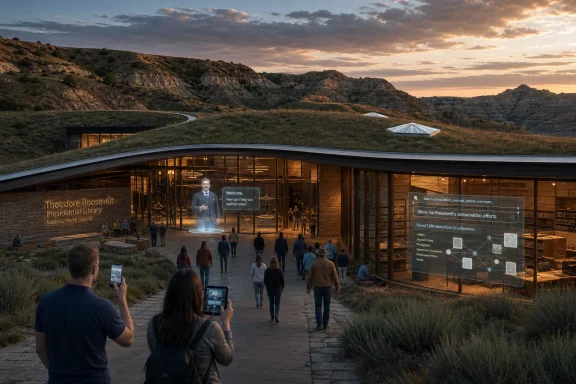
On July 4, 2026, the Theodore Roosevelt Presidential Library opens in Medora, North Dakota, with Microsoft-backed AI systems that let visitors search Roosevelt’s scattered archives and converse with a lifelike digital version of the 26th president. The headline is charmingly weird: Teddy Roosevelt, reanimated by a knowledge base. The larger story is more consequential. Microsoft is helping turn the museum from a building that stores history into a platform that performs it.
That distinction matters because this is not simply another touchscreen bolted onto an exhibit wall. The library is being positioned as a “living library,” a phrase that sounds like donor-friendly museum prose until you look at the architecture behind it. Hundreds of thousands of documents, long dispersed across dozens of collections, have been fed into an AI-backed system designed to organize, reconstruct, contextualize, and surface the historical record in natural language.
The result is part archive, part exhibit, part chatbot, and part test case for what cultural institutions may become when generative AI moves from novelty to infrastructure. For Microsoft, the Theodore Roosevelt Presidential Library is a prestige deployment of its AI-for-public-good pitch. For historians and visitors, it is an experiment in whether an AI interface can widen access to the past without flattening it into a parlor trick.
Theodore Roosevelt is an unusually good subject for this kind of experiment because he left behind a vast written trail. He was a president, soldier, rancher, reformer, conservationist, author, letter-writer, political brawler, and compulsive narrator of his own life. If generative AI needs a corpus to work from, Roosevelt provides one with muscle.
The problem is that abundance is not the same thing as access. According to the library, Roosevelt’s written record spent more than a century scattered across 32 collections at 18 institutions. That is the kind of fragmentation that professional historians learn to navigate but ordinary readers rarely even see.
Microsoft’s contribution, through its AI For Good Lab, is the technical spine of a system called Box 1. Archivists uploaded hundreds of thousands of historical documents into that environment, where AI could help organize them, enrich metadata, and reconstruct fragmented materials into searchable records. The language used around the project is careful: the AI is not being marketed as the historian. It is the retrieval layer, the connective tissue, the system that helps users ask better questions of a sprawling archive.
That restraint is important. The strongest version of this project is not an AI Roosevelt producing clever presidential fan fiction. It is an interface that makes primary sources easier to find, compare, and understand. If the system can reliably answer a plain-English question with Roosevelt’s actual letters, writings, photographs, and surrounding context, then it is doing something more useful than impersonation.
Still, impersonation is the part people will remember. The in-person exhibit includes a lifelike AI-powered avatar of Roosevelt that visitors can talk to about his experiences, leadership, and legacy. When a senator reportedly met the avatar in late June, the digital Roosevelt joked that the office was a place for people who speak the truth — “and for senators as well.” It is a neat line, and a revealing one, because it shows the balancing act at the heart of the project: the avatar must sound enough like Roosevelt to delight visitors, but not so much like a ghost that anyone forgets it is software.
The traditional presidential library model has always carried an access contradiction. These institutions preserve public history, but physical access depends on geography, travel budgets, time, and professional knowledge. A scholar knows where to look, whom to ask, and how to work through a finding aid. A high-school student in another state may know only that Roosevelt was a Rough Rider and that a teddy bear was named after him.
Natural-language search changes that front door. Instead of requiring visitors to know the archival structure, the system invites them to start with curiosity: What did Roosevelt write about conservation? How did he describe grief after the deaths of his wife and mother? What did he think about corporations, war, citizenship, race, or the presidency? A good AI retrieval system can translate those questions into archival pathways.
That is the promise, anyway. The risk is that conversational interfaces often create an illusion of completeness. A search box feels like a tool; a chatbot feels like an answer. If the system returns a coherent response, users may assume it has exhausted the record, resolved the ambiguity, and spoken with historical authority.
For a museum, that is dangerous terrain. Archives are full of gaps, contradictions, misdated materials, uncertain provenance, and context that changes with scholarship. An AI-powered reading room has to teach visitors that discovery is not the same thing as certainty. The best version of the Campfire Reading Room will not merely retrieve documents; it will show its work, preserve ambiguity, and make the messiness of history legible.
Microsoft and the library appear to understand that danger. Laura Hoffman of Microsoft’s AI For Good Lab has described the effort as an attempt to capture Roosevelt’s personality while keeping the experience safe and age-appropriate. The avatar is designed to demur or redirect when conversations go out of bounds. It also apparently avoids pretending to know modern figures as if Roosevelt had somehow been briefed on the 21st century.
That last point is more important than it sounds. One of the easiest ways for historical AI to become kitsch is to collapse time entirely. Ask Abraham Lincoln about cryptocurrency, ask Jane Austen about TikTok, ask Theodore Roosevelt about today’s Senate, and the system can produce fluent nonsense that entertains while teaching nothing. A responsible historical avatar must know not only what to say but what it cannot know.
The reported senator joke works because it does not require Roosevelt to recognize a current politician. It draws on a general political sensibility and a recognizable rhetorical style without pretending that the historical figure has current awareness. That is a narrow path, but it is the path such systems must walk.
The deeper issue is consent and authority. Roosevelt cannot approve his digital double. Historians, archivists, designers, and engineers are making interpretive decisions about tone, vocabulary, humor, ideology, and restraint. That does not make the project illegitimate; museums have always interpreted the dead. But AI makes interpretation feel conversational, and conversation feels intimate. That intimacy can obscure the institutional choices behind it.
That makes the building’s physical design part of the argument. The new library sits in the Badlands landscape rather than in a conventional capital-city setting. Its grass-covered form and skylit interior are meant to blend the institution into the terrain, not simply house artifacts inside a neutral box. Recent reporting has described a nearly 100,000-square-foot facility rising from a butte near Theodore Roosevelt National Park, with a roof planted in native grasses and interior materials meant to echo the Badlands.
This matters because AI exhibits are often criticized, fairly, for disembodying experience. Why go to a museum if the museum is just a chatbot? The Roosevelt library’s answer seems to be that the digital system and the landscape should reinforce each other. The online tool expands access to the documents; the physical site gives visitors a sensory relationship to the place that shaped the man.
That is a more compelling model than replacing museum-going with remote interaction. The best cultural technology does not make place irrelevant. It makes place more intelligible before, during, and after the visit.
There is also a tourism bet here. Medora is small, remote, and already tied to Theodore Roosevelt National Park, which draws hundreds of thousands of annual visitors. Opening the presidential library on July 4, 2026 — America’s 250th birthday — turns a regional cultural project into a national event. It also places the AI system inside a much larger story about patriotism, memory, conservation, and who gets to narrate American identity.
That does not mean it is free of strategic value. A successful deployment gives Microsoft a polished case study for AI in museums, archives, universities, libraries, and public-sector institutions. The company says it plans to release a paper documenting how the technology works and to open source the software used in the project. If that happens, the Roosevelt library could become a reference implementation for cultural AI.
Open sourcing the software would be a meaningful move, but it will not answer every question. The hard part of institutional AI is rarely the demo. It is governance, maintenance, provenance, copyright, accessibility, bias, cost, and trust. A museum can launch a dazzling AI experience in year one and then spend the next decade discovering that models change, APIs change, vendors change, funding changes, and visitor expectations change faster than exhibits used to.
The “living library” idea embraces that churn. Hoffman has argued that as generative AI improves and more documents are added to Box 1, the Roosevelt avatar and related tools can update with additional context. That is exactly the kind of freshness cultural institutions often struggle to maintain. Static exhibits age; software iterates.
But the same flexibility creates a preservation paradox. Museums exist partly to stabilize memory. AI systems are designed to evolve. If the interface changes, the model changes, or the underlying ranking logic changes, then the visitor’s encounter with Roosevelt changes too. Future curators may need to preserve not only documents and artifacts but versions of the AI experience itself.
They are not sufficient. A historical avatar has a different safety problem: it can accidentally launder modern assumptions through a famous voice. If a visitor asks Roosevelt about race, empire, labor unrest, immigration, policing, gender, or war, a sanitized answer could mislead as much as an offensive one. Roosevelt was a complicated figure with views and actions that do not map cleanly onto contemporary civic branding.
That is where AI systems often struggle. They are tuned to be helpful, smooth, and nonconfrontational. History is not smooth. A responsible Roosevelt avatar must be able to say, in effect, that Roosevelt held views common to his time that many people today rightly find troubling, while grounding that statement in documentary evidence. It must resist both hagiography and cheap presentism.
The same applies to leadership philosophy, one of the experience’s advertised themes. Roosevelt is an appealing leadership brand: energetic, direct, outdoorsy, reform-minded, quotable. But leadership without context becomes motivational wallpaper. The archive should complicate the avatar, not merely feed it lines.
This is the central test for the project. If visitors leave thinking they have met “Teddy” and received a set of timeless leadership tips, the technology has shrunk the man. If they leave wanting to read the documents, argue with the record, and understand how myth and evidence diverge, then the AI has done real public-history work.
That same pattern runs through enterprise copilots, customer-service agents, developer tools, and document intelligence systems. The presidential library is unusual because the corpus is historically rich and emotionally resonant. The underlying move is not unusual at all.
The lesson for IT pros is that the quality of the AI experience will depend less on the glamour of the model than on the condition of the data pipeline. Box 1 is interesting because it acknowledges the unglamorous work: archival ingestion, enrichment, reconstruction, metadata, context, and retrieval. Anyone who has tried to make AI useful inside a company will recognize the point. The chatbot is the visible tip; the knowledge base is the iceberg.
There is also a governance lesson. In a museum, bad retrieval can distort history. In an enterprise, bad retrieval can distort policy, compliance, customer records, or security procedures. The Roosevelt library dramatizes the same problem in a public setting: if users trust the conversational layer, the institution must be able to defend what sits beneath it.
That is why the promised technical paper and open-source release matter. Cultural institutions do not have the budgets or engineering staffs of Microsoft. If this approach is meant to travel beyond Medora, it needs to be inspectable, adaptable, and realistic for organizations that cannot afford a bespoke flagship build.
That makes the project vulnerable to overstatement. AI will not magically democratize history. Digitization alone has never guaranteed understanding, and natural-language search does not eliminate the need for teachers, archivists, curators, historians, or critical readers. If anything, better access increases the need for better interpretation.
But dismissing the effort as a gimmick would be too easy. Archives have always been shaped by tools: catalogs, indexes, microfilm, databases, scanning projects, optical character recognition, metadata standards, and search engines. Generative AI is another tool in that lineage, but one with a more persuasive voice. Its power lies in reducing friction; its danger lies in reducing skepticism.
The Roosevelt library’s bet is that the institution can capture the benefit without surrendering to the danger. It wants the warmth of a campfire and the rigor of an archive. It wants visitors to feel addressed by history without confusing simulation for resurrection.
That is a worthy experiment, provided the institution keeps reminding users where the performance ends and the record begins.
That distinction matters because this is not simply another touchscreen bolted onto an exhibit wall. The library is being positioned as a “living library,” a phrase that sounds like donor-friendly museum prose until you look at the architecture behind it. Hundreds of thousands of documents, long dispersed across dozens of collections, have been fed into an AI-backed system designed to organize, reconstruct, contextualize, and surface the historical record in natural language.
The result is part archive, part exhibit, part chatbot, and part test case for what cultural institutions may become when generative AI moves from novelty to infrastructure. For Microsoft, the Theodore Roosevelt Presidential Library is a prestige deployment of its AI-for-public-good pitch. For historians and visitors, it is an experiment in whether an AI interface can widen access to the past without flattening it into a parlor trick.
 Microsoft Turns the Presidential Library Into a Product Demo With a Soul
Theodore Roosevelt is an unusually good subject for this kind of experiment because he left behind a vast written trail. He was a president, soldier, rancher, reformer, conservationist, author, letter-writer, political brawler, and compulsive narrator of his own life. If generative AI needs a corpus to work from, Roosevelt provides one with muscle.The problem is that abundance is not the same thing as access. According to the library, Roosevelt’s written record spent more than a century scattered across 32 collections at 18 institutions. That is the kind of fragmentation that professional historians learn to navigate but ordinary readers rarely even see.
Microsoft’s contribution, through its AI For Good Lab, is the technical spine of a system called Box 1. Archivists uploaded hundreds of thousands of historical documents into that environment, where AI could help organize them, enrich metadata, and reconstruct fragmented materials into searchable records. The language used around the project is careful: the AI is not being marketed as the historian. It is the retrieval layer, the connective tissue, the system that helps users ask better questions of a sprawling archive.
That restraint is important. The strongest version of this project is not an AI Roosevelt producing clever presidential fan fiction. It is an interface that makes primary sources easier to find, compare, and understand. If the system can reliably answer a plain-English question with Roosevelt’s actual letters, writings, photographs, and surrounding context, then it is doing something more useful than impersonation.
Still, impersonation is the part people will remember. The in-person exhibit includes a lifelike AI-powered avatar of Roosevelt that visitors can talk to about his experiences, leadership, and legacy. When a senator reportedly met the avatar in late June, the digital Roosevelt joked that the office was a place for people who speak the truth — “and for senators as well.” It is a neat line, and a revealing one, because it shows the balancing act at the heart of the project: the avatar must sound enough like Roosevelt to delight visitors, but not so much like a ghost that anyone forgets it is software.
The Archive Is the Real Breakthrough, Not the Avatar
The temptation is to make the digital Roosevelt the story, because a presidential chatbot is the kind of sentence that writes its own headline. But the more durable innovation is the Campfire Reading Room, the AI-powered research tool built on the same Box 1 foundation. That tool will be available not only to visitors in Medora but to people online, which means the library’s most important room may not be a room at all.The traditional presidential library model has always carried an access contradiction. These institutions preserve public history, but physical access depends on geography, travel budgets, time, and professional knowledge. A scholar knows where to look, whom to ask, and how to work through a finding aid. A high-school student in another state may know only that Roosevelt was a Rough Rider and that a teddy bear was named after him.
Natural-language search changes that front door. Instead of requiring visitors to know the archival structure, the system invites them to start with curiosity: What did Roosevelt write about conservation? How did he describe grief after the deaths of his wife and mother? What did he think about corporations, war, citizenship, race, or the presidency? A good AI retrieval system can translate those questions into archival pathways.
That is the promise, anyway. The risk is that conversational interfaces often create an illusion of completeness. A search box feels like a tool; a chatbot feels like an answer. If the system returns a coherent response, users may assume it has exhausted the record, resolved the ambiguity, and spoken with historical authority.
For a museum, that is dangerous terrain. Archives are full of gaps, contradictions, misdated materials, uncertain provenance, and context that changes with scholarship. An AI-powered reading room has to teach visitors that discovery is not the same thing as certainty. The best version of the Campfire Reading Room will not merely retrieve documents; it will show its work, preserve ambiguity, and make the messiness of history legible.
The Lifelike Roosevelt Has to Be Entertaining Without Becoming Fake
The avatar is where the project moves from access into interpretation. A searchable archive can remain relatively sober; a talking Roosevelt must perform. That performance raises a harder editorial question: what does it mean for a museum to put words into the mouth of a dead president?Microsoft and the library appear to understand that danger. Laura Hoffman of Microsoft’s AI For Good Lab has described the effort as an attempt to capture Roosevelt’s personality while keeping the experience safe and age-appropriate. The avatar is designed to demur or redirect when conversations go out of bounds. It also apparently avoids pretending to know modern figures as if Roosevelt had somehow been briefed on the 21st century.
That last point is more important than it sounds. One of the easiest ways for historical AI to become kitsch is to collapse time entirely. Ask Abraham Lincoln about cryptocurrency, ask Jane Austen about TikTok, ask Theodore Roosevelt about today’s Senate, and the system can produce fluent nonsense that entertains while teaching nothing. A responsible historical avatar must know not only what to say but what it cannot know.
The reported senator joke works because it does not require Roosevelt to recognize a current politician. It draws on a general political sensibility and a recognizable rhetorical style without pretending that the historical figure has current awareness. That is a narrow path, but it is the path such systems must walk.
The deeper issue is consent and authority. Roosevelt cannot approve his digital double. Historians, archivists, designers, and engineers are making interpretive decisions about tone, vocabulary, humor, ideology, and restraint. That does not make the project illegitimate; museums have always interpreted the dead. But AI makes interpretation feel conversational, and conversation feels intimate. That intimacy can obscure the institutional choices behind it.
Medora Gives the Technology a Landscape It Could Not Invent
The library’s location in Medora is not incidental scenery. Roosevelt’s time in the Dakota Badlands in the 1880s became central to his personal mythology and political identity. He went west after devastating personal loss, invested in ranching, hunted, wrote, and later framed the landscape as a place that toughened him for public life.That makes the building’s physical design part of the argument. The new library sits in the Badlands landscape rather than in a conventional capital-city setting. Its grass-covered form and skylit interior are meant to blend the institution into the terrain, not simply house artifacts inside a neutral box. Recent reporting has described a nearly 100,000-square-foot facility rising from a butte near Theodore Roosevelt National Park, with a roof planted in native grasses and interior materials meant to echo the Badlands.
This matters because AI exhibits are often criticized, fairly, for disembodying experience. Why go to a museum if the museum is just a chatbot? The Roosevelt library’s answer seems to be that the digital system and the landscape should reinforce each other. The online tool expands access to the documents; the physical site gives visitors a sensory relationship to the place that shaped the man.
That is a more compelling model than replacing museum-going with remote interaction. The best cultural technology does not make place irrelevant. It makes place more intelligible before, during, and after the visit.
There is also a tourism bet here. Medora is small, remote, and already tied to Theodore Roosevelt National Park, which draws hundreds of thousands of annual visitors. Opening the presidential library on July 4, 2026 — America’s 250th birthday — turns a regional cultural project into a national event. It also places the AI system inside a much larger story about patriotism, memory, conservation, and who gets to narrate American identity.
Microsoft’s “AI for Good” Pitch Meets the Museum World’s Hardest Problem
Microsoft has spent the last several years trying to define AI not merely as a productivity accelerator but as civic infrastructure. The Theodore Roosevelt project fits neatly into that branding. It is educational, noncommercial in tone, culturally prestigious, and built around access to knowledge rather than job displacement or surveillance.That does not mean it is free of strategic value. A successful deployment gives Microsoft a polished case study for AI in museums, archives, universities, libraries, and public-sector institutions. The company says it plans to release a paper documenting how the technology works and to open source the software used in the project. If that happens, the Roosevelt library could become a reference implementation for cultural AI.
Open sourcing the software would be a meaningful move, but it will not answer every question. The hard part of institutional AI is rarely the demo. It is governance, maintenance, provenance, copyright, accessibility, bias, cost, and trust. A museum can launch a dazzling AI experience in year one and then spend the next decade discovering that models change, APIs change, vendors change, funding changes, and visitor expectations change faster than exhibits used to.
The “living library” idea embraces that churn. Hoffman has argued that as generative AI improves and more documents are added to Box 1, the Roosevelt avatar and related tools can update with additional context. That is exactly the kind of freshness cultural institutions often struggle to maintain. Static exhibits age; software iterates.
But the same flexibility creates a preservation paradox. Museums exist partly to stabilize memory. AI systems are designed to evolve. If the interface changes, the model changes, or the underlying ranking logic changes, then the visitor’s encounter with Roosevelt changes too. Future curators may need to preserve not only documents and artifacts but versions of the AI experience itself.
The Safety Problem Is Bigger Than Keeping Things PG
The library and Microsoft have emphasized safety protocols, especially because the avatar is meant for visitors of all ages. That likely means filters around profanity, sexual content, extremist prompts, harassment, and other obvious misuse. For a public museum, those guardrails are necessary.They are not sufficient. A historical avatar has a different safety problem: it can accidentally launder modern assumptions through a famous voice. If a visitor asks Roosevelt about race, empire, labor unrest, immigration, policing, gender, or war, a sanitized answer could mislead as much as an offensive one. Roosevelt was a complicated figure with views and actions that do not map cleanly onto contemporary civic branding.
That is where AI systems often struggle. They are tuned to be helpful, smooth, and nonconfrontational. History is not smooth. A responsible Roosevelt avatar must be able to say, in effect, that Roosevelt held views common to his time that many people today rightly find troubling, while grounding that statement in documentary evidence. It must resist both hagiography and cheap presentism.
The same applies to leadership philosophy, one of the experience’s advertised themes. Roosevelt is an appealing leadership brand: energetic, direct, outdoorsy, reform-minded, quotable. But leadership without context becomes motivational wallpaper. The archive should complicate the avatar, not merely feed it lines.
This is the central test for the project. If visitors leave thinking they have met “Teddy” and received a set of timeless leadership tips, the technology has shrunk the man. If they leave wanting to read the documents, argue with the record, and understand how myth and evidence diverge, then the AI has done real public-history work.
Windows Users Should Recognize the Pattern Behind the Curtain
For WindowsForum readers, the Roosevelt library may look like a cultural story at first glance, but its technical pattern is familiar. This is another instance of Microsoft pushing AI into a knowledge-work interface: ingest a corpus, structure it, retrieve from it, generate conversational responses, and wrap the result in an experience that feels less like search and more like dialogue.That same pattern runs through enterprise copilots, customer-service agents, developer tools, and document intelligence systems. The presidential library is unusual because the corpus is historically rich and emotionally resonant. The underlying move is not unusual at all.
The lesson for IT pros is that the quality of the AI experience will depend less on the glamour of the model than on the condition of the data pipeline. Box 1 is interesting because it acknowledges the unglamorous work: archival ingestion, enrichment, reconstruction, metadata, context, and retrieval. Anyone who has tried to make AI useful inside a company will recognize the point. The chatbot is the visible tip; the knowledge base is the iceberg.
There is also a governance lesson. In a museum, bad retrieval can distort history. In an enterprise, bad retrieval can distort policy, compliance, customer records, or security procedures. The Roosevelt library dramatizes the same problem in a public setting: if users trust the conversational layer, the institution must be able to defend what sits beneath it.
That is why the promised technical paper and open-source release matter. Cultural institutions do not have the budgets or engineering staffs of Microsoft. If this approach is meant to travel beyond Medora, it needs to be inspectable, adaptable, and realistic for organizations that cannot afford a bespoke flagship build.
The Presidential Library Becomes a Test of AI’s Civic Manners
The timing is almost too symbolic. A presidential library devoted to a mythic American figure opens on the 250th anniversary of the United States, using AI from one of the world’s most powerful technology companies to mediate the past. It is a museum story, a Microsoft story, a North Dakota story, and a democracy story all at once.That makes the project vulnerable to overstatement. AI will not magically democratize history. Digitization alone has never guaranteed understanding, and natural-language search does not eliminate the need for teachers, archivists, curators, historians, or critical readers. If anything, better access increases the need for better interpretation.
But dismissing the effort as a gimmick would be too easy. Archives have always been shaped by tools: catalogs, indexes, microfilm, databases, scanning projects, optical character recognition, metadata standards, and search engines. Generative AI is another tool in that lineage, but one with a more persuasive voice. Its power lies in reducing friction; its danger lies in reducing skepticism.
The Roosevelt library’s bet is that the institution can capture the benefit without surrendering to the danger. It wants the warmth of a campfire and the rigor of an archive. It wants visitors to feel addressed by history without confusing simulation for resurrection.
That is a worthy experiment, provided the institution keeps reminding users where the performance ends and the record begins.
The Badlands Experiment Leaves a Short Checklist for Everyone Else
The Theodore Roosevelt Presidential Library is not just launching an exhibit; it is publishing a template. Other museums, universities, local archives, and public libraries will be watching to see whether the mix of AI retrieval and embodied interaction creates deeper engagement or merely better marketing.- The most important technology in the project is the archival knowledge base, not the lifelike avatar visitors will photograph first.
- The strongest public benefit is remote access to Roosevelt’s scattered documents through ordinary language rather than specialist finding aids.
- The largest interpretive risk is that a conversational interface can make uncertain or incomplete historical evidence feel settled.
- The avatar will succeed only if it preserves historical distance, admits limits, and resists turning Roosevelt into a modern motivational assistant.
- Microsoft’s promise to document and open source the work will determine whether this becomes a reusable cultural-institution model or a one-off prestige project.
- The project’s long-term credibility will depend on transparent governance as much as on model quality.
References
- Primary source: Microsoft Source
Published: 2026-07-01T15:10:12.978519
Loading…
news.microsoft.com - Related coverage: trlibrary.com
Loading…
www.trlibrary.com - Related coverage: ndtourism.com
Loading…
www.ndtourism.com - Related coverage: doi.gov
Loading…
www.doi.gov - Related coverage: governor.nd.gov
Loading…
www.governor.nd.gov - Related coverage: fourth-july.com
Loading…
fourth-july.com