

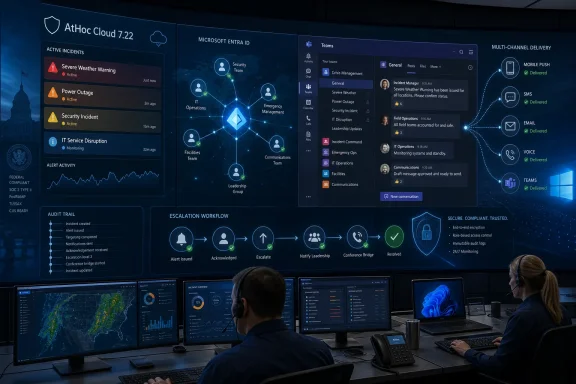
BlackBerry released BlackBerry AtHoc Cloud 7.22 on June 30, 2026, adding direct Microsoft Entra ID synchronization, expanded Microsoft Teams-based crisis collaboration, alert response comments, and other operator-focused changes for enterprise and government critical event management customers. The announcement is not just a feature-drop for a niche SaaS product; it is BlackBerry trying to put AtHoc where modern incident response actually happens. For WindowsForum readers, the story is less about BlackBerry’s old handset mythology and more about how emergency communications, identity governance, and collaboration platforms are converging into one operational stack.
The easiest way to misunderstand this AtHoc update is to treat it as another attempt by BlackBerry to reintroduce itself to enterprise IT. That ship sailed long ago. The modern BlackBerry is an infrastructure software company, and AtHoc sits in the part of the portfolio that still speaks directly to governments, regulated industries, emergency operations centers, and organizations where a missed notification can become a board-level event.
AtHoc has always lived in a category with a deceptively bland name: critical event management. The phrase sounds like procurement language, but the use cases are anything but abstract. Severe weather, cyber incidents, workplace violence, outages, evacuations, military base alerts, hospital disruptions, field-team accountability, and public-sector emergency response all depend on getting the right message to the right people while the organization is already under stress.
That is why the Microsoft integrations matter. BlackBerry is not merely adding another notification channel. It is acknowledging that the command surface for many organizations has shifted to Microsoft 365, with Teams as the collaboration hub and Entra ID as the identity fabric beneath it.
In other words, BlackBerry is trying to make AtHoc less of a separate emergency console and more of a system that plugs into the daily operating environment of Windows-heavy enterprises. That is the correct direction. The risk is that in a crisis, every dependency becomes part of the blast radius.
BlackBerry’s Teams work leans into that reality. The Microsoft AppSource listing for BlackBerry Critical Event Management for Microsoft Teams describes an experience where incident managers can send notifications, use established Teams channels for collaboration, and keep affected users informed through targeted two-way communications. That positioning is important because it does not try to make Teams the emergency management system by itself. It makes Teams one of the surfaces through which an emergency management system can operate.
That distinction matters. Teams is great at conversation, file sharing, meetings, and presence. It is not, by default, a full emergency notification platform with role-based targeting, accountability workflows, geofencing, audit trails, escalation paths, and delivery validation across multiple channels. AtHoc’s pitch is that Teams can be part of the response without becoming the only response.
For IT departments, that is a familiar pattern. Security teams already pipe alerts into Teams. DevOps teams use Teams for incident bridges. Facilities groups create channels during building problems. Executives often expect a Teams meeting before the formal incident report exists. AtHoc’s integration formalizes behavior that is already happening informally.
The catch is that informal behavior is often resilient precisely because it is flexible. Formalizing it through a crisis platform adds governance and repeatability, but it also adds configuration work, permissions, testing, and failure modes that administrators must understand before the first real emergency.
That sounds like hygiene, and in emergency communications hygiene is everything. A crisis notification platform is only as good as the people, roles, locations, groups, contact methods, and status attributes behind it. If the directory is stale, alerts go to ex-employees, contractors who no longer have access, people in the wrong office, or managers who changed roles six months ago.
Entra ID has become the center of gravity for Microsoft-oriented identity environments. It is where many organizations manage users, groups, conditional access, device posture, multifactor authentication, application assignments, lifecycle workflows, and increasingly, identity-related risk signals. Connecting AtHoc more directly to that source of truth reduces an old class of administrative drift.
It also changes who owns the quality of emergency communications. If AtHoc membership, attributes, and contactability are downstream of Entra ID, then identity teams become indirect stewards of crisis readiness. A bad attribute mapping is no longer merely an application provisioning bug. It can become an emergency response problem.
That is the kind of dependency sysadmins understand instinctively. Directory correctness is not glamorous. It is the plumbing nobody thanks you for until it fails.
BlackBerry’s Entra integration fits that world. Critical event management systems increasingly need to know not only that a person exists, but whether that person is in the right role, assigned to the right site, reachable through trusted channels, and authorized to trigger or manage sensitive communications. During a crisis, the difference between “all employees” and “all clinical staff on the east campus currently assigned to emergency operations” can be the difference between clarity and noise.
That is where AtHoc’s “mission orchestration” language starts to make sense, even if the branding sounds a little over-polished. Mass notification was once mostly about broadcasting. The modern requirement is coordination: gather status, route updates, account for people, escalate non-responses, document decisions, and keep leadership synchronized without flooding everyone else.
Identity-aware crisis management is the natural next step. If Entra is already the authoritative source for employees, groups, roles, and access, AtHoc can use that structure to target and manage responses. But the inverse is also true: if Entra is mismanaged, over-permissioned, or full of legacy groups nobody owns, the emergency platform inherits that disorder.
This is the central tradeoff of the update. BlackBerry is reducing manual administration, but it is also making AtHoc more dependent on the accuracy and resilience of Microsoft identity architecture.
Vendors that want enterprise adoption now have to decide whether to compete with that stack, sit beside it, or plug into it. BlackBerry has chosen the third path for AtHoc. That is pragmatic. A crisis platform that requires operators to abandon their normal workspace during an incident starts at a disadvantage.
The challenge is that Microsoft integrations are no longer a bonus feature; they are table stakes. Every emergency communications vendor can claim some flavor of Microsoft 365 integration. The differentiator is not the mere existence of a connector. It is whether the connector survives real operational pressure: complex tenants, hybrid identities, guest users, government clouds, conditional access policies, privileged roles, mobile constraints, mergers, shared services, and the thousand small irregularities that define enterprise IT.
That is where BlackBerry’s legacy could help. AtHoc has long been sold into high-assurance environments, including public-sector and defense-adjacent use cases. Those customers tend to punish shallow integrations quickly. If the new Entra sync and Teams workflows are designed with that world in mind, BlackBerry has a credible story.
If the integrations are thin, customers will notice just as quickly. In critical event management, demos are cheap and exercises are unforgiving.
BlackBerry has also emphasized FedRAMP-related readiness for AtHoc, including recent messaging around high-impact federal use. That matters because emergency communications products used by government agencies are judged not just on features, but on authorization posture, reliability, auditability, and whether they can be trusted during exactly the kind of disorder that breaks normal workflows.
For federal, state, local, and education customers, Microsoft Teams has become common enough that integrating crisis workflows into it makes practical sense. But public-sector environments often segment users, restrict app consent, enforce strict identity policies, and require careful review before third-party applications touch collaboration data or directory attributes.
That means the AtHoc update will not simply be “turned on” everywhere. It will need administrator review, security approval, identity mapping, pilot testing, training, and exercises. A local government or agency that has spent years cleaning up Entra ID will likely find the integration appealing. One with tangled groups, inconsistent user attributes, and legacy sync assumptions may find that the integration exposes old problems.
That is not a reason to avoid it. It is a reason to treat emergency communications as part of the identity and collaboration architecture, not as a sidecar purchased by a separate department.
This is not a theoretical concern. Microsoft 365 outages happen. Identity incidents happen. Conditional Access mistakes happen. DNS failures, network segmentation errors, expired certificates, compromised accounts, and tenant-wide configuration errors happen. During a cyberattack, administrators may intentionally restrict collaboration tools or disable accounts. During a physical disaster, users may be on mobile networks with uneven connectivity.
A crisis platform that integrates with Teams should not depend on Teams as its only path. AtHoc’s broader value proposition includes multi-channel communication and emergency notification beyond ordinary chat. That is the right architectural stance. Teams can be the command room, but it should not be the only siren.
The Entra side deserves the same caution. Direct synchronization improves user accuracy, but emergency access and operator authorization should be designed with failure scenarios in mind. If the identity provider is impaired, locked down, or under investigation, can authorized emergency managers still operate? Are there break-glass procedures? Are they tested? Are they documented outside the systems they are meant to recover?
These questions may sound tedious, but they are where crisis technology succeeds or fails. A platform used only during normal business hours is easy to admire. A platform used during a cascading infrastructure failure is much harder to trust.
AtHoc’s Microsoft integrations do not automatically prove durable revenue growth. They do, however, support a coherent strategic narrative: BlackBerry is trying to deepen its software footprint in operational resilience, secure communications, and mission-critical workflows. In a market where organizations are thinking harder about cyber resilience, geopolitical instability, climate events, and business continuity, that is not a bad place to be.
The revenue challenge is execution. Critical event management is important, but it is also a procurement-heavy category. Sales cycles can be long, budgets may sit outside central IT, and incumbent products are sticky because switching emergency communications systems requires retraining, migration, policy updates, and live exercises.
Microsoft alignment could help shorten some of that friction. If AtHoc plugs into Entra ID and Teams, it can argue that it fits the platform strategy many CIOs have already approved. That is a better story than asking customers to maintain a disconnected emergency database and a separate communications workflow.
Still, product integration is not the same as market dominance. BlackBerry must show that these features translate into adoption, renewals, expansion, and measurable operational value. Investors can celebrate momentum; administrators will wait for reliability.
That is the reality AtHoc is trying to replace. Organizations often discover during tabletop exercises that their crisis process depends on tribal knowledge. The person who knows the distribution list is on vacation. The building roster is wrong. Contractors are missing. The incident channel includes people who changed roles. A critical manager cannot receive mobile alerts because a device policy changed. Nobody knows whether a non-response means “unsafe,” “unreachable,” or “ignored.”
A direct Entra ID sync attacks part of that problem by reducing duplicated user management. Teams integration attacks another part by moving response coordination closer to where people already collaborate. Alert response comments add nuance, letting recipients provide more context than a binary acknowledgement.
None of that eliminates the need for planning. It does, however, make planning more likely to survive contact with reality. The more a crisis platform reflects the actual organization, the less it depends on heroic improvisation.
For sysadmins, the lesson is familiar: the best emergency workflow is the one that has already been embedded into normal operations, tested under constraints, and maintained as part of routine governance.
Traditional mass notification often treats users as endpoints: notify, acknowledge, move on. That model works for simple safety checks but falls short when responders need situational detail. “I am safe” is useful. “I am safe, but the north stairwell is blocked” is operationally different.
Comments can also help distinguish noncompliance from confusion. A user may be unable to evacuate, may be sheltering in place, may be with a visitor, may lack transportation, or may have observed a condition not captured by the original alert. Structured responses are good for reporting; free-text comments are often where the real intelligence appears.
The risk is information overload. During a large incident, hundreds or thousands of comments can become another stream nobody has time to read. BlackBerry’s broader orchestration claims will be tested by how well AtHoc helps operators sort, route, and act on that human detail.
Still, the direction is right. Emergency platforms should not merely shout. They should listen.
The Entra integration should trigger questions about provisioning scope, attribute authority, group ownership, service principals, consent policies, lifecycle handling, and audit logging. Which users flow into AtHoc? Which attributes matter for targeting? How quickly do changes sync? What happens when a user is disabled? How are contractors, guests, volunteers, or public-safety partners represented?
The Teams integration should trigger a different set of questions. Which channels can be used for incidents? Who can initiate alerts? Are messages retained according to policy? How do sensitivity labels, external access, private channels, or shared channels affect the workflow? Can mobile users act effectively under conditional access restrictions?
Security teams should also examine privilege boundaries. Emergency messaging systems can send high-trust communications at high speed. That power is useful and dangerous. A compromised operator account, poorly governed role, or overly broad Teams integration could create confusion during precisely the moment when clarity matters most.
This is where tabletop exercises become more than compliance theater. The right way to test AtHoc 7.22 is not to admire the integration diagram. It is to simulate a building outage, identity disruption, executive impersonation attempt, regional weather event, or ransomware containment scenario and watch where the process bends.
If BlackBerry can make AtHoc feel like a natural extension of a Microsoft tenant, it lowers the psychological cost of adoption. Customers can tell themselves they are not buying another isolated platform. They are adding a crisis orchestration layer to the identity and collaboration infrastructure they already operate.
That is a powerful story, but it puts BlackBerry in a delicate position. The closer AtHoc gets to Microsoft’s stack, the more customers will expect Microsoft-grade administration, logging, policy compatibility, documentation, and lifecycle behavior. “It integrates with Entra” is not enough. It has to integrate in ways that satisfy identity architects, security reviewers, and the person who gets paged when provisioning breaks.
There is also the strategic platform question. Microsoft has its own ambitions across security, compliance, identity, communications, and operations. Third-party vendors thrive in the Microsoft ecosystem when they do something Microsoft does not do deeply enough, or when they meet specialized requirements Microsoft does not prioritize. AtHoc’s best defense is specialization: government-grade emergency communications, multi-channel resilience, auditability, and crisis workflows that go beyond ordinary collaboration.
That is a plausible niche. It is not a small one. But it demands constant proof.
That is precisely why it may matter. Resilience is usually built out of boring things done consistently: accurate directories, tested workflows, clear ownership, hardened access, redundant channels, and tools that do not require users to learn a new behavior during an emergency.
The technology industry often sells crisis response as a dashboard problem. But incidents rarely fail because a dashboard lacks a gradient map or a dramatic command-center view. They fail because the roster is wrong, the message is ambiguous, the approval chain is unclear, the identity policy blocks a responder, or the conversation is happening in five places at once.
BlackBerry’s update appears to address those unglamorous failure points. Whether it does so well enough will depend on implementation, customer discipline, and the depth of the Microsoft integrations under real-world conditions.
For administrators, the value of this release is not that it makes AtHoc more modern. It is that it forces a healthier conversation about where crisis readiness actually lives: in identity, collaboration, communications, governance, and repeated practice.
 BlackBerry Is Selling Control, Not Nostalgia
The easiest way to misunderstand this AtHoc update is to treat it as another attempt by BlackBerry to reintroduce itself to enterprise IT. That ship sailed long ago. The modern BlackBerry is an infrastructure software company, and AtHoc sits in the part of the portfolio that still speaks directly to governments, regulated industries, emergency operations centers, and organizations where a missed notification can become a board-level event.AtHoc has always lived in a category with a deceptively bland name: critical event management. The phrase sounds like procurement language, but the use cases are anything but abstract. Severe weather, cyber incidents, workplace violence, outages, evacuations, military base alerts, hospital disruptions, field-team accountability, and public-sector emergency response all depend on getting the right message to the right people while the organization is already under stress.
That is why the Microsoft integrations matter. BlackBerry is not merely adding another notification channel. It is acknowledging that the command surface for many organizations has shifted to Microsoft 365, with Teams as the collaboration hub and Entra ID as the identity fabric beneath it.
In other words, BlackBerry is trying to make AtHoc less of a separate emergency console and more of a system that plugs into the daily operating environment of Windows-heavy enterprises. That is the correct direction. The risk is that in a crisis, every dependency becomes part of the blast radius.
The Teams Integration Recognizes Where Incidents Are Already Being Managed
Microsoft Teams has become one of the default places where enterprise incidents are discussed, triaged, escalated, and documented. That is true whether the incident is a ransomware scare, a building closure, a failed network change, or a business continuity event that forces leaders into an ad hoc war room before anyone has opened a formal incident tool.BlackBerry’s Teams work leans into that reality. The Microsoft AppSource listing for BlackBerry Critical Event Management for Microsoft Teams describes an experience where incident managers can send notifications, use established Teams channels for collaboration, and keep affected users informed through targeted two-way communications. That positioning is important because it does not try to make Teams the emergency management system by itself. It makes Teams one of the surfaces through which an emergency management system can operate.
That distinction matters. Teams is great at conversation, file sharing, meetings, and presence. It is not, by default, a full emergency notification platform with role-based targeting, accountability workflows, geofencing, audit trails, escalation paths, and delivery validation across multiple channels. AtHoc’s pitch is that Teams can be part of the response without becoming the only response.
For IT departments, that is a familiar pattern. Security teams already pipe alerts into Teams. DevOps teams use Teams for incident bridges. Facilities groups create channels during building problems. Executives often expect a Teams meeting before the formal incident report exists. AtHoc’s integration formalizes behavior that is already happening informally.
The catch is that informal behavior is often resilient precisely because it is flexible. Formalizing it through a crisis platform adds governance and repeatability, but it also adds configuration work, permissions, testing, and failure modes that administrators must understand before the first real emergency.
Entra ID Sync Is the Less Flashy Feature With the Bigger Operational Consequence
The Entra ID integration is likely the more consequential part of the AtHoc 7.22 update, even if it is less visually impressive than a Teams workflow. BlackBerry says AtHoc can now connect directly to Microsoft Entra ID and synchronize user data automatically, reducing reliance on the older manual User Sync Client model.That sounds like hygiene, and in emergency communications hygiene is everything. A crisis notification platform is only as good as the people, roles, locations, groups, contact methods, and status attributes behind it. If the directory is stale, alerts go to ex-employees, contractors who no longer have access, people in the wrong office, or managers who changed roles six months ago.
Entra ID has become the center of gravity for Microsoft-oriented identity environments. It is where many organizations manage users, groups, conditional access, device posture, multifactor authentication, application assignments, lifecycle workflows, and increasingly, identity-related risk signals. Connecting AtHoc more directly to that source of truth reduces an old class of administrative drift.
It also changes who owns the quality of emergency communications. If AtHoc membership, attributes, and contactability are downstream of Entra ID, then identity teams become indirect stewards of crisis readiness. A bad attribute mapping is no longer merely an application provisioning bug. It can become an emergency response problem.
That is the kind of dependency sysadmins understand instinctively. Directory correctness is not glamorous. It is the plumbing nobody thanks you for until it fails.
Crisis Platforms Are Becoming Identity-Aware Infrastructure
The AtHoc update arrives at a moment when Microsoft is tightening and modernizing many parts of Entra ID. Microsoft has been moving customers toward stronger authentication models, cleaner synchronization behavior, improved governance, and more consistent Conditional Access enforcement. The direction of travel is obvious: identity is not just login anymore; it is the control plane for the enterprise.BlackBerry’s Entra integration fits that world. Critical event management systems increasingly need to know not only that a person exists, but whether that person is in the right role, assigned to the right site, reachable through trusted channels, and authorized to trigger or manage sensitive communications. During a crisis, the difference between “all employees” and “all clinical staff on the east campus currently assigned to emergency operations” can be the difference between clarity and noise.
That is where AtHoc’s “mission orchestration” language starts to make sense, even if the branding sounds a little over-polished. Mass notification was once mostly about broadcasting. The modern requirement is coordination: gather status, route updates, account for people, escalate non-responses, document decisions, and keep leadership synchronized without flooding everyone else.
Identity-aware crisis management is the natural next step. If Entra is already the authoritative source for employees, groups, roles, and access, AtHoc can use that structure to target and manage responses. But the inverse is also true: if Entra is mismanaged, over-permissioned, or full of legacy groups nobody owns, the emergency platform inherits that disorder.
This is the central tradeoff of the update. BlackBerry is reducing manual administration, but it is also making AtHoc more dependent on the accuracy and resilience of Microsoft identity architecture.
The Microsoft Stack Is the New Gravity Well
For Windows shops, the gravitational pull of Microsoft 365 is hard to overstate. Teams is where work happens. Entra ID is where identity lives. SharePoint and OneDrive hold documents. Exchange Online remains the messaging backbone. Intune manages devices. Defender and Purview increasingly shape security and compliance operations.Vendors that want enterprise adoption now have to decide whether to compete with that stack, sit beside it, or plug into it. BlackBerry has chosen the third path for AtHoc. That is pragmatic. A crisis platform that requires operators to abandon their normal workspace during an incident starts at a disadvantage.
The challenge is that Microsoft integrations are no longer a bonus feature; they are table stakes. Every emergency communications vendor can claim some flavor of Microsoft 365 integration. The differentiator is not the mere existence of a connector. It is whether the connector survives real operational pressure: complex tenants, hybrid identities, guest users, government clouds, conditional access policies, privileged roles, mobile constraints, mergers, shared services, and the thousand small irregularities that define enterprise IT.
That is where BlackBerry’s legacy could help. AtHoc has long been sold into high-assurance environments, including public-sector and defense-adjacent use cases. Those customers tend to punish shallow integrations quickly. If the new Entra sync and Teams workflows are designed with that world in mind, BlackBerry has a credible story.
If the integrations are thin, customers will notice just as quickly. In critical event management, demos are cheap and exercises are unforgiving.
The Government Angle Is Not Incidental
AtHoc’s customer base and messaging have long tilted toward government, defense, public safety, and regulated sectors. That makes the Microsoft integrations more interesting than they would be for an ordinary SaaS collaboration add-on. Government agencies are increasingly Microsoft-heavy, but they also operate under procurement, security, auditing, and continuity constraints that complicate even simple integrations.BlackBerry has also emphasized FedRAMP-related readiness for AtHoc, including recent messaging around high-impact federal use. That matters because emergency communications products used by government agencies are judged not just on features, but on authorization posture, reliability, auditability, and whether they can be trusted during exactly the kind of disorder that breaks normal workflows.
For federal, state, local, and education customers, Microsoft Teams has become common enough that integrating crisis workflows into it makes practical sense. But public-sector environments often segment users, restrict app consent, enforce strict identity policies, and require careful review before third-party applications touch collaboration data or directory attributes.
That means the AtHoc update will not simply be “turned on” everywhere. It will need administrator review, security approval, identity mapping, pilot testing, training, and exercises. A local government or agency that has spent years cleaning up Entra ID will likely find the integration appealing. One with tangled groups, inconsistent user attributes, and legacy sync assumptions may find that the integration exposes old problems.
That is not a reason to avoid it. It is a reason to treat emergency communications as part of the identity and collaboration architecture, not as a sidecar purchased by a separate department.
A Better Crisis Workflow Still Needs a Plan B
The uncomfortable question for any Teams-integrated emergency platform is obvious: what happens when Teams is part of the incident?This is not a theoretical concern. Microsoft 365 outages happen. Identity incidents happen. Conditional Access mistakes happen. DNS failures, network segmentation errors, expired certificates, compromised accounts, and tenant-wide configuration errors happen. During a cyberattack, administrators may intentionally restrict collaboration tools or disable accounts. During a physical disaster, users may be on mobile networks with uneven connectivity.
A crisis platform that integrates with Teams should not depend on Teams as its only path. AtHoc’s broader value proposition includes multi-channel communication and emergency notification beyond ordinary chat. That is the right architectural stance. Teams can be the command room, but it should not be the only siren.
The Entra side deserves the same caution. Direct synchronization improves user accuracy, but emergency access and operator authorization should be designed with failure scenarios in mind. If the identity provider is impaired, locked down, or under investigation, can authorized emergency managers still operate? Are there break-glass procedures? Are they tested? Are they documented outside the systems they are meant to recover?
These questions may sound tedious, but they are where crisis technology succeeds or fails. A platform used only during normal business hours is easy to admire. A platform used during a cascading infrastructure failure is much harder to trust.
The Investor Story Is Real, but It Is Not the IT Story
The Simply Wall St framing highlights BlackBerry’s share price momentum, analyst target concerns, and valuation debate. That is useful context for investors, especially given the stock’s strong recent performance. But for IT professionals, the product question is separate from the trading question.AtHoc’s Microsoft integrations do not automatically prove durable revenue growth. They do, however, support a coherent strategic narrative: BlackBerry is trying to deepen its software footprint in operational resilience, secure communications, and mission-critical workflows. In a market where organizations are thinking harder about cyber resilience, geopolitical instability, climate events, and business continuity, that is not a bad place to be.
The revenue challenge is execution. Critical event management is important, but it is also a procurement-heavy category. Sales cycles can be long, budgets may sit outside central IT, and incumbent products are sticky because switching emergency communications systems requires retraining, migration, policy updates, and live exercises.
Microsoft alignment could help shorten some of that friction. If AtHoc plugs into Entra ID and Teams, it can argue that it fits the platform strategy many CIOs have already approved. That is a better story than asking customers to maintain a disconnected emergency database and a separate communications workflow.
Still, product integration is not the same as market dominance. BlackBerry must show that these features translate into adoption, renewals, expansion, and measurable operational value. Investors can celebrate momentum; administrators will wait for reliability.
The Real Competition Is Organizational Chaos
BlackBerry’s most serious competitor is not always another vendor. It is the spreadsheet, the stale call tree, the overloaded Teams channel, the emergency contact list maintained by one person in HR, the SMS blast tool nobody has tested in a year, and the assumption that “we’ll figure it out when it happens.”That is the reality AtHoc is trying to replace. Organizations often discover during tabletop exercises that their crisis process depends on tribal knowledge. The person who knows the distribution list is on vacation. The building roster is wrong. Contractors are missing. The incident channel includes people who changed roles. A critical manager cannot receive mobile alerts because a device policy changed. Nobody knows whether a non-response means “unsafe,” “unreachable,” or “ignored.”
A direct Entra ID sync attacks part of that problem by reducing duplicated user management. Teams integration attacks another part by moving response coordination closer to where people already collaborate. Alert response comments add nuance, letting recipients provide more context than a binary acknowledgement.
None of that eliminates the need for planning. It does, however, make planning more likely to survive contact with reality. The more a crisis platform reflects the actual organization, the less it depends on heroic improvisation.
For sysadmins, the lesson is familiar: the best emergency workflow is the one that has already been embedded into normal operations, tested under constraints, and maintained as part of routine governance.
Alert Response Comments Show the Shift From Broadcast to Dialogue
One of the quieter AtHoc 7.22 changes is support for alert response comments. It is easy to overlook because it does not have the enterprise-platform glamour of Entra ID or Teams. But in emergency communications, allowing recipients to add context can be extremely valuable.Traditional mass notification often treats users as endpoints: notify, acknowledge, move on. That model works for simple safety checks but falls short when responders need situational detail. “I am safe” is useful. “I am safe, but the north stairwell is blocked” is operationally different.
Comments can also help distinguish noncompliance from confusion. A user may be unable to evacuate, may be sheltering in place, may be with a visitor, may lack transportation, or may have observed a condition not captured by the original alert. Structured responses are good for reporting; free-text comments are often where the real intelligence appears.
The risk is information overload. During a large incident, hundreds or thousands of comments can become another stream nobody has time to read. BlackBerry’s broader orchestration claims will be tested by how well AtHoc helps operators sort, route, and act on that human detail.
Still, the direction is right. Emergency platforms should not merely shout. They should listen.
Admins Should Treat This as an Architecture Change
For a WindowsForum audience, the operational advice is straightforward: do not evaluate this update only from the AtHoc console. Evaluate it from Entra ID, Teams governance, mobile access, emergency operations, compliance, and business continuity at the same time.The Entra integration should trigger questions about provisioning scope, attribute authority, group ownership, service principals, consent policies, lifecycle handling, and audit logging. Which users flow into AtHoc? Which attributes matter for targeting? How quickly do changes sync? What happens when a user is disabled? How are contractors, guests, volunteers, or public-safety partners represented?
The Teams integration should trigger a different set of questions. Which channels can be used for incidents? Who can initiate alerts? Are messages retained according to policy? How do sensitivity labels, external access, private channels, or shared channels affect the workflow? Can mobile users act effectively under conditional access restrictions?
Security teams should also examine privilege boundaries. Emergency messaging systems can send high-trust communications at high speed. That power is useful and dangerous. A compromised operator account, poorly governed role, or overly broad Teams integration could create confusion during precisely the moment when clarity matters most.
This is where tabletop exercises become more than compliance theater. The right way to test AtHoc 7.22 is not to admire the integration diagram. It is to simulate a building outage, identity disruption, executive impersonation attempt, regional weather event, or ransomware containment scenario and watch where the process bends.
BlackBerry’s SaaS Ambition Runs Through the Microsoft Tenant
The broader business signal is that BlackBerry wants AtHoc to be seen as part of its recurring enterprise software identity, not as a legacy communications product with a niche installed base. That is why the Microsoft alignment is strategically useful. Microsoft 365 is where budgets, administrators, and compliance processes already converge.If BlackBerry can make AtHoc feel like a natural extension of a Microsoft tenant, it lowers the psychological cost of adoption. Customers can tell themselves they are not buying another isolated platform. They are adding a crisis orchestration layer to the identity and collaboration infrastructure they already operate.
That is a powerful story, but it puts BlackBerry in a delicate position. The closer AtHoc gets to Microsoft’s stack, the more customers will expect Microsoft-grade administration, logging, policy compatibility, documentation, and lifecycle behavior. “It integrates with Entra” is not enough. It has to integrate in ways that satisfy identity architects, security reviewers, and the person who gets paged when provisioning breaks.
There is also the strategic platform question. Microsoft has its own ambitions across security, compliance, identity, communications, and operations. Third-party vendors thrive in the Microsoft ecosystem when they do something Microsoft does not do deeply enough, or when they meet specialized requirements Microsoft does not prioritize. AtHoc’s best defense is specialization: government-grade emergency communications, multi-channel resilience, auditability, and crisis workflows that go beyond ordinary collaboration.
That is a plausible niche. It is not a small one. But it demands constant proof.
The AtHoc Update Is a Bet on Boring Resilience
The most important thing about AtHoc 7.22 is that its biggest ideas are almost boring. Sync users from the identity source. Coordinate in the collaboration tool people already use. Let recipients add context. Improve operator visibility. Align the interface with current branding. None of this sounds revolutionary.That is precisely why it may matter. Resilience is usually built out of boring things done consistently: accurate directories, tested workflows, clear ownership, hardened access, redundant channels, and tools that do not require users to learn a new behavior during an emergency.
The technology industry often sells crisis response as a dashboard problem. But incidents rarely fail because a dashboard lacks a gradient map or a dramatic command-center view. They fail because the roster is wrong, the message is ambiguous, the approval chain is unclear, the identity policy blocks a responder, or the conversation is happening in five places at once.
BlackBerry’s update appears to address those unglamorous failure points. Whether it does so well enough will depend on implementation, customer discipline, and the depth of the Microsoft integrations under real-world conditions.
For administrators, the value of this release is not that it makes AtHoc more modern. It is that it forces a healthier conversation about where crisis readiness actually lives: in identity, collaboration, communications, governance, and repeated practice.
The New AtHoc Is Only as Strong as the Tenant Beneath It
The practical read is that BlackBerry has made AtHoc more relevant to Microsoft-centric organizations, but customers should approach the update as an operational program rather than a switch to flip. The benefits are concrete, and so are the dependencies.- AtHoc Cloud 7.22 makes Microsoft Entra ID a more direct source of user data, which can reduce manual synchronization work and improve targeting accuracy if the directory is well governed.
- The Microsoft Teams integration reflects how many organizations already manage incidents in practice, but Teams should remain one channel in a broader emergency communications strategy.
- Alert response comments move AtHoc closer to two-way operational intelligence, though large incidents will require disciplined triage to avoid comment overload.
- Government and regulated customers may benefit most from tighter identity and collaboration integration, but they will also face the most demanding approval, audit, and testing requirements.
- The investor excitement around BlackBerry’s momentum should not be confused with proof of execution, because adoption, renewals, and crisis-tested reliability are the metrics that matter for this product category.
- IT teams evaluating the update should test identity failure, collaboration outage, mobile access, operator privilege, and stale-attribute scenarios before trusting the workflow in a live emergency.
References
- Primary source: simplywall.st
Published: Thu, 02 Jul 2026 08:45:04 GMT
Loading…
simplywall.st - Related coverage: blackberry.com
Loading…
www.blackberry.com - Official source: appsource.microsoft.com
Loading…
appsource.microsoft.com - Related coverage: docs.blackberry.com
Loading…
docs.blackberry.com - Official source: learn.microsoft.com
Microsoft Entra releases and announcements - Microsoft Entra | Microsoft Learn
Learn what is new with Microsoft Entra, such as the latest release notes, known issues, bug fixes, deprecated functionality, and upcoming changes.learn.microsoft.com - Official source: techcommunity.microsoft.com
Loading…
techcommunity.microsoft.com