

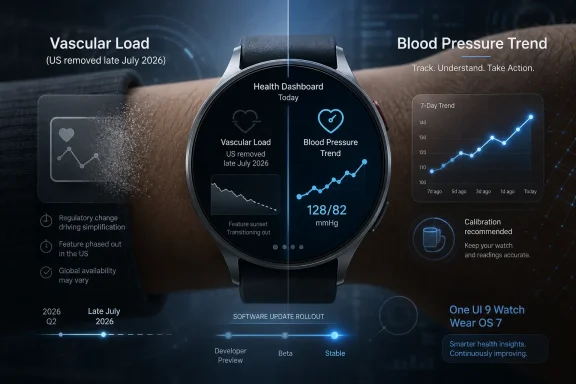
Samsung’s own Samsung Health notice says Vascular Load will be removed from Galaxy Watches in the United States in late July 2026, while a new Blood Pressure Trend feature will arrive with One UI 9 Watch on the upcoming Galaxy Watch 9 and Galaxy Watch Ultra 2. That is not a formal beta announcement, but it is the kind of breadcrumb Samsung often drops when its wearable software is already moving through the launch chute. The practical story is not merely that One UI 9 Watch may enter beta this month. It is that Samsung is turning its watches into regulated, region-sensitive health platforms where software availability matters almost as much as the hardware on your wrist.
The most interesting Samsung leaks rarely come from glossy marketing pages. They come from the places where product reality has to meet compliance reality: app notices, support documents, firmware strings, store listings, and regional disclaimers. This time, the clue appears to be Samsung Health telling users that Vascular Load is going away in the United States in late July, and that Blood Pressure Trend will arrive with One UI 9 Watch on Samsung’s next watches.
That timing matters because Samsung’s watch launches have settled into a familiar rhythm. New Galaxy Watches tend to debut with the next One UI Watch release, while older models follow through beta programs or staged stable rollouts. If the Galaxy Watch 9 and Galaxy Watch Ultra 2 are arriving later this month with One UI 9 Watch onboard, a beta for at least some older models would be entirely consistent with Samsung’s recent playbook.
But the notice does more than hint at a date. It also tells us what kind of update One UI 9 Watch is likely to be. This is not just a cosmetic layer on top of Wear OS 7. It is a health-platform update, a regulatory update, and a feature-segmentation update all at once.
That combination is increasingly the defining shape of modern smartwatch software. The operating system is no longer just the thing that runs apps and watch faces. It is the gatekeeper for what your device is allowed to measure, where it is allowed to measure it, and whether Samsung is comfortable describing that measurement as wellness guidance, medical-adjacent insight, or nothing at all.
Samsung reportedly positioned Vascular Load as an experimental or Labs-style feature, which is an important distinction. Labs features let companies test consumer appetite and collect feedback without promising the same level of permanence or medical authority as a fully cleared health function. They are also easier to remove when regional rules, clinical validation, or product strategy changes.
The U.S. removal is therefore not necessarily an admission that the feature was wrong. It may simply reflect that Samsung would rather ship a clearer blood-pressure-focused feature than keep a broader cardiovascular-load metric exposed in a market where health claims are scrutinized aggressively. The difference between “your vascular load changed overnight” and “your blood pressure trend is moving over time” may sound subtle to consumers, but it is enormous for lawyers, regulators, and product managers.
That is the paradox of smartwatch health features. The more useful they become, the less they can behave like ordinary software toggles. Samsung can change a watch face globally with minimal drama. It cannot treat cardiovascular interpretation the same way.
Samsung already has experience with blood pressure monitoring on Galaxy Watches, including a U.S. rollout that required careful framing and compatibility limits. A trend feature lets Samsung push the platform forward without pretending the watch has become a replacement for a cuff or a clinician. It can present directionality, consistency, and changes over time while avoiding the false precision that can make wearable health metrics dangerous.
The trade-off is friction. Blood pressure features typically require calibration with a traditional cuff, and that makes them less magical than passive overnight metrics. But for many users, especially those tracking cardiovascular health with a physician, calibrated trend data may be more useful than a proprietary wellness score whose meaning is difficult to compare across devices or doctors’ offices.
This is where Samsung’s strategy becomes clearer. Vascular Load may have been the more elegant consumer feature, but Blood Pressure Trend is the more defensible platform feature. It fits into Samsung Health, it can be explained in medical terms consumers already know, and it gives Samsung a stronger answer to Apple, Fitbit, Garmin, and Google without overclaiming what the sensor can do.
Since Samsung abandoned Tizen for the Google partnership, Galaxy Watch software has become a hybrid creature. Google supplies the Android-derived foundation, app ecosystem, Play Store integration, and platform services. Samsung supplies the interface, health stack, device continuity features, and the hardware-software integration that actually ships at scale.
That relationship has worked because both companies needed it. Google needed Samsung to make Wear OS relevant again. Samsung needed a broader app and developer ecosystem than Tizen could sustain alone. But every major update exposes the seams of that bargain.
Wear OS 7 reportedly brings broader interface and notification changes, including more dynamic information surfaces and closer alignment with Android’s current design and real-time update model. Samsung will then decide how much of that appears as Google intended and how much is filtered through One UI Watch conventions. The result will matter for users, but it will matter even more for developers who have to support watches that are technically Wear OS devices but behaviorally Samsung devices.
For IT-minded readers, that distinction is familiar. It is the Android equivalent of buying a Windows laptop and discovering that the OEM utilities, firmware update model, power profiles, and bundled security layers matter almost as much as the Windows version. The base platform sets the rules. The vendor experience determines the daily reality.
Wearables are unforgiving test beds. A phone bug can be annoying; a watch bug can be intimate. It can wreck sleep tracking, drain a tiny battery by lunchtime, break notifications during work, or record health data inconsistently enough to undermine trust in the entire platform.
That makes beta timing especially important. If Samsung opens One UI 9 Watch testing around the same window as the new devices, it can use early adopters on older watches to validate upgrade paths while reviewers and launch buyers test the Watch 9 family. The company gets parallel telemetry across new and old hardware, and users get a chance to see whether their existing watch feels refreshed or merely tolerated.
The risk is expectation management. A beta arriving near the launch of the Watch 9 and Watch Ultra 2 will inevitably be read as a promise that older watches are getting the best new features. That may not be true. Health features are increasingly tied to sensor generations, regulatory approvals, and market-specific permissions. One UI 9 Watch may reach a given older model without bringing every Watch 9 capability with it.
Still, software support is not the same thing as feature parity. A Galaxy Watch 7 or Galaxy Watch Ultra may be a strong candidate for One UI 9 Watch beta support, but that does not guarantee full access to every new health tool. Older models may lack required sensors, may not meet Samsung’s validation thresholds, or may be excluded from features Samsung wants to keep as launch differentiators for the Watch 9 line.
That is not unique to Samsung. Apple, Google, and Garmin all segment features across hardware generations. Sometimes the reason is genuinely technical. Sometimes it is commercial. Often it is both, and the user has no clean way to separate them.
The Vascular Load-to-Blood Pressure Trend shift makes that ambiguity sharper. If Samsung removes Vascular Load in the U.S. for existing users but reserves Blood Pressure Trend for new models at launch, some customers will feel that an existing feature was taken away and replaced with an upsell. Even if Samsung has a defensible regulatory or technical explanation, the optics will be delicate.
This is the burden of selling health as software. Users do not experience a removed metric as an abstract compliance adjustment. They experience it as a missing part of their daily routine.
Samsung’s notice reportedly says Vascular Load is being removed for U.S. users, not globally. That regional split is the real signal. We are no longer in an era where buying the same watch model means getting the same health platform everywhere.
For consumers, that creates confusion. For reviewers, it creates tedious caveats. For administrators managing corporate wellness programs or employee device fleets, it creates a policy problem: a wearable’s capabilities may vary by region, firmware, app version, account settings, and sometimes even the phone paired to it.
Microsoft and Windows admins have lived with similar complexity for years. A feature may exist in Windows, but availability depends on edition, region, policy, hardware capability, enrollment state, and update channel. Smartwatches are catching up to that same model, only with heart data and sleep data instead of BitLocker and Group Policy.
That is why the One UI 9 Watch beta matters beyond Samsung fandom. It is a preview of how consumer health tech is becoming managed software. The device on your wrist is less a finished appliance than a policy-controlled endpoint.
That maturation has advantages. It means longer support windows, more coherent branding, and a recognizable annual upgrade cadence. It also means Galaxy Watch owners need to think about update channels the way Galaxy phone owners already do: beta versus stable, new-device exclusives versus backports, and regional feature availability versus global marketing.
One UI 9 Watch could be a useful test of whether Samsung can communicate that complexity without irritating loyal customers. If the company is clear about which watches get the beta, which features require newer hardware, and why Vascular Load is disappearing in the U.S., the rollout can look disciplined. If it relies on vague app notices and fragmented regional messaging, it will look like a bait-and-switch even if the underlying reasons are legitimate.
The smartwatch category makes this harder because users attach emotion to health data. Nobody loves losing a phone camera filter, but people may care deeply about a cardiovascular metric they have watched for weeks or months. Samsung has to treat health-feature removals as trust events, not housekeeping.
That may be the most important lesson from this leak. One UI 9 Watch is not just a new build number. It is a trust negotiation.
If Samsung ships One UI 9 Watch smoothly, Google gets to claim platform momentum without having to win the entire wearable market on Pixel hardware alone. Developers get a larger target for Wear OS 7 features. Users get a more consistent sense that Android watches are not an afterthought.
If Samsung stumbles, the damage will not stay inside Samsung’s ecosystem. Wear OS has spent years recovering from the impression that it was fragmented, underpowered, and neglected. A messy update, especially one tied to removed health features, would revive exactly the kind of skepticism Google and Samsung have worked to bury.
This is why the beta is useful as a pressure valve. It lets Samsung expose defects to enthusiasts rather than the whole installed base. It also gives Google indirect feedback about how Wear OS 7 behaves outside Google’s own hardware assumptions.
The irony is that the more Samsung succeeds, the more Wear OS becomes identified with Samsung’s version of it. That is good for sales and awkward for platform purity. Android has seen this movie before.
The new competition is interpretation. Everyone can collect more signals than most users know what to do with. The hard part is turning those signals into advice that is accurate enough to be useful, conservative enough to be safe, and simple enough to be read at 7 a.m. before coffee.
Vascular Load belongs to the interpretation era. So does Blood Pressure Trend. So do readiness scores, energy scores, sleep coaching, recovery metrics, and AI-generated health summaries. These features are software products built on sensor inputs, and they will rise or fall on validation, transparency, and user trust.
Samsung wants to be seen as a serious health platform, not just a maker of attractive Android watches. That ambition requires more than new sensors. It requires Samsung Health to become a place where users believe the numbers mean something, where doctors are not horrified by screenshots, and where regulators do not see marketing language outrunning evidence.
One UI 9 Watch is therefore likely to be judged less by its launcher redesign than by how confidently Samsung handles this health transition. If Blood Pressure Trend feels clear, reliable, and responsibly framed, the removal of Vascular Load may fade quickly. If it feels restricted, confusing, or commercially gated, the feature swap will become the story.
That intimacy changes the marketing burden. Samsung can talk about AI, wellness, heart health, and longevity, but users will ask more practical questions. Will the watch last through the day with sleep tracking enabled? Will the new metrics be available in their country? Will older watches get them? Will Samsung remove another feature next year?
For the Galaxy Watch Ultra 2, the stakes are even higher. The Ultra line is supposed to justify a premium by combining durability, battery, sensors, and exclusivity. If One UI 9 Watch gives the Ultra 2 genuinely better health capabilities, Samsung can make a coherent case for the upgrade. If the differences are mostly watch faces and software locks, enthusiasts will notice.
The standard Galaxy Watch 9 has a different job. It has to make the mainstream Android smartwatch feel modern again. That means stable software, stronger battery life, cleaner notifications, better health trends, and less friction between the watch, the phone, and the cloud.
A beta this month would not answer all of those questions. But it would show whether Samsung is confident enough to put One UI 9 Watch in public hands before the broader rollout.
Users in the United States should pay closer attention to Samsung Health notices than usual. The Vascular Load removal is not a normal cosmetic change, and anyone who has been relying on that metric should export or screenshot anything they consider personally useful before the transition. Health dashboards have a way of feeling permanent until a server-side switch proves otherwise.
Beta testers should also be realistic. A watch beta can be more disruptive than a phone beta because the device’s battery margin is smaller and its sensors run continuously. If you rely on your Galaxy Watch for sleep tracking, workout records, notifications, or health reminders, installing a first beta build on your primary watch may be a poor trade.
That does not mean enthusiasts should avoid it. Betas are how Samsung finds edge cases, and Galaxy Watch users have historically been good at surfacing the bugs that do not show up in controlled labs. But the sensible posture is curiosity, not blind confidence.
That reset will probably look polished on stage. It will involve new hardware, a cleaner health narrative, and the usual promise that Galaxy devices work better together. But the real test will happen after the keynote, when existing users discover which pieces of the new platform flow backward and which remain locked to the new watches.
Samsung has earned some goodwill on long-term updates, but health-feature segmentation can spend that goodwill quickly. A user who bought a Galaxy Watch Ultra expecting a premium long-lived device will not be thrilled if meaningful health upgrades become annual hardware carrots. Conversely, Samsung cannot pretend older sensors can do everything newer sensors can do.
The company’s challenge is to be specific. Vague promises age badly. Clear compatibility tables, direct regional explanations, and honest calibration requirements would do more for Samsung’s credibility than another montage of glowing health rings.
 Samsung’s Health App Just Became the Launch Calendar
The most interesting Samsung leaks rarely come from glossy marketing pages. They come from the places where product reality has to meet compliance reality: app notices, support documents, firmware strings, store listings, and regional disclaimers. This time, the clue appears to be Samsung Health telling users that Vascular Load is going away in the United States in late July, and that Blood Pressure Trend will arrive with One UI 9 Watch on Samsung’s next watches.That timing matters because Samsung’s watch launches have settled into a familiar rhythm. New Galaxy Watches tend to debut with the next One UI Watch release, while older models follow through beta programs or staged stable rollouts. If the Galaxy Watch 9 and Galaxy Watch Ultra 2 are arriving later this month with One UI 9 Watch onboard, a beta for at least some older models would be entirely consistent with Samsung’s recent playbook.
But the notice does more than hint at a date. It also tells us what kind of update One UI 9 Watch is likely to be. This is not just a cosmetic layer on top of Wear OS 7. It is a health-platform update, a regulatory update, and a feature-segmentation update all at once.
That combination is increasingly the defining shape of modern smartwatch software. The operating system is no longer just the thing that runs apps and watch faces. It is the gatekeeper for what your device is allowed to measure, where it is allowed to measure it, and whether Samsung is comfortable describing that measurement as wellness guidance, medical-adjacent insight, or nothing at all.
Vascular Load Was Always a Risky Kind of Feature
Vascular Load is exactly the kind of wearable metric that sounds compelling in a keynote and complicated in the fine print. It promises a simplified view of stress on the cardiovascular system, the sort of overnight or passive signal that makes a smartwatch feel smarter than a step counter. But features like this live in a gray zone: useful enough to influence behavior, abstract enough to invite misunderstanding, and close enough to cardiovascular health to attract regulatory caution.Samsung reportedly positioned Vascular Load as an experimental or Labs-style feature, which is an important distinction. Labs features let companies test consumer appetite and collect feedback without promising the same level of permanence or medical authority as a fully cleared health function. They are also easier to remove when regional rules, clinical validation, or product strategy changes.
The U.S. removal is therefore not necessarily an admission that the feature was wrong. It may simply reflect that Samsung would rather ship a clearer blood-pressure-focused feature than keep a broader cardiovascular-load metric exposed in a market where health claims are scrutinized aggressively. The difference between “your vascular load changed overnight” and “your blood pressure trend is moving over time” may sound subtle to consumers, but it is enormous for lawyers, regulators, and product managers.
That is the paradox of smartwatch health features. The more useful they become, the less they can behave like ordinary software toggles. Samsung can change a watch face globally with minimal drama. It cannot treat cardiovascular interpretation the same way.
Blood Pressure Trend Is the Safer Bet
Blood Pressure Trend sounds less futuristic than Vascular Load, but that may be the point. Blood pressure is a familiar measurement with a familiar clinical context. Users understand that it involves calibration, periodic readings, and long-term patterns rather than a mysterious single-score estimate of vascular strain.Samsung already has experience with blood pressure monitoring on Galaxy Watches, including a U.S. rollout that required careful framing and compatibility limits. A trend feature lets Samsung push the platform forward without pretending the watch has become a replacement for a cuff or a clinician. It can present directionality, consistency, and changes over time while avoiding the false precision that can make wearable health metrics dangerous.
The trade-off is friction. Blood pressure features typically require calibration with a traditional cuff, and that makes them less magical than passive overnight metrics. But for many users, especially those tracking cardiovascular health with a physician, calibrated trend data may be more useful than a proprietary wellness score whose meaning is difficult to compare across devices or doctors’ offices.
This is where Samsung’s strategy becomes clearer. Vascular Load may have been the more elegant consumer feature, but Blood Pressure Trend is the more defensible platform feature. It fits into Samsung Health, it can be explained in medical terms consumers already know, and it gives Samsung a stronger answer to Apple, Fitbit, Garmin, and Google without overclaiming what the sensor can do.
One UI 9 Watch Is Really Wear OS 7 Wearing Samsung’s Suit
One UI 9 Watch is expected to be Samsung’s customized layer over Wear OS 7, the next major version of Google’s smartwatch operating system. That means the update is not only about Samsung Health. It is also about how Samsung absorbs Google’s platform changes while preserving the Galaxy Watch identity that made the Wear OS revival commercially credible in the first place.Since Samsung abandoned Tizen for the Google partnership, Galaxy Watch software has become a hybrid creature. Google supplies the Android-derived foundation, app ecosystem, Play Store integration, and platform services. Samsung supplies the interface, health stack, device continuity features, and the hardware-software integration that actually ships at scale.
That relationship has worked because both companies needed it. Google needed Samsung to make Wear OS relevant again. Samsung needed a broader app and developer ecosystem than Tizen could sustain alone. But every major update exposes the seams of that bargain.
Wear OS 7 reportedly brings broader interface and notification changes, including more dynamic information surfaces and closer alignment with Android’s current design and real-time update model. Samsung will then decide how much of that appears as Google intended and how much is filtered through One UI Watch conventions. The result will matter for users, but it will matter even more for developers who have to support watches that are technically Wear OS devices but behaviorally Samsung devices.
For IT-minded readers, that distinction is familiar. It is the Android equivalent of buying a Windows laptop and discovering that the OEM utilities, firmware update model, power profiles, and bundled security layers matter almost as much as the Windows version. The base platform sets the rules. The vendor experience determines the daily reality.
The Beta Is Less About New Toys Than Damage Control
If One UI 9 Watch beta appears this month, enthusiasts will naturally install it looking for new watch faces, animations, battery tweaks, and health dashboards. That is part of the fun. But Samsung’s more serious reason for a beta is to flush out the ugly interactions between firmware, sensors, Samsung Health, Google services, carrier variants, and regional feature flags before the stable rollout reaches millions of wrists.Wearables are unforgiving test beds. A phone bug can be annoying; a watch bug can be intimate. It can wreck sleep tracking, drain a tiny battery by lunchtime, break notifications during work, or record health data inconsistently enough to undermine trust in the entire platform.
That makes beta timing especially important. If Samsung opens One UI 9 Watch testing around the same window as the new devices, it can use early adopters on older watches to validate upgrade paths while reviewers and launch buyers test the Watch 9 family. The company gets parallel telemetry across new and old hardware, and users get a chance to see whether their existing watch feels refreshed or merely tolerated.
The risk is expectation management. A beta arriving near the launch of the Watch 9 and Watch Ultra 2 will inevitably be read as a promise that older watches are getting the best new features. That may not be true. Health features are increasingly tied to sensor generations, regulatory approvals, and market-specific permissions. One UI 9 Watch may reach a given older model without bringing every Watch 9 capability with it.
Older Galaxy Watches May Get the Platform Without the Headline
Samsung has generally been better than the old Android stereotype when it comes to supporting recent Galaxy Watches. The company has promised multiple generations of Wear OS and One UI Watch upgrades for models released since the Wear OS transition, and that has helped reassure buyers that a Galaxy Watch is not disposable after one summer.Still, software support is not the same thing as feature parity. A Galaxy Watch 7 or Galaxy Watch Ultra may be a strong candidate for One UI 9 Watch beta support, but that does not guarantee full access to every new health tool. Older models may lack required sensors, may not meet Samsung’s validation thresholds, or may be excluded from features Samsung wants to keep as launch differentiators for the Watch 9 line.
That is not unique to Samsung. Apple, Google, and Garmin all segment features across hardware generations. Sometimes the reason is genuinely technical. Sometimes it is commercial. Often it is both, and the user has no clean way to separate them.
The Vascular Load-to-Blood Pressure Trend shift makes that ambiguity sharper. If Samsung removes Vascular Load in the U.S. for existing users but reserves Blood Pressure Trend for new models at launch, some customers will feel that an existing feature was taken away and replaced with an upsell. Even if Samsung has a defensible regulatory or technical explanation, the optics will be delicate.
This is the burden of selling health as software. Users do not experience a removed metric as an abstract compliance adjustment. They experience it as a missing part of their daily routine.
The U.S. Is Becoming the Hardest Market for Wearable Health
The United States is often the priority market for consumer electronics, but health features complicate that assumption. A feature can be technically ready, commercially desirable, and already available elsewhere, yet still arrive late or in modified form in the U.S. because the regulatory and liability environment is different.Samsung’s notice reportedly says Vascular Load is being removed for U.S. users, not globally. That regional split is the real signal. We are no longer in an era where buying the same watch model means getting the same health platform everywhere.
For consumers, that creates confusion. For reviewers, it creates tedious caveats. For administrators managing corporate wellness programs or employee device fleets, it creates a policy problem: a wearable’s capabilities may vary by region, firmware, app version, account settings, and sometimes even the phone paired to it.
Microsoft and Windows admins have lived with similar complexity for years. A feature may exist in Windows, but availability depends on edition, region, policy, hardware capability, enrollment state, and update channel. Smartwatches are catching up to that same model, only with heart data and sleep data instead of BitLocker and Group Policy.
That is why the One UI 9 Watch beta matters beyond Samsung fandom. It is a preview of how consumer health tech is becoming managed software. The device on your wrist is less a finished appliance than a policy-controlled endpoint.
Samsung’s Watch Strategy Is Becoming More Like Its Phone Strategy
Samsung’s phone software has spent the past few years becoming more predictable, more layered, and more strategically segmented. Flagship devices debut features, older flagships receive many of them later, midrange devices get a filtered subset, and regional rollouts stagger across weeks or months. The watch line is now following the same pattern.That maturation has advantages. It means longer support windows, more coherent branding, and a recognizable annual upgrade cadence. It also means Galaxy Watch owners need to think about update channels the way Galaxy phone owners already do: beta versus stable, new-device exclusives versus backports, and regional feature availability versus global marketing.
One UI 9 Watch could be a useful test of whether Samsung can communicate that complexity without irritating loyal customers. If the company is clear about which watches get the beta, which features require newer hardware, and why Vascular Load is disappearing in the U.S., the rollout can look disciplined. If it relies on vague app notices and fragmented regional messaging, it will look like a bait-and-switch even if the underlying reasons are legitimate.
The smartwatch category makes this harder because users attach emotion to health data. Nobody loves losing a phone camera filter, but people may care deeply about a cardiovascular metric they have watched for weeks or months. Samsung has to treat health-feature removals as trust events, not housekeeping.
That may be the most important lesson from this leak. One UI 9 Watch is not just a new build number. It is a trust negotiation.
Google Gets a Quieter Win If Samsung Ships Smoothly
Google’s role in this story is easy to understate because Samsung branding dominates the Galaxy Watch experience. But Wear OS 7’s credibility will depend heavily on how well Samsung deploys it. Pixel Watch matters, but Samsung remains the volume and visibility partner that gives Wear OS its mainstream Android smartwatch identity.If Samsung ships One UI 9 Watch smoothly, Google gets to claim platform momentum without having to win the entire wearable market on Pixel hardware alone. Developers get a larger target for Wear OS 7 features. Users get a more consistent sense that Android watches are not an afterthought.
If Samsung stumbles, the damage will not stay inside Samsung’s ecosystem. Wear OS has spent years recovering from the impression that it was fragmented, underpowered, and neglected. A messy update, especially one tied to removed health features, would revive exactly the kind of skepticism Google and Samsung have worked to bury.
This is why the beta is useful as a pressure valve. It lets Samsung expose defects to enthusiasts rather than the whole installed base. It also gives Google indirect feedback about how Wear OS 7 behaves outside Google’s own hardware assumptions.
The irony is that the more Samsung succeeds, the more Wear OS becomes identified with Samsung’s version of it. That is good for sales and awkward for platform purity. Android has seen this movie before.
The Health Feature Race Is Moving From Sensors to Interpretation
For years, smartwatch competition was easy to describe in hardware terms. Which device had ECG? Which had blood oxygen? Which had skin temperature? Which had better GPS, battery life, or optical heart-rate accuracy? That race is not over, but the center of gravity is shifting.The new competition is interpretation. Everyone can collect more signals than most users know what to do with. The hard part is turning those signals into advice that is accurate enough to be useful, conservative enough to be safe, and simple enough to be read at 7 a.m. before coffee.
Vascular Load belongs to the interpretation era. So does Blood Pressure Trend. So do readiness scores, energy scores, sleep coaching, recovery metrics, and AI-generated health summaries. These features are software products built on sensor inputs, and they will rise or fall on validation, transparency, and user trust.
Samsung wants to be seen as a serious health platform, not just a maker of attractive Android watches. That ambition requires more than new sensors. It requires Samsung Health to become a place where users believe the numbers mean something, where doctors are not horrified by screenshots, and where regulators do not see marketing language outrunning evidence.
One UI 9 Watch is therefore likely to be judged less by its launcher redesign than by how confidently Samsung handles this health transition. If Blood Pressure Trend feels clear, reliable, and responsibly framed, the removal of Vascular Load may fade quickly. If it feels restricted, confusing, or commercially gated, the feature swap will become the story.
The Watch 9 Launch Could Define the Upgrade Mood for 2026
Samsung’s next Unpacked cycle is expected to bring the Galaxy Watch 9 and Galaxy Watch Ultra 2 alongside the usual summer hardware parade. Watches rarely dominate those events, but they increasingly serve as Samsung’s most personal ecosystem pitch. A phone is something you use. A watch is something Samsung asks you to sleep with.That intimacy changes the marketing burden. Samsung can talk about AI, wellness, heart health, and longevity, but users will ask more practical questions. Will the watch last through the day with sleep tracking enabled? Will the new metrics be available in their country? Will older watches get them? Will Samsung remove another feature next year?
For the Galaxy Watch Ultra 2, the stakes are even higher. The Ultra line is supposed to justify a premium by combining durability, battery, sensors, and exclusivity. If One UI 9 Watch gives the Ultra 2 genuinely better health capabilities, Samsung can make a coherent case for the upgrade. If the differences are mostly watch faces and software locks, enthusiasts will notice.
The standard Galaxy Watch 9 has a different job. It has to make the mainstream Android smartwatch feel modern again. That means stable software, stronger battery life, cleaner notifications, better health trends, and less friction between the watch, the phone, and the cloud.
A beta this month would not answer all of those questions. But it would show whether Samsung is confident enough to put One UI 9 Watch in public hands before the broader rollout.
The Practical Read for Galaxy Watch Owners Is Patience With a Raised Eyebrow
For current Galaxy Watch owners, the immediate advice is simple: do not treat the beta rumor as a guaranteed upgrade schedule. Samsung has not made a formal public beta announcement for One UI 9 Watch at the time of writing, and the evidence points to a plausible window rather than a published timetable. Late July is the important marker, but it is not the same thing as “your watch gets the beta on this date.”Users in the United States should pay closer attention to Samsung Health notices than usual. The Vascular Load removal is not a normal cosmetic change, and anyone who has been relying on that metric should export or screenshot anything they consider personally useful before the transition. Health dashboards have a way of feeling permanent until a server-side switch proves otherwise.
Beta testers should also be realistic. A watch beta can be more disruptive than a phone beta because the device’s battery margin is smaller and its sensors run continuously. If you rely on your Galaxy Watch for sleep tracking, workout records, notifications, or health reminders, installing a first beta build on your primary watch may be a poor trade.
That does not mean enthusiasts should avoid it. Betas are how Samsung finds edge cases, and Galaxy Watch users have historically been good at surfacing the bugs that do not show up in controlled labs. But the sensible posture is curiosity, not blind confidence.
The Late-July Clue Says More Than Samsung Intended
The strongest signal in Samsung’s notice is not the specific wording around Vascular Load. It is the collision of timing, platform version, and product names. Late July, One UI 9 Watch, Galaxy Watch 9, Galaxy Watch Ultra 2, Samsung Health 7.0, and a U.S.-specific feature change all point to the same conclusion: Samsung is preparing a coordinated wearable software reset.That reset will probably look polished on stage. It will involve new hardware, a cleaner health narrative, and the usual promise that Galaxy devices work better together. But the real test will happen after the keynote, when existing users discover which pieces of the new platform flow backward and which remain locked to the new watches.
Samsung has earned some goodwill on long-term updates, but health-feature segmentation can spend that goodwill quickly. A user who bought a Galaxy Watch Ultra expecting a premium long-lived device will not be thrilled if meaningful health upgrades become annual hardware carrots. Conversely, Samsung cannot pretend older sensors can do everything newer sensors can do.
The company’s challenge is to be specific. Vague promises age badly. Clear compatibility tables, direct regional explanations, and honest calibration requirements would do more for Samsung’s credibility than another montage of glowing health rings.
The Galaxy Watch Upgrade Path Now Runs Through the Fine Print
Samsung’s apparent late-July One UI 9 Watch window leaves Galaxy Watch owners with a few concrete things to watch before installing anything or buying new hardware.- One UI 9 Watch is likely tied to the Galaxy Watch 9 and Galaxy Watch Ultra 2 launch window, but a public beta for older models remains plausible rather than officially confirmed.
- Vascular Load is reportedly being removed from Galaxy Watches in the United States with Samsung Health 7.0 and the One UI 9 Watch transition.
- Blood Pressure Trend appears positioned as Samsung’s replacement health feature, but its availability may depend on region, model, calibration, and regulatory framing.
- Wear OS 7 will provide the Google platform foundation, while Samsung’s One UI Watch layer will determine the experience most Galaxy Watch users actually see.
- Owners of older Galaxy Watches should expect the platform update and headline health features to be separate questions, not a single guarantee.
- Anyone who depends on their watch for daily health tracking should be cautious about early beta builds and should read Samsung Health notices carefully before the late-July changeover.
References
- Primary source: SamMobile
Published: Thu, 02 Jul 2026 07:42:00 GMT
Loading…
www.sammobile.com - Related coverage: sammyfans.com
Loading…
www.sammyfans.com - Related coverage: notebookcheck.net
Loading…
www.notebookcheck.net - Related coverage: phonearena.com
Loading…
www.phonearena.com - Related coverage: androidauthority.com
Loading…
www.androidauthority.com - Related coverage: androidcentral.com
Loading…
www.androidcentral.com