

On July 2, 2026, Microsoft Deputy CISO Raji Dani said Microsoft is tightening security across its Cloud Solution Provider ecosystem by strengthening partner vetting, requiring better CSP tenant posture, enforcing granular delegated access, and expanding monitoring and revocation capabilities across partner-facing platforms. The important part is not that Microsoft has discovered partner risk; everyone in enterprise security already knows the supply chain is dangerous. The important part is that Microsoft is now describing partner access as something close to core infrastructure, not a commercial convenience bolted onto Azure and Microsoft 365. That shift is overdue, and it will not be painless for partners accustomed to broad, durable administrative reach.
Microsoft’s partner ecosystem has always been one of its great commercial advantages. Cloud Solution Providers help customers buy, configure, manage, and optimize Microsoft 365, Azure, and related services, especially in the small and midsize business market where many customers do not have deep in-house cloud administration teams. That reach gives Microsoft scale it could not reproduce with direct sales and support alone.
But the same architecture that makes CSPs useful also makes them attractive targets. A single partner tenant can sit upstream from dozens, hundreds, or even thousands of downstream customer environments. If that tenant is poorly secured, the attacker is not merely compromising one business; the attacker is potentially gaining a management path into many.
That is the uncomfortable truth behind Microsoft’s latest Deputy CISO post. Dani’s framing is careful, corporate, and partner-friendly, but the message underneath is blunt: partner platforms are not “external” enough to be treated as someone else’s problem. If they can be used to administer customer resources, attackers will treat them as part of Microsoft’s effective control plane.
This is the same lesson the industry has relearned repeatedly since the supply-chain compromises of the last decade. Trust relationships are infrastructure. Administrative delegation is infrastructure. A partner console with broad rights is infrastructure, even if it lives in another company’s tenant and is wrapped in the language of channel enablement.
That simplicity created durable risk. Long-lived, high-privilege access is exactly what modern attackers look for because it compresses the attack path. Instead of phishing or exploiting every customer separately, a threat actor can compromise a partner and inherit the partner’s downstream reach.
Microsoft has already been moving away from that world through granular delegated administrative privileges, or GDAP. GDAP is meant to replace the older pattern of broad delegated administrative privileges with narrower, time-bound access that customers explicitly approve. In plain English, it is Microsoft’s attempt to make partner administration look less like a master key and more like a set of limited, auditable passes.
The new blog post matters because it places GDAP inside a wider enforcement story. Microsoft is not merely telling partners to use least privilege because it sounds good in a Zero Trust slide deck. It is saying that partner authorization itself can depend on maintaining a baseline security posture, and that Microsoft security teams can revoke a CSP’s GDAP access to customers when risk demands it.
That is a meaningful escalation. Guidance is advisory. Authorization is leverage. Revocation is control.
The threat model here is broader than a legitimate partner being compromised. It also includes fraudulent or weakly validated entities attempting to enter the ecosystem in the first place. If a malicious or negligent organization can obtain partner standing, the platform has created risk before any customer relationship begins.
Microsoft says it is continuing to enhance these vetting capabilities based on threat intelligence and attacker trends. That is the right direction, though the company’s public post does not provide much detail about the mechanics. For obvious reasons, Microsoft is unlikely to publish a checklist for attackers to study, but the lack of specifics also means customers and partners must take much of this assurance on trust.
Still, the principle is sound. The partner channel cannot be secured only after privileges are granted. The first security decision is admission.
For years, vendors have used the language of shared responsibility to divide duties between platform provider and customer. In this case, Microsoft is applying the same idea to the partner layer. Microsoft owns the platform and control plane mechanisms; partners own the security posture of the tenants they use for CSP operations.
The difference is that Microsoft is now tying that posture to the right to operate as an authorized CSP. That changes the economics. Security controls are no longer just best practices that mature partners adopt and laggards postpone. They become part of the cost of participating in the ecosystem.
This will likely be welcomed by customers who have worried about the opaque security practices of their providers. It may be less welcome to smaller partners that built service offerings around lean operations and inherited administrative models. But the direction is hard to argue with. A CSP tenant is too powerful to be treated like an ordinary business tenant with some extra licensing workflows.
The unresolved question is how transparent Microsoft will be about the baseline. If requirements shift over time, partners need enough notice to budget, automate, and train. Customers also need enough visibility to evaluate whether their provider is merely authorized or actually mature.
Under GDAP, partner access is supposed to be constrained by role, scope, and duration. Customers must grant access, and partners request the permissions they need for specific administrative work. This model aligns more closely with how security teams already think about privileged access management inside a single enterprise.
That sounds obvious until it collides with the messy reality of managed services. Partners often support many customers with standardized runbooks, shared tooling, and automation. Narrowing access can require redesigning operational processes that were built around broad administrative convenience.
That friction is not a reason to avoid the change. It is the proof that the change has substance. A least-privilege model that imposes no operational cost is often just a least-privilege label pasted over old permissions.
For WindowsForum readers who run small businesses or manage Microsoft 365 tenants on behalf of others, this is where the abstract policy becomes practical. Customers should know which partner relationships exist in their tenant, what roles have been granted, how long those roles last, and whether old delegated access remains in place. Partners should be able to explain their GDAP model without hiding behind acronyms.
That capability is both reassuring and politically sensitive. Reassuring, because a compromised partner should not retain access while everyone debates process. Sensitive, because Microsoft is asserting emergency authority over relationships that may involve separate commercial contracts between customers and partners.
In practice, this is what mature cloud security increasingly looks like. The platform provider cannot simply say that partner relationships are external and therefore untouchable. If the platform can see misuse and can technically stop it, there is pressure to act.
But revocation also raises governance questions. How are customers notified? How are false positives handled? What happens to customers who depend on that partner for urgent operational support? Microsoft’s post mentions incident response, partner-status changes, and termination scenarios, but it does not turn the kill switch into a full public operating model.
That may be intentional. Attackers should not receive a procedural map. Even so, enterprises will want more than a blog-level assurance when their production environments depend on delegated administration.
That matters because delegated administration can blur accountability. If a suspicious action occurs in a customer tenant through a partner path, the customer may blame the partner, the partner may blame tooling, and the platform provider may be the only party with enough cross-tenant visibility to see the pattern. Without telemetry, shared responsibility becomes shared confusion.
Microsoft’s advantage is scale. It can observe authentication patterns, privilege changes, partner behavior, and customer-impacting activity across the ecosystem in a way no individual customer or CSP can. That scale is precisely why the company is under pressure to use its visibility aggressively.
The trade-off is that centralized visibility makes Microsoft even more central to the security story. Customers who chose a partner to avoid managing every operational detail themselves still depend on Microsoft’s platform judgment. Partners that operate across customer tenants must now assume their administrative behavior is part of a broader risk-scoring environment, even if Microsoft does not describe it that way publicly.
This is not a bad thing. It is the reality of hyperscale cloud. The control plane is watched because the control plane is where the leverage is.
Customers often evaluate partners on responsiveness, licensing expertise, migration experience, and price. Security posture is discussed, but it can be treated as a procurement checkbox rather than a live operational dependency. The CSP model makes that attitude obsolete.
If a partner can administer your tenant, reset accounts, modify configurations, touch subscriptions, or interact with support paths, that partner is part of your attack surface. The fact that its employees are not on your payroll is irrelevant to the attacker. The fact that its tenant is not your tenant is also less comforting than it appears.
This does not mean customers should abandon partners. Good partners are often essential, especially for organizations without dedicated cloud security staff. It does mean the customer’s vendor-risk program must move from paperwork to technical verification.
At minimum, customers should understand whether partner access is GDAP-based, whether it is time-bound, whether privileged roles are narrowly scoped, and whether stale relationships have been removed. They should also ask how the partner secures its own tenant, protects administrator accounts, monitors automation, and responds when one customer relationship becomes a risk to others.
Those customers are often the least equipped to detect abuse through delegated administration. They may not review audit logs regularly. They may not know which roles a partner holds. They may not even realize that a partner relationship created years ago still carries meaningful access.
For that segment, Microsoft’s platform-level controls are especially important. A small business should not have to become an Entra permissions expert to avoid catastrophic exposure through a partner relationship. The platform should make dangerous defaults harder to sustain.
Still, platform controls do not absolve customers of responsibility. Even small organizations should periodically review partner relationships, disable unused access, and insist that their provider explain how it handles privileged administration. The uncomfortable truth is that many SMBs trust partners more deeply than they understand them.
Microsoft’s move may gradually improve that market by forcing lagging providers to modernize or leave. That is good for customers, but it may also create short-term disruption if smaller CSPs struggle to meet evolving requirements.
Microsoft’s post is notable because it treats those costs as unavoidable. A CSP that manages many customers cannot rely on trust as a static credential. It must continuously justify access through security posture, authorization, and behavior.
That is the right standard. It also creates a tension inside Microsoft’s own business. The company wants a broad, energetic partner ecosystem that can sell and manage cloud services at scale. Security controls that add friction can slow onboarding, complicate support, and irritate partners that see themselves as trusted extensions of Microsoft’s field operation.
But the alternative is worse. If customers come to believe that the partner channel is a privileged side door into their Microsoft cloud estate, the commercial value of the ecosystem becomes a liability. Trust is not preserved by keeping administration easy. It is preserved by making abuse harder.
The best partners should benefit from this shift. Strong security posture becomes a market differentiator when customers know to ask about it. Weak partners, meanwhile, may discover that the era of broad access and vague assurances is ending.
That context matters because partner ecosystem security is not a side quest. It is part of the same accountability problem. Microsoft can harden products, improve identity defaults, and invest in detection, but customer compromise can still flow through trusted operational relationships.
The blog’s careful tone should not obscure the strategic concession. Microsoft is saying that its responsibility extends beyond the code and services it directly operates into the connective tissue that lets others manage those services. That is a broader view of platform responsibility than the industry historically preferred.
It is also a more realistic one. Customers do not experience risk according to vendor org charts. They experience it as downtime, data exposure, fraudulent activity, business disruption, and emergency response bills.
This is especially important in tenants that have gone through mergers, MSP changes, licensing transitions, or emergency support engagements. Old partner access has a way of surviving organizational memory. Attackers love forgotten trust.
Admins should also treat partner access as part of incident response planning. If a partner is compromised, how quickly can access be revoked? Who has authority to make that decision? What business processes break when the partner is cut off? Those questions should be answered before an alert arrives.
For partners, the lesson is equally direct. Secure your own tenant as though it were a production control plane for every customer you serve, because in practice it is. That means strong identity controls, administrative separation, logging, conditional access, phishing-resistant authentication where possible, and disciplined handling of automation credentials.
Microsoft’s new framing makes one point unavoidable: a partner’s internal security failure is not internal if it can spill into customer environments.
The company is defining a security perimeter around partner operations. It is linking partner authorization to security posture. It is promoting least-privilege, time-bound access as the correct model. It is reserving the ability to revoke access when risk demands it. It is presenting telemetry and response as platform obligations, not optional extras.
That combination points toward a future in which partner privileges are more dynamic, more conditional, and more closely watched. Customers may see fewer invisible, indefinite trust relationships. Partners may face more audits, more automation work, and more pressure to document security controls.
The key uncertainty is how quickly Microsoft will move from principles to enforcement. Security baselines that are not enforced become theater. Enforcement that arrives without transparency becomes chaos. The best outcome is a phased model that gives partners clear requirements while giving customers better visibility into who can touch their environments and why.
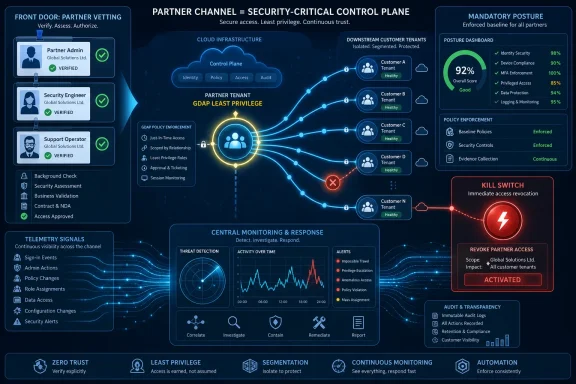 Microsoft Puts the Partner Channel Inside the Blast Radius
Microsoft’s partner ecosystem has always been one of its great commercial advantages. Cloud Solution Providers help customers buy, configure, manage, and optimize Microsoft 365, Azure, and related services, especially in the small and midsize business market where many customers do not have deep in-house cloud administration teams. That reach gives Microsoft scale it could not reproduce with direct sales and support alone.But the same architecture that makes CSPs useful also makes them attractive targets. A single partner tenant can sit upstream from dozens, hundreds, or even thousands of downstream customer environments. If that tenant is poorly secured, the attacker is not merely compromising one business; the attacker is potentially gaining a management path into many.
That is the uncomfortable truth behind Microsoft’s latest Deputy CISO post. Dani’s framing is careful, corporate, and partner-friendly, but the message underneath is blunt: partner platforms are not “external” enough to be treated as someone else’s problem. If they can be used to administer customer resources, attackers will treat them as part of Microsoft’s effective control plane.
This is the same lesson the industry has relearned repeatedly since the supply-chain compromises of the last decade. Trust relationships are infrastructure. Administrative delegation is infrastructure. A partner console with broad rights is infrastructure, even if it lives in another company’s tenant and is wrapped in the language of channel enablement.
The Old Delegation Model Aged Badly
The historical problem with delegated administration in cloud ecosystems is not difficult to understand. Partners need access to customer tenants to do real work, and customers often want someone else to handle the complexity of licensing, configuration, identity, support, and cloud operations. In the pre-Zero Trust era, the simplest answer was to grant broad administrative privileges and leave them in place.That simplicity created durable risk. Long-lived, high-privilege access is exactly what modern attackers look for because it compresses the attack path. Instead of phishing or exploiting every customer separately, a threat actor can compromise a partner and inherit the partner’s downstream reach.
Microsoft has already been moving away from that world through granular delegated administrative privileges, or GDAP. GDAP is meant to replace the older pattern of broad delegated administrative privileges with narrower, time-bound access that customers explicitly approve. In plain English, it is Microsoft’s attempt to make partner administration look less like a master key and more like a set of limited, auditable passes.
The new blog post matters because it places GDAP inside a wider enforcement story. Microsoft is not merely telling partners to use least privilege because it sounds good in a Zero Trust slide deck. It is saying that partner authorization itself can depend on maintaining a baseline security posture, and that Microsoft security teams can revoke a CSP’s GDAP access to customers when risk demands it.
That is a meaningful escalation. Guidance is advisory. Authorization is leverage. Revocation is control.
Vetting Becomes the Front Door, Not a Paper Exercise
The first layer Microsoft describes is partner vetting. Before an organization can operate as a CSP, Microsoft says it must verify the organization’s identity and confirm that it legitimately intends to operate in that role. That sounds basic, but in a partner ecosystem, basic controls are often the difference between a trusted network and a marketplace of unknown operators.The threat model here is broader than a legitimate partner being compromised. It also includes fraudulent or weakly validated entities attempting to enter the ecosystem in the first place. If a malicious or negligent organization can obtain partner standing, the platform has created risk before any customer relationship begins.
Microsoft says it is continuing to enhance these vetting capabilities based on threat intelligence and attacker trends. That is the right direction, though the company’s public post does not provide much detail about the mechanics. For obvious reasons, Microsoft is unlikely to publish a checklist for attackers to study, but the lack of specifics also means customers and partners must take much of this assurance on trust.
Still, the principle is sound. The partner channel cannot be secured only after privileges are granted. The first security decision is admission.
Mandatory Posture Turns Security From Advice Into Rent
The second layer is more consequential for existing CSPs. Microsoft says it has evolved CSP authorization to include mandatory security requirements as a condition for obtaining and retaining authorization. That is the sentence partners should read twice.For years, vendors have used the language of shared responsibility to divide duties between platform provider and customer. In this case, Microsoft is applying the same idea to the partner layer. Microsoft owns the platform and control plane mechanisms; partners own the security posture of the tenants they use for CSP operations.
The difference is that Microsoft is now tying that posture to the right to operate as an authorized CSP. That changes the economics. Security controls are no longer just best practices that mature partners adopt and laggards postpone. They become part of the cost of participating in the ecosystem.
This will likely be welcomed by customers who have worried about the opaque security practices of their providers. It may be less welcome to smaller partners that built service offerings around lean operations and inherited administrative models. But the direction is hard to argue with. A CSP tenant is too powerful to be treated like an ordinary business tenant with some extra licensing workflows.
The unresolved question is how transparent Microsoft will be about the baseline. If requirements shift over time, partners need enough notice to budget, automate, and train. Customers also need enough visibility to evaluate whether their provider is merely authorized or actually mature.
Least Privilege Finally Meets the Channel Business
The most technically important part of Microsoft’s approach remains least privilege. CSPs need access to customer environments, but they do not need permanent, unlimited access to everything. GDAP is Microsoft’s vehicle for making that distinction real.Under GDAP, partner access is supposed to be constrained by role, scope, and duration. Customers must grant access, and partners request the permissions they need for specific administrative work. This model aligns more closely with how security teams already think about privileged access management inside a single enterprise.
That sounds obvious until it collides with the messy reality of managed services. Partners often support many customers with standardized runbooks, shared tooling, and automation. Narrowing access can require redesigning operational processes that were built around broad administrative convenience.
That friction is not a reason to avoid the change. It is the proof that the change has substance. A least-privilege model that imposes no operational cost is often just a least-privilege label pasted over old permissions.
For WindowsForum readers who run small businesses or manage Microsoft 365 tenants on behalf of others, this is where the abstract policy becomes practical. Customers should know which partner relationships exist in their tenant, what roles have been granted, how long those roles last, and whether old delegated access remains in place. Partners should be able to explain their GDAP model without hiding behind acronyms.
The New Kill Switch Is the Real Power Move
Microsoft’s statement that its internal security teams can rapidly revoke a CSP’s GDAP access to customers deserves more attention than the company gives it. This is the control that turns monitoring into containment. If a partner is compromised, falls out of compliance, or exits a relationship, Microsoft says access can be withdrawn quickly to limit downstream impact.That capability is both reassuring and politically sensitive. Reassuring, because a compromised partner should not retain access while everyone debates process. Sensitive, because Microsoft is asserting emergency authority over relationships that may involve separate commercial contracts between customers and partners.
In practice, this is what mature cloud security increasingly looks like. The platform provider cannot simply say that partner relationships are external and therefore untouchable. If the platform can see misuse and can technically stop it, there is pressure to act.
But revocation also raises governance questions. How are customers notified? How are false positives handled? What happens to customers who depend on that partner for urgent operational support? Microsoft’s post mentions incident response, partner-status changes, and termination scenarios, but it does not turn the kill switch into a full public operating model.
That may be intentional. Attackers should not receive a procedural map. Even so, enterprises will want more than a blog-level assurance when their production environments depend on delegated administration.
Telemetry Becomes the Price of Trust
Microsoft also says it collects a high volume of diverse telemetry across its platforms and analyzes those signals to detect suspicious activity. In the partner context, telemetry is not merely a defensive tool. It is the evidence base that justifies intervention.That matters because delegated administration can blur accountability. If a suspicious action occurs in a customer tenant through a partner path, the customer may blame the partner, the partner may blame tooling, and the platform provider may be the only party with enough cross-tenant visibility to see the pattern. Without telemetry, shared responsibility becomes shared confusion.
Microsoft’s advantage is scale. It can observe authentication patterns, privilege changes, partner behavior, and customer-impacting activity across the ecosystem in a way no individual customer or CSP can. That scale is precisely why the company is under pressure to use its visibility aggressively.
The trade-off is that centralized visibility makes Microsoft even more central to the security story. Customers who chose a partner to avoid managing every operational detail themselves still depend on Microsoft’s platform judgment. Partners that operate across customer tenants must now assume their administrative behavior is part of a broader risk-scoring environment, even if Microsoft does not describe it that way publicly.
This is not a bad thing. It is the reality of hyperscale cloud. The control plane is watched because the control plane is where the leverage is.
Partner Security Is Now Customer Security
The most important sentence in Microsoft’s blog is not about GDAP or vetting. It is the assertion that partner platforms cannot be an afterthought, even when they are not directly part of Microsoft’s product or service infrastructure. That is the thesis enterprise IT should carry forward.Customers often evaluate partners on responsiveness, licensing expertise, migration experience, and price. Security posture is discussed, but it can be treated as a procurement checkbox rather than a live operational dependency. The CSP model makes that attitude obsolete.
If a partner can administer your tenant, reset accounts, modify configurations, touch subscriptions, or interact with support paths, that partner is part of your attack surface. The fact that its employees are not on your payroll is irrelevant to the attacker. The fact that its tenant is not your tenant is also less comforting than it appears.
This does not mean customers should abandon partners. Good partners are often essential, especially for organizations without dedicated cloud security staff. It does mean the customer’s vendor-risk program must move from paperwork to technical verification.
At minimum, customers should understand whether partner access is GDAP-based, whether it is time-bound, whether privileged roles are narrowly scoped, and whether stale relationships have been removed. They should also ask how the partner secures its own tenant, protects administrator accounts, monitors automation, and responds when one customer relationship becomes a risk to others.
The Small Business Angle Is Bigger Than It Looks
The CSP ecosystem is particularly important for small and midsize customers, many of whom rely on partners as their de facto IT department. That makes this security push more than an enterprise governance story. It is also about the security floor for organizations that cannot hire a full identity team or cloud architect.Those customers are often the least equipped to detect abuse through delegated administration. They may not review audit logs regularly. They may not know which roles a partner holds. They may not even realize that a partner relationship created years ago still carries meaningful access.
For that segment, Microsoft’s platform-level controls are especially important. A small business should not have to become an Entra permissions expert to avoid catastrophic exposure through a partner relationship. The platform should make dangerous defaults harder to sustain.
Still, platform controls do not absolve customers of responsibility. Even small organizations should periodically review partner relationships, disable unused access, and insist that their provider explain how it handles privileged administration. The uncomfortable truth is that many SMBs trust partners more deeply than they understand them.
Microsoft’s move may gradually improve that market by forcing lagging providers to modernize or leave. That is good for customers, but it may also create short-term disruption if smaller CSPs struggle to meet evolving requirements.
The Partner Channel Gets a Zero Trust Bill
Zero Trust has often been marketed as a broad philosophy: verify explicitly, use least privilege, assume breach. The partner ecosystem is where that philosophy becomes expensive. It requires identity hygiene, role engineering, customer approval flows, monitoring, incident processes, and operational redesign.Microsoft’s post is notable because it treats those costs as unavoidable. A CSP that manages many customers cannot rely on trust as a static credential. It must continuously justify access through security posture, authorization, and behavior.
That is the right standard. It also creates a tension inside Microsoft’s own business. The company wants a broad, energetic partner ecosystem that can sell and manage cloud services at scale. Security controls that add friction can slow onboarding, complicate support, and irritate partners that see themselves as trusted extensions of Microsoft’s field operation.
But the alternative is worse. If customers come to believe that the partner channel is a privileged side door into their Microsoft cloud estate, the commercial value of the ecosystem becomes a liability. Trust is not preserved by keeping administration easy. It is preserved by making abuse harder.
The best partners should benefit from this shift. Strong security posture becomes a market differentiator when customers know to ask about it. Weak partners, meanwhile, may discover that the era of broad access and vague assurances is ending.
Microsoft’s Own History Shadows the Announcement
Microsoft’s security messaging now lands in a different environment than it did five years ago. The company has spent years responding to criticism over cloud security incidents, identity compromises, government scrutiny, and the challenge of defending a vast software and services estate. Its Secure Future Initiative was, in part, an acknowledgment that security needed to be treated as a top-level engineering and cultural priority.That context matters because partner ecosystem security is not a side quest. It is part of the same accountability problem. Microsoft can harden products, improve identity defaults, and invest in detection, but customer compromise can still flow through trusted operational relationships.
The blog’s careful tone should not obscure the strategic concession. Microsoft is saying that its responsibility extends beyond the code and services it directly operates into the connective tissue that lets others manage those services. That is a broader view of platform responsibility than the industry historically preferred.
It is also a more realistic one. Customers do not experience risk according to vendor org charts. They experience it as downtime, data exposure, fraudulent activity, business disruption, and emergency response bills.
The Practical Reading for Admins Is Tenant Hygiene
For administrators, the immediate lesson is not to wait for Microsoft’s next baseline revision. Review delegated partner relationships now. Confirm whether your organization still needs each relationship, whether GDAP is in use, and whether the roles granted match the work being performed.This is especially important in tenants that have gone through mergers, MSP changes, licensing transitions, or emergency support engagements. Old partner access has a way of surviving organizational memory. Attackers love forgotten trust.
Admins should also treat partner access as part of incident response planning. If a partner is compromised, how quickly can access be revoked? Who has authority to make that decision? What business processes break when the partner is cut off? Those questions should be answered before an alert arrives.
For partners, the lesson is equally direct. Secure your own tenant as though it were a production control plane for every customer you serve, because in practice it is. That means strong identity controls, administrative separation, logging, conditional access, phishing-resistant authentication where possible, and disciplined handling of automation credentials.
Microsoft’s new framing makes one point unavoidable: a partner’s internal security failure is not internal if it can spill into customer environments.
The Signal Beneath Microsoft’s Polished Language
Microsoft’s blog is written in the language of alignment, collaboration, and ecosystem health. That is expected; the company is not going to publicly scold the partner channel that helps drive its cloud business. But the substance is firmer than the tone.The company is defining a security perimeter around partner operations. It is linking partner authorization to security posture. It is promoting least-privilege, time-bound access as the correct model. It is reserving the ability to revoke access when risk demands it. It is presenting telemetry and response as platform obligations, not optional extras.
That combination points toward a future in which partner privileges are more dynamic, more conditional, and more closely watched. Customers may see fewer invisible, indefinite trust relationships. Partners may face more audits, more automation work, and more pressure to document security controls.
The key uncertainty is how quickly Microsoft will move from principles to enforcement. Security baselines that are not enforced become theater. Enforcement that arrives without transparency becomes chaos. The best outcome is a phased model that gives partners clear requirements while giving customers better visibility into who can touch their environments and why.
The Fine Print Admins Should Pull Into the Next Review
Microsoft’s July 2026 post is not a patch note, and it is not a product launch. It is a policy signal about where the company believes cloud partner security must go. The practical implications are concrete enough that customers and CSPs should treat it as a planning document, not just a blog entry.- Microsoft is explicitly treating CSP partner platforms as security-critical infrastructure because attackers can use partner access to reach downstream customers.
- CSP authorization is being tied to mandatory security posture requirements, which means partner security maturity is becoming a condition of participation rather than a voluntary differentiator.
- GDAP remains the central mechanism for replacing broad, long-lived delegated access with customer-approved, time-bound, least-privilege administration.
- Microsoft says its security teams can rapidly revoke a CSP’s GDAP access when risk requires containment, including during incident response or partner-status changes.
- Customers should review existing partner relationships, confirm that permissions are still needed, and ask providers to explain their tenant security posture in operational detail.
- Partners should assume that their own tenants are now part of their customers’ effective control plane and secure them accordingly.
References
- Primary source: Microsoft
Published: Thu, 02 Jul 2026 16:00:00 GMT
Loading…
www.microsoft.com