

AI agents for end-to-end ad campaign management in 2026 are software systems from OpenAI, Google, Microsoft, Salesforce, Adobe, HubSpot, Jasper, and specialist marketing vendors that help plan, create, target, optimize, analyze, and report on digital campaigns across advertising and customer-data platforms. The useful answer is not that one of them “wins.” The useful answer is that the market has split into two camps: agents that live inside ad platforms, and agents that sit above them trying to coordinate the whole marketing machine.
That distinction matters more than the branding. A Google-native assistant can understand Google Ads better than a generic chatbot, but it will not be neutral about where budget should go. A CRM-native agent can personalize a journey better than a media-buying tool, but it may struggle to see what is happening outside the customer database. The 2026 marketer is not choosing between AI and manual work; they are choosing where to surrender judgment, where to demand proof, and where to keep a human hand on the budget lever.
For years, advertising automation meant rules, scripts, templates, and dashboards. Marketers could automate bids, schedule reports, rotate creatives, and trigger emails, but the systems mostly waited for instructions. The new pitch is different: an agent is supposed to interpret a goal, decide what steps are needed, call tools, generate assets, monitor results, and recommend or even execute changes.
That is why ad campaign management has become one of the most natural early homes for agentic AI. Campaign work is repetitive, tool-heavy, data-rich, and time-sensitive. It involves dozens of small decisions that are individually mundane but collectively expensive: which keyword cluster deserves more budget, which audience segment has fatigue, which landing-page copy matches the ad promise, which report needs to be translated into language a sales director will actually read.
The best systems in 2026 are not magic campaign managers. They are workflow compressors. They reduce the number of tabs, drafts, exports, and late-night spreadsheet rituals required to keep campaigns moving. That is valuable even when the AI is not fully autonomous, because much of modern marketing is less about one brilliant insight than about keeping the machine aligned.
But the agent label is also being stretched to cover almost everything. A chatbot that writes ad copy, a recommendation engine inside Google Ads, a CRM assistant that drafts nurture emails, and an enterprise orchestration layer that coordinates multiple workflows may all be called agents. The word has become a commercial umbrella, not a technical guarantee.
That advantage is not just convenience. Google has direct access to search behavior, conversion signals, merchant feeds, YouTube inventory, Maps intent, app campaigns, and auction dynamics that outside tools can only approximate. For advertisers trying to manage Search, Shopping, YouTube, Discover, and Performance Max together, Google’s automation can see the terrain better than a detached general-purpose agent.
The trade-off is independence. Google’s AI is optimized to make Google advertising work better, not to tell a marketer that a dollar should leave Google and move to LinkedIn, TikTok, Microsoft Advertising, direct sponsorships, or owned media. That does not make the system bad; it makes it interested. The marketer’s job is to understand that platform-native intelligence is powerful precisely because it is platform-native.
This is where the old tension in digital advertising reappears in AI clothing. The vendor wants fewer knobs, more automation, and more budget flowing through its pipes. The advertiser wants performance, transparency, and control. Gemini for Google Ads may be the best operational assistant for Google campaigns, but it should not be mistaken for an independent media strategist.
The promise is straightforward: create campaigns faster, generate assets, surface recommendations, summarize performance, and help teams turn advertising data into deliverables. For WindowsForum readers, the more important point is that Microsoft is trying to normalize Copilot as the interface layer across business software. Advertising is another surface where the company can argue that AI belongs inside the workflow rather than off to the side.
That approach has practical appeal for agencies and internal marketing teams that already report through Microsoft 365. A campaign manager may optimize in Microsoft Advertising, analyze in Excel, discuss in Teams, and present in PowerPoint. If Copilot can carry context across those handoffs, the productivity gain is real.
The risk is that Copilot becomes another layer of plausible prose over incomplete evidence. Campaign reporting is full of metrics that sound definitive but require context: attribution windows, offline conversions, assisted revenue, incrementality, seasonal effects, and channel overlap. An assistant that can draft a polished summary is useful; an assistant that makes weak performance look narratively coherent is dangerous.
A campaign does not end when someone clicks an ad. It continues through form fills, lead scoring, nurture sequences, sales follow-up, renewal prompts, support experiences, and account expansion. Salesforce wants Agentforce to operate across that chain, building campaigns, journeys, and assets while using enterprise data to decide who should receive what message and when.
That is compelling for businesses with mature Salesforce deployments. If the CRM is clean, the data model is disciplined, and the marketing operations team has clear governance, an AI agent can reduce friction across sales and marketing. It can identify segments, draft outreach, recommend next actions, and coordinate journeys with more context than a media platform alone could provide.
The hard part is hidden in that “if.” Many companies do not have clean CRM data. They have duplicate contacts, inconsistent lifecycle stages, poorly mapped fields, stale consent records, and sales processes that vary by region or team. In that environment, an agent does not solve the problem; it accelerates the consequences. Agentforce is potentially powerful, but it is also a mirror held up to the organization’s data hygiene.
Adobe’s advantage is the creative and experience layer. Marketers do not only need audiences and bids; they need assets, landing pages, brand compliance, personalization, testing, and approval workflows. An agent that can turn a marketing brief into structured content, suggest experiments, and work within enterprise content systems attacks one of the most persistent bottlenecks in campaign management: getting enough good creative into market quickly.
That matters because AI-driven media buying increases the demand for creative variation. Performance Max, dynamic search, social algorithms, and automated placements all perform better when they have assets to test. The bottleneck moves from bid management to creative operations. Adobe is positioning its agents at that choke point.
The concern is complexity. Enterprise experience platforms can become cathedrals of integration, powerful but slow to change. If Adobe’s agentic layer reduces that burden, it is meaningful. If it becomes another expensive orchestration tier that requires consultants to operate, smaller and mid-market teams will look elsewhere.
The value proposition is not that Breeze will out-optimize Google in Google Ads or out-orchestrate Adobe in a global enterprise. It is that many businesses do not have a marketing operations department. They have a small team trying to publish content, capture leads, send emails, update the CRM, report on campaigns, and keep sales informed. For them, an embedded assistant that drafts, summarizes, segments, and automates routine tasks can be the difference between a campaign that ships and a campaign that sits in planning.
HubSpot’s challenge is depth. SMB-friendly tools win by being simple, but agentic automation becomes more valuable as workflows become more specific. A generic AI assistant may be good enough for drafting emails or creating first-pass campaign assets, but serious revenue teams will quickly ask for better attribution, stronger governance, richer segmentation, and more control over what the agent can change.
Still, the simplicity advantage should not be dismissed. Most marketing failures are not caused by a lack of theoretical optimization. They are caused by inconsistent execution. An AI agent that helps a team execute reliably may outperform a more sophisticated system that no one has time to implement properly.
The problem is that content generation is becoming a feature inside larger platforms. Google can suggest ad assets. Microsoft can generate campaign copy. HubSpot can draft emails. Adobe can produce brand-governed content. OpenAI’s models can create and revise almost anything with the right instructions. Jasper has to prove that a specialist layer is worth paying for when generation is increasingly bundled.
Its best argument is brand discipline. Generic AI copy often sounds like generic AI copy: enthusiastic, polished, and strangely weightless. Teams that care about voice, compliance, review workflows, campaign consistency, and multi-channel adaptation may still prefer a dedicated marketing-content system. Jasper’s future depends on whether it remains a sharper creative operating system or gets swallowed by the broader suite economy.
That is the larger pattern across this market. Point solutions must either integrate deeply enough to become indispensable or specialize enough to justify their place. The agent era does not eliminate SaaS sprawl by default. It may simply give every vendor a chat interface and call the result orchestration.
That flexibility is exactly why ChatGPT is useful for planning and analysis. It can move across channels and concepts without caring whether the campaign is on Google, Microsoft, Meta, LinkedIn, TikTok, email, or display. It can help a marketer think before the budget is committed. It can also critique platform recommendations in plain language, which is increasingly important when ad networks ask advertisers to trust automated systems.
But ChatGPT is not automatically an ad management platform. Unless integrated with campaign accounts, analytics tools, CRM systems, and approval workflows, it operates on what the user gives it. That makes it excellent for reasoning and drafting but limited as an autonomous campaign operator. It can produce a persuasive recommendation from incomplete data just as easily as from complete data.
The best use of ChatGPT in 2026 is as the cross-platform analyst and creative partner. It is where marketers can develop strategy, compare options, prepare briefs, and interrogate results. The worst use is as an unsupervised authority over spend, compliance, or targeting without reliable data connections and human review.
Multi-platform agents need integrations, and integrations are where simple stories go to die. Google Ads, Microsoft Advertising, Meta, LinkedIn, TikTok, CRM systems, analytics platforms, data warehouses, consent-management tools, and content systems all define success differently. A conversion in one platform may not match a conversion in another. A lead may be valuable in the CRM but appear cheap in the ad dashboard. A campaign may look efficient until offline revenue data arrives.
That is why the best AI campaign agents are not merely the ones with the most connectors. They are the ones that make assumptions visible. If an agent recommends shifting budget, it should explain which data it used, which attribution window it trusted, which audience it evaluated, and what uncertainty remains. Otherwise, marketers are not managing campaigns; they are accepting machine-generated hunches.
For IT pros and administrators, this is also a governance problem. AI agents require access to ad accounts, customer data, creative libraries, analytics reports, and sometimes financial systems. That means identity management, role-based permissions, audit logs, data retention policies, vendor risk reviews, and incident response planning. The marketing team may buy the tool, but IT inherits the blast radius.
They can also reduce latency. In advertising, delayed reaction is expensive. If a keyword spikes, a landing page breaks, a creative fatigues, or a segment starts converting, the difference between noticing today and noticing next week can be material. Agents are well-suited to monitoring and first-pass diagnosis.
But the gains will be uneven. Businesses with clean conversion tracking, strong first-party data, organized creative libraries, and clear campaign goals will benefit more than businesses with vague objectives and broken analytics. AI does not rescue bad measurement. It scales whatever measurement regime already exists.
There is also a strategic ceiling. Optimization inside an existing campaign can make a weak offer less wasteful, but it cannot make the offer compelling. It can personalize a message, but it cannot decide whether the brand promise is credible. It can generate landing-page variants, but it cannot fix a product-market mismatch. Marketers should welcome automation without confusing it for strategy.
Businesses evaluating these tools should ask where data is processed, whether customer data is used to train models, how prompts and outputs are retained, what controls exist for sensitive fields, and how the vendor handles deletion requests. They should also ask how the system prevents an agent from using data for a purpose that consent does not cover. In advertising, privacy failures often begin as workflow conveniences.
This is particularly important as agents move from recommendation to action. A reporting assistant that summarizes anonymized campaign performance carries one risk profile. An autonomous agent that creates audiences, launches campaigns, and personalizes messaging from CRM data carries another. The governance model has to change as the autonomy level rises.
Security teams should treat marketing agents like any other privileged automation. They need least-privilege access, logging, review processes, and clear rollback procedures. The days when marketing SaaS could be treated as a harmless departmental tool are over.
A campaign agent can optimize toward lower cost per lead, but a human has to know whether those leads waste the sales team’s time. An agent can generate urgent copy, but a human has to decide whether urgency damages the brand. An agent can recommend budget shifts, but a human has to understand cash flow, channel strategy, and executive priorities.
This is why the best deployments will not be “AI replaces the marketer.” They will be “AI changes the marketer’s control surface.” Less time will be spent drafting first versions, pulling routine reports, and manually checking every campaign setting. More time will be spent auditing recommendations, designing experiments, interpreting results, and aligning campaign behavior with business strategy.
That shift favors experienced operators. Junior marketers may get faster at production, but senior marketers become more valuable as reviewers of machine-generated action. The scarce skill is not typing prompts. It is knowing when the answer is plausible but wrong.
There is no universal best agent because there is no universal campaign architecture. Advertising stacks reflect business models. E-commerce, B2B SaaS, local services, enterprise software, media subscriptions, and consumer apps all measure success differently. A tool that is excellent for high-volume search campaigns may be mediocre for account-based marketing. A CRM agent that shines in nurture workflows may not be the best tool for auction-time bid decisions.
The mature answer is composability with governance. Use platform-native AI where platform context matters. Use CRM-native AI where customer context matters. Use creative specialists where brand and asset volume matter. Use general-purpose models where reasoning, drafting, and cross-channel analysis matter. Then put permissions, measurement, and review around the whole thing.
That is less glamorous than declaring a winner. It is also how serious teams will avoid turning AI adoption into another round of expensive SaaS theater.
That distinction matters more than the branding. A Google-native assistant can understand Google Ads better than a generic chatbot, but it will not be neutral about where budget should go. A CRM-native agent can personalize a journey better than a media-buying tool, but it may struggle to see what is happening outside the customer database. The 2026 marketer is not choosing between AI and manual work; they are choosing where to surrender judgment, where to demand proof, and where to keep a human hand on the budget lever.
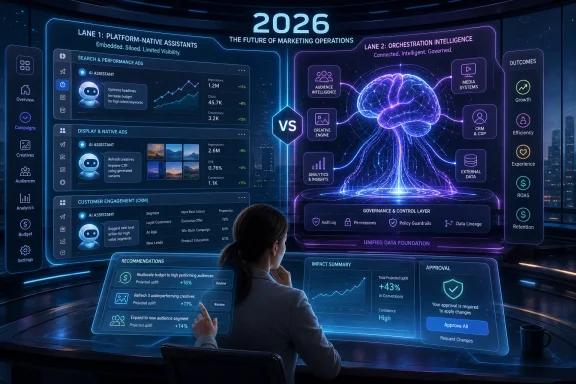 The Agent Pitch Has Finally Caught Up With the Marketing Stack
For years, advertising automation meant rules, scripts, templates, and dashboards. Marketers could automate bids, schedule reports, rotate creatives, and trigger emails, but the systems mostly waited for instructions. The new pitch is different: an agent is supposed to interpret a goal, decide what steps are needed, call tools, generate assets, monitor results, and recommend or even execute changes.That is why ad campaign management has become one of the most natural early homes for agentic AI. Campaign work is repetitive, tool-heavy, data-rich, and time-sensitive. It involves dozens of small decisions that are individually mundane but collectively expensive: which keyword cluster deserves more budget, which audience segment has fatigue, which landing-page copy matches the ad promise, which report needs to be translated into language a sales director will actually read.
The best systems in 2026 are not magic campaign managers. They are workflow compressors. They reduce the number of tabs, drafts, exports, and late-night spreadsheet rituals required to keep campaigns moving. That is valuable even when the AI is not fully autonomous, because much of modern marketing is less about one brilliant insight than about keeping the machine aligned.
But the agent label is also being stretched to cover almost everything. A chatbot that writes ad copy, a recommendation engine inside Google Ads, a CRM assistant that drafts nurture emails, and an enterprise orchestration layer that coordinates multiple workflows may all be called agents. The word has become a commercial umbrella, not a technical guarantee.
Google Owns the Ad Graph, Which Makes Gemini Hard to Ignore
For Google Ads campaigns, Google’s AI stack remains the most obvious starting point. Gemini-infused advertising tools, Performance Max, AI Max for Search, automated creative suggestions, keyword expansion, asset generation, bid optimization, and campaign diagnostics all benefit from proximity to the world’s largest search and intent-advertising engine. If the campaign lives primarily in Google’s ecosystem, the assistant closest to the auction has a structural advantage.That advantage is not just convenience. Google has direct access to search behavior, conversion signals, merchant feeds, YouTube inventory, Maps intent, app campaigns, and auction dynamics that outside tools can only approximate. For advertisers trying to manage Search, Shopping, YouTube, Discover, and Performance Max together, Google’s automation can see the terrain better than a detached general-purpose agent.
The trade-off is independence. Google’s AI is optimized to make Google advertising work better, not to tell a marketer that a dollar should leave Google and move to LinkedIn, TikTok, Microsoft Advertising, direct sponsorships, or owned media. That does not make the system bad; it makes it interested. The marketer’s job is to understand that platform-native intelligence is powerful precisely because it is platform-native.
This is where the old tension in digital advertising reappears in AI clothing. The vendor wants fewer knobs, more automation, and more budget flowing through its pipes. The advertiser wants performance, transparency, and control. Gemini for Google Ads may be the best operational assistant for Google campaigns, but it should not be mistaken for an independent media strategist.
Microsoft’s Advertising Copilot Is a Productivity Play With a Windows-Sized Shadow
Microsoft Copilot for Advertising sits in a different position. Microsoft Advertising does not have Google’s search dominance, but it has a deep productivity footprint, a growing AI identity, LinkedIn adjacency through Microsoft’s broader empire, and a user base that lives in Excel, Teams, Outlook, PowerPoint, and Windows. That makes Copilot less interesting as a standalone ad optimizer and more interesting as a bridge between campaign work and office work.The promise is straightforward: create campaigns faster, generate assets, surface recommendations, summarize performance, and help teams turn advertising data into deliverables. For WindowsForum readers, the more important point is that Microsoft is trying to normalize Copilot as the interface layer across business software. Advertising is another surface where the company can argue that AI belongs inside the workflow rather than off to the side.
That approach has practical appeal for agencies and internal marketing teams that already report through Microsoft 365. A campaign manager may optimize in Microsoft Advertising, analyze in Excel, discuss in Teams, and present in PowerPoint. If Copilot can carry context across those handoffs, the productivity gain is real.
The risk is that Copilot becomes another layer of plausible prose over incomplete evidence. Campaign reporting is full of metrics that sound definitive but require context: attribution windows, offline conversions, assisted revenue, incrementality, seasonal effects, and channel overlap. An assistant that can draft a polished summary is useful; an assistant that makes weak performance look narratively coherent is dangerous.
Salesforce Agentforce Turns Campaigns Into CRM Workflows
Salesforce Agentforce represents the CRM-first view of advertising automation. Its strength is not media buying in the narrow sense. Its strength is connecting campaign activity to customer records, lead stages, service interactions, sales motions, and revenue operations. In enterprise marketing, that is often where the real money is.A campaign does not end when someone clicks an ad. It continues through form fills, lead scoring, nurture sequences, sales follow-up, renewal prompts, support experiences, and account expansion. Salesforce wants Agentforce to operate across that chain, building campaigns, journeys, and assets while using enterprise data to decide who should receive what message and when.
That is compelling for businesses with mature Salesforce deployments. If the CRM is clean, the data model is disciplined, and the marketing operations team has clear governance, an AI agent can reduce friction across sales and marketing. It can identify segments, draft outreach, recommend next actions, and coordinate journeys with more context than a media platform alone could provide.
The hard part is hidden in that “if.” Many companies do not have clean CRM data. They have duplicate contacts, inconsistent lifecycle stages, poorly mapped fields, stale consent records, and sales processes that vary by region or team. In that environment, an agent does not solve the problem; it accelerates the consequences. Agentforce is potentially powerful, but it is also a mirror held up to the organization’s data hygiene.
Adobe Is Selling the Enterprise Control Plane
Adobe’s Experience Platform Agent Orchestrator is aimed at a different class of buyer: the enterprise that sees advertising as one part of customer experience management. Adobe’s argument is that brands need agents for content, journeys, experimentation, personalization, audience building, and insights — all operating against a governed experience platform. This is not the cheapest or simplest vision of AI marketing, but it may be the one most aligned with large organizations.Adobe’s advantage is the creative and experience layer. Marketers do not only need audiences and bids; they need assets, landing pages, brand compliance, personalization, testing, and approval workflows. An agent that can turn a marketing brief into structured content, suggest experiments, and work within enterprise content systems attacks one of the most persistent bottlenecks in campaign management: getting enough good creative into market quickly.
That matters because AI-driven media buying increases the demand for creative variation. Performance Max, dynamic search, social algorithms, and automated placements all perform better when they have assets to test. The bottleneck moves from bid management to creative operations. Adobe is positioning its agents at that choke point.
The concern is complexity. Enterprise experience platforms can become cathedrals of integration, powerful but slow to change. If Adobe’s agentic layer reduces that burden, it is meaningful. If it becomes another expensive orchestration tier that requires consultants to operate, smaller and mid-market teams will look elsewhere.
HubSpot Breeze Makes the Agent Case for Smaller Teams
HubSpot Breeze is the most approachable version of the AI marketing-agent story for many small and midsize businesses. HubSpot’s platform already combines CRM, marketing automation, email, content, forms, landing pages, social tools, and reporting. Adding AI agents and assistants to that environment makes sense because the workflow is already centralized.The value proposition is not that Breeze will out-optimize Google in Google Ads or out-orchestrate Adobe in a global enterprise. It is that many businesses do not have a marketing operations department. They have a small team trying to publish content, capture leads, send emails, update the CRM, report on campaigns, and keep sales informed. For them, an embedded assistant that drafts, summarizes, segments, and automates routine tasks can be the difference between a campaign that ships and a campaign that sits in planning.
HubSpot’s challenge is depth. SMB-friendly tools win by being simple, but agentic automation becomes more valuable as workflows become more specific. A generic AI assistant may be good enough for drafting emails or creating first-pass campaign assets, but serious revenue teams will quickly ask for better attribution, stronger governance, richer segmentation, and more control over what the agent can change.
Still, the simplicity advantage should not be dismissed. Most marketing failures are not caused by a lack of theoretical optimization. They are caused by inconsistent execution. An AI agent that helps a team execute reliably may outperform a more sophisticated system that no one has time to implement properly.
Jasper Remains the Creative Specialist in a Market Moving Toward Suites
Jasper’s position is both strong and exposed. It built its reputation around AI-generated marketing content, brand voice, campaign copy, landing-page language, email sequences, and collaborative content workflows. In an advertising market hungry for more creative variants, that is useful. Every automated campaign system needs material to test.The problem is that content generation is becoming a feature inside larger platforms. Google can suggest ad assets. Microsoft can generate campaign copy. HubSpot can draft emails. Adobe can produce brand-governed content. OpenAI’s models can create and revise almost anything with the right instructions. Jasper has to prove that a specialist layer is worth paying for when generation is increasingly bundled.
Its best argument is brand discipline. Generic AI copy often sounds like generic AI copy: enthusiastic, polished, and strangely weightless. Teams that care about voice, compliance, review workflows, campaign consistency, and multi-channel adaptation may still prefer a dedicated marketing-content system. Jasper’s future depends on whether it remains a sharper creative operating system or gets swallowed by the broader suite economy.
That is the larger pattern across this market. Point solutions must either integrate deeply enough to become indispensable or specialize enough to justify their place. The agent era does not eliminate SaaS sprawl by default. It may simply give every vendor a chat interface and call the result orchestration.
ChatGPT Is the Flexible Strategist, Not the System of Record
OpenAI’s ChatGPT is often the most flexible tool in the marketer’s kit. It can brainstorm campaigns, draft creative, summarize reports, create audience hypotheses, analyze exported performance data, generate test plans, write briefs, turn messy notes into executive summaries, and help non-specialists reason through campaign structure. It is the generalist that marketing teams reach for when the platform-specific tool is too narrow.That flexibility is exactly why ChatGPT is useful for planning and analysis. It can move across channels and concepts without caring whether the campaign is on Google, Microsoft, Meta, LinkedIn, TikTok, email, or display. It can help a marketer think before the budget is committed. It can also critique platform recommendations in plain language, which is increasingly important when ad networks ask advertisers to trust automated systems.
But ChatGPT is not automatically an ad management platform. Unless integrated with campaign accounts, analytics tools, CRM systems, and approval workflows, it operates on what the user gives it. That makes it excellent for reasoning and drafting but limited as an autonomous campaign operator. It can produce a persuasive recommendation from incomplete data just as easily as from complete data.
The best use of ChatGPT in 2026 is as the cross-platform analyst and creative partner. It is where marketers can develop strategy, compare options, prepare briefs, and interrogate results. The worst use is as an unsupervised authority over spend, compliance, or targeting without reliable data connections and human review.
Multi-Platform Management Is the Prize, but Integration Is the Tax
The dream of end-to-end campaign management is a single agent that plans the campaign, builds assets, launches across platforms, monitors performance, reallocates budget, syncs leads into the CRM, personalizes follow-up, and reports results to executives. That is the dream vendors are selling. The reality is messier because every platform has different data models, permissions, attribution rules, creative requirements, and incentives.Multi-platform agents need integrations, and integrations are where simple stories go to die. Google Ads, Microsoft Advertising, Meta, LinkedIn, TikTok, CRM systems, analytics platforms, data warehouses, consent-management tools, and content systems all define success differently. A conversion in one platform may not match a conversion in another. A lead may be valuable in the CRM but appear cheap in the ad dashboard. A campaign may look efficient until offline revenue data arrives.
That is why the best AI campaign agents are not merely the ones with the most connectors. They are the ones that make assumptions visible. If an agent recommends shifting budget, it should explain which data it used, which attribution window it trusted, which audience it evaluated, and what uncertainty remains. Otherwise, marketers are not managing campaigns; they are accepting machine-generated hunches.
For IT pros and administrators, this is also a governance problem. AI agents require access to ad accounts, customer data, creative libraries, analytics reports, and sometimes financial systems. That means identity management, role-based permissions, audit logs, data retention policies, vendor risk reviews, and incident response planning. The marketing team may buy the tool, but IT inherits the blast radius.
The Performance Gains Are Real, but They Are Not Evenly Distributed
AI agents can improve campaign performance in several practical ways. They can catch anomalies faster than a human checking dashboards once a day. They can produce more creative variants than a team would manually draft. They can summarize performance for different audiences: tactical notes for campaign managers, pipeline impact for sales, budget implications for finance, and narrative context for executives.They can also reduce latency. In advertising, delayed reaction is expensive. If a keyword spikes, a landing page breaks, a creative fatigues, or a segment starts converting, the difference between noticing today and noticing next week can be material. Agents are well-suited to monitoring and first-pass diagnosis.
But the gains will be uneven. Businesses with clean conversion tracking, strong first-party data, organized creative libraries, and clear campaign goals will benefit more than businesses with vague objectives and broken analytics. AI does not rescue bad measurement. It scales whatever measurement regime already exists.
There is also a strategic ceiling. Optimization inside an existing campaign can make a weak offer less wasteful, but it cannot make the offer compelling. It can personalize a message, but it cannot decide whether the brand promise is credible. It can generate landing-page variants, but it cannot fix a product-market mismatch. Marketers should welcome automation without confusing it for strategy.
Data Privacy Is No Longer a Legal Sidebar
The more capable AI campaign agents become, the more sensitive their data access becomes. End-to-end ad management touches customer identities, behavioral signals, purchase histories, lead scores, email engagement, website analytics, audience segments, and sometimes inferred attributes. That is exactly the sort of data regulators, customers, and security teams care about.Businesses evaluating these tools should ask where data is processed, whether customer data is used to train models, how prompts and outputs are retained, what controls exist for sensitive fields, and how the vendor handles deletion requests. They should also ask how the system prevents an agent from using data for a purpose that consent does not cover. In advertising, privacy failures often begin as workflow conveniences.
This is particularly important as agents move from recommendation to action. A reporting assistant that summarizes anonymized campaign performance carries one risk profile. An autonomous agent that creates audiences, launches campaigns, and personalizes messaging from CRM data carries another. The governance model has to change as the autonomy level rises.
Security teams should treat marketing agents like any other privileged automation. They need least-privilege access, logging, review processes, and clear rollback procedures. The days when marketing SaaS could be treated as a harmless departmental tool are over.
Human Oversight Becomes More Important, Not Less
The phrase “end-to-end” encourages a fantasy of hands-off marketing. In practice, the better AI agents become, the more important human oversight becomes. That sounds contradictory only if one assumes the human’s job is to perform every task. It is not. The human’s job is to set goals, define constraints, judge trade-offs, and catch failures that the system is not designed to understand.A campaign agent can optimize toward lower cost per lead, but a human has to know whether those leads waste the sales team’s time. An agent can generate urgent copy, but a human has to decide whether urgency damages the brand. An agent can recommend budget shifts, but a human has to understand cash flow, channel strategy, and executive priorities.
This is why the best deployments will not be “AI replaces the marketer.” They will be “AI changes the marketer’s control surface.” Less time will be spent drafting first versions, pulling routine reports, and manually checking every campaign setting. More time will be spent auditing recommendations, designing experiments, interpreting results, and aligning campaign behavior with business strategy.
That shift favors experienced operators. Junior marketers may get faster at production, but senior marketers become more valuable as reviewers of machine-generated action. The scarce skill is not typing prompts. It is knowing when the answer is plausible but wrong.
The Shortlist Is Really a Map of Your Existing Stack
The most useful way to rank AI campaign agents in 2026 is to start with the system that already owns your workflow. A Google-heavy advertiser should begin with Google’s AI tools. A Microsoft Advertising and Microsoft 365 shop should evaluate Copilot’s ability to connect campaign work with productivity workflows. A Salesforce-centered revenue organization should look closely at Agentforce. An Adobe enterprise should examine Agent Orchestrator as part of its broader experience platform. A HubSpot customer should test Breeze before adding complexity. A team that needs flexible strategy and content support should keep ChatGPT or Jasper in the mix.There is no universal best agent because there is no universal campaign architecture. Advertising stacks reflect business models. E-commerce, B2B SaaS, local services, enterprise software, media subscriptions, and consumer apps all measure success differently. A tool that is excellent for high-volume search campaigns may be mediocre for account-based marketing. A CRM agent that shines in nurture workflows may not be the best tool for auction-time bid decisions.
The mature answer is composability with governance. Use platform-native AI where platform context matters. Use CRM-native AI where customer context matters. Use creative specialists where brand and asset volume matter. Use general-purpose models where reasoning, drafting, and cross-channel analysis matter. Then put permissions, measurement, and review around the whole thing.
That is less glamorous than declaring a winner. It is also how serious teams will avoid turning AI adoption into another round of expensive SaaS theater.
The 2026 Campaign Stack Rewards Buyers Who Know Where the Agent Stops
The concrete lesson from the current crop of AI advertising agents is that capability follows context. The closer the agent is to the data and workflow, the more useful it becomes — and the more carefully it must be governed.- Google’s AI advertising tools are the strongest fit for advertisers whose performance depends heavily on Google Ads, Search, Shopping, YouTube, and Performance Max.
- Microsoft Copilot for Advertising is most compelling when campaign management needs to flow into Microsoft 365 reporting, collaboration, and productivity work.
- Salesforce Agentforce is best understood as a CRM and journey orchestration play, not merely an ad-buying assistant.
- Adobe’s agent strategy is aimed at enterprises that need governed creative, personalization, experimentation, and customer-experience workflows at scale.
- HubSpot Breeze is likely to appeal most to smaller teams that need execution help inside an already centralized CRM and marketing platform.
- ChatGPT and Jasper remain valuable horizontal tools for planning, analysis, messaging, and creative production, but they need integrations and oversight before they can function as true campaign operators.
References
- Primary source: Analytics Insight
Published: 2026-07-02T18:15:11.778406
Loading…
www.analyticsinsight.net - Related coverage: investor.salesforce.com
Loading…
investor.salesforce.com - Related coverage: experienceleague.adobe.com
Loading…
experienceleague.adobe.com - Related coverage: hubspot.es
Loading…
www.hubspot.es - Related coverage: business.adobe.com
Loading…
business.adobe.com - Related coverage: windowscentral.com
Microsoft Copilot Windows 11 setting fails in new ad | Windows Central
Microsoft's obsession with AI in Windows 11 is becoming so toxic that its latest ad campaign shows Copilot failing to help a user in their quest to change a setting, while pretending it worked as intended.www.windowscentral.com
- Related coverage: axios.com
Loading…
www.axios.com - Related coverage: kiplinger.com
Best AI Stocks to Buy: Smart Artificial Intelligence Investments | Kiplinger
Artificial intelligence is the catalyst for what many observers recognize as a fourth industrial revolution. Here are the best AI stocks to buy right now.www.kiplinger.com - Related coverage: salesforce.com
Loading…
www.salesforce.com